Psalms 94:23

Hebrew (Westminster Leningrad Codex) Psalms 94:23 appears in the Hebrew Old Testament. The text above is from the Westminster Leningrad Codex. Each word links to its Strong’s number, a concise gloss, and parsing drawn from the Open Scriptures Hebrew Bible morphology. Click any word for its full Brown-Driver-Briggs (BDB) entry.
Download image
Cite this verse

Psalms 94:23 (World English Bible). Public Domain. Lemma interlinear Bible study tool, https://lemma.gebible.app/v/psalms/94/23.

Show BibTeX & RIS
BibTeX
RIS
English Translation
He has brought on them their own iniquity, And will cut them off in their own wickedness. Yahweh, our God, will cut them off.
World English Bible · Public Domain
Download a study sheet

One document with this verse’s original text, its word-by-word gloss line, the meaning frame, cross-references with their text, attributed commentary, and full source and license credits — printable, and it pastes into notes with its structure intact.

This verse Autodidact and up

Study sheet (.html) Plain text (.txt)

A passage Seminary Student

Up to 50 verses in one chapter. A passage sheet keeps up to 6 commentary sources and 12 cross-references per verse, in the order this page ranks them, and says so on the sheet whenever that leaves anything out. Ask for a single verse and you get the Autodidact verse sheet above.

Everything on this page stays free to read, with no account — the sheet is a download of what is already on screen, not access to it.

Want to remove ads? Support Godless Engineer
Compare translations 3

The same verse in 3 English versions, stacked beneath the original-language interlinear above. Click any original word for its lexicon entry.

Each is an independent rendering of the whole verse — the interlinear is not word-aligned to these translations.

Highlighted words mark where these versions differ — a whole-verse word diff, not a word-by-word alignment.

  • World English Bible Public Domain
    He has brought on them their own iniquity, And will cut them off in their own wickedness. Yahweh, our God, will cut them off.
  • King James Version Public Domain
    And he shall bring upon them their own iniquity, and shall cut them off in their own wickedness; yea, the LORD our God shall cut them off.
  • unfoldingWord Literal Text CC BY-SA 4.0
    He will return on them their iniquity and he will destroy them in their wickedness. Yahweh our God will destroy them.

unfoldingWord Literal Text — © unfoldingWord, licensed CC BY-SA 4.0. Word-aligned USFM3 via Door43 (git.door43.org/unfoldingWord/en_ult).

Versions to compare (up to 4)

3 of 4 selected

Show all 18 translations

Every available English version of this verse, each an independent rendering of the whole verse.

  • World English Bible Public Domain
    He has brought on them their own iniquity, And will cut them off in their own wickedness. Yahweh, our God, will cut them off.
  • Berean Standard Bible Public Domain
    He will bring upon them their own iniquity and destroy them for their wickedness. The LORD our God will destroy them.
  • Majority Standard Bible Public Domain
    He will bring upon them their own iniquity and destroy them for their wickedness. The LORD our God will destroy them.
  • King James Version Public Domain
    And he shall bring upon them their own iniquity, and shall cut them off in their own wickedness; yea, the LORD our God shall cut them off.
  • American Standard Version (1901) Public Domain
    And he hath brought upon them their own iniquity, And will cut them off in their own wickedness; Jehovah our God will cut them off.
  • Revised Version (1885) Public Domain
    And he hath brought upon them their own iniquity, and shall cut them off in their own evil; the LORD our God shall cut them off.
  • Geneva Bible (1599) Public Domain
    And hee will recompence them their wickednes, and destroy them in their owne malice: yea, the Lord our God shall destroy them.
  • Douay-Rheims (1899) Public Domain
    And he will render them their iniquity: and in their malice he will destroy them: the Lord our God will destroy them.
  • Young's Literal Translation Public Domain
    And turneth back on them their iniquity, And in their wickedness cutteth them off; Jehovah our God doth cut them off!
  • Literal Standard Version CC BY-SA 4.0
    And He turns back their iniquity on them, || And in their wickedness cuts them off; Our God YHWH cuts them off!
  • Unlocked Literal Bible CC BY-SA 4.0
    He will bring on them their own iniquity and will cut them off in their own wickedness. Yahweh our God will cut them off.
  • unfoldingWord Literal Text CC BY-SA 4.0
    He will return on them their iniquity and he will destroy them in their wickedness. Yahweh our God will destroy them.
  • Darby Bible Public Domain
    And he will bring upon them their iniquity, and will cut them off in their own evil: Jehovah our God will cut them off.
  • World Messianic Bible Public Domain
    He has brought on them their own iniquity, and will cut them off in their own wickedness. The LORD, our God, will cut them off.
  • Webster's Bible Public Domain
    And he will bring upon them their own iniquity, and will cut them off in their own wickedness; yes, the LORD our God will cut them off.
  • Free Bible Version CC BY-SA 4.0
    He will turn the wickedness of evil people back upon them; he will destroy them because of their sins; the Lord our God will destroy them.
  • Bible in Basic English Public Domain
    And he has made their evil designs come back on themselves, cutting them off in their sin; the Lord our God will put an end to them.
  • JPS Tanakh (1917) Public Domain
    And He hath brought upon them their own iniquity, and will cut them off in their own evil; the LORD our God will cut them off.

Literal Standard Version (2020), Covenant Press — licensed CC BY-SA 4.0. Text via the HelloAO Bible API (eBible.org). Unlocked Literal Bible (unfoldingWord) — licensed CC BY-SA 4.0. Text via the HelloAO Bible API (eBible.org). unfoldingWord Literal Text — © unfoldingWord, licensed CC BY-SA 4.0. Word-aligned USFM3 via Door43 (git.door43.org/unfoldingWord/en_ult). Free Bible Version, Dr. Jonathan Gallagher — licensed CC BY-SA 4.0. Text via the HelloAO Bible API (eBible.org).

Word by word

More ways to search: Search by grammar → Find every occurrence → Compare this word →

Practice this passage: Drill this verse → Learn its vocabulary →

יַצְמִיתֵ֑ם
tsâmath
H6789
“to cut off · them”
Verb, Hiphil, Imperfect, 3rd Person, Masculine, Singular + Suffix, Personal, 3rd Person, Masculine, Plural
Part of Speech
Verb
Stem
Hiphil
Form
Imperfect
Person
3rd Person
Gender
Masculine
Number
Singular
Full BDB Definition

Origin: a primitive root

TWOT: 1932

to put an end to, cut off, destroy, exterminate, extirpate - (Qal) to put an end to, terminate - (Niphal) to be ended, be annihilated, be exterminated - (Piel) to put an end to - (Pilel) to be exterminated, be annihilated - (Hiphil) to exterminate, annihilate
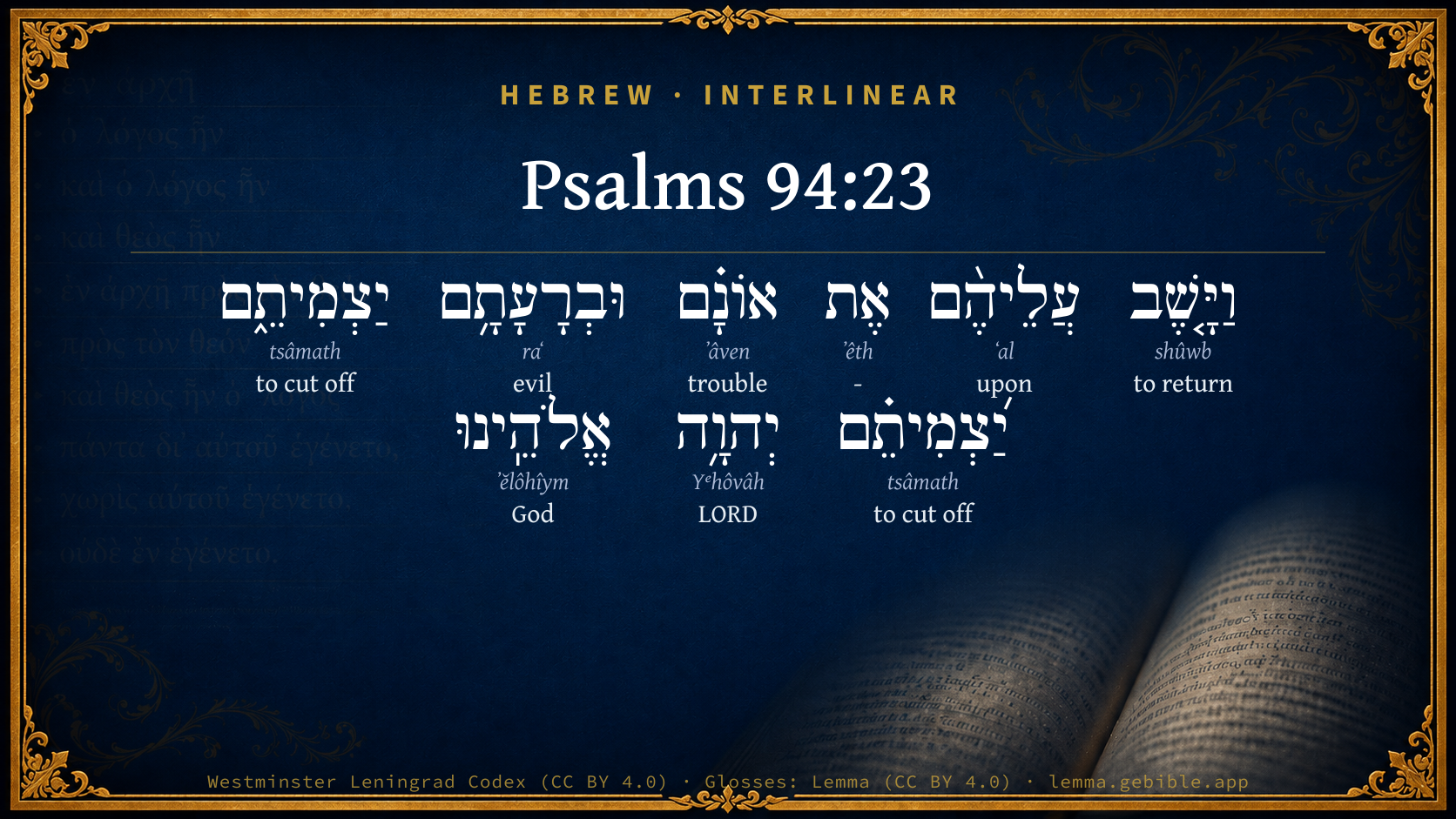
  1. וַיָּ֤שֶׁב shûwb H7725 “and · to return” Conjunction + Verb, Hiphil, Sequential Imperfect, 3rd Person, Masculine, Singular
  2. עֲלֵיהֶ֨ם ʻal H5921 “upon · them” Preposition + Suffix, Personal, 3rd Person, Masculine, Plural
  3. אֶת ʼêth H853 “-” Particle, Direct Object
  4. אוֹנָ֗ם ʼâven H205 “trouble · their” Noun, Common, Masculine, Singular, Construct + Suffix, Personal, 3rd Person, Masculine, Plural
  5. וּבְרָעָתָ֥ם raʻ H7451 “and · in/at · evil · their” Conjunction + Preposition + Noun, Common, Feminine, Singular, Construct + Suffix, Personal, 3rd Person, Masculine, Plural
  6. יַ֝צְמִיתֵ֗ם tsâmath H6789 “to cut off · them” Verb, Hiphil, Imperfect, 3rd Person, Masculine, Singular + Suffix, Personal, 3rd Person, Masculine, Plural
  7. יְהוָ֥ה Yᵉhôvâh H3068 “LORD” Noun, Proper
  8. אֱלֹהֵֽינוּ ʼĕlôhîym H430 “God(s) · our” Noun, Common, Masculine, Plural, Construct + Suffix, Personal, 1st Person, Common, Plural

About this verse

These counts appear in no published source. They are computed here, from the morphology-tagged text and Lemma’s own curated glosses. What Lemma adds →

9
words
8
distinct lemmas
Wisdom
section

Notable vocabulary

The rarest word here is יַצְמִיתֵ֑ם to cut off H6789 — appearing just 15 times in the whole Hebrew Bible.

Shared distinctive vocabulary

יַצְמִיתֵ֑ם to cut off H6789 occurs in 14 verses of the Hebrew Bible. Also found in:

Grammatical profile

  • 3 verbs
  • 4 nouns
  • 1 preposition
  • 1 particle

Verb forms

  • וַיָּ֤שֶׁב Hiphil · Sequential Imperfect
  • יַצְמִיתֵ֑ם Hiphil · Imperfect
  • יַ֝צְמִיתֵ֗ם Hiphil · Imperfect

Repetition

A word recurs within this verse — often emphatic in Hebrew:

  • יַצְמִיתֵ֑ם to cut off H6789 ×2

Hebrew & Septuagint length

In English translation the verse runs 24 words from the Hebrew and 19 from the Septuagint (LXX English) — closely comparable.

A rough comparison of the two English renderings, which tokenize alike — not a word-level alignment.

Word counts can differ between the Hebrew and the Greek without any difference in meaning — e.g. the Hebrew direct-object marker אֵת has no separate Greek word, and Greek often adds the article ὁ.

Cross-references

14

Topical passages linked to Psalms 94:23 in the Treasury of Scripture Knowledge — connected by theme and wording, ordered by reader-vote popularity; previews shown in the World English Bible.

  • Psalms 7:16 The trouble he causes shall return to his own head. His violence shall come down on the crown of his own head.
  • Proverbs 2:22 But the wicked will be cut off from the land. The treacherous will be rooted out of it.
  • Proverbs 14:32 The wicked is brought down in his calamity, But in death, the righteous has a refuge.
  • Psalms 55:23 But you, God, will bring them down into the pit of destruction. Bloodthirsty and deceitful men shall not live out half their days, But I will trust in you.
  • 1 Samuel 26:10–11 David said, As Yahweh lives, Yahweh will strike him; or his day shall come to die; or he shall go down into battle and perish.
  • Proverbs 5:22 The evil deeds of the wicked ensnare him. The cords of his sin hold him firmly.
  • Esther 7:10 So they hanged Haman on the gallows that he had prepared for Mordecai. Then was the king's wrath pacified.
  • Psalms 64:8 Their own tongues shall ruin them. All who see them will shake their heads.
  • Psalms 9:16–17 Yahweh has made himself known. He has executed judgment. The wicked is snared by the work of his own hands. Meditation. Selah.
  • Psalms 12:3 May Yahweh cut off all flattering lips, And the tongue that boasts,
  • Ezekiel 18:24 But when the righteous turns away from his righteousness, and commits iniquity, and does according to all the abominations that the wicked man does, shall he live? None of his righteous deeds that he has done shall be remembered: in his trespass that he has trespassed, and in his sin that he has sinned, in them shall he die.
  • Proverbs 1:31 Therefore they will eat of the fruit of their own way, And be filled with their own schemes.
  • Daniel 7:24 As for the ten horns, out of this kingdom shall ten kings arise: and another shall arise after them; and he shall be diverse from the former, and he shall put down three kings.
  • Daniel 9:26 After the sixty-two weeks the Anointed One shall be cut off, and shall have nothing: and the people of the prince who shall come shall destroy the city and the sanctuary; and the end of it shall be with a flood, and even to the end shall be war; desolations are determined.

Cross-references courtesy of OpenBible.info (CC BY 4.0).

Hebrew and Greek witnesses Masoretic Hebrew ↔ Greek Septuagint

The same verse in the two great witnesses to the Old Testament, shown verse-for-verse.

You’re reading Greek Psalm 93 (Hebrew Psalm 94). The Septuagint counts the superscription, so verse numbers can differ from the Hebrew — chapter-level alignment, not verse-by-verse. Numbering follows Rahlfs.

These are two independent witnesses, not word-aligned to each other, and the Septuagint is shown in lemma (dictionary) form.

Hebrew Psalms 94:23 Masoretic · Westminster Leningrad Codex

וַיָּ֤שֶׁב עֲלֵיהֶ֨ם אֶת אוֹנָ֗ם וּבְרָעָתָ֥ם יַצְמִיתֵ֑ם יַ֝צְמִיתֵ֗ם יְהוָ֥ה אֱלֹהֵֽינוּ

He has brought on them their own iniquity, And will cut them off in their own wickedness. Yahweh, our God, will cut them off.

World English Bible · Public Domain

Greek LXX Greek Psalm 93:23 Septuagint · lemma form

καί ἀποδίδωμι αὐτός ὁ ἀνομία αὐτός καί κατά ὁ πονηρία αὐτός ἀπο ἀναἵζω αὐτός κύριος ὁ θεός ἐγώ

And he will recompense to them their iniquity and their wickedness: the Lord our God shall utterly destroy them.

LXX2012 (modern English Septuagint) · Public Domain

On this verse, Adam Clarke's Commentary discusses the Septuagint’s reading. Read the note in Commentary ↓

Hebrew: Westminster Leningrad Codex (CC BY 4.0). Greek: Septuagint (public domain); English from LXX2012 (modern English Septuagint) (Public Domain). How the Septuagint differs from the Hebrew →

Commentary

Notes on Psalms 94:23 from classic Christian and Jewish commentators (each source and its license shown beneath its notes). The classic Christian expositions comment on the surrounding passage and are grouped to its opening verse, so a note may address several verses; the Jewish commentaries on the Tanakh (Rashi and others) are per-verse, so they appear only where the commentator wrote on this verse.

Lemma curates 59 commentaries, every one of them public domain or Creative Commons licensed, each selected and text-cleaned for this edition rather than reprinted as found. About our sources →

Adam Clarke's Commentary

Verse 23. Shall cut them off] This is repeated, to show that the destruction of the Babylonians was fixed and indubitable: and in reference to the Jews, the persecutors and murderers of our Lord and his apostles, it was not less so. Babylon is totally destroyed; not even a vestige of it remains. The Jews are no longer a nation; they are scattered throughout the world, and have no certain place of abode. They do not possess even one village on the face of the earth.

The last verse is thus translated and paraphrased in the old Psalter: -

Trans. And he sal yelde to thaim thair wickednes, and in thair malice he sall skater thaim: skater thaim sal Lorde oure God.

Par. Alswa say efter thair il entent, that thai wil do gude men harme; he sall yelde thaim pyne, and in thair malice thai sal be sundred fra the hali courte of hevene, and skatred emang the wiked fendes of hell.

For different views of several parts of this Psalm, see the Analysis.

ANALYSIS OF THE NINETY-FOURTH PSALM

In this Psalm the parts are, -

I. A petition for vengeance upon the wicked, Ps 94:1-2.

II. A pitiful complaint, with the causes of it, which were two: -

1. The delay of God's judgments on them, Ps 94:3-4.

2. Their insolence, oppression of the poor, and blasphemy against God, Ps 94:4-7.

III. A sharp reprehension of their blasphemy and atheism, and the refutation of it.

IV. A consolation to all good men, that God will punish the wicked and defend the righteous, Ps 94:12-23. Which is confirmed, -

1. From God's faithfulness, who hath promised, and will perform it, Ps 94:14.

2. From David's own experience, Ps 94:16-20.

3. From God's hatred of injustice, tyranny, and oppression, Ps 94:20-21. 1. Which will cause him to be a rock and defence to his people, Ps 94:22. 2. A severe revenger to the oppressors, Ps 94:23.

1. He begins with a petition that God would take vengeance of the oppressors of his people: "O Lord God, to whom vengeance belongs, to whom vengeance belongs;" as if he had said, Thou art the most powerful Lord, a God of justice and power, and hast vengeance in thine own hand. Therefore now -

1. "Show thyself." Appear, shine forth evidently, and apparently show thy justice, Ps 94:1.

2. "Lift up thyself, thou Judge of the earth." Do thy office of judicature; ascend thy throne and tribunal, as judges use to do when they give judgment.

3. "Render a reward unto the proud." For the proud humble themselves not unto thee; they repent not.

II. And now the prophet begins to complain that, by the delay of God's judgment, wicked men were hardened in their impiety, and gloried in their villany.

1. "How long? how long?" This thy forbearance seems tedious; especially since the wicked grow worse and worse by it, and insult over us the more.

2. "For they triumph in their strength." They glory in their prosperity, and in their wickedness.

3. "They utter and speak hard things." Boldly, rashly, proudly, they threaten ruin to thy Church.

4. "They are workers of iniquity, and they boast themselves." It is not sufficient for them to do ill, but they boast of it.

Now to what end do they make use of all these? The consequence is lamentable - the event sad. The effects are lamentable, for in their fury and injustice -

1. "They break in pieces thy people, O Lord." The people dedicated to thee.

2. "They afflict thine heritage." The people that thou hast chosen for thy possession.

3. "They slay the widow," destitute of the comfort of a husband - 1. "And the stranger." A man far from his friends and country. 2. "And murder the fatherless." All which thou hast taken into thy protection, and commanded that they be not wronged. Ex 22:21-22; De 24:14; De 24:17-22. Yet such is their fury, that they spare neither sex, nor age, nor any condition of men.

"Yet they say, The Lord shall not see, neither shall the God of Jacob regard it." This is their impiety; this is their blasphemy; this is the true cause of all their injustice, tyranny, cruelty, and oppression.

III. Now our prophet sets himself seriously to reprehend and confute this. By an apostrophe he turns to them, and calls them fools; and proves by a manifest argument that they are fools; demonstrating, from the cause to the effect, that God is neither deaf nor blind, as they presumed and conceived: and urgeth them emphatically, -

1. "Understand, ye brutish among the people. O ye fools, when will ye be wise?" What! will ye be brutish always? will ye never have common sense in your heads?

2. "He planted the ear," caused you to hear; "and shall he not then hear?"

3. He formed the eye with all the tunicles, and put into it the faculty of vision by which you see; "and shall he not see?" To say the contrary, is as if you should affirm that the fountain that sends forth the stream had no water in it; or the sun that enlightens the world had no light; or the fire that warms, no heat. Are these affirmations fit for wise men? Neither is it, that the God of Jacob doth not hear nor see.

4. "He chastiseth the heathen," as Sodom, Gomorrah, c., or he chastises them by the checks of their own conscience "and shall not he then correct you," who go under the name of his people, and yet so impiously blaspheme?

5. "He that teacheth man knowledge" - hath endued him with a reasonable soul, and made him capable of all arts and sciences; is he stupid? is he without understanding? "Shall not he know?" He looks into your hearts, and knows your thoughts and counsels, and findeth them all vain: "The Lord knows the thoughts of man, that they are but vanity." With which he concludes his reprehension.

IV. And so from them he comes to the good man, and shows his happiness, whom he labours to comfort in his extremities, pronouncing him blessed: "Blessed is the man." And his blessedness lies in three things: -

1. In his sufferings; because when he is punished, he is but chastised, and his chastisements are from the Lord: "Blessed is the man whom thou chastenest."

2. In his teaching, for when he is chastised, he is but taught obedience to the law of God, taught out of thy law.

3. In consideration of the end; that he feel not, but bear more moderately, the injuries of the wicked; for the end why God chastiseth and teacheth thee out of his law is: That he may give thee rest - a quiet and even soul, from the days of adversity; and that thou shouldst expect with patience, till the pit be digged up for the ungodly. Such a day there is, and the day will come. Hell is as ready to receive the sinner, as a grave digged up for a dead body. Expect therefore, their punishment and thy deliverance with a quiet mind. For which he gives three reasons: -

The first reason is, that though God for a time seem to be angry, and suffer his people to be afflicted, yet he will not utterly neglect and forsake them: -

1. "For the Lord will not cast off his people, neither will he forsake his inheritance."

2. A day of judgment and execution of justice shall come, "when judgment shall return unto righteousness."

A second confirmation of the comfort he gave to the Church in affliction is drawn from his own experience, Ps 94:16-20.

1. Object. Yea, but this time of judgment may be long; in the meanwhile it is necessary to have some helper and help against the persecutions and injuries of cruel men. Who will arise for me, and labour to protect me in so great a concourse of devils or mischievous men? "Who will stand up for me, and defend me against the workers of iniquity?"

Resp. Even he that then stood up for me. No man, but God alone. He did it; and "unless the Lord had been my help, my soul had almost dwelt in silence;" I had been laid in the grave among the dead, saith David, Ps 94:17.

2. If I said, and complained to him, that I was in any danger, my foot slips - I was tempted and ready to fall, thy mercy, O Lord. held me up; in mercy he lent me his hand, and sustained me.

3. "In the multitude of my thoughts within me thy comforts delight my soul:" -

(1) The thoughts within me were sorrows of heart, and many they were, occasioned from within, from without; a multitude of them.

(2) "Thy comforts delight my soul." As were the troubles in the flesh, so were comforts in my soul.

His third reason, to comfort the Church in affliction, is drawn from the nature of God, to whom all iniquity is hateful.

1. "Shall the throne of iniquity have fellowship with thee?" Thou art a just God, and wilt thou have any thing to do, any society, with those that sit upon thrones and seats of justice, and execute injustice?

2. "Which frame mischief by a law," i.e. frame wicked laws; or, under the colour of law and justice, oppress the innocent. With those who do injustice by the sword of justice, God will have no fellowship.

3. And yet there is a third pretense of wicked men to colour their proceedings against innocent men. The first was their throne, the second was the law, and the third is their council, and consultations in them. These they call to that end. They meet by troops as thieves; they assemble, they convene in synods; "they gather themselves together," and that to a most wicked end: -

1. "Against the soul of the righteous." θηρευσαι, To hunt. - Septuagint.

2. "To condemn the innocent blood." Their laws are Draco's laws. Now what shall the poor innocent do in such a case? How shall he be comforted? Help he must not expect from man; from man it cannot come; it must come from heaven; and therefore let him say with David, Though my enemies rage as they list, and exercise all cruelties towards me, under a pretence of zeal, piety, and legal justice; yet

1. "The Lord is my defence," so that their treachery and plots shall not hurt me.

2. "My God is the rock of my refuge," on whom my hope shall safely rely.

3. "I am fully assured, for I have his word and his promise engaged for it."

1. "That he shall bring upon them their own iniquity;" that is, that the iniquity of the wicked man shall return upon his own head.

2. "And shall cut them off in their own wickedness;" not so much for their sin as for the malice of it.

3. Which for assurance of it he repeats, and explains who it is that shall do it: "Yea, the Lord our God shall cut them off;" the Lord, whose providence they derided; "our God," the God of Jacob, whom they contemned, Ps 94:7, he "shall cut them off;" they shall have no part with his people.

Adam Clarke's Commentary on the Bible (1810–1826) — public domain. Text from a community e-Sword/MySword module.

Trapp's Complete Commentary

John Trapp

Psa 94:23 And he shall bring upon them their own iniquity, and shall cut them off in their own wickedness; [yea], the LORD our God shall cut them off.

Ver. 23. And he shall bring upon them, &c.] See Psa 7:15-16.

John Trapp, A Commentary or Exposition upon All the Books of the Old and New Testament (1647–1656) — public domain. Text from a community e-Sword module.

J. A. Alexander on Psalms

Joseph Addison Alexander

23. (Psa 94:23) And he returns upon them their iniquity, and in their wickedness he mill destroy them, (yes) destroy them will Jehovah our God. The first verb denotes retaliation or requital. The preposition upon suggests the idea of infliction by a superior power. Iniquity expresses their misconduct towards others, wickedness the general depravity which prompted it. In their wickedness, i.e. in the midst of it, and by implication on account of it. The verb destroy is the one used in Psa 54:5; Psa 69:4; Psa 101:5. The repetition of the last verb with its object is like that in Psa 90:17. Compare Psa 92:7; Psa 93:4; Psa 94:1. The force of this emphatic repetition may be partially secured in English by a particle of affirmation, yea or yes.

Joseph Addison Alexander, The Psalms Translated and Explained (1850) — public domain. Text from a community e-Sword module.

Geneva Bible (1599)

Geneva Bible translators

It is a great token of God’s judgment when the purpose of the wicked is broken, but most, when they are destroyed in their own malice.

Geneva Bible (1599) marginal notes — public domain. Text via Bolls.life.

John Gill's Exposition

And he shall bring upon them their own iniquity,.... The just punishment of it; or cause the mischief they designed to others to fall upon themselves; or make retaliation to them; that whereas they had drank the blood of the saints and martyrs of Jesus, blood should be given them to drink; or their own blood should be shed, Rev 16:6, the Jews (i) say, that the Levites stood on their desks, and recited this passage, both at the precise time of the destruction of the first temple by Nebuchadnezzar, and of the second by the Romans:

and shall cut them off in their own wickedness; in the midst of it, while slaying the witnesses, and triumphing over them, Rev 18:7, yea,

the Lord our God shall cut them off; the God of Jacob, who, they said, did not see nor regard what they did, Psa 94:7, and so this latter part of the psalm fulfils the former, and proves that God is a God of vengeance, to whom it belongs; and he will exercise it in due time.

(i) Seder Olam Rabba, c. 30. p. 92.

Next: Psalms Chapter 95

John Gill's Exposition of the Whole Bible (1746–1763) — public domain (CC PDM 1.0). Text via the HelloAO Bible API.

Albert Barnes' Notes on the Bible

And he shall bring upon them their own iniquity - The consequences of their sin. He shall punish them as they deserve. See the notes at Psa 7:16.

And shall cut them off in their own wickedness - As the result of their wickedness, and while they are engaged in perpetrating acts of sin.

Yea, the Lord our God shall cut them off - Expressing, by the repetition of the sentiment, the utmost confidence that this would be so. This is in accordance with the prayer with which the psalm opens, and is expressive of entire faith that God will deal justly with the children of men. However the wicked may seem to prosper and to triumph, yet the day of vengeance is approaching, and all which they have deserved will come upon them.

Albert Barnes' Notes on the Bible (1834–1885) — public domain. Text from a community e-Sword/MySword module.

Matthew Poole's English Annotations

Their own iniquity, i.e. the fruit and punishment of their sins.

In their own wickedness; either in the midst of their sins; or by their own wicked devices, the mischief whereof he will cause to fall upon their own heads.

The Lord our God; the God of Jacob, of whom they said that lie did not see nor regard them, but now they find the contrary proved to their cost.

Matthew Poole's English Annotations on the Holy Bible (1683–1685) — public domain. Text from a community e-Sword/MySword module.

The Treasury of David

Charles H. Spurgeon

Ver. 23. The natural result of oppression is the destruction of the despot; his own iniquities crush him ere long. Providence arranges retaliations as remarkable as they are just. High crimes in the end bring on heavy judgments, to sweep away evil men from off the face of the earth; yea, God himself interposes in a special manner, and cuts short the career of tyrants while they are in the very midst of their crimes. Wicked men are often arrested by the pursuivants of divine justice red handed, with the evidences of their guilt upon them.

He shall bring upon them their own iniquity, and shall cut them off in their own wickedness. While the stolen bread is in their mouths wrath slays them, while the ill gotten wedge of gold is yet in their tent judgment overtakes them. God himself conspicuously visits them, and reveals his own power in their overthrow,

yea, the Lord our God shall cut them off.

Here, then, the matter ends; faith reads the present in the light of the future, and ends her song without a trembling note.

Ver. 23. He shall bring upon them their own iniquity, etc. It is an ill work wicked ones are about, they make fetters for their own feet, and build houses for to fall upon their own heads; so mischievous is the nature of sin that it damnifies and destroys the parents of it. William Greenhill.

Ver. 23.

1. None may punish God's enemies but himself. "He shall bring, "etc.

2. None need punish them but himself. (a) It will be complete, "shall cut them off." (b) Certain. "Yea, "etc. G.R.

In the Works of Cardinal Sadoleto (1477-1547), pp. 895-972, there is an Exposition of this Psalm, 8 volume edition, Anno Domini 1607.

Charles H. Spurgeon's The Treasury of David (1869–1885) — public domain. Psalms only. Text from a community e-Sword/MySword module.

Whedon's Commentary on the Bible

Daniel D. Whedon

23. He shall bring upon them their own iniquity—The iniquity of their own devising. “He shall return that mischief on them which they designed to bring on others, and by making their sins their scourges and certain ruin, manifest his fatherly care over his obedient and faithful servants.”— Hammond.

Daniel D. Whedon (gen. ed.), Commentary on the Old and New Testaments (1874–1909) — public domain. Text from a community e-Sword module.

The Pulpit Commentary

And he shall bring upon them their own iniquity. Most manifestly when he makes them fall into their own snare, (Psa_7:15 Psa_35:8 Psa_57:6 Psa_141:9, Psa_141:10) but really also whenever he punishes them for their sins. And shall cut them off; or, "destroy," "exterminate" them. In their own wickedness; or, "by their wickedness." The wicked man is often "hoist with his own petard." Yea, the Lord our God shall cut them off. The repetition, like that in ver. 1, is emphatic, and solemnly confirms the entire section (vers. 20-23).

The Pulpit Commentary (1880–1919), ed. H.D.M. Spence-Jones & Joseph S. Exell — public domain. Text from a community e-Sword module.

Rashi

Rabbi Shlomo Yitzchaki (Rashi)

their violence Heb. אונם, their violence, as (Job 21:19): “Should God lay away his violence (אונו) for his sons?”

Rashi on the Tanakh — English translations: “The Judaica Press complete Tanach with Rashi, translated by A. J. Rosenberg” (CC BY 4.0); “Pentateuch with Rashi's commentary by M. Rosenbaum and A.M. Silbermann, 1929-1934” (public domain); “The Metsudah Tanach series, Lakewood, N.J” (CC BY 4.0); and “The Book of Joshua, Metsudah Publications, 1997” (CC BY 4.0). Text via Sefaria.

Lesson kit

Teaching starters — assembled from the data on this page, not authored interpretation. Every prompt links to the verse data it draws on. Edit before teaching.

Psalms, in the Wisdom, opens this verse with 9 words (8 distinct Hebrew lemmas). Its most distinctive word is tsâmath (“to cut off”). A historical commentator’s framing appears above. Read the whole chapter for the surrounding context.

Discussion questions

  1. The word tsâmath carries the sense “to cut off.” How does it shape the verse?
  2. 2 Samuel 22:41 shares the word «to cut off» with this verse. How do the two illuminate each other?
  3. “to cut off” occurs 2× in this one verse. What is the effect of the repetition?
  4. These translations render this verse differently. What is at stake in choosing one wording over another?
  5. The verb «וַיָּ֤שֶׁב» is Hiphil Sequential Imperfect. How does its form color the action?
  6. Reading how Adam Clarke's Commentary and Trapp's Complete Commentary read this verse, where do the two commentators agree and where do they part?

Things to notice

  • These translations choose different wording for 14 words in this verse.
  • “to cut off” occurs 2× in this single verse.
  • 8 distinct Hebrew lemmas span 9 words in this verse.

Reading settings

Reading text

Shown beneath each verse's original-language words.

Old Testament
Old Testament edition

Read the OT as the Masoretic Hebrew (MT) or the Greek Septuagint (LXX).

English shown for the Greek Septuagint (in the Hebrew ↔ Greek comparison).

Comparing translations? Open the Compare panel on any verse page to stack up to four side by side.