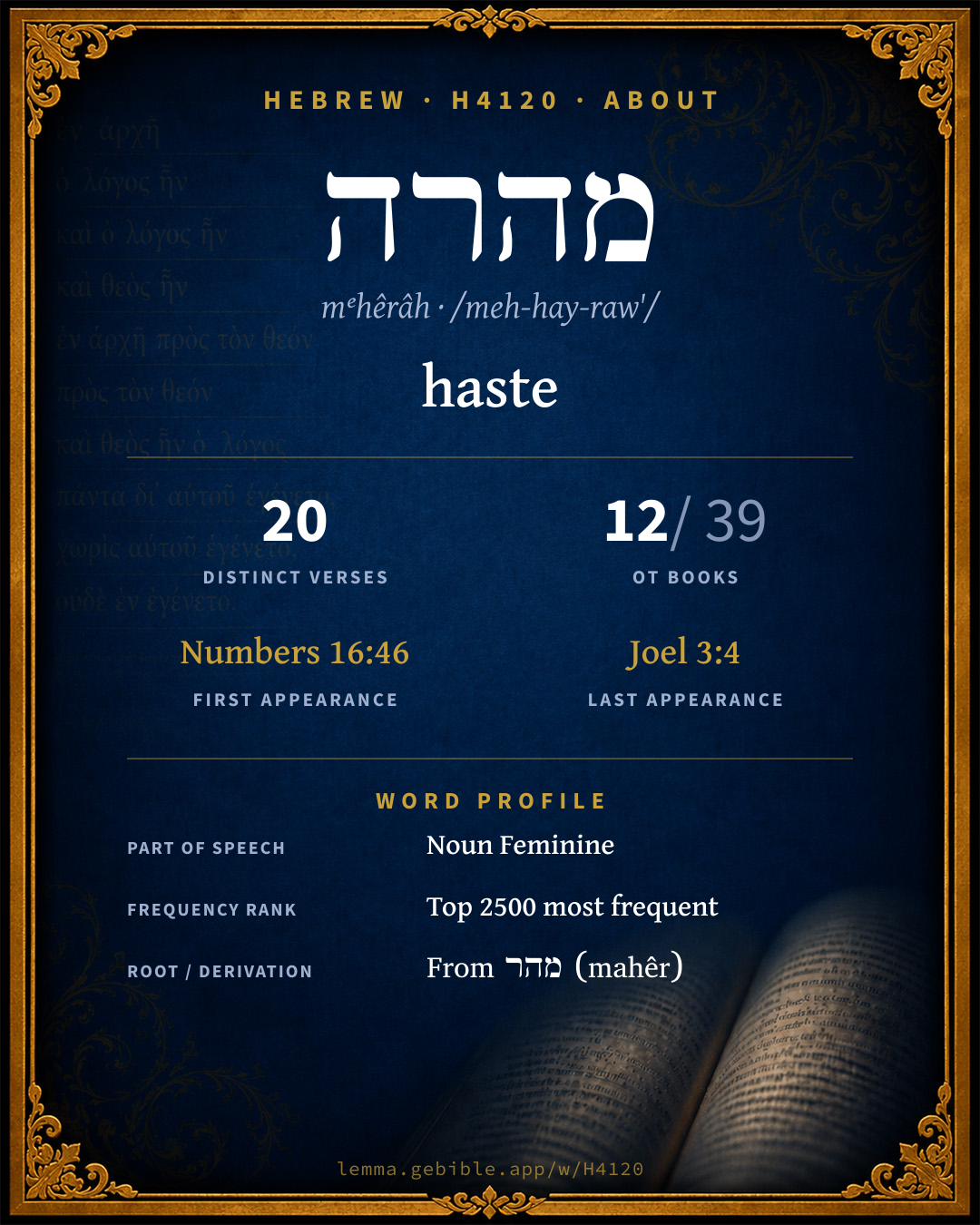
מְהֵרָה
haste
‘haste’ is one of 3 main senses fuller range ↓
Full lexicon entry — Brown-Driver-Briggs (BDB)
From Brown-Driver-Briggs (BDB)
Where this word appears
Grammar key — what these labels mean
Part of speech
- Noun
- A naming word — a person, place, thing, or idea.
Noun type
- Common
- A common noun — a general class of person, place, or thing (“king,” “city,” “water”), not a specific name.
State
- Absolute
- The independent form of a noun, not bound to a following word.
Gender
- Feminine
- Grammatically feminine.
Number
- Singular
- One.
Every verse where H4120 appears — 20 distinct verses across 12 books. Click any verse to open its interlinear word-by-word view. Verse text shown in the World English Bible for context — . Each verse’s Hebrew form is shown with its reference; the English is not keyword-highlighted, since the data carries no word-level English alignment. Use “Compare translations” on any verse to read it across multiple English versions. This concordance covers the Hebrew Bible; Septuagint (Greek Old Testament) occurrences are not indexed here.
Numbers 1 verse
Deuteronomy 1 verse
Joshua 3 verses
- Joshua 8:19 מְהֵרָ֨ה n c fs The ambush arose quickly out of their place, and they ran as soon as he had stretched out his hand, and entered into the city, and took it; and they hurried and set the city on fire.
- Joshua 10:6 מְהֵרָ֗ה n c fs The men of Gibeon sent to Joshua to the camp to Gilgal, saying, Don't slack your hand from your servants; come up to us quickly, and save us, and help us: for all the kings of the Amorites that dwell in the hill-country are gathered together against us.
- Joshua 23:16 מְהֵרָ֔ה n c fs When you disobey the covenant of Yahweh your God, which he commanded you, and go and serve other gods, and bow down yourselves to them; then will the anger of Yahweh be kindled against you, and you shall perish quickly from off the good land which he has given to you.
Judges 1 verse
1 Samuel 1 verse
2 Samuel 3 verses
- 2 Samuel 17:16 מְהֵרָה֩ n c fs Now therefore send quickly, and tell David, saying, Don't lodge this night at the fords of the wilderness, but by all means pass over; lest the king be swallowed up, and all the people who are with him.
- 2 Samuel 17:18 מְהֵרָ֜ה n c fs But a boy saw them, and told Absalom: and they went both of them away quickly, and came to the house of a man in Bahurim, who had a well in his court; and they went down there.
- 2 Samuel 17:21 מְהֵרָה֙ n c fs It happened, after they had departed, that they came up out of the well, and went and told king David; and they said to David, Arise you, and pass quickly over the water; for thus has Ahithophel counseled against you.
2 Kings 1 verse
Psalms 3 verses
- Psalms 31:2 מְהֵרָ֪ה n c fs Bow down your ear to me. Deliver me speedily. Be to me a strong rock, A house of defense to save me.
- Psalms 37:2 מְהֵרָ֣ה n c fs For they shall soon be cut down like the grass, And wither like the green herb.
- Psalms 147:15 מְ֝הֵרָ֗ה n c fs He sends out his commandment to the earth. His word runs very swiftly.
Ecclesiastes 2 verses
- Ecclesiastes 4:12 בִ/מְהֵרָ֖ה prep + n c fs If a man prevails against one who is alone, two shall withstand him; and a threefold cord is not quickly broken.
- Ecclesiastes 8:11 מְהֵרָ֑ה n c fs Because sentence against an evil work is not executed speedily, therefore the heart of the sons of men is fully set in them to do evil.
Isaiah 2 verses
- Isaiah 5:26 מְהֵרָ֖ה n c fs He will lift up a banner to the nations from far, And he will whistle for them from the end of the earth. Behold, they will come speedily and swiftly.
- Isaiah 58:8 מְהֵרָ֣ה n c fs Then shall your light break forth as the morning, and your healing shall spring forth speedily; and your righteousness shall go before you; the glory of Yahweh shall by your rearward.
Jeremiah 1 verse
Joel 1 verse
About this entry
At a glance — auto-summarized from this page’s data, not written by a person. Every figure links to its source below. This summary describes the numbers; it doesn’t interpret them.
מהרה — transliterated mᵉhêrâh — is a Hebrew noun carrying the sense “haste.” It first appears in Numbers 16:46. The Hebrew Bible uses it across 20 verses — uncommon. Its lexical range runs to 3 senses. Related forms include מהר and מהר שלל חש בז. Each statement above links to its evidence; the full detail follows below.
Gloss history
Strong's 1890 vs modern scholarship
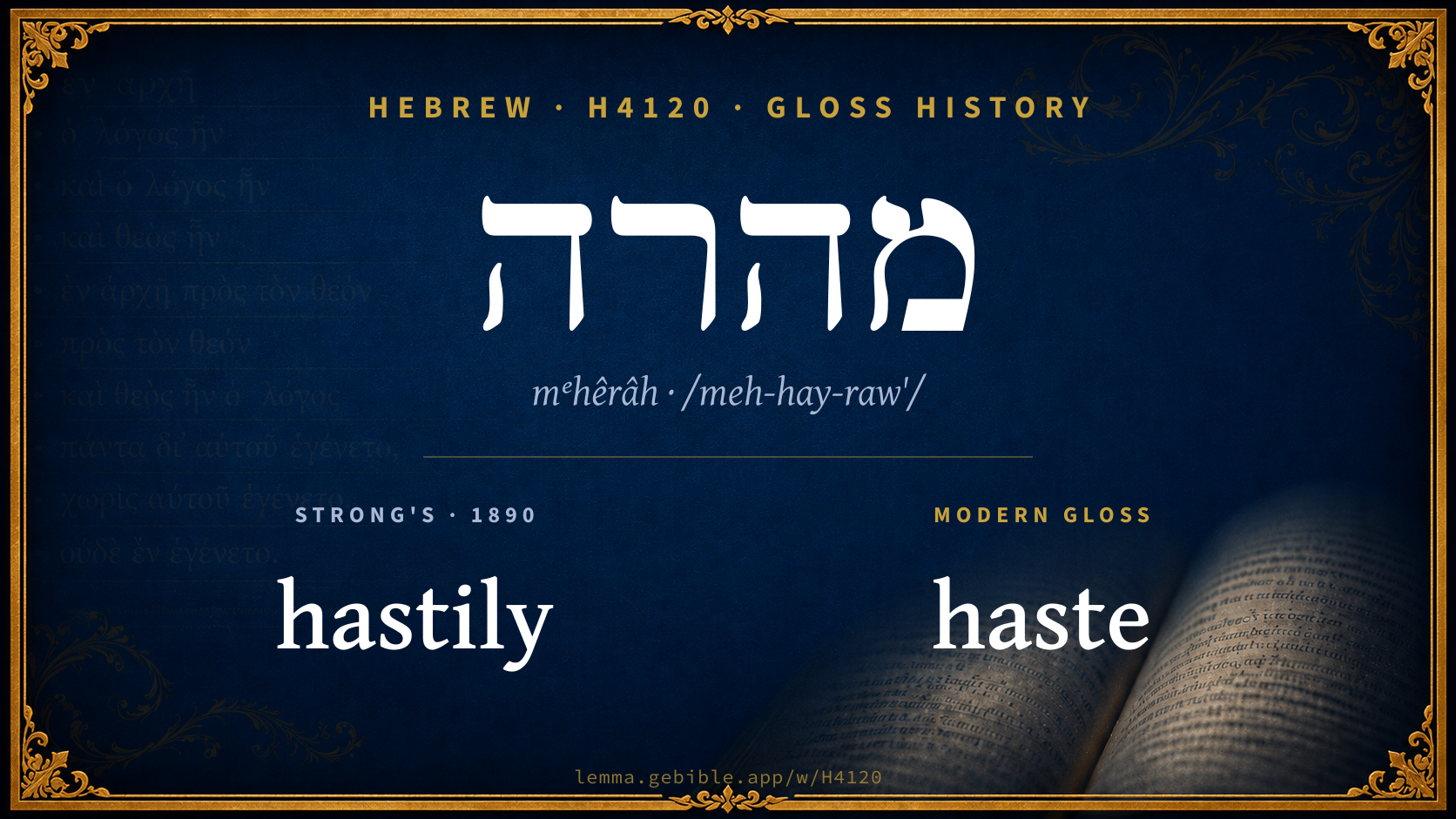
About this word
Strong's H4120 catalogs a Hebrew word from the Hebrew Old Testament.
These counts are not copied from any lexicon or concordance. They are computed here, from the morphology-tagged Hebrew Old Testament. What Lemma adds →
- 20
- distinct verses
- The word appears in 20 distinct verses.
- 12 / 39
- OT books
- The word appears in 12 of 39 Old Testament books.
- #1,513
- by frequency
- Top 2500 most frequent Hebrew words (rank 1,513 of 8,640 Hebrew words by occurrence).
View all 20 occurrences in the concordance →
By section of the Old Testament
By traditional corpus
Conventional, traditional groupings — biblical authorship is debated, so this is a traditional corpus grouping, not an authorship claim. Each share is this word’s portion of its verses in that division of the Hebrew canon. Each figure is a share of the word’s 20 distinct verses.
- Prophets (Nevi'im) 13 verses · 65%
- Writings (Ketuvim) 5 verses · 25%
- Torah (Pentateuch) 2 verses · 10%
How translations render this word
Counts come from each version’s own published word-to-Strong’s tagging or interlinear alignment — an approximate guide to how each version renders this word, not a word-level alignment the data otherwise carries. Because each total is that version’s own tagged count, the per-version totals vary from one another and need not match the appearance or distinct-verse counts above. These counts may also differ from a printed concordance because Lemma counts each distinctly tagged rendering and does not collapse phrase taggings into a single head-word total. This is a fixed set of word-tagged versions (KJV, ASV, BSB, ULT) and does not change with the reading translation you choose elsewhere. Each version’s license is shown beside its name below (and on Sources).
- King James Version: Quickly 7×, Speedily 4×
- American Standard Version: Quickly 5×, Speedily 2×
- Berean Standard Bible: Quickly 8×, Once 2×, Speedily 2×
- unfoldingWord Literal Text: Quickly 14×, Haste 2×
King James Version Public Domain
Renders H4120 across 20 tagged occurrences — most commonly:
Plus 9 renderings that appear only once — usually multi-word phrases or single function words the recovered tagging swept in, not distinct renderings.
American Standard Version Public Domain
Renders H4120 across 20 tagged occurrences — most commonly:
Plus 13 renderings that appear only once — usually multi-word phrases or single function words the recovered tagging swept in, not distinct renderings.
Berean Standard Bible Public Domain
Renders H4120 across 19 tagged occurrences — most commonly:
Plus 7 renderings that appear only once — usually multi-word phrases or single function words the recovered tagging swept in, not distinct renderings. Not rendered by a distinct English word in 1 further occurrence.
unfoldingWord Literal Text CC BY-SA 4.0
Renders H4120 across 20 tagged occurrences — most commonly:
Plus 4 renderings that appear only once — usually multi-word phrases or single function words the recovered tagging swept in, not distinct renderings.
Senses in BDB
The 3 senses BDB distinguishes for this word, in lexicon order (not ranked by frequency or importance). The full entry — with sub-senses — is in the Lexicon Entry tab.
- haste, speed
- hastily, speedily (as adverb)
- in haste (with preposition)
Word origin
n.f. haste, speed;—usually as adverb. acc. hastily, quickly: Jos 8:19; 10:6; 23:16 (all JE), Nu 17:11 (P), Dt 11:17; Ju 9:54; 2 S 17:16, 18, 21; Je 27:16; Ec 8:11 (in all these cases after vb.); before vb. (poet.) Is 5:26 (‖ קַל), ψ 31:3; 37:2 Is 58:8 Jo 4:4 (‖ קַל); so also 1 S 20:38 מ׳ הוּשָׁה (cf. Dr); 2 K 1:11 מ׳ רֵ֑דָה;—but perhaps read מַהֲרָה, i.e. Pi. Imv. of מהר (cf. 1 S 23:27); c. prep. (late): בִּמ׳ in haste = quickly Ec 4:12; עַד־מ׳, id. ψ 147:15.
— Brown-Driver-Briggs (Oxford 1906, public domain), digitized via Sefaria, supplemented by the OpenScriptures HebrewLexicon (CC BY 4.0). See Sources.
Derived from מהר (mahêr) (H4118) — swift.
Jastrow Dictionary
A second Hebrew/Aramaic lexicon for comparison, covering Aramaic and post-biblical (Talmudic, Targumic, Midrashic) usage that the biblical-Hebrew BDB does not. Matched by lemma rather than by Strong’s number, so a lemma may carry more than one Jastrow headword (shown separately below), and the entries cover usage well beyond the Bible.
מְהֵרָה
- preced.) speed; בִּמְ׳ speedily, easily. Ab. V, 20 במ׳ בימינו soon, in our life-time. Ber. 17ᵃ מ׳ הפר וכ׳ soon destroy their counsel. Ned. 20ᵃ לא במ׳ הוא חוטא will not easily be led to sin; a. e.
A Dictionary of the Targumim, the Talmud Babli and Yerushalmi, and the Midrashic Literature (Marcus Jastrow; London, Luzac, 1903) — Public Domain. Digitized via Sefaria. Digitized via Sefaria. Full attribution on Sources.
Forms in the corpus
The 14 distinct written forms H4120 takes in the Hebrew Bible, most frequent first — each parse links to that state’s occurrences in the concordance. Hebrew forms include their vowel points and cantillation, so a single lemma takes many written forms.
| Form | Parsing | Example | Uses |
|---|---|---|---|
| מְהֵרָ֑ה | Noun, Common, Feminine, Singular, Absolute | Ecclesiastes 8:11 | 2 |
| מְהֵרָ֔ה | Noun, Common, Feminine, Singular, Absolute | Joel 3:4 | 2 |
| מְהֵרָ֗ה | Noun, Common, Feminine, Singular, Absolute | Deuteronomy 11:17 | 2 |
| מְהֵרָ֜ה | Noun, Common, Feminine, Singular, Absolute | 2 Samuel 17:18 | 2 |
| מְהֵרָ֣ה | Noun, Common, Feminine, Singular, Absolute | Isaiah 58:8 | 2 |
| מְהֵרָ֥ה | Noun, Common, Feminine, Singular, Absolute | 1 Samuel 20:38 | 2 |
| בִ/מְהֵרָ֖ה | Noun, Common, Feminine, Singular, Absolute | Ecclesiastes 4:12 | 1 |
| מְ֝הֵרָ֗ה | Noun, Common, Feminine, Singular, Absolute | Psalms 147:15 | 1 |
| מְהֵרָ֖ה | Noun, Common, Feminine, Singular, Absolute | Isaiah 5:26 | 1 |
| מְהֵרָ֛ה | Noun, Common, Feminine, Singular, Absolute | Numbers 16:46 | 1 |
| מְהֵרָ֨ה | Noun, Common, Feminine, Singular, Absolute | Joshua 8:19 | 1 |
| מְהֵרָ֪ה | Noun, Common, Feminine, Singular, Absolute | Psalms 31:2 | 1 |
| מְהֵרָה֙ | Noun, Common, Feminine, Singular, Absolute | 2 Samuel 17:21 | 1 |
| מְהֵרָה֩ | Noun, Common, Feminine, Singular, Absolute | 2 Samuel 17:16 | 1 |
Same root — word family
Other BDB entries built from the same root as H4120, grouped by Strong’s listed origin. These share a root / origin per the lexicon — not necessarily a shared meaning. Each links to that word’s own entry.
Derives from
Proper names from this root
People and places named from this root — a name, not an additional meaning of the word.
Compare all same-root words → 1 of the same-root words is a proper name (a person or place). They share a root, not necessarily a meaning.
Septuagint verse parallels
This word appears in 18 verses that also exist in the Greek Old Testament (Septuagint), out of the 20 Hebrew verses it occurs in. You can read those verses in Greek by switching the Old Testament edition to the Septuagint.
Read these verses in the Septuagint
- Deuteronomy 11:17
- Joshua 8:19
- Judges 9:54
- 1 Samuel 20:38
- 2 Samuel 17:16
- 2 Kings 1:11
- Psalms 31:2
- Ecclesiastes 4:12
- Isaiah 5:26
- Jeremiah 27:16
- Joel 3:4
This is a verse-level parallel only — the same verses exist in both the Hebrew and Greek Old Testaments. No word-level Hebrew↔Greek correspondence is claimed: the data carries no such alignment, so no Greek word is shown as this Hebrew word’s translation. Coverage is not total — the Septuagint omits the deuterocanon and renumbers the Psalms, so some Hebrew verses have no direct Greek parallel.