

Job 37:5

Hebrew (Westminster Leningrad Codex) Job 37:5 appears in the Hebrew Old Testament. The text above is from the Westminster Leningrad Codex. Each word links to its Strong’s number, a concise gloss, and parsing drawn from the Open Scriptures Hebrew Bible morphology. Click any word for its full Brown-Driver-Briggs (BDB) entry.
Download image
Cite this verse

Job 37:5 (World English Bible). Public Domain. Lemma interlinear Bible study tool, https://lemma.gebible.app/v/job/37/5.

Show BibTeX & RIS
BibTeX
RIS
English Translation
God thunders marvelously with his voice. He does great things, which we can't comprehend.
World English Bible · Public Domain
Download a study sheet

One document with this verse’s original text, its word-by-word gloss line, the meaning frame, cross-references with their text, attributed commentary, and full source and license credits — printable, and it pastes into notes with its structure intact.

This verse Autodidact and up

Study sheet (.html) Plain text (.txt)

A passage Seminary Student

Up to 50 verses in one chapter. A passage sheet keeps up to 6 commentary sources and 12 cross-references per verse, in the order this page ranks them, and says so on the sheet whenever that leaves anything out. Ask for a single verse and you get the Autodidact verse sheet above.

Everything on this page stays free to read, with no account — the sheet is a download of what is already on screen, not access to it.

Want to remove ads? Support Godless Engineer
Compare translations 3

The same verse in 3 English versions, stacked beneath the original-language interlinear above. Click any original word for its lexicon entry.

Each is an independent rendering of the whole verse — the interlinear is not word-aligned to these translations.

Highlighted words mark where these versions differ — a whole-verse word diff, not a word-by-word alignment.

  • World English Bible Public Domain
    God thunders marvelously with his voice. He does great things, which we can't comprehend.
  • King James Version Public Domain
    God thundereth marvellously with his voice; great things doeth he, which we cannot comprehend.
  • unfoldingWord Literal Text CC BY-SA 4.0
    God thunders marvelously with his voice, doing great and we do not know.

unfoldingWord Literal Text — © unfoldingWord, licensed CC BY-SA 4.0. Word-aligned USFM3 via Door43 (git.door43.org/unfoldingWord/en_ult).

Versions to compare (up to 4)

3 of 4 selected

Show all 18 translations

Every available English version of this verse, each an independent rendering of the whole verse.

  • World English Bible Public Domain
    God thunders marvelously with his voice. He does great things, which we can't comprehend.
  • Berean Standard Bible Public Domain
    God thunders wondrously with His voice; He does great things we cannot comprehend.
  • Majority Standard Bible Public Domain
    God thunders wondrously with His voice; He does great things we cannot comprehend.
  • King James Version Public Domain
    God thundereth marvellously with his voice; great things doeth he, which we cannot comprehend.
  • American Standard Version (1901) Public Domain
    God thundereth marvellously with his voice; Great things doeth he, which we cannot comprehend.
  • Revised Version (1885) Public Domain
    God thundereth marvelously with his voice; great things doeth he, which we cannot comprehend.
  • Geneva Bible (1599) Public Domain
    God thundereth marueilously with his voyce: he worketh great things, which we know not.
  • Douay-Rheims (1899) Public Domain
    God shall thunder wonderfully with his voice, he that doth great and unsearchable things.
  • Young's Literal Translation Public Domain
    God thundereth with His voice wonderfully, Doing great things and we know not.
  • Literal Standard Version CC BY-SA 4.0
    God thunders with His voice wonderfully, || Doing great things and we do not know.
  • Unlocked Literal Bible CC BY-SA 4.0
    God thunders marvelously with his voice; he does great things that we cannot comprehend.
  • unfoldingWord Literal Text CC BY-SA 4.0
    God thunders marvelously with his voice, doing great and we do not know.
  • Darby Bible Public Domain
    ùGod thundereth marvellously with his voice, doing great things which we do not comprehend.
  • World Messianic Bible Public Domain
    God thunders marvelously with his voice. He does great things, which we can’t comprehend.
  • Webster's Bible Public Domain
    God thundereth marvelously with his voice; great things he doeth, which we cannot comprehend.
  • Free Bible Version CC BY-SA 4.0
    God's thunderous voice is wonderful! We can't comprehend the great things he does!
  • Bible in Basic English Public Domain
    He does wonders, more than may be searched out; great things of which we have no knowledge;
  • JPS Tanakh (1917) Public Domain
    God thundereth marvellously with His voice; great things doeth He, which we cannot comprehend.

Literal Standard Version (2020), Covenant Press — licensed CC BY-SA 4.0. Text via the HelloAO Bible API (eBible.org). Unlocked Literal Bible (unfoldingWord) — licensed CC BY-SA 4.0. Text via the HelloAO Bible API (eBible.org). unfoldingWord Literal Text — © unfoldingWord, licensed CC BY-SA 4.0. Word-aligned USFM3 via Door43 (git.door43.org/unfoldingWord/en_ult). Free Bible Version, Dr. Jonathan Gallagher — licensed CC BY-SA 4.0. Text via the HelloAO Bible API (eBible.org).

Word by word

More ways to search: Search by grammar → Find every occurrence → Compare this word →

Practice this passage: Drill this verse → Learn its vocabulary →

About this verse

These counts appear in no published source. They are computed here, from the morphology-tagged text and Lemma’s own curated glosses. What Lemma adds →

8
words
8
distinct lemmas
Wisdom
section

Notable vocabulary

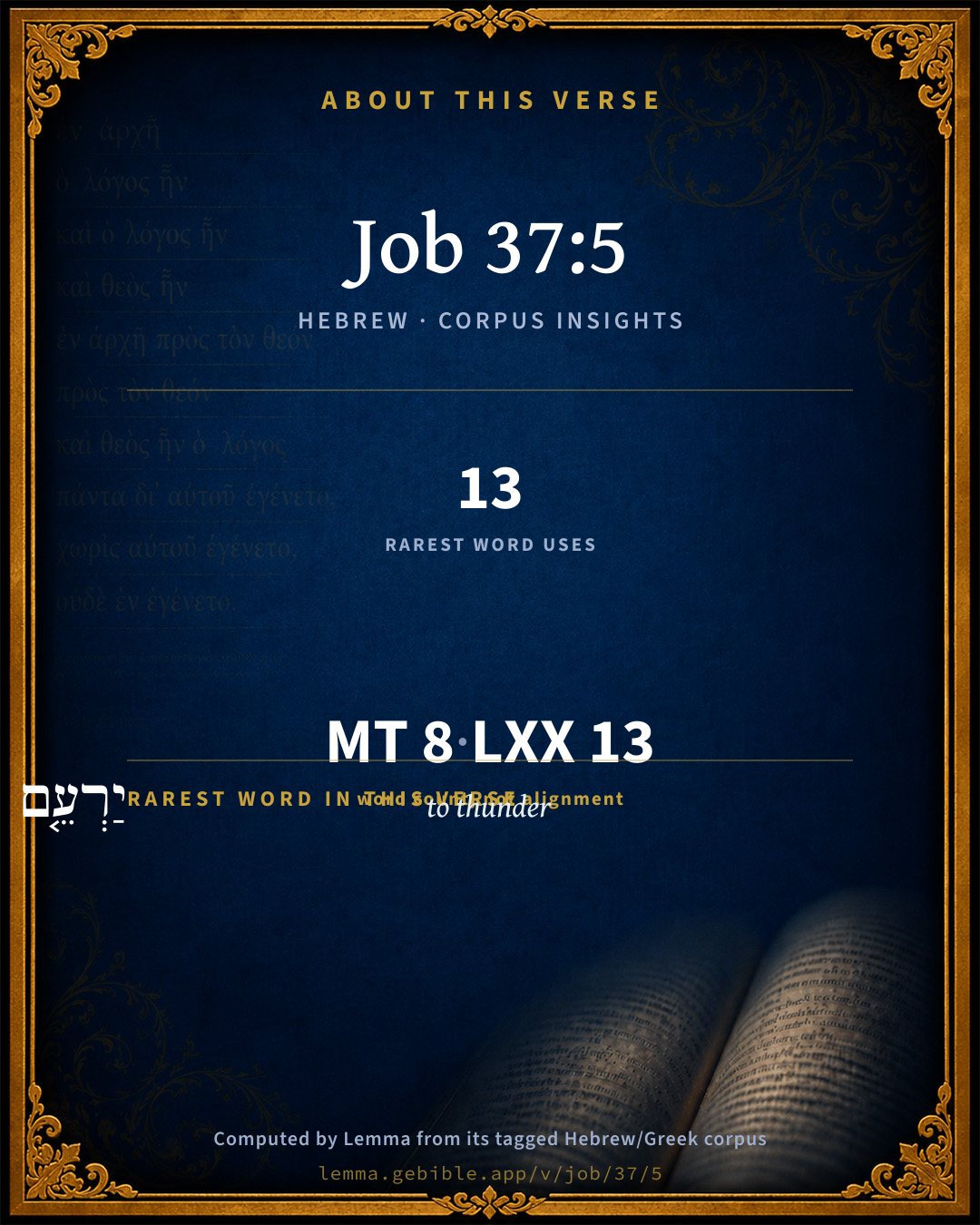
The rarest word here is יַרְעֵ֤ם to thunder H7481 — appearing just 13 times in the whole Hebrew Bible.

Shared distinctive vocabulary

יַרְעֵ֤ם to thunder H7481 occurs in 13 verses of the Hebrew Bible. Also found in:

Grammatical profile

  • 4 verbs
  • 2 nouns
  • 1 adjective
  • 1 particle

Verb forms

  • יַרְעֵ֤ם Hiphil · Imperfect
  • נִפְלָא֑וֹת Niphal · Participle Active
  • עֹשֶׂ֥ה Qal · Participle Active
  • נֵדָֽע Qal · Imperfect

Hebrew & Septuagint length

In English translation the verse runs 14 words from the Hebrew and 19 from the Septuagint (LXX English) — closely comparable.

A rough comparison of the two English renderings, which tokenize alike — not a word-level alignment.

Word counts can differ between the Hebrew and the Greek without any difference in meaning — e.g. the Hebrew direct-object marker אֵת has no separate Greek word, and Greek often adds the article ὁ.

In the original languages it is 8 Hebrew tokens and 13 Greek tokens — but the two are counted differently (Hebrew bundles its prefixes and suffixes into one token; the Greek is in lemma form), so that isn’t a like-for-like length.

Cross-references

11

Topical passages linked to Job 37:5 in the Treasury of Scripture Knowledge — connected by theme and wording, ordered by reader-vote popularity; previews shown in the World English Bible.

  • Job 5:9 Who does great things that can't be fathomed, Marvelous things without number;
  • Romans 11:33 Oh the depth of the riches both of the wisdom and the knowledge of God! How unsearchable are his judgments, and his ways past tracing out!
  • Job 9:10 Who does great things past finding out, Yes, marvelous things without number.
  • Ecclesiastes 3:11 He has made everything beautiful in its time. He has also set eternity in their hearts, yet so that man can't find out the work that God has done from the beginning even to the end.
  • Isaiah 40:28 Have you not known? have you not heard? The everlasting God, Yahweh, the Creator of the ends of the earth, doesn't faint, neither is weary; there is no searching of his understanding.
  • Job 26:14 Behold, these are but the outskirts of his ways. How small a whisper do we hear of him! But the thunder of his power who can understand?"
  • Job 36:26 Behold, God is great, and we don't know him. The number of his years is unsearchable.
  • Revelation 15:3 They sang the song of Moses, the servant of God, and the song of the Lamb, saying, "Great and marvelous are your works, Lord God, the Almighty; Righteous and true are your ways, you King of the nations.
  • 2 Samuel 22:14–15 Yahweh thundered from heaven, The Most High uttered his voice.
  • Job 11:7 "Can you fathom the mystery of God? Or can you probe the limits of the Almighty?
  • Isaiah 40:21–22 Have you not known? have yet not heard? has it not been told you from the beginning? have you not understood from the foundations of the earth?

Cross-references courtesy of OpenBible.info (CC BY 4.0).

Hebrew and Greek witnesses Masoretic Hebrew ↔ Greek Septuagint

The same verse in the two great witnesses to the Old Testament, shown verse-for-verse.

These are two independent witnesses, not word-aligned to each other, and the Septuagint is shown in lemma (dictionary) form.

Hebrew Job 37:5 Masoretic · Westminster Leningrad Codex

יַרְעֵ֤ם אֵ֣ל בְּ֭קוֹלוֹ נִפְלָא֑וֹת עֹשֶׂ֥ה גְ֝דֹל֗וֹת וְלֹ֣א נֵדָֽע

God thunders marvelously with his voice. He does great things, which we can't comprehend.

World English Bible · Public Domain

Greek LXX Job 37:5 Septuagint · lemma form

βροντάω ὁ ἰσχυρός ἐν φωνή αὐτός θαυμάσιος ποιέω γάρ μέγας ὅς οὐ οἶδα

The Mighty One shall thunder wonderfully with his voice: for he has done great things which we knew not;

LXX2012 (modern English Septuagint) · Public Domain

Hebrew: Westminster Leningrad Codex (CC BY 4.0). Greek: Septuagint (public domain); English from LXX2012 (modern English Septuagint) (Public Domain). How the Septuagint differs from the Hebrew →

Commentary

Notes on Job 37:5 from classic Christian and Jewish commentators (each source and its license shown beneath its notes). The classic Christian expositions comment on the surrounding passage and are grouped to its opening verse, so a note may address several verses; the Jewish commentaries on the Tanakh (Rashi and others) are per-verse, so they appear only where the commentator wrote on this verse.

Lemma curates 59 commentaries, every one of them public domain or Creative Commons licensed, each selected and text-cleaned for this edition rather than reprinted as found. About our sources →

Trapp's Complete Commentary

John Trapp

Job 37:5 God thundereth marvellously with his voice; great things doeth he, which we cannot comprehend.

Ver. 5. God thundereth marvellousIy with his voice] Or, God thundereth out marvellous things with his voice. Marvellous indeed, if we consider the effects of thunder, lightning, and lightnig bolts, which differ from lightning in form only, and not in matter; and for the effects thereof naturalists tell us strange things; as that by them the money hath been melted without hurting the purse; the sword hath been broken within the scabbard, the wine hath been exhausted within the barrel, the bones broke within the flesh, &c. How various and marvellous the nature, generation, matter, form, effects of the thunder and thunderbolt are, not only Seneca, Pliny, and other meteorologists testify, but daily experience sealeth to the truth of it.

Great things doth he, which we cannot comprehend] As being above the reach of our shallow capacity; or, which we will not know; so the Hebrew hath it; such is our oscitance, or obstinace, that we will not take knowledge of God’s works of wonder, though they do even run into our senses. This he construeth for a high contempt; as a skilful artificer would do when he hath set forth a curious piece to public view, and none will take notice of it. God seemeth to have made the meteors in such great variety, that therein he might show his own skill, and their imperfection.

John Trapp, A Commentary or Exposition upon All the Books of the Old and New Testament (1647–1656) — public domain. Text from a community e-Sword module.

Jamieson, Fausset & Brown

Robert Jamieson, A. R. Fausset & David Brown

(Job 36:26; Psa 65:6; Psa 139:14). The sublimity of the description lies in this, that God is everywhere in the storm, directing it whither He will [BARNES]. See Psa 29:1-11, where, as here, the "voice" of God is repeated with grand effect. The thunder in Arabia is sublimely terrible.

Jamieson, Fausset & Brown — Commentary Critical and Explanatory on the Whole Bible (1871) — public domain (CC PDM 1.0). Text via the HelloAO Bible API.

Adam Clarke's Commentary

Verse 5. God thundereth marvellously with his voice] This is the conclusion of Elihu's description of the lightning and thunder: and here only should chap. xxxvi. have ended. He began, Job 36:29, with the noise of God's tabernacle; and he ends here with the marvellous thundering of Jehovah. Probably the writer of the book of Job had seen the description of a similar thunder storm as given by the psalmist, Ps 77:16-19: -

Ver. 16. The waters saw thee, O God!

The waters saw thee, and were afraid.

Yea, the deeps were affrighted!

Ver. 17. The clouds poured out water;

The ethers sent forth a sound;

Yea, thine arrows went abroad.

Ver. 18. The voice of thy thunder was through the expanse:

The lightnings illumined the globe;

The earth trembled and shook!

Ver. 19. Thy way is in the sea,

And thy paths on many waters;

But thy footsteps are not known.

Great things doeth he] This is the beginning of a new paragraph; and relates particularly to the phenomena which are afterwards mentioned. All of them wondrous things; and, in many respects, to us incomprehensible.

Adam Clarke's Commentary on the Bible (1810–1826) — public domain. Text from a community e-Sword/MySword module.

John Gill's Exposition

God thundereth marvellously with his voice,.... Or "marvels" (c), or marvellous things, which may respect the marvellous effects of thunder and lightning: such as rending rocks and mountains; throwing down high and strong towers; shattering to pieces high and mighty oaks and cedars, and other such like effects, mentioned in Psa 29:5; and there are some things reported which seem almost incredible, were they not well attested facts; as that an egg should be consumed thereby, and the shell unhurt; a cask of liquor, the liquor in it spoiled, and the cask not touched; money melted in the purse, and the purse whole; the fetus in the womb killed, and the woman preserved; with other things of the like kind mentioned by various writers (d); and which are to be accounted for only by the swift motion and piercing and penetrating nature of lightning. So the voice of God in the Gospel thunders out and declares many wonderful things; as the doctrines of the trinity of Persons in one God; of the everlasting love of the three Persons; of the Person of Christ, and the union of the two natures in him; of his incarnation, of redemption and salvation by him; of regeneration by the spirit of God; of union to Christ, and communion with him; and of the resurrection of the dead: and it produces marvellous effects, attended with a divine power; as quickening sinners dead in trespasses and sins; enlightening those who are darkness itself; bearing down all opposition before it; casting down the strong holds of sin and Satan, and reducing the most stubborn and obstinate to the obedience of Christ;

great things doth he, which we cannot comprehend; or "know" (e): great things in creation, the nature and causes of which lie greatly out of the reach of man; and which he rather guesses at than knows, and still less comprehends. Great things in providence; in sustaining all creatures and providing for them; and in the government of the world, and in his dispensations in it; his judgments being unsearchable, and his ways past finding out: and great things in grace; as the salvation of sinners by Christ, and the conversion of their souls by his Spirit; and even what is known of them is known but in part and very imperfectly. This is a transition to other great things done by the Lord, besides those before mentioned, and particular instances follow.

(c) "mirabilia", Pagninus, Montanus. (d) Plin. Nat. Hist. l. 2. c. 51. Senec. Nat. Quaest. l. 2. c. 31. (e) "et nesciemus", Pagninus, Montanus; so Schultens.

John Gill's Exposition of the Whole Bible (1746–1763) — public domain (CC PDM 1.0). Text via the HelloAO Bible API.

Albert Barnes' Notes on the Bible

God thundereth marvelously - He thunders in a wonderful manner. The idea is, that the voice of his thunder is an amazing exhibition of his majesty and power.

Great things doeth he, which we cannot comprehend - That is, not only in regard to the thunder and the tempest, but in other things. The description of the storm properly ends here, and in the subsequent verses Elihu proceeds to specify various other phenomena, which were wholly incomprehensible by man. The reference here to the storm, and to the other grand and incomprehensible phenomena of nature, is a most appropriate introduction to the manifestation of God himself as described in the next chapter, and could not but have done much to prepare Job and his friends for that sublime close of the controversy.

The passage before us Job 36:29-33; Job 37:1-5, is probably the earliest description of a thunderstorm on record. A tempest is a phenomenon which must early have attracted attention, and which we may expect to find described or alluded to in all early poetry. It may be interesting, therefore, to compare this description of a storm, in probably the oldest poem in the world, with what has been furnished by the masters of song in ancient and modern times, and we shall find that in sublimity and beauty the Hebrew poet will suffer nothing in comparison. In one respect, which constitutes the chief sublimity of the description. he surpasses them all: I mean in the recognition of God. In the Hebrew description. God is every where in the storm He excites it; he holds the lightnings in both hands; he directs it where he pleases; he makes it the instrument of his pleasure and of executing his purposes. Sublime, therefore, as is the description of the storm itself, furious as is the tempest; bright as is the lightning: and heavy and awful as is the roar of the thunder, yet the description derives its chief sublimity from the fact that “God” presides over all, riding on the tempest and directing the storm as he pleases. Other poets have rarely attempted to give this direction to the thoughts in their description of a tempest, if we may except Klopstock, and they fall, therefore, far below the sacred poet. The following is the description of a storm by Elihu, according to the exposition which I have given:

Who can understand the outspreading of the clouds,

And the fearful thunderings in his pavilion?

Behold, he spreadeth his light upon it;

He also covereth the depths of the sea.

By these he executeth judgment upon the people,

By these he giveth food in abundance.

With his hands he covereth the lightning,

And commandeth it where to strike.

He pointeth out to his friends -

The collecting of his wrath is upon the wicked.

At this also my heart palpitates,

And is moved out of its place.

Hear, O hear, the thunder of his voice!

The muttering thunder that goes from his mouth!

He directeth it under the whole heaven.

And his lightning to the end of the earth.

After it, the thunder roareth;

He thundereth with the voice of his majesty,

And he will not restrain the tempest when his voice is heard.

God thundereth marvelously with his voice;

He doeth wonders, which we cannot comprehend.

The following is the description of a Tempest by Aeschylus, in the Prometh. Desm., beginning,

- Χθὼν αεσάλευται;

Βρυχία δ ̓ ἠχὼ παραμυκᾶται

Βροντῆς, κ.τ.λ.

- Chthōn sesaleutai;

Bruchia d' ēchō paramukatai

Brontēs, etc.

- “I feel in very deed

The firm earth rock: the thunder’s deepening roar

Rolls with redoubled rage; the bickering flames

Flash thick; the eddying sands are whirled on high;

In dreadful opposition, the wild winds

Rend the vex’d air; the boisterous billows rise

Confounding earth and sky: the impetuous storm

Rolls all its terrible fury.”

Potter

Ovid’s description is the following:

Aethera conscendit, vultumque sequentia traxit

Nubila; queis nimbos, immistaque fulgura ventis

Addidit, et tonitrus, et inevitabile fulmen.

Meta. ii.

The description of a storm by Lucretius, is the following:

Praeterea persaepe niger quoque per mare nimbus

Ut picis e coelo demissum flumen, in undas

Sic cadit, et fertur tenebris, procul et trahit atram

Fulminibus gravidam tempestatem, atque procellis.

Ignibus ac ventis cum primus ipse repletus:

In terris quoque ut horrescant ae tecta requirant.

S c igitur sutpranostrum caput esso putandum est

Tempestatem altam. Neque enim caligine tanta

Obruerat terras, nisi inaedificata superne

Multa forent multis exempto nubila sole.

Lib. vi.

The well-known description of the storm by Virgil is as follows:

Nimborum in patriam, loca foeta furentibus austris,

Aeoliam venit. Hic vasto Rex Aeolus antro

Luctantis ventos tempestatesque sonoras

Imperio premit, ac vinelis et carcere frenat.

Illi indignantes, magno cum murmure, montis

Circum claustra fremunt. Celsa sedet Aeolus arce,

Sceptra tenens: molliitque animos, et temperat iras.

- Venti, velut agmine facto.

Qua data petra, ruunt, et terras turbine perflant.

Incubuere mari, totumque a sedibus imis,

Una Eurusque Notusque ruunt, creberque procelis

Africus, et vastos volvunt ad litora fluctus.

Aeneid i. 51-57, 82-86.

One of the most sublime descriptions of a storm to be found any where, is furnished by Klopstock. It contains a beautiful recognition of the presence and majesty of God, and a most tender and affecting description of the protection which his friends experience when the storm rushes by. It is in the Fruhlingsfeier - a poem which is regarded by many as his masterpiece. A small portion of it I will transcribe:

Wolken stromen herauf!

Sichtbar ist; der komant, der Ewige!

Nun schweben sie, rauschen sie, wirbeln die Winde!

Wie beugt sich der Wald! Wie hebet sich det Strom!

Sichtbar, wie du es Sterblichen seyn kannst,

Ja, das bist du, sichtbar, Unendlicher!

Zurnest du, Herr,

Weil Nacht dein Gewand ist?

Diese Nacht ist Segen der Erde.

Vater, du Zurnest nicht!

Seht ihr den Zeugendes Nahen, den zucken den Strahi?

Hort ihr Jehovah’s Donner?

Hort ihr ihn? hort ihr ihn.

Der erschtternden Donner des Herrn?

Herr! Herr! Gott!

Barmhertzig, und gnadig!

Angebetet, gepriesen,

Sey dein herrlicher Name!

Und die Gowitterwinde! Sie tragen den Donner!

Wie sie rauschen! Wie sie mit lawter Woge den Wald du: chstromen!

Und nun schwiegen sie. Langsam wandelt

Die schwartze Wolke.

Seht ihr den neurn Zeugen des Nahen, den fliegenden Strahl!

Horet ihr hoch in Wolke den Donner dex Herrn?

Er ruft: Jehova! Jehova!

Und der geschmetterte Wald dampft!

Abet nicht unsre Hutte

Unser Vater gebot

Seinem Verderber,

Vor unsrer Hutte voruberzugehn!

Albert Barnes' Notes on the Bible (1834–1885) — public domain. Text from a community e-Sword/MySword module.

Matthew Poole's English Annotations

Marvellously; with a wonderful and terrible noise, and so as to produce many wonderful effects, as the breaking down of great and strong trees or buildings, the killing of men in a stupendous manner, &c.

Great things doeth he, even in the course of nature, and in visible things; which all men see, but scarce any can give the true and satisfactory reasons of them; for the greatest philosophers speak only by guess, and are greatly divided among themselves about them. And therefore it is not strange if the secret and deep counsels of Divine Providence be out of our reach; and it is great arrogancy in thee, O Job, to censure them, because thou dost not fully understand them.

Matthew Poole's English Annotations on the Holy Bible (1683–1685) — public domain. Text from a community e-Sword/MySword module.

The Pulpit Commentary

God thundereth marvellously with his voice. In finishing off his description of the thunderstorm, Elihu dwells upon its marvellousness. Each step in the entire process is strange and wonderful, beyond man"s comprehension; and the lesson to be drawn from the consideration of the whole series of phenomena is that great things doeth he (i.e. God), which we cannot comprehend. Even after all that has been done of late years to advance the science of meteorolegy, it cannot be said that the rationale of storms is fully grasped by the scientific intellect.

The Pulpit Commentary (1880–1919), ed. H.D.M. Spence-Jones & Joseph S. Exell — public domain. Text from a community e-Sword module.

Lesson kit

Teaching starters — assembled from the data on this page, not authored interpretation. Every prompt links to the verse data it draws on. Edit before teaching.

Job, in the Wisdom, opens this verse with 8 words (8 distinct Hebrew lemmas). Its most distinctive word is râʻam (“to thunder”). A historical commentator’s framing appears above. Read the whole chapter for the surrounding context.

Discussion questions

  1. What does “to thunder” (râʻam) contribute to the verse as a whole?
  2. 1 Samuel 1:6 shares the word «to thunder» with this verse. How do the two illuminate each other?
  3. These translations render this verse differently; the difference is in the English rendering, not the original. What questions does that raise?
  4. The verb «יַרְעֵ֤ם» is Hiphil Imperfect. How does its form color the action?
  5. Reading how Trapp's Complete Commentary and Jamieson, Fausset & Brown read this verse, where do the two commentators agree and where do they part?

Things to notice

Reading settings

Reading text

Shown beneath each verse's original-language words.

Old Testament
Old Testament edition

Read the OT as the Masoretic Hebrew (MT) or the Greek Septuagint (LXX).

English shown for the Greek Septuagint (in the Hebrew ↔ Greek comparison).

Comparing translations? Open the Compare panel on any verse page to stack up to four side by side.