
Psalms 105:2

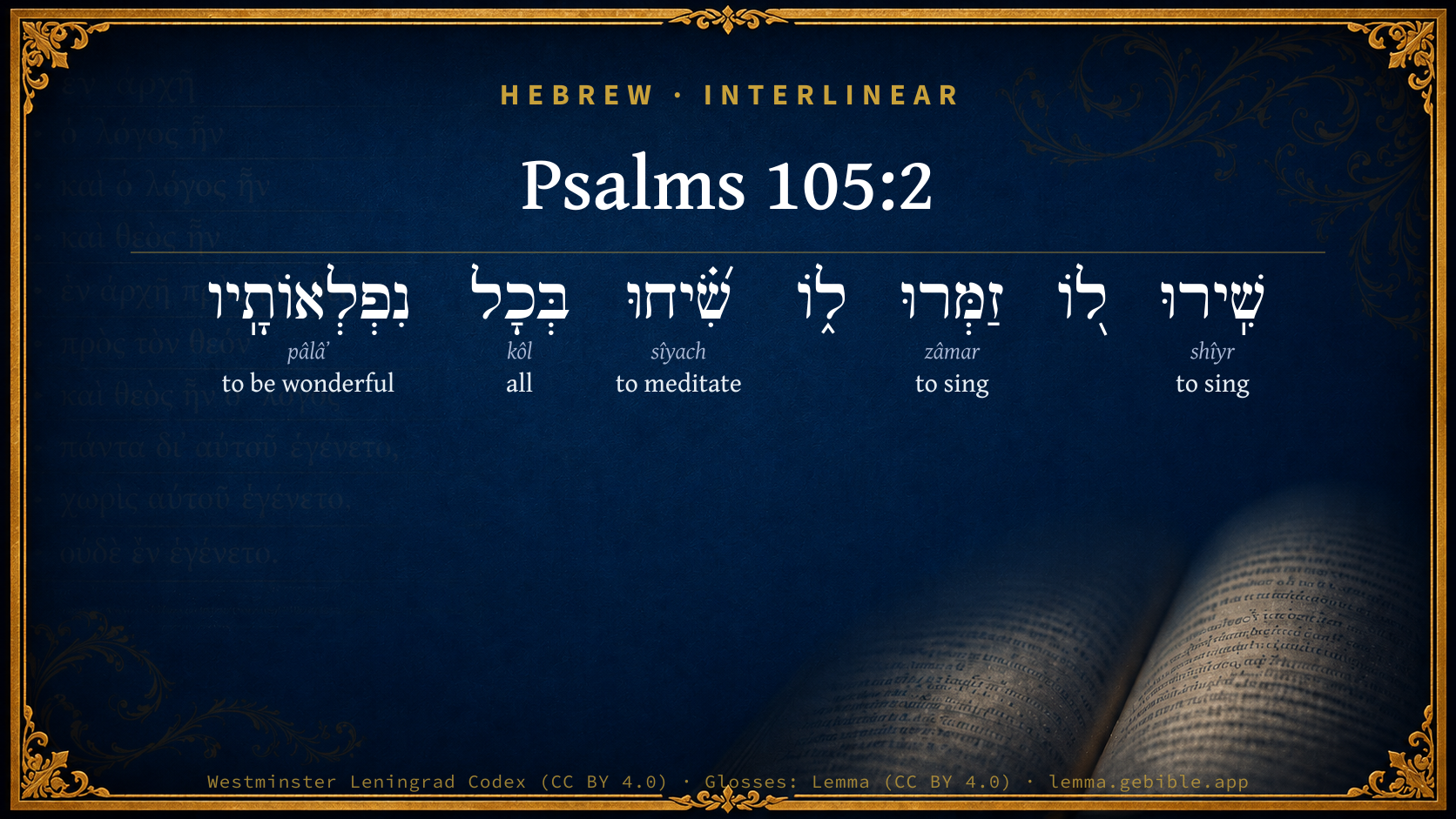
Hebrew (Westminster Leningrad Codex) Psalms 105:2 appears in the Hebrew Old Testament. The text above is from the Westminster Leningrad Codex. Each word links to its Strong’s number, a concise gloss, and parsing drawn from the Open Scriptures Hebrew Bible morphology. Click any word for its full Brown-Driver-Briggs (BDB) entry.
Download image
Cite this verse

Psalms 105:2 (World English Bible). Public Domain. Lemma interlinear Bible study tool, https://lemma.gebible.app/v/psalms/105/2.

Show BibTeX & RIS
BibTeX
RIS
English Translation
Sing to him, sing praises to him! Tell of all his marvelous works.
World English Bible · Public Domain
Download a study sheet

One document with this verse’s original text, its word-by-word gloss line, the meaning frame, cross-references with their text, attributed commentary, and full source and license credits — printable, and it pastes into notes with its structure intact.

This verse Autodidact and up

Study sheet (.html) Plain text (.txt)

A passage Seminary Student

Up to 50 verses in one chapter. A passage sheet keeps up to 6 commentary sources and 12 cross-references per verse, in the order this page ranks them, and says so on the sheet whenever that leaves anything out. Ask for a single verse and you get the Autodidact verse sheet above.

Everything on this page stays free to read, with no account — the sheet is a download of what is already on screen, not access to it.

Want to remove ads? Support Godless Engineer
Compare translations 3

The same verse in 3 English versions, stacked beneath the original-language interlinear above. Click any original word for its lexicon entry.

Each is an independent rendering of the whole verse — the interlinear is not word-aligned to these translations.

Highlighted words mark where these versions differ — a whole-verse word diff, not a word-by-word alignment.

  • World English Bible Public Domain
    Sing to him, sing praises to him! Tell of all his marvelous works.
  • King James Version Public Domain
    Sing unto him, sing psalms unto him: talk ye of all his wondrous works.
  • unfoldingWord Literal Text CC BY-SA 4.0
    Sing to him, make music to him; exclaim about all of his marvelous deeds!

unfoldingWord Literal Text — © unfoldingWord, licensed CC BY-SA 4.0. Word-aligned USFM3 via Door43 (git.door43.org/unfoldingWord/en_ult).

Versions to compare (up to 4)

3 of 4 selected

Show all 18 translations

Every available English version of this verse, each an independent rendering of the whole verse.

  • World English Bible Public Domain
    Sing to him, sing praises to him! Tell of all his marvelous works.
  • Berean Standard Bible Public Domain
    Sing to Him, sing praises to Him; tell of all His wonders.
  • Majority Standard Bible Public Domain
    Sing to Him, sing praises to Him; tell of all His wonders.
  • King James Version Public Domain
    Sing unto him, sing psalms unto him: talk ye of all his wondrous works.
  • American Standard Version (1901) Public Domain
    Sing unto him, sing praises unto him; Talk ye of all his marvelous works.
  • Revised Version (1885) Public Domain
    Sing unto him, sing praises unto him; talk ye of all his marvelous works.
  • Geneva Bible (1599) Public Domain
    Sing vnto him, sing prayse vnto him, and talke of all his wonderous workes.
  • Douay-Rheims (1899) Public Domain
    Sing to him, yea sing praises to him: relate all his wondrous works.
  • Young's Literal Translation Public Domain
    Sing ye to Him -- sing praise to Him, Meditate ye on all His wonders.
  • Literal Standard Version CC BY-SA 4.0
    Sing to Him—sing praise to Him, || Meditate on all His wonders.
  • Unlocked Literal Bible CC BY-SA 4.0
    Sing to him, sing praises to him; speak of all his marvelous deeds.
  • unfoldingWord Literal Text CC BY-SA 4.0
    Sing to him, make music to him; exclaim about all of his marvelous deeds!
  • Darby Bible Public Domain
    Sing unto him, sing psalms unto him; meditate upon all his wondrous works.
  • World Messianic Bible Public Domain
    Sing to him, sing praises to him! Tell of all his marvelous works.
  • Webster's Bible Public Domain
    Sing to him, sing psalms to him: talk ye of all his wondrous works.
  • Free Bible Version CC BY-SA 4.0
    Sing to him, sing his praises; tell everyone the great things he's done!
  • Bible in Basic English Public Domain
    Let your voice be sounding in songs and melody; let all your thoughts be of the wonder of his works.
  • JPS Tanakh (1917) Public Domain
    Sing unto Him, sing praises unto Him; speak ye of all His marvellous works.

Literal Standard Version (2020), Covenant Press — licensed CC BY-SA 4.0. Text via the HelloAO Bible API (eBible.org). Unlocked Literal Bible (unfoldingWord) — licensed CC BY-SA 4.0. Text via the HelloAO Bible API (eBible.org). unfoldingWord Literal Text — © unfoldingWord, licensed CC BY-SA 4.0. Word-aligned USFM3 via Door43 (git.door43.org/unfoldingWord/en_ult). Free Bible Version, Dr. Jonathan Gallagher — licensed CC BY-SA 4.0. Text via the HelloAO Bible API (eBible.org).

Word by word

More ways to search: Search by grammar → Find every occurrence → Compare this word →

Practice this passage: Drill this verse → Learn its vocabulary →

שִׂ֝֗יחוּ
sîyach
H7878
“meditate”
Verb, Qal, Imperative, 2nd Person, Masculine, Plural
Part of Speech
Verb
Stem
Qal
Form
Imperative
Person
2nd Person
Gender
Masculine
Number
Plural
Full BDB Definition

Origin: a primitive root

TWOT: 2255

to put forth, mediate, muse, commune, speak, complain, ponder, sing - (Qal) - to complain - to muse, meditate upon, study, ponder - to talk, sing, speak - (Polel) to meditate, consider, put forth thoughts
  1. שִֽׁירוּ shîyr H7891 “sing” Verb, Qal, Imperative, 2nd Person, Masculine, Plural
  2. זַמְּרוּ zâmar H2167 “sing” Verb, Piel, Imperative, 2nd Person, Masculine, Plural
  3. בְּכָל kôl H3605 “in/at · all of” Preposition + Noun, Common, Masculine, Singular, Construct
  4. נִפְלְאוֹתָֽיו pâlâʼ H6381 “being wonderful · him” Verb, Niphal, Participle Active, Feminine, Plural, Construct + Suffix, Personal, 3rd Person, Masculine, Singular

About this verse

These counts appear in no published source. They are computed here, from the morphology-tagged text and Lemma’s own curated glosses. What Lemma adds →

7
words
5
distinct lemmas
Wisdom
section

Notable vocabulary

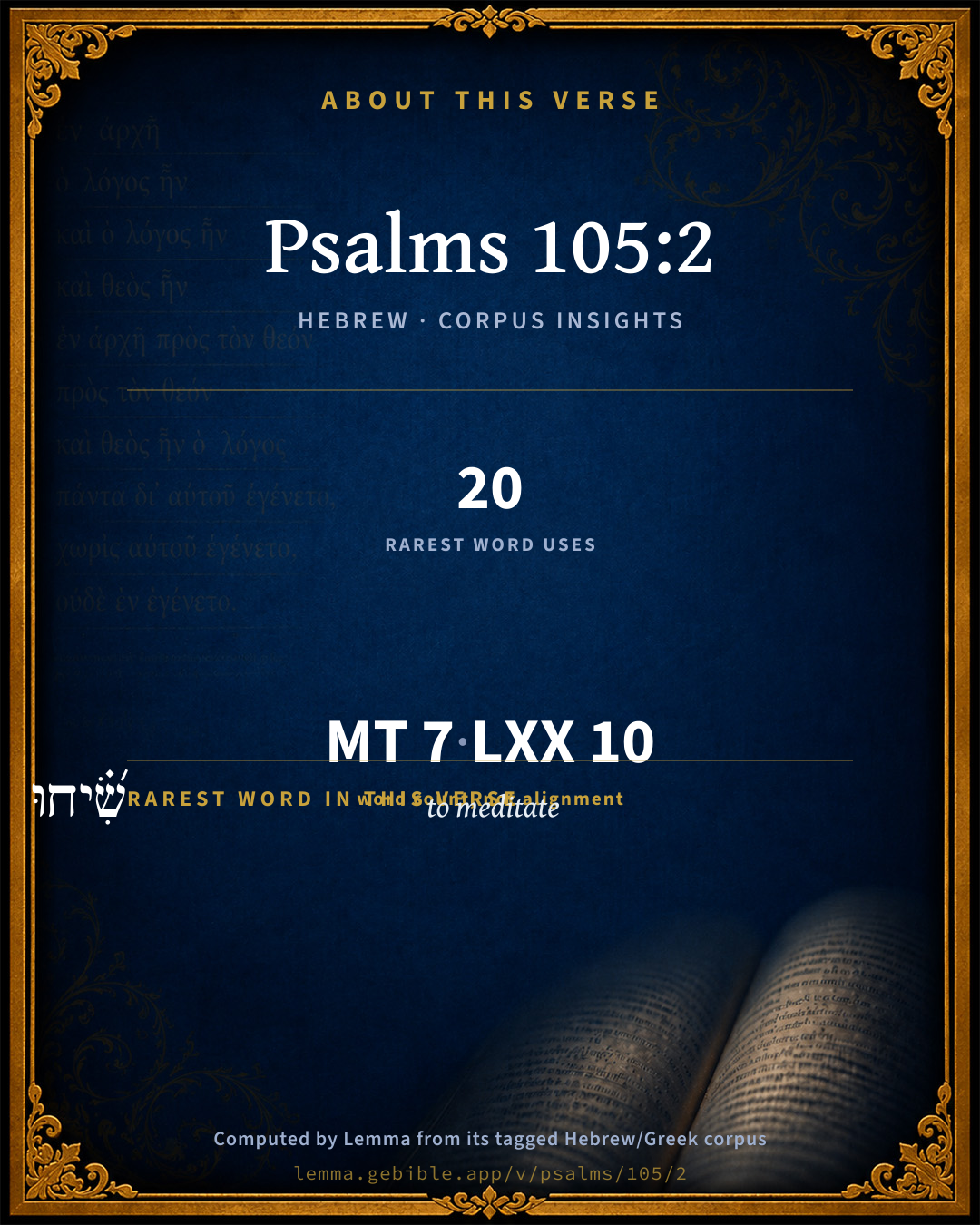
The rarest word here is שִׂ֝֗יחוּ to meditate H7878 — appearing just 20 times in the whole Hebrew Bible.

Shared distinctive vocabulary

שִׂ֝֗יחוּ to meditate H7878 occurs in 20 verses of the Hebrew Bible. Also found in:

Grammatical profile

  • 4 verbs
  • 1 noun
  • 2 prepositions

Verb forms

  • שִֽׁירוּ Qal · Imperative
  • זַמְּרוּ Piel · Imperative
  • שִׂ֝֗יחוּ Qal · Imperative
  • נִפְלְאוֹתָֽיו Niphal · Participle Active

Hebrew & Septuagint length

In English translation the verse runs 13 words from the Hebrew and 14 from the Septuagint (LXX English) — closely comparable.

A rough comparison of the two English renderings, which tokenize alike — not a word-level alignment.

Word counts can differ between the Hebrew and the Greek without any difference in meaning — e.g. the Hebrew direct-object marker אֵת has no separate Greek word, and Greek often adds the article ὁ.

In the original languages it is 7 Hebrew tokens and 10 Greek tokens — but the two are counted differently (Hebrew bundles its prefixes and suffixes into one token; the Greek is in lemma form), so that isn’t a like-for-like length.

Cross-references

16

Topical passages linked to Psalms 105:2 in the Treasury of Scripture Knowledge — connected by theme and wording, ordered by reader-vote popularity; previews shown in the World English Bible.

  • Psalms 119:27 Let me understand the teaching of your precepts! Then I will meditate on your wondrous works.
  • Isaiah 12:5–6 Sing to Yahweh, for he has done excellent things! Let this be known in all the earth!
  • Psalms 77:12 I will also meditate on all your work, And consider your doings.
  • Psalms 98:5 Sing praises to Yahweh with the harp, With the harp and the voice of melody.
  • Psalms 98:1 Sing to Yahweh a new song, For he has done marvelous things! His right hand, and his holy arm, have worked salvation for him.
  • Psalms 78:4–6 We will not hide them from their children, Telling to the generation to come the praises of Yahweh, His strength, and his wondrous works that he has done.
  • Ephesians 5:19 speaking to one another in psalms, hymns, and spiritual songs; singing, and singing praises in your heart to the Lord;
  • Exodus 13:8–9 You shall tell your son in that day, saying, 'It is because of that which Yahweh did for me when I came forth out of Egypt.'
  • Deuteronomy 6:6–9 These words, which I command you this day, shall be on your heart;
  • Judges 5:3 Hear, you kings; give ear, you princes; I, [even] I, will sing to Yahweh; I will sing praise to Yahweh, the God of Israel.
  • Psalms 47:6–7 Sing praise to God, sing praises. Sing praises to our King, sing praises.
  • Psalms 96:1–2 Sing to Yahweh a new song! Sing to Yahweh, all the earth.
  • Isaiah 42:10–12 Sing to Yahweh a new song, and his praise from the end of the earth; you who go down to the sea, and all that is therein, the isles, and the inhabitants of it.
  • Luke 24:14–53 They talked with each other about all of these things which had happened.
  • Revelation 15:3–4 They sang the song of Moses, the servant of God, and the song of the Lamb, saying, "Great and marvelous are your works, Lord God, the Almighty; Righteous and true are your ways, you King of the nations.
  • Exodus 13:14 It shall be, when your son asks you in time to come, saying, 'What is this?' that you shall tell him, 'By strength of hand Yahweh brought us out from Egypt, from the house of bondage;

Cross-references courtesy of OpenBible.info (CC BY 4.0).

Hebrew and Greek witnesses Masoretic Hebrew ↔ Greek Septuagint

The same verse in the two great witnesses to the Old Testament, shown verse-for-verse.

You’re reading Greek Psalm 104 (Hebrew Psalm 105). The Septuagint counts the superscription, so verse numbers can differ from the Hebrew — chapter-level alignment, not verse-by-verse. Numbering follows Rahlfs.

These are two independent witnesses, not word-aligned to each other, and the Septuagint is shown in lemma (dictionary) form.

Hebrew Psalms 105:2 Masoretic · Westminster Leningrad Codex

שִֽׁירוּ ל֭וֹ זַמְּרוּ ל֑וֹ שִׂ֝֗יחוּ בְּכָל נִפְלְאוֹתָֽיו

Sing to him, sing praises to him! Tell of all his marvelous works.

World English Bible · Public Domain

Greek LXX Greek Psalm 104:2 Septuagint · lemma form

ᾄδω αὐτός καί ψάλλω αὐτός διαἡγέομαι πᾶς ὁ θαυμάσιος αὐτός

Sing to him, yes, sing praises to him: tell forth all his wonderful works.

LXX2012 (modern English Septuagint) · Public Domain

Hebrew: Westminster Leningrad Codex (CC BY 4.0). Greek: Septuagint (public domain); English from LXX2012 (modern English Septuagint) (Public Domain). How the Septuagint differs from the Hebrew →

Commentary

Notes on Psalms 105:2 from classic Christian and Jewish commentators (each source and its license shown beneath its notes). The classic Christian expositions comment on the surrounding passage and are grouped to its opening verse, so a note may address several verses; the Jewish commentaries on the Tanakh (Rashi and others) are per-verse, so they appear only where the commentator wrote on this verse.

Lemma curates 59 commentaries, every one of them public domain or Creative Commons licensed, each selected and text-cleaned for this edition rather than reprinted as found. About our sources →

Trapp's Complete Commentary

John Trapp

Psa 105:2 Sing unto him, sing psalms unto him: talk ye of all his wondrous works.

Ver. 2. Sing unto him, sing] Both with mouth and with musical instruments.

Talk ye] Or, meditate ye, let your heart indite a good matter, and your tongue be as the pen of a ready writer, Psa 45:1.

John Trapp, A Commentary or Exposition upon All the Books of the Old and New Testament (1647–1656) — public domain. Text from a community e-Sword module.

J. A. Alexander on Psalms

Joseph Addison Alexander

2. (Psa 105:2) Sing to him, play to him, muse on all his wondrous deeds. The exhortation seems to be addressed to the Gentiles, who are called upon to join in the praises and to share the blessings of the chosen people. For the meaning of the last verb, see above, on Psa 104:34.

Joseph Addison Alexander, The Psalms Translated and Explained (1850) — public domain. Text from a community e-Sword module.

Adam Clarke's Commentary

Verse 2. Talk ye of all his wondrous works.] נפלאתיו niphleothaiv, "of his miracles." Who have so many of these to boast of as Christians! Christianity is a tissue of miracles; and every part of the work of grace on the soul is a miracle. Genuine Christian converts may talk of miracles from morning to night; and they should talk of them, and recommend to others their miracle-working God and Saviour.

Adam Clarke's Commentary on the Bible (1810–1826) — public domain. Text from a community e-Sword/MySword module.

Ellicott's Commentary for English Readers

(2) Sing psalms.—Rather, play, sing unto Him, play unto Him; the usual choral direction.

A Bible Commentary for English Readers, edited by Charles John Ellicott (1878–1897) — public domain. Text from a community e-Sword module.

The Cambridge Bible for Schools and Colleges

gen. ed. J. J. S. Perowne

2. sing psalms] Or, make melody. Cp. Psa_92:1, note.

talk ye] R.V. marg., meditate: cp. Psa_104:34. The primary meaning of the word is probably to occupy oneself diligently with: hence either to meditate upon, or as context and parallelism require here and in Psa_140:5, to speak, discourse of, a meaning which the word regularly has in post-Biblical Heb.

his wondrous works] R.V., as A.V. in Psa_105:5, his marvellous works. Cp. Psa_96:3, and see note on Psa_9:1.

The Cambridge Bible for Schools and Colleges (gen. ed. J. J. S. Perowne; Cambridge University Press, 1878–1918) — public domain. Text from a community e-Sword module.

John Gill's Exposition

Sing unto him, sing psalms unto him,.... Both vocally and instrumentally, with the voice and upon instruments of music, as were used in David's time. Psalms, hymns, and spiritual songs, are to be sung now, even the song of Moses, and of the Lamb. The wondrous things God had done for his people were sufficient matter for a song; and these were to be put into one, to be transmitted to posterity: it was usual in ancient times to hand down the history of memorable events by a song.

Talk ye of all his wondrous works: all the works of the Lord are wonderful; what David elsewhere says of himself may be said of them, that they are wonderfully made, even the least and most inconsiderable of them; and especially his works of grace, when it is observed for whom they are performed, or on whom they are wrought; sinful creatures, enemies to God, and deserving of his wrath. These are to be talked of freely and frequently, in friendly conversation, in order to gain a further knowledge of them, and warm each others hearts with them, and to lead into adoring and admiring views of the love and grace of God in them; and all of them deserve notice, none should be omitted, all are worthy of consideration and contemplation; for so the words may be rendered, "mediate" (z) "on all his wondrous works" Here is a large field for meditation; and when the heart is in a proper frame for it, meditation on the works of God is sweet, pleasant, and profitable.

(z) "meditamini", Cocceius, Gejerus, Michaelis.

John Gill's Exposition of the Whole Bible (1746–1763) — public domain (CC PDM 1.0). Text via the HelloAO Bible API.

Albert Barnes' Notes on the Bible

Sing unto him - Sing before him; offer him praise.

Sing psalms unto him - The word here rendered “sing psalms” means properly “to prune,” and then, to” cut off,” as a discourse at regular periods; or, to utter in rhythmical numbers; and then it means to accompany such words with an instrument of music. The idea here is, that he is to be approached, not merely with “singing,” but with sentiments expressed in the form of regular composition - in musical numbers.

Talk ye - The word used here very commonly means to meditate, to muse (compare the notes at Psa 1:2), but would here seem to be employed in the sense of “talking over,” to wit, in singing. That is, In the psalms used let there be a “narrative” of what God has done. Let his works be the subject of the words used in the psalm.

Of all his wondrous works - Of what he has done that is suited to excite wonder and admiration. Compare Psa 77:12.

Albert Barnes' Notes on the Bible (1834–1885) — public domain. Text from a community e-Sword/MySword module.

The Treasury of David

Charles H. Spurgeon

Ver. 2. Sing unto him. Bring your best thoughts and express them in the best language to the sweetest sounds. Take care that your singing is "unto him, "and not merely for the sake of the music or to delight the ears of others. Singing is so delightful an exercise that it is a pity so much or it should be wasted upon trifles or worse than trifles. O ye who can emulate the nightingale, and almost rival the angels, we do most earnestly pray that your hearts may be renewed that so your floods of melody may be poured out at your Maker's and Redeemer's feet.

Talk ye of all his wondrous works. Men love to speak of marvels, and others are generally glad to hear of surprising things; surely the believer in the living God has before him the most amazing series of wonders ever heard of or imagined, his themes are inexhaustible and they are such as should hold men spellbound. We ought to have more of this "talk": no one would be blamed as a Mr. Talkative if this were his constant theme. Talk ye, all of you: you all know something by experience of the marvellous loving kindness of the Lord"talk ye." In this way, by all dwelling on this blessed subject, "all" his wondrous works will be published. One cannot do it, nor ten thousand times ten thousand, but if all speak to the Lord's honour, they will at least come nearer to accomplishing the deed. We ought to have a wide range when conversing upon the Lord's doings, and should not shut our eyes to any part of them. Talk ye of his wondrous works in creation and in grace, in judgment and in mercy, in providential interpositions and in spiritual comforting; leave out none, or it will be to your damage. Obedience to this verse will give every sanctified tongue some work to do: the trained musicians can sing, and the commoner voices can talk, and in both ways the Lord will receive a measure of the thanks due to him, and his deeds will be made known among the people.

Ver. 2. Talk ye of all his wondrous works, yytalpn niphleothaiv, "of his miracles." Who have so many of these to boast of as Christians! Christianity is a tissue of miracles; and every part of the work of grace on the soul is a miracle. Genuine Christian converts may talk of miracles from morning to night; and they should talk of them, and recommend to others their miracle working God and Saviour. Adam Clarke.

Ver. 2. Sing...talk, etc. Music and conversation are two things by which the mind of man receiveth much good, or a great deal of harm. They who make "Jehovah" and his "wondrous works" the subject of both, enjoy a heaven upon earth. And they who do in reality love the Saviour, will always find themselves inclined to "sing to him, "and to "talk of him." George Horne.

Ver. 2. Sing psalms. It is not sufficient to offer the empty vessel of our joy unto God, or our singing voice in musical tune only; but also it is required that we fill our joyful voice with holy matter and good purpose, whereby God only may be reasonably praised: "Sing psalms unto him." David Dickson.

Ver. 2. Sing psalms. Psalmody is the calm of the soul, the repose of the spirit, the arbiter of peace. It silences the wave, and conciliates the whirlwind of our passions, soothing the impetuous, tempering the unchaste. It is an engenderer of friendship, a healer of dissension, a reconciler of enemies. For who can longer count him his enemy, with whom to the throne of God he hath raised the strain? Psalmody repels the demons, and lures the ministry of angels. It is a weapon of defence in nightly terrors and a respite from daily toil. To the infant it is a presiding genius; to manhood a crown of glory; a balm of comfort to the aged; a congenial ornament to women. Basil.

Ver. 2.

1. The pleasure of talking to God. "Sing, "etc.; making melody in the heart.

2. The duty of talking of God. "Talk ye, "etc. G.R.

Ver. 2. The Christian's table talk.

Psalms 105:3*

Charles H. Spurgeon's The Treasury of David (1869–1885) — public domain. Psalms only. Text from a community e-Sword/MySword module.

Whedon's Commentary on the Bible

Daniel D. Whedon

2. Sing—With the voice.

Sing psalms—The word denotes singing, with playing on an instrument as an accompaniment.

Talk ye—Either publish, as in Isa_53:8, or meditate, as the word often means; for meditation is speaking to one’s self. Psa_119:48; Psa_119:78; Psa_143:5

Daniel D. Whedon (gen. ed.), Commentary on the Old and New Testaments (1874–1909) — public domain. Text from a community e-Sword module.

The Pulpit Commentary

Sing unto him, sing psalms unto him; or," make melody unto him" (Cheyne); i.e. praise his Name (ver. 1) with song and music. Talk ye of all his wondrous works, (comp. Psa_119:37, Psa_119:46) Those who are full of gratitude to God for all his mercies that he has vouchsafed them cannot refrain from speaking of his goodness when they converse with others.

The Pulpit Commentary (1880–1919), ed. H.D.M. Spence-Jones & Joseph S. Exell — public domain. Text from a community e-Sword module.

Lesson kit

Teaching starters — assembled from the data on this page, not authored interpretation. Every prompt links to the verse data it draws on. Edit before teaching.

Psalms, in the Wisdom, opens this verse with 7 words (5 distinct Hebrew lemmas). Its most distinctive word is sîyach (“to meditate”). A historical commentator’s framing appears above. Read the whole chapter for the surrounding context.

Discussion questions

  1. The word sîyach carries the sense “to meditate.” How does it shape the verse?
  2. Judges 5:10 shares the word «to meditate» with this verse. How do the two illuminate each other?
  3. These translations render this verse differently. What is at stake in choosing one wording over another?
  4. The verb «שִֽׁירוּ» is Qal Imperative. How does its form color the action?
  5. Reading how Trapp's Complete Commentary and J. A. Alexander on Psalms read this verse, where do the two commentators agree and where do they part?

Things to notice

Reading settings

Reading text

Shown beneath each verse's original-language words.

Old Testament
Old Testament edition

Read the OT as the Masoretic Hebrew (MT) or the Greek Septuagint (LXX).

English shown for the Greek Septuagint (in the Hebrew ↔ Greek comparison).

Comparing translations? Open the Compare panel on any verse page to stack up to four side by side.