
Psalms 135:19

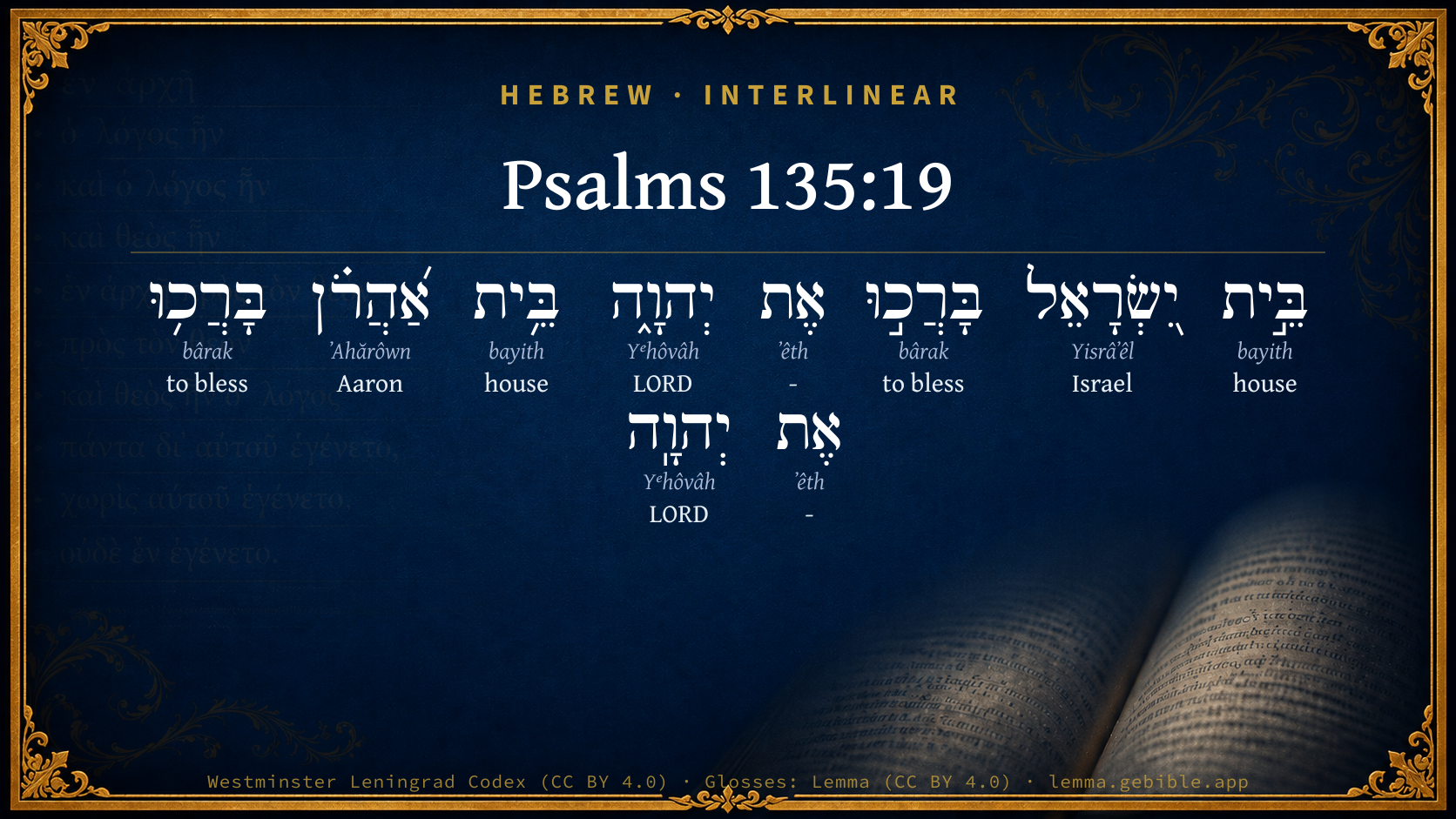
Hebrew (Westminster Leningrad Codex) Psalms 135:19 appears in the Hebrew Old Testament. The text above is from the Westminster Leningrad Codex. Each word links to its Strong’s number, a concise gloss, and parsing drawn from the Open Scriptures Hebrew Bible morphology. Click any word for its full Brown-Driver-Briggs (BDB) entry.
Download image
Cite this verse

Psalms 135:19 (World English Bible). Public Domain. Lemma interlinear Bible study tool, https://lemma.gebible.app/v/psalms/135/19.

Show BibTeX & RIS
BibTeX
RIS
English Translation
House of Israel, praise Yahweh! House of Aaron, praise Yahweh!
World English Bible · Public Domain
Download a study sheet

One document with this verse’s original text, its word-by-word gloss line, the meaning frame, cross-references with their text, attributed commentary, and full source and license credits — printable, and it pastes into notes with its structure intact.

This verse Autodidact and up

Study sheet (.html) Plain text (.txt)

A passage Seminary Student

Up to 50 verses in one chapter. A passage sheet keeps up to 6 commentary sources and 12 cross-references per verse, in the order this page ranks them, and says so on the sheet whenever that leaves anything out. Ask for a single verse and you get the Autodidact verse sheet above.

Everything on this page stays free to read, with no account — the sheet is a download of what is already on screen, not access to it.

Want to remove ads? Support Godless Engineer
Compare translations 3

The same verse in 3 English versions, stacked beneath the original-language interlinear above. Click any original word for its lexicon entry.

Each is an independent rendering of the whole verse — the interlinear is not word-aligned to these translations.

Highlighted words mark where these versions differ — a whole-verse word diff, not a word-by-word alignment.

  • World English Bible Public Domain
    House of Israel, praise Yahweh! House of Aaron, praise Yahweh!
  • King James Version Public Domain
    Bless the LORD, O house of Israel: bless the LORD, O house of Aaron:
  • unfoldingWord Literal Text CC BY-SA 4.0
    House of Israel, bless Yahweh; house of Aaron, bless Yahweh.

unfoldingWord Literal Text — © unfoldingWord, licensed CC BY-SA 4.0. Word-aligned USFM3 via Door43 (git.door43.org/unfoldingWord/en_ult).

Versions to compare (up to 4)

3 of 4 selected

Show all 17 translations

Every available English version of this verse, each an independent rendering of the whole verse.

  • World English Bible Public Domain
    House of Israel, praise Yahweh! House of Aaron, praise Yahweh!
  • Berean Standard Bible Public Domain
    O house of Israel, bless the LORD; O house of Aaron, bless the LORD;
  • Majority Standard Bible Public Domain
    O house of Israel, bless the LORD; O house of Aaron, bless the LORD;
  • King James Version Public Domain
    Bless the LORD, O house of Israel: bless the LORD, O house of Aaron:
  • American Standard Version (1901) Public Domain
    O house of Israel, bless ye Jehovah: O house of Aaron, bless ye Jehovah:
  • Revised Version (1885) Public Domain
    O house of Israel, bless ye the LORD: O house of Aaron, bless ye the LORD:
  • Geneva Bible (1599) Public Domain
    Praise the Lord, ye house of Israel: praise the Lord, ye house of Aaron.
  • Young's Literal Translation Public Domain
    O house of Israel, bless ye Jehovah, O house of Aaron, bless ye Jehovah,
  • Literal Standard Version CC BY-SA 4.0
    O house of Israel, bless YHWH, || O house of Aaron, bless YHWH,
  • Unlocked Literal Bible CC BY-SA 4.0
    Descendants of Israel, bless Yahweh; descendants of Aaron, bless Yahweh.
  • unfoldingWord Literal Text CC BY-SA 4.0
    House of Israel, bless Yahweh; house of Aaron, bless Yahweh.
  • Darby Bible Public Domain
    House of Israel, bless ye Jehovah; house of Aaron, bless ye Jehovah;
  • World Messianic Bible Public Domain
    House of Israel, praise the LORD! House of Aaron, praise the LORD!
  • Webster's Bible Public Domain
    Bless the LORD, O house of Israel: bless the LORD, O house of Aaron:
  • Free Bible Version CC BY-SA 4.0
    People of Israel, praise the Lord! Descendants of Aaron, praise the Lord!
  • Bible in Basic English Public Domain
    Give praise to the Lord, O children of Israel: give praise to the Lord, O sons of Aaron:
  • JPS Tanakh (1917) Public Domain
    O house of Israel, bless ye the LORD; O house of Aaron, bless ye the LORD;

Literal Standard Version (2020), Covenant Press — licensed CC BY-SA 4.0. Text via the HelloAO Bible API (eBible.org). Unlocked Literal Bible (unfoldingWord) — licensed CC BY-SA 4.0. Text via the HelloAO Bible API (eBible.org). unfoldingWord Literal Text — © unfoldingWord, licensed CC BY-SA 4.0. Word-aligned USFM3 via Door43 (git.door43.org/unfoldingWord/en_ult). Free Bible Version, Dr. Jonathan Gallagher — licensed CC BY-SA 4.0. Text via the HelloAO Bible API (eBible.org).

Word by word

More ways to search: Search by grammar → Find every occurrence → Compare this word →

Practice this passage: Drill this verse → Learn its vocabulary →

About this verse

These counts appear in no published source. They are computed here, from the morphology-tagged text and Lemma’s own curated glosses. What Lemma adds →

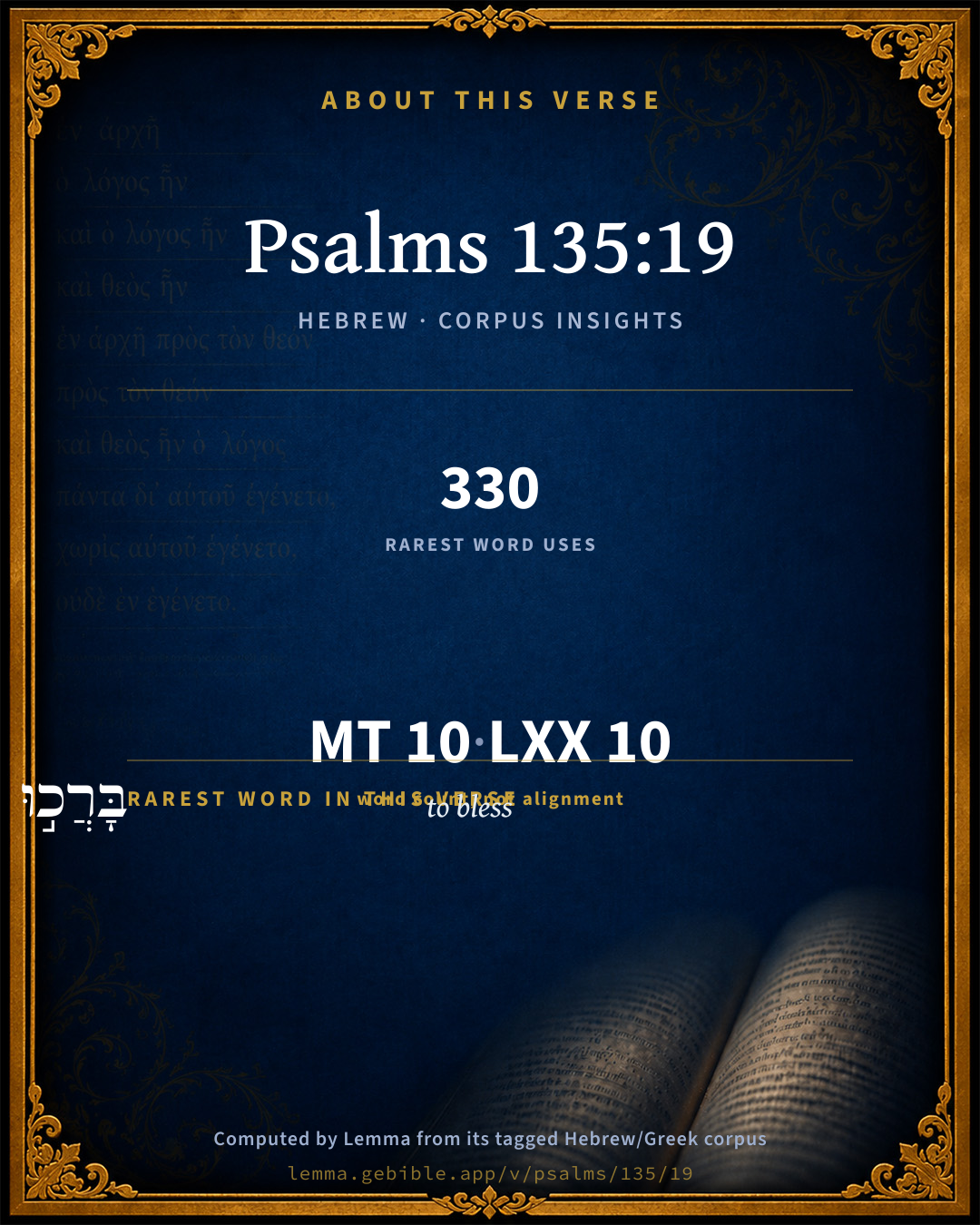
10
words
6
distinct lemmas
Wisdom
section

Grammatical profile

  • 2 verbs
  • 6 nouns
  • 2 particles

Verb forms

  • בָּרֲכ֣וּ Piel · Imperative
  • בָּרֲכ֥וּ Piel · Imperative

Repetition

Words recur within this verse — often emphatic in Hebrew:

  • בֵּ֣ית house H1004 ×2
  • בָּרֲכ֣וּ to bless H1288 ×2
  • יְהוָ֑ה LORD H3068 ×2

Hebrew & Septuagint length

In English translation the verse runs 10 words from the Hebrew and 16 from the Septuagint (LXX English) — closely comparable.

A rough comparison of the two English renderings, which tokenize alike — not a word-level alignment.

Word counts can differ between the Hebrew and the Greek without any difference in meaning — e.g. the Hebrew direct-object marker אֵת has no separate Greek word, and Greek often adds the article ὁ.

In the original languages it is 10 Hebrew tokens and 10 Greek tokens — but the two are counted differently (Hebrew bundles its prefixes and suffixes into one token; the Greek is in lemma form), so that isn’t a like-for-like length.

Cross-references

6

Topical passages linked to Psalms 135:19 in the Treasury of Scripture Knowledge — connected by theme and wording, ordered by reader-vote popularity; previews shown in the World English Bible.

  • Psalms 115:9–11 Israel, trust in Yahweh! He is their help and their shield.
  • Psalms 118:1–4 Give thanks to Yahweh, for he is good, For his loving kindness endures forever.
  • Psalms 145:10 All your works will give thanks to you, Yahweh. Your saints will extol you.
  • Psalms 147:19–20 He shows his word to Jacob; His statutes and his ordinances to Israel.
  • Psalms 148:14 He has lifted up the horn of his people, The praise of all his saints; Even of the children of Israel, a people near to him. Praise Yah!
  • Revelation 19:5 A voice came forth from the throne, saying, "Give praise to our God, all you his servants, you who fear him, the small and the great!"

Cross-references courtesy of OpenBible.info (CC BY 4.0).

Hebrew and Greek witnesses Masoretic Hebrew ↔ Greek Septuagint

The same verse in the two great witnesses to the Old Testament, shown verse-for-verse.

You’re reading Greek Psalm 134 (Hebrew Psalm 135). The Septuagint counts the superscription, so verse numbers can differ from the Hebrew — chapter-level alignment, not verse-by-verse. Numbering follows Rahlfs.

These are two independent witnesses, not word-aligned to each other, and the Septuagint is shown in lemma (dictionary) form.

Hebrew Psalms 135:19 Masoretic · Westminster Leningrad Codex

בֵּ֣ית יִ֭שְׂרָאֵל בָּרֲכ֣וּ אֶת יְהוָ֑ה בֵּ֥ית אַ֝הֲרֹ֗ן בָּרֲכ֥וּ אֶת יְהוָֽה

House of Israel, praise Yahweh! House of Aaron, praise Yahweh!

World English Bible · Public Domain

Greek LXX Greek Psalm 134:19 Septuagint · lemma form

οἶκος ἰσραήλ εὐλογέω ὁ κύριος οἶκος ἀαρών εὐλογέω ὁ κύριος

O house of Israel, bless you⌃ the Lord: O house of Aaron, bless you⌃ the Lord:

LXX2012 (modern English Septuagint) · Public Domain

Hebrew: Westminster Leningrad Codex (CC BY 4.0). Greek: Septuagint (public domain); English from LXX2012 (modern English Septuagint) (Public Domain). How the Septuagint differs from the Hebrew →

Commentary

Notes on Psalms 135:19 from classic Christian and Jewish commentators (each source and its license shown beneath its notes). The classic Christian expositions comment on the surrounding passage and are grouped to its opening verse, so a note may address several verses; the Jewish commentaries on the Tanakh (Rashi and others) are per-verse, so they appear only where the commentator wrote on this verse.

Lemma curates 59 commentaries, every one of them public domain or Creative Commons licensed, each selected and text-cleaned for this edition rather than reprinted as found. About our sources →

Trapp's Complete Commentary

John Trapp

Psa 135:19 Bless the LORD, O house of Israel: bless the LORD, O house of Aaron:

Ver. 19. Bless the Lord] And not an idol, Isa 66:3, as the Philistines did their Dagon; and as Papists still do their male and female saints.

John Trapp, A Commentary or Exposition upon All the Books of the Old and New Testament (1647–1656) — public domain. Text from a community e-Sword module.

Joseph Benson's Commentary

Psa 135:19-21. Bless the Lord, O house of Israel — He who proved himself to be infinitely superior to the objects of heathen idolatry, is no less superior to every object on which deluded men can place their affections. Let the house of Israel, therefore, the house of Levi, and the house of Aaron, the church, the ministers thereof; and let all who fear the Lord, though not of the house of Israel, bless and praise his holy name, in his temple here below, until they shall be admitted to do it for evermore in that which is above: see Horne.

Joseph Benson's Commentary on the Old and New Testaments (1811–1818) — public domain. Text from a community e-Sword module.

J. A. Alexander on Psalms

Joseph Addison Alexander

19. (Psa 135:19) O house of Israel, bless Jehovah! O house of Aaron, bless Jehovah! Having shewn what God is, in himself and in comparison with idols, he repeats the exhortation which this description was intended to explain and justify. With this and the next verse compare Ps. cxv. 9-11, cxviii. 2-4. Instead of trust we have here bless, as at the beginning of the Psalm. Compare Psa 134:1.

Joseph Addison Alexander, The Psalms Translated and Explained (1850) — public domain. Text from a community e-Sword module.

Tyndale Open Study Notes

Tyndale Open Resources

135:19-21 The groups named here comprised the covenant community (see 115:9-11).

Tyndale Open Study Notes — © Tyndale Open Resources, licensed CC BY-SA 4.0. Text via the HelloAO Bible API.

Adam Clarke's Commentary

Verse 19. Bless the Lord. O house, &c.] See similar verses, Ps 115:9-13, and the notes there.

Adam Clarke's Commentary on the Bible (1810–1826) — public domain. Text from a community e-Sword/MySword module.

Ellicott's Commentary for English Readers

(19, 21) From Psa_115:9-11, with the addition, “O house of Levi.”

A Bible Commentary for English Readers, edited by Charles John Ellicott (1878–1897) — public domain. Text from a community e-Sword module.

The Cambridge Bible for Schools and Colleges

gen. ed. J. J. S. Perowne

19, 20. The three-fold call of Psa_115:9-11; Psa_118:2-4 is here expanded by the addition of the house of Levi.

19–21. All Israel is summoned to praise Jehovah.

The Cambridge Bible for Schools and Colleges (gen. ed. J. J. S. Perowne; Cambridge University Press, 1878–1918) — public domain. Text from a community e-Sword module.

John Gill's Exposition

Bless the Lord, O house of Levi,.... These were of the same tribe with the house of Aaron, but inferior ministers; they ministered to the priests, and had the charge of things in the tabernacle and temple; many of them were porters in the latter, and others were singers, and of these Kimchi interprets the words; whose work it was to give thanks morning and evening, and so are with great propriety called upon to bless the Lord, Num 3:6; and may mystically design inferior officers in the church, who are helps and assistants to ministers in the government and discipline of it, and have the care of its secular affairs; and who, when they behave well, purchase to themselves a good degree, and boldness in the faith; and even doorkeepers in the house of the Lord have reason to bless his name for a place there; and all the saints are the sweet singers of Israel, have the new song of electing, redeeming, and calling grace, put into their mouths, and therefore should bless the Lord;

ye that fear the Lord, bless the Lord; these are distinct from the Israelites, priests, and Levites, and design the proselytes among them of other nations that truly feared God, as Jarchi notes; and all such persons, whoever and wherever they are, have reason to bless the Lord for the fear of him they have, which is not from nature, but from grace; and for the layouts shown them, the blessings bestowed upon them, the good things laid up for them, and the guard that is about them, which the Scriptures abundantly declare, and experience confirms.

John Gill's Exposition of the Whole Bible (1746–1763) — public domain (CC PDM 1.0). Text via the HelloAO Bible API.

Albert Barnes' Notes on the Bible

Bless the Lord, O house of Israel ... - This passage, also, is evidently an imitation of the passage in Psa 115:9-13. The form in Ps. 115, however, is rather an exhortation to trust in the Lord, and an assurance that God would bless the classes spoken of, than a call on them to bless the Lord. Still the same classes of persons are referred to; the house of Israel; the house of Aaron; and those who feared the Lord. The passage needs no further illustration than what is found in the notes at Psa 115:9-13. It is an earnest call on all classes of the people to bless and praise the Lord. It is language expressive of overflowing joy; the utterance of a heart full of exalted conceptions of the majesty, the glory, and the mercy of God; of a heart which feels to the utmost the fitness of praise, and desires that all classes of people - priests and people - that all created things should unite in the praise of Yahweh. Who, in reading the psalm, can fail to catch the feelings of the psalmist, and to say Amen and amen!

Albert Barnes' Notes on the Bible (1834–1885) — public domain. Text from a community e-Sword/MySword module.

The Treasury of David

Charles H. Spurgeon

Ver. 19. Bless the LORD, O house of Israel. All of you, in all your tribes, praise the one Jehovah. Each tribe, from Reuben to Benjamin, has its own special cause for blessing the Lord, and the nation as a whole has substantial reasons for pouring out benedictions upon his name. Those whom God has named "the house of Israel", a family of prevailing princes, ought to show their loyalty by thankfully bowing before their sovereign Lord. Bless the LORD, O house of Aaron. These were elected to high office and permitted to draw very near to the divine presence; therefore they beyond all others were bound to bless the Lord. Those who are favoured to be leaders in the church should be foremost in adoration. In God's house the house of Aaron should feel bound to speak well of his name before all the house of Israel.

Ver. 19. Bless the LORD. Blessing of God is to wish well to, and speak well of God, out of goodwill to God himself, and a sense of his goodness to ourselves. God loves your good word, that is, to be spoken of well by you; he rejoiceth in your well wishes, and to hear from you expressions of rejoicings in his own independent blessedness. Though God hath an infinite ocean of all blessedness, to which we can add nothing, and he is therefore called by way of eminency, "The Blessed One" (Mr 14:61), a title solely proper and peculiar to him, yet he delights to hear the amen of the saints, his creatures, resounding thereto; he delights to hear us utter our "so be it." Thomas Goodwin.

Ver. 19. Bless the LORD. And not an idol (Isa 66:3), as the Philistines did their Dagon, and as Papists still do their he saints and she saints. John Trapp.

Ver. 19. House of Israel. The Lord's great goodness to all his people, perceived and proclaimed, and the Lord praised for it.

Ver. 19. House of Aaron. God's blessing on Aaron's house typical of his grace to those who are priests unto God.

Ver. 19-21.

1. The Exhortation.

a) To bless the Lord.

b) To bless him in his own house.

2. To whom it is addressed.

a) To the house of Israel, or the whole church.

b) To the house of Aaron, or ministers of the sanctuary.

c) To the house of Levi, or the attendants upon ministers, and assistants in the services.

d) To all who fear God, wherever they may be. Even they who fear God are invited to praise him, which is a sure sign that he delighteth in mercy. G. R.

Psalms 135:20*

Charles H. Spurgeon's The Treasury of David (1869–1885) — public domain. Psalms only. Text from a community e-Sword/MySword module.

Whedon's Commentary on the Bible

Daniel D. Whedon

19, 20. These verses are taken from Psa_115:9-11, where see notes. To the enumeration of “Israel,” “house of Aaron,” and “those who fear the Lord,” in the latter passage, and in Psa_118:2-4, we have added in the text the house of Levi, by which language the common priesthood, as distinguished from the highpriesthood, is meant.

Daniel D. Whedon (gen. ed.), Commentary on the Old and New Testaments (1874–1909) — public domain. Text from a community e-Sword module.

The Pulpit Commentary

Bless the Lord, O house of Israel. The concluding strain corresponds to the opening one, and is a simple hymn of praise. Israel generally, the priestly order, the Levites, and the devout worshippers of God, of whatever class, are called upon in succession to praise and bless Jehovah. (comp. Psa_115:9-11) Bless the Lord, O house of Aaron. (see Psa_115:10, 12 118:3)

The Pulpit Commentary (1880–1919), ed. H.D.M. Spence-Jones & Joseph S. Exell — public domain. Text from a community e-Sword module.

Keil & Delitzsch

C. F. Keil & F. Delitzsch

A call to the praise of Jahve, who is exalted above the gods of the nations, addressed to Israel as a whole, rounds off the Psalm by recurring to its beginning. The threefold call in Psa 115:9-11; Psa 118:2-4, is rendered fourfold here by the introduction of the house of the Levites, and the wishing of a blessing in Psa 134:3 is turned into an ascription of praise. Zion, whence Jahve's self-attestation, so rich in power and loving-kindness, is spread abroad, is also to be the place whence His glorious attestation by the mouth of men is spread abroad. History has realized this.

Keil & Delitzsch — Biblical Commentary on the Old Testament (1861–1891) — public domain (CC PDM 1.0). Text via the HelloAO Bible API. (Old Testament only.)

unfoldingWord translationNotes

Door43 World Missions Community

he who lives in Jerusalem

God is spoken of as if he lived in Jerusalem because the temple where the Israelites worshiped him was there. AT: "he whose temple is in Jerusalem" (See: Metonymy)

translationWords

descend

bless

Aaron

Levi

honor

Zion

life

Jerusalem

praise

unfoldingWord translationNotes — © Distant Shores Media and the Door43 World Missions Community, licensed CC BY-SA 4.0. Source: git.door43.org/Door43/en_tn.

Lesson kit

Teaching starters — assembled from the data on this page, not authored interpretation. Every prompt links to the verse data it draws on. Edit before teaching.

Psalms, in the Wisdom, opens this verse with 10 words (6 distinct Hebrew lemmas). Its most distinctive word is bârak (“to bless”). A historical commentator’s framing appears above. Read the whole chapter for the surrounding context.

Discussion questions

  1. How does “to bless” (bârak) shape what this verse is saying?
  2. How does Psalms 115:9–11, which shares this passage’s theme, read alongside this verse?
  3. What does the repetition of “house” (2× in this one verse) do in this verse?
  4. These translations render this verse differently. What is at stake in choosing one wording over another?
  5. «בָּרֲכ֣וּ» is a Piel Imperative verb. How does that grammatical form shape the action described?
  6. Compare how Trapp's Complete Commentary and Joseph Benson's Commentary read this verse. Where do they agree or differ?

Things to notice

Reading settings

Reading text

Shown beneath each verse's original-language words.

Old Testament
Old Testament edition

Read the OT as the Masoretic Hebrew (MT) or the Greek Septuagint (LXX).

English shown for the Greek Septuagint (in the Hebrew ↔ Greek comparison).

Comparing translations? Open the Compare panel on any verse page to stack up to four side by side.