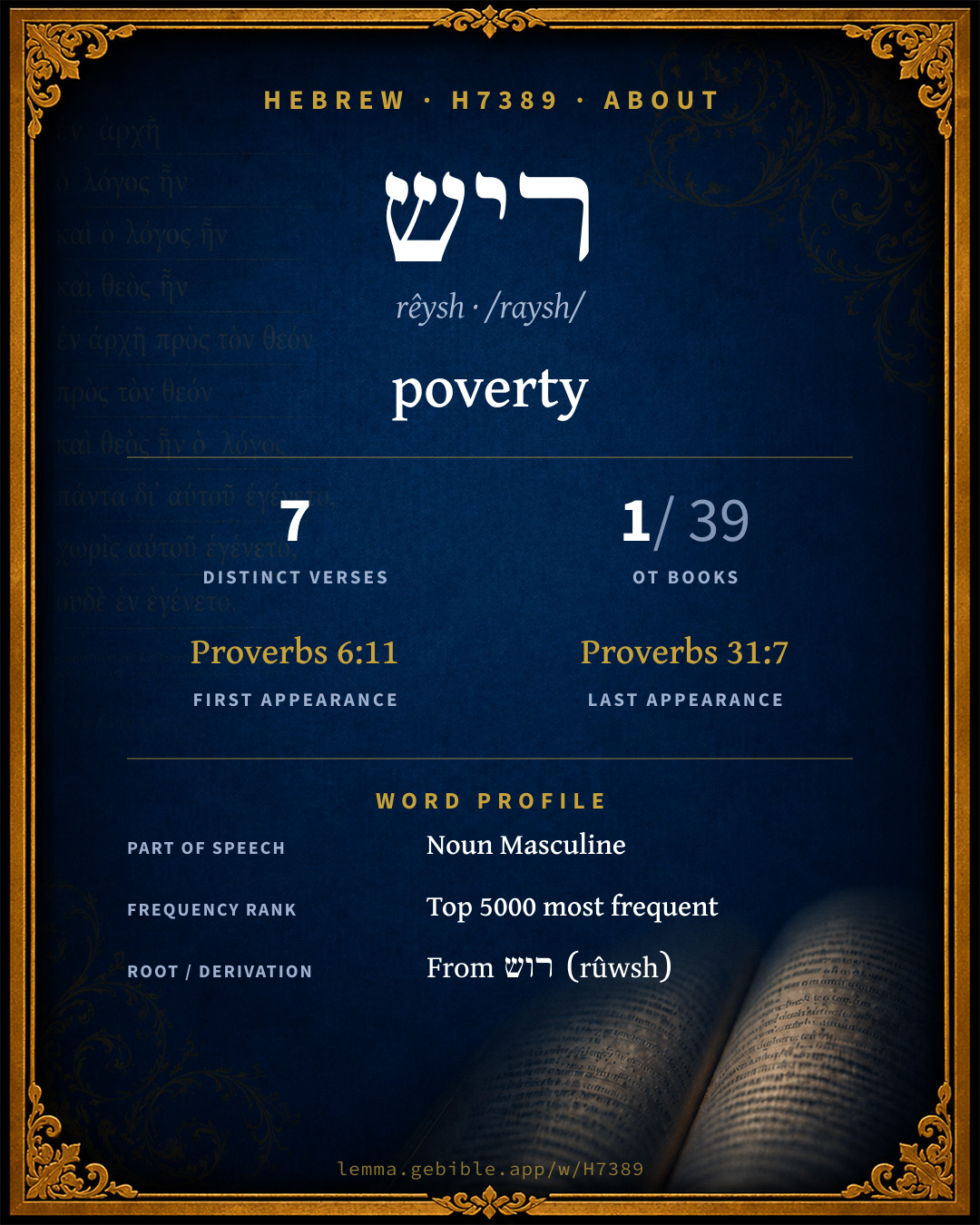
ריש
poverty
Full lexicon entry — Brown-Driver-Briggs (BDB)
From Brown-Driver-Briggs (BDB)
Where this word appears
See every Construct-state word in the Hebrew Bible →
Grammar key — what these labels mean
Part of speech
- Noun
- A naming word — a person, place, thing, or idea.
Noun type
- Common
- A common noun — a general class of person, place, or thing (“king,” “city,” “water”), not a specific name.
State
- Absolute
- The independent form of a noun, not bound to a following word.
- Construct
- A noun bound to a following noun in a possessive / “of” relationship (the construct chain).
Gender
- Masculine
- Grammatically masculine.
Number
- Singular
- One.
Grammatical forms
- Noun, Common, Masculine, Singular, Construct 4 times (57%)
- Noun, Common, Masculine, Singular, Absolute 3 times (43%)
Parsed forms decoded from the imported morphology (morphhb / Westminster Leningrad Codex — WLC text public domain, morphhb tagging CC BY 4.0), counted across 7 parsed occurrences — not distinct verses.
Every verse where H7389 appears — 7 distinct verses across 1 book. Click any verse to open its interlinear word-by-word view. Verse text shown in the World English Bible for context — . Each verse’s Hebrew form is shown with its reference; the English is not keyword-highlighted, since the data carries no word-level English alignment. Use “Compare translations” on any verse to read it across multiple English versions. This concordance covers the Hebrew Bible; Septuagint (Greek Old Testament) occurrences are not indexed here.
Proverbs 7 verses
- Proverbs 6:11 רֵאשֶׁ֑/ךָ n c ms cs + sfx pers 2ms So your poverty will come as a robber, And your scarcity as an armed man.
- Proverbs 10:15 רֵישָֽׁ/ם n c ms cs + sfx pers 3mp The rich man's wealth is his strong city. The destruction of the poor is their poverty.
- Proverbs 13:18 רֵ֣ישׁ n c ms Poverty and shame come to him who refuses discipline, But he who heeds correction shall be honored.
- Proverbs 24:34 רֵישֶׁ֑/ךָ n c ms cs + sfx pers 2ms So shall your poverty come as a robber, And your want as an armed man.
- Proverbs 28:19 רִֽישׁ n c ms One who works his land will have an abundance of food; But one who chases fantasies will have his fill of poverty.
- Proverbs 30:8 רֵ֣אשׁ n c ms Remove far from me falsehood and lies. Give me neither poverty nor riches. Feed me with the food that is needful for me;
- Proverbs 31:7 רִישׁ֑/וֹ n c ms cs + sfx pers 3ms Let him drink, and forget his poverty, And remember his misery no more.
About this entry
At a glance — auto-summarized from this page’s data, not written by a person. Every figure links to its source below. This summary describes the numbers; it doesn’t interpret them.
At its core, ריש (rêysh) means “poverty.” Its uses cluster heavily in Proverbs (100% of all occurrences). With 7 verses in 1 book, it is an uncommon word in the Hebrew Bible. Scripture first uses it in Proverbs 6:11. Each statement above links to its evidence; the full detail follows below.
Gloss history
Strong's 1890 vs modern scholarship
About this word
Strong's H7389 catalogs a Hebrew word from the Hebrew Old Testament.
These counts are not copied from any lexicon or concordance. They are computed here, from the morphology-tagged Hebrew Old Testament. What Lemma adds →
- 7
- distinct verses
- The word appears in 7 distinct verses.
- 1 / 39
- OT books
- The word appears in 1 of 39 Old Testament books.
- #2,835
- by frequency
- Top 5000 most frequent Hebrew words (rank 2,835 of 8,640 Hebrew words by occurrence).
View all 7 occurrences in the concordance →
Most concentrated in
- Proverbs 7 verses 100%
By section of the Old Testament
By traditional corpus
Conventional, traditional groupings — biblical authorship is debated, so this is a traditional corpus grouping, not an authorship claim. Each share is this word’s portion of its verses in that division of the Hebrew canon. Each figure is a share of the word’s 7 distinct verses.
- Writings (Ketuvim) 7 verses · 100%
How translations render this word
Counts come from each version’s own published word-to-Strong’s tagging or interlinear alignment — an approximate guide to how each version renders this word, not a word-level alignment the data otherwise carries. Because each total is that version’s own tagged count, the per-version totals vary from one another and need not match the appearance or distinct-verse counts above. These counts may also differ from a printed concordance because Lemma counts each distinctly tagged rendering and does not collapse phrase taggings into a single head-word total. This is a fixed set of word-tagged versions (KJV, ASV, BSB, ULT) and does not change with the reading translation you choose elsewhere. Each version’s license is shown beside its name below (and on Sources).
BDB lists this Strong’s number as 2 distinct words (homographs). Each count above pools all of them and is not split by sense — see the Senses section below. A low-frequency rendering may belong to a different one of those words, not the primary meaning.
- King James Version†: Poverty 3×, Shall thy poverty 2×
- American Standard Version†: Poverty 3×, Shall thy poverty 2×
- Berean Standard Bible†: Poverty 7×
- unfoldingWord Literal Text†: Poverty 6×
King James Version Public Domain
Renders H7389 across 7† tagged occurrences — most commonly:
Plus 2 renderings that appear only once — usually multi-word phrases or single function words the recovered tagging swept in, not distinct renderings.
American Standard Version Public Domain
Renders H7389 across 7† tagged occurrences — most commonly:
Plus 2 renderings that appear only once — usually multi-word phrases or single function words the recovered tagging swept in, not distinct renderings.
Berean Standard Bible Public Domain
Renders H7389 across 7† tagged occurrences — most commonly:
unfoldingWord Literal Text CC BY-SA 4.0
Renders H7389 across 7† tagged occurrences — most commonly:
Plus 1 rendering that appears only once — usually multi-word phrases or single function words the recovered tagging swept in, not distinct renderings.
Senses in the full BDB
Hebrew verbs can shift meaning by stem (binyan): Qal is the basic action, Niphal is often passive or reflexive, Piel often intensifies or makes it factitive, and Hiphil is typically causative. The senses below are grouped under the stem BDB assigns to each.
What do BDB’s symbols mean?
BDB uses these scholarly abbreviations:
| Symbol | Meaning |
|---|---|
| 𝔊 | the Septuagint (the ancient Greek translation, LXX) |
| 𝔙 | the Vulgate (the Latin translation) |
| 𝔖 | the Syriac version (the Peshitta) |
| 𝔗 | the Targum (the Aramaic translation) |
| ψ | the Psalms |
| √ | root (the underlying root or stem) |
| ‖ | parallel passage (a synonymous or contrasted parallel) |
| † | the dagger: every passage where the word occurs is cited |
The 2 senses and sub-senses the full Brown-Driver-Briggs lexicon distinguishes for this word, in lexicon order (not ranked by frequency), with BDB’s own verbatim wording and sub-sense lettering. Shown in Hebrew script with BDB’s own scholarly abbreviations. The condensed entry is in the Lexicon Entry tab. See also the Forms in the corpus table below.
ריש I be in want, poor (related to ירשׁ [cf.
Qal
- 3,
Niph. Hiph
- 3
ריש II poverty, only Pr
Senses from the full Brown-Driver-Briggs lexicon (Brown, Driver, Briggs; Oxford 1906 — public domain), digitized via Sefaria, supplemented by the OpenScriptures HebrewLexicon (CC BY 4.0). Full attribution on Sources.
Word origin
I. vb. be in want, poor (related to ירשׁ [cf.
I. n.m. poverty, only Pr;—רִישׁ 28:19, sf. רִישׁוֹ 31:7; רֵישׁ 13:18, sf. רֵישֶׁ֑ךָ 24:34 (‖ מַחְסֹרֶיךָ), רֵישָׁם 10:15 (opp. עָשִׁיר); רֵאשׁ 30:8 (opp. עֹשֶׁר), sf. רֵאשֶׁ֑ךָ 6:11 (= 24:34, ‖ id.).
— Brown-Driver-Briggs (Oxford 1906, public domain), digitized via Sefaria, supplemented by the OpenScriptures HebrewLexicon (CC BY 4.0). See Sources.
Derived from רוש (rûwsh) (H7326) — to be poor.
Jastrow Dictionary
A second Hebrew/Aramaic lexicon for comparison, covering Aramaic and post-biblical (Talmudic, Targumic, Midrashic) usage that the biblical-Hebrew BDB does not. Matched by lemma rather than by Strong’s number, so a lemma may carry more than one Jastrow headword (shown separately below), and the entries cover usage well beyond the Bible.
רֵישׁ II
- = h. רֹאשׁ,
- 1. head, chief. Targ. Gen. XL, 16. Targ. O. Ex. XIV, 8, v. גְּלֵי. Ib. XXX, 23. Targ. Y. II, Deut. XXXIII, 20 ראשא. Targ. I Chr. V, 12. Targ. Lev. V, 24; a. fr.—Y. Sabb. I, 4ᵃ top אילולא … רֵישִׁי וכ׳ but for fear of putting my head between lions (v. אַרְיָא), I should have given a reason. Ḥull. 11ᵃ (mixed dict.) ר׳ של עולה the head of a burnt-offering. Sabb. 55ᵃ ר׳ דרֵישָׁךְ, v. חמִּים; Y. Nidd. III, 50ᵈ רֵישֵׁיה דרישך, v. כָּוָה. M. Kat. 25ᵃ לא הוה … רֵישִׁין מיניה we could not raise our head before him. Cant. R. to VII, 7 ראשה, v. נָבוֹז; a. v. fr.—ר׳ גלותא, ר׳ מתיבתא &c., v. respective determinants.—Pl. רֵישִׁין, רֵישַׁיָּא, רֵישֵׁי, רָאשׁ׳. Targ. Deut. I, 13. Targ. Is. IX, 9 (some ed. רָשַׁ׳, רַשַּׁ׳). Targ. Gen. II, 10; a. fr.—Men. 37ᵃ אתיליד … תרי ר׳ a child with two heads was born to me. Y. Sabb. VII, 10ᵃ bot. כד מפרכייא ברָאשַׁיָּיא when she crushes the heads of onions. Gen. R. s. 61 רָאשֵׁי אומין chiefs of nations. Y. Sabb. IV, 7ᵃ top תחותי רֵשֵׁיכוֹן (not תוחתי רשיבון) under your heads; a. fr.—V. רֵישְׁתָּא.
- 2. beginning, first thing, firstling. Targ. O. Deut. XI, 12. Targ. Prov. VIII, 2. Targ. O. Num. XV, 20; a. fr.—ר׳ ירחא, ר׳ שתא &c., v. respective determinants.—מר׳ at first, formerly. Ḥull. 105ᵇ מר׳ הוה אמינא וכ׳ formerly I thought &c. Keth. 105ᵇ; a. fr.—Esp. רישא the first clause of a Mishnah, a verse &c. Ḥull. 94ᵇ. Sabb. 86ᵃ; a. fr., v. סֵיפָא, a. מְצִיעֲתָא.—(רֹאשׁ) רֵישׁ מַיָּא pr. n. pl. Resh Maya (Spring). Tosef. Shebi. IV, 11, a. e., v. גַּעְתּוֹן.
רִישׁ
- v. רָשׁ) poverty, misery. Num. R. s. 10 (ref. to Prov. XXXI, 7) על האובד יאמר שישכח המות שהיא רִישׁוֹ ועמלו this refers to the lost (the culprit before execution), (give him to drink,) that he may forget the threatening death which is his misery and trouble. e.g. Proverbs 31:7
רֵישׁ III
- = b. h. רֹאשׁ (cmp. רִיס I) [drop,] poison. Targ. O. Deut. XXXII, 33 (some ed. pl.).—Pl. רֵישֵׁי constr. Targ. Y. ib. Targ. ib. 32. Targ. Ps. LXIX, 22; a. e.
A Dictionary of the Targumim, the Talmud Babli and Yerushalmi, and the Midrashic Literature (Marcus Jastrow; London, Luzac, 1903) — Public Domain. Digitized via Sefaria. Digitized via Sefaria. Full attribution on Sources.
Forms in the corpus
The 7 distinct written forms H7389 takes in the Hebrew Bible, most frequent first — each parse links to that state’s occurrences in the concordance. Hebrew forms include their vowel points and cantillation, so a single lemma takes many written forms.
| Form | Parsing | Example | Uses |
|---|---|---|---|
| רִֽישׁ | Noun, Common, Masculine, Singular, Absolute | Proverbs 28:19 | 1 |
| רִישׁ֑/וֹ | Noun, Common, Masculine, Singular, Construct | Proverbs 31:7 | 1 |
| רֵ֣אשׁ | Noun, Common, Masculine, Singular, Absolute | Proverbs 30:8 | 1 |
| רֵ֣ישׁ | Noun, Common, Masculine, Singular, Absolute | Proverbs 13:18 | 1 |
| רֵאשֶׁ֑/ךָ | Noun, Common, Masculine, Singular, Construct | Proverbs 6:11 | 1 |
| רֵישֶׁ֑/ךָ | Noun, Common, Masculine, Singular, Construct | Proverbs 24:34 | 1 |
| רֵישָֽׁ/ם | Noun, Common, Masculine, Singular, Construct | Proverbs 10:15 | 1 |
Septuagint verse parallels
This word appears in 7 verses that also exist in the Greek Old Testament (Septuagint), out of the 7 Hebrew verses it occurs in. You can read those verses in Greek by switching the Old Testament edition to the Septuagint.
Read these verses in the Septuagint
This is a verse-level parallel only — the same verses exist in both the Hebrew and Greek Old Testaments. No word-level Hebrew↔Greek correspondence is claimed: the data carries no such alignment, so no Greek word is shown as this Hebrew word’s translation. Coverage is not total — the Septuagint omits the deuterocanon and renumbers the Psalms, so some Hebrew verses have no direct Greek parallel.