
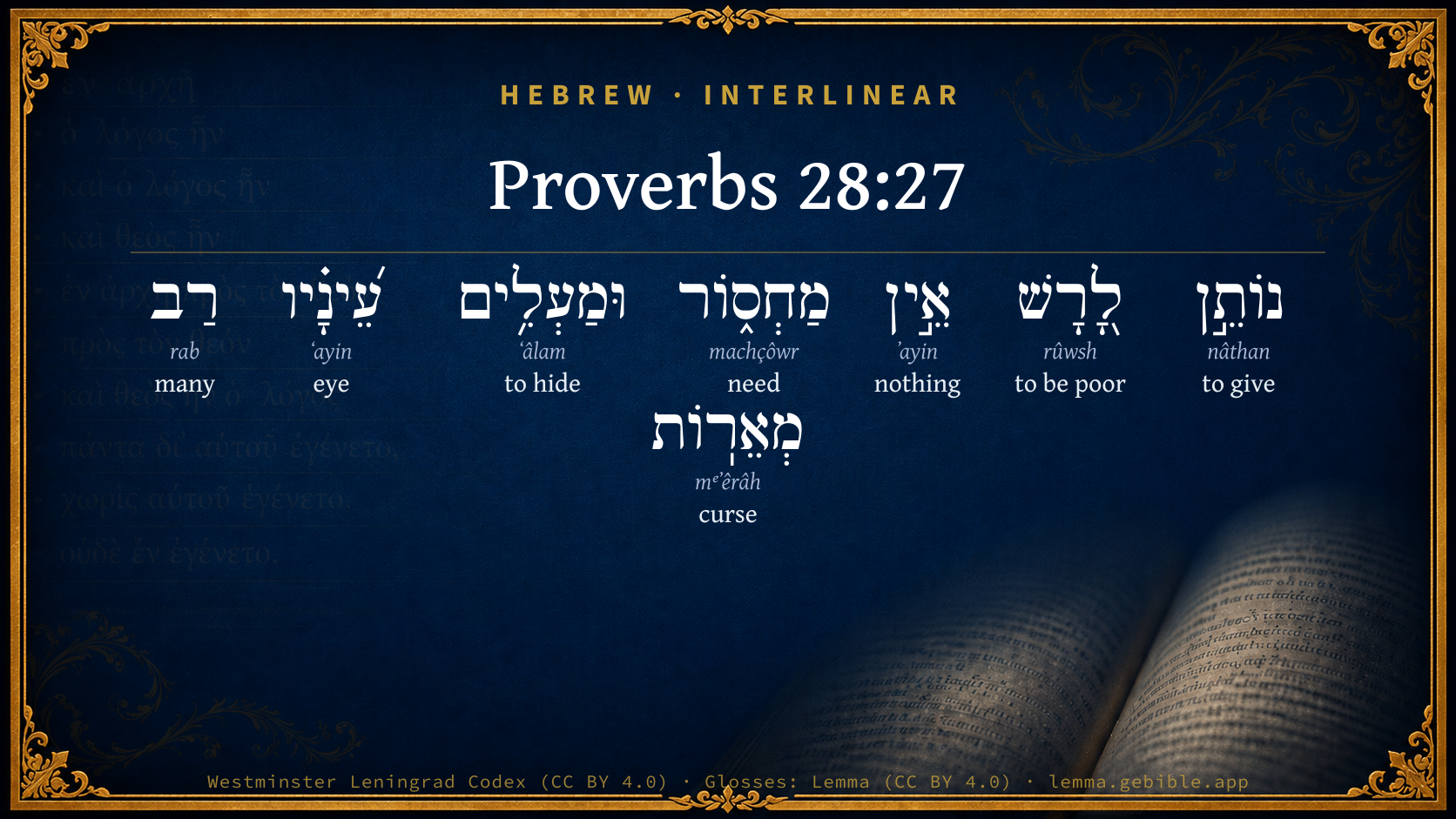
Proverbs 28:27

Hebrew (Westminster Leningrad Codex) Proverbs 28:27 appears in the Hebrew Old Testament. The text above is from the Westminster Leningrad Codex. Each word links to its Strong’s number, a concise gloss, and parsing drawn from the Open Scriptures Hebrew Bible morphology. Click any word for its full Brown-Driver-Briggs (BDB) entry.
Download image
Cite this verse

Proverbs 28:27 (World English Bible). Public Domain. Lemma interlinear Bible study tool, https://lemma.gebible.app/v/proverbs/28/27.

Show BibTeX & RIS
BibTeX
RIS
English Translation
One who gives to the poor has no lack; But one who closes his eyes will have many curses.
World English Bible · Public Domain
Download a study sheet

One document with this verse’s original text, its word-by-word gloss line, the meaning frame, cross-references with their text, attributed commentary, and full source and license credits — printable, and it pastes into notes with its structure intact.

This verse Autodidact and up

Study sheet (.html) Plain text (.txt)

A passage Seminary Student

Up to 50 verses in one chapter. A passage sheet keeps up to 6 commentary sources and 12 cross-references per verse, in the order this page ranks them, and says so on the sheet whenever that leaves anything out. Ask for a single verse and you get the Autodidact verse sheet above.

Everything on this page stays free to read, with no account — the sheet is a download of what is already on screen, not access to it.

Want to remove ads? Support Godless Engineer
Compare translations 3

The same verse in 3 English versions, stacked beneath the original-language interlinear above. Click any original word for its lexicon entry.

Each is an independent rendering of the whole verse — the interlinear is not word-aligned to these translations.

Highlighted words mark where these versions differ — a whole-verse word diff, not a word-by-word alignment.

  • World English Bible Public Domain
    One who gives to the poor has no lack; But one who closes his eyes will have many curses.
  • King James Version Public Domain
    He that giveth unto the poor shall not lack: but he that hideth his eyes shall have many a curse.
  • unfoldingWord Literal Text CC BY-SA 4.0
    One giving to the one who is poor—there is no lack, but one hiding his eyes—an abundance of curses.

unfoldingWord Literal Text — © unfoldingWord, licensed CC BY-SA 4.0. Word-aligned USFM3 via Door43 (git.door43.org/unfoldingWord/en_ult).

Versions to compare (up to 4)

3 of 4 selected

Show all 18 translations

Every available English version of this verse, each an independent rendering of the whole verse.

  • World English Bible Public Domain
    One who gives to the poor has no lack; But one who closes his eyes will have many curses.
  • Berean Standard Bible Public Domain
    Whoever gives to the poor will not be in need, but he who hides his eyes will receive many curses.
  • Majority Standard Bible Public Domain
    Whoever gives to the poor will not be in need, but he who hides his eyes will receive many curses.
  • King James Version Public Domain
    He that giveth unto the poor shall not lack: but he that hideth his eyes shall have many a curse.
  • American Standard Version (1901) Public Domain
    He that giveth unto the poor shall not lack; But he that hideth his eyes shall have many a curse.
  • Revised Version (1885) Public Domain
    He that giveth unto the poor shall not lack: but he that hideth his eyes shall have many a curse.
  • Geneva Bible (1599) Public Domain
    He that giueth vnto the poore, shall not lacke: but he that hideth his eyes, shall haue many curses.
  • Douay-Rheims (1899) Public Domain
    He that giveth to the poor, shall not want: he that despiseth his entreaty, shall suffer indigence.
  • Young's Literal Translation Public Domain
    Whoso is giving to the poor hath no lack, And whoso is hiding his eyes multiplied curses.
  • Literal Standard Version CC BY-SA 4.0
    Whoever is giving to the poor has no lack, || And whoever is hiding his eyes multiplied curses.
  • Unlocked Literal Bible CC BY-SA 4.0
    The one who gives to the poor will lack nothing, but whoever closes his eyes to them will receive many curses.
  • unfoldingWord Literal Text CC BY-SA 4.0
    One giving to the one who is poor—there is no lack, but one hiding his eyes—an abundance of curses.
  • Darby Bible Public Domain
    He that giveth unto the poor shall not lack; but he that withdraweth his eyes shall have many a curse.
  • World Messianic Bible Public Domain
    One who gives to the poor has no lack; but one who closes his eyes will have many curses.
  • Webster's Bible Public Domain
    He that giveth to the poor shall not want: but he that hideth his eyes shall have many a curse.
  • Free Bible Version CC BY-SA 4.0
    If you give to the poor, you won't be in need; but if you look the other way, you'll have many curses.
  • Bible in Basic English Public Domain
    He who gives to the poor will never be in need, but great curses will be on him who gives no attention to them.
  • JPS Tanakh (1917) Public Domain
    He that giveth unto the poor shall not lack; but he that hideth his eyes shall have many a curse.

Literal Standard Version (2020), Covenant Press — licensed CC BY-SA 4.0. Text via the HelloAO Bible API (eBible.org). Unlocked Literal Bible (unfoldingWord) — licensed CC BY-SA 4.0. Text via the HelloAO Bible API (eBible.org). unfoldingWord Literal Text — © unfoldingWord, licensed CC BY-SA 4.0. Word-aligned USFM3 via Door43 (git.door43.org/unfoldingWord/en_ult). Free Bible Version, Dr. Jonathan Gallagher — licensed CC BY-SA 4.0. Text via the HelloAO Bible API (eBible.org).

Word by word

More ways to search: Search by grammar → Find every occurrence → Compare this word →

Practice this passage: Drill this verse → Learn its vocabulary →

About this verse

These counts appear in no published source. They are computed here, from the morphology-tagged text and Lemma’s own curated glosses. What Lemma adds →

8
words
8
distinct lemmas
Wisdom
section

Notable vocabulary

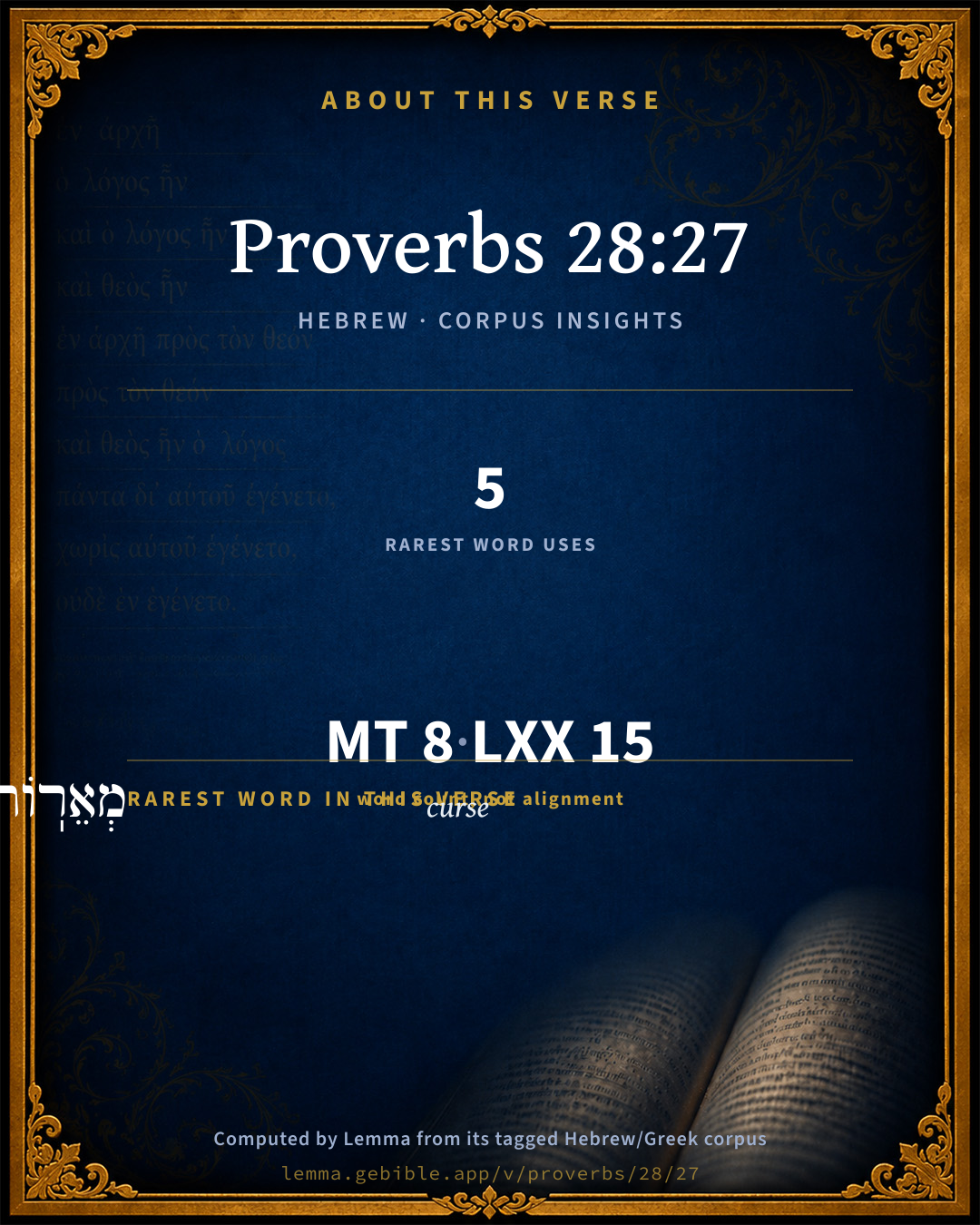
The rarest word here is מְאֵרֽוֹת curse H3994 — appearing just 5 times in the whole Hebrew Bible.

Shared distinctive vocabulary

מְאֵרֽוֹת curse H3994 occurs in 5 verses of the Hebrew Bible. Also found in:

Grammatical profile

  • 3 verbs
  • 3 nouns
  • 1 adjective
  • 1 particle

Verb forms

  • נוֹתֵ֣ן Qal · Participle Active
  • לָ֭רָשׁ Qal · Participle Active
  • וּמַעְלִ֥ים Hiphil · Participle Active

Hebrew & Septuagint length

In English translation the verse runs 19 words from the Hebrew and 25 from the Septuagint (LXX English) — closely comparable.

A rough comparison of the two English renderings, which tokenize alike — not a word-level alignment.

Word counts can differ between the Hebrew and the Greek without any difference in meaning — e.g. the Hebrew direct-object marker אֵת has no separate Greek word, and Greek often adds the article ὁ.

In the original languages it is 8 Hebrew tokens and 15 Greek tokens — but the two are counted differently (Hebrew bundles its prefixes and suffixes into one token; the Greek is in lemma form), so that isn’t a like-for-like length.

Cross-references

12

Topical passages linked to Proverbs 28:27 in the Treasury of Scripture Knowledge — connected by theme and wording, ordered by reader-vote popularity; previews shown in the World English Bible.

  • Proverbs 19:17 He who has pity on the poor lends to Yahweh; He will reward him.
  • Deuteronomy 15:7 If there be with you a poor man, one of your brothers, within any of your gates in your land which Yahweh your God gives you, you shall not harden your heart, nor shut your hand from your poor brother;
  • Psalms 41:1–3 Blessed is he who considers the poor: Yahweh will deliver him in the day of evil.
  • Proverbs 11:24 There is one who scatters, and increases yet more. There is one who withholds more than is appropriate, but gains poverty.
  • Deuteronomy 15:10 You shall surely give him, and your heart shall not be grieved when you give to him; because that for this thing Yahweh your God will bless you in all your work, and in all that you put your hand to.
  • Psalms 112:5–9 It is well with the man who deals graciously and lends. He will maintain his cause in judgment.
  • 2 Corinthians 9:6–11 Remember this: he who sows sparingly will also reap sparingly. He who sows bountifully will also reap bountifully.
  • Proverbs 22:9 He who has a generous eye will be blessed; For he shares his food with the poor.
  • Proverbs 11:26 People curse someone who withholds grain, But blessing will be on the head of him who sells it.
  • Isaiah 1:15 When you spread forth your hands, I will hide my eyes from you; Yes, when you make many prayers, I will not hear. Your hands are full of blood.
  • Hebrews 13:16 But don't forget to be doing good and sharing, for with such sacrifices God is well pleased.
  • Proverbs 24:24 He who says to the wicked, "You are righteous;" Peoples shall curse him, and nations shall abhor him--

Cross-references courtesy of OpenBible.info (CC BY 4.0).

Hebrew and Greek witnesses Masoretic Hebrew ↔ Greek Septuagint

The same verse in the two great witnesses to the Old Testament, shown verse-for-verse.

These are two independent witnesses, not word-aligned to each other, and the Septuagint is shown in lemma (dictionary) form.

Hebrew Proverbs 28:27 Masoretic · Westminster Leningrad Codex

נוֹתֵ֣ן לָ֭רָשׁ אֵ֣ין מַחְס֑וֹר וּמַעְלִ֥ים עֵ֝ינָ֗יו רַב מְאֵרֽוֹת

One who gives to the poor has no lack; But one who closes his eyes will have many curses.

World English Bible · Public Domain

Greek LXX Proverbs 28:27 Septuagint · lemma form

ὅς δίδωμι πτωχός οὐ ἐνδέω ὅς δέ ἀποστρέφω ὁ ὀφθαλμός αὐτός ἐν πολύς ἀπορία εἰμί

He that gives to the poor shall not be in lack: but he that turns away his eye from him shall be in great distress.

LXX2012 (modern English Septuagint) · Public Domain

On this verse, The Pulpit Commentary discusses the Septuagint’s reading. Read the note in Commentary ↓

Hebrew: Westminster Leningrad Codex (CC BY 4.0). Greek: Septuagint (public domain); English from LXX2012 (modern English Septuagint) (Public Domain). How the Septuagint differs from the Hebrew →

Commentary

Notes on Proverbs 28:27 from classic Christian and Jewish commentators (each source and its license shown beneath its notes). The classic Christian expositions comment on the surrounding passage and are grouped to its opening verse, so a note may address several verses; the Jewish commentaries on the Tanakh (Rashi and others) are per-verse, so they appear only where the commentator wrote on this verse.

Lemma curates 59 commentaries, every one of them public domain or Creative Commons licensed, each selected and text-cleaned for this edition rather than reprinted as found. About our sources →

Trapp's Complete Commentary

John Trapp

Pro 28:27 He that giveth unto the poor shall not lack: but he that hideth his eyes shall have many a curse.

Ver. 27. He that giveth unto the poor shall not lack.] Eleemosyna ars omnium questuosissima, saith Chrysostom: Not getting but giving is the way to wealth. God will bless the bountiful man’s stock and store, his barn and his basket; {Deu 15:10} his righteousness and his riches together shall endure for ever. {Psa 112:3}

But he that hideth his eyes,] i.e., That when he hath a fit object and opportunity of showing mercy offered him, frameth excuse, and pretendeth this thing and that, to his worldly and wicked retentions; that useth his wits to save his half penny, but will not use his eyes to affect his heart with pity. {Isa 58:7}

Shall have many a curse.] Men shall curse him, and call him a Pamphagus, a churl, a hog in a trough, a fellow of no fashion, &c. God shall also curse him, and set off all hearts from him, as he did from Haman; in his necessity he will shut his ears to such a man’s moans in misery, and hide his eyes from his supplication. {Psa 55:1 Isa 1:15} Finally, "he shall have judgment without mercy, that hath showed no mercy"; {Jas 2:13} "an evil, an only evil shall befall him"; {Eze 7:5} his punishments shall come close together, and God shall so set them on as no creature shall be able to take them off.

John Trapp, A Commentary or Exposition upon All the Books of the Old and New Testament (1647–1656) — public domain. Text from a community e-Sword module.

Joseph Benson's Commentary

Pro 28:27. He that giveth unto the poor shall not lack — Shall not empoverish himself by it, as covetous men imagine or pretend, but shall be enriched, which is implied; but he that hideth his eyes — Lest he should see poor and miserable persons, and thereby be moved to pity, or obliged to relieve them; shall have many a curse — Partly from the poor, whose curses, being not causeless, shall come upon him, and partly from God, who will curse his very blessings, and bring him to extreme want and misery.

Joseph Benson's Commentary on the Old and New Testaments (1811–1818) — public domain. Text from a community e-Sword module.

Matthew Henry's Commentary

Here is, 1. A promise to the charitable: He that gives to the poor shall himself be never the poorer for so doing; he shall not lack. If he have but little, and so be in danger of lacking, let him give out of his little, and that will prevent it from coming to nothing; as the bounty of the widow of Sarepta to Elijah (for whom she made a little cake first) saved what she had, when it was reduced to a handful of meal. If he have much, let him give much out of it, and that will prevent its growing less; he and his shall not want what is given in pious charity. What we gave we have. 2. A threatening to the uncharitable: He that hides his eyes, that he may not see the miseries of the poor nor read their petitions, lest his eye should affect his heart and extort some relief from him, he shall have many a curse, both from God and man, and neither causeless, and therefore they shall come. Woeful is the condition of that man who has the word of God and the prayers of the poor against him.

Matthew Henry's Commentary on the Whole Bible (1708–1710) — public domain (CC PDM 1.0). Text via the HelloAO Bible API.

Jamieson, Fausset & Brown

Robert Jamieson, A. R. Fausset & David Brown

(Compare Pro 11:24-26).

hideth his eyes--as the face (Psa 27:9; Psa 69:17), denotes inattention.

Jamieson, Fausset & Brown — Commentary Critical and Explanatory on the Whole Bible (1871) — public domain (CC PDM 1.0). Text via the HelloAO Bible API.

Adam Clarke's Commentary

Verse 27. He that giveth unto the poor] See the notes on the passages referred to in the margin (De 15:7; De 19:17; De 22:9).

Adam Clarke's Commentary on the Bible (1810–1826) — public domain. Text from a community e-Sword/MySword module.

Ellicott's Commentary for English Readers

(27) He that giveth unto the poor shall not lack.—See above on Pro_11:24.

Shall have many a curse.—With this comp. Sir_4:5-6.

A Bible Commentary for English Readers, edited by Charles John Ellicott (1878–1897) — public domain. Text from a community e-Sword module.

The Cambridge Bible for Schools and Colleges

gen. ed. J. J. S. Perowne

27. hideth his eyes] in neglect or disgust. Comp. Isa_1:15; and see Sir_4:5-6.

The Cambridge Bible for Schools and Colleges (gen. ed. J. J. S. Perowne; Cambridge University Press, 1878–1918) — public domain. Text from a community e-Sword module.

John Gill's Exposition

He that giveth unto the poor shall not lack,.... That gives alms unto them, relieves them in their distress, supplies them with money, food, or clothes, and does it cheerfully, largely, and liberally, as the case requires; such an one shall not want any good thing; he shall not be the poorer for what he gives; he shall not miss it, nor his substance be diminished; he shall not come to poverty and want, yea, he shall be enriched, and his substance increased, for more is intended than is expressed. Jarchi interprets this of a wise man not restraining doctrine from a disciple, but giving it to him liberally;

but he that hideth his eyes; that is, from the poor, as the Targum and Syriac version add; that does not care to see his person, to behold his miseries, or know his case, lest his heart should be moved with compassion, and should draw out anything from him; see Isa 58:7. Such an one

shall have many a curse; not only from the poor he hardens himself against, but from other persons, who observe his miserable and covetous disposition; and from the Lord himself, who abhors such persons, and curses their very blessings now, and will bid them depart from him as accursed persons hereafter.

John Gill's Exposition of the Whole Bible (1746–1763) — public domain (CC PDM 1.0). Text via the HelloAO Bible API.

Albert Barnes' Notes on the Bible

Hideth his eyes - i. e., Turns away from, disregards, the poor. Compare Isa 1:15.

Albert Barnes' Notes on the Bible (1834–1885) — public domain. Text from a community e-Sword/MySword module.

Haydock's Catholic Bible Commentary

CHAPTER XXVIII.

George Leo Haydock (1774–1849), Haydock's Catholic Family Bible and Commentary, 1859 edition — public domain. Excludes Psalms (Douay-Rheims chapter numbering differs from Protestant) and Deuterocanonical books (Catholic canon only).

Matthew Poole's English Annotations

Shall not lack; shall not impoverish himself by it, as covetous men imagine or pretend; but shall be enriched, which is implied.

That hideth his eyes, lest he should see poor and miserable men, and thereby be moved to pity or obliged to relieve them. So he cunningly avoids the beginnings, and occasions, and provocations to charity; teaching us to use the same caution against sin.

Shall have many a curse; partly from the poor, whose curses, being not causeless, shall come upon him, and partly from God, who will curse his very blessings, and bring him to extreme want and misery.

Matthew Poole's English Annotations on the Holy Bible (1683–1685) — public domain. Text from a community e-Sword/MySword module.

Whedon's Commentary on the Bible

Daniel D. Whedon

27. Hideth his eyes — Covers them up, so that he may not see the wants of the poor; pretends not to know the necessities of those in distress, and so does not relieve them. Comp. Pro_11:25; Pro_13:4; Isa_1:15.

Daniel D. Whedon (gen. ed.), Commentary on the Old and New Testaments (1874–1909) — public domain. Text from a community e-Sword module.

The Pulpit Commentary

He that giveth unto the poor shall not lack. (see Pro_11:24, etc.; Pro_19:17) God in some way compensates what is spent in almsdeeds by shedding his blessing on the benevolent. "Der Geiz," runs the German maxim, "sammlet sich arm, die Milde giebt sich reich," "Charity gives itself rich; covetousness hoards itself poor" (Trench). "Alms," said the rabbis, "are the salt of riches." But he that hideth his eyes shall have many a curse. (Pro_11:26) The uncharitable man either turns away his eyes that he may not see the misery around him, or pretends not to notice it, lest his compassion should be claimed. The expression, "hiding the eyes," occurs in Isa_1:15, "When ye spread forth your hands, I will hide mine eyes from you." The unmerciful man meets with the curses of those whom he has neglected to relieve when he had the power, and such curses are ratified and fulfilled because they are deserved, and Divine retribution attends them (see the opposite view, Ver. 20). "Turn not away thine eye from the needy," says the Son of Sirach, "and give him none occasion to curse thee; for if be curse thee in the bitterness of his soul, his prayer shall be heard of him that made him". (Ecc_4:4, etc.; comp. RAPC Tob 4:7) So in the "Didache," ch. 4., we have, Ouk apostrafhsh tomenon , "Thou shalt not turn thyself from one in need." Septuagint, "lie that turneth away his eye shall be in great distress;" Vulgate, Qui despicit deprecantem sustinebit penuriam.

Vers. 27, 28. The life that "breeds perpetual benediction.

I THE KINDLY AND GENEROUS HEART". (Ver. 27) This prompts the generous hand; gathers more than it sows; is not suffered to want any good thing. It stands out in bright colours and winning aspect against the dark background of the selfish, self-concentrated, hard hearted life Let us cultivate the open eye which drinks in the knowledge of all that concerns our fellows, and the open hand in harmony with it.

II ITS WORTH IS HEIGHTENED BY CONTRAST. (Ver. 28) Men cower, their brows contract, their mien becomes depressed, their soul enslaved, their manhood unmanned, beneath the proud man"s oppression and the wicked"s scorn. Persecution drives the moral sunshine out of the world, and tends to depopulate its moral life. As the increase of goodness depends largely on sound social and political conditions, it must be an object of prayer and of endeavour with all good men to overthrow tyranny and abolish fraud, that "the fruits of righteousness may abound and increase on every hand. J.

The Pulpit Commentary (1880–1919), ed. H.D.M. Spence-Jones & Joseph S. Exell — public domain. Text from a community e-Sword module.

Keil & Delitzsch

C. F. Keil & F. Delitzsch

27 He that giveth to the poor suffereth no want;

But he that covereth his eyes meeteth many curses.

In the first line the pronoun לּו, referring back to the subject noun, is to be supplied, as at Pro 27:7 להּ. He who gives to the poor has no want (מחסּור), for God's blessing reimburses him richly for what he bestows. He, on the other hand, who veils (מעלּים( sl, cf. the Hithpa., Isa 58:7) his eyes so as not to see the misery which calls forth compassion, or as if he did not see the misery which has a claim on his compassion; he is (becomes) rich in curses, i.e., is laden with the curses of those whose wants he cared not for; curses which, because they are deserved, change by virtue of a divine requital (vid., Sir. 4:5f.; Tob. 4:7) into all kinds of misfortunes (opp. רב־בּרכות, 20a). מארה is constructed after the form מגרה, מקרה from ארר.

Keil & Delitzsch — Biblical Commentary on the Old Testament (1861–1891) — public domain (CC PDM 1.0). Text via the HelloAO Bible API. (Old Testament only.)

Bridges on Proverbs

Charles Bridges

’There is none that desireth want, nor that wisheth to be poor. And therefore the carnally-minded, to save themselves from it, carefully gather together, and enclose so much wealth as they can by any means possible; and they think that by such means they shall avoid lack. And indeed after man’s judgment, it is the best way that a man can take. But the Holy Ghost doth teach us another means, clean contrary to natural reason. He that giveth unto the poor shall not lack. This is against reason, which saith, that we must gather and hold fast, to avoid poverty. She looketh not to what God can and will do. She is blind in the works of the Lord, and chiefly in those that he worketh according to his free promise.’†1

However close we may hold our substance, who can give security against coming want? But this promise gives a security, that no earthly abundance can afford. Covetousness indeed combines with reason to contradict the word of God. Yet the promise is given by him, who hath full power to make it good; who has a thousand ways of repaying what is done or sacrificed at his command. (Psa 24:1 .) The fruit is absolutely certain, ’as the best preventive against poverty, putting money into the bank of heaven, which can never forfeit credit.’†2 The best securities on earth will not hinder "riches from making to themselves wings, and flying away." (Pro 23:5 .) But when have the promises of heaven ever been falsified?†3 Yet after all, with the carnal mind, covetousness prevails above faith, and a "trust in uncertain riches makes the living God a liar."†4

Do we, the professed followers of Christ, lay these truths really to heart, testing our own principles and practice by them, and honestly intending to take them, instead of selfish prudence and expediency, as our rule and measure of conduct? Most honorable is it to the Christian profession, and a sure seal of blessing upon our family, when we forbear to plead family claims, as an excuse for contracting our liberality. Again and again does God ratify this engagement.†5 Yet many, who are "earnest in contending for the faith" of the Gospel, and who would resist at any cost the invasion of heresy — we fear — would be ashamed to expose the scanty limits of their liberality.

Did we really believe the promise annexed to this duty, we should not so often hide our eyes from a case of distress. Yet not only do we neglect to look out for objects of compassion, but actually we turn away from them, as the servant of God would turn away from sin;†6 and then justify ourselves on the ground of frequent imposition, and the many worthy objects, which may or may not come before us. Many a curse is entailed upon this grudging spirit, both from God and man.†7 And is there no danger here of the everlasting curse?†8 Ponder it well — lest prudence and discrimination check the glow of charity, prove a cloak for selfishness, and obscure the light of Christian benevolence and love, which ought to shine before men in the profession of the true servants of God.

Footnotes:

†1 Cope in loco.

†2 Lawson in loco.

†3 Num 23:19. 2Co 1:20 .

†4 1Ti 6:17 . 1Jn 5:10 .

†5 Pro 3:9-10; Pro 11:24-25 ; Pro 13:7 ; Pro 14:22 ; Pro 19:17 ; Pro 22:9 . Deu 15:7-10 ; Psa 41:1-3 ; Psa 112:5-9, with 2Co 9:6-11 . Ecc 11:1 . Isa 32:8 ; Isa 58:7-11 . Mat 5:7 . Luk 6:38 . Observe the glowing exuberance of this last promise — Not only "shall it be given you" — but good measure — justly proportioned to the exercise of love — pressed down — to secure it as full measure — shaken together — as with corn, that it may lie closer in its place — and as if this were not enough — running over — without bounds — given into your bosom — so that you shall taste the large indulgence of the blessing.

†6 Job 31:1, with Gen 39:10 .

†7 Pro 11:26. 1Sa 25:17, 1Sa 25:25-26, 1Sa 25:38 .

†8 Mat 25:41-45. Jas 2:13 ; Jas 5:1-4 .

Charles Bridges, An Exposition of the Book of Proverbs (1846) — public domain. Text from a community e-Sword module.

unfoldingWord translationNotes

Door43 World Missions Community

The one

"The person"

the poor

This refers to poor people in general. AT: "poor people" (See: Nominal Adjectives)

lack nothing

This double negative is used for emphasis. AT: "have everything they need" (See: Litotes)

whoever closes his eyes to them will receive many curses

This can be stated in active form. Possible meanings are 1) they will receive many curses from the poor. AT: "the poor will give many curses to whoever closes his eyes to them" or 2) they will receive many curses from people in general. AT: "people will give many curses to whoever closes his eyes to the poor" or 3) they will receive many curses from God. AT: "God will give many curses to whoever closes his eyes to the poor" (See: Active or Passive)

whoever closes

"anyone who closes"

closes his eyes to

Closing the eyes represents not responding to the needs of the poor. AT: "ignores" or "chooses not to help" (See: Metonymy)

When the wicked arise

This is an idiom that means when wicked people gain power or start to rule. AT: "When wicked people rise to power" (See: Idiom)

people hide themselves

This is an exaggeration for doing everything they can to avoid having wicked people harm them. AT: "people go into hiding" (See: Hyperbole and Generalization and Reflexive Pronouns)

perish

Possible meanings are 1) "go away" or 2) "fall from power" or 3) "are destroyed."

increase

Possible meanings are 1) "multiply" or 2) "rise to power."

translationWords

receive

curse

evil

raise

perish

unfoldingWord translationNotes — © Distant Shores Media and the Door43 World Missions Community, licensed CC BY-SA 4.0. Source: git.door43.org/Door43/en_tn.

Rashi

Rabbi Shlomo Yitzchaki (Rashi)

He who gives to a poor man charity.

will suffer no want (to give him much charity.) And so it is with the teacher who does not withhold Torah from his pupil.

Rashi on the Tanakh — English translations: “The Judaica Press complete Tanach with Rashi, translated by A. J. Rosenberg” (CC BY 4.0); “Pentateuch with Rashi's commentary by M. Rosenbaum and A.M. Silbermann, 1929-1934” (public domain); “The Metsudah Tanach series, Lakewood, N.J” (CC BY 4.0); and “The Book of Joshua, Metsudah Publications, 1997” (CC BY 4.0). Text via Sefaria.

Lesson kit

Teaching starters — assembled from the data on this page, not authored interpretation. Every prompt links to the verse data it draws on. Edit before teaching.

Proverbs, in the Wisdom, opens this verse with 8 words (8 distinct Hebrew lemmas). Its most distinctive word is mᵉʼêrâh (“curse”). A historical commentator’s framing appears above. Read the whole chapter for the surrounding context.

Discussion questions

  1. The word mᵉʼêrâh carries the sense “curse.” How does it shape the verse?
  2. Deuteronomy 28:20 shares the word «curse» with this verse. How do the two illuminate each other?
  3. These translations render this verse differently; the difference is in the English rendering, not the original. What questions does that raise?
  4. The verb «נוֹתֵ֣ן» is Qal Participle Active. How does its form color the action?
  5. Reading how Trapp's Complete Commentary and Joseph Benson's Commentary read this verse, where do the two commentators agree and where do they part?

Things to notice

Reading settings

Reading text

Shown beneath each verse's original-language words.

Old Testament
Old Testament edition

Read the OT as the Masoretic Hebrew (MT) or the Greek Septuagint (LXX).

English shown for the Greek Septuagint (in the Hebrew ↔ Greek comparison).

Comparing translations? Open the Compare panel on any verse page to stack up to four side by side.