Jeremiah 37:9

Hebrew (Westminster Leningrad Codex) Jeremiah 37:9 appears in the Hebrew Old Testament. The text above is from the Westminster Leningrad Codex. Each word links to its Strong’s number, a concise gloss, and parsing drawn from the Open Scriptures Hebrew Bible morphology. Click any word for its full Brown-Driver-Briggs (BDB) entry.
Download image
Cite this verse

Jeremiah 37:9 (World English Bible). Public Domain. Lemma interlinear Bible study tool, https://lemma.gebible.app/v/jeremiah/37/9.

Show BibTeX & RIS
BibTeX
RIS
English Translation
Thus says Yahweh, Don't deceive yourselves, saying, The Chaldeans shall surely depart from us; for they shall not depart.
World English Bible · Public Domain
Download a study sheet

One document with this verse’s original text, its word-by-word gloss line, the meaning frame, cross-references with their text, attributed commentary, and full source and license credits — printable, and it pastes into notes with its structure intact.

This verse Autodidact and up

Study sheet (.html) Plain text (.txt)

A passage Seminary Student

Up to 50 verses in one chapter. A passage sheet keeps up to 6 commentary sources and 12 cross-references per verse, in the order this page ranks them, and says so on the sheet whenever that leaves anything out. Ask for a single verse and you get the Autodidact verse sheet above.

Everything on this page stays free to read, with no account — the sheet is a download of what is already on screen, not access to it.

Want to remove ads? Support Godless Engineer
Compare translations 3

The same verse in 3 English versions, stacked beneath the original-language interlinear above. Click any original word for its lexicon entry.

Each is an independent rendering of the whole verse — the interlinear is not word-aligned to these translations.

Highlighted words mark where these versions differ — a whole-verse word diff, not a word-by-word alignment.

  • World English Bible Public Domain
    Thus says Yahweh, Don't deceive yourselves, saying, The Chaldeans shall surely depart from us; for they shall not depart.
  • King James Version Public Domain
    Thus saith the LORD; Deceive not yourselves, saying, The Chaldeans shall surely depart from us: for they shall not depart.
  • unfoldingWord Literal Text CC BY-SA 4.0
    Yahweh says this: Do not deceive yourselves by saying, ‘Surely the Chaldeans are leaving us,’ for they will not leave.

unfoldingWord Literal Text — © unfoldingWord, licensed CC BY-SA 4.0. Word-aligned USFM3 via Door43 (git.door43.org/unfoldingWord/en_ult).

Versions to compare (up to 4)

3 of 4 selected

Show all 18 translations

Every available English version of this verse, each an independent rendering of the whole verse.

  • World English Bible Public Domain
    Thus says Yahweh, Don't deceive yourselves, saying, The Chaldeans shall surely depart from us; for they shall not depart.
  • Berean Standard Bible Public Domain
    This is what the LORD says: Do not deceive yourselves by saying, ‘The Chaldeans will go away for good,’ for they will not!
  • Majority Standard Bible Public Domain
    This is what the LORD says: Do not deceive yourselves by saying, ‘The Chaldeans will go away for good,’ for they will not!
  • King James Version Public Domain
    Thus saith the LORD; Deceive not yourselves, saying, The Chaldeans shall surely depart from us: for they shall not depart.
  • American Standard Version (1901) Public Domain
    Thus saith Jehovah, Deceive not yourselves, saying, The Chaldeans shall surely depart from us; for they shall not depart.
  • Revised Version (1885) Public Domain
    Thus saith the LORD: Deceive not yourselves, saying, The Chaldeans shall surely depart from us: for they shall not depart.
  • Geneva Bible (1599) Public Domain
    Thus sayth the Lord, Deceiue not your selues, saying, The Caldeans shall surely depart from vs: for they shall not depart.
  • Douay-Rheims (1899) Public Domain
    But if you should even beat al: the army of the Chaldeans that fight against you, and there should be left of them some wounded men: they shall rise up, every man from his tent, and burn this city with Are.
  • Young's Literal Translation Public Domain
    `Thus said Jehovah: Lift not up your souls saying, The Chaldeans surely go from off us, for they do not go;
  • Literal Standard Version CC BY-SA 4.0
    Thus said YHWH: Do not lift up your souls, saying, The Chaldeans surely go from off us, for they do not go;
  • Unlocked Literal Bible CC BY-SA 4.0
    Yahweh says this: Do not deceive yourselves by saying, 'Surely the Chaldeans are leaving us,' for they will not leave.
  • unfoldingWord Literal Text CC BY-SA 4.0
    Yahweh says this: Do not deceive yourselves by saying, ‘Surely the Chaldeans are leaving us,’ for they will not leave.
  • Darby Bible Public Domain
    Thus saith Jehovah: Deceive not yourselves, saying, The Chaldeans are certainly gone away from us; for they are not gone.
  • World Messianic Bible Public Domain
    “The LORD says, ‘Don’t deceive yourselves, saying, “The Kasdim will surely depart from us;” for they will not depart.
  • Webster's Bible Public Domain
    Thus saith the LORD; Deceive not yourselves, saying, The Chaldeans will surely depart from us: for they will not depart.
  • Free Bible Version CC BY-SA 4.0
    This is what the Lord says: Don't fool yourselves by saying, “The Babylonians are gone for good,” because they're not!
  • Bible in Basic English Public Domain
    The Lord has said, Have no false hopes, saying to yourselves, The Chaldaeans will go away from us: for they will not go away.
  • JPS Tanakh (1917) Public Domain
    Thus saith the LORD: Deceive not yourselves, saying: The Chaldeans shall surely depart from us; for they shall not depart.

Literal Standard Version (2020), Covenant Press — licensed CC BY-SA 4.0. Text via the HelloAO Bible API (eBible.org). Unlocked Literal Bible (unfoldingWord) — licensed CC BY-SA 4.0. Text via the HelloAO Bible API (eBible.org). unfoldingWord Literal Text — © unfoldingWord, licensed CC BY-SA 4.0. Word-aligned USFM3 via Door43 (git.door43.org/unfoldingWord/en_ult). Free Bible Version, Dr. Jonathan Gallagher — licensed CC BY-SA 4.0. Text via the HelloAO Bible API (eBible.org).

Word by word

More ways to search: Search by grammar → Find every occurrence → Compare this word →

Practice this passage: Drill this verse → Learn its vocabulary →

תַּשִּׁ֤אוּ
nâshâʼ
H5377
“to deceive”
Verb, Hiphil, Jussive, 2nd Person, Masculine, Plural
Part of Speech
Verb
Stem
Hiphil
Form
Jussive
Person
2nd Person
Gender
Masculine
Number
Plural
Full BDB Definition

Origin: a primitive root

TWOT: 1425

to beguile, deceive - (Niphal) to be beguiled - (Hiphil) to beguile, deceive - (Qal) utterly (infinitif)
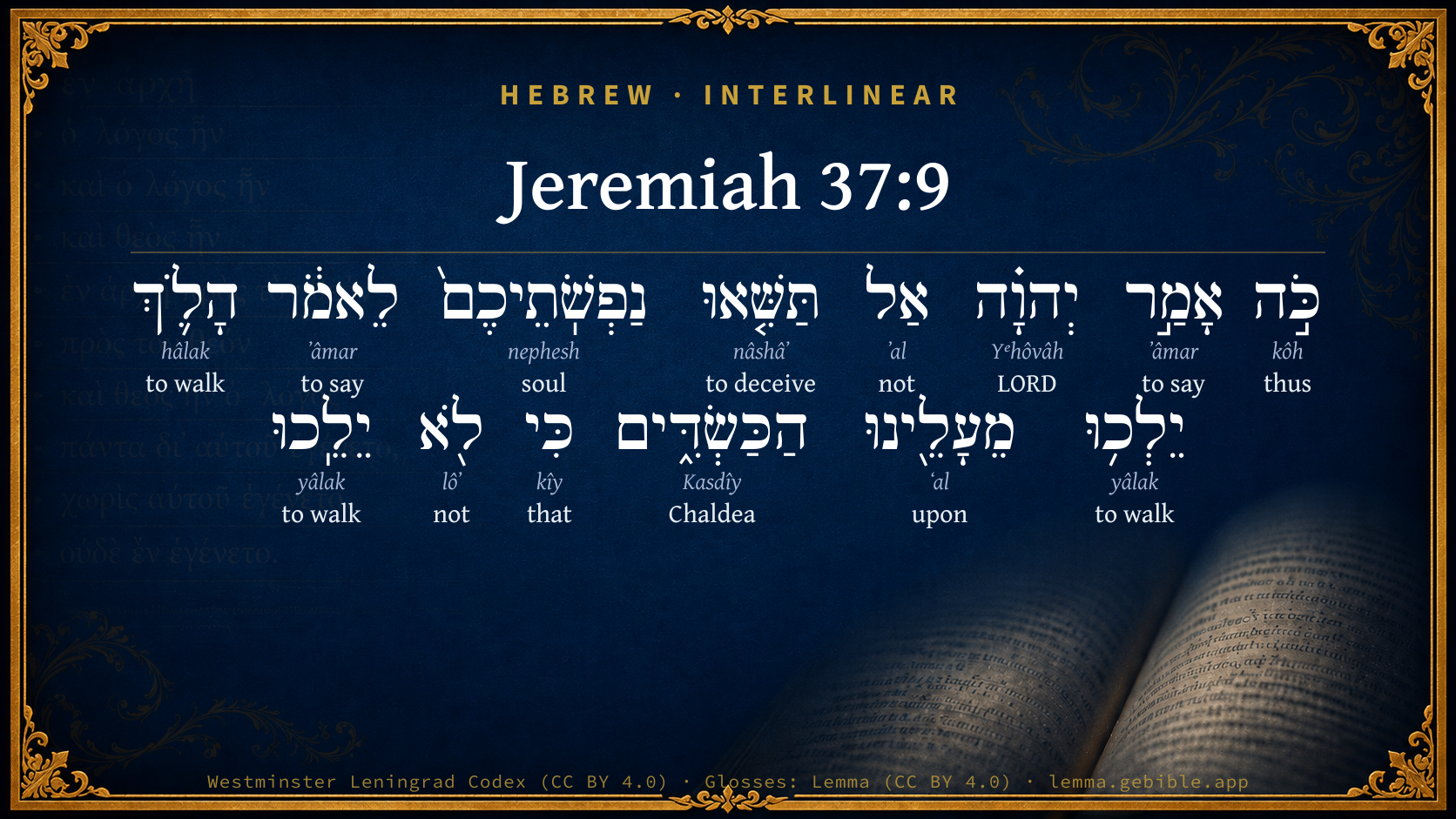
  1. כֹּ֣ה kôh H3541 “thus” Adverb
  2. אָמַ֣ר ʼâmar H559 “to say” Verb, Qal, Perfect, 3rd Person, Masculine, Singular
  3. יְהוָ֗ה Yᵉhôvâh H3068 “LORD” Noun, Proper
  4. אַל ʼal H408 “not” Particle, Negative
  5. נַפְשֹֽׁתֵיכֶם֙ nephesh H5315 “souls · your” Noun, Common, Both, Plural, Construct + Suffix, Personal, 2nd Person, Masculine, Plural
  6. לֵאמֹ֔ר ʼâmar H559 “to say” Preposition + Verb, Qal, Infinitive Construct
  7. הָלֹ֛ךְ hâlak H1980 “to walk” Verb, Qal, Infinitive Absolute
  8. יֵלְכ֥וּ yâlak H3212 “to walk” Verb, Qal, Imperfect, 3rd Person, Masculine, Plural
  9. מֵעָלֵ֖ינוּ ʻal H5921 “from · upon · us” Preposition + Preposition + Suffix, Personal, 1st Person, Common, Plural
  10. הַכַּשְׂדִּ֑ים Kasdîy H3778 “the · Chaldea” Particle, Definite Article + Noun, Proper
  11. כִּי kîy H3588 “that” Conjunction
  12. לֹ֖א lôʼ H3808 “not” Particle, Negative
  13. יֵלֵֽכוּ yâlak H3212 “to walk” Verb, Qal, Imperfect, 3rd Person, Masculine, Plural

About this verse

These counts appear in no published source. They are computed here, from the morphology-tagged text and Lemma’s own curated glosses. What Lemma adds →

14
words
12
distinct lemmas
Prophets
section

Notable vocabulary

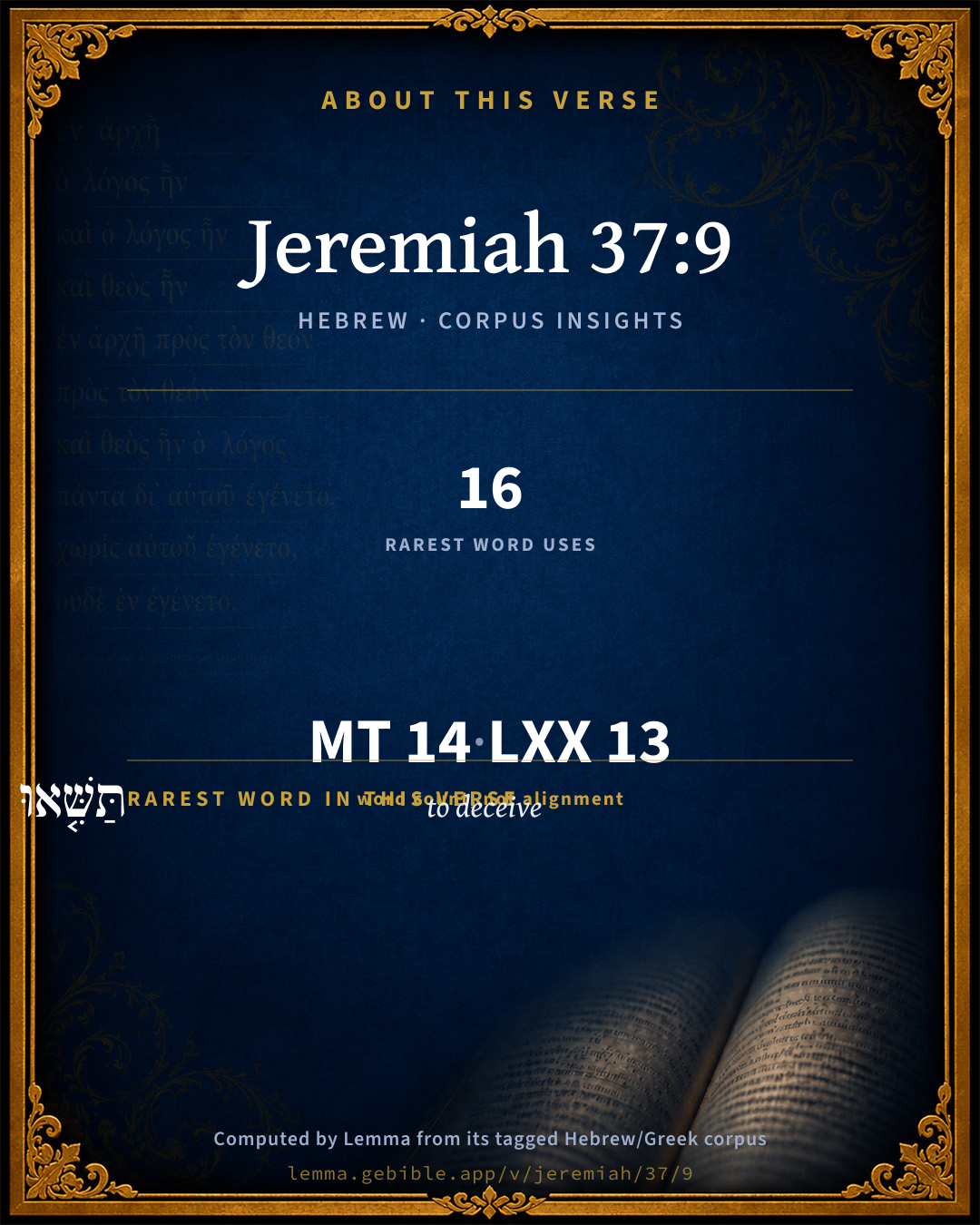
The rarest word here is תַּשִּׁ֤אוּ to deceive H5377 — appearing just 16 times in the whole Hebrew Bible.

Shared distinctive vocabulary

תַּשִּׁ֤אוּ to deceive H5377 occurs in 15 verses of the Hebrew Bible. Also found in:

Grammatical profile

  • 6 verbs
  • 3 nouns
  • 1 preposition
  • 1 conjunction
  • 1 adverb
  • 2 particles

Verb forms

  • אָמַ֣ר Qal · Perfect
  • תַּשִּׁ֤אוּ Hiphil · Jussive
  • לֵאמֹ֔ר Qal · Infinitive Construct
  • הָלֹ֛ךְ Qal · Infinitive Absolute
  • יֵלְכ֥וּ Qal · Imperfect
  • יֵלֵֽכוּ Qal · Imperfect

Repetition

Words recur within this verse — often emphatic in Hebrew:

  • אָמַ֣ר to say H559 ×2
  • יֵלְכ֥וּ to walk H3212 ×2

Hebrew & Septuagint length

In the original languages it is 14 Hebrew tokens and 13 Greek tokens — but the two are counted differently (Hebrew bundles its prefixes and suffixes into one token; the Greek is in lemma form), so that isn’t a like-for-like length.

Cross-references

8

Topical passages linked to Jeremiah 37:9 in the Treasury of Scripture Knowledge — connected by theme and wording, ordered by reader-vote popularity; previews shown in the World English Bible.

  • Obadiah 1:3 The pride of your heart has deceived you, you who dwell in the clefts of the rock, whose habitation is high, who says in his heart, 'Who will bring me down to the ground?'
  • Jeremiah 29:8 For thus says Yahweh of hosts, the God of Israel: Don't let your prophets who are in the midst of you, and your diviners, deceive you; neither listen you to your dreams which you cause to be dreamed.
  • Matthew 24:4–5 Jesus answered them, "Be careful that no one leads you astray.
  • Galatians 6:3 For if a man thinks himself to be something when he is nothing, he deceives himself.
  • Galatians 6:7 Don't be deceived. God is not mocked, for whatever a man sows, that will he also reap.
  • 2 Thessalonians 2:3 Let no one deceive you in any way. For it will not be, unless the departure comes first, and the man of sin is revealed, the son of destruction,
  • James 1:22 But be doers of the word, and not only hearers, deluding your own selves.
  • Ephesians 5:6 Let no one deceive you with empty words. For because of these things, the wrath of God comes on the children of disobedience.

Cross-references courtesy of OpenBible.info (CC BY 4.0).

Hebrew and Greek witnesses Masoretic Hebrew ↔ Greek Septuagint

The same verse in the two great witnesses to the Old Testament, shown verse-for-verse.

These are two independent witnesses, not word-aligned to each other, and the Septuagint is shown in lemma (dictionary) form.

Hebrew Jeremiah 37:9 Masoretic · Westminster Leningrad Codex

כֹּ֣ה אָמַ֣ר יְהוָ֗ה אַל תַּשִּׁ֤אוּ נַפְשֹֽׁתֵיכֶם֙ לֵאמֹ֔ר הָלֹ֛ךְ יֵלְכ֥וּ מֵעָלֵ֖ינוּ הַכַּשְׂדִּ֑ים כִּי לֹ֖א יֵלֵֽכוּ

Thus says Yahweh, Don't deceive yourselves, saying, The Chaldeans shall surely depart from us; for they shall not depart.

World English Bible · Public Domain

Greek LXX Structure differs

In the Septuagint, Jeremiah is about an eighth shorter than the Hebrew and arranges its material differently — the Oracles Against the Nations (Hebrew chapters 46–51) appear in the middle of the Greek book, after 25:13. Because the chapter and verse boundaries do not line up, a verse-for-verse comparison with the Hebrew is not shown.

A verse-for-verse comparison isn’t shown here because the chapters and verses don’t line up. Switch to the LXX edition with the MT / LXX toggle above to read the Greek directly.

Hebrew: Westminster Leningrad Codex (CC BY 4.0). Greek: Septuagint (public domain); English from a public-domain English Septuagint. How the Septuagint differs from the Hebrew →

Targum (Aramaic paraphrase)

1

The Targum is the ancient Jewish Aramaic paraphrase of the Hebrew Scriptures — an interpretive translation, not the Hebrew text itself. Onkelos (literal) and Pseudo-Jonathan (expansive) render the Torah, and Jonathan the Prophets. Coverage is partial: where no permissively-licensed English translation exists for a verse, only the Aramaic is shown. This is verse-level text, not a word-by-word alignment to the Hebrew.

  1. Targum Jonathan Prophets (Joshua–Malachi)
    כִּדְנַן אֲמַר יְיָ לָא תִטְעוֹן נַפְשָׁתֵיכוֹן לְמֵימָר אִסְתַּלָקָא יִסְתַּלָקוּן מִנָנָא כַּסְדָאֵי אֲרֵי לָא יִסְתַּלְקוּן:

    (no public-domain English translation for this verse)

    Targum Jonathan — Aramaic: “Mikraot Gedolot” (public domain). English: “Sefaria Community Translation” (CC0 1.0 (public-domain dedication)); “London "Chaldee Paraphrase," 1871” (public domain). Text via Sefaria.

Commentary

Notes on Jeremiah 37:9 from classic Christian and Jewish commentators (each source and its license shown beneath its notes). The classic Christian expositions comment on the surrounding passage and are grouped to its opening verse, so a note may address several verses; the Jewish commentaries on the Tanakh (Rashi and others) are per-verse, so they appear only where the commentator wrote on this verse.

Lemma curates 59 commentaries, every one of them public domain or Creative Commons licensed, each selected and text-cleaned for this edition rather than reprinted as found. About our sources →

Trapp's Complete Commentary

John Trapp

Jer 37:9 Thus saith the LORD; Deceive not yourselves, saying, The Chaldeans shall surely depart from us: for they shall not depart.

Ver. 9. Deceive not yourselves.] As far too many do, qui praesumendo sperant, et sperando pereunt. hope beforehand and will die hoping.

For they shall not depart,] scil., For altogether; not for any space of time, or to any purpose. Like hereunto is that in Mat 9:24, "The damsel is not dead."

John Trapp, A Commentary or Exposition upon All the Books of the Old and New Testament (1647–1656) — public domain. Text from a community e-Sword module.

The Biblical Illustrator

Joseph S. Exell

Jer_37:9-10

Thus saith the Lord, Deceive not yourselves, saying, The Chaldeans shall surely depart from us: for they shall not depart.

The punishment of evil

The great teaching of the text is that we must not allow appearances to mislead us respecting the fact and certainty of the law of retribution. God has threatened the transgressor with severe penalties, and we may be sure that these penalties will be inflicted, however unlikely such retribution may sometimes seem, and however long it may be delayed. By wonderful ways God brings His judgments to pass.

I. We mark some illustrations of the law of retribution furnished by the history of the nations. Very memorable was the retribution that Israel brought on Egypt. At the other end of their national history, Israel itself furnishes a most striking illustration of the working of the law of retribution through all improbabilities. When the Christ was crucified through weakness, the people cried, His blood be upon us, and upon our children. How unlikely did it seem that the Victim of Calvary could ever be avenged upon an unjust nation! And yet that wounded Man rose up invested with strange powers, and burned their city with fire. And let us not think that these instances of retribution are to be placed in the category of the miraculous; they were the natural consequences of great denials of truth and justice. Men unjustly pierced through are terrible avengers in all ages and nations. For centuries did the kings and nobles of France oppress the peasantry; it is impossible for us to think adequately of the vast hopeless wretchedness of the people from the cradle to the grave. When Louis XVI. came to the throne it seemed incredible that the long-suffering people would ever avenge themselves upon the powerful classes by whom they were ground to the dust, and yet by a marvellous series of events the wounded men arose in awful wrath, burning palaces with fire and trampling greatness underfoot. Pierced through were those hungry hopeless millions; but the day of doom came, and every bleeding wretch arose invincible with torch and sword. For generations the African was wronged by the American; the negro had no military, political, or literary power; he was bought and sold as are the dumb driven cattle, and it seemed as if the fetters of a shameful degradation were riveted upon him for ever. Was there a shied or spear seen among forty thousand in Israel? As late as 1854 Wendell Phillips wrote despairingly, Indeed, the Government has fallen rote the hands of the slave power completely. So far as national politics are concerned, we are beaten--theres no hope The future seems to unfold a vast slave empire united with Brazil, and darkening the whole West. I hope I may be a false prophet, but the sky was never so dark. And yet immediately after this the wounded men arose, deluging the land with blood, and burning the cities of the great Republic with fire. Some of our writers argue that retribution does not follow on national wrong-doing, because territory gained by cruelty, treachery, bloodshed, is not as a matter of fact torn away from its guilty conquerors, but such ill-acquired territory remains a permanent portion of their splendid empire. But there are other ways of inflicting retribution upon a nation than by immediately depriving it of provinces. There is something very like irony in the government of God, and He sometimes punishes the victors through the spoil. Our Indian Empire is said to have been ill-gotten, and yet we retain it, that country being to Britain what the tail is to the peacock--our glory and pride. But the gilded train, it will be remembered, has been already splashed with blood, and the end is not yet. Retribution may not come in the form of specially inflicted judgments, but it will come. No pestilence, war, earthquake, or famine marks the Divine displeasure, but the retribution arises out of the iniquity. With great injustice and cruelty the French drove out the Huguenot, but in expelling these sons of faith, genius, industry, virtue, the French fatally impoverished their national life, and they are suffering to-day from these missing, elements which none may restore. Retribution may not be revealed in material disaster, but it will come. As Mommsen, one of the greatest of historians, declares, History has a Nemesis for every sin ! It may seem that all might and majesty are with an unjust nation and that wounded men only are on the other side; but at Gods call wounded men are Michaels wielding flaming swords. The foolishness of God is wiser than men. Sometimes we are greatly amazed and perplexed at the way in which history unfolds itself--it would seem as if the diplomacy of evil were too much for the Ruler of the world, as if Providence made hesitating moves, weak moves, fatal moves; but we have only to wait a while to know that Gods foolishness is wiser than men. He taketh the wise in their own craftiness; The Lord shall have them in derision. The weakness of God is stronger than men. The sun is sometimes weak, but its earliest ray in the dawn is more than all our electric lights, the first faint beam of the spring is infinitely more than all the sparks of our kindling; the sea is sometimes weak--it is a mill-pond, we say--but in its softest ripple is a suggestion of power that fills us with awe; the wind is sometimes weak, but in the gentlest zephyr is hinted the majesty of infinite strength. Nature shows how the weakness of God is immeasurably stronger than men; so does history with equal clearness. The oft-quoted saying, Providence is always on the side of the big battalions, is one with an imposing sound, but it is disproved by history over and over again. The worlds Ruler defeated Pharaoh with frogs and flies; He humbled Israel with the grasshopper; He smeared the splendour of Herod with worms; on the plains of Russia He broke the power of Napoleon with a snowflake. God has no need to despatch an archangel; when once He is angry, a microbe will do.

II. We note the law of retribution as exemplified in the individual life. The great law works infallibly in the personal history as it does in the national life. God has wonderful ways of confounding us, and we may be sure that our sins will find us out.

1. Let us not permit ourselves to be deceived by flattering prophets. Loudly does revelation declare the obligation of righteousness, and grievous are the judgments that it pronounces against transgressors, but this in our age has been accepted in quite a modified sense. Men will now hardly allow such a word as, wrath; they will not permit a man to suffer simply as a punishment for his sin; the violation of laws human and divine must be condoned and passed over with the ]east reprobation and vengeance. Let us rejoice in the growth of the sentiment of humanity, but we must shut our ears to the effeminate and sentimental teaching which will inevitably relax and destroy a noble morality. God is merciful, but fire does not forget to burn, teeth to tear, water to drown, and no transgression of the law can pass without detection and punishment. And it shall come to pass, that him that escapeth the sword of Hazael shall Jehu slay. Gods complex system of retribution permits not the cleverest sinner to slip through.

2. Let us not deceive ourselves because appearances seem to promise immunity. Our modem knowledge of science, of the unity and interdependence of all things, of the continuity and persistence of force and motion, of the inviolable integrity of all organisms, ought to make it easy to us to believe that whatsoever a man soweth that shall he reap, however appearances may promise otherwise. Let us not be beguiled by the immediate aspects of life and circumstance. Gods blind men watch us; His lame men run us down; His deaf men filch our secrets; His dumb men impeach us; His wounded men arise, every man a messenger of revenge.

3. Let us not deceive ourselves because judgment is delayed. In contending with God we are plotting against a Wisdom that seems sometimes to hesitate and fail; but never is that Wisdom more profound than in the moments of seeming perplexity, and if we yield to flattering hopes of victory, our final overthrow will only be the more complete and irreparable for these protractions of the conflict. In contending with God we are warring with a Power that ever and anon seems baffled and beaten; it seems to retreat, it allows us to win skirmishes here and there--only the more conspicuously to crush us in the decisive battle, if we persist to fight it out to the bitter end. In contending with God we are provoking a Justice which sometimes seems incapable of asserting itself; but inveterate perversity discovers in the event that all such hesitations and delays were the whettings of a sword which needs not to smite twice. Slowly it may be, but surely, do we ripen for judgment; and when once ripe, how little a thing is necessary to precipitate the calamity! As the Hindoos say, When men are ripe for slaughter, even straws turn into thunderbolts.

4. Let us improve the gracious respite. Many rebel altogether against the doctrine of grace, sternly insisting on inexorable law, justice, retribution; they utterly reprobate the ideas of repentance, forgiveness, and salvation. But mercy is a fact as much as justice is. Within that great system of severities we call nature there are ameliorative arrangements softening the rigours of broken law; in human life and government, too, which is nature still, only on a higher plane, mercy and forgiveness assert themselves, and society greatly prizes the gracious quality; and it is therefore a mistake, judged by the light of nature, to make an antithesis of equity and grace, as if these qualities were mutually antagonistic and eternally irreconcilable--they both exist side by side in this tangible human world with which we are so familiar. Now, the grand burden of the Gospel is to bring into fullest light that doctrine of mercy hinted by nature, and to show us that grace is not arbitrariness, the negation of law, the neglect of justice, but that the fullest and most splendid revelation of grace may take place on the basis of eternal truth and justice. (W. L. Watkinson.)

The Biblical Illustrator, edited by Joseph S. Exell (c. 1880s–1900s) — public domain. Text from a community e-Sword module.

Geneva Bible (1599)

Geneva Bible translators

Or, lift not up your minds.

Geneva Bible (1599) marginal notes — public domain. Text via Bolls.life.

Jamieson, Fausset & Brown

Robert Jamieson, A. R. Fausset & David Brown

yourselves--Hebrew, "souls."

Jamieson, Fausset & Brown — Commentary Critical and Explanatory on the Whole Bible (1871) — public domain (CC PDM 1.0). Text via the HelloAO Bible API.

John Calvin's Commentaries

The Prophet confirms the former verse, and it was indeed necessary that this should be added, for though Zedekiah might not have divested himself of all anxiety and fear, he must yet have been moved by that prophecy, and thus he might have become more hardened in his obduracy, as it is the case with hypocrites; who, when they find that they can gain nothing, become furious against God, and run on headlong in their course. This might then have been the case with Zedekiah and also the Jews; hence Jeremiah adds, by way of confirmation, Elate not your hearts, or, Deceive not yourselves; that is, on account of the report respecting the Egyptian army. Thus he told the Jews that they had no reason to expect any alleviation. And the reason is added, For if, he says, ye had smitten, the Chaldeans so that few remained, yet they would rise up every one from his tent, and burn this city

John Calvin's Commentaries (1540-1563) — public domain. Text from the Calvin Translation Society English edition (1840s-50s) via the Christian Classics Ethereal Library (ccel.org). Calvin's coverage is partial (roughly two-thirds of the Bible); uncommented books and verses are honest gaps, never fabricated. The 19th-century editor's footnotes and remarks are omitted so the notes are faithfully Calvin's own voice.

Ellicott's Commentary for English Readers

(9, 10) Deceive not yourselves . . .—Literally, Deceive not your souls. The words indicate that the king and his counsellors had buoyed themselves up with expectations of deliverance. The chariots and horses of Egypt were, they thought, certain to defeat the Chaldæans in a pitched battle. The prophet tells them, in the language of a bold hyperbole, reminding us of Isa_30:17, that even the wounded remnant of the Chaldæan army should be strong enough to accomplish the purpose of Jehovah in the destruction of Jerusalem.

A Bible Commentary for English Readers, edited by Charles John Ellicott (1878–1897) — public domain. Text from a community e-Sword module.

John Gill's Exposition

Thus saith the Lord, deceive not yourselves,.... Or, "your souls"; with a false opinion, a vain persuasion and belief of the departure of the Chaldeans never to return; which they would have confirmed by the Lord; or, "lift not up your souls" (b); with vain hopes of the above things: self or soul deception is a dreadful thing; and sad is the disappointment when men are elated with a false and vain hope:

saying, the Chaldeans shall surely depart from us; they had departed from Jerusalem; but they were persuaded they would depart out of the land of Judea, and go into their own land, the land of Babylon, from whence they came, and never return more:

for they shall not depart; out of the land of Judea, into their own land; at least not till they had done the work they were sent about.

(b) "ne efferatis animas vestras", Tigurine version, Calvin; "ne tollatis (in spem) animas vestras", Schmidt.

John Gill's Exposition of the Whole Bible (1746–1763) — public domain (CC PDM 1.0). Text via the HelloAO Bible API.

Haydock's Catholic Bible Commentary

Tent. So easy it is for God to destroy by few as well as by many! (Haydock)

George Leo Haydock (1774–1849), Haydock's Catholic Family Bible and Commentary, 1859 edition — public domain. Excludes Psalms (Douay-Rheims chapter numbering differs from Protestant) and Deuterocanonical books (Catholic canon only).

The Pulpit Commentary

"Be not deceived.

There was ground for this exhortation, and there is still. Then as now

I VERY MANY WERE DECEIVED.

II APPEARANCES WERE DECEPTIVE.

III NONE COULD CLAIM EXEMPTION FROM THE POSSIBILITY OF BEING DECEIVED.

IV THERE WAS A TRAITOR WITHIN THE comp. Their hearts wished that to be true which they therefore thought to be true.

V TO BE DECEIVED IS TO BE PLUNGED IN THE UTTERMOST OF SORROW.

VI WE NEED NOT BE. There is One who says, "I will guide thee with my counsel. C.

Vers. 9, 10. Israel"s delusion as to its enemy.

I THE DELUSION ENTERTAINED. That a great army is before Jerusalem is, of course, no delusion, and that it may effect a great deal of damage of a certain sort is no delusion. The delusion lies here, in supposing that the removal of the army would be the removal of the danger. And this delusion being strong in the minds of the people led them to seek the help of Egypt. A carnal foe was to be overcome by the help of a carnal friend. And similarly we are all led into most mistaken policies of life by seeing only our visible enemies. In our solicitude to guard against the seen enemy, and keep in safety our own visible possessions, we make too much of visible things altogether. It is very hard, of course, to admit this; it is very hard for the natural mind to see its delusions; but then it is the very mark of delusions that they put on the semblance of fundamental and important truths. Again and again appeal is made to what is called common sense to testify to the validity of delusions. The common belief of the multitude is cited to stop the mouth of any one who ventures to proclaim what he is sure is true. Those who have got to the heights and advanced places of spiritual experience know full well that the maxims and rules of the natural man are little but a mass of pernicious delusions. Thus men carefully preserve the shell of life, while the interior treasure for which the shell exists is utterly neglected.

II THE DELUSION EXPOSED. God makes plain who the real enemy of Jerusalem is, an enemy whom a thousand Pharaohs and a thousand Egypts would vainly contend against. In one sense Jehovah himself is enemy, but what he says amounts to this, that Jerusalem itself is its own worst enemy. While it is rebellious against him, and full of all unrighteousness, he must work against it by all available instruments. To destroy the Chaldean army is only as it were to break the warriors sword; he can seize another and continue the conflict. It is of the greatest possible consequence that we should know in any conflict whether we are fighting simply against man, or whether behind the man who is in front of us there be the purpose and the strength of God. How much of human energy has been wasted, how many have had failure stamped on all their efforts, simply because it has not been known that God has been behind human conflicts! God would have us make sure and he gives us ample means for the attainment that we are not fighting against him.

III THE DELUSION MAINTAINED. This is made plain to us as we read on in the narrative. An example is given to us of how people often do not wake to the delusions of life till too late. They walk contentedly in a vain show, and the realities flowing out of the ministry of Christ they reckon to be dreams. We may depend upon it that delusions will be maintained, most ingeniously, most tenaciously, until by the power of God our eyes are opened to distinguish reality from appearance, and truth from falsehood. Y.

The Pulpit Commentary (1880–1919), ed. H.D.M. Spence-Jones & Joseph S. Exell — public domain. Text from a community e-Sword module.

unfoldingWord translationNotes

Door43 World Missions Community

Do not deceive yourselves

The word "yourselves" refers to King Zedekiah and the rest of the people of Judah.

Surely the Chaldeans are leaving us

The people of Judah think that they will be safe because the Chaldeans had left. AT: "Surely we are safe because the Chaldeans are leaving us" (See: Assumed Knowledge and Implicit Information)

they would get up

"the wounded men would get up"

translationWords

Yahweh

deceive

Chaldea

tent

unfoldingWord translationNotes — © Distant Shores Media and the Door43 World Missions Community, licensed CC BY-SA 4.0. Source: git.door43.org/Door43/en_tn.

Lesson kit

Teaching starters — assembled from the data on this page, not authored interpretation. Every prompt links to the verse data it draws on. Edit before teaching.

Jeremiah, in the Prophets, opens this verse with 14 words (12 distinct Hebrew lemmas). Its most distinctive word is nâshâʼ (“to deceive”). A historical commentator’s framing appears above. Read the whole chapter for the surrounding context.

Discussion questions

  1. The word nâshâʼ carries the sense “to deceive.” How does it shape the verse?
  2. Genesis 3:13 shares the word «to deceive» with this verse. How do the two illuminate each other?
  3. “to say” occurs 2× in this one verse. What is the effect of the repetition?
  4. These translations render this verse differently; the difference is in the English rendering, not the original. What questions does that raise?
  5. The verb «אָמַ֣ר» is Qal Perfect. How does its form color the action?
  6. Reading how Trapp's Complete Commentary and The Biblical Illustrator read this verse, where do the two commentators agree and where do they part?

Things to notice

Reading settings

Reading text

Shown beneath each verse's original-language words.

Old Testament
Old Testament edition

Read the OT as the Masoretic Hebrew (MT) or the Greek Septuagint (LXX).

English shown for the Greek Septuagint (in the Hebrew ↔ Greek comparison).

Comparing translations? Open the Compare panel on any verse page to stack up to four side by side.