
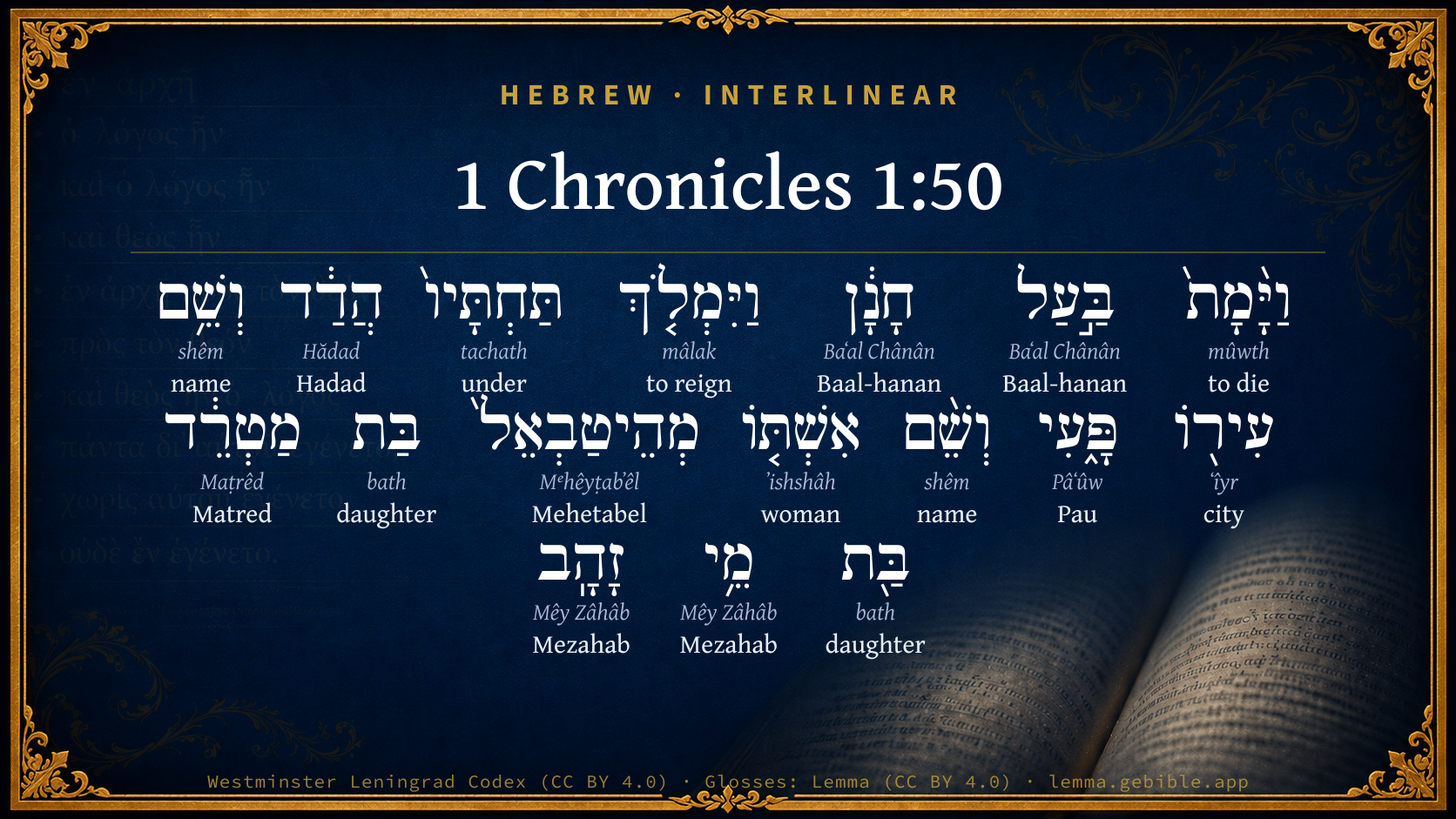
1 Chronicles 1:50

Hebrew (Westminster Leningrad Codex) 1 Chronicles 1:50 appears in the Hebrew Old Testament. The text above is from the Westminster Leningrad Codex. Each word links to its Strong’s number, a concise gloss, and parsing drawn from the Open Scriptures Hebrew Bible morphology. Click any word for its full Brown-Driver-Briggs (BDB) entry.
Download image
Cite this verse

1 Chronicles 1:50 (World English Bible). Public Domain. Lemma interlinear Bible study tool, https://lemma.gebible.app/v/1-chronicles/1/50.

Show BibTeX & RIS
BibTeX
RIS
English Translation
Baal Hanan died, and Hadad reigned in his place; and the name of his city was Pai: and his wife's name was Mehetabel, the daughter of Matred, the daughter of Me-zahab.
World English Bible · Public Domain
Download a study sheet

One document with this verse’s original text, its word-by-word gloss line, the meaning frame, cross-references with their text, attributed commentary, and full source and license credits — printable, and it pastes into notes with its structure intact.

This verse Autodidact and up

Study sheet (.html) Plain text (.txt)

A passage Seminary Student

Up to 50 verses in one chapter. A passage sheet keeps up to 6 commentary sources and 12 cross-references per verse, in the order this page ranks them, and says so on the sheet whenever that leaves anything out. Ask for a single verse and you get the Autodidact verse sheet above.

Everything on this page stays free to read, with no account — the sheet is a download of what is already on screen, not access to it.

Want to remove ads? Support Godless Engineer
Compare translations 3

The same verse in 3 English versions, stacked beneath the original-language interlinear above. Click any original word for its lexicon entry.

Each is an independent rendering of the whole verse — the interlinear is not word-aligned to these translations.

Highlighted words mark where these versions differ — a whole-verse word diff, not a word-by-word alignment.

  • World English Bible Public Domain
    Baal Hanan died, and Hadad reigned in his place; and the name of his city was Pai: and his wife's name was Mehetabel, the daughter of Matred, the daughter of Me-zahab.
  • King James Version Public Domain
    And when Baalhanan was dead, Hadad reigned in his stead: and the name of his city was Pai; and his wife's name was Mehetabel, the daughter of Matred, the daughter of Mezahab.
  • unfoldingWord Literal Text CC BY-SA 4.0
    And Baal Hanan died, and Hadad reigned in his place. And the name of his city Pai. And the name of his wife Mehetabel, the daughter of Matred, the daughter of Mezahab. ts*

unfoldingWord Literal Text — © unfoldingWord, licensed CC BY-SA 4.0. Word-aligned USFM3 via Door43 (git.door43.org/unfoldingWord/en_ult).

Versions to compare (up to 4)

3 of 4 selected

Show all 18 translations

Every available English version of this verse, each an independent rendering of the whole verse.

  • World English Bible Public Domain
    Baal Hanan died, and Hadad reigned in his place; and the name of his city was Pai: and his wife's name was Mehetabel, the daughter of Matred, the daughter of Me-zahab.
  • Berean Standard Bible Public Domain
    When Baal-hanan died, Hadad reigned in his place. His city was named Pau, and his wife’s name was Mehetabel daughter of Matred, the daughter of Me-zahab.
  • Majority Standard Bible Public Domain
    When Baal-hanan died, Hadad reigned in his place. His city was named Pau, and his wife’s name was Mehetabel daughter of Matred, the daughter of Me-zahab.
  • King James Version Public Domain
    And when Baalhanan was dead, Hadad reigned in his stead: and the name of his city was Pai; and his wife's name was Mehetabel, the daughter of Matred, the daughter of Mezahab.
  • American Standard Version (1901) Public Domain
    And Baal-hanan died, and Hadad reigned in his stead; and the name of his city was Pai: and his wife's name was Mehetabel, the daughter of Matred, the daughter of Me-zahab.
  • Revised Version (1885) Public Domain
    And Baal-hanan died, and Hadad reigned in his stead; and the name of his city was Pai: and his wife’s name was Mehetabel, the daughter of Matred, the daughter of Me-zahab.
  • Geneva Bible (1599) Public Domain
    And Baal-hanan dyed, and Hadad reigned in his stead, and the name of his citie was Pai, and his wiues name Mehetabel the daughter of Matred the daughter of Mezahab.
  • Douay-Rheims (1899) Public Domain
    He also died, and Adad reigned in his stead: and the name of his city was Phau, and his wife was called Meetabel the daughter of Matred, the daughter of Mezaab.
  • Young's Literal Translation Public Domain
    and Baal-Hanan dieth, and reign in his stead doth Hadad, and the name of his city `is' Pai, and the name of his wife `is' Mehetabel daughter of Matred, daughter of Me-Zahab; Hadad also dieth.
  • Literal Standard Version CC BY-SA 4.0
    and Ba‘al-Hanan dies, and Hadad reigns in his stead, and the name of his city [is] Pai, and the name of his wife [is] Mehetabel daughter of Matred, daughter of Me-Zahab; Hadad also dies.
  • Unlocked Literal Bible CC BY-SA 4.0
    When Baal-Hanan son of Akbor died, Hadad reigned in his place. The name of his city was Pau. His wife's name was Mehetabel daughter of Matred daughter of Me-Zahab.
  • unfoldingWord Literal Text CC BY-SA 4.0
    And Baal Hanan died, and Hadad reigned in his place. And the name of his city Pai. And the name of his wife Mehetabel, the daughter of Matred, the daughter of Mezahab. ts*
  • Darby Bible Public Domain
    And Baal-hanan died; and Hadad reigned in his stead: and the name of his city was Pai; and his wife's name was Mehetabel the daughter of Matred, daughter of Mezahab.
  • World Messianic Bible Public Domain
    Baal Hanan died, and Hadad reigned in his place; and the name of his city was Pai. His wife’s name was Mehetabel, the daughter of Matred, the daughter of Mezahab.
  • Webster's Bible Public Domain
    And when Baal-hanan was dead, Hadad reigned in his stead: and the name of his city was Pai; and his wife's name was Mehetabel, the daughter of Matred, the daughter of Mezahab.
  • Free Bible Version CC BY-SA 4.0
    When Baal-Hanan died, Hadad took over as king. The name of his city was Pau. The name of his wife was Mehetabel, daughter of Matred, the daughter of Me-Zahab.
  • Bible in Basic English Public Domain
    And at the death of Baal-hanan, Hadad became king in his place; his town was named Pai, and his wife's name was Mehetabel, the daughter of Matred, the daughter of Me-zahab.
  • JPS Tanakh (1917) Public Domain
    And Baal-hanan died, and Hadad reigned in his stead; and the name of his city was Pai; and his wife's name was Mehetabel, the daughter of Matred, the daughter of Mezahab.

Literal Standard Version (2020), Covenant Press — licensed CC BY-SA 4.0. Text via the HelloAO Bible API (eBible.org). Unlocked Literal Bible (unfoldingWord) — licensed CC BY-SA 4.0. Text via the HelloAO Bible API (eBible.org). unfoldingWord Literal Text — © unfoldingWord, licensed CC BY-SA 4.0. Word-aligned USFM3 via Door43 (git.door43.org/unfoldingWord/en_ult). Free Bible Version, Dr. Jonathan Gallagher — licensed CC BY-SA 4.0. Text via the HelloAO Bible API (eBible.org).

Word by word

More ways to search: Search by grammar → Find every occurrence → Compare this word →

Practice this passage: Drill this verse → Learn its vocabulary →

פָּ֑עִי
Pâʻûw
H6464
“Pau”
Noun, Proper
Part of Speech
Noun
Type
Proper
Full BDB Definition

Origin: from H6463

TWOT: None

Pai or Pau = "bleating" - the capital of king Hadar of Edom; site uncertain
  1. וַיָּ֨מָת֙ mûwth H4191 “and · to die” Conjunction + Verb, Qal, Sequential Imperfect, 3rd Person, Masculine, Singular
  2. בַּ֣עַל Baʻal Chânân H1177 “Baal-hanan” Noun, Proper
  3. חָנָ֔ן Baʻal Chânân H1177 “Baal-hanan” Noun, Proper
  4. וַיִּמְלֹ֤ךְ mâlak H4427 “and · to reign” Conjunction + Verb, Qal, Sequential Imperfect, 3rd Person, Masculine, Singular
  5. תַּחְתָּיו֙ tachath H8478 “under · him” Preposition + Suffix, Personal, 3rd Person, Masculine, Singular
  6. הֲדַ֔ד Hădad H1908 “Hadad” Noun, Proper
  7. וְשֵׁ֥ם shêm H8034 “and · name of” Conjunction + Noun, Common, Masculine, Singular, Construct
  8. עִיר֖וֹ ʻîyr H5892 “city · his” Noun, Common, Feminine, Singular, Construct + Suffix, Personal, 3rd Person, Masculine, Singular
  9. וְשֵׁ֨ם shêm H8034 “and · name of” Conjunction + Noun, Common, Masculine, Singular, Construct
  10. אִשְׁתּ֤וֹ ʼishshâh H802 “woman · his” Noun, Common, Feminine, Singular, Construct + Suffix, Personal, 3rd Person, Masculine, Singular
  11. מְהֵיטַבְאֵל֙ Mᵉhêyṭabʼêl H4105 “Mehetabel” Noun, Proper
  12. בַּת bath H1323 “daughter of” Noun, Common, Feminine, Singular, Construct
  13. מַטְרֵ֔ד Maṭrêd H4308 “Matred” Noun, Proper
  14. בַּ֖ת bath H1323 “daughter of” Noun, Common, Feminine, Singular, Construct
  15. מֵ֥י Mêy Zâhâb H4314 “Mezahab” Noun, Proper
  16. זָהָֽב Mêy Zâhâb H4314 “Mezahab” Noun, Proper

About this verse

These counts appear in no published source. They are computed here, from the morphology-tagged text and Lemma’s own curated glosses. What Lemma adds →

17
words
13
distinct lemmas
Historical
section

Notable vocabulary

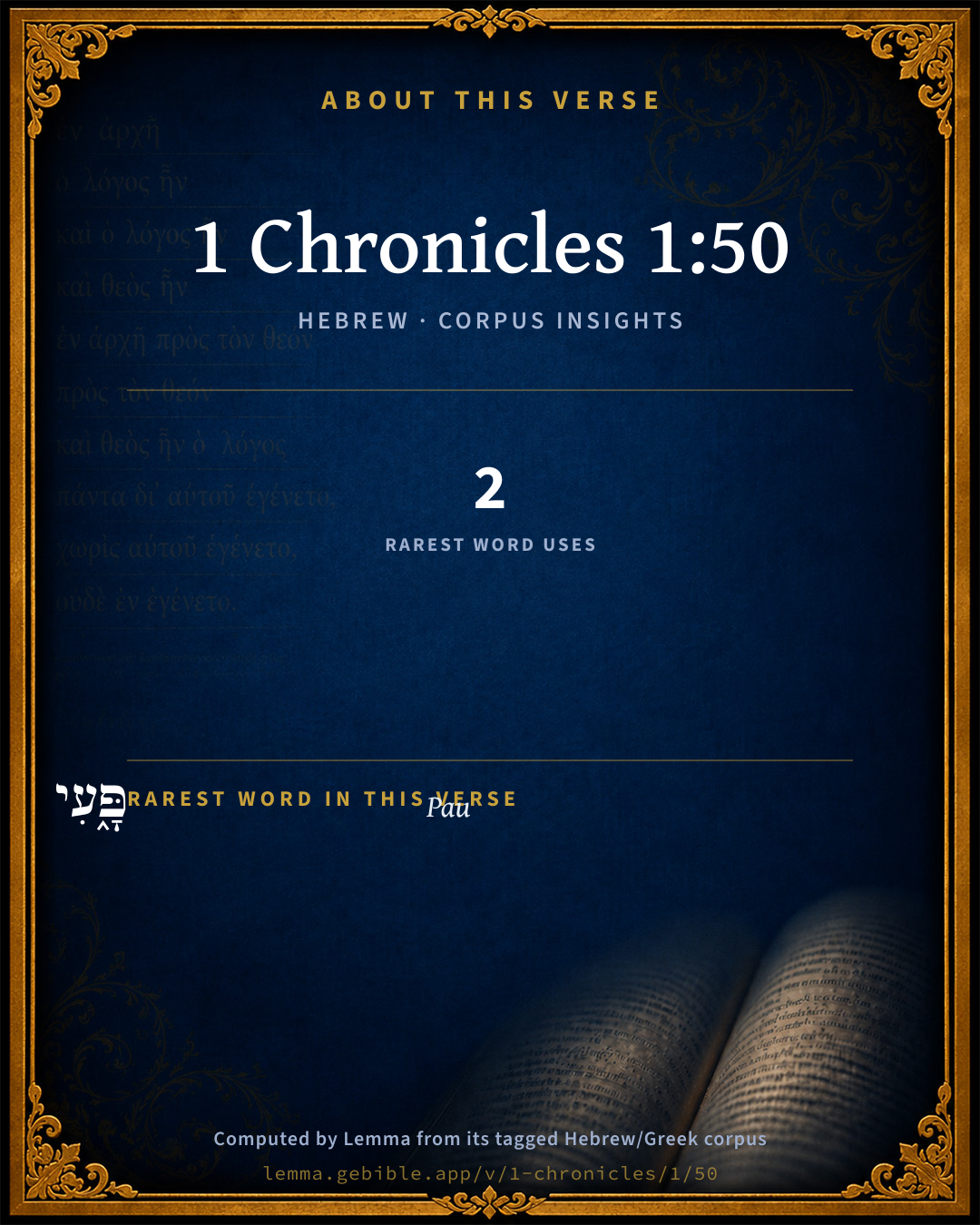
The rarest word here is פָּ֑עִי Pau H6464 — appearing just 2 times in the whole Hebrew Bible.

Shared distinctive vocabulary

פָּ֑עִי Pau H6464 occurs in 2 verses of the Hebrew Bible. Also found in:

Grammatical profile

  • 2 verbs
  • 14 nouns
  • 1 preposition

Verb forms

  • וַיָּ֨מָת֙ Qal · Sequential Imperfect
  • וַיִּמְלֹ֤ךְ Qal · Sequential Imperfect

Repetition

Words recur within this verse — often emphatic in Hebrew:

  • בַּ֣עַל Baal-hanan H1177 ×2
  • וְשֵׁ֥ם name H8034 ×2
  • בַּת daughter H1323 ×2
  • מֵ֥י Mezahab H4314 ×2

Hebrew & Septuagint length

In English translation the verse runs 31 words from the Hebrew and 20 from the Septuagint (LXX English) — the Septuagint runs noticeably shorter here. See the side-by-side →

A rough comparison of the two English renderings, which tokenize alike — not a word-level alignment.

Word counts can differ between the Hebrew and the Greek without any difference in meaning — e.g. the Hebrew direct-object marker אֵת has no separate Greek word, and Greek often adds the article ὁ.

Cross-references

1

Topical passages linked to 1 Chronicles 1:50 in the Treasury of Scripture Knowledge — connected by theme and wording, ordered by reader-vote popularity; previews shown in the World English Bible.

  • Genesis 36:39 Baal Hanan the son of Achbor died, and Hadar reigned in his place. The name of his city was Pau. His wife's name was Mehetabel, the daughter of Matred, the daughter of Me-zahab.

Cross-references courtesy of OpenBible.info (CC BY 4.0).

Hebrew and Greek witnesses Masoretic Hebrew ↔ Greek Septuagint

The same verse in the two great witnesses to the Old Testament, shown verse-for-verse.

Here the Septuagint runs noticeably shorter than the Hebrew — LXX2012 (modern English Septuagint) 20 words vs World English Bible 31. A rough length comparison of the two English translations, not a word-level alignment — read both below.

These are two independent witnesses, not word-aligned to each other, and the Septuagint is shown in lemma (dictionary) form.

Hebrew 1 Chronicles 1:50 Masoretic · Westminster Leningrad Codex

וַיָּ֨מָת֙ בַּ֣עַל חָנָ֔ן וַיִּמְלֹ֤ךְ תַּחְתָּיו֙ הֲדַ֔ד וְשֵׁ֥ם עִיר֖וֹ פָּ֑עִי וְשֵׁ֨ם אִשְׁתּ֤וֹ מְהֵיטַבְאֵל֙ בַּת מַטְרֵ֔ד בַּ֖ת מֵ֥י זָהָֽב

Baal Hanan died, and Hadad reigned in his place; and the name of his city was Pai: and his wife's name was Mehetabel, the daughter of Matred, the daughter of Me-zahab.

World English Bible · Public Domain

Greek LXX 1 Chronicles 1:50 Septuagint · lemma form
And Balaennor died, and Adad son of Barad reigned in his stead; and the name of his city was Phogor.

LXX2012 (modern English Septuagint) · Public Domain

Hebrew: Westminster Leningrad Codex (CC BY 4.0). Greek: Septuagint (public domain); English from LXX2012 (modern English Septuagint) (Public Domain). How the Septuagint differs from the Hebrew →

Commentary

Notes on 1 Chronicles 1:50 from classic Christian and Jewish commentators (each source and its license shown beneath its notes). The classic Christian expositions comment on the surrounding passage and are grouped to its opening verse, so a note may address several verses; the Jewish commentaries on the Tanakh (Rashi and others) are per-verse, so they appear only where the commentator wrote on this verse.

Lemma curates 59 commentaries, every one of them public domain or Creative Commons licensed, each selected and text-cleaned for this edition rather than reprinted as found. About our sources →

Trapp's Complete Commentary

John Trapp

1Ch 1:50 And when Baalhanan was dead, Hadad reigned in his stead: and the name of his city [was] Pai; and his wife’s name [was] Mehetabel, the daughter of Matred, the daughter of Mezahab.

Ver. 50. Baalhanan.] Or Hannibal.

John Trapp, A Commentary or Exposition upon All the Books of the Old and New Testament (1647–1656) — public domain. Text from a community e-Sword module.

Geneva Bible (1599)

Geneva Bible translators

Or, Pau.

Geneva Bible (1599) marginal notes — public domain. Text via Bolls.life.

Adam Clarke's Commentary

Verse 50. Daughter of Mezahab.] This word מי זהב mey zahab, is literally the golden waters; or What is gold? The Targumist paraphrases thus: "Mehetabel, the daughter of Matred, was so earnest and diligent in business that she became immensely rich; but when she was converted, she said, What is this silver, and What is this gold? That is, They are of no real worth."

Adam Clarke's Commentary on the Bible (1810–1826) — public domain. Text from a community e-Sword/MySword module.

Ellicott's Commentary for English Readers

(50) Baal-hanan.—Some MSS. have “ben Achbor,” as in Gen_36:39; so in 1Ch_1:51. “Alvah,” of Genesis, is more correct than our “Aliah.” The Hebrew margin reads “Alvah” (Alwah).

Pai.—Many MSS. have “Pau,” the reading of Gen., which is right. Hadar (Gen_36:39), on the other hand, is probably a mistake for Hadad.

Mehetabel.—El benefiteth. Perhaps Mehetabel was an Israelite, as no other queen of Edom is mentioned. But her name is Aramean.

A Bible Commentary for English Readers, edited by Charles John Ellicott (1878–1897) — public domain. Text from a community e-Sword module.

The Cambridge Bible for Schools and Colleges

gen. ed. J. J. S. Perowne

50. Hadad] As in 1Ch_1:46; in Gen_36:39, “Hadar.”

51a. Hadad died also] R.V. And Hadad died. The words are repeated by a copyist’s error from 1Ch_1:47 (R.V. “And Hadad died,” as here); they are not found in Genesis.

The Cambridge Bible for Schools and Colleges (gen. ed. J. J. S. Perowne; Cambridge University Press, 1878–1918) — public domain. Text from a community e-Sword module.

Haydock's Catholic Bible Commentary

Mezaab. It is unusual for the Scripture to mark so particularly the genealogy of a woman. We might translate the Hebrew, "a native, or who was a native of Mezaab," which is probably the same with Dizahab, "abundance of gold," Deuteronomy i. 1. Mezaab signifies, "waters of gold," (Calmet) or "whose is gold," whence some infer that the woman was very rich, (Lyranus) or had discovered the art of drawing gold thread. (Abulensis) --- It is more probably a proper name. (Menochius)

George Leo Haydock (1774–1849), Haydock's Catholic Family Bible and Commentary, 1859 edition — public domain. Excludes Psalms (Douay-Rheims chapter numbering differs from Protestant) and Deuterocanonical books (Catholic canon only).

Lesson kit

Teaching starters — assembled from the data on this page, not authored interpretation. Every prompt links to the verse data it draws on. Edit before teaching.

1 Chronicles, in the Historical, opens this verse with 17 words (13 distinct Hebrew lemmas). Its most distinctive word is Pâʻûw (“Pau”). The Greek Septuagint runs shorter here. A historical commentator’s framing appears above. Read the whole chapter for the surrounding context.

Discussion questions

  1. How does “Pau” (Pâʻûw) shape what this verse is saying?
  2. How does Genesis 36:39, which shares the word «Pau», read alongside this verse?
  3. What does the repetition of “Baal-hanan” (2× in this one verse) do in this verse?
  4. The Septuagint runs shorter here than the Hebrew. What might account for the difference?
  5. These translations render this verse differently; the difference is in the English rendering, not the original. What questions does that raise?
  6. «וַיָּ֨מָת֙» is a Qal Sequential Imperfect verb. How does that grammatical form shape the action described?
  7. Compare how Trapp's Complete Commentary and Geneva Bible (1599) read this verse. Where do they agree or differ?

Things to notice

Reading settings

Reading text

Shown beneath each verse's original-language words.

Old Testament
Old Testament edition

Read the OT as the Masoretic Hebrew (MT) or the Greek Septuagint (LXX).

English shown for the Greek Septuagint (in the Hebrew ↔ Greek comparison).

Comparing translations? Open the Compare panel on any verse page to stack up to four side by side.