
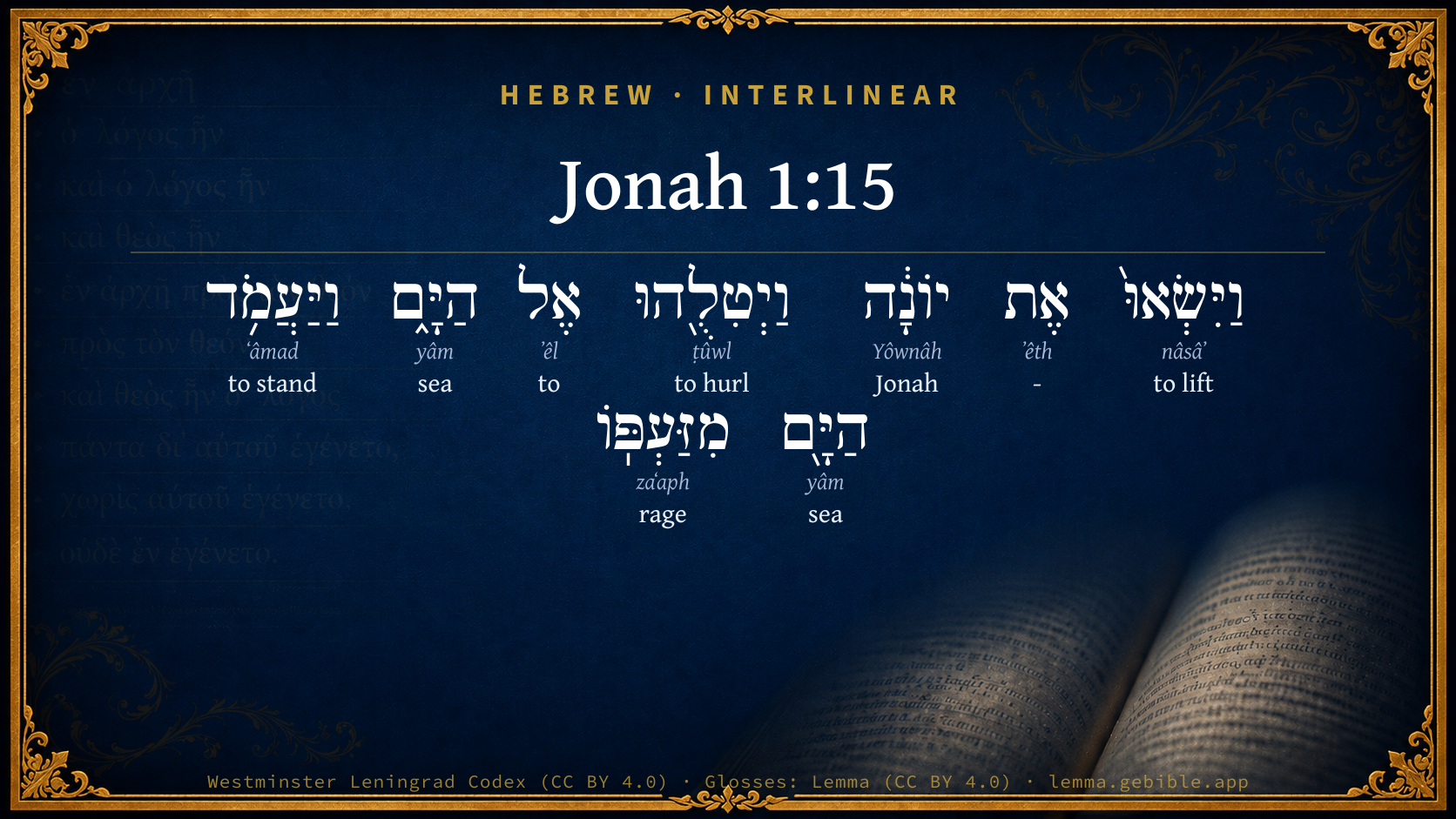
Jonah 1:15

Hebrew (Westminster Leningrad Codex) Jonah 1:15 appears in the Hebrew Old Testament. The text above is from the Westminster Leningrad Codex. Each word links to its Strong’s number, a concise gloss, and parsing drawn from the Open Scriptures Hebrew Bible morphology. Click any word for its full Brown-Driver-Briggs (BDB) entry.
Download image
Cite this verse

Jonah 1:15 (World English Bible). Public Domain. Lemma interlinear Bible study tool, https://lemma.gebible.app/v/jonah/1/15.

Show BibTeX & RIS
BibTeX
RIS
English Translation
So they took up Jonah, and threw him into the sea; and the sea ceased its raging.
World English Bible · Public Domain
Download a study sheet

One document with this verse’s original text, its word-by-word gloss line, the meaning frame, cross-references with their text, attributed commentary, and full source and license credits — printable, and it pastes into notes with its structure intact.

This verse Autodidact and up

Study sheet (.html) Plain text (.txt)

A passage Seminary Student

Up to 50 verses in one chapter. A passage sheet keeps up to 6 commentary sources and 12 cross-references per verse, in the order this page ranks them, and says so on the sheet whenever that leaves anything out. Ask for a single verse and you get the Autodidact verse sheet above.

Everything on this page stays free to read, with no account — the sheet is a download of what is already on screen, not access to it.

Want to remove ads? Support Godless Engineer
Compare translations 3

The same verse in 3 English versions, stacked beneath the original-language interlinear above. Click any original word for its lexicon entry.

Each is an independent rendering of the whole verse — the interlinear is not word-aligned to these translations.

Highlighted words mark where these versions differ — a whole-verse word diff, not a word-by-word alignment.

  • World English Bible Public Domain
    So they took up Jonah, and threw him into the sea; and the sea ceased its raging.
  • King James Version Public Domain
    So they look up Jonah, and cast him forth into the sea: and the sea ceased from her raging.
  • unfoldingWord Literal Text CC BY-SA 4.0
    So they lifted up Jonah and threw him into the sea, and the sea ceased from its raging.

unfoldingWord Literal Text — © unfoldingWord, licensed CC BY-SA 4.0. Word-aligned USFM3 via Door43 (git.door43.org/unfoldingWord/en_ult).

Versions to compare (up to 4)

3 of 4 selected

Show all 18 translations

Every available English version of this verse, each an independent rendering of the whole verse.

  • World English Bible Public Domain
    So they took up Jonah, and threw him into the sea; and the sea ceased its raging.
  • Berean Standard Bible Public Domain
    At this, they picked up Jonah and cast him into the sea, and the raging sea grew calm.
  • Majority Standard Bible Public Domain
    Then they picked up Jonah and cast him into the sea, and the raging sea grew calm.
  • King James Version Public Domain
    So they look up Jonah, and cast him forth into the sea: and the sea ceased from her raging.
  • American Standard Version (1901) Public Domain
    So they took up Jonah, and cast him forth into the sea; and the sea ceased from its raging.
  • Revised Version (1885) Public Domain
    So they took up Jonah, and cast him forth into the sea: and the sea ceased from her raging.
  • Geneva Bible (1599) Public Domain
    So they tooke vp Ionah, and cast him into the sea, and the sea ceased from her raging.
  • Douay-Rheims (1899) Public Domain
    And they took Jonas, and cast him into the sea, and the sea ceased from raging.
  • Young's Literal Translation Public Domain
    And they lift up Jonah, and cast him into the sea, and the sea ceaseth from its raging;
  • Literal Standard Version CC BY-SA 4.0
    And they lift up Jonah, and cast him into the sea, and the sea ceases from its raging;
  • Unlocked Literal Bible CC BY-SA 4.0
    So they picked up Jonah and threw him into the sea, and the sea stopped raging.
  • unfoldingWord Literal Text CC BY-SA 4.0
    So they lifted up Jonah and threw him into the sea, and the sea ceased from its raging.
  • Darby Bible Public Domain
    And they took up Jonah, and cast him forth into the sea: and the sea ceased from its raging.
  • World Messianic Bible Public Domain
    So they took up Jonah and threw him into the sea; and the sea ceased its raging.
  • Webster's Bible Public Domain
    So they took Jonah, and cast him into the sea: and the sea ceased from her raging.
  • Free Bible Version CC BY-SA 4.0
    So they picked Jonah up and threw him into the sea, and it became calm.
  • Bible in Basic English Public Domain
    So they took Jonah up and put him into the sea: and the sea was no longer angry.
  • JPS Tanakh (1917) Public Domain
    So they took up Jonah, and cast him forth into the sea; and the sea ceased from its raging.

Literal Standard Version (2020), Covenant Press — licensed CC BY-SA 4.0. Text via the HelloAO Bible API (eBible.org). Unlocked Literal Bible (unfoldingWord) — licensed CC BY-SA 4.0. Text via the HelloAO Bible API (eBible.org). unfoldingWord Literal Text — © unfoldingWord, licensed CC BY-SA 4.0. Word-aligned USFM3 via Door43 (git.door43.org/unfoldingWord/en_ult). Free Bible Version, Dr. Jonathan Gallagher — licensed CC BY-SA 4.0. Text via the HelloAO Bible API (eBible.org).

Word by word

More ways to search: Search by grammar → Find every occurrence → Compare this word →

Practice this passage: Drill this verse → Learn its vocabulary →

מִזַּעְפּֽוֹ
zaʻaph
H2197
“from · rage · him”
Preposition + Verb, Qal, Infinitive Construct + Suffix, Personal, 3rd Person, Masculine, Singular
Part of Speech
Preposition + Verb
Stem
Qal
Form
Infinitive Construct
Full BDB Definition

Origin: from H2196

TWOT: 569a

rage, raging, storming, indignation
  1. וַיִּשְׂאוּ֙ nâsâʼ H5375 “and · to lift” Conjunction + Verb, Qal, Sequential Imperfect, 3rd Person, Masculine, Plural
  2. אֶת ʼêth H853 “-” Particle, Direct Object
  3. יוֹנָ֔ה Yôwnâh H3124 “Jonah” Noun, Proper
  4. וַיְטִלֻ֖הוּ ṭûwl H2904 “and · to hurl · him” Conjunction + Verb, Hiphil, Sequential Imperfect, 3rd Person, Masculine, Plural + Suffix, Personal, 3rd Person, Masculine, Singular
  5. אֶל ʼêl H413 “to” Preposition
  6. הַיָּ֑ם yâm H3220 “the · sea” Particle, Definite Article + Noun, Common, Masculine, Singular, Absolute
  7. וַיַּעֲמֹ֥ד ʻâmad H5975 “and · to stand” Conjunction + Verb, Qal, Sequential Imperfect, 3rd Person, Masculine, Singular
  8. הַיָּ֖ם yâm H3220 “the · sea” Particle, Definite Article + Noun, Common, Masculine, Singular, Absolute

About this verse

These counts appear in no published source. They are computed here, from the morphology-tagged text and Lemma’s own curated glosses. What Lemma adds →

9
words
8
distinct lemmas
Prophets
section

Notable vocabulary

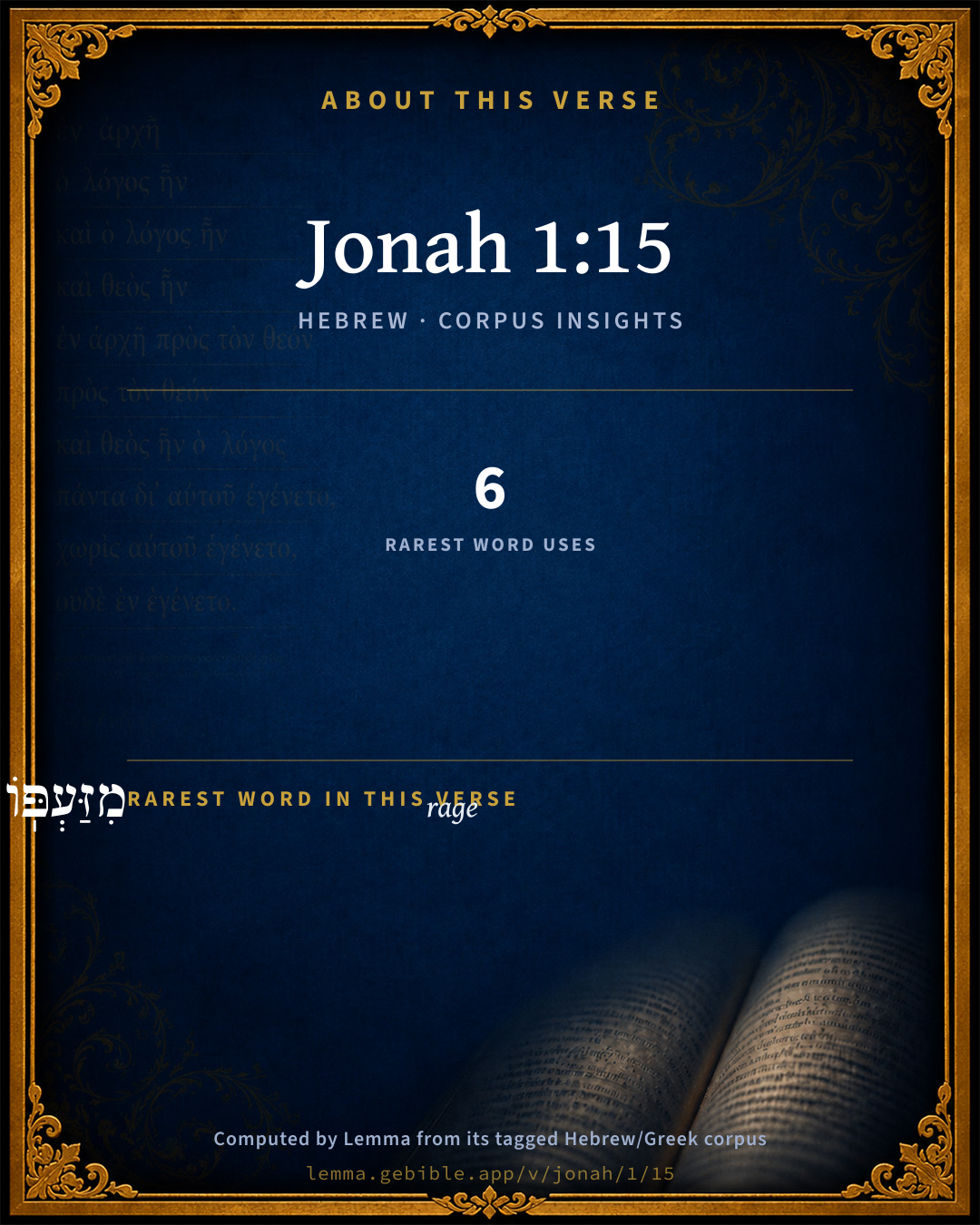
The rarest word here is מִזַּעְפּֽוֹ rage H2197 — appearing just 6 times in the whole Hebrew Bible.

Shared distinctive vocabulary

מִזַּעְפּֽוֹ rage H2197 occurs in 6 verses of the Hebrew Bible. Also found in:

Grammatical profile

  • 4 verbs
  • 3 nouns
  • 1 preposition
  • 1 particle

Verb forms

  • וַיִּשְׂאוּ֙ Qal · Sequential Imperfect
  • וַיְטִלֻ֖הוּ Hiphil · Sequential Imperfect
  • וַיַּעֲמֹ֥ד Qal · Sequential Imperfect
  • מִזַּעְפּֽוֹ Qal · Infinitive Construct

Repetition

A word recurs within this verse — often emphatic in Hebrew:

  • הַיָּ֑ם sea H3220 ×2

Hebrew & Septuagint length

In English translation the verse runs 17 words from the Hebrew and 18 from the Septuagint (LXX English) — closely comparable.

A rough comparison of the two English renderings, which tokenize alike — not a word-level alignment.

Word counts can differ between the Hebrew and the Greek without any difference in meaning — e.g. the Hebrew direct-object marker אֵת has no separate Greek word, and Greek often adds the article ὁ.

Cross-references

8

Topical passages linked to Jonah 1:15 in the Treasury of Scripture Knowledge — connected by theme and wording, ordered by reader-vote popularity; previews shown in the World English Bible.

  • Psalms 93:3–4 The floods have lifted up, Yahweh, The floods have lifted up their voice. The floods lift up their waves.
  • Luke 8:24 They came to him, and awoke him, saying, "Master, master, we are dying!" He awoke, and rebuked the wind and the raging of the water, and they ceased, and it was calm.
  • Psalms 89:9 You rule the pride of the sea. When its waves rise up, you calm them.
  • Psalms 107:29 He makes the storm a calm, So that its waves are still.
  • Psalms 65:7 Who stills the roaring of the seas, The roaring of their waves, And the turmoil of the nations.
  • Matthew 8:26 He said to them, "Why are you fearful, oh you of little faith?" Then he got up, rebuked the wind and the sea, and there was a great calm.
  • Joshua 7:24–26 Joshua, and all Israel with him, took Achan the son of Zerah, and the silver, and the mantle, and the wedge of gold, and his sons, and his daughters, and his oxen, and his donkeys, and his sheep, and his tent, and all that he had: and they brought them up to the valley of Achor.
  • 2 Samuel 21:8–9 But the king took the two sons of Rizpah the daughter of Aiah, whom she bore to Saul, Armoni and Mephibosheth; and the five sons of Michal the daughter of Saul, whom she bore to Adriel the son of Barzillai the Meholathite:

Cross-references courtesy of OpenBible.info (CC BY 4.0).

Hebrew and Greek witnesses Masoretic Hebrew ↔ Greek Septuagint

The same verse in the two great witnesses to the Old Testament, shown verse-for-verse.

These are two independent witnesses, not word-aligned to each other, and the Septuagint is shown in lemma (dictionary) form.

Hebrew Jonah 1:15 Masoretic · Westminster Leningrad Codex

וַיִּשְׂאוּ֙ אֶת יוֹנָ֔ה וַיְטִלֻ֖הוּ אֶל הַיָּ֑ם וַיַּעֲמֹ֥ד הַיָּ֖ם מִזַּעְפּֽוֹ

So they took up Jonah, and threw him into the sea; and the sea ceased its raging.

World English Bible · Public Domain

Greek LXX Jonah 1:15 Septuagint · lemma form

καί λαμβάνω ὁ ιωνας καί ἐκβάλλω αὐτός εἰς ὁ θάλασσα καί ἵστημι ὁ θάλασσα ἐκ ὁ σάλος αὐτός

So they took Jonas, and cast him out into the sea: and the sea ceased from its raging.

LXX2012 (modern English Septuagint) · Public Domain

On this verse, The Pulpit Commentary discusses the Septuagint’s reading. Read the note in Commentary ↓

Hebrew: Westminster Leningrad Codex (CC BY 4.0). Greek: Septuagint (public domain); English from LXX2012 (modern English Septuagint) (Public Domain). How the Septuagint differs from the Hebrew →

Targum (Aramaic paraphrase)

1

The Targum is the ancient Jewish Aramaic paraphrase of the Hebrew Scriptures — an interpretive translation, not the Hebrew text itself. Onkelos (literal) and Pseudo-Jonathan (expansive) render the Torah, and Jonathan the Prophets. Coverage is partial: where no permissively-licensed English translation exists for a verse, only the Aramaic is shown. This is verse-level text, not a word-by-word alignment to the Hebrew.

  1. Targum Jonathan Prophets (Joshua–Malachi)
    וּנְסִיבוּ יַת יוֹנָה וּרְמוֹהִי לְיַמָא וְנַח יַמָא מִנַחְשׁוֹלֵיהּ:

    And they lifted up Jonah and threw him into the sea, and the sea calmed from its cyclone.

    Targum Jonathan — Aramaic: “Mikraot Gedolot” (public domain). English: “Sefaria Community Translation” (CC0 1.0 (public-domain dedication)); “London "Chaldee Paraphrase," 1871” (public domain). Text via Sefaria.

Commentary

Notes on Jonah 1:15 from classic Christian and Jewish commentators (each source and its license shown beneath its notes). The classic Christian expositions comment on the surrounding passage and are grouped to its opening verse, so a note may address several verses; the Jewish commentaries on the Tanakh (Rashi and others) are per-verse, so they appear only where the commentator wrote on this verse.

Lemma curates 59 commentaries, every one of them public domain or Creative Commons licensed, each selected and text-cleaned for this edition rather than reprinted as found. About our sources →

Trapp's Complete Commentary

John Trapp

Jon 1:15 So they took up Jonah, and cast him forth into the sea: and the sea ceased from her raging.

Ver. 15. So they took up Jonah] Not against his will, but in a sort offering himself to condign punishment. The mariners had tried all ways to save him, till they saw they must either destroy him or be destroyed with him. So deal many with their beloved sins, which they are loth to mortify, they see they must either kill or be killed, Rom 8:13; either turn from them to God, or burn for ever in hell. Jonah’s charity is exemplary, who yielded to perish alone rather than to have others perish with him and for him; the devil and his imps desire to draw company the same way with themselves; and say, as that wretch of old, When I die, may the earth be all fired, εμου θαναντος γαια μιχθητω τυρι εμου δε ζωντος dixit Caligula .

And cast him forth into the sea] Thus dealeth God by his servant Jonah; formerly faithful in his office, and able thereunto, and therefore sent to Nineveh. "Behold, the righteous shall be recompensed in the earth," Pro 11:31; here they are sure of their payment, neither can all their good deeds bear out one prepensed wickedness of a lesser fault that lies unrepented for, as were easy to instance in Moses, Miriam, David, and others. And all this proceeds from love displeased.

And the sea ceased from raging] Heb. stood from its wrath, or indignation. Nee marls ira manet (Ovid. Metam.). Nec horret iratum mare (Horat. lib. Epod.). The sea having found what it sought for, and now possessed of the prisoner it pursued, resteth quiet and content; Vide hic mare et disce sapere, saith one; see the sea here, and learn obedience to thy Creator, since winds, waves, and all are at his beck and check. See Mat 8:26.

John Trapp, A Commentary or Exposition upon All the Books of the Old and New Testament (1647–1656) — public domain. Text from a community e-Sword module.

Jamieson, Fausset & Brown

Robert Jamieson, A. R. Fausset & David Brown

sea ceased . . . raging--so at Jesus' word (). God spares the prayerful penitent, a truth illustrated now in the case of the sailors, presently in that of Jonah, and thirdly, in that of Nineveh.

Jamieson, Fausset & Brown — Commentary Critical and Explanatory on the Whole Bible (1871) — public domain (CC PDM 1.0). Text via the HelloAO Bible API.

John Calvin's Commentaries

Jonah shows here that the tempest arose through his fault; for the issue proved this with certainty. The sailors had not only cast lots, but after Jonah was thrown into the sea the storm calmed, and the sea became still, — this sudden change sufficiently proved that Jonah was the only cause why they were so nearly shipwrecked. For if the sea had not calmed immediately, but after some interval of time, it might have been ascribed to chance: but as the sea instantly rested, it could not be otherwise said than that Jonah was condemned by the judgment of God. He was indeed cast into the sea by the hands of men; but God so presided, that nothing could be ascribed to men, but that they executed the judgment which the Lord had openly demanded and required from them. This, then, is the import of this verse. He now adds —

John Calvin's Commentaries (1540-1563) — public domain. Text from the Calvin Translation Society English edition (1840s-50s) via the Christian Classics Ethereal Library (ccel.org). Calvin's coverage is partial (roughly two-thirds of the Bible); uncommented books and verses are honest gaps, never fabricated. The 19th-century editor's footnotes and remarks are omitted so the notes are faithfully Calvin's own voice.

Ellicott's Commentary for English Readers

(15) Raging.—Comp. maris ira, Ovid. Met. i. 330; iratum mare, Hor. Epod. ii.57.

“At whose burden

The angered ocean foams.”

SHAKESPEARE: Ant. and Cleop.

A Bible Commentary for English Readers, edited by Charles John Ellicott (1878–1897) — public domain. Text from a community e-Sword module.

The Cambridge Bible for Schools and Colleges

gen. ed. J. J. S. Perowne

15. they took up] With respect and reluctance, with no struggle on his part, or violence on theirs.

her raging] Lit., her anger. “Maris ira,” Ovid. Met. I. 330, “iratum mare,” Hor. Epod. II. 5, 6, are quoted by the commentators.

The Cambridge Bible for Schools and Colleges (gen. ed. J. J. S. Perowne; Cambridge University Press, 1878–1918) — public domain. Text from a community e-Sword module.

John Gill's Exposition

So they took up, Jonah, and cast him forth into the sea,.... They took him out of the hold or cabin where he was, and brought him upon deck; they took him, not against his will, but with his full consent, and according to the direction and advice he gave them: "they", for there were more than one employed in this affair; one or more very probably took him by the legs, and others put their hands under his arm holes, and so threw him into the sea:

and the sea ceased from her raging; immediately, and became a calm; and the wind also ceased from blowing, which is supposed; the end being answered by the storm, and the person found and obtained, what was sought after by it, it was still and quiet. The story the Jews (m) tell of his being let down into the sea to his knees, upon which the sea was calm, but became raging again upon his being taken up; and so, at the second time, to his navel; and the third time to his neck; is all fabulous; but he being wholly thrown in, it raged no more.

(m) Pirke Eliezer, c. 10. fol. 10. 2.

John Gill's Exposition of the Whole Bible (1746–1763) — public domain (CC PDM 1.0). Text via the HelloAO Bible API.

Albert Barnes' Notes on the Bible

They took up Jonah - o “He does not say, ‘laid hold on him’, nor ‘came upon him’ but ‘lifted’ him; as it were, bearing him with respect and honor, they cast him into the sea, not resisting, but yielding himself to their will.”

The sea ceased (literally “stood”) from his raging - Ordinarily, the waves still swell, when the wind has ceased. The sea, when it had received Jonah, was hushed at once, to show that God alone raised and quelled it. It “stood” still, like a servant, when it had accomplished its mission. God, who at all times saith to it Job 38:11, “Hitherto shalt thou come and no further, and here shall thy proud waves be stayed,” now unseen, as afterward in the flesh Mat 8:26, “rebuked the winds and the sea, and there was a great calm” . “If we consider the errors of the world before the Passion of Christ, and the conflicting blasts of diverse doctrines, and the vessel, and the whole race of man, i. e., the creature of the Lord, imperiled, and, after His Passion, the tranquility of faith and the peace of the world and the security of all things and the conversion to God, we shall see how, after Jonah was cast in, the sea stood from its raging” . “Jonah, in the sea, a fugitive, shipwrecked, dead, sayeth the tempest-tossed vessel; he sayeth the pagan, aforetime tossed to and fro by the error of the world into divers opinions. And Hosea, Amos, Isaiah, Joel, who prophesied at the same time, could not amend the people in Judaea; whence it appeared that the breakers could not be calmed, save by the death of (Him typified by) the fugitive.”

Albert Barnes' Notes on the Bible (1834–1885) — public domain. Text from a community e-Sword/MySword module.

Matthew Poole's English Annotations

So, Heb. And,

they took up Jonah; as he advised; with reset to themselves, though with full-consent of Jonah, at last they yield. Cast him forth into the sea: see Jon 1:12.

And the sea ceased from her raging; as Jonah had assured them, so they find the sea all on a sudden calm and friendly, which we must understand includes the wind sent into the sea, though it be not mentioned here.

Matthew Poole's English Annotations on the Holy Bible (1683–1685) — public domain. Text from a community e-Sword/MySword module.

Whedon's Commentary on the Bible

Daniel D. Whedon

15, 16. The prayer ended, they cast Jonah out, and immediately the sea grew calm.

The men feared Jehovah exceedingly — The sudden cessation of the tempest was unfailing evidence that the God of Jonah was the God (Mar_4:41). In his presence they were utterly helpless, and they were still more afraid (Jon_1:10).

Offered a sacrifice — Immediately. Partly to express their gratitude and partly to receive the good will and favor of Jehovah.

Made vows — The things which they might consider necessary for suitable sacrifices to this powerful God may have been scanty on the ship, therefore, they promise that on the safe completion of the voyage they will bring additional and richer gifts. Nothing more is heard of the sailors.

Daniel D. Whedon (gen. ed.), Commentary on the Old and New Testaments (1874–1909) — public domain. Text from a community e-Sword module.

The Pulpit Commentary

They took up, with a certain reverence. Ceased from her raging; literally, stood from its anger; Septuagint, esth ek tou salou authv , "stood from its tossing." The sudden cessation of the storm showed that it had been sent on Jonah"s account, and that the crew had not sinned by executing the sentence upon him. Usually it takes some time for the swell to cease after the wind has sunk: here there was suddenly a great. (Mat_8:26)

The Pulpit Commentary (1880–1919), ed. H.D.M. Spence-Jones & Joseph S. Exell — public domain. Text from a community e-Sword module.

Keil & Delitzsch

C. F. Keil & F. Delitzsch

After they had prayed thus, they cast Jonah into the sea, and "the sea stood still (ceased) from its raging." The sudden cessation of the storm showed that the bad weather had come entirely on Jonah's account, and that the sailors had not shed innocent blood by casting him into the sea. In this sudden change in the weather, the arm of the holy God was so suddenly manifested, that the sailors "feared Jehovah with great fear, and offered sacrifice to Jehovah" - not after they landed, but immediately, on board the ship - "and vowed vows," i.e., vowed that they would offer Him still further sacrifices on their safe arrival at their destination.

Keil & Delitzsch — Biblical Commentary on the Old Testament (1861–1891) — public domain (CC PDM 1.0). Text via the HelloAO Bible API. (Old Testament only.)

Lesson kit

Teaching starters — assembled from the data on this page, not authored interpretation. Every prompt links to the verse data it draws on. Edit before teaching.

Jonah, in the Prophets, opens this verse with 9 words (8 distinct Hebrew lemmas). Its most distinctive word is zaʻaph (“rage”). A historical commentator’s framing appears above. Read the whole chapter for the surrounding context.

Discussion questions

  1. What does “rage” (zaʻaph) contribute to the verse as a whole?
  2. How does 2 Chronicles 16:10, which shares the word «rage», read alongside this verse?
  3. What does the repetition of “sea” (2× in this one verse) do in this verse?
  4. These translations render this verse differently. What is at stake in choosing one wording over another?
  5. «וַיִּשְׂאוּ֙» is a Qal Sequential Imperfect verb. How does that grammatical form shape the action described?
  6. Compare how Trapp's Complete Commentary and Jamieson, Fausset & Brown read this verse. Where do they agree or differ?

Things to notice

Reading settings

Reading text

Shown beneath each verse's original-language words.

Old Testament
Old Testament edition

Read the OT as the Masoretic Hebrew (MT) or the Greek Septuagint (LXX).

English shown for the Greek Septuagint (in the Hebrew ↔ Greek comparison).

Comparing translations? Open the Compare panel on any verse page to stack up to four side by side.