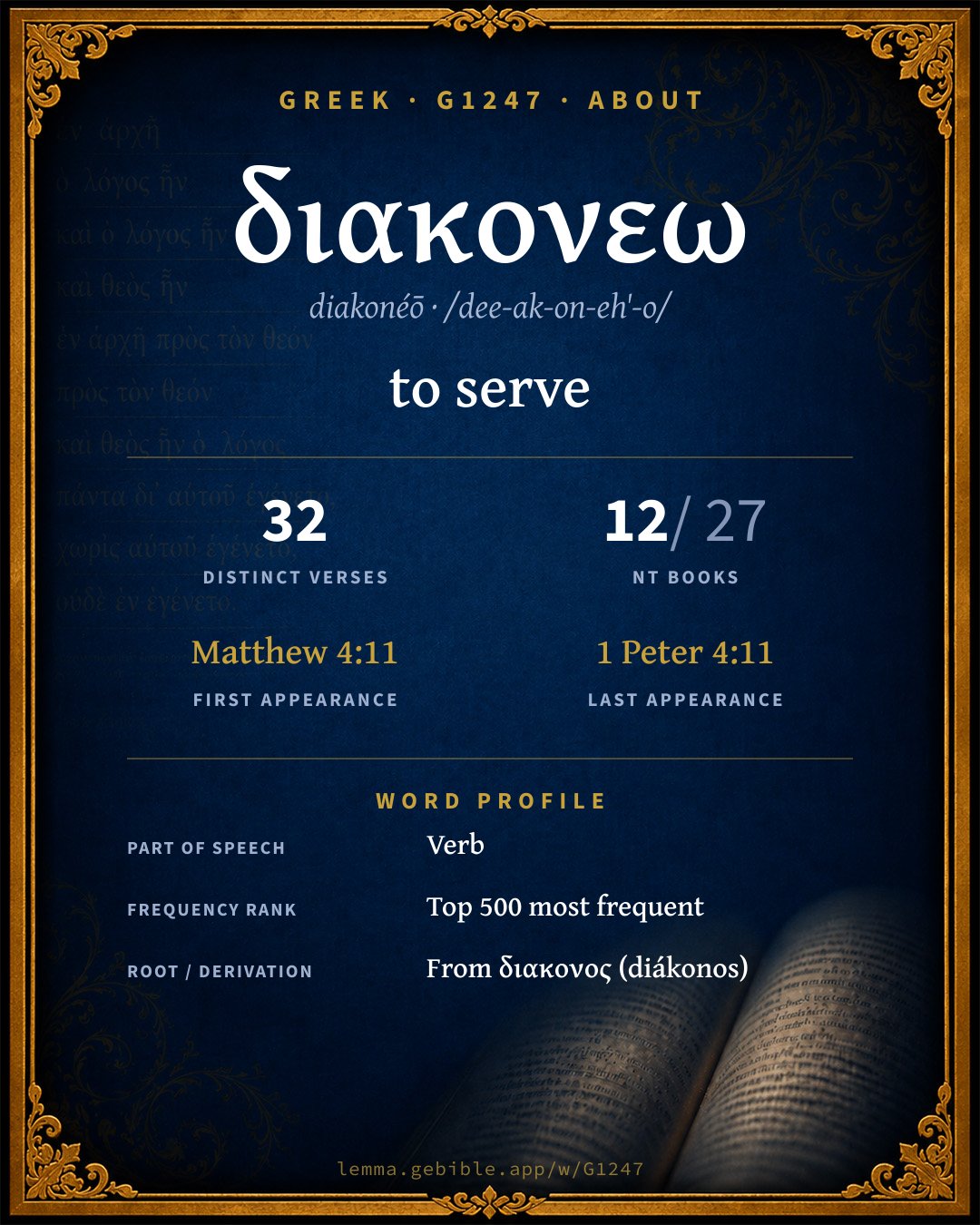
διακονέω
to serve
Full lexicon entry — Thayer's Greek Lexicon
From Thayer's Greek Lexicon
Where this word appears
See every Present-tense verb in the Greek New Testament →
Grammar key — what these labels mean
Part of speech
- Verb
- An action or state-of-being word.
Tense
- Imperfect
- Continuous or repeated action in past time (“was writing”).
- Present
- Ongoing or general action in present time (imperfective aspect).
- Aorist
- Action viewed as a simple whole, without regard to duration — often past (perfective aspect).
- Future
- Action expected in future time.
Voice
- Active
- The subject performs the action.
- Passive
- The subject receives the action.
Mood
- Indicative
- States a fact or asks a factual question (the mood of reality).
- Participle
- A verbal adjective (“writing,” “having written”).
- Subjunctive
- Expresses probability, purpose, or possibility (the mood of contingency).
- Infinitive
- A verbal noun (“to write”), unmarked for person or number.
- Imperative
- Expresses a command or request.
Case
- Nominative
- The case of the subject (and the predicate nominative).
- Dative
- The case of the indirect object, means, or location — “to / for / with / in.”
- Genitive
- The case of source, possession, or “of” — answers “whose / from what.”
Person
- 3rd person
- The one spoken about (“he / she / it / they”).
- 1st person
- The speaker (“I / we”).
- 2nd person
- The one addressed (“you”).
Gender
- Masculine
- Grammatically masculine.
- Feminine
- Grammatically feminine.
Number
- Plural
- More than one.
- Singular
- One.
Grammatical forms 19 distinct
- Verb, Imperfect, Active, Indicative, 3rd person, Plural 5 times (14%)
- Verb, Imperfect, Active, Indicative, 3rd person, Singular 4 times (11%)
- Verb, Present, Active, Participle, Nominative, Singular, Masculine 4 times (11%)
- Verb, Present, Active, Subjunctive, 3rd person, Singular 3 times (8%)
- Verb, Aorist, Active, Infinitive 2 times (5%)
- Verb, Aorist, Active, Participle, Nominative, Plural, Masculine 2 times (5%)
- Verb, Aorist, Passive, Infinitive 2 times (5%)
- Verb, Present, Active, Infinitive 2 times (5%)
+11 more forms (13 occurrences)
Parsed forms decoded from the imported morphology (Robinson–Tischendorf, public domain), counted across 37 parsed occurrences — not distinct verses.
Every verse where G1247 appears — 32 distinct verses across 12 books. Click any verse to open its interlinear word-by-word view. Verse text shown in the World English Bible for context — . Each verse’s Greek form is shown with its reference; the English is not keyword-highlighted, since the data carries no word-level English alignment. Use “Compare translations” on any verse to read it across multiple English versions. This concordance covers the Greek New Testament; Septuagint (Greek Old Testament) occurrences of this word are not indexed here.
Matthew 5 verses
- Matthew 4:11 διηκόνουν impf act ind 3pl Then the devil left him, and behold, angels came and ministered to him.
- Matthew 8:15 διηκόνει impf act ind 3sg He touched her hand, and the fever left her. She got up and served him.
- Matthew 20:28 διακονηθῆναι διακονῆσαι aor pass inf aor act inf even as the Son of Man came not to be served, but to serve, and to give his life as a ransom for many."
- Matthew 25:44 διηκονήσαμέν aor act ind 1pl "Then they will also answer, saying, 'Lord, when did we see you hungry, or thirsty, or a stranger, or naked, or sick, or in prison, and didn't help you?'
- Matthew 27:55 διακονοῦσαι pres act ptcp nom pl fem Many women were there watching from afar, who had followed Jesus from Galilee, serving him.
Mark 4 verses
- Mark 1:13 διηκόνουν impf act ind 3pl He was there in the wilderness forty days tempted by Satan. He was with the wild animals; and the angels were ministering to him.
- Mark 1:31 διηκόνει impf act ind 3sg He came and took her by the hand, and raised her up. The fever left her, and she served them.
- Mark 10:45 διακονηθῆναι διακονῆσαι aor pass inf aor act inf For the Son of Man also came not to be served, but to serve, and to give his life as a ransom for many."
- Mark 15:41 διηκόνουν impf act ind 3pl who, when he was in Galilee, followed him, and served him; and many other women who came up with him to Jerusalem.
Luke 7 verses
- Luke 4:39 διηκόνει impf act ind 3sg He stood over her, and rebuked the fever; and it left her. Immediately she rose up and served them.
- Luke 8:3 διηκόνουν impf act ind 3pl and Joanna, the wife of Chuzas, Herod's steward; Susanna; and many others; who ministered to them from their possessions.
- Luke 10:40 διακονεῖν pres act inf But Martha was distracted with much serving, and she came up to him, and said, "Lord, don't you care that my sister left me to serve alone? Ask her therefore to help me."
- Luke 12:37 διακονήσει fut act ind 3sg Blessed are those servants, whom the lord will find watching when he comes. Most assuredly I tell you, that he will dress himself, and make them recline, and will come and serve them.
- Luke 17:8 διακόνει pres act impv 2sg and will not rather tell him, 'Prepare my supper, clothe yourself properly, and serve me, while I eat and drink. Afterward you shall eat and drink'?
- Luke 22:26 διακονῶν pres act ptcp nom sg masc But not so with you. But one who is the greater among you, let him become as the younger, and one who is governing, as one who serves.
- Luke 22:27 διακονῶν διακονῶν pres act ptcp nom sg masc pres act ptcp nom sg masc For who is greater, one who sits at the table, or one who serves? Isn't it he who sits at the table? But I am in the midst of you as one who serves.
John 2 verses
- John 12:2 διηκόνει impf act ind 3sg So they made him a supper there. Martha served, but Lazarus was one of those who sat at the table with him.
- John 12:26 διακονῇ διακονῇ pres act subj 3sg pres act subj 3sg If anyone serves me, let him follow me. Where I am, there will my servant also be. If anyone serves me, the Father will honor him.
Acts 2 verses
- Acts 6:2 διακονεῖν pres act inf The twelve summoned the multitude of the disciples and said, "It is not appropriate for us to forsake the word of God and serve tables.
- Acts 19:22 διακονούντων pres act ptcp gen pl masc Having sent into Macedonia two of those who ministered to him, Timothy and Erastus, he himself stayed in Asia for a while.
Romans 1 verse
2 Corinthians 3 verses
- 2 Corinthians 3:3 διακονηθεῖσα aor pass ptcp nom sg fem being revealed that you are a letter of Christ, ministered by us, written not with ink, but with the Spirit of the living God; not in tablets of stone, but in tablets that are hearts of flesh.
- 2 Corinthians 8:19 διακονουμένῃ pres pass ptcp dat sg fem Not only so, but who was also appointed by the assemblies to travel with us in this grace, which is served by us to the glory of the Lord himself, and to show our readiness.
- 2 Corinthians 8:20 διακονουμένῃ pres pass ptcp dat sg fem We are avoiding this, that any man should blame us concerning this abundance which is administered by us.
1 Timothy 2 verses
- 1 Timothy 3:10 διακονείτωσαν pres act impv 3pl Let them also first be tested; then let them serve as deacons, if they are blameless.
- 1 Timothy 3:13 διακονήσαντες aor act ptcp nom pl masc For those who have served well as deacons gain to themselves a good standing, and great boldness in the faith which is in Christ Jesus.
2 Timothy 1 verse
Philemon 1 verse
Hebrews 1 verse
1 Peter 3 verses
- 1 Peter 1:12 διηκόνουν impf act ind 3pl To them it was revealed, that not to themselves, but to you, did they minister these things, which now have been announced to you through those who preached the Gospel to you by the Holy Spirit sent out from heaven; which things angels desire to look into.
- 1 Peter 4:10 διακονοῦντες pres act ptcp nom pl masc According as each has received a gift, be ministering it among yourselves, as good stewards of the grace of God in its various forms.
- 1 Peter 4:11 διακονεῖ pres act ind 3sg If any man speaks, let it be as it were oracles of God. If any man serves, let it be as of the strength which God supplies, that in all things God may be glorified through Jesus Christ, to whom belong the glory and the dominion forever and ever. Amen.
About this entry
At a glance — auto-summarized from this page’s data, not written by a person. Every figure links to its source below. This summary describes the numbers; it doesn’t interpret them.
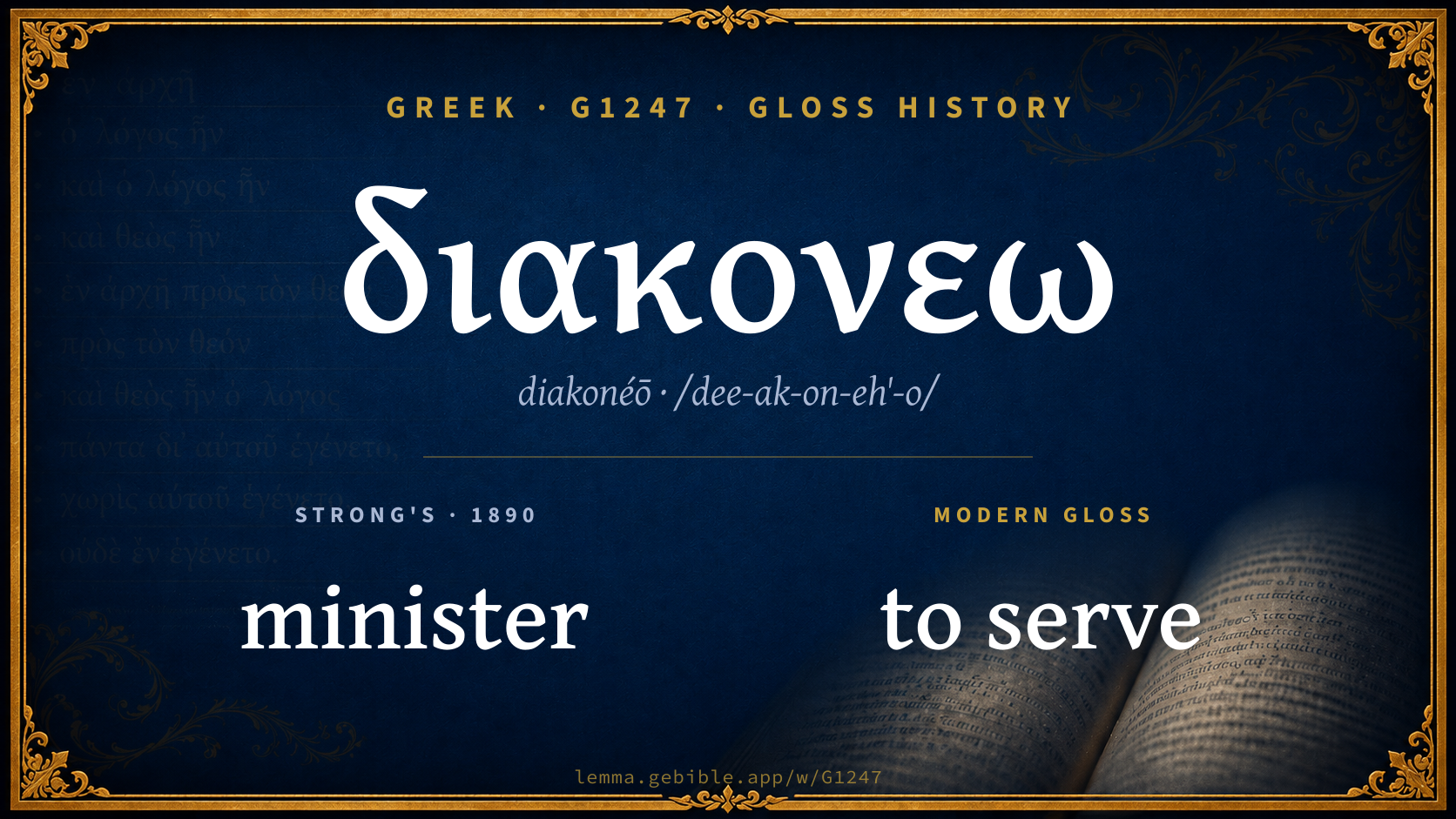
“to serve” is the headline sense of the Greek verb διακονεω (diakonéō). Its English rendering has broadened — “ministered” classically, “serve” (Berean Standard Bible) in modern versions; see the renderings breakdown. The Greek New Testament uses it across 32 verses — moderately common. Its earliest occurrence is Matthew 4:11. Related forms include διακονος and διακονια. See the sense tree, 32-verse concordance, and the renderings breakdown below.
Gloss history
Strong's 1890 vs modern scholarship
About this word
Strong's G1247 catalogs a Greek word from the Greek New Testament.
These counts are not copied from any lexicon or concordance. They are computed here, from the morphology-tagged Greek New Testament. What Lemma adds →
- 32
- distinct verses
- The word appears in 32 distinct verses.
- 12 / 27
- NT books
- The word appears in 12 of 27 New Testament books.
- #397
- by frequency
- Top 500 most frequent Greek words (rank 397 of 5,347 Greek words by occurrence).
View all 32 occurrences in the concordance →
By section of the New Testament
By traditional corpus
Conventional, traditional groupings — biblical authorship is debated, so this is a traditional corpus grouping, not an authorship claim. Some books belong to more than one corpus (Luke is in both the Gospels and the Lukan corpus, and so on), so these shares overlap and need not total 100%. Each figure is a share of the word’s 32 distinct verses.
- Gospels 18 verses · 56%
- Lukan (Luke–Acts) 9 verses · 28%
- Pauline corpus 8 verses · 25%
- General (Catholic) Epistles 3 verses · 9%
- Johannine 2 verses · 6%
- Hebrews 1 verse · 3%
How translations render this word
Counts come from each version’s own published word-to-Strong’s tagging or interlinear alignment — an approximate guide to how each version renders this word, not a word-level alignment the data otherwise carries. Because each total is that version’s own tagged count, the per-version totals vary from one another and need not match the appearance or distinct-verse counts above. These counts may also differ from a printed concordance because Lemma counts each distinctly tagged rendering and does not collapse phrase taggings into a single head-word total. This is a fixed set of word-tagged versions (KJV, ASV, BSB, ULT) and does not change with the reading translation you choose elsewhere. Each version’s license is shown beside its name below (and on Sources).
- King James Version: Ministered 8×, Minister 6×, Serve 6×
- American Standard Version: Ministered 7×, Serve 6×, Minister 3×
- Berean Standard Bible: Serve 6×, Serves 6×, Ministered 3×
- unfoldingWord Literal Text: Serve 7×, Serving 6×, Be served 2×
King James Version Public Domain
Renders G1247 across 38 tagged occurrences — most commonly:
Plus 12 renderings that appear only once — usually multi-word phrases or single function words the recovered tagging swept in, not distinct renderings.
American Standard Version Public Domain
Renders G1247 across 38 tagged occurrences — most commonly:
Plus 13 renderings that appear only once — usually multi-word phrases or single function words the recovered tagging swept in, not distinct renderings.
Berean Standard Bible Public Domain
Renders G1247 across 37 tagged occurrences — most commonly:
Plus 14 renderings that appear only once — usually multi-word phrases or single function words the recovered tagging swept in, not distinct renderings.
unfoldingWord Literal Text CC BY-SA 4.0
Renders G1247 across 40 tagged occurrences — most commonly:
Plus 19 renderings that appear only once — usually multi-word phrases or single function words the recovered tagging swept in, not distinct renderings.
Senses in Thayer's
The 1 sense Thayer's distinguishes for this word, in lexicon order (not ranked by frequency or importance). The full entry — with sub-senses — is in the Lexicon Entry tab.
- to be a servant, attendant, domestic, to serve, wait upon
Word origin
Derived from διακονος (diákonos) (G1249) — servant.
From G1249 ; to be an attendant that is wait upon (menially or as a host friend or [figuratively] teacher); technically to act as a Christian deacon : - (ad-) minister (unto) serve use the office of a deacon.
— Strong’s Exhaustive Concordance (1890), public domain.
Forms in the corpus
The 19 distinct written forms G1247 takes in the Greek New Testament, most frequent first — each parse links to that tense’s occurrences in the concordance.
Same root — word family
Other Thayer's entries built from the same root as G1247, grouped by Strong’s listed origin. These share a root / origin per the lexicon — not necessarily a shared meaning. Each links to that word’s own entry.
Derives from
Shares the same root
Compare all same-root words → They share a root, not necessarily a meaning.