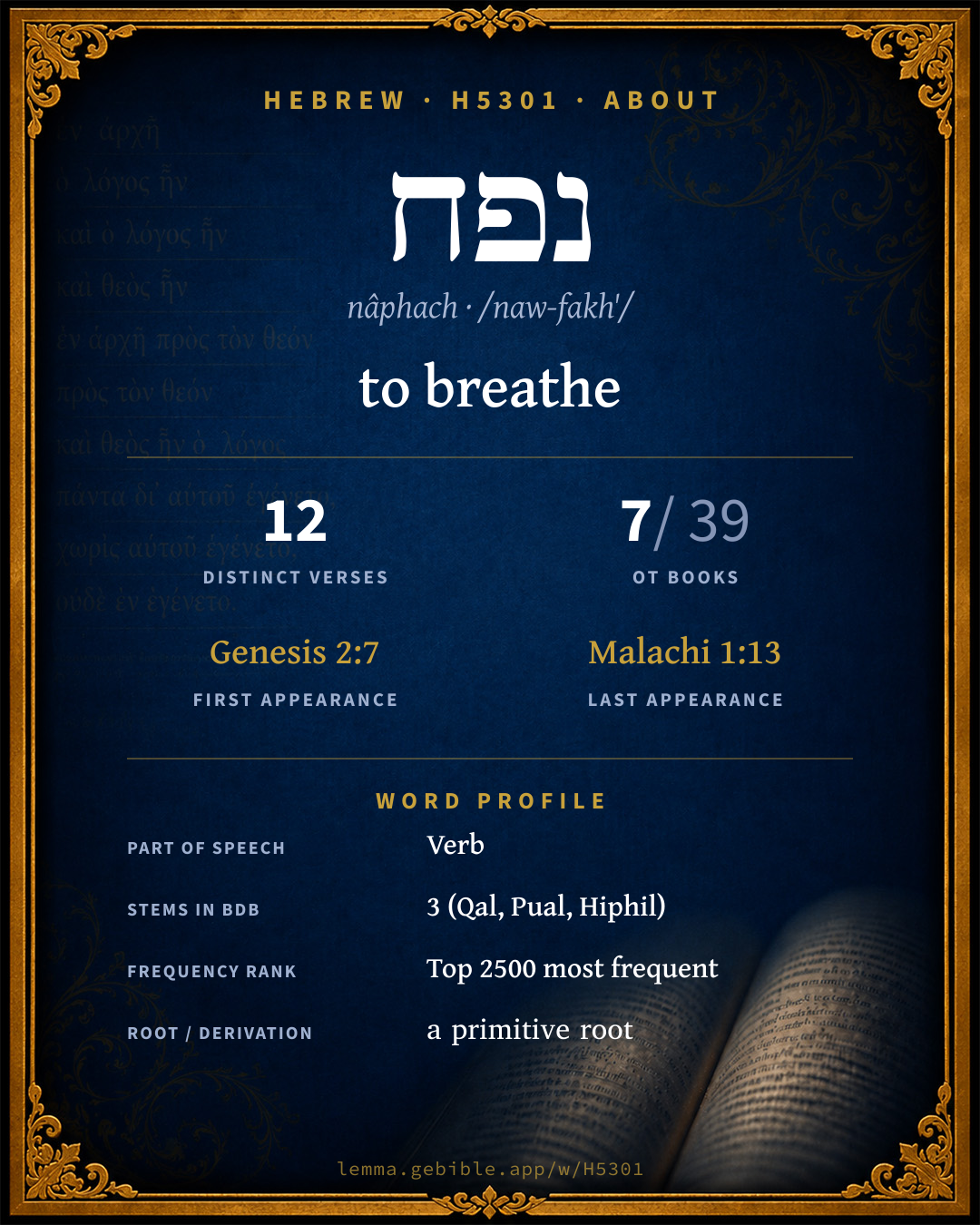
נָפַח
to breathe
also: blow, sniff at, seethe fuller range ↓
Full lexicon entry — Brown-Driver-Briggs (BDB)
From Brown-Driver-Briggs (BDB)
Where this word appears
See every Qal verb in the Hebrew Bible →
Grammar key — what these labels mean
Part of speech
- Verb
- An action or state-of-being word.
Stem
- Qal
- The basic, simple active stem — the plain form of the verb (“he wrote”).
- Hiphil
- The causative active stem (“he caused / brought about”).
- Pual
- The passive counterpart of the Piel.
Form
- Participle Passive
- A verbal adjective expressing action received (“written”).
- Sequential Perfect
- A perfect with prefixed waw continuing a preceding imperfect or command (waw-consecutive perfect).
- Perfect
- A completed action or state — Hebrew marks aspect (completeness) more than strict tense (“he wrote”).
- Imperative
- A direct command (“write!”).
- Sequential Imperfect
- An imperfect with prefixed waw — the standard past-narrative form (waw-consecutive imperfect).
- Infinitive Construct
- A bound verbal noun, frequently with prepositions (“to write / in writing”).
- Participle Active
- A verbal adjective expressing ongoing or characteristic action (“writing / one who writes”).
State
- Absolute
- The independent form of a noun, not bound to a following word.
Person
- 2nd Person
- The one addressed (“you”).
- 1st Person
- The speaker (“I / we”).
- 3rd Person
- The one spoken about (“he / she / it / they”).
Gender
- Masculine
- Grammatically masculine.
- Common
- Either gender — not distinguished for this form.
- Feminine
- Grammatically feminine.
Number
- Singular
- One.
- Plural
- More than one (in Hebrew, generally three or more).
Grammatical forms 11 distinct
- Verb, Qal, Participle Passive, Masculine, Singular, Absolute 2 times (17%)
- Verb, Hiphil, Sequential Perfect, 2nd Person, Masculine, Plural 1 time (8%)
- Verb, Qal, Perfect, 1st Person, Common, Singular 1 time (8%)
- Verb, Qal, Sequential Perfect, 1st Person, Common, Singular 1 time (8%)
- Verb, Qal, Imperative, 2nd Person, Feminine, Singular 1 time (8%)
- Verb, Qal, Sequential Imperfect, 3rd Person, Masculine, Singular 1 time (8%)
- Verb, Qal, Infinitive Construct 1 time (8%)
- Verb, Pual, Perfect, 3rd Person, Masculine, Singular 1 time (8%)
+3 more forms (3 occurrences)
Parsed forms decoded from the imported morphology (morphhb / Westminster Leningrad Codex — WLC text public domain, morphhb tagging CC BY 4.0), counted across 12 parsed occurrences — not distinct verses.
Every verse where H5301 appears — 12 distinct verses across 7 books. Click any verse to open its interlinear word-by-word view. Verse text shown in the World English Bible for context — . Each verse’s Hebrew form is shown with its reference; the English is not keyword-highlighted, since the data carries no word-level English alignment. Use “Compare translations” on any verse to read it across multiple English versions. This concordance covers the Hebrew Bible; Septuagint (Greek Old Testament) occurrences are not indexed here.
Genesis 1 verse
Job 3 verses
- Job 20:26 נֻפָּ֑ח Pual pf 3ms All darkness is laid up for his treasures. An unfanned fire shall devour him. It shall consume that which is left in his tent.
- Job 31:39 הִפָּֽחְתִּי Hiphil pf 1cs If I have eaten the fruits of it without money, Or have caused the owners of it to lose their life:
- Job 41:20 נָפ֣וּחַ Qal ptcp.pass ms Out of his nostrils a smoke goes, As of a boiling pot over a fire of reeds.
Isaiah 1 verse
Jeremiah 2 verses
- Jeremiah 1:13 נָפ֨וּחַ֙ Qal ptcp.pass ms The word of Yahweh came to me the second time, saying, What see you? I said, I see a boiling caldron; and the face of it is from the north.
- Jeremiah 15:9 נָפְחָ֥ה Qal pf 3fs She who has borne seven languishes; she has given up the spirit; her sun is gone down while it was yet day; she has been disappointed and confounded: and the residue of them will I deliver to the sword before their enemies, says Yahweh.
Ezekiel 3 verses
- Ezekiel 22:20 לָ/פַֽחַת prep + Qal inf.cs As they gather silver and brass and iron and lead and tin into the midst of the furnace, to blow the fire on it, to melt it; so will I gather you in my anger and in my wrath, and I will lay you there, and melt you.
- Ezekiel 22:21 וְ/נָפַחְתִּ֥י conj + Qal wpf 1cs Yes, I will gather you, and blow on you with the fire of my wrath, and you shall be melted in the midst of it.
- Ezekiel 37:9 וּ/פְחִ֛י conj + Qal impv 2fs Then said he to me, Prophesy to the wind, prophesy, son of man, and tell the wind, Thus says the Lord Yahweh: Come from the four winds, breath, and breathe on these slain, that they may live.
Haggai 1 verse
Malachi 1 verse
About this entry
At a glance — auto-summarized from this page’s data, not written by a person. Every figure links to its source below. This summary describes the numbers; it doesn’t interpret them.
The Hebrew verb נפח centers on the idea of “to breathe.” Debuting at Genesis 2:7, it then recurs through the corpus. Spanning 12 verses in 7 books, it ranks among the uncommon words of the Hebrew Bible. Job dominates its distribution — 3 of 12 verses. As a verb its force shifts by stem, across 3 stems (Qal, Pual, and more). Dig into 12-verse concordance and the renderings breakdown below.
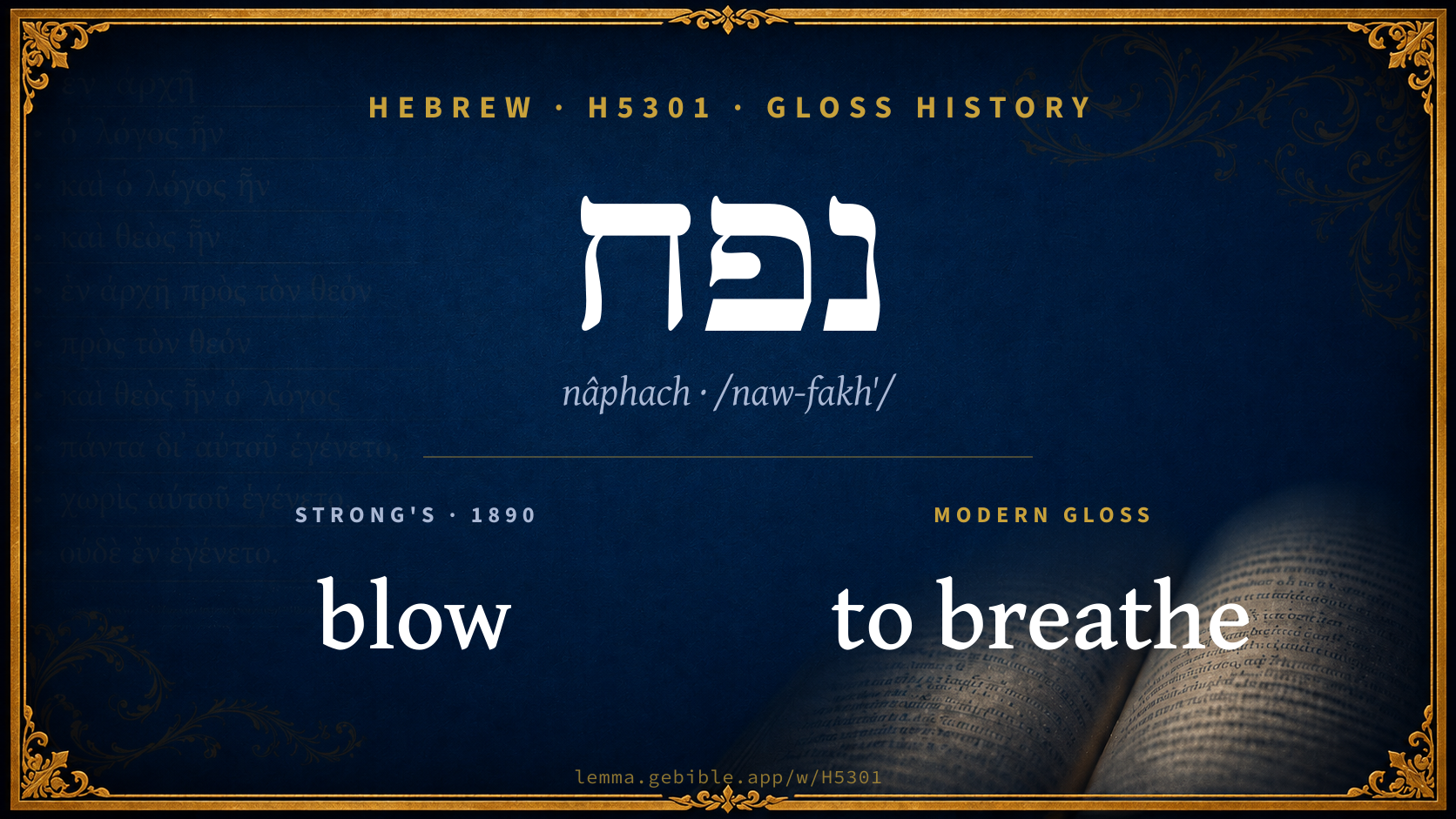
Gloss history
Strong's 1890 vs modern scholarship
About this word
Strong's H5301 catalogs a Hebrew word from the Hebrew Old Testament.
These counts are not copied from any lexicon or concordance. They are computed here, from the morphology-tagged Hebrew Old Testament. What Lemma adds →
- 12
- distinct verses
- The word appears in 12 distinct verses.
- 7 / 39
- OT books
- The word appears in 7 of 39 Old Testament books.
- #2,101
- by frequency
- Top 2500 most frequent Hebrew words (rank 2,101 of 8,640 Hebrew words by occurrence).
View all 12 occurrences in the concordance →
By section of the Old Testament
By traditional corpus
Conventional, traditional groupings — biblical authorship is debated, so this is a traditional corpus grouping, not an authorship claim. Each share is this word’s portion of its verses in that division of the Hebrew canon. Each figure is a share of the word’s 12 distinct verses.
- Prophets (Nevi'im) 8 verses · 67%
- Writings (Ketuvim) 3 verses · 25%
- Torah (Pentateuch) 1 verse · 8%
How translations render this word
Counts come from each version’s own published word-to-Strong’s tagging or interlinear alignment — an approximate guide to how each version renders this word, not a word-level alignment the data otherwise carries. Because each total is that version’s own tagged count, the per-version totals vary from one another and need not match the appearance or distinct-verse counts above. These counts may also differ from a printed concordance because Lemma counts each distinctly tagged rendering and does not collapse phrase taggings into a single head-word total. This is a fixed set of word-tagged versions (KJV, ASV, BSB, ULT) and does not change with the reading translation you choose elsewhere. Each version’s license is shown beside its name below (and on Sources).
- King James Version: Seething 2×
- American Standard Version: Boiling 2×
- Berean Standard Bible: Boiling 2×
- unfoldingWord Literal Text: Blown 2×
King James Version Public Domain
Renders H5301 across 12 tagged occurrences — most commonly:
Plus 10 renderings that appear only once — usually multi-word phrases or single function words the recovered tagging swept in, not distinct renderings.
American Standard Version Public Domain
Renders H5301 across 12 tagged occurrences — most commonly:
Plus 10 renderings that appear only once — usually multi-word phrases or single function words the recovered tagging swept in, not distinct renderings.
Berean Standard Bible Public Domain
Renders H5301 across 10 tagged occurrences — most commonly:
Plus 8 renderings that appear only once — usually multi-word phrases or single function words the recovered tagging swept in, not distinct renderings. Not rendered by a distinct English word in 2 further occurrences.
unfoldingWord Literal Text CC BY-SA 4.0
Renders H5301 across 13 tagged occurrences — most commonly:
Plus 11 renderings that appear only once — usually multi-word phrases or single function words the recovered tagging swept in, not distinct renderings.
Senses in the full BDB
Hebrew verbs can shift meaning by stem (binyan): Qal is the basic action, Niphal is often passive or reflexive, Piel often intensifies or makes it factitive, and Hiphil is typically causative. The senses below are grouped under the stem BDB assigns to each. This entry also uses Pual (the passive of Piel).
What do BDB’s symbols mean?
BDB uses these scholarly abbreviations:
| Symbol | Meaning |
|---|---|
| 𝔊 | the Septuagint (the ancient Greek translation, LXX) |
| 𝔙 | the Vulgate (the Latin translation) |
| 𝔖 | the Syriac version (the Peshitta) |
| 𝔗 | the Targum (the Aramaic translation) |
| ψ | the Psalms |
| √ | root (the underlying root or stem) |
| ‖ | parallel passage (a synonymous or contrasted parallel) |
| † | the dagger: every passage where the word occurs is cited |
The 3 senses and sub-senses the full Brown-Driver-Briggs lexicon distinguishes for this word, in lexicon order (not ranked by frequency), with BDB’s own verbatim wording and sub-sense lettering. Shown in Hebrew script with BDB’s own scholarly abbreviations. The condensed entry is in the Lexicon Entry tab. See also the Forms in the corpus table below.
Qal
- Pf. 3 fs. נָֽפְחָה Je 15:9; וְנָפַ֫חְתִּי Hg 1:9; וְנָפַחְתִּ֫י Ez 22:21; Impf. וַיִּפַּח Gn 2:7; Imv. fs. פְּחִי Ez 37:9; Inf. (לָ)פַ֫חַת Ez 22:20; Pt. act. נֹפֵחַ Is 54:16; pass. נָפוּחַ Je 1:13 Jb 41:12;—breathe, blow, וַיִּפַּח בְּאַפּוֹ נִשְׁמַת חַיִּים Gn 2:7 (J); sq. ב also Ez 37:9; Is 54:16 and Hg 1:9 blow into it (to scatter it); sq. עַל־: לָפַחַת עָלָיו אֵשׁ Ez 22:20 to blow fire upon it (ore, for melting), so fig. Ez 22:21 and I will blow upon you with (ב) the fire of my wrath; נ׳ נַפְשָׁהּ Je 15:9 she hath breathed out her life (of a mother, cf. Hiph.); abs. סִיר נָפוּחַ Je 1:13 a blown (i.e. well-heated, boiling) pot, cf. דּוּד נ׳ Jb 41:12 (sim.). e.g. Jeremiah 15:9
Pual
- Pf. אֵשׁ לֹא נֻפָּ֑ח Jb 20:26 a fire not blown (by any human breath). So perhaps also Nu 21:30 (reading עַד־נֻפַּח אֵשׁ וגו׳ until fire was blown [hot] as far as Medeba), cf. Di. e.g. Job 20:26
Hiphil
- Pf. 1 s. נֶפֶשׁ בְּעָלֶיהָ חִפָּ֑חְתִּי Jb 31:39 (or if) the life of its (the land’s) owners I have caused them to breathe out; וְהִפַּחְתֶּם אוֹתוֹ Mal 1:13 and ye have sniffed at it (in contempt). e.g. Job 31:39
Senses from the full Brown-Driver-Briggs lexicon (Brown, Driver, Briggs; Oxford 1906 — public domain), digitized via Sefaria, supplemented by the OpenScriptures HebrewLexicon (CC BY 4.0). Full attribution on Sources.
Word origin
vb. breathe, blow (כור נפוח Ecclus 43:4 a furnace blown upon (heated hot); NH נָפַח, id., 𝔗 נְפַח, Syriac ܢܦܰܚ; Assyrian napâḫu, inflame, nappaḫu, smith DlHWB 474; Arabic (نَفَحَ and) نَفَخَ blow; Ethiopic ነፍኀ: or ነፍሐ: Di712);—
— Brown-Driver-Briggs (Oxford 1906, public domain), digitized via Sefaria, supplemented by the OpenScriptures HebrewLexicon (CC BY 4.0). See Sources.
Origin: a primitive root
Jastrow Dictionary
A second Hebrew/Aramaic lexicon for comparison, covering Aramaic and post-biblical (Talmudic, Targumic, Midrashic) usage that the biblical-Hebrew BDB does not. Matched by lemma rather than by Strong’s number, so a lemma may carry more than one Jastrow headword (shown separately below), and the entries cover usage well beyond the Bible.
נָפַח
- 1. to blow, breathe. Y. Sabb. VII, 10ᵈ הנוֹפֵח כלי זכוכית he who shapes glass vessels by blowing (on the Sabbath); Bab. Sabb. 75ᵇ המְנַפֵּחַ בכלי וכ׳. Makhsh. I, 6 הנופח בעדשים וכ׳ he who breathes at lentils to ascertain their quality. Tosef. Sabb. XV (XVI), 2 נופח בחוטמו וכ׳ you blow into its nostrils and put the teat into its mouth; Sabb. 128ᵇ; Y. ib. XVIII, end, 16ᶜ מביא יין ונופח וכ׳ you take wine and squirt it &c. B. Mets. 60ᵇ אין נוֹפְחִין בקרביים it is not permitted to blow up entrails (for sale, to give them a delusive appearance); a. fr.
- 2. to be blown up, to swell. Tanḥ. K’dosh. 8 נָפְחוּ פניו his face was swollen. Ib. עיניו נְפוּחוֹת his eyes swollen.
- same. Sabb. 75ᵇ, v. supra. Maasr. IV, 5 מְנַפֵּיחַ … ואם ני׳ וכ׳ Y. ed. (Bab. ed. מנפח … נפח; Ms. M. מנפיח; Mish. ed. מנפה … נפה, v. Rabb. D. S. a. l. note 7) he may blow out (the chaff of the wheat-ears) from hand to hand and eat, but if he blows and puts the grain in his lap, he is bound (to pay tithes); Bets. 13ᵇ. Ib. 14ᵃ. Ber. 19ᵇ; Nidd. 57ᵃ, a. e., v. פְּרַס; a. fr.—[Y. Peah VIII, 21ᵇ top המנפח, read המכפח, v. קָפַח.]
- to be blown, fanned. Treat. S’maḥ. ch. VIII מוטב … אש שנוּפְּחָה ולא אש שלא נופחה וכ׳ it is better that a fire consume me which has been blown (by man), than a fire that has not been fanned (Gehenna; Job XX, 26). e.g. Job 20:26
- to be blown up, to swell. Num. R. s. 7 תִּנָּפֵחַ כרסי וכ׳ my belly may swell and burst.
נְפַח
- 1. to blow. Targ. Gen. II, 7; a. fr.—Y. Bets. II, end, 62ᵇ (ל) מִנְפּוֹחַ וכ׳ to blow meat up. Gitt. 69ᵃ bot. לִינְפַּח ליה חבריה וכ׳ let his neighbor blow white cress-seeds (into his throat) through a straw. Ḥull. 46ᵇ ונַפְחִינָא לה and we blow the lungs up; a. fr.—Part. pass. נְפִיחַ; f. נְפִיחָא; pl. נְפִיחִין; נְפִיחָן blown, ignited; blown up, swollen. Targ. Job XX, 26. Targ. O. Num. V, 21; a. fr.—Ḥull. 47ᵇ א"ד דנפיחא (not דנפיחה) some explain דמיא לאופתא (v. אוּפְתָּא) as meaning lungs which look as if distended (white). Sabb. 33ᵃ נְפִיחֵי כפן, v. כַּפְנָא; a. fr.
- 2. to be blown up, to swell. Targ. O. Num. V, 27, v. Ithpa. (Y. ותְנָפַח, prob. to be read: ותִתְנְפַח).—Lev. R. s. 33; Cant. R. to II, 14, v. קוּלְתָא.
- same, to blow, cause swelling. Targ. Y. Num. V, 22 (O. לְאַפָּחָא, Af.; ed. Amst. לַאֲפָחָא); a. e.—Part. pass. מְנַפַּח; f. מְנַפְּחָא; pl. מְנַפְּחִין; מְנַפְּחָן. Targ. Y. ib. 21.—Lam. R. to I, 1 רבתי (חד כות׳ 1) כל עמא מְנַפְּחִין לי וכ׳ (I dreamt) all the people were blowing at me with their full cheeks. Ib. דאינון מנפחין (it meant) that it (the wheat) was swollen (through rain drippings). Snh. 43ᵃ; B. Bath. 134ᵇ מְנַפֵּח רב ששת וכ׳ R. Sh. blew into his hand (intimating that the question raised was scurrilous); a. e.
- 1. to blow, swell. Targ. O. Num. V, 22, v. supra. Targ. Ps. XI, 6 מַפְּחִין דאשתא (Ms. מפ׳ אש׳) blowers (winds) of fire (h. text פחים אש).
- 2. (with נפש) to incite longing, to cause despair. Targ. Job XXXI, 39. Targ. I Sam. II, 33 (h. text לאדיב).—V. מַפַּח.
- ; Ithpe. אִתְנְפַח, אִינְּ׳
- 1. to be swollen. Targ. Y. Num. V, 27 (v. supra; O. ויִפְּחוּן, ed. Berl. ויִפְחוּן). Targ. Job XIX, 26 (ed. Wil. אִתְּפָח; h. text נקפו). Targ. Koh. XII, 5.—Y. Maas. Sh. IV, end, 55ᶜ אִינַּפְּחָן the wheat shall swell (v. supra).
- 2. to be blown, ignited. Sabb. 26ᵃ אינפח בה נורא she caught fire.
נֶפֶח
- (preced.) swelling; bulk, volume (v. אַפּוּחָא). B. Mets. VI, 5 הנ׳ קשה כמשאוי an increase of volume makes the load harder for the animal (Bab. ed. 80ᵃ הנ׳ קשה כמשאוי an increase of size is as hard for the animal as an increase of weight), v. נִפְחָא. B. Kam. 47ᵃ נִיפְחָהּ, v. נִפְחָא.
נַפָּח
- (preced. wds.) smith. Gen. R. s. 84, beg. [read:] נ׳ שהיה מפוחו פתוח באמצע פלטיא ופתח בנו זהבי מפוח כנגדו a smith whose open shop was in the middle of the road, and whose son, a jeweler, opened a smithy opposite him; Tanḥ. Vayesheb 1; a. fr.—Y. R. Hash. II, 58ᵇ top, a. e. בן הנ׳ the smith’s son, i.e. R. Johanan, v. next w.—Pl. נַפָּחִין. Y. B. Bath. II, beg. 13ᵇ ולא של נ׳ nor dare an oven for smiths be put up (without the precautions mentioned in the Mishnah).
A Dictionary of the Targumim, the Talmud Babli and Yerushalmi, and the Midrashic Literature (Marcus Jastrow; London, Luzac, 1903) — Public Domain. Digitized via Sefaria. Digitized via Sefaria. Full attribution on Sources.
Forms in the corpus
The 12 distinct written forms H5301 takes in the Hebrew Bible, most frequent first — each parse links to that stem’s occurrences in the concordance. Hebrew forms include their vowel points and cantillation, so a single lemma takes many written forms.
| Form | Parsing | Example | Uses |
|---|---|---|---|
| הִפָּֽחְתִּי | Verb, Hiphil, Perfect, 1st Person, Common, Singular | Job 31:39 | 1 |
| וְ/הִפַּחְתֶּ֣ם | Verb, Hiphil, Sequential Perfect, 2nd Person, Masculine, Plural | Malachi 1:13 | 1 |
| וְ/נָפַ֣חְתִּי | Verb, Qal, Perfect, 1st Person, Common, Singular | Haggai 1:9 | 1 |
| וְ/נָפַחְתִּ֥י | Verb, Qal, Sequential Perfect, 1st Person, Common, Singular | Ezekiel 22:21 | 1 |
| וַ/יִּפַּ֥ח | Verb, Qal, Sequential Imperfect, 3rd Person, Masculine, Singular | Genesis 2:7 | 1 |
| וּ/פְחִ֛י | Verb, Qal, Imperative, 2nd Person, Feminine, Singular | Ezekiel 37:9 | 1 |
| לָ/פַֽחַת | Verb, Qal, Infinitive Construct | Ezekiel 22:20 | 1 |
| נָפ֣וּחַ | Verb, Qal, Participle Passive, Masculine, Singular, Absolute | Job 41:20 | 1 |
| נָפ֨וּחַ֙ | Verb, Qal, Participle Passive, Masculine, Singular, Absolute | Jeremiah 1:13 | 1 |
| נָפְחָ֥ה | Verb, Qal, Perfect, 3rd Person, Feminine, Singular | Jeremiah 15:9 | 1 |
| נֹפֵ֨חַ֙ | Verb, Qal, Participle Active, Masculine, Singular, Absolute | Isaiah 54:16 | 1 |
| נֻפָּ֑ח | Verb, Pual, Perfect, 3rd Person, Masculine, Singular | Job 20:26 | 1 |
Same root — word family
Other BDB entries built from the same root as H5301, grouped by Strong’s listed origin. These share a root / origin per the lexicon — not necessarily a shared meaning. Each links to that word’s own entry.
Derived from this word
Proper names from this root
People and places named from this root — a name, not an additional meaning of the word.
Compare all same-root words → Showing 4 of 5 — not the complete family. 1 of the same-root words is a proper name (a person or place). They share a root, not necessarily a meaning.
Septuagint verse parallels
This word appears in 12 verses that also exist in the Greek Old Testament (Septuagint), out of the 12 Hebrew verses it occurs in. You can read those verses in Greek by switching the Old Testament edition to the Septuagint.
Read these verses in the Septuagint
This is a verse-level parallel only — the same verses exist in both the Hebrew and Greek Old Testaments. No word-level Hebrew↔Greek correspondence is claimed: the data carries no such alignment, so no Greek word is shown as this Hebrew word’s translation. Coverage is not total — the Septuagint omits the deuterocanon and renumbers the Psalms, so some Hebrew verses have no direct Greek parallel.