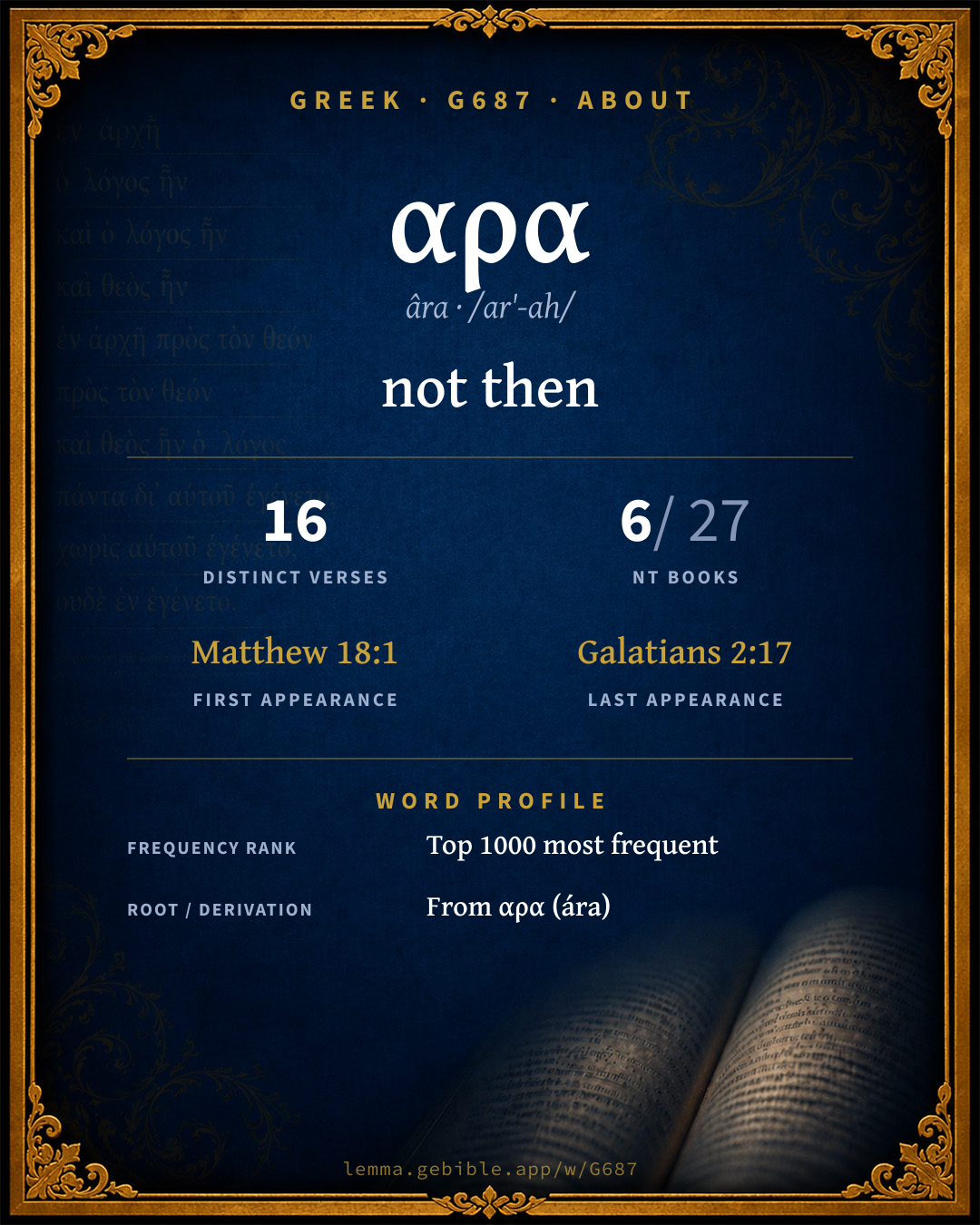
ἆρα
not then
Full lexicon entry — Thayer's Greek Lexicon
From Thayer's Greek Lexicon
Where this word appears
Grammar key — what these labels mean
Part of speech
- Particle
- A short, often untranslatable function word adding nuance or connection.
Degree
- Interrogative
- Marks an interrogative form.
Every verse where G687 appears — 16 distinct verses across 6 books. Click any verse to open its interlinear word-by-word view. Verse text shown in the World English Bible for context — . Each verse’s Greek form is shown with its reference; the English is not keyword-highlighted, since the data carries no word-level English alignment. Use “Compare translations” on any verse to read it across multiple English versions. This concordance covers the Greek New Testament; Septuagint (Greek Old Testament) occurrences of this word are not indexed here.
Matthew 4 verses
- Matthew 18:1 ἄρα ptcl interrog In that hour the disciples came to Jesus, saying, "Who then is greatest in the Kingdom of Heaven?"
- Matthew 19:25 ἄρα ptcl interrog When the disciples heard it, they were exceedingly astonished, saying, "Who then can be saved?"
- Matthew 19:27 ἄρα ptcl interrog Then Peter answered, "Behold, we have left everything, and followed you. What then will we have?"
- Matthew 24:45 ἄρα ptcl interrog "Who then is the faithful and wise servant, whom his lord has set over his household, to give them their food in due season?
Mark 2 verses
- Mark 4:41 ἄρα ptcl interrog They were greatly afraid, and said to one another, "Who then is this, that even the wind and the sea obey him?"
- Mark 11:13 ἄρα ptcl interrog Seeing a fig tree afar off having leaves, he came to see if perhaps he might find anything on it. When he came to it, he found nothing but leaves, for it was not the season for figs.
Luke 5 verses
- Luke 1:66 ἄρα ptcl interrog All who heard them laid them up in their heart, saying, "What then will this child be?" The hand of the Lord was with him.
- Luke 8:25 ἄρα ptcl interrog He said to them, "Where is your faith?" Being afraid they marveled, saying one to another, "Who is this, then, that he commands even the winds and the water, and they obey him?"
- Luke 12:42 ἄρα ptcl interrog The Lord said, "Who then is the faithful and wise steward, whom his lord will set over his household, to give them their portion of food at the right times?
- Luke 18:8 ἆρα ptcl interrog I tell you that he will avenge them quickly. Nevertheless, when the Son of Man comes, will he find faith on the earth?"
- Luke 22:23 ἄρα ptcl interrog They began to question among themselves, which of them it was who would do this thing.
Acts 3 verses
- Acts 8:22 ἄρα ptcl interrog Repent therefore of this, your wickedness, and ask God if perhaps the thought of your heart may be forgiven you.
- Acts 12:18 ἄρα ptcl interrog Now as soon as it was day, there was no small stir among the soldiers about what had become of Peter.
- Acts 21:38 ἄρα ptcl interrog Aren't you then the Egyptian, who before these days stirred up to sedition and led out into the wilderness the four thousand men of the Assassins?"
2 Corinthians 1 verse
Galatians 1 verse
About this entry
At a glance — auto-summarized from this page’s data, not written by a person. Every figure links to its source below. This summary describes the numbers; it doesn’t interpret them.
αρα — transliterated âra — is a Greek word carrying the sense “not then.” Its earliest occurrence is Matthew 18:1. It appears 16 verses across 6 books of the Greek New Testament, among its uncommon vocabulary. More than a quarter of its appearances fall in Luke. Each statement above links to its evidence; the full detail follows below.
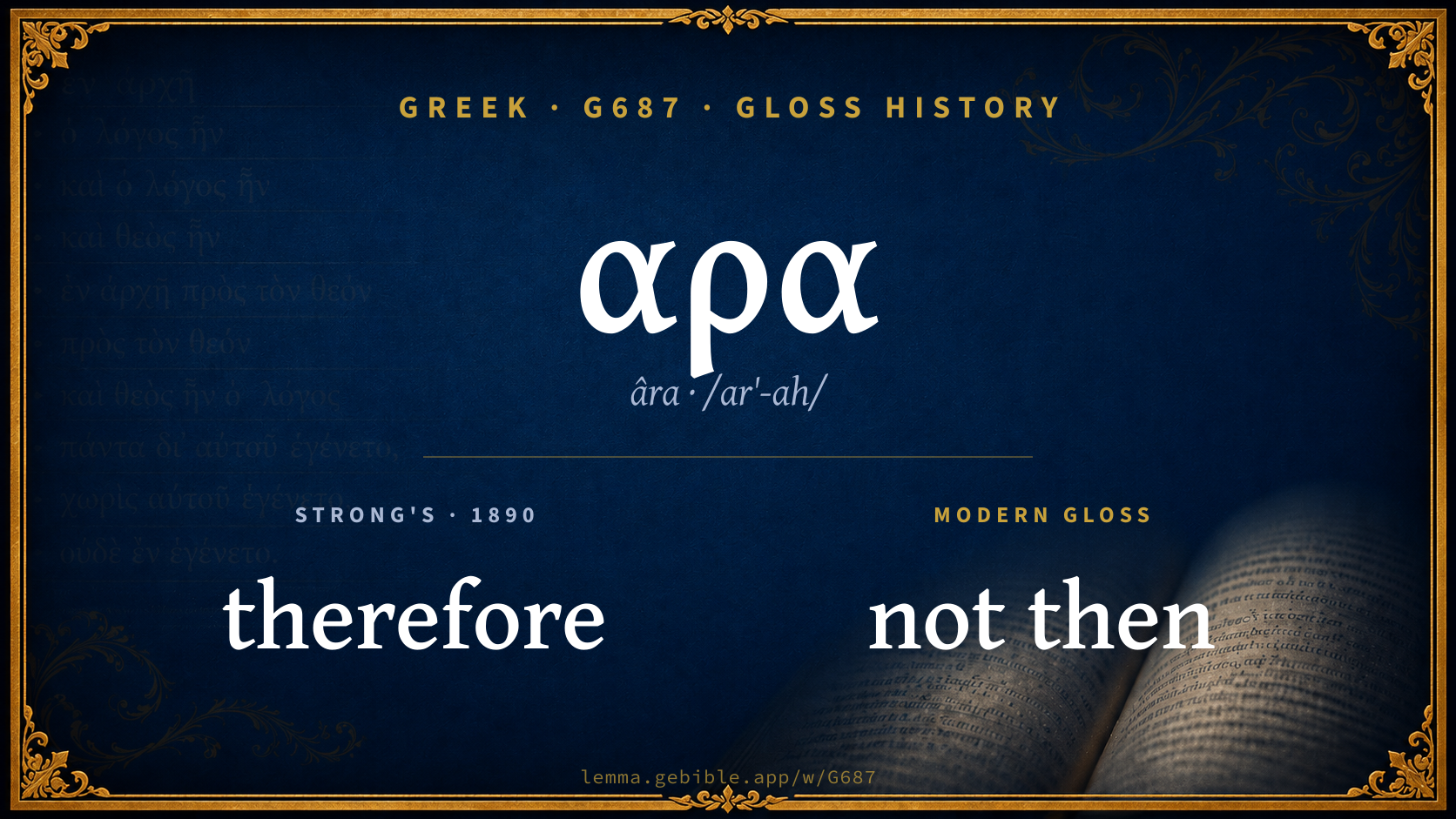
Gloss history
Strong's 1890 vs modern scholarship
About this word
Strong's G687 catalogs a Greek word from the Greek New Testament.
These counts are not copied from any lexicon or concordance. They are computed here, from the morphology-tagged Greek New Testament. What Lemma adds →
- 16
- distinct verses
- The word appears in 16 distinct verses.
- 6 / 27
- NT books
- The word appears in 6 of 27 New Testament books.
- #726
- by frequency
- Top 1000 most frequent Greek words (rank 726 of 5,347 Greek words by occurrence).
View all 16 occurrences in the concordance →
By section of the New Testament
By traditional corpus
Conventional, traditional groupings — biblical authorship is debated, so this is a traditional corpus grouping, not an authorship claim. Some books belong to more than one corpus (Luke is in both the Gospels and the Lukan corpus, and so on), so these shares overlap and need not total 100%. Each figure is a share of the word’s 16 distinct verses.
- Gospels 11 verses · 69%
- Lukan (Luke–Acts) 8 verses · 50%
- Pauline corpus 2 verses · 13%
How translations render this word
Counts come from each version’s own published word-to-Strong’s tagging or interlinear alignment — an approximate guide to how each version renders this word, not a word-level alignment the data otherwise carries. Because each total is that version’s own tagged count, the per-version totals vary from one another and need not match the appearance or distinct-verse counts above. These counts may also differ from a printed concordance because Lemma counts each distinctly tagged rendering and does not collapse phrase taggings into a single head-word total. This is a fixed set of word-tagged versions (KJV, ASV, BSB, ULT) and does not change with the reading translation you choose elsewhere. Each version’s license is shown beside its name below (and on Sources).
- King James Version: Is therefore 1×, Understandest thou 1×, When 1×
- American Standard Version: Then 8×
- Berean Standard Bible: Perhaps 2×
- unfoldingWord Literal Text: Do you understand 1×, Indeed 1×, Then 1×
King James Version Public Domain
Renders G687 across 3 tagged occurrences — most commonly:
American Standard Version Public Domain
Renders G687 across 10 tagged occurrences — most commonly:
Plus 2 renderings that appear only once — usually multi-word phrases or single function words the recovered tagging swept in, not distinct renderings.
Berean Standard Bible Public Domain
Renders G687 across 3 tagged occurrences — most commonly:
Plus 1 rendering that appears only once — usually multi-word phrases or single function words the recovered tagging swept in, not distinct renderings. Not rendered by a distinct English word in 1 further occurrence.
unfoldingWord Literal Text CC BY-SA 4.0
Renders G687 across 3 tagged occurrences — most commonly:
Senses in Thayer's
The 1 sense Thayer's distinguishes for this word, in lexicon order (not ranked by frequency or importance). The full entry — with sub-senses — is in the Lexicon Entry tab.
- a Greek interrogative particle that implies anxiety or impatience on the part of the questioner
Word origin
Derived from αρα (ára) (G686) — therefore.
A form of G686 denoting an interrogation to which a negative answer is presumed : - therefore.
— Strong’s Exhaustive Concordance (1890), public domain.
Forms in the corpus
The 2 distinct written forms G687 takes in the Greek New Testament, most frequent first — each parse links to that case’s occurrences in the concordance.
| Form | Parsing | Example | Uses |
|---|---|---|---|
| ἄρα ára | Particle, Interrogative | Matthew 18:1 | 14 |
| ἆρα âra | Particle, Interrogative | Luke 18:8 | 2 |