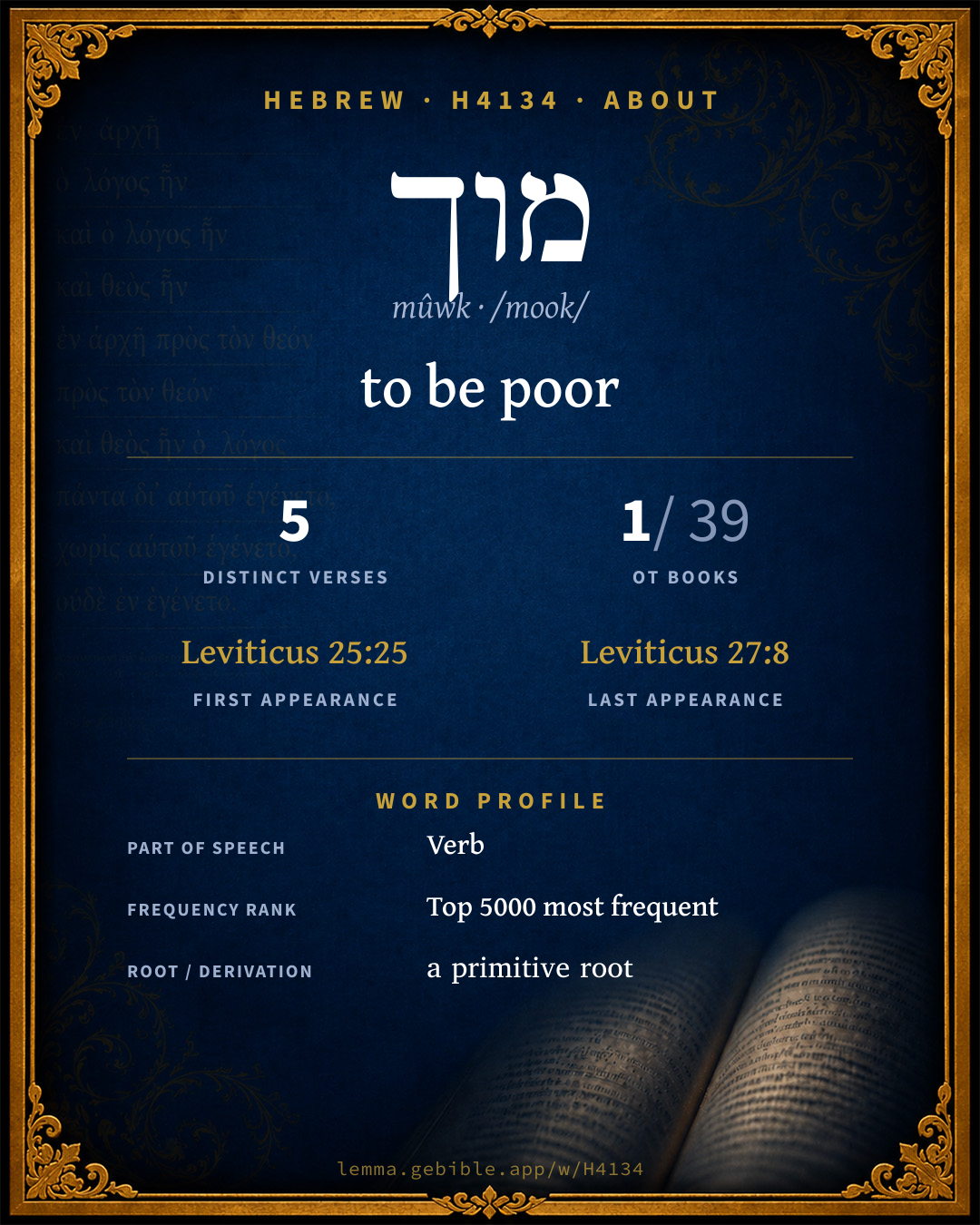
מוּךְ
to be poor
Full lexicon entry — Brown-Driver-Briggs (BDB)
From Brown-Driver-Briggs (BDB)
Where this word appears
Grammar key — what these labels mean
Part of speech
- Verb
- An action or state-of-being word.
Stem
- Qal
- The basic, simple active stem — the plain form of the verb (“he wrote”).
Form
- Imperfect
- An incomplete, ongoing, or future action (“he will / would write”).
- Sequential Perfect
- A perfect with prefixed waw continuing a preceding imperfect or command (waw-consecutive perfect).
- Participle Active
- A verbal adjective expressing ongoing or characteristic action (“writing / one who writes”).
State
- Absolute
- The independent form of a noun, not bound to a following word.
Person
- 3rd Person
- The one spoken about (“he / she / it / they”).
Gender
- Masculine
- Grammatically masculine.
Number
- Singular
- One.
Grammatical forms
- Verb, Qal, Imperfect, 3rd Person, Masculine, Singular 3 times (60%)
- Verb, Qal, Sequential Perfect, 3rd Person, Masculine, Singular 1 time (20%)
- Verb, Qal, Participle Active, Masculine, Singular, Absolute 1 time (20%)
Parsed forms decoded from the imported morphology (morphhb / Westminster Leningrad Codex — WLC text public domain, morphhb tagging CC BY 4.0), counted across 5 parsed occurrences — not distinct verses.
Every verse where H4134 appears — 5 distinct verses across 1 book. Click any verse to open its interlinear word-by-word view. Verse text shown in the World English Bible for context — . Each verse’s Hebrew form is shown with its reference; the English is not keyword-highlighted, since the data carries no word-level English alignment. Use “Compare translations” on any verse to read it across multiple English versions. This concordance covers the Hebrew Bible; Septuagint (Greek Old Testament) occurrences are not indexed here.
Leviticus 5 verses
- Leviticus 25:25 יָמ֣וּךְ Qal impf 3ms "'If your brother becomes poor, and sells some of his possessions, then his kinsman who is next to him shall come, and redeem that which his brother has sold.
- Leviticus 25:35 יָמ֣וּךְ Qal impf 3ms "'If your brother has become poor, and his hand can't support him among you; then you shall uphold him. As a stranger and a sojourner he shall live with you.
- Leviticus 25:39 יָמ֥וּךְ Qal impf 3ms "'If your brother has grown poor among you, and sells himself to you; you shall not make him to serve as a slave.
- Leviticus 25:47 וּ/מָ֥ךְ conj + Qal wpf 3ms "'If a stranger or sojourner with you becomes rich, and your brother beside him has grown poor, and sells himself to the stranger or foreigner living among you, or to a member of the stranger's family;
- Leviticus 27:8 מָ֥ךְ Qal ptcp.act ms But if he is poorer than your valuation, then he shall be set before the priest, and the priest shall value him; according to the ability of him who vowed shall the priest value him.
About this entry
At a glance — auto-summarized from this page’s data, not written by a person. Every figure links to its source below. This summary describes the numbers; it doesn’t interpret them.
מוך — transliterated mûwk — is a Hebrew verb carrying the sense “to be poor.” It occurs a mere 5 verses across Scripture. Its uses cluster heavily in Leviticus (100% of all occurrences). Its earliest occurrence is Leviticus 25:25. Sharing its root, it stands alongside מכי. See the sense tree, 5-verse concordance, and the renderings breakdown below.
Gloss history
Strong's 1890 vs modern scholarship
About this word
Strong's H4134 catalogs a Hebrew word from the Hebrew Old Testament.
These counts are not copied from any lexicon or concordance. They are computed here, from the morphology-tagged Hebrew Old Testament. What Lemma adds →
- 5
- distinct verses
- The word appears in 5 distinct verses.
- 1 / 39
- OT books
- The word appears in 1 of 39 Old Testament books.
- #3,337
- by frequency
- Top 5000 most frequent Hebrew words (rank 3,337 of 8,640 Hebrew words by occurrence).
View all 5 occurrences in the concordance →
Most concentrated in
- Leviticus 5 verses 100%
By section of the Old Testament
By traditional corpus
Conventional, traditional groupings — biblical authorship is debated, so this is a traditional corpus grouping, not an authorship claim. Each share is this word’s portion of its verses in that division of the Hebrew canon. Each figure is a share of the word’s 5 distinct verses.
- Torah (Pentateuch) 5 verses · 100%
How translations render this word
Counts come from each version’s own published word-to-Strong’s tagging or interlinear alignment — an approximate guide to how each version renders this word, not a word-level alignment the data otherwise carries. Because each total is that version’s own tagged count, the per-version totals vary from one another and need not match the appearance or distinct-verse counts above. These counts may also differ from a printed concordance because Lemma counts each distinctly tagged rendering and does not collapse phrase taggings into a single head-word total. This is a fixed set of word-tagged versions (KJV, ASV, BSB, ULT) and does not change with the reading translation you choose elsewhere. Each version’s license is shown beside its name below (and on Sources).
- King James Version: Be waxen poor 2×
- American Standard Version: Be waxed poor 4×
- Berean Standard Bible: Becomes destitute 3×
- unfoldingWord Literal Text: Becomes poor 4×
King James Version Public Domain
Renders H4134 across 5 tagged occurrences — most commonly:
Plus 3 renderings that appear only once — usually multi-word phrases or single function words the recovered tagging swept in, not distinct renderings.
American Standard Version Public Domain
Renders H4134 across 5 tagged occurrences — most commonly:
Plus 1 rendering that appears only once — usually multi-word phrases or single function words the recovered tagging swept in, not distinct renderings.
Berean Standard Bible Public Domain
Renders H4134 across 5 tagged occurrences — most commonly:
Plus 2 renderings that appear only once — usually multi-word phrases or single function words the recovered tagging swept in, not distinct renderings.
unfoldingWord Literal Text CC BY-SA 4.0
Renders H4134 across 6 tagged occurrences — most commonly:
Plus 2 renderings that appear only once — usually multi-word phrases or single function words the recovered tagging swept in, not distinct renderings.
Senses in BDB
The 1 sense BDB distinguishes for this word, in lexicon order (not ranked by frequency or importance). The full entry — with sub-senses — is in the Lexicon Entry tab.
- (Qal) to be low, grow poor, be depressed, be poor
Word origin
[ מוּךְ ] vb. be low, depressed, grow poor
— Brown-Driver-Briggs (Oxford 1906, public domain), digitized via Sefaria, supplemented by the OpenScriptures HebrewLexicon (CC BY 4.0). See Sources.
Origin: a primitive root
Jastrow Dictionary
A second Hebrew/Aramaic lexicon for comparison, covering Aramaic and post-biblical (Talmudic, Targumic, Midrashic) usage that the biblical-Hebrew BDB does not. Matched by lemma rather than by Strong’s number, so a lemma may carry more than one Jastrow headword (shown separately below), and the entries cover usage well beyond the Bible.
מוּךְ
- (b. h.) to be crushed; to be low, sink; to be poor. Tanḥ. B’har 3 על שמָךְ בעונות because he sank into sins.—V. מָךְ.
- 1. same. Mekh. B’shall., Amal., s. 1 כשהוא מֵמִיךְ ידיו עתידין ישראל להָמִיךְ ול׳ when he (Moses) let his hands sink, (it intimated) that Israel is destined to sink in the knowledge of the words of the Law to be given through his hands; Tanḥ. B’shall. 27.
- 2. to lower, let sink. Ib., v. supra.—Sifré Num. 90 כאן הקב"ה ממיך ומשה מגביה וכ׳ here the Lord lowers (his anger) and Moses raises (is more angry), but when the golden calf was made, the Lord raised, and Moses lowered (tried to soften his anger); Yalk. Num. 735 מַמְאִיךְ (fr. מָאַךְ).
- ; f. נְמוּכָה; pl. נְמוּכִים low. Kil. IV, 7 נ׳ מי׳ טפחים lower than ten handbreadths. Ruth R. to III, 3 בנ׳ שבעיר in the lowest part of the city. Y. Maas. Sh. V, end, 56ᵈ; Y. Sot. IX, 24ᵃ bot. קול נ׳ in a low voice, opp. גבוה. Ber. 10ᵇ. Sifré Num. 58. Ib. 83, v. נָמַךְ. Ab. V, 19 רוח נְ׳ a lowly spirit, v. גָּבוֹהַּ.—Cant. R. to IV, 4 ההרים הנ׳ the lower mountains; a. fr.
מוּךְ ²
- 1. to decline, sink. Targ. Y. II, Ex. XII, 42. Targ. Hab. III, 6; a. e. (v. מְכִי). e.g. Habakkuk 3:6
- 2. to become soft. Snh. 95ᵃ מָכָא ליה ארעא וכ׳ the ground under him became soft.
- 3. (denom. of מוךְ) to lay under, make a bed. Targ. Ps. CXXXIX, 8.—Pes. 49ᵃ בר מָךְ רבע one who lays under (his cloak) and lies down (at any place, a shiftless person). Taan. 6ᵇ; Ber. 59ᵃ (prov.) כד מפתח בבי … מוֹךְ שקיך וגני if it rains when the doors are opened (in the morning), lay down thy bag, ass-driver, and sleep (do not export, for provisions will be cheap); a. e.—Part. מָאֵיךְ, מָיֵיךְ. B. Mets. 84ᵇ הוו מָיְיכֵי ליה וכ׳ (Rashi: מָיְיכִין; Var. מייתי, v. Rabb. D. S. a. l. note 1) they spread for him sixty mattresses. Taan. 21ᵇ bot. מאיך Ar. (ed. מך), v. בִּיסְתַּרְקָא.—V. מָכָא.
- 1. to lower. Targ. Ps. CXIII, 6 מְמֵיךְ Ms. (ed. מַמֵיךְ, מֵמִיךְ; h. text המשפילי).
- 2. to make soft, crush. Ib. XLIV, 20 (h. text דִּכָּה).
- 3. to lay under, make a bed. Targ. Job XLI, 22 (h. text רפד).
מוֹךְ
- (preced. 2) a soft, spongy substance, hackled wool, rag, lint &c. Sabb. VI, 5 מ׳ שבאזנה wool in her ear (to resorb running pus); מ׳ שבסנדלה in her shoes (to soften them). Ib. 134ᵇ מ׳ יבש וכ׳ a dry compress or dry sponge. Tosef. Nidd. II, 6 משמשות במ׳ insert a resorbent (to prevent conception); a. fr.—Pl. מוֹכִין. B. Kam. X, 10 מ׳ שהכובס וכ׳ the lumps (of threads) which the washer takes out (of the trough). Tosef. ib. XI, 12; 13. Neg. XI, 12; a. fr.—[מוּכִּים, מוּכִּין, v. נָכָה.]
A Dictionary of the Targumim, the Talmud Babli and Yerushalmi, and the Midrashic Literature (Marcus Jastrow; London, Luzac, 1903) — Public Domain. Digitized via Sefaria. Digitized via Sefaria. Full attribution on Sources.
Forms in the corpus
The 4 distinct written forms H4134 takes in the Hebrew Bible, most frequent first — each parse links to that stem’s occurrences in the concordance. Hebrew forms include their vowel points and cantillation, so a single lemma takes many written forms.
| Form | Parsing | Example | Uses |
|---|---|---|---|
| יָמ֣וּךְ | Verb, Qal, Imperfect, 3rd Person, Masculine, Singular | Leviticus 25:25 | 2 |
| וּ/מָ֥ךְ | Verb, Qal, Sequential Perfect, 3rd Person, Masculine, Singular | Leviticus 25:47 | 1 |
| יָמ֥וּךְ | Verb, Qal, Imperfect, 3rd Person, Masculine, Singular | Leviticus 25:39 | 1 |
| מָ֥ךְ | Verb, Qal, Participle Active, Masculine, Singular, Absolute | Leviticus 27:8 | 1 |
Same root — word family
Other BDB entries built from the same root as H4134, grouped by Strong’s listed origin. These share a root / origin per the lexicon — not necessarily a shared meaning. Each links to that word’s own entry.
Proper names from this root
People and places named from this root — a name, not an additional meaning of the word.
Compare all same-root words → 1 of the same-root words is a proper name (a person or place). They share a root, not necessarily a meaning.
Septuagint verse parallels
This word appears in 5 verses that also exist in the Greek Old Testament (Septuagint), out of the 5 Hebrew verses it occurs in. You can read those verses in Greek by switching the Old Testament edition to the Septuagint.
Read these verses in the Septuagint
This is a verse-level parallel only — the same verses exist in both the Hebrew and Greek Old Testaments. No word-level Hebrew↔Greek correspondence is claimed: the data carries no such alignment, so no Greek word is shown as this Hebrew word’s translation. Coverage is not total — the Septuagint omits the deuterocanon and renumbers the Psalms, so some Hebrew verses have no direct Greek parallel.