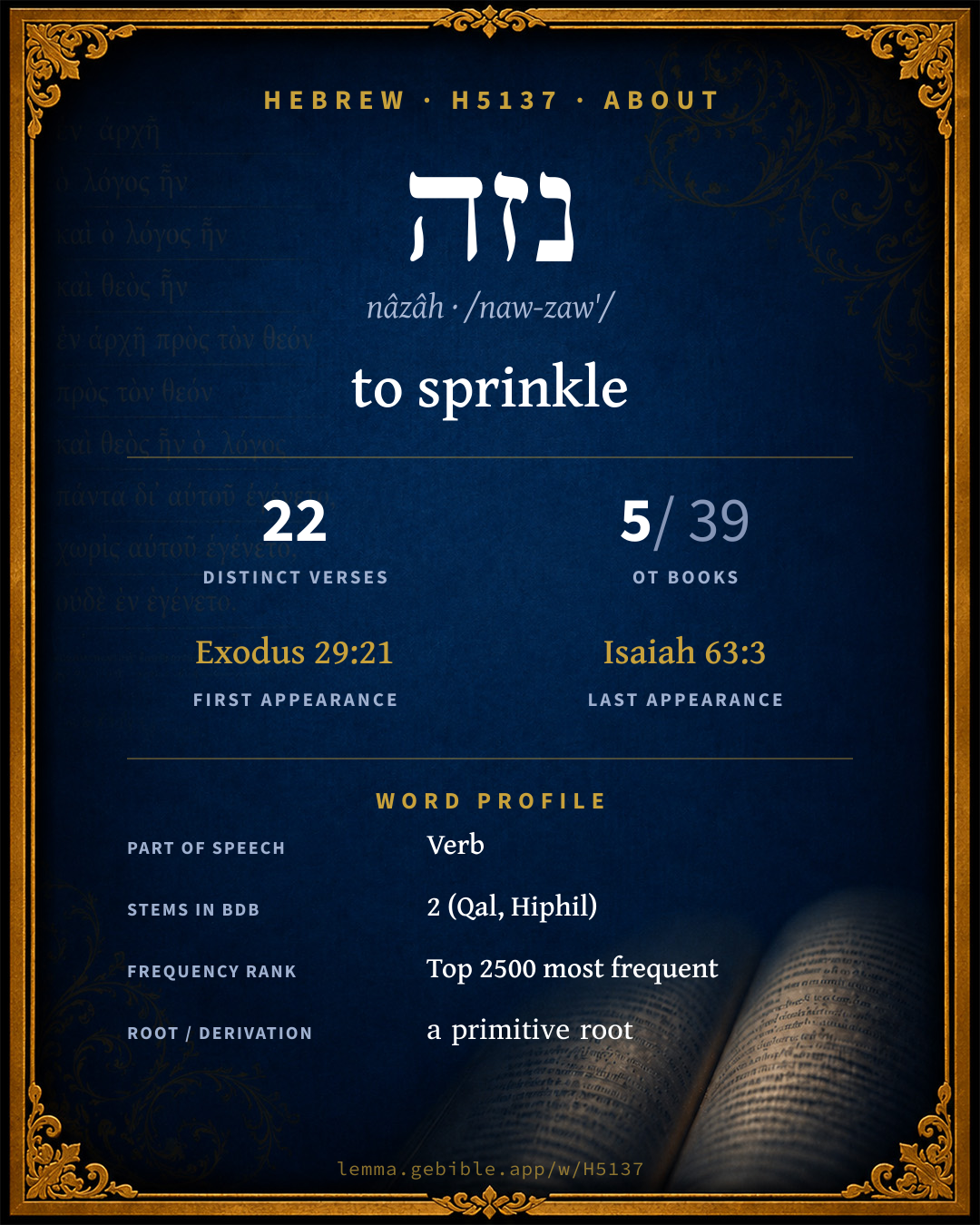
נָזָה
to sprinkle
‘to sprinkle’ is one of 2 main senses fuller range ↓
Full lexicon entry — Brown-Driver-Briggs (BDB)
From Brown-Driver-Briggs (BDB)
Where this word appears
See every Hiphil verb in the Hebrew Bible →
Grammar key — what these labels mean
Part of speech
- Verb
- An action or state-of-being word.
Stem
- Hiphil
- The causative active stem (“he caused / brought about”).
- Qal
- The basic, simple active stem — the plain form of the verb (“he wrote”).
Form
- Sequential Perfect
- A perfect with prefixed waw continuing a preceding imperfect or command (waw-consecutive perfect).
- Sequential Imperfect
- An imperfect with prefixed waw — the standard past-narrative form (waw-consecutive imperfect).
- Imperfect
- An incomplete, ongoing, or future action (“he will / would write”).
- Participle Active
- A verbal adjective expressing ongoing or characteristic action (“writing / one who writes”).
- Imperative
- A direct command (“write!”).
State
- Construct
- A noun bound to a following noun in a possessive / “of” relationship (the construct chain).
Person
- 3rd Person
- The one spoken about (“he / she / it / they”).
- 2nd Person
- The one addressed (“you”).
Gender
- Masculine
- Grammatically masculine.
Number
- Singular
- One.
Grammatical forms
- Verb, Hiphil, Sequential Perfect, 3rd Person, Masculine, Singular 13 times (54%)
- Verb, Qal, Imperfect, 3rd Person, Masculine, Singular 3 times (13%)
- Verb, Hiphil, Sequential Imperfect, 3rd Person, Masculine, Singular 2 times (8%)
- Verb, Hiphil, Imperfect, 3rd Person, Masculine, Singular 2 times (8%)
- Verb, Hiphil, Sequential Perfect, 2nd Person, Masculine, Singular 1 time (4%)
- Verb, Hiphil, Participle Active, Masculine, Singular, Construct 1 time (4%)
- Verb, Qal, Sequential Imperfect, 3rd Person, Masculine, Singular 1 time (4%)
- Verb, Hiphil, Imperative, 2nd Person, Masculine, Singular 1 time (4%)
Parsed forms decoded from the imported morphology (morphhb / Westminster Leningrad Codex — WLC text public domain, morphhb tagging CC BY 4.0), counted across 24 parsed occurrences — not distinct verses.
Every verse where H5137 appears — 22 distinct verses across 5 books. Click any verse to open its interlinear word-by-word view. Verse text shown in the World English Bible for context — . Each verse’s Hebrew form is shown with its reference; the English is not keyword-highlighted, since the data carries no word-level English alignment. Use “Compare translations” on any verse to read it across multiple English versions. This concordance covers the Hebrew Bible; Septuagint (Greek Old Testament) occurrences are not indexed here.
Exodus 1 verse
Leviticus 13 verses
- Leviticus 4:6 וְ/הִזָּ֨ה conj + Hiphil wpf 3ms The priest shall dip his finger in the blood, and sprinkle some of the blood seven times before Yahweh, before the veil of the sanctuary.
- Leviticus 4:17 וְ/הִזָּ֞ה conj + Hiphil wpf 3ms and the priest shall dip his finger in the blood, and sprinkle it seven times before Yahweh, before the veil.
- Leviticus 5:9 וְ/הִזָּ֞ה conj + Hiphil wpf 3ms He shall sprinkle some of the blood of the sin offering on the side of the altar; and the rest of the blood shall be drained out at the base of the altar. It is a sin offering.
- Leviticus 6:27 יִזֶּ֤ה יִזֶּ֣ה Qal impf 3ms Qal impf 3ms Whatever shall touch its flesh shall be holy. When there is any of its blood sprinkled on a garment, you shall wash that on which it was sprinkled in a holy place.
- Leviticus 8:11 וַ/יַּ֥ז conj + Hiphil wimpf 3ms He sprinkled it on the altar seven times, and anointed the altar and all its vessels, and the basin and its base, to sanctify them.
- Leviticus 8:30 וַ/יַּ֤ז conj + Hiphil wimpf 3ms Moses took some of the anointing oil, and some of the blood which was on the altar, and sprinkled it on Aaron, on his garments, and on his sons, and on his sons' garments with him, and sanctified Aaron, his garments, and his sons, and his sons' garments with him.
- Leviticus 14:7 וְ/הִזָּ֗ה conj + Hiphil wpf 3ms He shall sprinkle on him who is to be cleansed from the leprosy seven times, and shall pronounce him clean, and shall let the living bird go into the open field.
- Leviticus 14:16 וְ/הִזָּ֨ה conj + Hiphil wpf 3ms The priest shall dip his right finger in the oil that is in his left hand, and shall sprinkle some of the oil with his finger seven times before Yahweh.
- Leviticus 14:27 וְ/הִזָּ֤ה conj + Hiphil wpf 3ms and the priest shall sprinkle with his right finger some of the oil that is in his left hand seven times before Yahweh.
- Leviticus 14:51 וְ/הִזָּ֥ה conj + Hiphil wpf 3ms He shall take the cedar wood, and the hyssop, and the scarlet, and the living bird, and dip them in the blood of the slain bird, and in the running water, and sprinkle the house seven times.
- Leviticus 16:14 וְ/הִזָּ֧ה יַזֶּ֧ה conj + Hiphil wpf 3ms Hiphil impf 3ms He shall take some of the blood of the bull, and sprinkle it with his finger on the mercy seat on the east; and before the mercy seat he shall sprinkle some of the blood with his finger seven times.
- Leviticus 16:15 וְ/הִזָּ֥ה conj + Hiphil wpf 3ms "Then he shall kill the goat of the sin offering, that is for the people, and bring his blood within the veil, and do with his blood as he did with the blood of the bull, and sprinkle it on the mercy seat, and before the mercy seat:
- Leviticus 16:19 וְ/הִזָּ֨ה conj + Hiphil wpf 3ms He shall sprinkle some of the blood on it with his finger seven times, and cleanse it, and make it holy from the uncleanness of the children of Israel.
Numbers 5 verses
- Numbers 8:7 הַזֵּ֥ה Hiphil impv 2ms Thus shall you do to them, to cleanse them: sprinkle the water of cleansing on them, let them shave their whole bodies with a razor, and let them wash their clothes, and cleanse themselves.
- Numbers 19:4 וְ/הִזָּ֞ה conj + Hiphil wpf 3ms and Eleazar the priest shall take of her blood with his finger, and sprinkle her blood toward the front of the tent of meeting seven times.
- Numbers 19:18 וְ/הִזָּ֤ה conj + Hiphil wpf 3ms and a clean person shall take hyssop, and dip it in the water, and sprinkle it on the tent, and on all the vessels, and on the persons who were there, and on him who touched the bone, or the slain, or the dead, or the grave:
- Numbers 19:19 וְ/הִזָּ֤ה conj + Hiphil wpf 3ms and the clean person shall sprinkle on the unclean on the third day, and on the seventh day: and on the seventh day he shall purify him; and he shall wash his clothes, and bathe himself in water, and shall be clean at even.
- Numbers 19:21 וּ/מַזֵּ֤ה conj + Hiphil ptcp.act ms cs It shall be a perpetual statute to them: and he who sprinkles the water for impurity shall wash his clothes, and he who touches the water for impurity shall be unclean until even.
2 Kings 1 verse
Isaiah 2 verses
- Isaiah 52:15 יַזֶּה֙ Hiphil impf 3ms so shall he sprinkle many nations; kings shall shut their mouths at him: for that which had not been told them shall they see; and that which they had not heard shall they understand.
- Isaiah 63:3 וְ/יֵ֤ז conj + Qal impf 3ms I have trodden the winepress alone; and of the peoples there was no man with me: yes, I trod them in my anger, and trampled them in my wrath; and their lifeblood is sprinkled on my garments, and I have stained all my clothing.
About this entry
At a glance — auto-summarized from this page’s data, not written by a person. Every figure links to its source below. This summary describes the numbers; it doesn’t interpret them.
נזה — transliterated nâzâh — is a Hebrew verb carrying the sense “to sprinkle.” Its uses cluster heavily in Leviticus (59% of all occurrences). Spanning 22 verses in 5 books, it ranks among the uncommon words of the Hebrew Bible. Its earliest occurrence is Exodus 29:21. The verb spans 2 stems, from Qal to Hiphil. See the sense tree, 22-verse concordance, and the renderings breakdown below.
Gloss history
Strong's 1890 vs modern scholarship
About this word
Strong's H5137 catalogs a Hebrew word from the Hebrew Old Testament.
These counts are not copied from any lexicon or concordance. They are computed here, from the morphology-tagged Hebrew Old Testament. What Lemma adds →
- 22
- distinct verses
- The word appears in 22 distinct verses.
- 5 / 39
- OT books
- The word appears in 5 of 39 Old Testament books.
- #1,327
- by frequency
- Top 2500 most frequent Hebrew words (rank 1,327 of 8,640 Hebrew words by occurrence).
View all 22 occurrences in the concordance →
By section of the Old Testament
By traditional corpus
Conventional, traditional groupings — biblical authorship is debated, so this is a traditional corpus grouping, not an authorship claim. Each share is this word’s portion of its verses in that division of the Hebrew canon. Each figure is a share of the word’s 22 distinct verses.
- Torah (Pentateuch) 19 verses · 86%
- Prophets (Nevi'im) 3 verses · 14%
How translations render this word
Counts come from each version’s own published word-to-Strong’s tagging or interlinear alignment — an approximate guide to how each version renders this word, not a word-level alignment the data otherwise carries. Because each total is that version’s own tagged count, the per-version totals vary from one another and need not match the appearance or distinct-verse counts above. These counts may also differ from a printed concordance because Lemma counts each distinctly tagged rendering and does not collapse phrase taggings into a single head-word total. This is a fixed set of word-tagged versions (KJV, ASV, BSB, ULT) and does not change with the reading translation you choose elsewhere. Each version’s license is shown beside its name below (and on Sources).
BDB lists this Strong’s number as 2 distinct words (homographs). Each count above pools all of them and is not split by sense — see the Senses section below. A low-frequency rendering may belong to a different one of those words, not the primary meaning.
- King James Version†: Sprinkle 9×, He shall sprinkle 3×, Shall he sprinkle 2×
- American Standard Version†: Sprinkle 8×, He shall sprinkle 3×, Is sprinkled 2×
- Berean Standard Bible†: Sprinkle 10×, He is to sprinkle 3×, He shall sprinkle 2×
- unfoldingWord Literal Text†: He shall sprinkle 12×, And 3×, He sprinkled 2×
King James Version Public Domain
Renders H5137 across 24† tagged occurrences — most commonly:
Plus 8 renderings that appear only once — usually multi-word phrases or single function words the recovered tagging swept in, not distinct renderings.
American Standard Version Public Domain
Renders H5137 across 24† tagged occurrences — most commonly:
Plus 7 renderings that appear only once — usually multi-word phrases or single function words the recovered tagging swept in, not distinct renderings.
Berean Standard Bible Public Domain
Renders H5137 across 23† tagged occurrences — most commonly:
Plus 8 renderings that appear only once — usually multi-word phrases or single function words the recovered tagging swept in, not distinct renderings. Not rendered by a distinct English word in 1 further occurrence.
unfoldingWord Literal Text CC BY-SA 4.0
Renders H5137 across 31† tagged occurrences — most commonly:
Plus 8 renderings that appear only once — usually multi-word phrases or single function words the recovered tagging swept in, not distinct renderings.
Senses in the full BDB
Hebrew verbs can shift meaning by stem (binyan): Qal is the basic action, Niphal is often passive or reflexive, Piel often intensifies or makes it factitive, and Hiphil is typically causative. The senses below are grouped under the stem BDB assigns to each.
What do BDB’s symbols mean?
BDB uses these scholarly abbreviations:
| Symbol | Meaning |
|---|---|
| 𝔊 | the Septuagint (the ancient Greek translation, LXX) |
| 𝔙 | the Vulgate (the Latin translation) |
| 𝔖 | the Syriac version (the Peshitta) |
| 𝔗 | the Targum (the Aramaic translation) |
| ψ | the Psalms |
| √ | root (the underlying root or stem) |
| ‖ | parallel passage (a synonymous or contrasted parallel) |
| † | the dagger: every passage where the word occurs is cited |
The 3 senses and sub-senses the full Brown-Driver-Briggs lexicon distinguishes for this word, in lexicon order (not ranked by frequency), with BDB’s own verbatim wording and sub-sense lettering. Shown in Hebrew script with BDB’s own scholarly abbreviations. The condensed entry is in the Lexicon Entry tab. See also the Forms in the corpus table below.
נזה I spurt, spatter, Hiph. sprinkle (NH Hiph. sprinkle
Qal
- Impf. 3 ms. יִזֶּה Lv 6:20(×2), וְיֵז Is 63:3 (but read; וַיֵּז Che Di Du Ges§ 53, p. N., 107 b N. al.), וַיִּז 2 K 9:33;—spurt, spatter, always of blood:—וַיִּן מִדָּמָהּ אֶל־ 2 K 9:33 and some of her blood spurted against the wall; so ויז נִצְחָם Is 63:3 (c. עַל־ rei, in metaph.); יִזֶּה מִדָּמָה Lv 6:20, cf. v 20 (both c. עַל־ rei). e.g. Leviticus 6:20
Hiphil
- Pf. 3 ms. וְהִזָּה consec. Lv 4:6 + 12 times; 2 ms. וְהִזֵּיתָ֫ Ex 29:21; Impf. יַזֶּה Lv 16:14 (Is 52:15, v. infr.); וַיַּז Lv 8:11, 30; Imv. הַזֵּה Nu 8:7; Pt. cstr. מַזֵּה Nu 19:21;—cause to spurt, sprinkle upon in ceremonials of P: c. acc. + עַל־ pers. Nu 8:7 (water), + עַל־ rei, לִפְנֵי rei Lv 16:15; obj. often מִן partit., or implied in context; sq. עַל־ Lv 5:9; 14:7; 16:14, 19 (all of blood); 8:11 (oil); Nu 19:18, 19 (water), Ex 29:21; Lv 8:30 (both blood and oil); sq. אֶל־ Lv 14:51 (blood and water), אֶל־נֹכַח פְּנֵי Nu 19:4 (blood); sq. לִפְנֵי Lv 4:6, 17; 16:14 (blood), 14:16, 27 (oil); once without prep. מַזֵּה Nu 19:21 the sprinkler of the water.—Is 52:15 v. II. נזה. e.g. Leviticus 4:6
נזה II (dub.) spring, leap (cf. Arabic نَزَا leap, leap up, upon, Thes Frey Prov. Ar. 1, 171. 297
Hiphil
- Impf. 3 ms. כֵּן יַזֶּה גּוֹיִם רַבִּים Is 52:15 so shall he cause to leap (i.e. in joyful surprise, or = startle) many nations; but perhaps crpt.; Che Comm. יַתֵּר in like sense; יִרְגְּזוּ (for יזהגוים) many shall tremble (v. רגז), GFM JBL 1890, 216 ff. cf. Che Hpt.. e.g. Isaiah 52:15
Senses from the full Brown-Driver-Briggs lexicon (Brown, Driver, Briggs; Oxford 1906 — public domain), digitized via Sefaria, supplemented by the OpenScriptures HebrewLexicon (CC BY 4.0). Full attribution on Sources.
Word origin
I. vb. spurt, spatter, Hiph. sprinkle (NH Hiph. sprinkle; Aramaic נְדָא, אַדֵּי Lv 4:6 and often, for הִזָּה; Syriac ܢܕܳܐ is erupit, stillavit Is 63:3, also prominuit, etc. PS2291);—
II. vb. (dub.) spring, leap (cf. Arabic نَزَا leap, leap up, upon, Thes Frey Prov. Ar. 1, 171. 297; 22, 138; 25, 11);—hence, according to many,
— Brown-Driver-Briggs (Oxford 1906, public domain), digitized via Sefaria, supplemented by the OpenScriptures HebrewLexicon (CC BY 4.0). See Sources.
Origin: a primitive root
Jastrow Dictionary
A second Hebrew/Aramaic lexicon for comparison, covering Aramaic and post-biblical (Talmudic, Targumic, Midrashic) usage that the biblical-Hebrew BDB does not. Matched by lemma rather than by Strong’s number, so a lemma may carry more than one Jastrow headword (shown separately below), and the entries cover usage well beyond the Bible.
נָזָה
- , v. נזי
נְזַהּ
- (Syr. נהז, P. Sm. 2295; cmp. זוּחַ II) to be agitated; to roar, low &c. Targ. Job VI, 5 יִנְזֶה Ms. (Bxt. יַנְזֶה Af.; ed. Lag. יגיח, ed. Wil. יגעי).
- to chide, rebuke. Sabb. 48ᵃ נַזְּהֵיה רבא Ms. M. (ed. רבה) R. chid him.
נזי
- to move, shake; to drip.
- to sprinkle. Yoma V, 3 וה׳ ממנו וכ׳ and sprinkled from it once upward &c. Ib. ולא היה מתכוין להַזּוֹת and he did not aim at definite points in sprinkling. Tosef. Toh. VIII, 12 שבא להזות who comes asking to be sprinkled upon; אין מַזִּין עליו וכ׳ we do not sprinkle upon him &c. Par. XII, 8 לא יַזֶּה וכ׳ he must not sprinkle upon the spindle and the whorl separately; a. fr.—Trnsf. to have a cleansing influence. Tosef. Dem. I, 14; Tosef. Makhsh. III, 15 טהור אחד מַוֶּה על וכ׳ one clean person has a cleansing influence on one hundred unclean persons; Y. Dem. III, 23ᶜ bot.
- to be sprinkled. Par. l. c. ואם הזה מוּזֶּה but if he has sprinkled (on each separately), it is sprinkled (the lustration is valid).
A Dictionary of the Targumim, the Talmud Babli and Yerushalmi, and the Midrashic Literature (Marcus Jastrow; London, Luzac, 1903) — Public Domain. Digitized via Sefaria. Digitized via Sefaria. Full attribution on Sources.
Forms in the corpus
The 17 distinct written forms H5137 takes in the Hebrew Bible, most frequent first — each parse links to that stem’s occurrences in the concordance. Hebrew forms include their vowel points and cantillation, so a single lemma takes many written forms.
Septuagint verse parallels
This word appears in 21 verses that also exist in the Greek Old Testament (Septuagint), out of the 22 Hebrew verses it occurs in. You can read those verses in Greek by switching the Old Testament edition to the Septuagint.
Read these verses in the Septuagint
This is a verse-level parallel only — the same verses exist in both the Hebrew and Greek Old Testaments. No word-level Hebrew↔Greek correspondence is claimed: the data carries no such alignment, so no Greek word is shown as this Hebrew word’s translation. Coverage is not total — the Septuagint omits the deuterocanon and renumbers the Psalms, so some Hebrew verses have no direct Greek parallel.