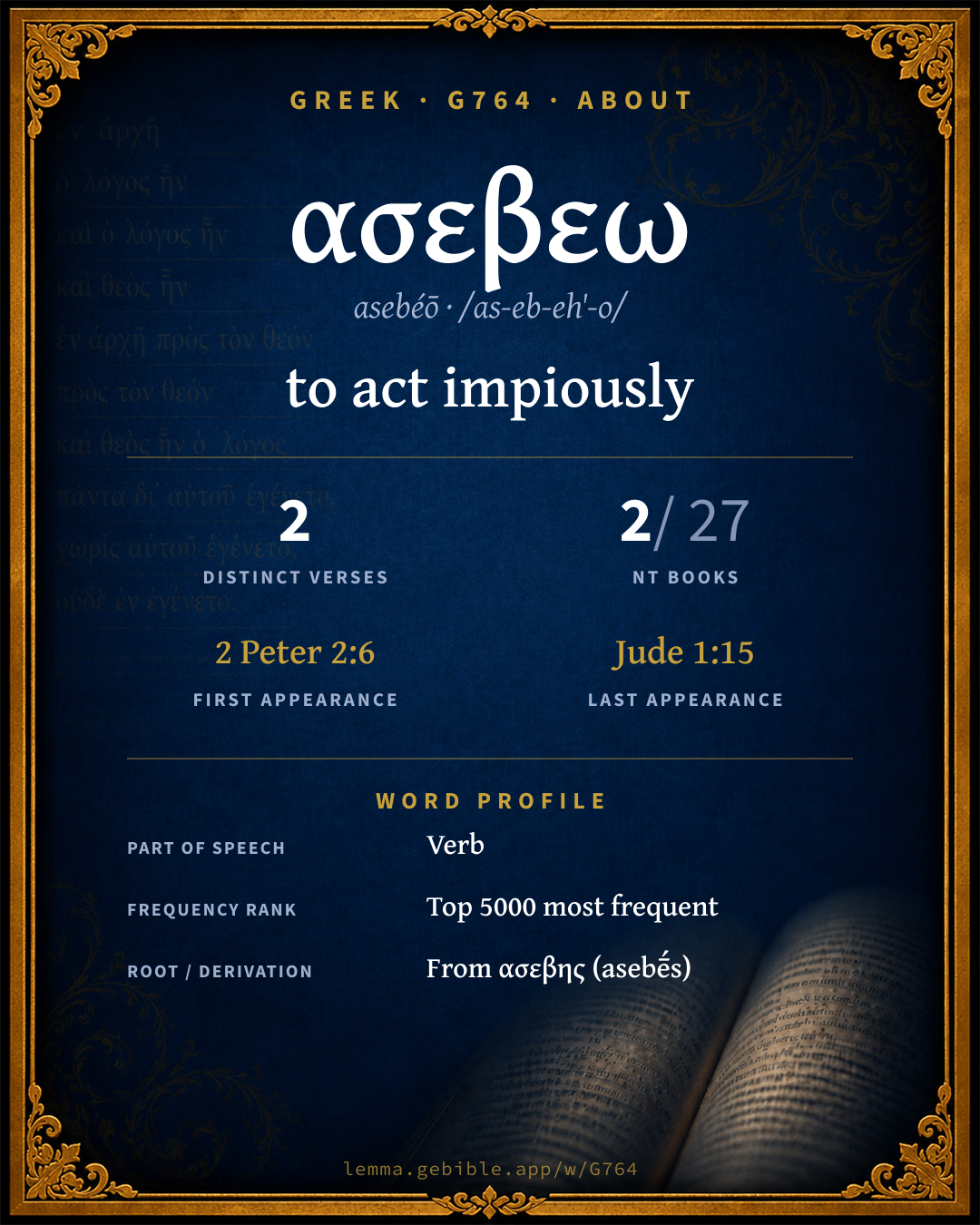
ἀσεβέω
to act impiously
Full lexicon entry — Thayer's Greek Lexicon
From Thayer's Greek Lexicon
Where this word appears
See every Aorist-tense verb in the Greek New Testament →
Grammar key — what these labels mean
Part of speech
- Verb
- An action or state-of-being word.
Tense
- Aorist
- Action viewed as a simple whole, without regard to duration — often past (perfective aspect).
- Present
- Ongoing or general action in present time (imperfective aspect).
Voice
- Active
- The subject performs the action.
Mood
- Indicative
- States a fact or asks a factual question (the mood of reality).
- Infinitive
- A verbal noun (“to write”), unmarked for person or number.
Person
- 3rd person
- The one spoken about (“he / she / it / they”).
Number
- Plural
- More than one.
Grammatical forms
- Verb, Aorist, Active, Indicative, 3rd person, Plural 1 time (50%)
- Verb, Present, Active, Infinitive 1 time (50%)
Parsed forms decoded from the imported morphology (Robinson–Tischendorf, public domain), counted across 2 parsed occurrences — not distinct verses.
Every verse where G764 appears — 2 distinct verses across 2 books. Click any verse to open its interlinear word-by-word view. Verse text shown in the World English Bible for context — . Each verse’s Greek form is shown with its reference; the English is not keyword-highlighted, since the data carries no word-level English alignment. Use “Compare translations” on any verse to read it across multiple English versions. This concordance covers the Greek New Testament; Septuagint (Greek Old Testament) occurrences of this word are not indexed here.
2 Peter 1 verse
Jude 1 verse
About this entry
At a glance — auto-summarized from this page’s data, not written by a person. Every figure links to its source below. This summary describes the numbers; it doesn’t interpret them.
ασεβεω — transliterated asebéō — is a Greek verb carrying the sense “to act impiously.” It occurs a mere 2 verses across Scripture. More than half of its appearances fall in 2 Peter. Debuting at 2 Peter 2:6, it then recurs through the corpus. Related forms include ασεβης and ασεβεια. Each statement above links to its evidence; the full detail follows below.
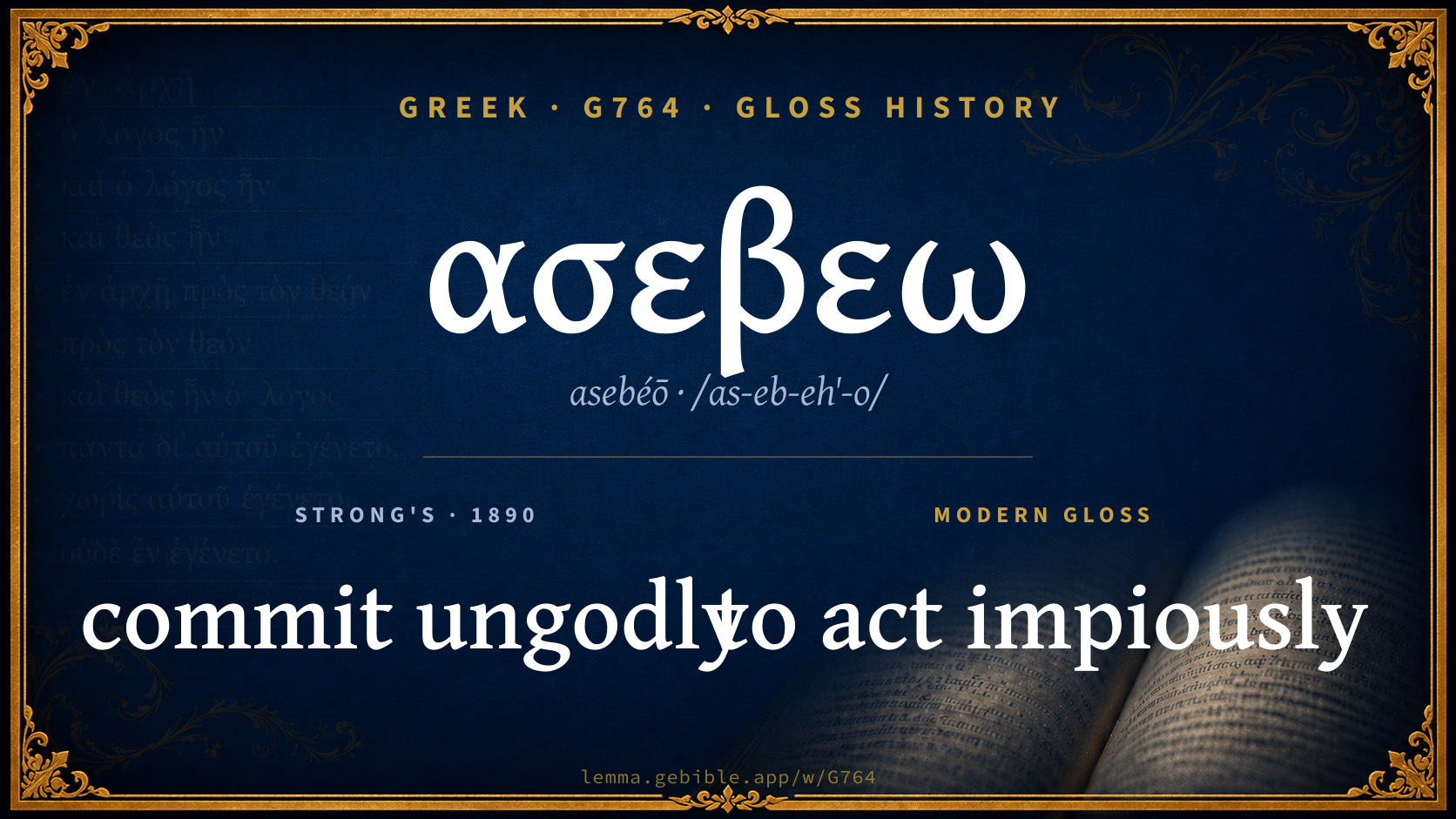
Gloss history
Strong's 1890 vs modern scholarship
About this word
Strong's G764 catalogs a Greek word from the Greek New Testament.
These counts are not copied from any lexicon or concordance. They are computed here, from the morphology-tagged Greek New Testament. What Lemma adds →
- 2
- distinct verses
- The word appears in 2 distinct verses.
- 2 / 27
- NT books
- The word appears in 2 of 27 New Testament books.
- #2,678
- by frequency
- Top 5000 most frequent Greek words (rank 2,678 of 5,347 Greek words by occurrence).
View all 2 occurrences in the concordance →
By traditional corpus
Conventional, traditional groupings — biblical authorship is debated, so this is a traditional corpus grouping, not an authorship claim. Some books belong to more than one corpus (Luke is in both the Gospels and the Lukan corpus, and so on), so these shares overlap and need not total 100%. Each figure is a share of the word’s 2 distinct verses.
- General (Catholic) Epistles 2 verses · 100%
How translations render this word
Counts come from each version’s own published word-to-Strong’s tagging or interlinear alignment — an approximate guide to how each version renders this word, not a word-level alignment the data otherwise carries. Because each total is that version’s own tagged count, the per-version totals vary from one another and need not match the appearance or distinct-verse counts above. These counts may also differ from a printed concordance because Lemma counts each distinctly tagged rendering and does not collapse phrase taggings into a single head-word total. This is a fixed set of word-tagged versions (KJV, ASV, BSB, ULT) and does not change with the reading translation you choose elsewhere. Each version’s license is shown beside its name below (and on Sources).
- King James Version: Live ungodly 1×, They have ungodly committed 1×
- American Standard Version: Live ungodly 1×, They have ungodly wrought 1×
- Berean Standard Bible: Ungodly 1×
- unfoldingWord Literal Text: They did in an ungodly way 1×
King James Version Public Domain
Renders G764 across 2 tagged occurrences — most commonly:
American Standard Version Public Domain
Renders G764 across 2 tagged occurrences — most commonly:
Berean Standard Bible Public Domain
Renders G764 across 1 tagged occurrence — most commonly:
unfoldingWord Literal Text CC BY-SA 4.0
Renders G764 across 1 tagged occurrence — most commonly:
Senses in Thayer's
The 1 sense Thayer's distinguishes for this word, in lexicon order (not ranked by frequency or importance). The full entry — with sub-senses — is in the Lexicon Entry tab.
- to be ungodly, act impiously
Word origin
Derived from ασεβης (asebḗs) (G765) — impious.
From G765 ; to be (by implication act ) impious or wicked : - commit (live that after should live) ungodly.
— Strong’s Exhaustive Concordance (1890), public domain.
Forms in the corpus
The 2 distinct written forms G764 takes in the Greek New Testament, most frequent first — each parse links to that tense’s occurrences in the concordance.
| Form | Parsing | Example | Uses |
|---|---|---|---|
| ἀσεβεῖν asebeîn | Verb, Present, Active, Infinitive | 2 Peter 2:6 | 1 |
| ἠσέβησαν ēsébēsan | Verb, Aorist, Active, Indicative, 3rd person, Plural | Jude 1:15 | 1 |
Same root — word family
Other Thayer's entries built from the same root as G764, grouped by Strong’s listed origin. These share a root / origin per the lexicon — not necessarily a shared meaning. Each links to that word’s own entry.
Derives from
Shares the same root
Compare all same-root words → They share a root, not necessarily a meaning.
Septuagint usage
The same Greek word ασεβεω appears 28 times in the Greek Old Testament (Septuagint), across 28 verses in 15 books.
- 28
- LXX occurrences
- Tagged occurrences of this Greek word in the Septuagint.
- 28
- verses
- Distinct Septuagint verses containing this word.
- 15 / 39
- OT books
- The word appears in 15 of the 39 Old Testament books.
Sample Septuagint occurrences
- Leviticus 20:12 ἀσεβέω
- Deuteronomy 17:13 ἀσεβέω
- 2 Samuel 22:22 ἀσεβέω
- Job 9:20 ἀσεβέω
- Psalms 17:22 ἀσεβέω
- Proverbs 8:36 ἀσεβέω
- Ecclesiastes 7:17 ἀσεβέω
- Isaiah 59:13 ἀσεβέω
- Jeremiah 2:8 ἀσεβέω
- Lamentations 3:42 ἀσεβέω
- Ezekiel 16:27 ἀσεβέω
- Daniel 9:5 ἀσεβέω
Septuagint occurrences (same lexeme)
Every verse where the same Strong’s number (G764) appears in the Greek Septuagint. Verse text shown in the World English Bible for context; the Greek form is the matched word — the English is not keyword-highlighted.
- Leviticus 20:12 ἀσεβέω "'If a man lies with his daughter-in-law, both of them shall surely be put to death: they have committed a perversion; their blood shall be upon them.
- Deuteronomy 17:13 ἀσεβέω All the people shall hear, and fear, and do no more presumptuously.
- Deuteronomy 18:20 ἀσεβέω But the prophet, who shall speak a word presumptuously in my name, which I have not commanded him to speak, or who shall speak in the name of other gods, that same prophet shall die.
- Deuteronomy 25:2 ἀσεβέω and it shall be, if the wicked man be worthy to be beaten, that the judge shall cause him to lie down, and to be beaten before his face, according to his wickedness, by number.
- 2 Samuel 22:22 ἀσεβέω For I have kept the ways of Yahweh, And have not wickedly departed from my God.
- Job 9:20 ἀσεβέω Though I am righteous, my own mouth shall condemn me. Though I am blameless, it shall prove me perverse.
- Job 9:21 ἀσεβέω I am blameless. I don't regard myself. I despise my life.
- Job 10:2 ἀσεβέω I will tell God, 'Do not condemn me, Show me why you contend with me.
- Job 10:7 ἀσεβέω Although you know that I am not wicked, There is no one who can deliver out of your hand.
- Job 34:8 ἀσεβέω Who goes in company with the workers of iniquity, And walks with wicked men?
- Job 34:10 ἀσεβέω "Therefore listen to me, you men of understanding: Far be it from God, that he should do wickedness, From the Almighty, that he should commit iniquity.
- Psalms 17:22 ἀσεβέω
- Proverbs 8:36 ἀσεβέω But he who sins against me wrongs his own soul. All those who hate me love death."
- Ecclesiastes 7:17 ἀσεβέω Don't be too wicked, neither be foolish. Why should you die before your time?
- Isaiah 59:13 ἀσεβέω transgressing and denying Yahweh, and turning away from following our God, speaking oppression and revolt, conceiving and uttering from the heart words of falsehood.
- Jeremiah 2:8 ἀσεβέω The priests didn't say, Where is Yahweh? and those who handle the law didn't know me: the rulers also transgressed against me, and the prophets prophesied by Baal, and walked after things that do not profit.
- Jeremiah 2:29 ἀσεβέω Why will you contend with me? you all have transgressed against me, says Yahweh.
- Jeremiah 3:13 ἀσεβέω Only acknowledge your iniquity, that you have transgressed against Yahweh your God, and have scattered your ways to the strangers under every green tree, and you have not obeyed my voice, says Yahweh.
- Jeremiah 22:3 ἀσεβέω Thus says Yahweh: Execute you justice and righteousness, and deliver him who is robbed out of the hand of the oppressor: and do no wrong, do no violence, to the foreigner, the fatherless, nor the widow; neither shed innocent blood in this place.
- Lamentations 3:42 ἀσεβέω We have transgressed and have rebelled; you have not pardoned.
- Ezekiel 16:27 ἀσεβέω See therefore, I have stretched out my hand over you, and have diminished your ordinary [food], and delivered you to the will of those who hate you, the daughters of the Philistines, who are ashamed of your lewd way.
- Ezekiel 18:31 ἀσεβέω Cast away from you all your transgressions, in which you have transgressed; and make you a new heart and a new spirit: for why will you die, house of Israel?
- Daniel 9:5 ἀσεβέω we have sinned, and have dealt perversely, and have done wickedly, and have rebelled, even turning aside from your precepts and from your ordinances;
- Hosea 7:13 ἀσεβέω Woe to them! For they have wandered from me. Destruction to them! For they have trespassed against me. Though I would redeem them, Yet they have spoken lies against me.
- Hosea 8:1 ἀσεβέω "Put the trumpet to your lips! Something like an eagle is over Yahweh's house, Because they have broken my covenant, And rebelled against my law.
- Amos 4:4 ἀσεβέω "Go to Bethel, and sin; To Gilgal, and sin more. Bring your sacrifices every morning, Your tithes every three days,
- Zephaniah 3:4 ἀσεβέω Her prophets are arrogant and treacherous people. Her priests have profaned the sanctuary. They have done violence to the law.
- Zephaniah 3:11 ἀσεβέω In that day you will not be disappointed for all your doings, in which you have transgressed against me; for then I will take away out of the midst of you your proudly exulting ones, and you will no more be haughty in my holy mountain.
These are occurrences of the same Greek lexeme (G764) in the Septuagint — not a translation of any one Hebrew word. The store carries no word-level Hebrew↔Greek alignment, so no Hebrew original is asserted here. Counts come from the recovered LXX Strong's tagging — high-frequency vocabulary is well covered, while rare or late forms may be untagged — so they reflect tagged occurrences and may slightly undercount.