Luke 22:62

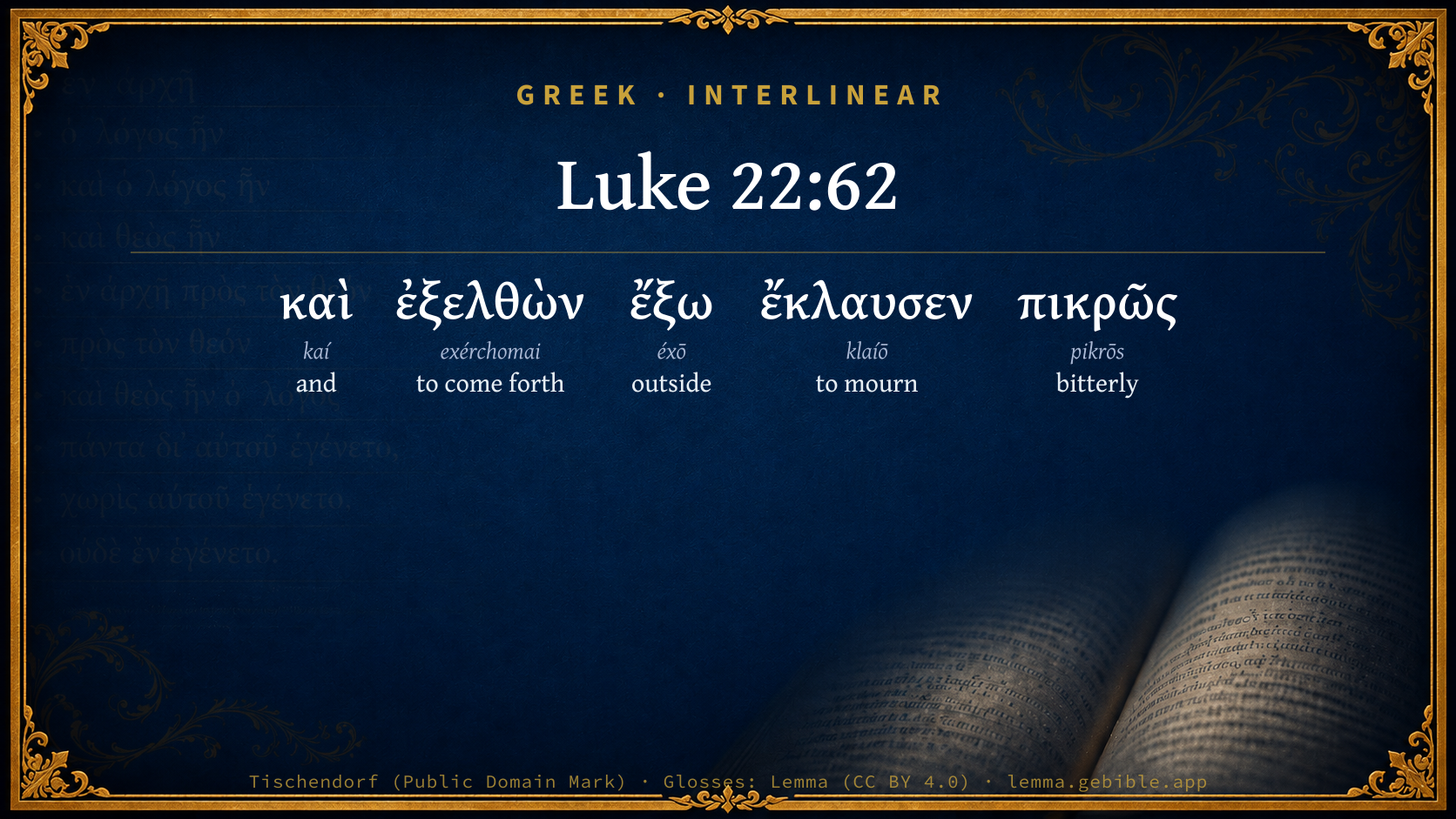
Greek (Tischendorf 8th ed.) Luke 22:62 appears in the Greek New Testament. The text above is from the Tischendorf 8th edition. Each word links to its Strong’s number and a concise gloss. Click any word for its full Thayer’s Greek Lexicon entry.
Download image
Cite this verse

Luke 22:62 (World English Bible). Public Domain. Lemma interlinear Bible study tool, https://lemma.gebible.app/v/luke/22/62.

Show BibTeX & RIS
BibTeX
RIS
English Translation
He went out, and wept bitterly.
World English Bible · Public Domain
Download a study sheet

One document with this verse’s original text, its word-by-word gloss line, the meaning frame, cross-references with their text, attributed commentary, and full source and license credits — printable, and it pastes into notes with its structure intact.

This verse Autodidact and up

Study sheet (.html) Plain text (.txt)

A passage Seminary Student

Up to 50 verses in one chapter. A passage sheet keeps up to 6 commentary sources and 12 cross-references per verse, in the order this page ranks them, and says so on the sheet whenever that leaves anything out. Ask for a single verse and you get the Autodidact verse sheet above.

Everything on this page stays free to read, with no account — the sheet is a download of what is already on screen, not access to it.

Want to remove ads? Support Godless Engineer
Compare translations 3

The same verse in 3 English versions, stacked beneath the original-language interlinear above. Click any original word for its lexicon entry.

Each is an independent rendering of the whole verse — the interlinear is not word-aligned to these translations.

Highlighted words mark where these versions differ — a whole-verse word diff, not a word-by-word alignment.

  • World English Bible Public Domain
    He went out, and wept bitterly.
  • King James Version Public Domain
    And Peter went out, and wept bitterly.
  • unfoldingWord Literal Text CC BY-SA 4.0
    And going outside, he wept bitterly.

unfoldingWord Literal Text — © unfoldingWord, licensed CC BY-SA 4.0. Word-aligned USFM3 via Door43 (git.door43.org/unfoldingWord/en_ult).

Versions to compare (up to 4)

3 of 4 selected

Show all 19 translations

Every available English version of this verse, each an independent rendering of the whole verse.

  • World English Bible Public Domain
    He went out, and wept bitterly.
  • Berean Standard Bible Public Domain
    And he went outside and wept bitterly.
  • Majority Standard Bible Public Domain
    And Peter went outside and wept bitterly.
  • King James Version Public Domain
    And Peter went out, and wept bitterly.
  • American Standard Version (1901) Public Domain
    And he went out, and wept bitterly.
  • Revised Version (1885) Public Domain
    And he went out, and wept bitterly.
  • Geneva Bible (1599) Public Domain
    And Peter went out, and wept bitterly.
  • Douay-Rheims (1899) Public Domain
    And Peter going out, wept bitterly.
  • Young's Literal Translation Public Domain
    and Peter having gone without, wept bitterly.
  • Literal Standard Version CC BY-SA 4.0
    and Peter having gone outside, wept bitterly.
  • Unlocked Literal Bible CC BY-SA 4.0
    Peter went outside and wept bitterly.
  • unfoldingWord Literal Text CC BY-SA 4.0
    And going outside, he wept bitterly.
  • Darby Bible Public Domain
    And Peter, going forth without, wept bitterly.
  • World Messianic Bible Public Domain
    He went out, and wept bitterly.
  • Webster's Bible Public Domain
    And Peter went out, and wept bitterly.
  • Free Bible Version CC BY-SA 4.0
    Peter went out and wept bitterly.
  • Bible in Basic English Public Domain
    And he went out, weeping bitterly.
  • Text-Critical English NT CC BY 4.0
    And Peter went out and wept bitterly.
  • Tyndale New Testament (1534) Public Domain
    And Peter went out and wepte bitterly.

Literal Standard Version (2020), Covenant Press — licensed CC BY-SA 4.0. Text via the HelloAO Bible API (eBible.org). Unlocked Literal Bible (unfoldingWord) — licensed CC BY-SA 4.0. Text via the HelloAO Bible API (eBible.org). unfoldingWord Literal Text — © unfoldingWord, licensed CC BY-SA 4.0. Word-aligned USFM3 via Door43 (git.door43.org/unfoldingWord/en_ult). Free Bible Version, Dr. Jonathan Gallagher — licensed CC BY-SA 4.0. Text via the HelloAO Bible API (eBible.org).

Word by word

More ways to search: Search by grammar → Find every occurrence → Compare this word →

Practice this passage: Drill this verse → Learn its vocabulary →

About this verse

These counts appear in no published source. They are computed here, from the morphology-tagged text and Lemma’s own curated glosses. What Lemma adds →

5
words
5
distinct lemmas
Gospels
section

Notable vocabulary

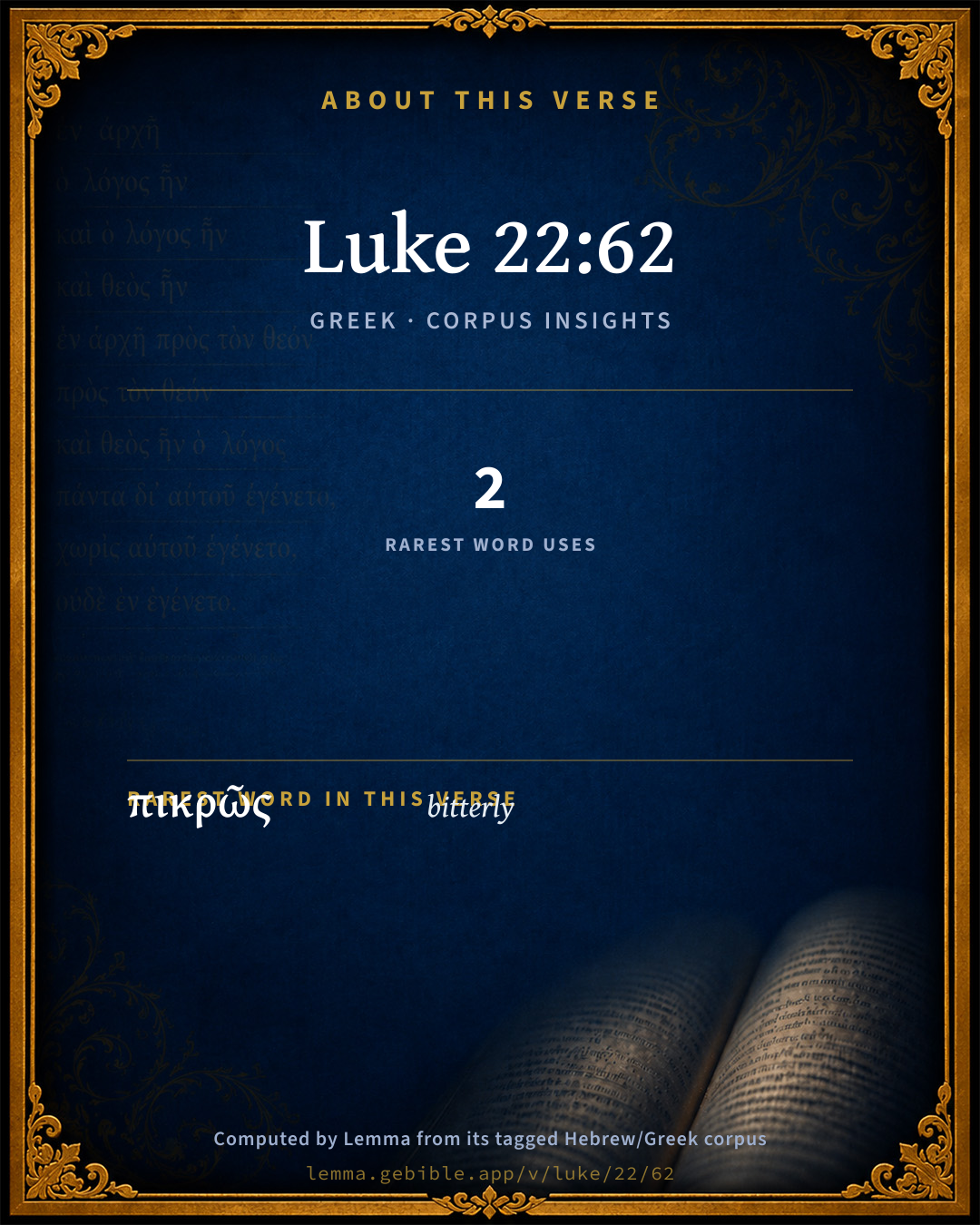
The rarest word here is πικρῶς bitterly G4090 — appearing just 2 times in the whole Greek New Testament.

Shared distinctive vocabulary

πικρῶς bitterly G4090 occurs in 2 verses of the Greek New Testament. Also found in:

Cross-references

12

Topical passages linked to Luke 22:62 in the Treasury of Scripture Knowledge — connected by theme and wording, ordered by reader-vote popularity; previews shown in the World English Bible.

  • Matthew 26:75 Peter remembered the word which Jesus had said to him, "Before the rooster crows, you will deny me three times." He went out and wept bitterly.
  • 1 Corinthians 10:12 Therefore let him who thinks he stands be careful that he doesn't fall.
  • Psalms 38:18 For I will declare my iniquity. I will be sorry for my sin.
  • Psalms 126:5–6 Those who sow in tears will reap in joy.
  • Psalms 130:1–4 Out of the depths I have cried to you, Yahweh.
  • Jeremiah 31:18 I have surely heard Ephraim bemoaning himself [thus], You have chastised me, and I was chastised, as a calf unaccustomed [to the yoke]: turn you me, and I shall be turned; for you are Yahweh my God.
  • Ezekiel 7:16 But those of those who escape shall escape, and shall be on the mountains like doves of the valleys, all of them moaning, every one in his iniquity.
  • Matthew 5:4 Blessed are those who mourn, For they shall be comforted.
  • Mark 14:72 The rooster crowed the second time. Peter remembered the word, how that Jesus said to him, "Before the rooster crows twice, you will deny me three times." When he thought about that, he wept.
  • 2 Corinthians 7:9–11 I now rejoice, not that you were made sorry, but that you were made sorry to repentance. For you were made sorry in a godly way, that you might suffer loss by us in nothing.
  • Psalms 143:1–4 Hear my prayer, Yahweh. Listen to my petitions. In your faithfulness and righteousness, relieve me.
  • Zechariah 12:10 I will pour on the house of David, and on the inhabitants of Jerusalem, the spirit of grace and of supplication; and they will look to me whom they have pierced; and they shall mourn for him, as one mourns for his only son, and will grieve bitterly for him, as one grieves for his firstborn.

Cross-references courtesy of OpenBible.info (CC BY 4.0).

Commentary

Notes on Luke 22:62 from classic Christian and Jewish commentators (each source and its license shown beneath its notes). The classic Christian expositions comment on the surrounding passage and are grouped to its opening verse, so a note may address several verses; the Jewish commentaries on the Tanakh (Rashi and others) are per-verse, so they appear only where the commentator wrote on this verse.

Lemma curates 59 commentaries, every one of them public domain or Creative Commons licensed, each selected and text-cleaned for this edition rather than reprinted as found. About our sources →

Expositor's Greek Testament

ed. W. Robertson Nicoll

Luk 22:62 exactly as in Mt.

The Expositor's Greek Testament, edited by W. Robertson Nicoll (1897–1910) — public domain. Text from a community e-Sword module.

Jamieson, Fausset & Brown

Robert Jamieson, A. R. Fausset & David Brown

And Peter went out, and wept bitterly--(Also see on Mar 14:72.)

Next: Luke Chapter 23

Jamieson, Fausset & Brown — Commentary Critical and Explanatory on the Whole Bible (1871) — public domain (CC PDM 1.0). Text via the HelloAO Bible API.

Adam Clarke's Commentary

Verse 62. And Peter went out] The word Peter is omitted by BDKLM, and many other good MSS., with some of the ancient versions. Griesbach leaves it out of the text.

Adam Clarke's Commentary on the Bible (1810–1826) — public domain. Text from a community e-Sword/MySword module.

The Cambridge Bible for Schools and Colleges

gen. ed. J. J. S. Perowne

62. went out] into the night, but “to meet the morning dawn.”

and wept] Not only edakruse, ‘shed tears,’ but eklause, ‘wept aloud;’ and, as St Mark says (Mar_14:72), eklaie, ‘he continued weeping.’ It was more than a mere burst of tears.

bitterly] St Mark says epibalon, which may mean, ‘when he thought thereon,’ or ‘flinging his mantle over his head.’

The Cambridge Bible for Schools and Colleges (gen. ed. J. J. S. Perowne; Cambridge University Press, 1878–1918) — public domain. Text from a community e-Sword module.

John Gill's Exposition

And many other things blasphemously spake they,.... As denying and ridiculing his deity, and divine sonship; mocking at, and burlesquing his offices, of prophet, priest, and king; asserting him to be a mere man, and a very wicked one; a profane sinner, a glutton, and a winebibber; a sabbath breaker, a blasphemer, and a seditious person; and one that had a devil, or dealt with familiar spirits: and thus spake they

against him; his person, office, and character.

John Gill's Exposition of the Whole Bible (1746–1763) — public domain (CC PDM 1.0). Text via the HelloAO Bible API.

Trapp's Complete Commentary

John Trapp

62 And Peter went out, and wept bitterly.

Ver. 62. See Mat 26:75. Titubatio Petri, omnium petra.

John Trapp, A Commentary or Exposition upon All the Books of the Old and New Testament (1647–1656) — public domain. Text from a community e-Sword module.

MacLaren's Expositions of Holy Scripture

Alexander MacLaren

Luke

IN THE HIGH PRIEST’S PALACE

Luk 22:54 - Luk 22:71.

The present passage deals with three incidents, each of which may be regarded either as an element in our Lord’s sufferings or as a revelation of man’s sin. He is denied, mocked, and formally rejected and condemned. A trusted friend proves faithless, the underlings of the rulers brutally ridicule His prophetic claims, and their masters vote Him a blasphemer for assenting His divinity and Messiahship.

I. We have the failure of loyalty and love in Peter’s denials.

I may observe that Luke puts all Peter’s denials before the hearing by the council, from which it is clear that the latter was later than the hearing recorded by Matthew and John. The first denial probably took place in the great hall of the high priest’s official residence, at the upper end of which the prisoner was being examined, while the hangers-on huddled round the fire, idly waiting the event.

The morning air bit sharply, and Peter, exhausted, sleepy, sad, and shivering, was glad to creep near the blaze. Its glinting on his face betrayed him to a woman’s sharp eye, and her gossiping tongue could not help blurting out her discovery. Curiosity, not malice, moved her; and there is no reason to suppose that any harm would have come to Peter, if he had said, as he should have done, ‘Yes, I am His disciple.’ The day for persecuting the servants was not yet come, but for the present it was Jesus only who was aimed at.

No doubt, cowardice had a share in the denials, but there was more than that in them. Peter was worn out with fatigue, excitement, and sorrow. His susceptible nature would be strongly affected by the trying scenes of the last day, and all the springs of life would be low. He was always easily influenced by surroundings, and just as, at a later date, he was ‘carried away’ by the presence at Antioch of the Judaisers, and turned his back on the liberal principles which he had professed, so now he could not resist the current of opinion, and dreaded being unlike even the pack of menials among whom he sat. He was ashamed of his Master and hid his colours, not so much for fear of bodily harm as of ridicule. Was there not a deeper depth still in his denials, even the beginnings of doubt whether, after all, Jesus was what he had thought Him? Christ prayed that Peter’s ‘faith’ should not ‘fail’ or be totally eclipsed, and that may indicate that the assault was made on his ‘faith’ and that it wavered, though it recovered steadfastness.

If he had been as sure of Christ’s work and nature as when he made his great confession, he could not have denied Him. But the sight of Jesus bound, unresisting, and evidently at the mercy of the rulers, might well make a firmer faith stagger. We have not to steel ourselves to bear bodily harm if we confess Christ; but many of us have to run counter to a strong current flowing around us, and to be alone in the midst of unsympathising companions ready to laugh and gibe, and some of us are tempted to waver in our convictions of Christ’s divinity and redeeming power, because He still seems to stand at the bar of the wise men and leaders of opinion, and to be treated by them as a pretender. It is a wretched thing to be persecuted out of one’s Christianity in the old-fashioned fire and sword style; but it is worse to be laughed out of it or to lose it, because we breathe an atmosphere of unbelief. Let the doctors at the top of the hall and the lackeys round the fire who take their opinions from them say what they like, but let them not make us ashamed of Jesus.

Peter slipped away to the gateway, and there, apparently, was again attacked, first by the porteress and then by others, which occasioned the second denial, while the third took place in the same place, about an hour afterwards. One sin makes many. The devil’s hounds hunt in packs. Consistency requires the denier to stick to his lie. Once the tiniest wing tip is in the spider’s web, before long the whole body will be wrapped round by its filthy, sticky threads.

If Peter had been less confident, he would have been more safe. If he had said less about going to prison and death, he would have had more reserve fidelity for the time of trial. What business had he thrusting himself into the palace? Over-reliance on self leads us to put ourselves in the way of temptations which it were wiser to avoid. Had he forgotten Christ’s warnings? Apparently so. Christ predicts the fall that it may not happen, and if we listen to Him, we shall not fall.

The moment of recovery seems to have been while our Lord was passing from the earlier to the later examination before the rulers. In the very floodtide of Peter’s oaths, the shrill cock-crow is heard, and at the sound the half-finished denial sticks in his throat. At the same moment he sees Jesus led past him, and that look, so full of love, reproof, and pardon, brought him back to loyalty, and saved him from despair. The assurance of Christ’s knowledge of our sins against Him melts the heart, when the assurance of His forgiveness and tender love comes with it. Then tears, which are wholly humble but not wholly grief, flow. They do not wash away the sin, but they come from the assurance that Christ’s love, like a flood, has swept it away. They save from remorse, which has no healing in it.

II. We have the rude taunts of the servants.

The mockery here comes from Jews, and is directed against Christ’s prophetic character, while the later jeers of the Roman soldiers make a jest of His kingship. Each set lays hold of what seems to it most ludicrous in His pretensions, and these servants ape their masters on the judgment seat, in laughing to scorn this Galilean peasant who claimed to be the Teacher of them all. Rude natures have to take rude ways of expression, and the vulgar mockery meant precisely the same as more polite and covert scorn means from more polished people; namely, rooted disbelief in Him. These mockers were contented to take their opinions on trust from priests and rabbis. How often, since then, have Christ’s servants been objects of popular odium at the suggestion of the same classes, and how often have the ignorant people been misled by their trust in their teachers to hate and persecute their true Master!

Jesus is silent under all the mockery, but then, as now, He knows who strikes Him. His eyes are open behind the bandage, and see the lifted hands and mocking lips. He will speak one day, and His speech will be detection and condemnation. Then He was silent, as patiently enduring shame and spitting for our sakes. Now He is silent, as long-suffering and wooing us to repentance; but He keeps count and record of men’s revilings, and the day comes when He whose eyes are as a flame of fire will say to every foe, ‘I know thy works.’

III. We have the formal rejection and condemnation by the council.

The hearing recorded in verses 66 to 71 took place ‘as soon as it was day,’ and was apparently a more formal official ratification of the proceedings of the earlier examination described by Matthew and John. The ruler’s question was put simply in order to obtain material for the condemnation already resolved on. Our Lord’s answer falls into two parts, in the first of which He in effect declines to recognise the bona fides of His judges and the competency of the tribunal, and in the second goes beyond their question, and claims participation in divine glory and power. ‘If I tell you, ye will not believe’; therefore He will not tell them.

Jesus will not unfold His claims to those who only seek to hear them in order to reject, not to examine, them. Silence is His answer to ingrained prejudice masquerading as honest inquiry. It is ever so. There is small chance of truth at the goal if there be foregone conclusions or biased questions at the starting-point. ‘If I ask you, ye will not answer.’ They had taken refuge in judicious but self-condemning silence when He had asked them the origin of John’s mission and the meaning of the One Hundred and Tenth Psalm, and thereby showed that they were not seeking light. Jesus will gladly speak with any who will be frank with Him, and let Him search their hearts; but He will not unfold His mission to such as refuse to answer His questions. But while thus He declines to submit Himself to that tribunal, and in effect accuses them of obstinate blindness and a fixed conclusion to reject the claims which they were pretending to examine, He will not leave them without once more asserting an even higher dignity than that of Messiah. As a prisoner at their bar, He has nothing to say to them; but as their King and future Judge, He has something. They desire to find materials for sentence of death, and though He will not give these in the character of a criminal before His judges, He also desires that the sentence should pass, and He will declare His divine prerogatives and fall possession of divine power in the hearing of the highest court of the nation.

It was fitting that the representatives of Israel, however prejudiced, should hear at that supreme moment the full assertion of full deity. It was fitting that Israel should condemn itself, by treating that claim as blasphemy. It was fitting that Jesus should bring about His death by His twofold claim-that made to the Sanhedrim, of being the Son of God, and that before Pilate, of being the King of the Jews.

The whole scene teaches us the voluntary character of Christ’s Death, which is the direct result of this tremendous assertion. It carries our thoughts forward to the time when the criminal of that morning shall be the Judge, and the judges and we shall stand at His bar. It raises the solemn question, Did Jesus claim truly when He claimed divine power? If truly, do we worship Him? If falsely, what was He? It mirrors the principles on which He deals with men universally, answering ‘him that cometh, according to the multitude of his idols,’ and meeting hypocritical pretences of seeking the truth about Him with silence, but ever ready to open His heart and the witness to His claims to the honest and docile spirits who are ready to accept His words, and glad to open their inmost secrets to Him.

Alexander MacLaren, Expositions of Holy Scripture (1904–1910) — public domain. Text from a community e-Sword module.

Cambridge Greek Testament for Schools and Colleges

62. ἐξελθών. Into the night, but “to meet the morning dawn.”

ἔκλαυσεν. Not only ἐδάκρυσεν, ‘shed tears,’ but ἔκλαυσεν, ‘wept aloud;’ and, as St Mark says (Mar 14:72), ἔκλαιεν, ‘he continued weeping.’ It was more than a mere burst of tears.

πικρῶς. St Mark says ἐπιβαλών, which may mean, ‘when he thought thereon,’ or ‘flinging his mantle over his head.’

Cambridge Greek Testament for Schools and Colleges (Cambridge University Press, 1896; 21 vols, various authors incl. Carr, Maclear, Plummer, Farrar, Lumby, Moule, M. R. James, Simcox) — public domain. Text from a community e-Sword module.

International Critical Commentary

62. WH. bracket this verse, which is wanting in a b e ff2 i 1* r. But ὁ Πέτρος (A Γ Δ Λ, Vulg.) is no doubt an addition both here and Mat 26:75.

International Critical Commentary — older volumes (1896–1929), various authors — public domain. Text from a community e-Sword module.

Lesson kit

Teaching starters — assembled from the data on this page, not authored interpretation. Every prompt links to the verse data it draws on. Edit before teaching.

Luke, in the Gospels, opens this verse with 5 words (5 distinct Greek lemmas). Its most distinctive word is pikrōs (“bitterly”). A historical commentator’s framing appears above. Read the whole chapter for the surrounding context.

Discussion questions

  1. The word pikrōs carries the sense “bitterly.” How does it shape the verse?
  2. How does Matthew 26:75, which shares the word «bitterly», read alongside this verse?
  3. These translations render this verse differently. What is at stake in choosing one wording over another?
  4. Compare how Expositor's Greek Testament and Jamieson, Fausset & Brown read this verse. Where do they agree or differ?

Things to notice

Reading settings

Reading text

Shown beneath each verse's original-language words.

Old Testament
Old Testament edition

Read the OT as the Masoretic Hebrew (MT) or the Greek Septuagint (LXX).

English shown for the Greek Septuagint (in the Hebrew ↔ Greek comparison).

Comparing translations? Open the Compare panel on any verse page to stack up to four side by side.