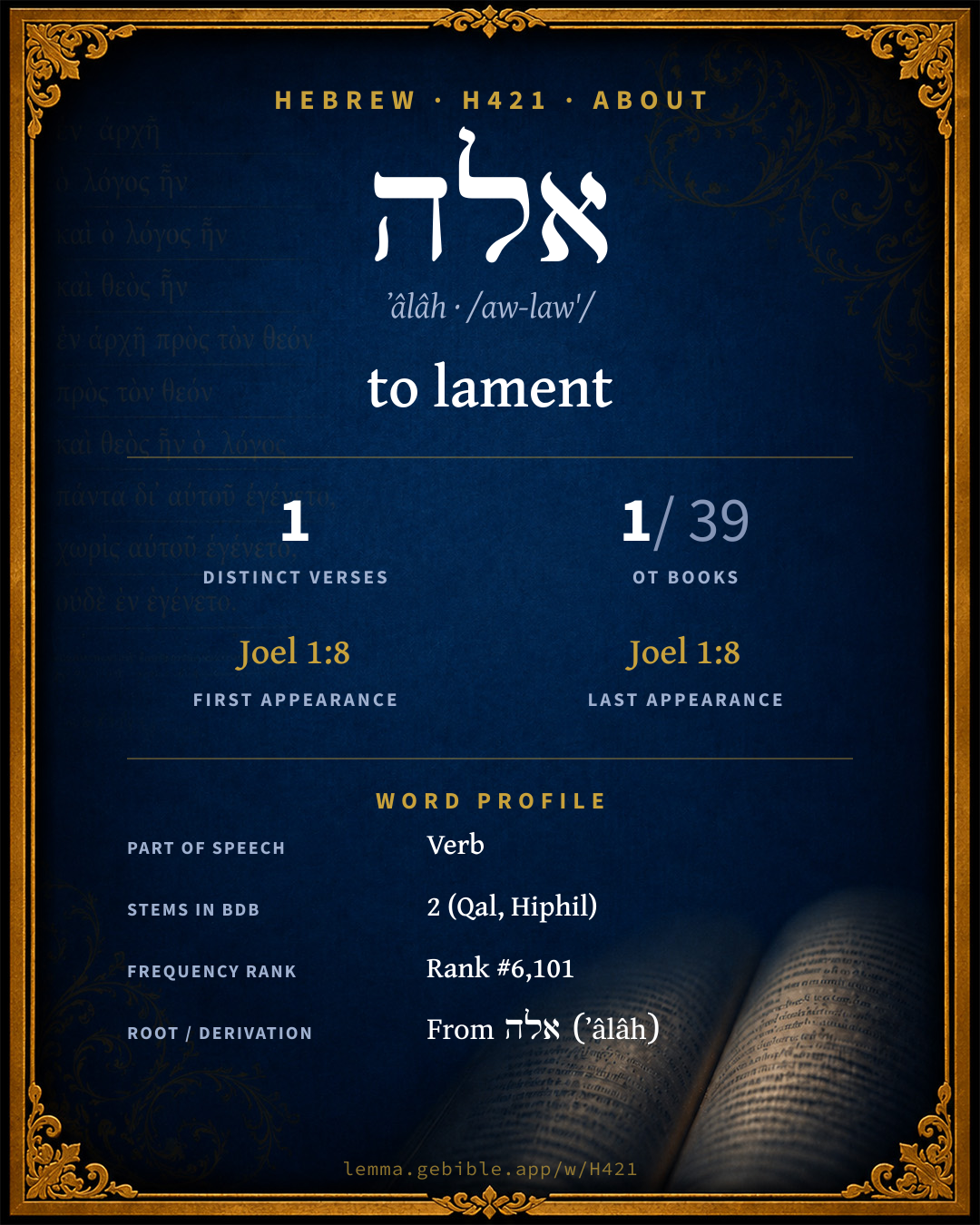
אָלָה
to lament
Full lexicon entry — Brown-Driver-Briggs (BDB)
From Brown-Driver-Briggs (BDB)
Where this word appears
Grammar key — what these labels mean
Part of speech
- Verb
- An action or state-of-being word.
Stem
- Qal
- The basic, simple active stem — the plain form of the verb (“he wrote”). Here: ‘swear’
Form
- Imperative
- A direct command (“write!”).
Person
- 2nd Person
- The one addressed (“you”).
Gender
- Feminine
- Grammatically feminine.
Number
- Singular
- One.
Every verse where H421 appears — 1 distinct verse across 1 book. Click any verse to open its interlinear word-by-word view. Verse text shown in the World English Bible for context — . Each verse’s Hebrew form is shown with its reference; the English is not keyword-highlighted, since the data carries no word-level English alignment. Use “Compare translations” on any verse to read it across multiple English versions. This concordance covers the Hebrew Bible; Septuagint (Greek Old Testament) occurrences are not indexed here.
Joel 1 verse
About this entry
At a glance — auto-summarized from this page’s data, not written by a person. Every figure links to its source below. This summary describes the numbers; it doesn’t interpret them.
“to lament” is the headline sense of the Hebrew verb אלה (ʼâlâh). The Hebrew Bible uses it only 1 verse. More than three-quarters of its appearances fall in Joel. Scripture uses it exactly once, at Joel 1:8. Across 2 stems, its meaning turns on the binyan (Qal, Hiphil). The sections below give every sense, occurrence, and version rendering.
Gloss history
Strong's 1890 vs modern scholarship
About this word
Strong's H421 catalogs a Hebrew word from the Hebrew Old Testament.
These counts are not copied from any lexicon or concordance. They are computed here, from the morphology-tagged Hebrew Old Testament. What Lemma adds →
- 1
- distinct verses
- The word appears in 1 distinct verse.
- 1 / 39
- OT books
- The word appears in 1 of 39 Old Testament books.
- #6,101
- by frequency
- Rank #6,101 (rank 6,101 of 8,640 Hebrew words by occurrence).
View all 1 occurrence in the concordance →
Most concentrated in
- Joel 1 verse 100%
By section of the Old Testament
By traditional corpus
Conventional, traditional groupings — biblical authorship is debated, so this is a traditional corpus grouping, not an authorship claim. Each share is this word’s portion of its verses in that division of the Hebrew canon. Each figure is a share of the word’s 1 distinct verse.
- Prophets (Nevi'im) 1 verse · 100%
How translations render this word
Counts come from each version’s own published word-to-Strong’s tagging or interlinear alignment — an approximate guide to how each version renders this word, not a word-level alignment the data otherwise carries. Because each total is that version’s own tagged count, the per-version totals vary from one another and need not match the appearance or distinct-verse counts above. These counts may also differ from a printed concordance because Lemma counts each distinctly tagged rendering and does not collapse phrase taggings into a single head-word total. This is a fixed set of word-tagged versions (KJV, ASV, BSB, ULT) and does not change with the reading translation you choose elsewhere. Each version’s license is shown beside its name below (and on Sources).
BDB lists this Strong’s number as 3 distinct words (homographs). Each count above pools all of them and is not split by sense — see the Senses section below. A low-frequency rendering may belong to a different one of those words, not the primary meaning.
- King James Version†: Lament 1×
- American Standard Version†: Lament 1×
- Berean Standard Bible†: Wail 1×
- unfoldingWord Literal Text†: Mourn 1×
King James Version Public Domain
Renders H421 across 1† tagged occurrence — most commonly:
American Standard Version Public Domain
Renders H421 across 1† tagged occurrence — most commonly:
Berean Standard Bible Public Domain
Renders H421 across 1† tagged occurrence — most commonly:
unfoldingWord Literal Text CC BY-SA 4.0
Renders H421 across 1† tagged occurrence — most commonly:
9 senses and sub-senses in the full BDB
Hebrew verbs can shift meaning by stem (binyan): Qal is the basic action, Niphal is often passive or reflexive, Piel often intensifies or makes it factitive, and Hiphil is typically causative. The senses below are grouped under the stem BDB assigns to each.
What do BDB’s symbols mean?
BDB uses these scholarly abbreviations:
| Symbol | Meaning |
|---|---|
| 𝔊 | the Septuagint (the ancient Greek translation, LXX) |
| 𝔙 | the Vulgate (the Latin translation) |
| 𝔖 | the Syriac version (the Peshitta) |
| 𝔗 | the Targum (the Aramaic translation) |
| ψ | the Psalms |
| √ | root (the underlying root or stem) |
| ‖ | parallel passage (a synonymous or contrasted parallel) |
| † | the dagger: every passage where the word occurs is cited |
The 9 senses and sub-senses the full Brown-Driver-Briggs lexicon distinguishes for this word, in lexicon order (not ranked by frequency), with BDB’s own verbatim wording and sub-sense lettering. Shown in Hebrew script with BDB’s own scholarly abbreviations. The condensed entry is in the Lexicon Entry tab.
אלה I swear, curse (cf. I. אלה? so Thes LagOr ii. 3)
Qal
- Pf. 1 K 8:31 (= 2 Ch 6:22 all Vrss Th Bö Bä Kp reading וְאָלָה); אָלִית Ju 17:2; Inf. abs. אָלֹה Ho 4:2; אָלוֹת Ho 10:4. e.g. 1 Kings 8:31
- 1. swear, take oath before God 1 K 8:31 (= 2 Ch 6:22); in covenants Ho 4:2; 10:4 (falsely). e.g. 1 Kings 8:31
- 2. curse Ju 17:2. e.g. Judges 17:2
Hiphil
- Impf. וַיֹּ֫אֶ֗ל 1 S 14:24; Inf. לְהַאֲלֹתוֹ 1 K 8:31 = 2 Ch 6:22 adjure, put under oath. e.g. 1 Samuel 14:24
אלה II oath Gn 26
- 1. oath in testimony Lv 5:1 Nu 5:21(×2) (P) Pr 29:24; בא באלה come into an oath Ne 10:30; הביא באלה bring into an oath Ez 17:13; נשׂא אלה 1 K 8:31 (= 2 Ch 6:22). e.g. Leviticus 5:1
- 2. oath of covenant Gn 24:41(×2); 26:28 (J) Dt 29:11, 13; בזה אלה despise an oath Ez 16:59; 17:16, 18, 19. e.g. Genesis 24:41
- 3. curse (a) from God Nu 5:23 (P) Dt 29:18, 19, 20; 30:7 2 Ch 34:24 Is 24:6 Je 23:10 Dn 9:11 Zc 5:3; (b) from men Jb 31:30 ψ 10:7; 59:13. e.g. Numbers 5:23
- 4. execration in the phrase היה לאלה become an execration Nu 5:27 (P) Je 29:18; 42:18; 44:12. e.g. Numbers 5:27
אלה III wail (Aramaic אֲלָא, ܐܶܠܴܐ ) only
Qal
- Imv. fs. אֱלִי Jo 1:8 (v. אַלְלַי). e.g. Joel 1:8
Senses from the full Brown-Driver-Briggs lexicon (Brown, Driver, Briggs; Oxford 1906 — public domain), digitized via Sefaria, supplemented by the OpenScriptures HebrewLexicon (CC BY 4.0). Full attribution on Sources.
Word origin
I. vb. swear, curse (cf. I. אלה? so Thes LagOr ii. 3)—
II. n.f. oath Gn 26:28 +; sf. אָלָתִי, אָלָתוֹ Gn 24:41 + (4 times); pl. אָלוֹת Dt 29:20 + (4 times)
III. vb. wail (Aramaic אֲלָא, ܐܶܠܴܐ ) only
— Brown-Driver-Briggs (Oxford 1906, public domain), digitized via Sefaria, supplemented by the OpenScriptures HebrewLexicon (CC BY 4.0). See Sources.
Derived from אלה (ʼâlâh) (H422) — to swear.
Jastrow Dictionary
A second Hebrew/Aramaic lexicon for comparison, covering Aramaic and post-biblical (Talmudic, Targumic, Midrashic) usage that the biblical-Hebrew BDB does not. Matched by lemma rather than by Strong’s number, so a lemma may carry more than one Jastrow headword (shown separately below), and the entries cover usage well beyond the Bible.
אָלָה
- to curse, v. אלי.
אָלָה ²
- imprecation, curse. Sot. II, 5 (17ᵃ); a. fr.—Pl. אָלוֹת. Ib. a. e.
אֵלֶּה
- c. pl. (b. h.; v. preced.) these, those (cmp. הרי). Ex. R. s. 30 v’elleh (and this) adds to the preceding (continues), elleh (these) restricts. V. אֵלּוּ.
אֵלָה
- v. preced. ws.) terebinth. Shebi. VII, 5.
אלה
- Sabb. 90ᵃ Ar., v. אֵילָא 3.
אַלָּה
- Josh. XXIV, 26; v. אַלָּתָא) [pointed, prominent] e.g. Joshua 24:26
- 1. lance, fork. Kel. XVI, 8 חפוי הא׳, v. חִפּוּי. Pes. 57ᵃ אוי לי מֵאַלָּתָן woe to me (I am afraid) of their fork (weapon). Sabb. VI, 3 (63ᵃ) ed. (Ms. אלא); Y. ibid. 8ᵇ (expl. דייקרן).
- 2. sign-pole, used in the barn as a mark. Ib.; Y. Maasr. I, 49ᵃ bot.; Tosef. Ter. III, 11 משתיעקר הא׳ (ed. Zuck. משיתעשר, corr. acc.) as soon as the sign-pole (fork) is removed (indicating that the grain is ready for use and priestly gifts).
אֱלָהּ
- (= h. אֱלוֹהַּ) God. Dan. III, 28; a. fr.—Targ. O. Deut. XXXIII, 26; a. fr.—Lev. R. s. 5, end את אלה רב Ar. (ed. אלוה). Y. B. Mets. II, 8ᶜ אלההון דיהודאי the God of the Jews. Y. Snh. X, 28ᵇ.—Pl. (also plur. majest.) אֱלָהִין. Dan. II, 11; a. e.—אֱלָהַיָּא. Jer. X, 11. Targ. Ps. CXXXVI, 2 אלהי אלהיא the God of gods. [Gen. R. s. 26 כומריא גנבו א׳ וכ׳ (read אלהון) when priests rob—who would swear by their god?] Ib. (ref. to Gen. VI, 2).—Lev. R. s. 33 תמן קריין … אֱלָהַיָּיא there (in Rome) they call their kings gods. e.g. Daniel 3:28
אלי I
- to curse. Sifré Num. 18 (ref. to Num. XVIII, 21) לאלה שיהו אָלִין בה וכ׳ ‘as a curse’ means that people shall curse by her (pointing to her), ‘may happen unto thee what happened to …’. e.g. Numbers 18:21
A Dictionary of the Targumim, the Talmud Babli and Yerushalmi, and the Midrashic Literature (Marcus Jastrow; London, Luzac, 1903) — Public Domain. Digitized via Sefaria. Digitized via Sefaria. Full attribution on Sources.
Same root — word family
Other BDB entries built from the same root as H421, grouped by Strong’s listed origin. These share a root / origin per the lexicon — not necessarily a shared meaning. Each links to that word’s own entry.
Derives from
Shares the same root
Derived from this word
Compare all same-root words → Showing 4 of 6 — not the complete family. They share a root, not necessarily a meaning.
Septuagint verse parallels
This word appears in 1 verse that also exists in the Greek Old Testament (Septuagint), out of the 1 Hebrew verse it occurs in. You can read those verses in Greek by switching the Old Testament edition to the Septuagint.
Read these verses in the Septuagint
This is a verse-level parallel only — the same verses exist in both the Hebrew and Greek Old Testaments. No word-level Hebrew↔Greek correspondence is claimed: the data carries no such alignment, so no Greek word is shown as this Hebrew word’s translation. Coverage is not total — the Septuagint omits the deuterocanon and renumbers the Psalms, so some Hebrew verses have no direct Greek parallel.