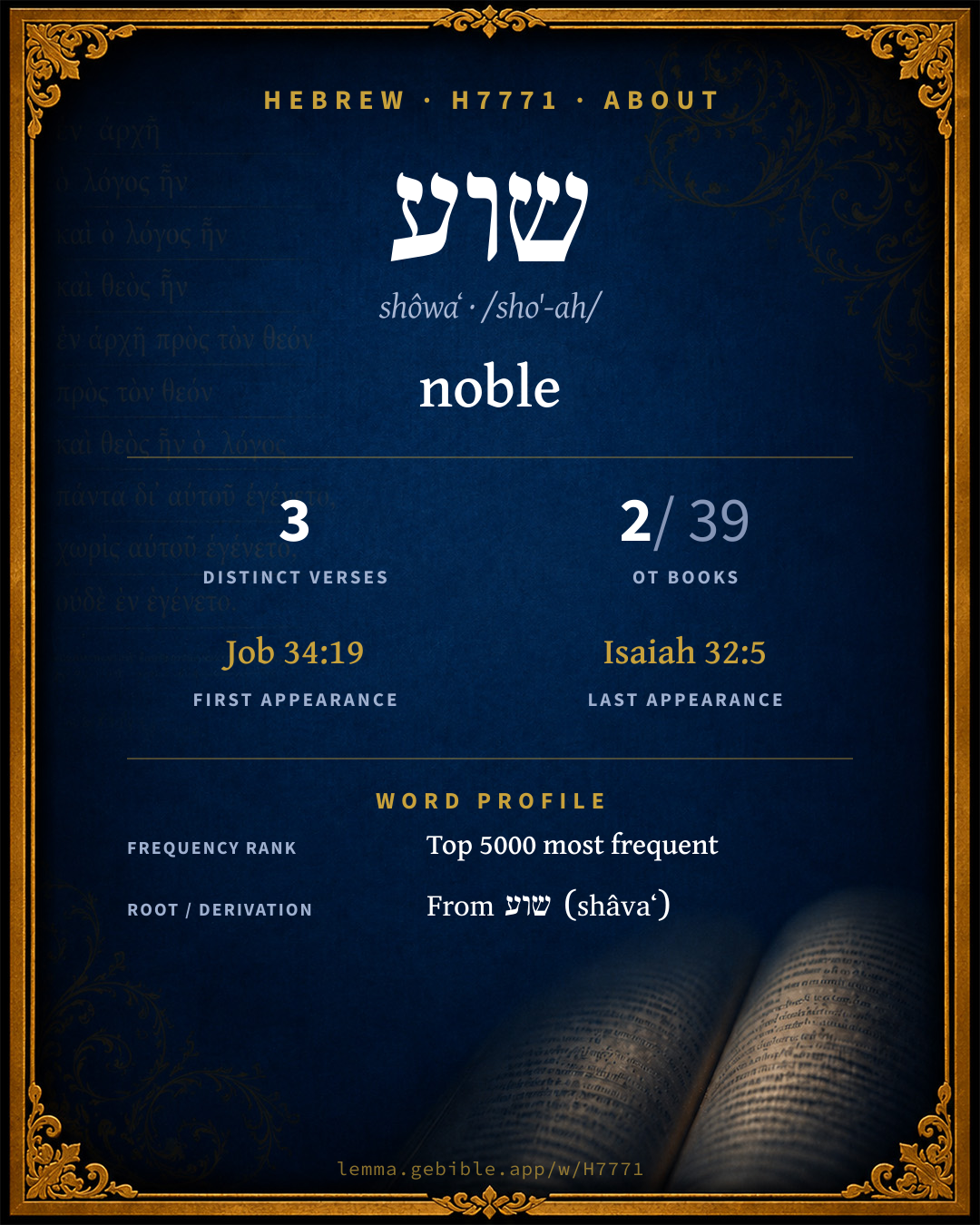
שׁוֹעַ
noble
also: independent, free, rich, generous fuller range ↓
Full lexicon entry — Brown-Driver-Briggs (BDB)
From Brown-Driver-Briggs (BDB)
Where this word appears
Grammar key — what these labels mean
Part of speech
- Noun
- A naming word — a person, place, thing, or idea.
Noun type
- Common
- A common noun — a general class of person, place, or thing (“king,” “city,” “water”), not a specific name.
State
- Absolute
- The independent form of a noun, not bound to a following word.
Gender
- Masculine
- Grammatically masculine.
Number
- Singular
- One.
Every verse where H7771 appears — 3 distinct verses across 2 books. Click any verse to open its interlinear word-by-word view. Verse text shown in the World English Bible for context — . Each verse’s Hebrew form is shown with its reference; the English is not keyword-highlighted, since the data carries no word-level English alignment. Use “Compare translations” on any verse to read it across multiple English versions. This concordance covers the Hebrew Bible; Septuagint (Greek Old Testament) occurrences are not indexed here.
Job 1 verse
Isaiah 2 verses
- Isaiah 22:5 וְ/שׁ֥וֹעַ conj + n c ms For it is a day of confusion, and of treading down, and of perplexity, from the Lord, Yahweh of Hosts, in the valley of vision; a breaking down of the walls, and a crying to the mountains.
- Isaiah 32:5 שֽׁוֹעַ n c ms The fool shall be no more called noble, nor the scoundrel be highly respected.
About this entry
At a glance — auto-summarized from this page’s data, not written by a person. Every figure links to its source below. This summary describes the numbers; it doesn’t interpret them.
שוע (shôwaʻ) is a Hebrew word most often rendered “noble.” A scarce word — 3 verses in all of the Hebrew Bible. Isaiah dominates its distribution — 2 of 3 verses. First canonically at Job 34:19, it enters the text early. Lexicons map it across 2 senses — beyond “noble” it also covers “independent”, “free”, and “rich”. Dig into 3-verse concordance and the renderings breakdown below.
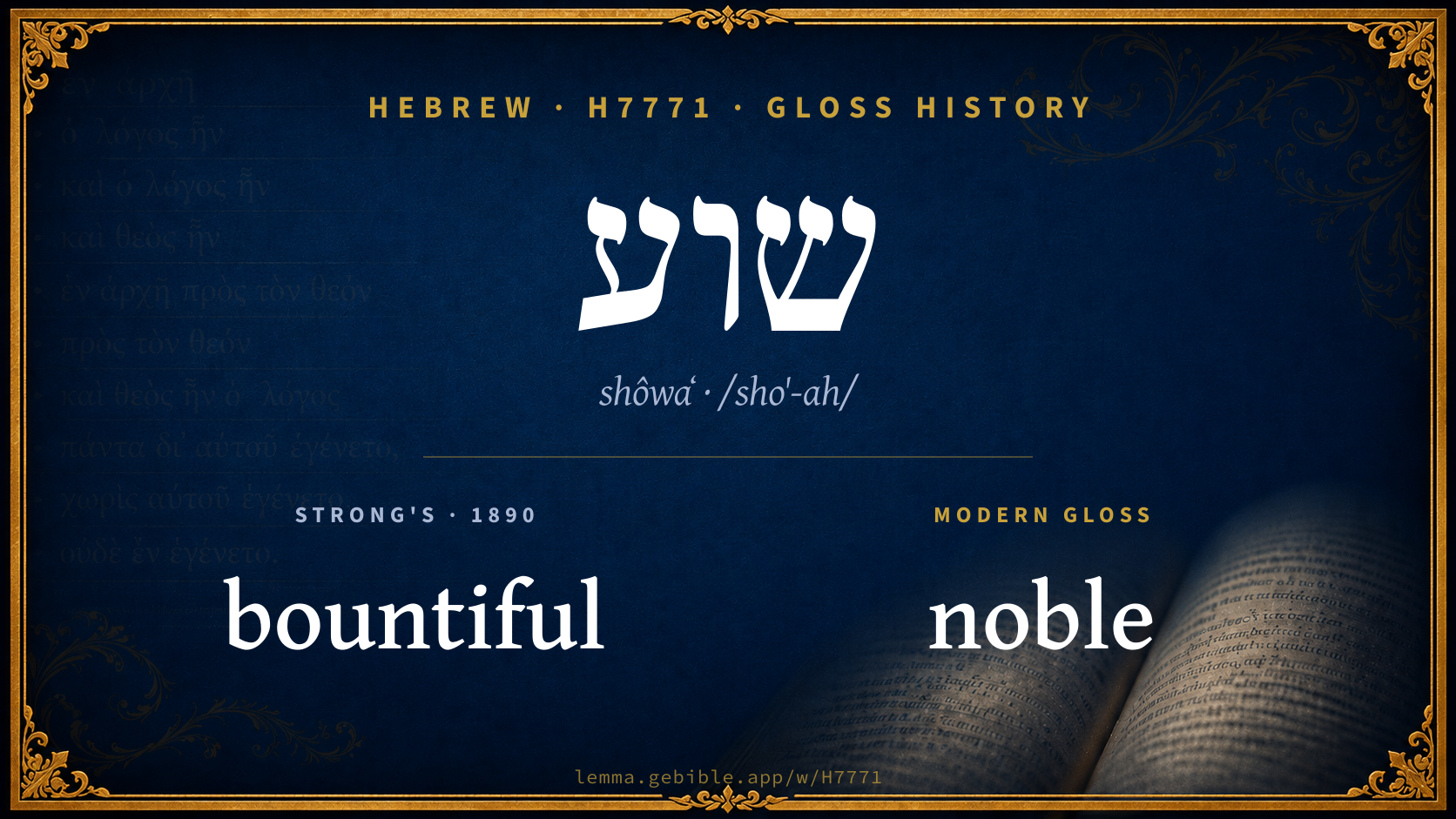
Gloss history
Strong's 1890 vs modern scholarship
About this word
Strong's H7771 catalogs a Hebrew word from the Hebrew Old Testament.
These counts are not copied from any lexicon or concordance. They are computed here, from the morphology-tagged Hebrew Old Testament. What Lemma adds →
- 3
- distinct verses
- The word appears in 3 distinct verses.
- 2 / 39
- OT books
- The word appears in 2 of 39 Old Testament books.
- #4,179
- by frequency
- Top 5000 most frequent Hebrew words (rank 4,179 of 8,640 Hebrew words by occurrence).
View all 3 occurrences in the concordance →
By traditional corpus
Conventional, traditional groupings — biblical authorship is debated, so this is a traditional corpus grouping, not an authorship claim. Each share is this word’s portion of its verses in that division of the Hebrew canon. Each figure is a share of the word’s 3 distinct verses.
- Prophets (Nevi'im) 2 verses · 67%
- Writings (Ketuvim) 1 verse · 33%
How translations render this word
Counts come from each version’s own published word-to-Strong’s tagging or interlinear alignment — an approximate guide to how each version renders this word, not a word-level alignment the data otherwise carries. Because each total is that version’s own tagged count, the per-version totals vary from one another and need not match the appearance or distinct-verse counts above. These counts may also differ from a printed concordance because Lemma counts each distinctly tagged rendering and does not collapse phrase taggings into a single head-word total. This is a fixed set of word-tagged versions (KJV, ASV, BSB, ULT) and does not change with the reading translation you choose elsewhere. Each version’s license is shown beside its name below (and on Sources).
BDB lists this Strong’s number as 4 distinct words (homographs). Each count above pools all of them and is not split by sense — see the Senses section below. A low-frequency rendering may belong to a different one of those words, not the primary meaning.
- King James Version†: Be bountiful 1×, Crying 1×, Rich 1×
- American Standard Version†: Be bountiful 1×, Crying 1×, Rich 1×
- Berean Standard Bible†: Be respected 1×, Crying 1×, Rich 1×
- unfoldingWord Literal Text†: Noble 1×, Outcry 1×, Rich 1×
King James Version Public Domain
Renders H7771 across 3† tagged occurrences — most commonly:
American Standard Version Public Domain
Renders H7771 across 3† tagged occurrences — most commonly:
Berean Standard Bible Public Domain
Renders H7771 across 3† tagged occurrences — most commonly:
unfoldingWord Literal Text CC BY-SA 4.0
Renders H7771 across 3† tagged occurrences — most commonly:
Senses in the full BDB
What do BDB’s symbols mean?
BDB uses these scholarly abbreviations:
| Symbol | Meaning |
|---|---|
| 𝔊 | the Septuagint (the ancient Greek translation, LXX) |
| 𝔙 | the Vulgate (the Latin translation) |
| 𝔖 | the Syriac version (the Peshitta) |
| 𝔗 | the Targum (the Aramaic translation) |
| ψ | the Psalms |
| √ | root (the underlying root or stem) |
| ‖ | parallel passage (a synonymous or contrasted parallel) |
| † | the dagger: every passage where the word occurs is cited |
The 0 senses and sub-senses the full Brown-Driver-Briggs lexicon distinguishes for this word, in lexicon order (not ranked by frequency), with BDB’s own verbatim wording and sub-sense lettering. Shown in Hebrew script with BDB’s own scholarly abbreviations. The condensed entry is in the Lexicon Entry tab. See also the Forms in the corpus table below.
שוע I (free), independent, noble (in station) (according to most from second √ שׁוע = ישׁע, in sense of Arabic وَسِع (cf. תְּשׁוּעָה infr.)
שוע II [m.] cry, perhaps war-cry, or cry for help in war Is 22
שוע III i. ii. שׁוּעַ, שׁוּעָא v. p. 447b supra.
Senses from the full Brown-Driver-Briggs lexicon (Brown, Driver, Briggs; Oxford 1906 — public domain), digitized via Sefaria, supplemented by the OpenScriptures HebrewLexicon (CC BY 4.0). Full attribution on Sources.
Word origin
I. adj. (free), independent, noble (in station) (according to most from second √ שׁוע = ישׁע, in sense of Arabic وَسِع (cf. תְּשׁוּעָה infr.); but actual existence of such a √ not proven; Thes allows שׁוֹעַ = יְשׁוֹעַ)—noble, of rank (and, by implic., of character) Is 32:5 (‖ נָדִיב, opp. כִּילַי), Jb 34:19 (Di al. rich, but ‖ שָׂרִים, opp. דַּל).—ii. שׁוֹעַ Is 22:5, v. sub [שָׁוַע]. iii. שׁוֹעַ n.pr.gent. Ez 23:23, v. שׁ׳.
II. n.[m.] cry, perhaps war-cry, or cry for help in war Is 22:5.—i. שׁוֹעַ v. ישׁע.
III. i. ii. שׁוּעַ, שׁוּעָא v. p. 447b supra.
IV. n.pr.gent. Ez 23:23 usually identified with Assyrian Sutû, Sutî, nomads of Mesop. and (later) E. of Tigris, DlPa 234 ff. COT ad loc. Wkl KAT.3. 22 DrHast.DB Koa.
— Brown-Driver-Briggs (Oxford 1906, public domain), digitized via Sefaria, supplemented by the OpenScriptures HebrewLexicon (CC BY 4.0). See Sources.
Derived from שוע (shâvaʻ) (H7768) — to cry out.
Jastrow Dictionary
A second Hebrew/Aramaic lexicon for comparison, covering Aramaic and post-biblical (Talmudic, Targumic, Midrashic) usage that the biblical-Hebrew BDB does not. Matched by lemma rather than by Strong’s number, so a lemma may carry more than one Jastrow headword (shown separately below), and the entries cover usage well beyond the Bible.
שׁוּעַ
- (cmp. שעע)
- 1. to be smooth, soft; trnsf. to be discouraged, to despair (cmp. מָסַס). Gen. R. s. 44 (ref. to תשתע, Is. XLI, 10) היה לבו … אל תשתע … לא תָשׁוּעַ his heart was soft as wax, and the Lord sent him two angels …; to this refers what is written al tishtʿa …, be not soft (despair not); Yalk. ib. 115 אל תָּשׁוּעַ אל יהא לבך לשעוה be not soft, let thy heart not turn into wax (cmp. Ps. XXII, 15); Gen. R. s. 65; (Yalk. Is. 313 אל תירא ואל תשתע). e.g. Isaiah 41:10
- 2. [to smooth,] to card, hackle.—Part. pass. שׁוּעַ, pl. שׁוּעִים, שׁוּעִין. Kil. IX, 8, a. e., v. נוּז. Ib. 9 לבדים … מפני שהן ש׳ felt clothes (of mixed material) are forbidden, because they are carded. Y. ib. IX, end, 32ᵈ הוינן אמרין הא שָׁע מותר we might have thought, but if one cards (wool and linen together), it is permitted; v. שַׁעַטְנֵז.
- to make slippery, cause to slip (cmp. חָלַק). Gen. R. s. 77 end (expl. ותקע, Gen. XXX, 6) שִׁיְּיעָהּ (or שַׁיְּיעָהּ Chald.; not שייעא; ed. Wil. שעייא, read: שַׁעֲיָיהּ, v. שְׁעֵי) he (the angel) made it (the hollow of the thigh) slip (be dislocated); Cant. R. to III, 6; Yalk. Gen. 132 שעייה (not שת׳), v. supra. e.g. Genesis 30:6
שׁוּעַ ²
- 1. [to smooth over,] to plaster. Targ. O. Lev. XIV, 42 וִישׁוּעַ (Kimḥi וִישִׁיעַ, v. Berl. Targ. O. II, p. 35; some ed. ויסוע, corr. acc.). Targ. Y. Deut. XXVII, 2; 4. Targ. Ez. XIII, 12; a. e.—Part. pass. שִׁיעַ smooth. Ḥull. 47ᵇ (expl. דמיא לאופתא) יעָא דלית וכ׳שֻׁד when the lung is a smooth-surfaced mass, without incisions marking the lobes.
- 2. to card. Part. pass. as ab. Targ. Y. Deut. XXII, 11.
- 1. to plaster. Ab. Zar. 47ᵇ דש׳ והדר שַׁיְּיעֵיה when he plastered once and plastered it over again. Gen. R. s. 38 [read:] אתי למֵישַׁיַּיע תרתין והוא שייע ארבע one came to plaster two (squares of a wall), and he plastered four; Yalk. ib. 62 אתי למֵישַׁע חדא והוא שייע ארבע.
- 2. to cause to slip, v. preced.
- 1. to be plastered, daubed. Targ. O. Lev. XIV, 43; 48 (some ed. אִתָּשַׁע, v. שְׁעַע).
- 2. to become a smooth mass. M. Kat. 25ᵇ אִישְׁתָּעוּ, v. מַחֲלָצַיָּיא.
שָׁוַע
- , Pi. שִׁוֵּעַ (b. h.) to cry (for help). Ab. Zar. 4ᵃ (ref. to Job XXX, 24 שׁוּעַ) בשכר שמְשַׁוְּועִין וכ׳ as a reward for their crying before me, I will help them; Yalk. Job 918 כשמְשַׁוְּעִין וכ׳.—Denom. שַׁוְעָה. e.g. Job 30:24
שׁוֹעַ
- (b. h.?; v. next w.) rock, fort.—Pl. שׁוֹעִים. Lam. R. introd. (R. Joḥ 1) (ref. to Is. XXII, 5) שהיו מקרקרין … על שׁוֹעֵיהֶם they tore down the walls of their houses and made of them breastworks, and placed them around their forts; Yalk. Is. 289. e.g. Isaiah 22:5
A Dictionary of the Targumim, the Talmud Babli and Yerushalmi, and the Midrashic Literature (Marcus Jastrow; London, Luzac, 1903) — Public Domain. Digitized via Sefaria. Digitized via Sefaria. Full attribution on Sources.
Forms in the corpus
The 3 distinct written forms H7771 takes in the Hebrew Bible, most frequent first — each parse links to that state’s occurrences in the concordance. Hebrew forms include their vowel points and cantillation, so a single lemma takes many written forms.
| Form | Parsing | Example | Uses |
|---|---|---|---|
| וְ/שׁ֥וֹעַ | Noun, Common, Masculine, Singular, Absolute | Isaiah 22:5 | 1 |
| שׁ֭וֹעַ | Noun, Common, Masculine, Singular, Absolute | Job 34:19 | 1 |
| שֽׁוֹעַ | Noun, Common, Masculine, Singular, Absolute | Isaiah 32:5 | 1 |
Same root — word family
Other BDB entries built from the same root as H7771, grouped by Strong’s listed origin. These share a root / origin per the lexicon — not necessarily a shared meaning. Each links to that word’s own entry.
Derives from
Shares the same root
Proper names from this root
People and places named from this root — a name, not an additional meaning of the word.
Compare all same-root words → Showing 4 of 7 — not the complete family. 2 of the same-root words are proper names (people or places). They share a root, not necessarily a meaning.
Septuagint verse parallels
This word appears in 3 verses that also exist in the Greek Old Testament (Septuagint), out of the 3 Hebrew verses it occurs in. You can read those verses in Greek by switching the Old Testament edition to the Septuagint.
Read these verses in the Septuagint
This is a verse-level parallel only — the same verses exist in both the Hebrew and Greek Old Testaments. No word-level Hebrew↔Greek correspondence is claimed: the data carries no such alignment, so no Greek word is shown as this Hebrew word’s translation. Coverage is not total — the Septuagint omits the deuterocanon and renumbers the Psalms, so some Hebrew verses have no direct Greek parallel.