Jeremiah 51:52

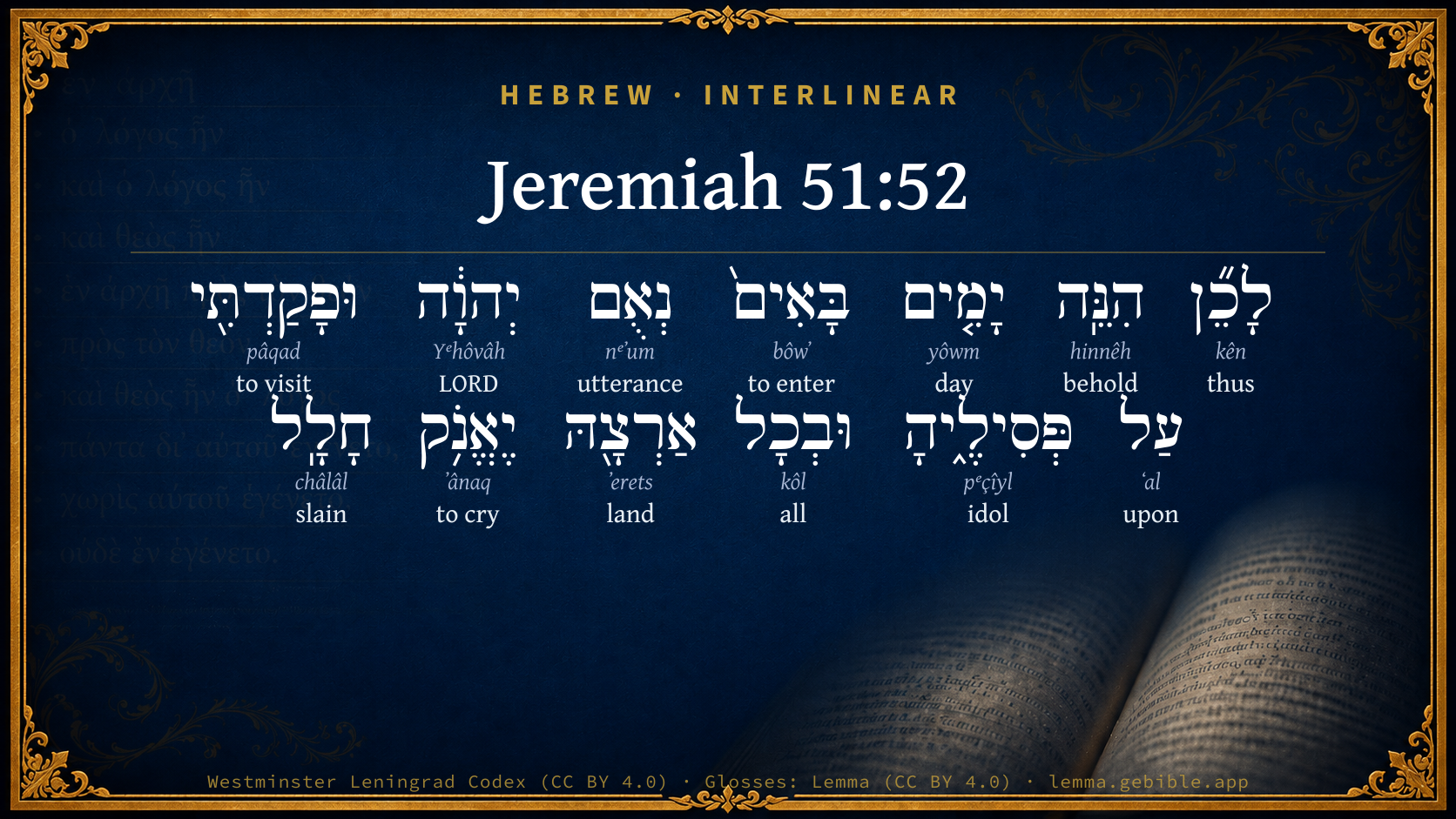
Hebrew (Westminster Leningrad Codex) Jeremiah 51:52 appears in the Hebrew Old Testament. The text above is from the Westminster Leningrad Codex. Each word links to its Strong’s number, a concise gloss, and parsing drawn from the Open Scriptures Hebrew Bible morphology. Click any word for its full Brown-Driver-Briggs (BDB) entry.
Download image
Cite this verse

Jeremiah 51:52 (World English Bible). Public Domain. Lemma interlinear Bible study tool, https://lemma.gebible.app/v/jeremiah/51/52.

Show BibTeX & RIS
BibTeX
RIS
English Translation
Therefore, behold, the days come, says Yahweh, that I will execute judgment on her engraved images; and through all her land the wounded shall groan.
World English Bible · Public Domain
Highlights
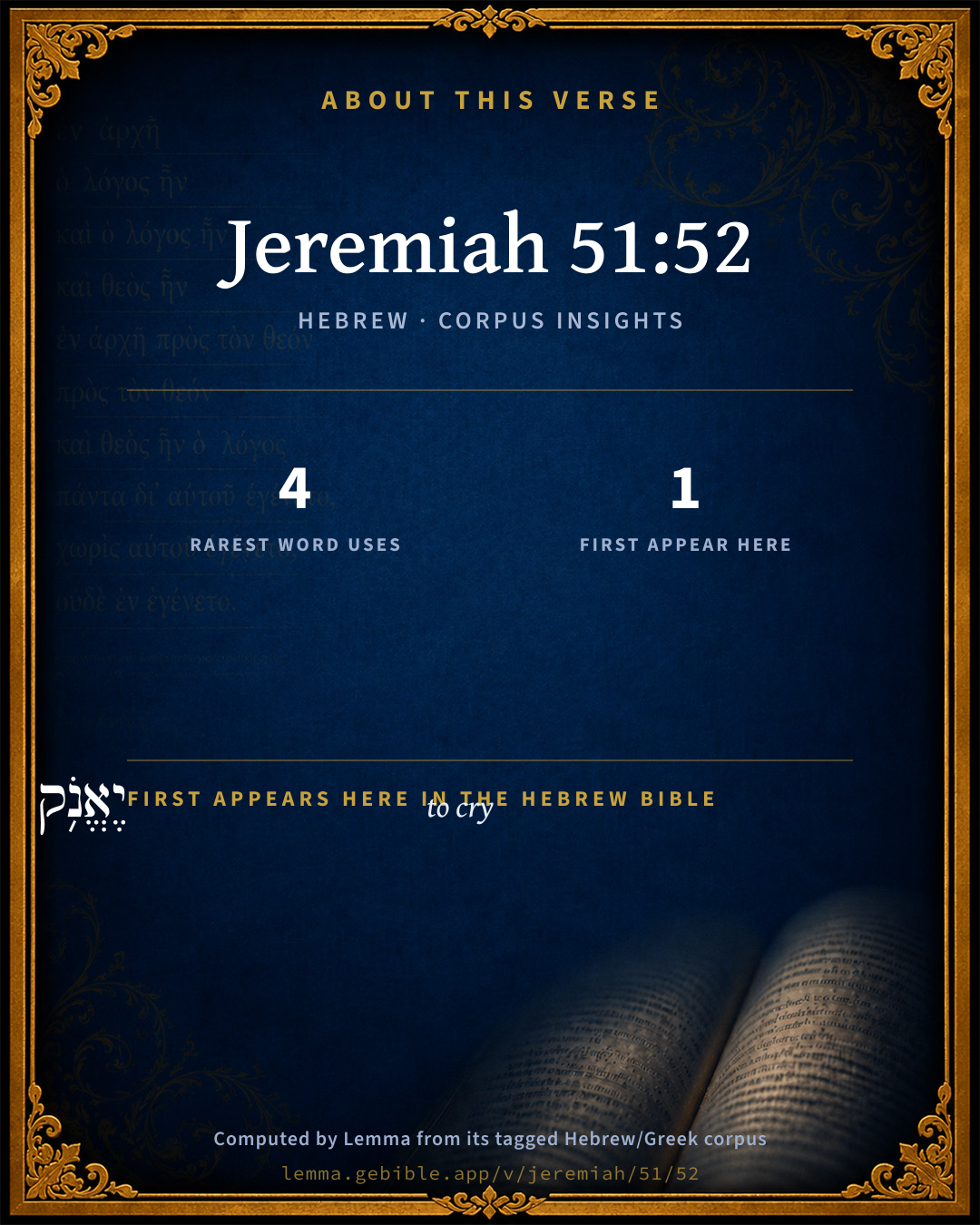
  • 1 first appearance in the Hebrew Bible
Full analysis ↓
Download a study sheet

One document with this verse’s original text, its word-by-word gloss line, the meaning frame, cross-references with their text, attributed commentary, and full source and license credits — printable, and it pastes into notes with its structure intact.

This verse Autodidact and up

Study sheet (.html) Plain text (.txt)

A passage Seminary Student

Up to 50 verses in one chapter. A passage sheet keeps up to 6 commentary sources and 12 cross-references per verse, in the order this page ranks them, and says so on the sheet whenever that leaves anything out. Ask for a single verse and you get the Autodidact verse sheet above.

Everything on this page stays free to read, with no account — the sheet is a download of what is already on screen, not access to it.

Want to remove ads? Support Godless Engineer
Compare translations 3

The same verse in 3 English versions, stacked beneath the original-language interlinear above. Click any original word for its lexicon entry.

Each is an independent rendering of the whole verse — the interlinear is not word-aligned to these translations.

Highlighted words mark where these versions differ — a whole-verse word diff, not a word-by-word alignment.

  • World English Bible Public Domain
    Therefore, behold, the days come, says Yahweh, that I will execute judgment on her engraved images; and through all her land the wounded shall groan.
  • King James Version Public Domain
    Wherefore, behold, the days come, saith the LORD, that I will do judgment upon her graven images: and through all her land the wounded shall groan.
  • unfoldingWord Literal Text CC BY-SA 4.0
    Therefore, see, days are coming—this is Yahweh’s declaration—when I will punish her carved idols, and the wounded people will groan in all of her land.

unfoldingWord Literal Text — © unfoldingWord, licensed CC BY-SA 4.0. Word-aligned USFM3 via Door43 (git.door43.org/unfoldingWord/en_ult).

Versions to compare (up to 4)

3 of 4 selected

Show all 18 translations

Every available English version of this verse, each an independent rendering of the whole verse.

  • World English Bible Public Domain
    Therefore, behold, the days come, says Yahweh, that I will execute judgment on her engraved images; and through all her land the wounded shall groan.
  • Berean Standard Bible Public Domain
    “Therefore, behold, the days are coming,” declares the LORD, “when I will punish her idols, and throughout her land the wounded will groan.
  • Majority Standard Bible Public Domain
    “Therefore, behold, the days are coming,” declares the LORD, “when I will punish her idols, and throughout her land the wounded will groan.
  • King James Version Public Domain
    Wherefore, behold, the days come, saith the LORD, that I will do judgment upon her graven images: and through all her land the wounded shall groan.
  • American Standard Version (1901) Public Domain
    Wherefore, behold, the days come, saith Jehovah, that I will execute judgment upon her graven images; and through all her land the wounded shall groan.
  • Revised Version (1885) Public Domain
    Wherefore, behold, the days come, saith the LORD, that I will do judgment upon her graven images; and through all her land the wounded shall groan.
  • Geneva Bible (1599) Public Domain
    Wherefore behold, the dayes come, sayth the Lord, that I will visite her grauen images, and through all her land the wounded shall grone.
  • Douay-Rheims (1899) Public Domain
    Therefore behold the days come, saith the Lord, and I will visit her graven things, and in all her land the wounded shall groan:
  • Young's Literal Translation Public Domain
    Therefore, lo, days are coming, An affirmation of Jehovah, And I have seen after its graven images, And in all its land groan doth the wounded.
  • Literal Standard Version CC BY-SA 4.0
    Therefore, behold, days are coming,” || A declaration of YHWH, || “And I have seen after her carved images, || And the wounded groan in all her land.
  • Unlocked Literal Bible CC BY-SA 4.0
    Therefore, see, days are coming—this is Yahweh's declaration—when I will punish her carved idols, and the wounded people will groan in all of her land.
  • unfoldingWord Literal Text CC BY-SA 4.0
    Therefore, see, days are coming—this is Yahweh’s declaration—when I will punish her carved idols, and the wounded people will groan in all of her land.
  • Darby Bible Public Domain
    -- Therefore behold, days come, saith Jehovah, that I will punish her graven images; and throughout her land the wounded shall groan.
  • World Messianic Bible Public Domain
    “Therefore behold, the days come,” says the LORD, “that I will execute judgment on her engraved images; and through all her land the wounded will groan.
  • Webster's Bible Public Domain
    Wherefore, behold, the days come, saith the LORD, that I will do judgment upon her graven images: and through all her land the wounded shall groan.
  • Free Bible Version CC BY-SA 4.0
    So keep watching, declares the Lord, because the time is coming when I will punish her for worshiping idols, and the sound of wounded people moaning will be heard throughout the country.
  • Bible in Basic English Public Domain
    For this reason, see, the days are coming, says the Lord, when I will send punishment on her images; and through all her land the wounded will be crying out in pain.
  • JPS Tanakh (1917) Public Domain
    Wherefore, behold, the days come, saith the LORD, that I will do judgment upon her graven images; and through all her land the wounded shall groan.

Literal Standard Version (2020), Covenant Press — licensed CC BY-SA 4.0. Text via the HelloAO Bible API (eBible.org). Unlocked Literal Bible (unfoldingWord) — licensed CC BY-SA 4.0. Text via the HelloAO Bible API (eBible.org). unfoldingWord Literal Text — © unfoldingWord, licensed CC BY-SA 4.0. Word-aligned USFM3 via Door43 (git.door43.org/unfoldingWord/en_ult). Free Bible Version, Dr. Jonathan Gallagher — licensed CC BY-SA 4.0. Text via the HelloAO Bible API (eBible.org).

Word by word

More ways to search: Search by grammar → Find every occurrence → Compare this word →

Practice this passage: Drill this verse → Learn its vocabulary →

יֶאֱנֹ֥ק
ʼânaq
H602
“to cry”
Verb, Qal, Imperfect, 3rd Person, Masculine, Singular
Part of Speech
Verb
Stem
Qal
Form
Imperfect
Person
3rd Person
Gender
Masculine
Number
Singular
Full BDB Definition

Origin: a primitive root

TWOT: 134

to cry, groan - (Qal) to cry, lament - (Niphal) to make lamentation
  1. לָכֵ֞ן kên H3651 “to/for · thus” Preposition + Adverb
  2. הִנֵּֽה hinnêh H2009 “behold” Particle, Demonstrative
  3. יָמִ֤ים yôwm H3117 “days” Noun, Common, Masculine, Plural, Absolute
  4. בָּאִים֙ bôwʼ H935 “entering” Verb, Qal, Participle Active, Masculine, Plural, Absolute
  5. נְאֻם nᵉʼum H5002 “utterance of” Noun, Common, Masculine, Singular, Construct
  6. יְהוָ֔ה Yᵉhôvâh H3068 “LORD” Noun, Proper
  7. וּפָקַדְתִּ֖י pâqad H6485 “and · to visit” Conjunction + Verb, Qal, Sequential Perfect, 1st Person, Common, Singular
  8. עַל ʻal H5921 “upon” Preposition
  9. פְּסִילֶ֑יהָ pᵉçîyl H6456 “idols · her” Noun, Common, Masculine, Plural, Construct + Suffix, Personal, 3rd Person, Feminine, Singular
  10. וּבְכָל kôl H3605 “and · in/at · all of” Conjunction + Preposition + Noun, Common, Masculine, Singular, Construct
  11. אַרְצָ֖הּ ʼerets H776 “land · her” Noun, Common, Both, Singular, Construct + Suffix, Personal, 3rd Person, Feminine, Singular
  12. חָלָֽל châlâl H2491 “slain” Adjective, Adjective, Masculine, Singular, Absolute

About this verse

These counts appear in no published source. They are computed here, from the morphology-tagged text and Lemma’s own curated glosses. What Lemma adds →

13
words
13
distinct lemmas
Prophets
section

Notable vocabulary

The rarest word here is יֶאֱנֹ֥ק to cry H602 — appearing just 4 times in the whole Hebrew Bible.

First appearance in Scripture

This word makes its first canonical appearance in the Hebrew Bible here:

  • יֶאֱנֹ֥ק to cry H602

Shared distinctive vocabulary

יֶאֱנֹ֥ק to cry H602 occurs in 4 verses of the Hebrew Bible. Also found in:

Grammatical profile

  • 3 verbs
  • 6 nouns
  • 1 adjective
  • 1 preposition
  • 1 adverb
  • 1 particle

Verb forms

  • בָּאִים֙ Qal · Participle Active
  • וּפָקַדְתִּ֖י Qal · Sequential Perfect
  • יֶאֱנֹ֥ק Qal · Imperfect

Cross-references

5

Topical passages linked to Jeremiah 51:52 in the Treasury of Scripture Knowledge — connected by theme and wording, ordered by reader-vote popularity; previews shown in the World English Bible.

  • Jeremiah 51:47 Therefore, behold, the days come, that I will execute judgment on the engraved images of Babylon; and her whole land shall be confounded; and all her slain shall fall in the midst of her.
  • Jeremiah 50:38 A drought is on her waters, and they shall be dried up; for it is a land of engraved images, and they are mad over idols.
  • Isaiah 13:15–16 Everyone who is found shall be thrust through; and everyone who is taken shall fall by the sword.
  • Ezekiel 30:24 I will strengthen the arms of the king of Babylon, and put my sword in his hand: but I will break the arms of Pharaoh, and he shall groan before him with the groanings of a deadly wounded man.
  • Daniel 5:30–31 In that night Belshazzar the Chaldean King was slain.

Cross-references courtesy of OpenBible.info (CC BY 4.0).

Hebrew and Greek witnesses Masoretic Hebrew ↔ Greek Septuagint

The same verse in the two great witnesses to the Old Testament, shown verse-for-verse.

These are two independent witnesses, not word-aligned to each other, and the Septuagint is shown in lemma (dictionary) form.

Hebrew Jeremiah 51:52 Masoretic · Westminster Leningrad Codex

לָכֵ֞ן הִנֵּֽה יָמִ֤ים בָּאִים֙ נְאֻם יְהוָ֔ה וּפָקַדְתִּ֖י עַל פְּסִילֶ֑יהָ וּבְכָל אַרְצָ֖הּ יֶאֱנֹ֥ק חָלָֽל

Therefore, behold, the days come, says Yahweh, that I will execute judgment on her engraved images; and through all her land the wounded shall groan.

World English Bible · Public Domain

Greek LXX Structure differs

In the Septuagint, Jeremiah is about an eighth shorter than the Hebrew and arranges its material differently — the Oracles Against the Nations (Hebrew chapters 46–51) appear in the middle of the Greek book, after 25:13. Because the chapter and verse boundaries do not line up, a verse-for-verse comparison with the Hebrew is not shown.

A verse-for-verse comparison isn’t shown here because the chapters and verses don’t line up. Switch to the LXX edition with the MT / LXX toggle above to read the Greek directly.

Hebrew: Westminster Leningrad Codex (CC BY 4.0). Greek: Septuagint (public domain); English from a public-domain English Septuagint. How the Septuagint differs from the Hebrew →

Targum (Aramaic paraphrase)

1

The Targum is the ancient Jewish Aramaic paraphrase of the Hebrew Scriptures — an interpretive translation, not the Hebrew text itself. Onkelos (literal) and Pseudo-Jonathan (expansive) render the Torah, and Jonathan the Prophets. Coverage is partial: where no permissively-licensed English translation exists for a verse, only the Aramaic is shown. This is verse-level text, not a word-by-word alignment to the Hebrew.

  1. Targum Jonathan Prophets (Joshua–Malachi)
    בְּכֵן הָא יוֹמַיָא אָתָן אֲמַר יְיָ וְאַסְעַר עַל צַלְמָהָא וּבְכָל אַרְעָא יִתְרְמוּן קְטִילַיָא:

    (no public-domain English translation for this verse)

    Targum Jonathan — Aramaic: “Mikraot Gedolot” (public domain). English: “Sefaria Community Translation” (CC0 1.0 (public-domain dedication)); “London "Chaldee Paraphrase," 1871” (public domain). Text via Sefaria.

Commentary

Notes on Jeremiah 51:52 from classic Christian and Jewish commentators (each source and its license shown beneath its notes). The classic Christian expositions comment on the surrounding passage and are grouped to its opening verse, so a note may address several verses; the Jewish commentaries on the Tanakh (Rashi and others) are per-verse, so they appear only where the commentator wrote on this verse.

Lemma curates 59 commentaries, every one of them public domain or Creative Commons licensed, each selected and text-cleaned for this edition rather than reprinted as found. About our sources →

Trapp's Complete Commentary

John Trapp

Jer 51:52 Wherefore, behold, the days come, saith the LORD, that I will do judgment upon her graven images: and through all her land the wounded shall groan.

Ver. 52. Wherefore, behold, the days come.] So soon is God up at the cry of his poor people. {Psa 12:5}

I will do judgment.] See Jer 51:37; Jer 51:49.

John Trapp, A Commentary or Exposition upon All the Books of the Old and New Testament (1647–1656) — public domain. Text from a community e-Sword module.

Tyndale Open Study Notes

Tyndale Open Resources

51:52 Yes: The Lord agreed with his people that their past was shameful, but he gave them hope for the future when Babylon’s power would be broken.

Tyndale Open Study Notes — © Tyndale Open Resources, licensed CC BY-SA 4.0. Text via the HelloAO Bible API.

Jamieson, Fausset & Brown

Robert Jamieson, A. R. Fausset & David Brown

Wherefore--because of these sighs of the Jews directed to God (Jer 51:21).

I . . . judgment upon . . . images--in opposition to the Babylonian taunt that Jehovah's religion was a thing of naught, since they had burned His temple (Jer 51:51): I will show that, though I have thus visited the Jews neglect of Me, yet those gods of Babylon cannot save themselves, much less their votaries, who shall "through all her land" lie and "groan" with wounds.

Jamieson, Fausset & Brown — Commentary Critical and Explanatory on the Whole Bible (1871) — public domain (CC PDM 1.0). Text via the HelloAO Bible API.

John Calvin's Commentaries

The design of the Prophet is, as I have reminded you, to raise up the minds of the godly that they might not succumb under their trials, on seeing that they were exposed to shame and were destitute of all honors. He then says that the time would come when God would take vengeance on the idols of Babylon. And thus God claims for himself that power which seemed then to have almost disappeared; for the temple being overthrown, the Babylonians seemed in a manner to triumph over him, as God’s power in the temple was overcome. Then as the ruin of it, as we have said, seemed to have extinguished God’s power, the Prophet applies a remedy, and says that though the temple was overthrown, yet God remained perfect and his power unchangeable. But among other things he bids the faithful patiently to wait, for he invites their attention to the hope of what was as yet hidden.

We now see how, these things, agree, and why the Prophet uses the particle “therefore,” לכן, laken: Therefore, behold, the days are coming, that is, though ye are confounded, yet God will give you a reason for glorying, so that ye shall again sing joyfully his praises. But he says, “the days will come;” by these words he reminds us that we are to cherish the hope of the promises until God completes his work; and thus he corrected that ardor by which we are seized in the midst of our afflictions, for we wish immediately to fly away to God. The Prophet, then, here exhorts the faithful to sustain courage until the time fixed by God; and so he refers them to God’s providence, lest they assumed too much in wishing him to act as their own minds led them. Come then shall the days when I shall visit the graven images of Babylon; and groan or cry, etc.; for the word אנק, anak, means to cry. Some render thus, “groan shall the wounded;” and they render the last word “wounded,” because they think it improper to say that the slain cry or groan. But the Prophet means that the cry in that slaughter would be great, that is, that while the Babylonians were slain, a great howling would be everywhere. It follows, —

John Calvin's Commentaries (1540-1563) — public domain. Text from the Calvin Translation Society English edition (1840s-50s) via the Christian Classics Ethereal Library (ccel.org). Calvin's coverage is partial (roughly two-thirds of the Bible); uncommented books and verses are honest gaps, never fabricated. The 19th-century editor's footnotes and remarks are omitted so the notes are faithfully Calvin's own voice.

The Cambridge Bible for Schools and Colleges

gen. ed. J. J. S. Perowne

52. See on Jer_51:47.

The Cambridge Bible for Schools and Colleges (gen. ed. J. J. S. Perowne; Cambridge University Press, 1878–1918) — public domain. Text from a community e-Sword module.

John Gill's Exposition

A sound of a cry cometh from Babylon,.... Of the inhabitants of it upon its being taken; which is said to denote the certainty of it, which was as sure as if the cry of the distressed was then heard:

and great destruction from the land of the Chaldeans; that is, the report of a great destruction there, was, or would be, carried from thence, and spread all over the world.

John Gill's Exposition of the Whole Bible (1746–1763) — public domain (CC PDM 1.0). Text via the HelloAO Bible API.

Matthew Poole's English Annotations

For which complaints of my people, or rather for which profanation of my holy place, I will be revenged upon their graven images, and not only upon their idols, but upon the worshippers of them, and cause a groaning of wounded men over all the country of the Chaldeans; I will cause them to know that their idols are not able to protect them from my power and justice.

Matthew Poole's English Annotations on the Holy Bible (1683–1685) — public domain. Text from a community e-Sword/MySword module.

The Pulpit Commentary

Vers. 52-64. The book cast into the river.

I MEN DO NOT SUFFER FOR THEIR SINS WITHOUT WARNING FROM GOD. Seraiah was to go to Babylon and see that he read there the words of the prophecy concerning the city. God has warned us of the doom of sin, and he has sent the warning to us. We have not to search for it. It sounds in our ears. It is written large in the Bible. It is repeated in the lessons of providence.

II IF A DIVINE WARNING IS DISREGARDED IT IS USELESS TO THE DOOMED. The prophecy seems to have had little or no effect on the people of Babylon. No doubt it was sent in mercy like Jonah"s preaching against Nineveh, to lead the people to repentance. But if they failed to repent, the Divine message could afford no protection. Unless we are influenced by the Bible, it will be useless for us to hold it in our hands. It can be then only a witness against us. Neither the mere possessor of Scripture, nor the reader, nor the student of it finds a way of safety in its teachings, but only he who follows its truths in practice. He who hears Christ"s sayings and does them builds on the rock.

III WHEN A DIVINE WARNING IS PROVED TO BE INEFFECTUAL IT MAY BE WITHHELD. The book, no longer of use, is to be cast into the river and sunk with a stone attached to it. The voice of conscience grows silent from being long unheeded. While men neglect to obey the teachings of Scripture, they harden themselves against the reception of them. If there is no mere warning, they may grow careless as though there were no more danger. They should rather take this silence as Ominous of the approaching destruction which the warning has been ineffectual in urging them to escape.

The Pulpit Commentary (1880–1919), ed. H.D.M. Spence-Jones & Joseph S. Exell — public domain. Text from a community e-Sword module.

John Wesley's Explanatory Notes

Wherefore - For this profanation of my holy place, I will be revenged not only upon their idols, but upon the worshippers of them, and cause a groaning of wounded men over all the country of the Chaldeans.

John Wesley, Explanatory Notes Upon the Whole Bible (1754–1765) — public domain. Text via the GEBible commentary corpus.

unfoldingWord translationNotes

Door43 World Missions Community

see

"look" or "listen" or "pay attention to what i am about to tell you"

days are coming ... when I will punish

Future time is spoken of as if the "days are coming." See how you translated this metaphor in Jeremiah 7:32. AT: "in the future ... I will punish" or "there will be a time ... when I will punish" (See: Metaphor)

this is Yahweh's declaration

Yahweh speaks of himself by name to express the certainty of what he is declaring. See how you translated this in Jeremiah 1:8. AT: "this is what Yahweh has declared" or "this is what I, Yahweh, have declared" (See: First, Second, or Third Person)

I will punish her carved idols

Removing or destroying idols is spoken of as if Yahweh would punish the idols. AT: "I will destroy her carved idols" or "I will remove her carved idols" (See: Metaphor)

her carved idols ... her land ... Babylon ... her highest fortresses ... to her

The people of Babylon are spoken of as if they were the city itself, and the city is spoken of as if it were a woman. AT: "their carved idols ... their land ... the Babylonians ... their highest fortresses ... to them" (See: Metonymy and Metaphor)

groan

to cry out because of pain or sadness

if Babylon went up ... or fortified ... destroyers would come from me

This is a hypothetical situation that Yahweh does not expect to happen. AT: "Babylon will not go up ... or fortify ... destroyers will surely come from me" (See: Hypothetical Situations)

translationWords

declare

false god

stronghold

destroy

unfoldingWord translationNotes — © Distant Shores Media and the Door43 World Missions Community, licensed CC BY-SA 4.0. Source: git.door43.org/Door43/en_tn.

Rashi

Rabbi Shlomo Yitzchaki (Rashi)

the mortally wounded shall groan Heb. יאנק. The mortally wounded shall cry. When they kill a person with an arrow or with a spear, and he groans when they remove the spear, that is אנקה.

Rashi on the Tanakh — English translations: “The Judaica Press complete Tanach with Rashi, translated by A. J. Rosenberg” (CC BY 4.0); “Pentateuch with Rashi's commentary by M. Rosenbaum and A.M. Silbermann, 1929-1934” (public domain); “The Metsudah Tanach series, Lakewood, N.J” (CC BY 4.0); and “The Book of Joshua, Metsudah Publications, 1997” (CC BY 4.0). Text via Sefaria.

Lesson kit

Teaching starters — assembled from the data on this page, not authored interpretation. Every prompt links to the verse data it draws on. Edit before teaching.

Jeremiah, in the Prophets, opens this verse with 13 words (13 distinct Hebrew lemmas). Its most distinctive word is ʼânaq (“to cry”). A historical commentator’s framing appears above. Read the whole chapter for the surrounding context.

Discussion questions

  1. The word ʼânaq carries the sense “to cry.” How does it shape the verse?
  2. The word “to cry” first appears here in Scripture. What is being introduced at this debut?
  3. Ezekiel 9:4 shares the word «to cry» with this verse. How do the two illuminate each other?
  4. These translations render this verse differently; the difference is in the English rendering, not the original. What questions does that raise?
  5. The verb «בָּאִים֙» is Qal Participle Active. How does its form color the action?
  6. Reading how Trapp's Complete Commentary and Tyndale Open Study Notes read this verse, where do the two commentators agree and where do they part?

Things to notice

Reading settings

Reading text

Shown beneath each verse's original-language words.

Old Testament
Old Testament edition

Read the OT as the Masoretic Hebrew (MT) or the Greek Septuagint (LXX).

English shown for the Greek Septuagint (in the Hebrew ↔ Greek comparison).

Comparing translations? Open the Compare panel on any verse page to stack up to four side by side.