Proverbs 8:29

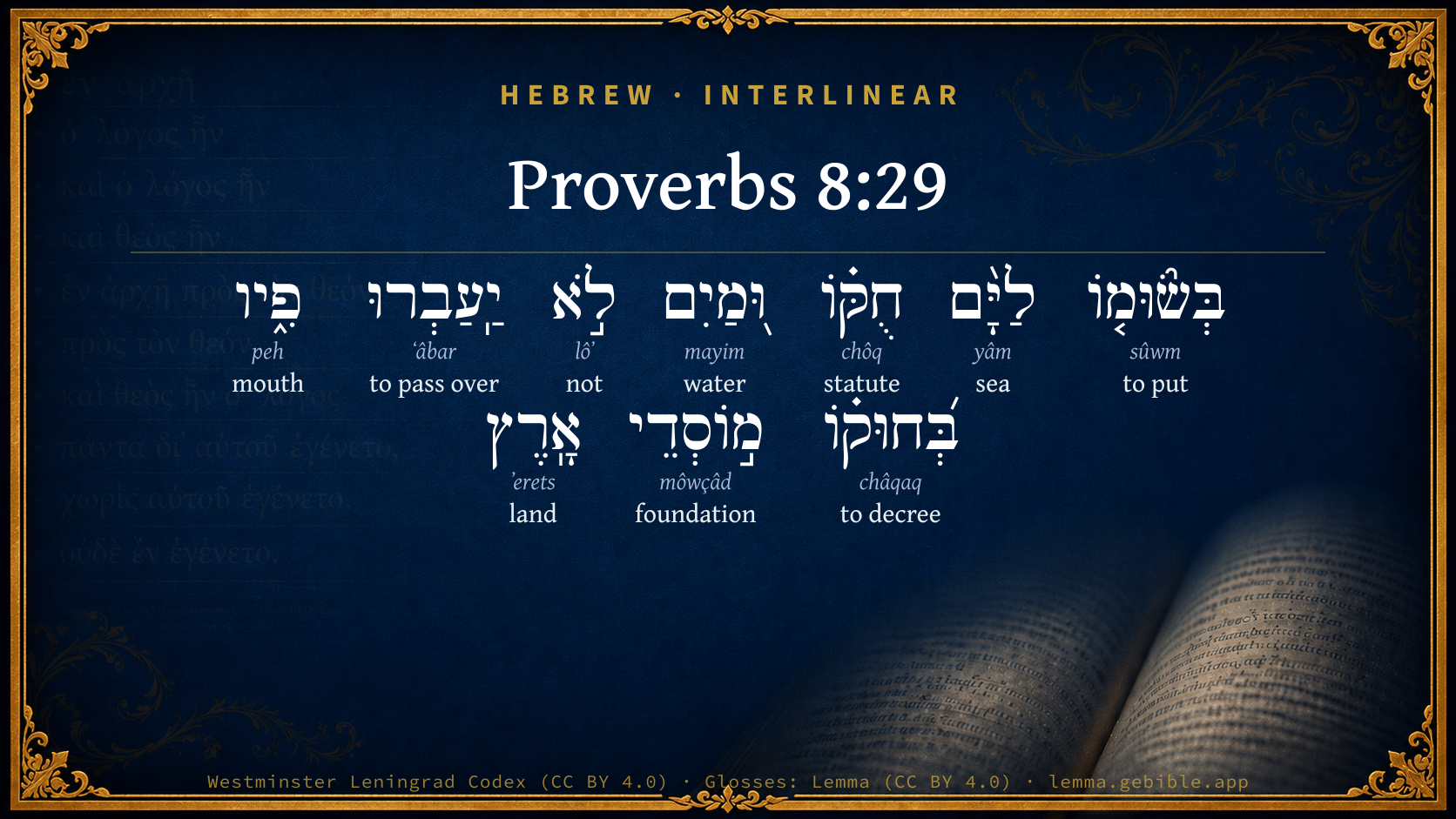
Hebrew (Westminster Leningrad Codex) Proverbs 8:29 appears in the Hebrew Old Testament. The text above is from the Westminster Leningrad Codex. Each word links to its Strong’s number, a concise gloss, and parsing drawn from the Open Scriptures Hebrew Bible morphology. Click any word for its full Brown-Driver-Briggs (BDB) entry.
Download image
Cite this verse

Proverbs 8:29 (World English Bible). Public Domain. Lemma interlinear Bible study tool, https://lemma.gebible.app/v/proverbs/8/29.

Show BibTeX & RIS
BibTeX
RIS
English Translation
When he gave to the sea its boundary, That the waters should not violate his commandment, When he marked out the foundations of the earth;
World English Bible · Public Domain
Download a study sheet

One document with this verse’s original text, its word-by-word gloss line, the meaning frame, cross-references with their text, attributed commentary, and full source and license credits — printable, and it pastes into notes with its structure intact.

This verse Autodidact and up

Study sheet (.html) Plain text (.txt)

A passage Seminary Student

Up to 50 verses in one chapter. A passage sheet keeps up to 6 commentary sources and 12 cross-references per verse, in the order this page ranks them, and says so on the sheet whenever that leaves anything out. Ask for a single verse and you get the Autodidact verse sheet above.

Everything on this page stays free to read, with no account — the sheet is a download of what is already on screen, not access to it.

Want to remove ads? Support Godless Engineer
Compare translations 3

The same verse in 3 English versions, stacked beneath the original-language interlinear above. Click any original word for its lexicon entry.

Each is an independent rendering of the whole verse — the interlinear is not word-aligned to these translations.

Highlighted words mark where these versions differ — a whole-verse word diff, not a word-by-word alignment.

  • World English Bible Public Domain
    When he gave to the sea its boundary, That the waters should not violate his commandment, When he marked out the foundations of the earth;
  • King James Version Public Domain
    When he gave to the sea his decree, that the waters should not pass his commandment: when he appointed the foundations of the earth:
  • unfoldingWord Literal Text CC BY-SA 4.0
    when he set up for the sea its statute, so waters do not cross over his mouth, when he inscribed the foundations of the earth.

unfoldingWord Literal Text — © unfoldingWord, licensed CC BY-SA 4.0. Word-aligned USFM3 via Door43 (git.door43.org/unfoldingWord/en_ult).

Versions to compare (up to 4)

3 of 4 selected

Show all 18 translations

Every available English version of this verse, each an independent rendering of the whole verse.

  • World English Bible Public Domain
    When he gave to the sea its boundary, That the waters should not violate his commandment, When he marked out the foundations of the earth;
  • Berean Standard Bible Public Domain
    when He set a boundary for the sea, so that the waters would not surpass His command, when He marked out the foundations of the earth.
  • Majority Standard Bible Public Domain
    when He set a boundary for the sea, so that the waters would not surpass His command, when He marked out the foundations of the earth.
  • King James Version Public Domain
    When he gave to the sea his decree, that the waters should not pass his commandment: when he appointed the foundations of the earth:
  • American Standard Version (1901) Public Domain
    When he gave to the sea its bound, That the waters should not transgress his commandment, When he marked out the foundations of the earth;
  • Revised Version (1885) Public Domain
    When he gave to the sea its bound, that the waters should not transgress his commandment: when he marked out the foundations of the earth:
  • Geneva Bible (1599) Public Domain
    When he gaue his decree to the Sea, that the waters shoulde not passe his commandement: when he appointed the foundations of the earth,
  • Douay-Rheims (1899) Public Domain
    When he compassed the sea with its bounds, and set a law to the waters that they should not pass their limits: when be balanced the foundations of the earth;
  • Young's Literal Translation Public Domain
    In His setting for the sea its limit, And the waters transgress not His command, In His decreeing the foundations of earth,
  • Literal Standard Version CC BY-SA 4.0
    In His setting for the sea its limit, || And the waters do not transgress His command, || In His decreeing the foundations of earth,
  • Unlocked Literal Bible CC BY-SA 4.0
    I was there when he made his limit for the sea, so the waters should not spread beyond his command, and when there was set the limit for the foundations of the dry land.
  • unfoldingWord Literal Text CC BY-SA 4.0
    when he set up for the sea its statute, so waters do not cross over his mouth, when he inscribed the foundations of the earth.
  • Darby Bible Public Domain
    when he imposed on the sea his decree that the waters should not pass his commandment, when he appointed the foundations of the earth:
  • World Messianic Bible Public Domain
    when he gave to the sea its boundary, that the waters should not violate his commandment, when he marked out the foundations of the earth,
  • Webster's Bible Public Domain
    When he gave to the sea his decree, that the waters should not pass his commandment: when he appointed the foundations of the earth:
  • Free Bible Version CC BY-SA 4.0
    when he set limits on the sea so that the waters would not go farther than he ordered, and when he laid out the foundations of the earth.
  • Bible in Basic English Public Domain
    When he put a limit to the sea, so that the waters might not go against his word: when he put in position the bases of the earth:
  • JPS Tanakh (1917) Public Domain
    When He gave to the sea His decree, that the waters should not transgress His commandment, when He appointed the foundations of the earth;

Literal Standard Version (2020), Covenant Press — licensed CC BY-SA 4.0. Text via the HelloAO Bible API (eBible.org). Unlocked Literal Bible (unfoldingWord) — licensed CC BY-SA 4.0. Text via the HelloAO Bible API (eBible.org). unfoldingWord Literal Text — © unfoldingWord, licensed CC BY-SA 4.0. Word-aligned USFM3 via Door43 (git.door43.org/unfoldingWord/en_ult). Free Bible Version, Dr. Jonathan Gallagher — licensed CC BY-SA 4.0. Text via the HelloAO Bible API (eBible.org).

Word by word

More ways to search: Search by grammar → Find every occurrence → Compare this word →

Practice this passage: Drill this verse → Learn its vocabulary →

מ֣וֹסְדֵי
môwçâd
H4144
“foundations of”
Noun, Common, Both, Plural, Construct
Part of Speech
Noun
Type
Common
Gender
Both
Number
Plural
State
Construct
Full BDB Definition

Origin: from H3245

TWOT: 875f

foundation
  1. בְּשׂ֘וּמ֤וֹ sûwm H7760 “in/at · to put · him” Preposition + Verb, Qal, Infinitive Construct + Suffix, Personal, 3rd Person, Masculine, Singular
  2. לַיָּ֨ם yâm H3220 “to/for the · sea” Preposition, Determined + Noun, Common, Masculine, Singular, Absolute
  3. חֻקּ֗וֹ chôq H2706 “statute · his” Noun, Common, Masculine, Singular, Construct + Suffix, Personal, 3rd Person, Masculine, Singular
  4. וּ֭מַיִם mayim H4325 “and · water(s)” Conjunction + Noun, Common, Masculine, Plural, Absolute
  5. לֹ֣א lôʼ H3808 “not” Particle, Negative
  6. יַֽעַבְרוּ ʻâbar H5674 “to pass over” Verb, Qal, Imperfect, 3rd Person, Masculine, Plural
  7. פִ֑יו peh H6310 “mouth · his” Noun, Common, Masculine, Singular, Construct + Suffix, Personal, 3rd Person, Masculine, Singular
  8. בְּ֝חוּק֗וֹ châqaq H2710 “in/at · to decree · him” Preposition + Verb, Qal, Infinitive Construct + Suffix, Personal, 3rd Person, Masculine, Singular
  9. אָֽרֶץ ʼerets H776 “land” Noun, Common, Both, Singular, Absolute

About this verse

These counts appear in no published source. They are computed here, from the morphology-tagged text and Lemma’s own curated glosses. What Lemma adds →

10
words
10
distinct lemmas
Wisdom
section

Notable vocabulary

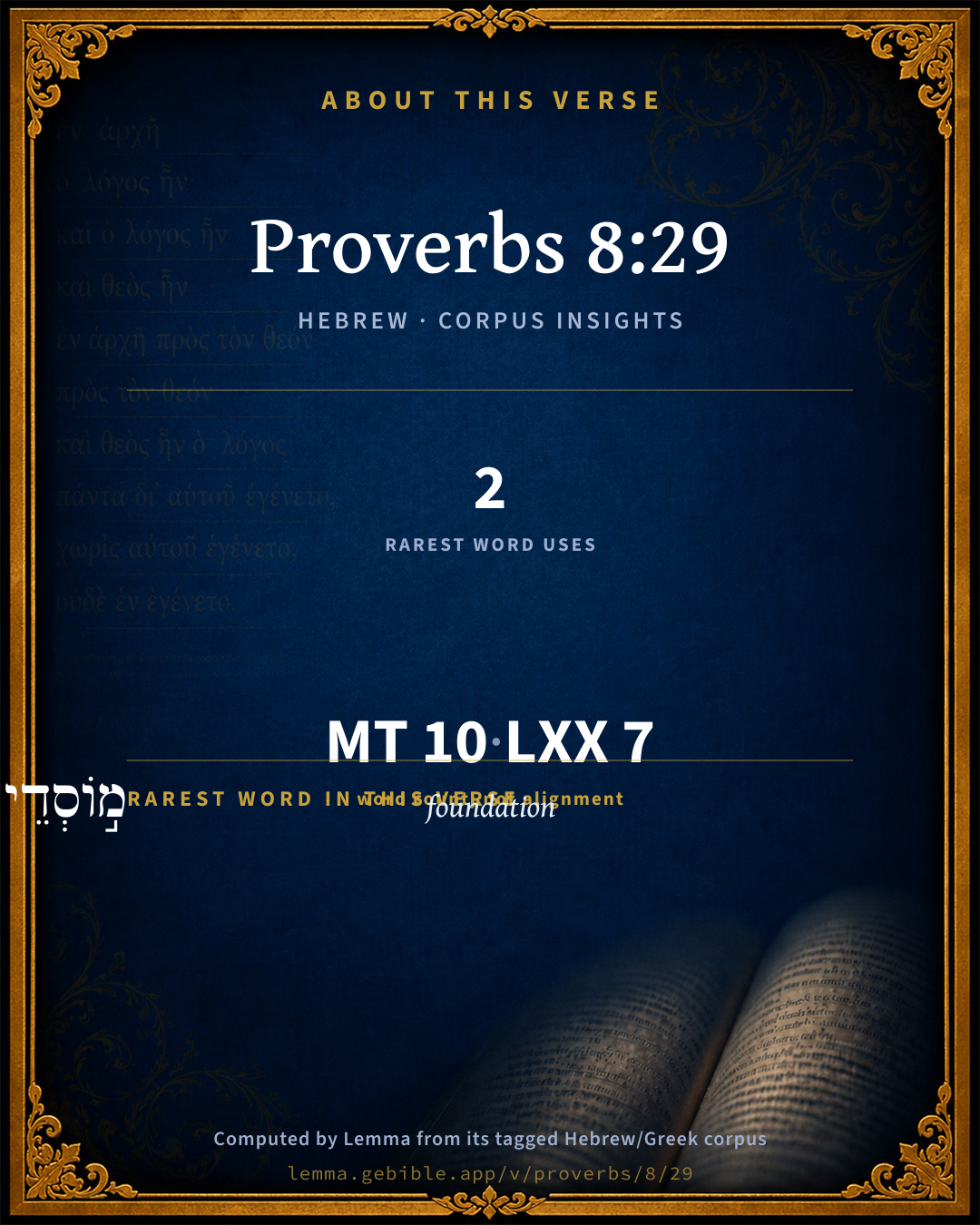
The rarest word here is מ֣וֹסְדֵי foundation H4144 — appearing just 2 times in the whole Hebrew Bible.

Shared distinctive vocabulary

מ֣וֹסְדֵי foundation H4144 occurs in 2 verses of the Hebrew Bible. Also found in:

Grammatical profile

  • 3 verbs
  • 6 nouns
  • 1 particle

Verb forms

  • בְּשׂ֘וּמ֤וֹ Qal · Infinitive Construct
  • יַֽעַבְרוּ Qal · Imperfect
  • בְּ֝חוּק֗וֹ Qal · Infinitive Construct

Hebrew & Septuagint length

In English translation the verse runs 25 words from the Hebrew and 10 from the Septuagint (LXX English) — the Septuagint runs noticeably shorter here. See the side-by-side →

A rough comparison of the two English renderings, which tokenize alike — not a word-level alignment.

Word counts can differ between the Hebrew and the Greek without any difference in meaning — e.g. the Hebrew direct-object marker אֵת has no separate Greek word, and Greek often adds the article ὁ.

In the original languages it is 10 Hebrew tokens and 7 Greek tokens — but the two are counted differently (Hebrew bundles its prefixes and suffixes into one token; the Greek is in lemma form), so that isn’t a like-for-like length.

Cross-references

6

Topical passages linked to Proverbs 8:29 in the Treasury of Scripture Knowledge — connected by theme and wording, ordered by reader-vote popularity; previews shown in the World English Bible.

  • Psalms 104:9 You have set a boundary that they may not pass over; That they don't turn again to cover the earth.
  • Jeremiah 5:22 Don't you fear me? says Yahweh: won't you tremble at my presence, who have placed the sand for the bound of the sea, by a perpetual decree, that it can't pass it? and though the waves of it toss themselves, yet they can't prevail; though they roar, yet they can't pass over it.
  • Genesis 1:9–10 God said, "Let the waters under the sky be gathered together to one place, and let the dry land appear," and it was so.
  • Job 38:4–11 "Where were you when I laid the foundations of the earth? Declare, if you have understanding.
  • Psalms 33:7 He gathers the waters of the sea together as a heap. He lays up the deeps in storehouses.
  • Psalms 104:5 He laid the foundations of the earth, That it should not be moved forever.

Cross-references courtesy of OpenBible.info (CC BY 4.0).

Hebrew and Greek witnesses Masoretic Hebrew ↔ Greek Septuagint

The same verse in the two great witnesses to the Old Testament, shown verse-for-verse.

Here the Septuagint runs noticeably shorter than the Hebrew — LXX2012 (modern English Septuagint) 10 words vs World English Bible 25. A rough length comparison of the two English translations, not a word-level alignment — read both below.

These are two independent witnesses, not word-aligned to each other, and the Septuagint is shown in lemma (dictionary) form.

Hebrew Proverbs 8:29 Masoretic · Westminster Leningrad Codex

בְּשׂ֘וּמ֤וֹ לַיָּ֨ם חֻקּ֗וֹ וּ֭מַיִם לֹ֣א יַֽעַבְרוּ פִ֑יו בְּ֝חוּק֗וֹ מ֣וֹסְדֵי אָֽרֶץ

When he gave to the sea its boundary, That the waters should not violate his commandment, When he marked out the foundations of the earth;

World English Bible · Public Domain

Greek LXX Proverbs 8:29 Septuagint · lemma form

καί ἰσχυρός ποιέω ὁ θεμέλιον ὁ γῆ

decree. and when he strengthened the foundations of the earth:

LXX2012 (modern English Septuagint) · Public Domain

On this verse, The Pulpit Commentary discusses the Septuagint’s reading. Read the note in Commentary ↓

Hebrew: Westminster Leningrad Codex (CC BY 4.0). Greek: Septuagint (public domain); English from LXX2012 (modern English Septuagint) (Public Domain). How the Septuagint differs from the Hebrew →

Commentary

Notes on Proverbs 8:29 from classic Christian and Jewish commentators (each source and its license shown beneath its notes). The classic Christian expositions comment on the surrounding passage and are grouped to its opening verse, so a note may address several verses; the Jewish commentaries on the Tanakh (Rashi and others) are per-verse, so they appear only where the commentator wrote on this verse.

Lemma curates 59 commentaries, every one of them public domain or Creative Commons licensed, each selected and text-cleaned for this edition rather than reprinted as found. About our sources →

Trapp's Complete Commentary

John Trapp

Pro 8:29 When he gave to the sea his decree, that the waters should not pass his commandment: when he appointed the foundations of the earth:

Ver. 29. When he appointed the foundations.] That it should remain unmoveable, though it hang in the air, as it were by geometry.

“ Terra pilae similis nullo fulcimine nixa,

Aere suspenso tam grave pendet onus. ” - Ovid.

John Trapp, A Commentary or Exposition upon All the Books of the Old and New Testament (1647–1656) — public domain. Text from a community e-Sword module.

Jamieson, Fausset & Brown

Robert Jamieson, A. R. Fausset & David Brown

commandment--better, the shore, that is, of the sea.

foundations--figuratively denotes the solid structure (Job 38:4; Psa 24:2).

Jamieson, Fausset & Brown — Commentary Critical and Explanatory on the Whole Bible (1871) — public domain (CC PDM 1.0). Text via the HelloAO Bible API.

Adam Clarke's Commentary

Verse 29. When he gave to the sea his decree] When he assigned its limits, adjusted its saltness, and proportioned the extent of the surface to the quantity of vapours to be raised from it, for the irrigation of the terrene surface.

The foundations of the earth] Those irreversible laws by which all its motions are governed; its annual and diurnal rotation, and particularly its centrifugal and centripetal forces; by the former of which it has its annual motion round the sun like all other planets; and by the latter all its particles are prevented from flying off, notwithstanding the great velocity of its motion round its own axis, which causes one thousand and forty-two miles of its equator to pass under any given point in the heavens in the course of a single hour! These are, properly speaking, the foundations of the earth; the principles on which it is constructed, and the laws by which it is governed.

Adam Clarke's Commentary on the Bible (1810–1826) — public domain. Text from a community e-Sword/MySword module.

Ellicott's Commentary for English Readers

(29) When he gave to the sea his decree . . .—Compare the same thoughts in Job_38:4; Job_38:10-11.

A Bible Commentary for English Readers, edited by Charles John Ellicott (1878–1897) — public domain. Text from a community e-Sword module.

The Cambridge Bible for Schools and Colleges

gen. ed. J. J. S. Perowne

29. his decree] So R.V. marg.; its bound, R.V. text. It may be doubted, however, whether the translators of A.V. did not mean, its (for which they often use his) decree, i.e. the law laid upon it by God for its observance. Terminum suum, Vulg. Comp. Job_38:8-11; Psa_104:9.

appointed] or, marked out, R.V.

The Cambridge Bible for Schools and Colleges (gen. ed. J. J. S. Perowne; Cambridge University Press, 1878–1918) — public domain. Text from a community e-Sword module.

John Gill's Exposition

When he gave to the sea his decree, that the waters should not pass his commandment,.... A perpetual decree, which never has been altered nor never will: he has placed the sand for the bounds of the sea everywhere, which it cannot pass, though its waves toss, foam, and roar; this is his decreed place, with which he has shut it up, as with doors, bars, and bolts; so that those proud waves may come hitherto and no further, Jer 5:22;

when he appointed the foundations of the earth; which are laid on the seas and floods; nay, the earth is hung like a ball in the air upon nothing; and yet its foundations are such as that it shall not be removed; being the purpose and decree, the power and might, of the Lord himself, Job 26:7. Now Christ was present when those were laid, for he was concerned in the laying of them himself, Heb 1:10. The Lord asks Job where he was then, Job 38:4; he was not theft in being, but Christ was.

John Gill's Exposition of the Whole Bible (1746–1763) — public domain (CC PDM 1.0). Text via the HelloAO Bible API.

Haydock's Catholic Bible Commentary

Pass. This is often remarked, Psalm xli. 8. --- Earth. See Job xxxviii. 8. (Calmet)

George Leo Haydock (1774–1849), Haydock's Catholic Family Bible and Commentary, 1859 edition — public domain. Excludes Psalms (Douay-Rheims chapter numbering differs from Protestant) and Deuterocanonical books (Catholic canon only).

Matthew Poole's English Annotations

His decree; or, his bound or limits, to wit, those parts of the earth which border upon it.

Not pass his commandment, i.e. not overflow the earth.

Appointed, or laid, the foundations o the earth; either,

1. The centre of the earth; or,

2. The earth itself, which is the foundation of the world; or rather,

3. The firm standing of the earth upon its foundations, notwithstanding all the assaults which the waters of the sea or within the earth make against it; which is a singular work of God’s providence.

Matthew Poole's English Annotations on the Holy Bible (1683–1685) — public domain. Text from a community e-Sword/MySword module.

Whedon's Commentary on the Bible

Daniel D. Whedon

29. Should not pass his commandment — קיו, his mouth, that is, the mouth of the sea, used tropically — the edge, margin, shore. Should not pass over its shore.

Foundations of the earth — Or, land. ארצ, (erets,) stands opposed to ים, (yam,) sea, and should, probably, be rendered land. The solid land, with its everlasting rocks as its foundations, constitutes the barrier of the sea, keeping it within its appointed limits. Translation: “When he defined to the sea its statute, (limit,) that the waters should not pass over its shore: when he decreed, (marked out,) the foundations of the land. Comp. Gen_1:9-10; Job_38:4; Job_38:10-11.

Daniel D. Whedon (gen. ed.), Commentary on the Old and New Testaments (1874–1909) — public domain. Text from a community e-Sword module.

The Pulpit Commentary

When he gave to the sea his decree; (chok, as Job_28:26 Jer_5:22) or, its bounds. The meaning is much the same in either case, being what is expressed in Job_38:8, etc, "Who shut up the sea with doors...and prescribed for it my decree, and set bars and doors, and said, Hitherto shall thou come, and no further, and here shall thy proud waves be stayed?" The LXX omits this hemistich. When he appointed the foundations of the earth. 9:9, "Wisdom was with thee; which knoweth thy works, and was present when thou madest the world." Joh_1:2, "The Word was with God." As one brought up with him; Vulgate, cuncta componens ; Septuagint, Hmhn par autw armozousa , "I was with him arranging things in harmony." The Hebrew word is wOma; (amon), "an artificer," "workman". (Jer_52:15) Thus in RAPC Wis 7:22 Wisdom is called h pantwn tecnitiv , "the worker of all things." The Authorized Version takes the word in a passive state, as equivalent to alumnus, "foster child." and this interpretation is etymologically admissible, and may possibly, as Schultens suggests, be glanced at in St. John"s expression, (Joh_1:18) "the only begotten Son, which is in the bosom of the Father." But as the point here is the creative energy of Wisdom, it is best to take the term as denoting "artificer." It will then accord with the expression dhmiourgov , applied by the Fathers to the Word of God, by whom all things were made. (Eph_3:9, Textus Receptus, and Heb_1:2) And I was daily his delight; literally, I was delights day by day, which may mean either as in Authorized Version, or "I had delight continually," i.e. it may signify

(1) either that God took pleasure in the wisdom which displayed his workmanship, saw that it was very good, (Gen_1:4, etc.) looked with delight on the beloved Son in whom he was well pleased; (Mat_3:17, etc.) or

(2) it may mean that Wisdom herself rejoiced in her power and her work, rejoiced in giving effect to the Creator"s idea, and so "founding the earth". (Pro_3:19) Vulgate, delectabar per singulos dies. The Septuagint adopts the former of these views, "I was that wherein he took delight." But the second interpretation seems most suitable, as the paragraph is stating rather what Wisdom is in herself than what she was in the eyes of Jehovah. What follows is a parallel. Rejoicing always before him; Vulgate, ludens coram eo omni tempore, as though the work of creation was a sport and pastime of a happy holiday. The expression is meant to denote the ease with which the operations were performed, and the pleasure which their execution yielded. David uses the same word, speaking of his dancing before the ark, when he says. "Therefore will I play before the Lord". (2Sa_6:21; comp. Pro_10:23)

The pre-eminent glory of Christ.

This is affirmed of wisdom, and wisdom in the Proverbs is always an abstraction, an attribute of God, or a grace conferred upon man. Thus we have the highly imaginative picture of a certain quality of thought described like a personal favourite in the heavenly presence. But surely it is not necessary for us to rest with this idea. The New Testament cannot be out of our minds when we read the Old. It was not long before Jews learnt to personify wisdom, and when Christ appeared he realized in his own Person what had previously been ascribed to an abstract quality. Christ is "the Truth" (Joh_14:6) and "the Wisdom of God". (1Co_1:24) His pre-existence is affirmed by himself (Joh_8:58) and repeatedly asserted by his apostles. (e.g. Col_1:16) We may, then, think of Christ embodying this wisdom of God in the awful ages of the past, and see how truly what is here predicated of wisdom applies to him in whom that wisdom dwelt.

I WISDOM IN CHRIST WAS WITH GOD. "I was by him.

1. Wisdom was always with God, always at his right hand. There was never a time when God acted blindly, imperfectly, without full consciousness. We have no ground for thinking of a lawless chaos previous to the exercise of Divine wisdom and power in creation. Even when the world was" without form and void", (Gen_1:2) God"s wise thought presided over it. God"s mind did not grow like ours, from infantile simplicity. He was ever fully God.

2. Christ was similarly eternal with God. "The Word was with God". (Joh_1:1) When he came to our earth he came forth from God. His condescension was seen in this, that he left his place by the right hand of his Father and came down to dwelt with men.

II WISDOM IN CHRIST WAS CONCERNED IN CREATION.

1. God made the universe in wisdom. It bears the impress of thought. Deep purposes have impregnated it. Creation is a parable of infinite ideas.

2. God created all things through Christ. "By whom he made the worlds". (Heb_1:2) Of course, the humanity of Jesus was not then existing. But the Divine side of our Lord was not only eternal; it was even directly active. Therefore there is a Christ-spirit in nature.

III WISDOM IS CHRIST WAS GOD"S DAILY DELIGHT.

1. God rejoices over his work, as an artist over the thing of beauty that his hand has fashioned according to the dream of his heart. "God saw that it was good". (Gen_1:10) The thought that is in God"s work is his especial delight. He cares not for mere exhibitions of brute force. He loves wisdom.

2. God rejoices over Christ. So Christ is God"s "beloved Son". (Mat_3:17) There are times when we grieve our Father, though at other seasons he may smile upon us. But Christ always dwelt under the smile of his Father, a daily delight rejoiced in for his wisdom and the holy and gracious use he made of it.

IV CHRIST, BY HIS WISDOM, WAS REJOICING ALWAYS BEFORE GOD. Wisdom is a source of joy. Wisdom devoted to God is doubly joyous. Christ had an ancient joy. (Joh_15:11) He left a happy home to come to us. The word for this joy is "sporting." Is there humour in nature? May there be in heaven those lighter, innocent joys which make up so much of the mirth of children on earth? Why should Christ have been always solemn?

The Pulpit Commentary (1880–1919), ed. H.D.M. Spence-Jones & Joseph S. Exell — public domain. Text from a community e-Sword module.

Rashi

Rabbi Shlomo Yitzchaki (Rashi)

when He gave the sea its boundary and decreed upon the Reed Sea when he created it, on the condition that it split before Moses.

when He established the foundations of the earth Heb. בחקו from an expression of engraving (חקוי), as in (Isa. 49:16): “Behold on [My] hands I have engraved you (חקתיך),” and so (Ezek. 43:14): “And from the bottom (מחיק) upon the ground.”

Rashi on the Tanakh — English translations: “The Judaica Press complete Tanach with Rashi, translated by A. J. Rosenberg” (CC BY 4.0); “Pentateuch with Rashi's commentary by M. Rosenbaum and A.M. Silbermann, 1929-1934” (public domain); “The Metsudah Tanach series, Lakewood, N.J” (CC BY 4.0); and “The Book of Joshua, Metsudah Publications, 1997” (CC BY 4.0). Text via Sefaria.

Lesson kit

Teaching starters — assembled from the data on this page, not authored interpretation. Every prompt links to the verse data it draws on. Edit before teaching.

Proverbs, in the Wisdom, opens this verse with 10 words (10 distinct Hebrew lemmas). Its most distinctive word is môwçâd (“foundation”). The Greek Septuagint runs shorter here. A historical commentator’s framing appears above. Read the whole chapter for the surrounding context.

Discussion questions

  1. The word môwçâd carries the sense “foundation.” How does it shape the verse?
  2. Psalms 82:5 shares the word «foundation» with this verse. How do the two illuminate each other?
  3. Compared with the Hebrew, the Septuagint runs shorter here. What questions does that raise?
  4. These translations render this verse differently; the difference is in the English rendering, not the original. What questions does that raise?
  5. The verb «בְּשׂ֘וּמ֤וֹ» is Qal Infinitive Construct. How does its form color the action?
  6. Reading how Trapp's Complete Commentary and Jamieson, Fausset & Brown read this verse, where do the two commentators agree and where do they part?

Things to notice

Reading settings

Reading text

Shown beneath each verse's original-language words.

Old Testament
Old Testament edition

Read the OT as the Masoretic Hebrew (MT) or the Greek Septuagint (LXX).

English shown for the Greek Septuagint (in the Hebrew ↔ Greek comparison).

Comparing translations? Open the Compare panel on any verse page to stack up to four side by side.