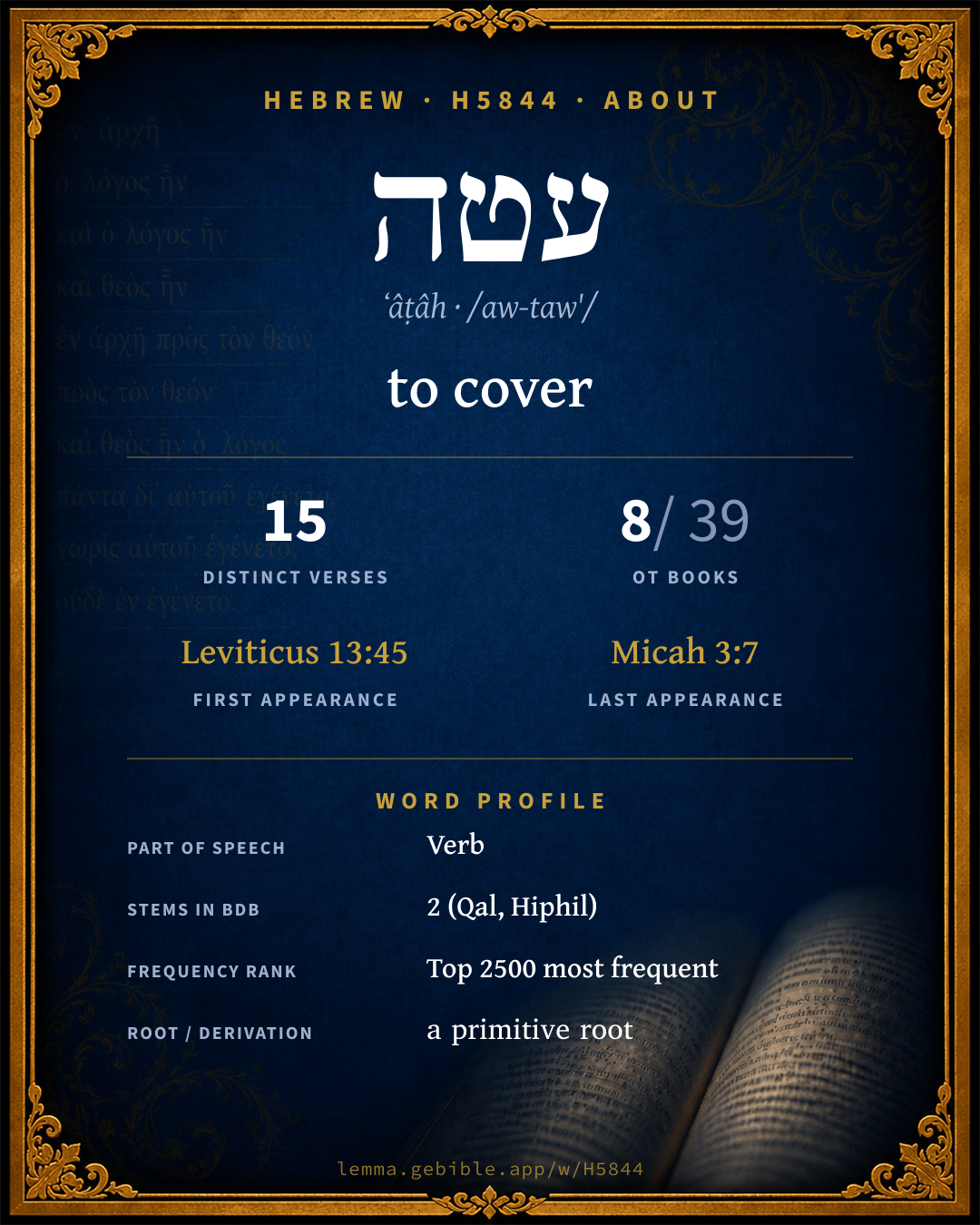
עָטָה
to cover
also: enwrap, wrap oneself, envelop oneself fuller range ↓
Full lexicon entry — Brown-Driver-Briggs (BDB)
From Brown-Driver-Briggs (BDB)
Where this word appears
See every Qal verb in the Hebrew Bible →
Grammar key — what these labels mean
Part of speech
- Verb
- An action or state-of-being word.
Stem
- Qal
- The basic, simple active stem — the plain form of the verb (“he wrote”).
- Hiphil
- The causative active stem (“he caused / brought about”).
Form
- Imperfect
- An incomplete, ongoing, or future action (“he will / would write”).
- Participle Active
- A verbal adjective expressing ongoing or characteristic action (“writing / one who writes”).
- Sequential Perfect
- A perfect with prefixed waw continuing a preceding imperfect or command (waw-consecutive perfect).
- Sequential Imperfect
- An imperfect with prefixed waw — the standard past-narrative form (waw-consecutive imperfect).
- Perfect
- A completed action or state — Hebrew marks aspect (completeness) more than strict tense (“he wrote”).
- Infinitive Absolute
- An unbound verbal noun, often intensifying or standing in for a finite verb.
State
- Absolute
- The independent form of a noun, not bound to a following word.
- Construct
- A noun bound to a following noun in a possessive / “of” relationship (the construct chain).
Person
- 3rd Person
- The one spoken about (“he / she / it / they”).
- 2nd Person
- The one addressed (“you”).
Gender
- Masculine
- Grammatically masculine.
- Common
- Either gender — not distinguished for this form.
- Feminine
- Grammatically feminine.
Number
- Singular
- One.
- Plural
- More than one (in Hebrew, generally three or more).
Grammatical forms 13 distinct
- Verb, Qal, Imperfect, 3rd Person, Masculine, Singular 3 times (18%)
- Verb, Qal, Participle Active, Masculine, Singular, Absolute 2 times (12%)
- Verb, Qal, Imperfect, 3rd Person, Masculine, Plural 2 times (12%)
- Verb, Qal, Sequential Perfect, 3rd Person, Common, Plural 1 time (6%)
- Verb, Qal, Sequential Perfect, 3rd Person, Masculine, Singular 1 time (6%)
- Verb, Qal, Participle Active, Masculine, Singular, Construct 1 time (6%)
- Verb, Qal, Sequential Imperfect, 3rd Person, Masculine, Singular 1 time (6%)
- Verb, Qal, Participle Active, Feminine, Singular, Absolute 1 time (6%)
+5 more forms (5 occurrences)
Parsed forms decoded from the imported morphology (morphhb / Westminster Leningrad Codex — WLC text public domain, morphhb tagging CC BY 4.0), counted across 17 parsed occurrences — not distinct verses.
Every verse where H5844 appears — 15 distinct verses across 8 books. Click any verse to open its interlinear word-by-word view. Verse text shown in the World English Bible for context — . Each verse’s Hebrew form is shown with its reference; the English is not keyword-highlighted, since the data carries no word-level English alignment. Use “Compare translations” on any verse to read it across multiple English versions. This concordance covers the Hebrew Bible; Septuagint (Greek Old Testament) occurrences are not indexed here.
Leviticus 1 verse
1 Samuel 1 verse
Psalms 6 verses
- Psalms 71:13 יַֽעֲט֣וּ Qal impf 3mp Let my accusers be disappointed and consumed. Let them be covered with disgrace and scorn who want to harm me.
- Psalms 84:6 יַעְטֶ֥ה Hiphil impf 3ms Passing through the valley of Weeping, they make it a place of springs. Yes, the autumn rain covers it with blessings.
- Psalms 89:45 הֶֽעֱטִ֨יתָ Hiphil pf 2ms You have shortened the days of his youth. You have covered him with shame. Selah.
- Psalms 104:2 עֹֽטֶה Qal ptcp.act ms He covers himself with light as with a garment. He stretches out the heavens like a curtain.
- Psalms 109:19 יַעְטֶ֑ה Qal impf 3ms Let it be to him as the clothing with which he covers himself, For the belt that is always around him.
- Psalms 109:29 וְ/יַעֲט֖וּ conj + Qal impf 3mp Let my adversaries be clothed with dishonor. Let them cover themselves with their own shame as with a robe.
Song of Solomon 1 verse
Isaiah 2 verses
- Isaiah 22:17 וְ/עֹטְ/ךָ֖ עָטֹֽה conj + Qal ptcp.act ms cs + sfx pers 2ms Qal inf.abs Behold, Yahweh, like a [strong] man, will hurl you away violently; yes, he will wrap you up closely.
- Isaiah 59:17 וַ/יַּ֥עַט conj + Qal wimpf 3ms He put on righteousness as a breastplate, and a helmet of salvation on his head; and he put on garments of vengeance for clothing, and was clad with zeal as a mantle.
Jeremiah 1 verse
Ezekiel 2 verses
- Ezekiel 24:17 תַעְטֶה֙ Qal impf 2ms Sigh, but not aloud, make no mourning for the dead; bind your headdress on you, and put your shoes on your feet, and don't cover your lips, and don't eat men's bread.
- Ezekiel 24:22 תַעְט֔וּ Qal impf 2mp You shall do as I have done: you shall not cover your lips, nor eat the bread of men.
Micah 1 verse
About this entry
At a glance — auto-summarized from this page’s data, not written by a person. Every figure links to its source below. This summary describes the numbers; it doesn’t interpret them.
The Hebrew verb עטה centers on the idea of “to cover.” Debuting at Leviticus 13:45, it then recurs through the corpus. It appears 15 verses across 8 books of the Hebrew Bible, among its uncommon vocabulary. The word gravitates to Psalms (40%), then Isaiah and Ezekiel. Different stems carry different senses — BDB groups them under 2 stems, among them Qal and Hiphil. For the data behind this summary, explore the sense tree and the renderings breakdown below.
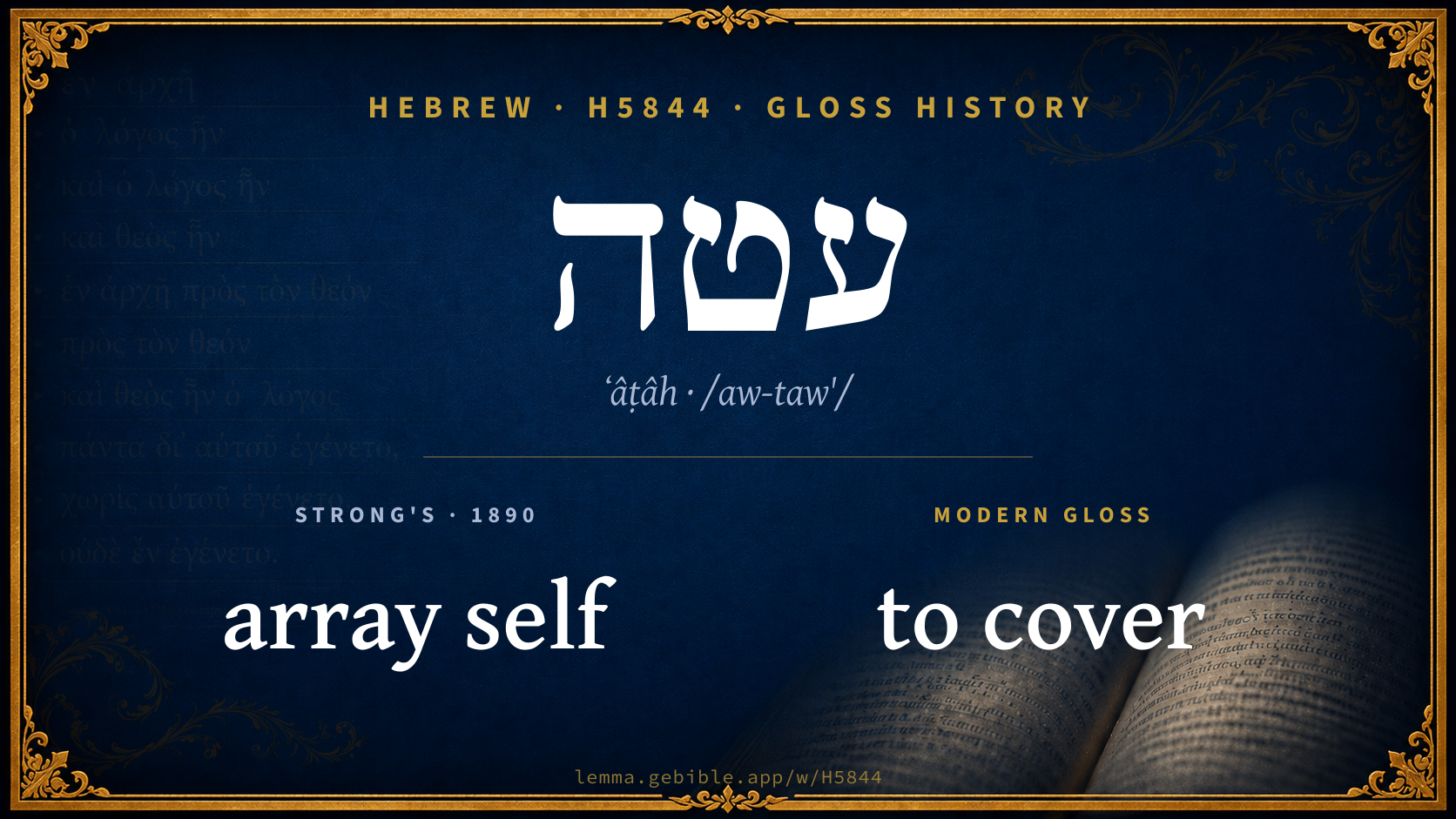
Gloss history
Strong's 1890 vs modern scholarship
About this word
Strong's H5844 catalogs a Hebrew word from the Hebrew Old Testament.
These counts are not copied from any lexicon or concordance. They are computed here, from the morphology-tagged Hebrew Old Testament. What Lemma adds →
- 15
- distinct verses
- The word appears in 15 distinct verses.
- 8 / 39
- OT books
- The word appears in 8 of 39 Old Testament books.
- #1,671
- by frequency
- Top 2500 most frequent Hebrew words (rank 1,671 of 8,640 Hebrew words by occurrence).
View all 15 occurrences in the concordance →
By section of the Old Testament
By traditional corpus
Conventional, traditional groupings — biblical authorship is debated, so this is a traditional corpus grouping, not an authorship claim. Each share is this word’s portion of its verses in that division of the Hebrew canon. Each figure is a share of the word’s 15 distinct verses.
- Prophets (Nevi'im) 7 verses · 47%
- Writings (Ketuvim) 7 verses · 47%
- Torah (Pentateuch) 1 verse · 7%
How translations render this word
Counts come from each version’s own published word-to-Strong’s tagging or interlinear alignment — an approximate guide to how each version renders this word, not a word-level alignment the data otherwise carries. Because each total is that version’s own tagged count, the per-version totals vary from one another and need not match the appearance or distinct-verse counts above. These counts may also differ from a printed concordance because Lemma counts each distinctly tagged rendering and does not collapse phrase taggings into a single head-word total. This is a fixed set of word-tagged versions (KJV, ASV, BSB, ULT) and does not change with the reading translation you choose elsewhere. Each version’s license is shown beside its name below (and on Sources).
BDB lists this Strong’s number as 2 distinct words (homographs). Each count above pools all of them and is not split by sense — see the Senses section below. A low-frequency rendering may belong to a different one of those words, not the primary meaning.
- King James Version†: Cover 2×
- American Standard Version†: Carry them away captive and he shall array 1×, Cover 1×, Coverest 1×
- Berean Standard Bible†: Cover 3×
- unfoldingWord Literal Text†: And 2×, Veil 2×, Wrapping 2×
King James Version Public Domain
Renders H5844 across 17† tagged occurrences — most commonly:
Plus 15 renderings that appear only once — usually multi-word phrases or single function words the recovered tagging swept in, not distinct renderings.
American Standard Version Public Domain
Renders H5844 across 16† tagged occurrences — most commonly:
Plus other, less common renderings.
Berean Standard Bible Public Domain
Renders H5844 across 17† tagged occurrences — most commonly:
Plus 14 renderings that appear only once — usually multi-word phrases or single function words the recovered tagging swept in, not distinct renderings.
unfoldingWord Literal Text CC BY-SA 4.0
Renders H5844 across 19† tagged occurrences — most commonly:
Plus 13 renderings that appear only once — usually multi-word phrases or single function words the recovered tagging swept in, not distinct renderings.
Senses in the full BDB
Hebrew verbs can shift meaning by stem (binyan): Qal is the basic action, Niphal is often passive or reflexive, Piel often intensifies or makes it factitive, and Hiphil is typically causative. The senses below are grouped under the stem BDB assigns to each.
What do BDB’s symbols mean?
BDB uses these scholarly abbreviations:
| Symbol | Meaning |
|---|---|
| 𝔊 | the Septuagint (the ancient Greek translation, LXX) |
| 𝔙 | the Vulgate (the Latin translation) |
| 𝔖 | the Syriac version (the Peshitta) |
| 𝔗 | the Targum (the Aramaic translation) |
| ψ | the Psalms |
| √ | root (the underlying root or stem) |
| ‖ | parallel passage (a synonymous or contrasted parallel) |
| † | the dagger: every passage where the word occurs is cited |
The 3 senses and sub-senses the full Brown-Driver-Briggs lexicon distinguishes for this word, in lexicon order (not ranked by frequency), with BDB’s own verbatim wording and sub-sense lettering. Shown in Hebrew script with BDB’s own scholarly abbreviations. The condensed entry is in the Lexicon Entry tab. See also the Forms in the corpus table below.
עטה I wrap oneself, enwrap, envelop oneself (Arabic غَطَا cover, conceal
Qal
- Pf. 3 ms. וְע׳ (consec.) Je 43:12; 3 pl. וְעָטוּ (consec.) Mi 3:7; Impf. 3 ms. יַעְטֶה Lv 13:45 + 2 times, וַיַּ֫עַט Is 59:17; 2 ms. תַּעְטֶה Ez 24:17; 3 mpl. יַעֲטוּ (Baer יַעְ׳ ψ 71:13; 109:29; 2 mpl. תַּעְטוּ Ez 24:22; Pt. act. עֹטֶה 1 S 28:14 ψ 104:2; fs. עֹטְיָה Ct 1:7;—wrap, envelop oneself with sthg. (acc., like לבשׁ): וְהוּא עֹטֶה מְעִיל 1 S 28:14 an old man ascending, and he is enwrapped in a robe; so יַע׳ הָרֹעֶה בִּגְדוֹ Je 43:12 (sim.), and וְע׳ אֶת־אֶרֶץ מִצְרַיִם v 12 he will wrap himself in the land of Egypt (use it as a robe, fig., of Nebuchadnezzar; so completely will it be in his power, Gf); so fig. of י׳, וַיַּעַט כַּמְעִיל קִנְאָה Is 59:17 (‖ לָבַשׁ), ע׳־אוֹר כַּשַּׂלְמָה ψ 104:2; of men, כְּבֶגֶד יַע׳ 109:19 (sim. ‖ לָבַשׁ v 18), וְיַע׳ כַמְעִיל בָּשְׁתָּם v 29 (‖ id.), יַע׳ חֶרְפָּה וגו׳ 71:13; c. עַל of part covered, in phrase וְעָטוּ עַל־שָׂפָם Mi 3:7 they shall envelop themselves upon their beard (cover the beard, sign of mourning or shame Che Now BenzArch. 165 NowArch. i. 195), so Ez 24:17, 22 and (of leper) Lv 13:45 (P); pt. f. עֹטְיָה Ct 1:7 as subst., one wrapping (a veil about her), i.e. a mourner; > a harlot (cf. Gn 38:14); but preferably II עטה picked lice.—וַיַּעַט etc., v. also עיט; מְעֻטָּה, v. מדט. e.g. Jeremiah 43:12
Hiphil
- Pf. 2 ms. הֶעֱטִיתָ עָלָיו בּוּשָׁה ψ 89:46 (of י׳) thou hast wrapped shame upon him (enwrapped him in shame); Impf. 3 ms. בְּרָכוֹת יַעְטֶה מוֹרֶה ψ 84:7 early rain enwrappeth (it, עֵמֶק הַבָּכָא v a) with blessings (𝔊 δώσει, as if from Arabic عطو, عَطَا iii, iv. give, cf. NeMarg. 41); read prob. also יַעֲטֵנִי Is 61:10 (for MT יְעָטָ֑נִי, v. יעט) with a robe of rightness he envelopeth me, so Brd Di RyKau Du; > Qal Pf. עָטָ֑נִי Klo CheHpt. e.g. Psalms 89:46
עטה II grasp (Arabic عطو, عَطَا i, vii. take with hands)
Qal
- Inf. abs. + Pt. act. sf. וְעֹטְךָ עָטֹה Is 22:17 he shall grasp thee forcibly, cf. GesComm. Hi Ew De CheComm. Di GuKau; > Thes RobGes BuhlLex (13) from I. עטה (he shall wrap, roll the tight together); picked lice Je 43:12 (BöttNÄ 163 𝔊 cf. Is 22:17 Ct 1:7). e.g. Isaiah 22:17
Senses from the full Brown-Driver-Briggs lexicon (Brown, Driver, Briggs; Oxford 1906 — public domain), digitized via Sefaria, supplemented by the OpenScriptures HebrewLexicon (CC BY 4.0). Full attribution on Sources.
Word origin
I. vb. wrap oneself, enwrap, envelop oneself (Arabic غَطَا cover, conceal; Aramaic ܥܛܳܐ extinguish, destroy; Assyrian eṭû, be dark, eṭûtu, darkness);—
I. vb. grasp (Arabic عطو, عَطَا i, vii. take with hands);—
— Brown-Driver-Briggs (Oxford 1906, public domain), digitized via Sefaria, supplemented by the OpenScriptures HebrewLexicon (CC BY 4.0). See Sources.
Origin: a primitive root
Jastrow Dictionary
A second Hebrew/Aramaic lexicon for comparison, covering Aramaic and post-biblical (Talmudic, Targumic, Midrashic) usage that the biblical-Hebrew BDB does not. Matched by lemma rather than by Strong’s number, so a lemma may carry more than one Jastrow headword (shown separately below), and the entries cover usage well beyond the Bible.
עֲטָא
- , v. עטי
עטי
- (b. h.) to wrap up; to cover one’s self. Cant. R. to I, 7 וע׳ את בגדו וכ׳ and rolled up his cloak and went off. Ib. כאבל הזה שהוא עוֹטֶה על שפמו וכ׳ like the mourner that wraps himself up to his lip and weeps. Ned. 49ᵇ ברוך שעָטַנִי מעיל blessed be he who wrapped me in a cloak; a. e.
A Dictionary of the Targumim, the Talmud Babli and Yerushalmi, and the Midrashic Literature (Marcus Jastrow; London, Luzac, 1903) — Public Domain. Digitized via Sefaria. Digitized via Sefaria. Full attribution on Sources.
Forms in the corpus
The 16 distinct written forms H5844 takes in the Hebrew Bible, most frequent first — each parse links to that stem’s occurrences in the concordance. Hebrew forms include their vowel points and cantillation, so a single lemma takes many written forms.
Same root — word family
Other BDB entries built from the same root as H5844, grouped by Strong’s listed origin. These share a root / origin per the lexicon — not necessarily a shared meaning. Each links to that word’s own entry.
Derived from this word
Compare all same-root words → They share a root, not necessarily a meaning.
Septuagint verse parallels
This word appears in 12 verses that also exist in the Greek Old Testament (Septuagint), out of the 15 Hebrew verses it occurs in. You can read those verses in Greek by switching the Old Testament edition to the Septuagint.
Read these verses in the Septuagint
- Leviticus 13:45
- 1 Samuel 28:14
- Psalms 71:13
- Song of Solomon 1:7
- Isaiah 22:17
- Jeremiah 43:12
- Ezekiel 24:17
- Micah 3:7
This is a verse-level parallel only — the same verses exist in both the Hebrew and Greek Old Testaments. No word-level Hebrew↔Greek correspondence is claimed: the data carries no such alignment, so no Greek word is shown as this Hebrew word’s translation. Coverage is not total — the Septuagint omits the deuterocanon and renumbers the Psalms, so some Hebrew verses have no direct Greek parallel.