
Jeremiah 33:4

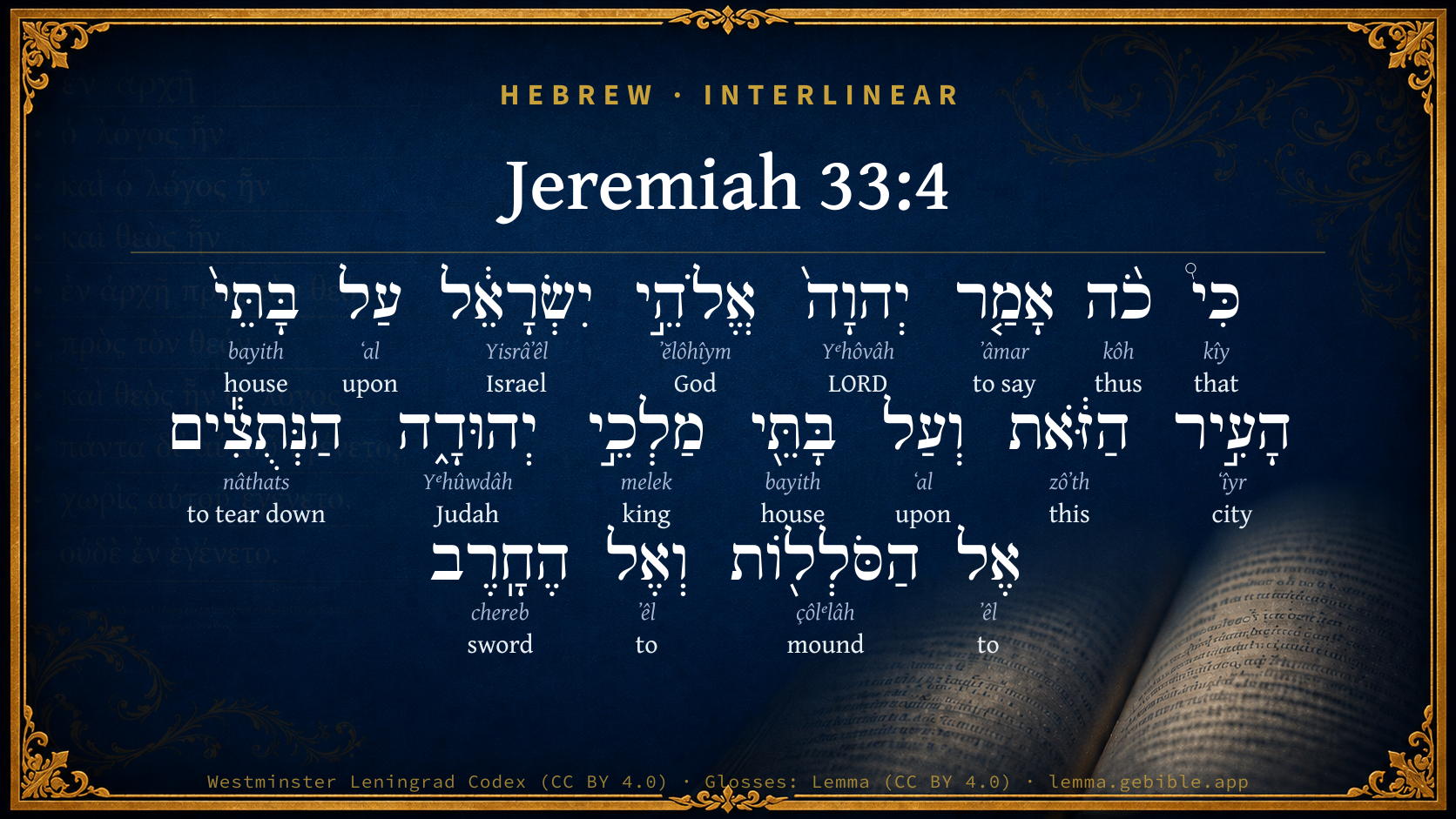
Hebrew (Westminster Leningrad Codex) Jeremiah 33:4 appears in the Hebrew Old Testament. The text above is from the Westminster Leningrad Codex. Each word links to its Strong’s number, a concise gloss, and parsing drawn from the Open Scriptures Hebrew Bible morphology. Click any word for its full Brown-Driver-Briggs (BDB) entry.
Download image
Cite this verse

Jeremiah 33:4 (World English Bible). Public Domain. Lemma interlinear Bible study tool, https://lemma.gebible.app/v/jeremiah/33/4.

Show BibTeX & RIS
BibTeX
RIS
English Translation
For thus says Yahweh, the God of Israel, concerning the houses of this city, and concerning the houses of the kings of Judah, which are broken down [to make a defense] against the mounds and against the sword;
World English Bible · Public Domain
Download a study sheet

One document with this verse’s original text, its word-by-word gloss line, the meaning frame, cross-references with their text, attributed commentary, and full source and license credits — printable, and it pastes into notes with its structure intact.

This verse Autodidact and up

Study sheet (.html) Plain text (.txt)

A passage Seminary Student

Up to 50 verses in one chapter. A passage sheet keeps up to 6 commentary sources and 12 cross-references per verse, in the order this page ranks them, and says so on the sheet whenever that leaves anything out. Ask for a single verse and you get the Autodidact verse sheet above.

Everything on this page stays free to read, with no account — the sheet is a download of what is already on screen, not access to it.

Want to remove ads? Support Godless Engineer
Compare translations 3

The same verse in 3 English versions, stacked beneath the original-language interlinear above. Click any original word for its lexicon entry.

Each is an independent rendering of the whole verse — the interlinear is not word-aligned to these translations.

Highlighted words mark where these versions differ — a whole-verse word diff, not a word-by-word alignment.

  • World English Bible Public Domain
    For thus says Yahweh, the God of Israel, concerning the houses of this city, and concerning the houses of the kings of Judah, which are broken down [to make a defense] against the mounds and against the sword;
  • King James Version Public Domain
    For thus saith the LORD, the God of Israel, concerning the houses of this city, and concerning the houses of the kings of Judah, which are thrown down by the mounts, and by the sword;
  • unfoldingWord Literal Text CC BY-SA 4.0
    For Yahweh, God of Israel, says this concerning the houses in this city and the houses of the kings of Judah that are torn down because of the siege ramps and the sword,

unfoldingWord Literal Text — © unfoldingWord, licensed CC BY-SA 4.0. Word-aligned USFM3 via Door43 (git.door43.org/unfoldingWord/en_ult).

Versions to compare (up to 4)

3 of 4 selected

Show all 18 translations

Every available English version of this verse, each an independent rendering of the whole verse.

  • World English Bible Public Domain
    For thus says Yahweh, the God of Israel, concerning the houses of this city, and concerning the houses of the kings of Judah, which are broken down [to make a defense] against the mounds and against the sword;
  • Berean Standard Bible Public Domain
    For this is what the LORD, the God of Israel, says about the houses of this city and the palaces of the kings of Judah that have been torn down for defense against the siege ramps and the sword:
  • Majority Standard Bible Public Domain
    For this is what the LORD, the God of Israel, says about the houses of this city and the palaces of the kings of Judah that have been torn down for defense against the siege ramps and the sword:
  • King James Version Public Domain
    For thus saith the LORD, the God of Israel, concerning the houses of this city, and concerning the houses of the kings of Judah, which are thrown down by the mounts, and by the sword;
  • American Standard Version (1901) Public Domain
    For thus saith Jehovah, the God of Israel, concerning the houses of this city, and concerning the houses of the kings of Judah, which are broken down `to make a defence' against the mounds and against the sword;
  • Revised Version (1885) Public Domain
    For thus saith the LORD, the God of Israel, concerning the houses of this city, and concerning the houses of the kings of Judah, which are broken down to make a defence against the mounts, and against the sword:
  • Geneva Bible (1599) Public Domain
    For thus saith the Lord God of Israel, concerning the houses of this citie, and concerning the houses of the Kings of Iudah, which are destroyed by the mounts, and by the sword,
  • Douay-Rheims (1899) Public Domain
    For thus saith the Lord the God of Israel to the houses of this city, and to the houses of the king of Juda, which rue destroyed, and to the bulwarks, and to the sword.
  • Young's Literal Translation Public Domain
    For thus said Jehovah, God of Israel, concerning the houses of this city, and concerning the houses of the kings of Judah, that are broken down for the mounts, and for the tool;
  • Literal Standard Version CC BY-SA 4.0
    For thus said YHWH, God of Israel, concerning the houses of this city, and concerning the houses of the kings of Judah that are broken down for the [siege] mounds, and for the tool;
  • Unlocked Literal Bible CC BY-SA 4.0
    For Yahweh, God of Israel, says this concerning the houses in this city and the houses of the kings of Judah that are torn down because of the siege ramps and the sword,
  • unfoldingWord Literal Text CC BY-SA 4.0
    For Yahweh, God of Israel, says this concerning the houses in this city and the houses of the kings of Judah that are torn down because of the siege ramps and the sword,
  • Darby Bible Public Domain
    For thus saith Jehovah the God of Israel concerning the houses of this city, and concerning the houses of the kings of Judah, which are thrown down because of the mounds and because of the sword:
  • World Messianic Bible Public Domain
    For the LORD, the God of Israel, says concerning the houses of this city and concerning the houses of the kings of Judah, which are broken down to make a defense against the mounds and against the sword:
  • Webster's Bible Public Domain
    For thus saith the LORD, the God of Israel, concerning the houses of this city, and concerning the houses of the kings of Judah, which are thrown down by the mounts, and by the sword;
  • Free Bible Version CC BY-SA 4.0
    For this is what the Lord, the God of Israel, says about Jerusalem's houses and the palaces of the kings of Judah that were demolished for materials to be used to defend against the siege ramps and the enemy attacks.
  • Bible in Basic English Public Domain
    For this is what the Lord, the God of Israel, has said about the houses of this town and the houses of the kings of Judah, which have been broken down to make earthworks and...;
  • JPS Tanakh (1917) Public Domain
    For thus saith the LORD, the God of Israel, concerning the houses of this city, and concerning the houses of the kings of Judah, which are broken down for mounds, and for ramparts;

Literal Standard Version (2020), Covenant Press — licensed CC BY-SA 4.0. Text via the HelloAO Bible API (eBible.org). Unlocked Literal Bible (unfoldingWord) — licensed CC BY-SA 4.0. Text via the HelloAO Bible API (eBible.org). unfoldingWord Literal Text — © unfoldingWord, licensed CC BY-SA 4.0. Word-aligned USFM3 via Door43 (git.door43.org/unfoldingWord/en_ult). Free Bible Version, Dr. Jonathan Gallagher — licensed CC BY-SA 4.0. Text via the HelloAO Bible API (eBible.org).

Word by word

More ways to search: Search by grammar → Find every occurrence → Compare this word →

Practice this passage: Drill this verse → Learn its vocabulary →

הַסֹּלְל֖וֹת
çôlᵉlâh
H5550
“the · mounds”
Particle, Definite Article + Noun, Common, Feminine, Plural, Absolute
Part of Speech
Particle + Noun
Type
Common
Gender
Feminine
Number
Plural
State
Absolute
Full BDB Definition

Origin: from H5549 , but used passively

TWOT: 1506b

mound
  1. כִּי֩ kîy H3588 “that” Conjunction
  2. כֹ֨ה kôh H3541 “thus” Adverb
  3. אָמַ֤ר ʼâmar H559 “to say” Verb, Qal, Perfect, 3rd Person, Masculine, Singular
  4. יְהוָה֙ Yᵉhôvâh H3068 “LORD” Noun, Proper
  5. אֱלֹהֵ֣י ʼĕlôhîym H430 “God(s) of” Noun, Common, Masculine, Plural, Construct
  6. יִשְׂרָאֵ֔ל Yisrâʼêl H3478 “Israel” Noun, Proper
  7. עַל ʻal H5921 “upon” Preposition
  8. בָּתֵּי֙ bayith H1004 “houses of” Noun, Common, Masculine, Plural, Construct
  9. הָעִ֣יר ʻîyr H5892 “the · city” Particle, Definite Article + Noun, Common, Feminine, Singular, Absolute
  10. הַזֹּ֔את zôʼth H2063 “the · this” Particle, Definite Article + Pronoun, Demonstrative, Feminine, Singular
  11. וְעַל ʻal H5921 “and · upon” Conjunction + Preposition
  12. בָּתֵּ֖י bayith H1004 “houses of” Noun, Common, Masculine, Plural, Construct
  13. מַלְכֵ֣י melek H4428 “kings of” Noun, Common, Masculine, Plural, Construct
  14. יְהוּדָ֑ה Yᵉhûwdâh H3063 “Judah” Noun, Proper
  15. הַנְּתֻצִ֕ים nâthats H5422 “the · torn down” Particle, Definite Article + Verb, Qal, Participle Passive, Masculine, Plural, Absolute
  16. אֶל ʼêl H413 “to” Preposition
  17. וְאֶל ʼêl H413 “and · to” Conjunction + Preposition
  18. הֶחָֽרֶב chereb H2719 “the · sword” Particle, Definite Article + Noun, Common, Feminine, Singular, Absolute

About this verse

These counts appear in no published source. They are computed here, from the morphology-tagged text and Lemma’s own curated glosses. What Lemma adds →

19
words
16
distinct lemmas
Prophets
section

Notable vocabulary

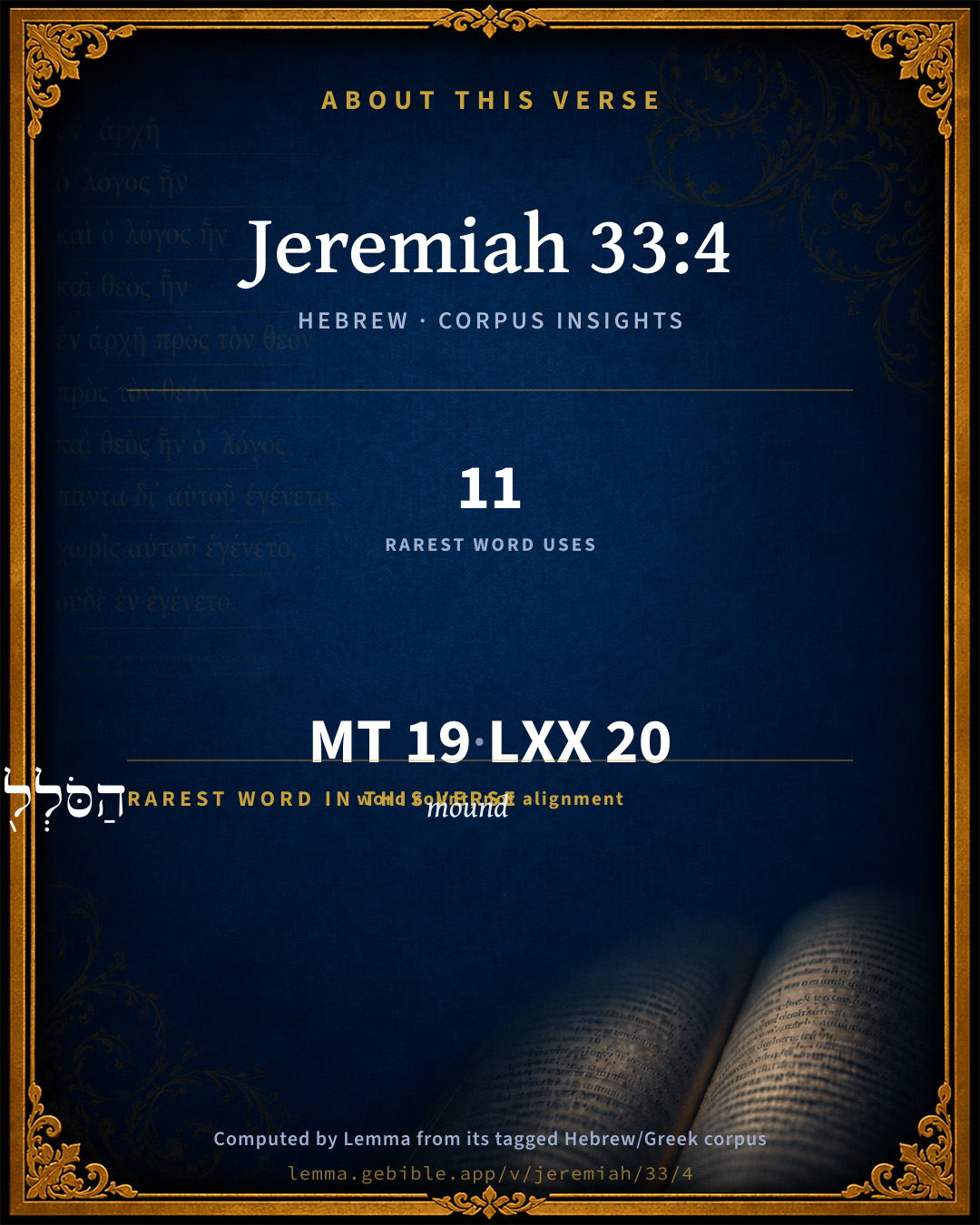
The rarest word here is הַסֹּלְל֖וֹת mound H5550 — appearing just 11 times in the whole Hebrew Bible.

Shared distinctive vocabulary

הַסֹּלְל֖וֹת mound H5550 occurs in 11 verses of the Hebrew Bible. Also found in:

Grammatical profile

  • 2 verbs
  • 10 nouns
  • 1 pronoun
  • 4 prepositions
  • 1 conjunction
  • 1 adverb

Verb forms

  • אָמַ֤ר Qal · Perfect
  • הַנְּתֻצִ֕ים Qal · Participle Passive

Repetition

Words recur within this verse — often emphatic in Hebrew:

  • עַל upon H5921 ×2
  • בָּתֵּי֙ house H1004 ×2
  • אֶל to H413 ×2

Hebrew & Septuagint length

In the original languages it is 19 Hebrew tokens and 20 Greek tokens — but the two are counted differently (Hebrew bundles its prefixes and suffixes into one token; the Greek is in lemma form), so that isn’t a like-for-like length.

Cross-references

5

Topical passages linked to Jeremiah 33:4 in the Treasury of Scripture Knowledge — connected by theme and wording, ordered by reader-vote popularity; previews shown in the World English Bible.

  • Jeremiah 32:24 Behold, the mounds, they are come to the city to take it; and the city is given into the hand of the Chaldeans who fight against it, because of the sword, and of the famine, and of the pestilence; and what you have spoken has happened; and, behold, you see it.
  • Ezekiel 4:2 and lay siege against it, and build forts against it, and cast up a mound against it; set camps also against it, and plant battering rams against it round about.
  • Habakkuk 1:10 Yes, he scoffs at kings, and princes are a derision to him. He laughs at every stronghold, for he builds up an earthen ramp, and takes it.
  • Ezekiel 21:22 In his right hand was the divination [for] Jerusalem, to set battering rams, to open the mouth in the slaughter, to lift up the voice with shouting, to set battering rams against the gates, to cast up mounds, to build forts.
  • Ezekiel 26:8 He shall kill with the sword your daughters in the field; and he shall make forts against you, and cast up a mound against you, and raise up the buckler against you.

Cross-references courtesy of OpenBible.info (CC BY 4.0).

Hebrew and Greek witnesses Masoretic Hebrew ↔ Greek Septuagint

The same verse in the two great witnesses to the Old Testament, shown verse-for-verse.

These are two independent witnesses, not word-aligned to each other, and the Septuagint is shown in lemma (dictionary) form.

Hebrew Jeremiah 33:4 Masoretic · Westminster Leningrad Codex

כִּי֩ כֹ֨ה אָמַ֤ר יְהוָה֙ אֱלֹהֵ֣י יִשְׂרָאֵ֔ל עַל בָּתֵּי֙ הָעִ֣יר הַזֹּ֔את וְעַל בָּתֵּ֖י מַלְכֵ֣י יְהוּדָ֑ה הַנְּתֻצִ֕ים אֶל הַסֹּלְל֖וֹת וְאֶל הֶחָֽרֶב

For thus says Yahweh, the God of Israel, concerning the houses of this city, and concerning the houses of the kings of Judah, which are broken down [to make a defense] against the mounds and against the sword;

World English Bible · Public Domain

Greek LXX Structure differs

In the Septuagint, Jeremiah is about an eighth shorter than the Hebrew and arranges its material differently — the Oracles Against the Nations (Hebrew chapters 46–51) appear in the middle of the Greek book, after 25:13. Because the chapter and verse boundaries do not line up, a verse-for-verse comparison with the Hebrew is not shown.

A verse-for-verse comparison isn’t shown here because the chapters and verses don’t line up. Switch to the LXX edition with the MT / LXX toggle above to read the Greek directly.

On this verse, Keil & Delitzsch discusses the Septuagint’s reading. Read the note in Commentary ↓

Hebrew: Westminster Leningrad Codex (CC BY 4.0). Greek: Septuagint (public domain); English from a public-domain English Septuagint. How the Septuagint differs from the Hebrew →

Targum (Aramaic paraphrase)

1

The Targum is the ancient Jewish Aramaic paraphrase of the Hebrew Scriptures — an interpretive translation, not the Hebrew text itself. Onkelos (literal) and Pseudo-Jonathan (expansive) render the Torah, and Jonathan the Prophets. Coverage is partial: where no permissively-licensed English translation exists for a verse, only the Aramaic is shown. This is verse-level text, not a word-by-word alignment to the Hebrew.

  1. Targum Jonathan Prophets (Joshua–Malachi)
    אֲרֵי כִדְנַן אֲמַר יְיָ אֱלָהָא דְיִשְׂרָאֵל עַל בָּתֵּי קַרְתָּא הָדָא וְעַל בָּתֵּי מַלְכַיָא דְבֵית יְהוּדָה דְמִתָרְעִין לְהוֹן וְצָבְרִין מִלֵיתָא לְתַקָפָא שׁוּרָא מִן קֳדָם דְקַטְלִין בְּחַרְבָּא:

    (no public-domain English translation for this verse)

    Targum Jonathan — Aramaic: “Mikraot Gedolot” (public domain). English: “Sefaria Community Translation” (CC0 1.0 (public-domain dedication)); “London "Chaldee Paraphrase," 1871” (public domain). Text via Sefaria.

Commentary

Notes on Jeremiah 33:4 from classic Christian and Jewish commentators (each source and its license shown beneath its notes). The classic Christian expositions comment on the surrounding passage and are grouped to its opening verse, so a note may address several verses; the Jewish commentaries on the Tanakh (Rashi and others) are per-verse, so they appear only where the commentator wrote on this verse.

Lemma curates 59 commentaries, every one of them public domain or Creative Commons licensed, each selected and text-cleaned for this edition rather than reprinted as found. About our sources →

Trapp's Complete Commentary

John Trapp

Jer 33:4 For thus saith the LORD, the God of Israel, concerning the houses of this city, and concerning the houses of the kings of Judah, which are thrown down by the mounts, and by the sword;

Ver. 4. Which are thrown down by the mounts.] Or, Catapults, or engines of demolition, used to batter with. See Jer 32:24.

And by the sword.] Or, Mattocks - scil., After that the enemy had entered the city, and cried, as Psa 137:3,

“ Destruite, ex imis subvertite fundamentis: ”

Down with it, down with it, even to the ground.

John Trapp, A Commentary or Exposition upon All the Books of the Old and New Testament (1647–1656) — public domain. Text from a community e-Sword module.

Joseph Benson's Commentary

Jer 33:4-5. Thus saith the Lord concerning the houses of this city — Not excepting those of the kings of Judah, thrown down by the mounts — Namely, by the battering engines placed upon the mounts, which were raised against the walls of the city; and by the sword — By the violence of war. The Hebrew word generally rendered sword may mean any instrument of iron, and particularly such as were used in demolishing any building. It is rendered a mattock by our translators, 2Ch 24:6, and axes, Eze 26:9. They come to fight with the Chaldeans — Most interpreters understand this as spoken of the Jews sallying forth against the Chaldeans, to beat them off from the siege, which they attempted to do in vain, and to their own destruction, only thus filling the houses of Jerusalem with the dead bodies of their men, who died of the wounds received from the Chaldeans in making those sallies. And the verse is thought to come in by way of parenthesis, between the fourth and sixth, to show that at present God would not prosper any efforts that were made for the defence of the city, though he would restore it hereafter to its former splendour.

Joseph Benson's Commentary on the Old and New Testaments (1811–1818) — public domain. Text from a community e-Sword module.

Keil & Delitzsch

C. F. Keil & F. Delitzsch

Repair of the injuries and renewal of the prosperity of Jerusalem and Judah. - Jer 33:4. "For thus saith Jahveh, the God of Israel, concerning the houses of this city, and concerning the houses of the kings of Judah, which are broken down because of the besiegers' mounds and because of the sword, Jer 33:5. While they come to fight with the Chaldeans, and to fill them with the corpses of men, whom I have slain in my wrath and in my fury, and for all whose wickedness I have hidden my face from this city: Jer 33:6. Behold, I will apply a bandage to it and a remedy, and will heal them, and will reveal to them abundance of peace and truth. Jer 33:7. And I will turn again the captivity of Judah and the captivity of Israel, and will build them up as at the first. Jer 33:8. And I will purify them from all their iniquity by which they have sinned against me, and will pardon all their iniquities, by which they have sinned and have transgressed against me. Jer 33:9. And it (the city) shall become to me a name of joy, a praise, and an honour among all the people of the earth that shall hear all the good which I do them, and shall tremble and quake because of all the good and because of all the prosperity that I show to it. Jer 33:10. Thus saith Jahveh: Again shall there be heard in this place-of which ye say, 'It is desolate, without man and without beast,'-in the cities of Judah, and in the streets of Jerusalem, which are laid waste, without men, and without inhabitants, and without beasts, Jer 33:11. The voice of gladness and the voice of joy, the voice of the bridegroom and the voice of the bride, the voice of those who say, 'Praise Jahveh of hosts, for Jahveh is good, for His mercy is for ever,' who bring thank-offerings into the house of Jahveh. For I will turn again the captivity of the land, as in the beginning, saith Jahveh. Jer 33:12. Thus saith Jahveh of hosts: In this place, which is laid waste, without man and beast, and in all its cities, there will yet be pasture-ground for shepherds making their flocks lie down in. Jer 33:13. In the cities of the hill-country, in the cities of the plain, and in the cities of the south, in the land of Benjamin, and in the environs of Jerusalem, and in the cities of Judah, the flock shall yet pass under the hand of one who counts them, saith Jahveh."

With Jer 33:4 begins the statement concerning the great and incomprehensible things which the Lord will make known to His people; it is introduced by כּי, which marks the ground or reason - so far as the mere statement of these things gives reason for the promise of them. The word of the Lord does not follow till Jer 33:6 and onwards. In Jer 33:4 and Jer 33:5 are mentioned those whom the word concerns - the houses of Jerusalem (Jer 33:4), and the people that defend the city (Jer 33:5). Corresponding to this order, there comes first the promise to the city (Jer 33:6), and then to the people. Along with the houses of the city are specially named also the houses of the kings of Judah; not, perhaps, as Hitzig thinks, because these, being built of stone, afforded a more suitable material for the declared object - for that these alone were built of stone is an unfounded supposition - but in order to show that no house or palace is spared to defend the city. "Which are broken down" refers to the houses, not only of the kings, but also of the city. They are broken, pulled down, according to Isa 22:10, in order to fortify the walls of the city against the attacks of the enemy, partly to strengthen them, partly to repair the damage caused by the battering-rams directed against them. This gives the following meaning to the expression אל־הסּללות ואל־החרב: in order to work against the mounds, i.e., the earthworks erected by the enemy, and against the sword. The sword is named as being the chief weapon, instead of all the instruments of war which the enemy employs for reducing the city; cf. Eze 26:9. It is against the laws of grammar to understand נתשׁים as referring to the destruction of the enemy by the siege material; for, on such a supposition, אל־ would require to designate the efficient cause, i.e., to stand for מפּני (cf. Jer 4:26), but neither אל־ nor על can mean this. - The first half of Jer 33:5 is difficult, especially בּאים, which the lxx have omitted, and which Movers and Hitzig would expunge, with the absurd remark, that it has come here from Jer 31:38; this is an easy and frivolous method of setting aside difficulties. All other ancient translations have read בּאים, and have attempted to point out how its genuineness is ascertained on critical grounds.

(Note: The different attempts to solve the difficulty by conjectures are of such a nature as scarcely to deserve mention. Ewald would change החרב בּאים into החרבים otni , "that are broken down opposite the earthworks and the cannons." But the plural of חרב is חרבות, Eze 26:21, and cannot possibly mean cannons. E. Meier would read החריב בּאים, "and for the destruction of those who are pressing in." Then בּאים must be the enemy who are pressing in; but how does this agree with what follows, "in order to fight with the Chaldeans"? Lastly, Ngelsbach would change את־ הכּשׂדּיםinto על־ירוּשׁלים, to obtain the idea that the earthworks and the sword come for the purpose of contending against Jerusalem (!).)

To connect בּאים closely with what precedes is impossible; and to understand it as referring to the houses, quae dirutae adhibentur ad dimicandum cum Chaldaeis (C. B. Michaelis), is incompatible with the idea contained in בּוא. Still more inadmissible is the view of L. de Dieu, Venema, Schnurrer, Dahler, and Rosenmller: venientibus ad oppugnandum cum Chaldaeis; according to this view, אּת־כּשׂדּים must be the nominative or subject to להלּחם את־הכּשׂדּים בּאים can only signify, "to contend with the Chaldeans" (against them); cf. Jer 32:5. According to this view, only the Jews can be the subject of בּאים. "They come to make war with the Chaldeans, and to fill them (the houses) with the dead bodies of men, whom I (the Lord) slay in my wrath." The subject is not named, since it is evident from the whole scope of the sentence what is meant. We take the verse as a predication regarding the issues of the conflict - but without a copula; or, as a statement added parenthetically, so that the participle may be rendered, "while they come," or, "get ready, to fight." בּוא, used of the approach of an enemy (cf. Dan 1:1), is here employed with regard to the advance of the Jews to battle against the besiegers of the city. The second infinitival clause, "to fill them," represents the issue of the struggle as contemplated by the Jews, in order to express most strongly its utter fruitlessness; while the relative clauses, "whom I have slain," etc., bring out the reasons for the evil consequences. Substantially, the statement in Jer 33:5 is parallel to that in Jer 33:4, so that we might supply the preposition על (ועל): "and concerning those who come to fight," etc. Through the attachment of this second predication to the first by means of the participle, the expression has become obscured. In the last clause, אשׁר is to be connected with על־רעתם.

In view of the destruction of Jerusalem now beginning, the Lord promises, Jer 33:6, "I will apply to it (the city) a bandage (see Jer 30:17) and a remedy," i.e., a bandage which brings healing, "and heal them" (the inhabitants); for, although the suffix in רפאתים might be referred to the houses, yet the following clause shows that it points to the inhabitants. Hitzig takes גּלּיתי in the meaning of גּלל, "I roll to them like a stream," and appeals to Amo 5:24; Isa 48:18; Isa 66:12, where the fulness of prosperity is compared to a stream, and the waves of the sea; but this use of גּלה is as uncertain here as in Jer 11:20. We keep, then, to the well-established sense of revealing, making known (cf. Psa 98:2, where it is parallel with הודיע), without any reference to the figure of sealed treasure-chambers (Deu 28:12), but with the accessory notion of the unfolding of the prosperity before all nations (Jer 33:9), as in Psa 98:2. עתרת is here to be taken as a noun, "fulness, wealth," from עתר, an Aramaizing form for עשׁר, to be rich (Eze 35:13). שׁלום ואמת does not mean "prosperity and stability," but "peace and truth;" but this is not to be toned down to "true peace," i.e., real, enduring happiness (Ngelsbach). אמת is the truth of God, i.e., His faithfulness in His promises and covenants, as in Psa 85:11-12, where mercy and truth, righteousness and peace, are specified as the gracious benefits with which the Lord blesses His people.

Keil & Delitzsch — Biblical Commentary on the Old Testament (1861–1891) — public domain (CC PDM 1.0). Text via the HelloAO Bible API. (Old Testament only.)

Lange's Commentary on the Holy Scriptures

2. Destruction in the Present. Nevertheless glorious Internal and External Rebuilding in the Future

Jer_33:4-9

4          For thus saith Jehovah, the God of Israel,

Concerning the houses of this city,

And concerning the houses of the kings of Judah,

Which were thrown down against the ramparts and against the sword,

5     Which are come to fight against the Chaldeans,1

And to fill them with the dead bodies of men,

Whom I have slain in my anger and in my fury,

And for all whose wickedness I have hid my face from this city:

6     Behold, I bring it health2 and cure, and heal them,

And reveal3 unto them an abundance4 of peace and truth.

7     And I turn the captivity of Judah and the captivity of Israel,

And build them as in the beginning.

8     And I cleanse them from all their guilt, with which they have sinned against me,

And pardon all their transgressions, with which they have sinned and transgressed5 against me.

9     And it [the city] shall be to me a name of joy,

A praise and an honor before 6 all the nations of the earth,

Who shall hear all the good that I do unto them;7

And shall tremble and quake on account of all the goodness,

And on account of all the prosperity, that I procure unto it.

EXEGETICAL AND CRITICAL

In connection with the view which the city of Jerusalem then afforded, with many houses thrown down in the interest of defence (Jer_33:4-5), the prophet promises the city healing and peace (Jer_33:6), the return of all the exiles, restoration (Jer_33:7) and forgiveness of all sin (Jer_33:8). Jehovah will again make Jerusalem the object of His joy and His glory in view of all the nations of the earth, who will be most powerfully impressed by this marvel of restoration to peace and prosperity (Jer_33:9).

Jer_33:4. 5, For thus saith Jehovah … from this city. By for at the beginning of Jer_33:4 the prophet introduces the specification of the great and wonderful facts of redemption promised in general in Jer_33:2-3. This כִּי is thus the key of the whole chapter.—Concerning the houses. From Isa_22:10 we see that houses were thrown down in sieges, to repair or strengthen the walls. It was natural that those houses should be used for this purpose which were nearest the walls, whether private or royal property, and it is unnecessary, with Hitzig, to explain the prominence of the royal houses from the greater ease in obtaining them or the superiority of their materials. It is clear that we cannot render for ramparts and for sword, for in the first place, as has been repeatedly remarked, the Hebrew does not signify ramparts of defence but of attack (comp. Jer_32:24; Jer_6:6; 2Sa_20:15; 2Ki_19:32; Eze_4:2; Eze_17:17; Eze_21:27; Eze_26:8; Dan_11:15), and in the second place, for sword would not be appropriate. We are not justified in rendering this singular in any other than the usual sense, especially as it is not at all certain that the plural חֲרָכוֹת, Eze_26:9, has any other than the usual meaning. Comp. Haevernick, in loc.—To take אֵל for לְ and to attribute a causal meaning to it so that it is equivalent to through, is altogether arbitrary. It cannot be urged that the prophet here speaks of all the houses of Jerusalem as being destroyed. Jeremiah only takes occasion, in a view of the houses destroyed in behalf of the defence, to set over against this gloomy picture of the present, which certainly was the prelude of entire destruction, the most glorious picture of the future restored city. אֵל is here therefore = against.—Sword is evidently used by synecdoche for all manual weapons, while the ramparts also include the machines erected upon them, so that these two words comprise the totality of the implements of attack. Comp. Eze_21:24-25.—Which are come, etc. Comp. Textual Notes. As the text now stands it is declared of the houses that they are come (1) to fight with the Chaldeans, (2) to fill them (viz., the houses) with corpses. Now though the first may be said, in so far as by a bold hyperbole, the houses thrown down would be designated as moved forward into line of battle and taking part in the fray, still the second is in the highest degree surprising. For how can the houses come to fill them with corpses? This “them” must either denote themselves, which would be grammatically and logically incorrect, or it must be referred to the other houses, which would be doing violence to it, seeing that the other houses have not been previously mentioned. Then also the filling, etc., must be regarded as the unintended result, which seems forced. Since, then, the present text proves to be incapable of giving us a satisfactory sense, nothing further is left us but to resort to an emendation. We have mentioned in the Textual Notes attempts already made, none of which, however, meet with our approval. Perhaps it would be better to read Jerusalem (Jer_37:10), or to Jerusalem (Jer_34:1-7 coll. Jer_32:24; Jer_32:29) instead of the Chaldeans. Then the words are come would refer to ramparts and sword. The circumstance that these substantives are feminine is of no account. For the masculine come may be referred κατὰ σύνεσιν to the persons, to whom the ramparts and sword serve as implements. (Comp. Naegelsb. Gr., § 60, 4).—Them after fill would then be referred to the idea of houses, which is prominent enough in Jer_33:4 to justify such a construction. Perhaps also we might read to fill it (comp. לָהּ Jer_33:6). The alteration into the Chaldeans might be explained by the difficulty of understanding are come of the ramparts and sword, and by the idea that it might refer to the houses of the city or their inhabitants. Perhaps also the remembrance of Jer_32:5 may have as sisted in this. Meanwhile I confess that I perceive the difficulties attending this conjecture also, and therefore will gladly receive better instruction.

Jer_33:6-7. Behold I bring … as in the beginning. In opposition to tearing down in Jer_33:4 the prophet promises bandages or healing, instead of filling with corpses he promises cure.—Peace and truth, i. e. genuine, lasting prosperity. Comp. Jer_14:13; Psa_85:11.—Build them. Comp. Jer_24:6; Jer_31:4. The expression is chosen with reference to the occasion of the prophecy, Jer_33:4. Yet the idea is not to be taken merely in the narrower sense.—As in the beginning. The phrase is used proleptically, comp. Jer_33:11. It is not the building which is compared with the building of the beginning, but the result of the building is compared with the original state of things. Comp. besides Isa_1:26; 1Ki_13:6.

Jer_33:8-9. And I cleanse … procure unto it. In Jer_33:8 the internal, heart-restoration is described. Comp. Jer_31:18-20; Jer_31:34.—Which they have sinned. Comp. Zep_3:11.

Jer_33:9. And it shall be. The subject is the city. Comp. להּ Jer_33:6.—A name of joy. שֵׁם שָׂשׂון, which reminds us of שֶׁמֶן שָׂשׂוֹן (Psa_45:8; Isa_61:3), is joyful renown, renown which brings joy. On the subject-matter comp. Jer_13:11; Zep_3:19-20; Deu_26:19.—Before all the nations. How far Jerusalem will extend the Lord’s glory among the nations is declared in the following clause. The view of all the good which the Lord is preparing for Jerusalem will fill them with dread. At any rate with a wholesome fear, for after they have in their terror perceived that they have neglected the almighty and benevolent God for vain idols, they will turn again to the former. Comp. Num_14:13-15; Deu_29:24; Isa_2:2-4; Isa_11:10; Isa_19:17.

DOCTRINAL AND ETHICAL

1. On Jer_32:3. “An effect of anger and a procedure almost like that of Ahab with the prophet Micah. The same spirit prevails now-a-days. For without entering on an investigation, with what right or reason men are found who often in pretty general expressions in a call to repentance, borrow from the prophet all sorts of judicial threatening and point to this or that city, we cannot avoid seeing why they are always put in arrest, viz.: for this cause, ‘Why dost thou prophesy what we do not like to hear?’ When one is sure of his cause, a noble disdain of such people would be the best means to use against them. But men cannot bear a bad conscience and threatenings of all sorts together, and the fear that it may be true has the foolish effect, that they cause the bearers of such unpleasant tidings to come to a bad end, in order to affright others from coming with similar messages.” Zinzendorf.

2. On Jer_32:7 sqq. “Fundatur in hoc textu locus classicus de contractibus emtionis et venditionis, quos improbant Anabaptistæ, probat Scriptura, sicut ostendunt hæc quæ jam sequuntur documenta: Pro_31:14; Mat_13:3.”Förster.

3. On Jer_32:15. “The prophet had often enough declared the land lost to the Chaldeans. Here, however, he must testify that it is not lost forever: his purchase was to restore confidence in the future to other troubled souls. Thus the most afflicted servant of God must again be the most hopeful.”—“When we are outwardly prosperous, we think no one can take our prosperity from us, and when trouble comes upon us, we again think that no one can help us. Both courses are, however, equally ungodly. Therefore God’s servants must contradict both those who are at ease, and those who are in despair. The reverse is always right. In good days humble thyself, and in bad days let thyself be exalted, for then it is a great thing to do.” Diedrich.

4. On Jer_32:9; Jer_32:16; Jer_32:24-25. “Jeremiah also contends, but as a servant of the Lord. First he obeys and afterwards speaks about it. This is a noble way, by which every teacher, who knows the Lord, may prove himself. As soon as he observes that the Lord wishes this or that, it is not the time to expostulate, but to act, not to call anything in question, but to set to work. If then any hesitation is left, or one and another scruple, it is time afterwards to consult with the Lord about it, when one has first shown obedience.” Zinzendorf. [“Though we are bound to follow God with an implicit obedience, yet we should endeavor that it may be more and more intelligent obedience. We must never dispute God’s statutes and judgments, but we may and must inquire, What mean these statutes and judgments? Deu_6:20.” Henry.—S. R. A.]

5. On Jer_32:25. Tertullian (c. Marc, L. IV., c. 40) sees in the words “Buy thee the field for money,” the prophetic passage to which Mat_27:9 refers, regarding the reading Ἰερεμίου as correct. Comp. Euseb. Demonstr. Ev., L. X., c. 4; Augustin, De consensu Evang., L. III., c. 7.

6. On Jer_32:27. To God there is no wonder [miracle]. There are wonders only on the lower stage of existence. Every higher stage is a wonder to the lower. Or is there only one stage of existence, and accordingly only one order of nature? When the North American savages cruelly murdered one of their number who had been on a visit to the Great Father in Washington, and told them of the wonders of civilization, as a demoniacally possessed liar, were they less in the right than our highly civilized savages, to whom it is a fundamental axiom, that there is no other world, but that which they can reach with their five senses? It is certainly not proved that there is a living, personal, omnipotent God. But this is not to be proved, it is to be felt from the heart. He who is born of God heareth His voice. To him also miracles cease to be aught irrational. He knows well how to distinguish between true and false miracles, but the former come to him like a voice from the higher world, in which he feels truly at home. For the stages of existence and orders of nature are not hermetically sealed towards each other, but the higher break through in order to lift the lower up to themselves.

7. On Jer_32:36 sqq. On the fulfilment of this prophecy comp. the Comm. on Jer_13:14, and the Doctrinal notes on Jer_3:18-25, No. 8. As the threatening that Israel should be dispersed among all nations from one end of the earth to the other (Deu_28:64-66) has been literally fulfilled, why should not this promise also be literally fulfilled, that they shall be collected from all lands whither the Lord has cast them out? Why cannot this people be destroyed? Why do they retain their peculiarities with such tenacity, that neither the most raging fanaticism, nor the most humane cosmopolitanism, which is much more dangerous than the former, can mingle them with other nations; so that we can follow the course of their national stream through the sea of nations, as it is said of the Rhine that its water flows unmingled through the lake of Constance? Assuredly this people must yet have a future. Only thus much is correct; that the real kernel of these prophecies is offered to us in a shell which the prophets prepared from contemporary events, but it is difficult to determine where the shell ceases and the kernel begins. Comp. Rinck, The Scripturalness of the doctrine of the Millennial reign defended against Hengstenberg. Eberfeld, 1866, S. 45 sqq.

8. On Jer_32:36 sqq. “Is the consummation of the redemptive work possible while Israel is rejected as a nation? According to the Old Testament this question must be unconditionally negatived. This knows only a temporary rejection of Israel, which at the same time has this result, that Israel does not perish as a nation, but is preserved for future restoration. Is this law aunulled since Israel despised the gracious visitation of the Messiah, the kingdom of God taken from them and given to a people which bring forth the fruits thereof? Are thus the predictions of the prophets, which treat of a glorification of Israel in the latter days, eternally abrogated on account of the nation’s sin? Or can their fulfilment be found only in a spiritual manner in the Christian church, the main trunk of which was formed by a chosen few from Israel? These questions are answered in the affirmative by Bertheau (Old Testament prophecy of Israel’s national glory in their own land. Jahrb. f. deutsche Theol., 1859 and 1860) in accordance with the older protestant theology (comp. especially Hollaz, Exam, theolog. ed. Teller, p. 1264 sqq.) as decidedly as according to our conviction they must, on the ground of Rom_1:25 sqq., be negatived. It seems to us to be irrefragably established that when the times of the world-nations are full (Luk_21:24), Israel will obey the gospel call, and thus be prepared to welcome the Messiah (Mat_23:39); that for this reason in its dispersion among the nations of the earth it has never been absorbed by them, but preserved in separate existence for its final destination, because God’s gifts of grace and calling are ἀμεταμέλητα.” Oehler in Herzog, R.-Enc., XVII., S. 658, 9.

9. On Jer_33:3. “This is the Lord’s declaration to His obedient servant Jeremiah. My dear child, He says, thou hast acted according to my will, without knowing why. Thou hast done well. But I will make it clear to thee, so that thou wilt wonder no more; I will tell thee that and yet more, so that thou wilt at last say., ‘Yes, let it be so.’ We find such connections a few times elsewhere in the Scriptures. The Lord says, ‘ How can I hide from Abraham the thing that I do!’ (Gen_18:17.) And the same Lord declares to His disciples, whence comes this inclination or predisposition to tell something new to His disciples, ‘ Henceforth I call you not servants, for the servant knoweth not what his Lord doeth, but I have called you friends, for all things that I have heard of my Father, I have made known unto you’ (Joh_15:16). So also is it here with Jeremiah.” Zinzendorf.

10. On Jer_33:6. Healing, restoration, joy and permanent prosperity are promised by the prophet to Jerusalem at a time when all seemed lost, and it seemed impossible to regain them. How desolate must it have then appeared in Jerusalem when one house after another was thrown down to furnish means of defence! How wildly raged the tumult of war, and how comfortless was the condition of the city shut in by the enemy and completely cut off from the rest of the country! To the mind of him, who then thought of Jerusalem in the future, pictures of destruction alone presented themselves. Jeremiah, however, whose sight was sharpened by the divine anointing, sees beyond the present abomination of desolation in the far distant future pictures of peace and, moreover, of everlasting peace, such as no eye has ever seen, nor hath it entered into the heart of man. There was the patience and faith of the saints (Rev_13:10). ‘Impossible’ is a word, which does not occur in God’s language.

11. On Jer_33:8. “After the stubborn race has been partly annihilated and partly humbled, God will turn the captivity of the nation, as a whole. Israel cannot perish eternally. God will purify the people from their sins, by forgiveness, the only way in which men can be really freed from sin. Grace and forgiveness are the only ground on which we stand as Christians. This seems nothing to the world, and yet it is more than heaven and earth.” Diedrich.

12. On Jer_33:7-13. “An important doctrine meets us in these words, that it is not the gifts of God which we should seek to apprehend, but the love of God which is manifested in that He imputes not our sin to us. Otherwise we treat the Divine benefits like the fishes which swallow the hook with the bait.” Heim and Hofmann. The major prophets expounded for edification, 1839, S. 509.

13. On Jer_33:14-17. “All God’s promises are at the same time fulfilled by the true man, the Son of Man, the pure sprout of David. He will be a King, in whom we have perfect protection from all destructive agencies, for He will help us from sin, procuring and executing on earth justice and righteousness for all mankind. As we all together inherited sin and death from Adam, so Jesus by His righteousness has brought justification of life for all men, if we would now only take it with joy. Jerusalem will itself bear the King’s name, as he was called in Jer_23:6 : Jehovah our Righteousness, i. e., that Jehovah bestows on us the righteousness, which is the bond, which at the same time unites us to the citizens of His celestial city.” Diedrich.

14. On Jer_33:15-16. [The Lord our righteousness. “This is to be explained by the union of the Church with Christ (see Rom_12:4-5; 1Co_10:17; 1Co_12:12; Eph_1:22; Eph_4:12; Eph_4:15-16; Eph_4:25; Eph_6:23; Col_1:18; Col_1:24) so that what belongs to Him is communicated to her (Calvin, Piscator, Muenster).—Thus, by virtue of her mystical union with Christ, and by the imputation of His merits, and the infusion of His Spirit, the Name of the Church may be said to be ‘ The Lord our righteousness;’ she hides herself in Him, and is seen by God as in Him; she is clothed with Christ the Sun of righteousness (see Rev_12:1) and is accepted in the Beloved (Eph_1:6).” Wordsworth.—S. R. A.]

15. On Jer_33:17. [“When the First-begotten was brought into the world it was declared concerning Him, The Lord God shall give unto Him the throne of His Father David, Luk_1:32.” Henry.—S.R. A.]

16. On Jer_33:13-22. [“Four words, each of them full of meaning, comprise the conceptions which we attribute to the Paradisaical state. They are these: Innocence, Love, Rural Life. Piety; and it is towards these conditions of earthly happiness that the human mind reverts, as often as it turns, sickened and disappointed, from the pursuit of whatever else it may have ever labored to acquire. The innocence we here think of is not virtue recovered, that has passed through its season of trial, but it is Moral Perfectness, darkened by no thought or knowledge of the contrary. This Paradisaical love is conjugal fondness, free from sensuous taint. This Rural Life is the constant flow of summer days, spent in gardens and afield, exempt from our exacted toil. This piety of Paradise is the grateful approach of the finite being to the Infinite,—a correspondence that is neither clouded, nor is apprehensive of a cloud.” Isaac Taylor, Spirit of Hebrew Poetry.—S. R. A.]

17. On Jer_33:19-22. [“The richest promises are confirmed by the strongest assurances.” Cowles.—S. R. A.] “As God’s arrangements in nature do not fail, still less can His word fail in His kingdom of grace, and all His word refers to the divine Son of David and His eternal kingdom of grace. Yea, the whole innumerable Israel, Abraham’s spiritual posterity, shall become Davids and Levites, i. e., priests and kings, as was designed even at the beginning of Israel. (Exo_19:6; 1Pe_2:9; Rev_5:6).” Diedrich.

18. On Jer_33:18-22. [Wordsworth rejects Hengstenberg’s explanation that these words are to be applied to all Christians indiscriminately, and approves of the argument derived by the ancient Christian fathers from the passage in favor of the threefold order of ministers in the Christian church. He adds “The Gospel of Christ and the Church of Christ possess the spiritual essence of whatever was commanded in the Levitical dispensations. Whatever was local and personal in those dispensations has passed away. The Tabernacle, the Temple, their Sacrifices, their Sabbaths, their Annual Festivals, their threefold Ministry, all these have been spiritualized in the Gospel. Sinai is perpetuated in Zion. The glory of the Law has been absorbed into that of the Gospel. See Psa_68:17, the great Pentecostal Psalm.”—S. R. A.]

19. On Jer_33:23-26. “In the first place they will not be warned, and afterwards they will not be comforted. The true prophet however announces death to sinners according to the law, but afterwards grace for renovation and for life. Despair is blasphemy. God’s kingdom stands and will be perfected, but the fainthearted will not enter it. God answers: so long as heaven and earth are preserved by Me, it is for the sake of My kingdom, and as a pledge that it will not fail. Israel or, what is the same thing, David’s seed shall be a royal seed, and the captivity which the people must now endure is transient. It is however impossible for the worldly to comprehend this, who persist in carnal repose as though no God could punish them, and again in affliction are so despondent, as though there were no God to help them any more.” Diedrich. [“Deep security commonly ends in deep despair; whereas those that keep up a holy fear at all times have a good hope to support themselves in the worst of times.” Henry.—S. R. A.]

HOMILETICAL AND PRACTICAL

1. On Jer_32:16. [“Before Jeremiah went to prayer he delivered the deeds that concerned his new purchase to Baruch, which may intimate to us, that when we are going to worship God we should get our minds as clear as may be from the cares and encumbrances of this world.—Note, Prayer is the salve of every sore.” Henry.—S. R. A.]

2. On Jer_32:17-25. The Divine promises our best consolation in every affliction. 1. There are promises of Divine help for every kind of distress in human life. 2. These promises often sound very wonderful (Jer_32:24-25). 3. Their fulfilment on the part of God is guaranteed by the perfection of the Divine nature (Jer_32:17-19). 4. Their fulfilment is on our part conditioned by faith.

3. On Jer_32:18-19. Harvest [Thanksgiving-day] Sermon. “To what should our admiration of the power and grace of God in the present harvest lead us? 1. To thank God. 2. To trust all to Him, that He has promised us. 3. To obey His voice.” Jentsch., Gesetz and Zeugniss, 1853.

4. On Jer_32:19. “The very serious and important truth, the eyes of the Lord are open to all the paths of the children of men. This should 1, shake us and awake us from our security, if some of our ways are sinful and such as the Lord must certainly disapprove; 2, humble us, if we are indeed under the discipline of God’s Spirit, and yet turn to our own self made courses, and have not yet allowed a fixed and sure heart to be imparted to us; 3, be for our comfort and encouragement, when we are often led in dark and difficult paths.” J. M. Mueller, Zeugnisse v. Christo. [Witnesses to Christ]. Neues Predigtbuch., Stuttgart, 1866, S. 757.

5. On Jer_32:19. [“The greatness of God’s wisdom and the abundance of His power. Proved from His nature. Rem. 1. God hath the power of making the deepest affliction of His children produce their highest happiness. 2. The contrivances of tyrants to oppress the church procure its establishment. 3. The triumphs of Satan turn to the destruction of his empire.” Saurin.—S. R. A.]

6. On Jer_32:39. Wedding-sermon, “The promise which the Lord gives to God-fearing couples. 1. One heart. 2. One way. 3. One blessing, which shall extend to their children.” Florey, 1862.

7. On Jer_32:40. Wedding-sermon. The nature and fruit of a true marriage. 1. Its nature: it is a covenant which a man and a woman conclude in the Lord, and with the Lord (put My fear in their hearts;—not depart from Me;—everlasting covenant). 2. Its fruit: good from the Lord without ceasing.

8. On Jer_32:40. [“Teachers may put good things into our heads, but it is God only that can put them into our hearts, that can work in us both to will and to do.” Henry.—S. R. A.]

9. On Jer_32:39-41. “The greatest and dearest of all the promises of God to a marriage in the highest degree happy and delightful.” G. Conr. Rieger.

10. On Jer_32:40-41. Baptismal Sermon. “The gracious promises of God, which He gives to a child of man in holy baptism.” Florey, 1862.

11. On Jer_32:42. “ In communion of suffering of pious Christians is also a blessed fellowship of consolation, since 1, when we as Christians bear with one another, we can also with each other and by each other obtain composure with respect to whatever has befallen us; 2, our heart is revived by what remains, viz., love on earth and hope in heaven; 3, we become strong for whatever duty is laid upon us, viz., labor and courage.” Florey, 1863.

12. On Jer_33:1. [“No confinement can deprive God’s people of His presence; no locks or bars can shut out His gracious visits, nay, oftentimes as their afflictions abound their consolations much more abound, and they have the most reviving communications of His favor then when the world frowns on them. Paul’s sweetest Epistles were those that bare date out of a prison.” Henry.—S. R. A.]

13. On Jer_33:6. “ The disease of our times is no other than a rebellious spirit, and the cause of this is no other than a want of reverence for God and His law.” Discourse on the Birth-day of the king by Deacon Hauber in Tübingen. Palmer, Ev Casualreden, 2te Folge, 1, 1850.

14. On Jer_33:14-16. “Jesus Christ a King. 1. From what a noble royal stock did He proceed! (Raised by God, descending from David, both by His deity and humanity heir of the throne). 2. How well has He exercised His rule with judgment and righteousness (He Himself is the Lord, who is our righteousness). 3. How far does His dominion extend! (From Jerusalem to the ends of the earth). 4. How safely does His people dwell by His help in peace !” Naumann, in Gesetz u. Zeugn., 1860, March.

15. On Jer_33:14-16. “Who is He announced to-day? 1. The long promised—with reference to His historical appearance. 2. The Son of David and at the same time God’s Son—this is His personal significance. 3. The Lord, who is our righteousness—this relates to His holy office and work.” Anacker, in Gesetz u. Zeugn., 1860, March.

Footnotes:

[1]Jer_33:5.—באים להלחם וגו׳. This passage is a difficult one. Movers and Hitzig strike out בָּאִים entirely, after the example of the LXX., by which the sense certainly becomes easy. But how can this difficult word have got into the text ? Ewald emends הֶרֶב בָּאִים into הַחֲרָבִים, which he takes, after Eze_26:9, in the sense of “heavy siege weapons, artillery.” But the plural of חרב is never חֲרָבִים. Meier reads הַחֲרִב בָּאִים, and translates “and against the desolation of the invaders.” Both this use of the infinitive, however, and the mode of expression (the ramparts are erected by the invaders not for the purpose of hindering the desolation of the invaders) render the alteration suspicious. If we adhere to the text the question is, To what does בָּאִים refer? It has been referred to the Chaldeans (veniunt ad pugnandum Chaldæi, De Dieu, Schnurrer, Rosenmueller). In this case, however, אֵת would be nota nominativi, which is impossible. Comp. Naegelsb. Gr., § 69, 1, Anm. 1.—Others refer it to the Jews. So Jerome, Chald., Syr., Seb. Schmidt, Venema, J. D. Michaelis, and these translate either veniunt or venientium, referring $$בָאִים to the persons implied in the city. In the first case there is no subject designated, and in the second the connection with בָּתֵּי הָעִיר וגו׳ is very harsh, apart from the circumstance that the expression בָּאִים is not appropriate to the inhabitants of the city, and that לְמַלְּאָם presents great difficulty with regard both to the suffix and the prefix. As the text now stands, we can take בִּאִים only as co-ordinate with רַּנִּתֻצִים in second apposition to בָּתִּים. The absence of the article is certainly not normal, but yet not without analogy. Comp. Jer_2:27; Jer_10:12; Jer_10:23; Psa_104:2-4; Psa_135:7; Zec_12:1; Naegelsb. Gr., § 97, 2 a.

[2]Jer_33:6.—On $$אֲרֻמָח comp. Comm. on Jer_8:22. The suffixes in רְפָאתִים and לָהֶם refer to the same object as the suffix in לָהּ, i.e. to the holy city. It is the same constructio ad sensum as in בָאִים. See rems. on this.

[3]Jer_33:6.—וגליתי. In itself there is nothing to hinder this word from being derived from גָלָה, to reveal. Yet comparison with נָּלִיתִּי, Jer_11:20; Jer_20:12, leads us to think that the form may be traced to נָלַל, to roll (Hitzig), or with Fuerst to גָלָה II., synonymous with גלל. Comp. Amo_5:24; Isa_48:18; Isa_66:12.

[4]Jer_33:6.—עתרת is ἅπ. λεγ. For the verb comp. Pro_27:6; Eze_35:13.

[5]Jer_33:8.—פָשַׁע radically means: to break, from which is developed the meaning: to revolt. It is stronger than הָטַא אשׁר. is the accusative of the instrument. Comp. Naegelsb. Gr., § 70, i.

[6]Jer_33:9.—לכל. The preposition as in לְעֵינֵי, Jer_28:1; Jer_28:5; Jer_28:11; Jer_32:12. Comp. Naegelsb. Gr., § 112, 5, b. e.

[7]Jer_33:9.—אוֹתָהּ may stand for אִתָּה (Jer_1:16), but it may also be the accusative of the object. Comp. Naegelsb. Gr., § 69, 2 d.

Lange's Commentary on the Holy Scriptures (Critical, Doctrinal, and Homiletical), ed. John Peter Lange, English translation edited by Philip Schaff (1864–1880) — public domain. Text from a community e-Sword module.

Tyndale Open Study Notes

Tyndale Open Resources

33:4 Zedekiah and his men had torn down some structures to reinforce the city’s walls against the Babylonians’ siege ramps and swords.

Tyndale Open Study Notes — © Tyndale Open Resources, licensed CC BY-SA 4.0. Text via the HelloAO Bible API.

Geneva Bible (1599)

Geneva Bible translators

Read Jer. 32:24.

Geneva Bible (1599) marginal notes — public domain. Text via Bolls.life.

Jamieson, Fausset & Brown

Robert Jamieson, A. R. Fausset & David Brown

houses . . . thrown down by the mounts--namely, by the missiles cast from the besiegers' mounds (Jer 32:24); "and by the sword" follows properly, as, after missiles had prepared the way, the foe next advanced to close quarters "with the sword."

Jamieson, Fausset & Brown — Commentary Critical and Explanatory on the Whole Bible (1871) — public domain (CC PDM 1.0). Text via the HelloAO Bible API.

Adam Clarke's Commentary

Verse 4. Thus saith the Lord] This is a new confirmation of what has already been said, viz., The city shall fall, a number of the inhabitants shall perish, the rest shall be carried into captivity; but the nation shall be preserved, and the people return from their captivity.

Adam Clarke's Commentary on the Bible (1810–1826) — public domain. Text from a community e-Sword/MySword module.

John Calvin's Commentaries

He now expresses what these hidden things were, As to the houses, he says, (so it is literally) thus saith Jehovah, the God of Israel, as to the houses of this city, and as to the houses of the kings of Judah The proposition; על, upon, often means with regard to, concerning. He names the houses of the kings, for the kings of Judah were not satisfied, as it is well known, with one palace, but had many houses without the city. As to the houses, he says, which had been thrown down This is variously explained; the houses, say some, had been pulled down for the warlike engines, that is, that these engines might be made from the materials, and for the sword. The sense, however, would appear more obvious were we to take this view, that the houses had been thrown down by the warlike engines, and also by the sword, that is, by the violence of the enemies. The word, סללת sallut, as it has been already stated, is rendered by some fortifications; but when the storming of cities is spoken of, it means no doubt warlike machines, such as the engines to throw darts, or battering-rams: but we know not in what form they were made by the Jews and the Chaldeans.

John Calvin's Commentaries (1540-1563) — public domain. Text from the Calvin Translation Society English edition (1840s-50s) via the Christian Classics Ethereal Library (ccel.org). Calvin's coverage is partial (roughly two-thirds of the Bible); uncommented books and verses are honest gaps, never fabricated. The 19th-century editor's footnotes and remarks are omitted so the notes are faithfully Calvin's own voice.

Ellicott's Commentary for English Readers

(4) Concerning the houses of this city . . .—The words point to the incident which was the occasion of the prophecy. The houses referred to had either been destroyed by the invaders, or, more probably, by the besieged, in order to erect a counter-work against the “mounts” which the Chaldæans had set against it. The “swords” (the word is translated by “axes” in Eze_26:9) include tools used for breaking down walls.

A Bible Commentary for English Readers, edited by Charles John Ellicott (1878–1897) — public domain. Text from a community e-Sword module.

The Cambridge Bible for Schools and Colleges

gen. ed. J. J. S. Perowne

4. mounts] See on Jer_6:6.

4, 5. These vv., as they stand, are evidently corrupt; for “they” (seeing that the word cannot, as strict grammar demands, mean “the houses”), as applied to the defenders of the city, would require the verb go out instead of “come.” There is something like an agreement among commentators that “the Chaldeans” were originally the subject, not the object, in Jer_33:5. Thus the general sense is given in Co.’s emendation of the passage, viz. “which are broken down, against which the Chaldaeans come with mounds and swords to fight and to fill them with the dead bodies, etc.”

4–9. See introd. summary to section.

The Cambridge Bible for Schools and Colleges (gen. ed. J. J. S. Perowne; Cambridge University Press, 1878–1918) — public domain. Text from a community e-Sword module.

John Gill's Exposition

For thus saith the Lord, the God of Israel,.... The destruction of Jerusalem by the Chaldeans, which was now fulfilling, is here mentioned as a pledge of the accomplishment of spiritual blessings after spoken of; and to assure the prophet, that as he would with his own eyes see the fulfilment of the prophecies he had delivered out in the name of the Lord concerning that, so likewise as certainly would the other be brought to pass:

concerning the houses of this city, and concerning the houses of the kings of Judah, which were thrown down by the mounts, and by the sword; by "the mounts", which the Chaldeans raised without the city; or by the engines they placed there, by which they cast out stones into the city, to the demolishing of the houses in it; not in common only, but particularly the houses of the king and nobles, which they especially directed their shot at; and by "the sword", hammers, axes, and mattocks, for which sometimes this word is used, when they entered into the city. Though some render the words, "which are thrown down for mounts, and for the sword" (r); that mounts might be made of them within, on which the Jews might fight and defend themselves against the Chaldeans. So the Targum,

"which they pulled down, and threw up mounts to strengthen the wall, against those that kill with the sword;''

and so Jarchi interprets it.

(r) "ad aggeres et vastitatem", Tigurine version; "in missilia catapultaria, et in gladium", Junius & Tremellius; "ad catapultas, et ad gladium", so some in Calvin.

John Gill's Exposition of the Whole Bible (1746–1763) — public domain (CC PDM 1.0). Text via the HelloAO Bible API.

Albert Barnes' Notes on the Bible

By ... by - Rather, against ... against. As the works of the enemy approached the walls, houses were pulled down to build inner fortifications. Swords are mentioned in Eze 26:9 (translated, axes), as used for breaking down the towers in the walls. See Jer 5:17, note.

Albert Barnes' Notes on the Bible (1834–1885) — public domain. Text from a community e-Sword/MySword module.

Haydock's Catholic Bible Commentary

To. "Concerning the houses....and the sword of them," who would not obey God, thus bringing on their own destruction.

George Leo Haydock (1774–1849), Haydock's Catholic Family Bible and Commentary, 1859 edition — public domain. Excludes Psalms (Douay-Rheims chapter numbering differs from Protestant) and Deuterocanonical books (Catholic canon only).

Matthew Poole's English Annotations

That is, which in part are thrown dawn, and shall yet further be thrown down, by the engines of war which the Chaldeans use to batter down the city: see before, Jer 32:24. Some read for the mounts, as if they were thrown down by the citizens to make room for the citizens to cast up defensive mounts. The word translated sword may be as well translated hammers or mattocks, as it is 2Ch 34:6. It is translated axes, Eze 26:9.

Matthew Poole's English Annotations on the Holy Bible (1683–1685) — public domain. Text from a community e-Sword/MySword module.

Whedon's Commentary on the Bible

Daniel D. Whedon

4. By the mounts, and by the sword — Literally, against, or on account of. The houses had been pulled down to strengthen the walls of the city and repair the breaches. Swords are here mentioned as being the leading, and so the most representative, weapon of offensive warfare.

Daniel D. Whedon (gen. ed.), Commentary on the Old and New Testaments (1874–1909) — public domain. Text from a community e-Sword module.

The Pulpit Commentary

Vers. 4-9. The houses of Jerusalem, destroyed by the engines of the besiegers or filled with dead bodies, shall be restored; the captives shall be brought back; their sins shall be forgiven, and God be glorified.

By the mounts, and by the sword; rather, because of the mounds (see on Jer_32:24) and because of the weapons of war. The latter are the warlike instruments used by the besiegers from their batteries or breastworks.

The Pulpit Commentary (1880–1919), ed. H.D.M. Spence-Jones & Joseph S. Exell — public domain. Text from a community e-Sword module.

unfoldingWord translationNotes

Door43 World Missions Community

that are torn down because of the siege ramps and the sword

This can be translated in active form. Possible meanings are 1) the people tore the houses down to make walls to defend against the Chaldeans. AT: "that the people have torn down to defend against the siege ramps and the sword" or 2) AT: "the houses that the Chaldeans have torn down to make siege ramps so they can make war" (See: Active or Passive)

the sword

This is a metonym for people dying violently when soldiers kill with swords. (See: Metonymy)

in my wrath and fury

The words "wrath" and "fury" mean basically the same thing and emphasize the intensity of his wrath. AT: "in my extreme wrath" (See: Doublet)

I hide my face

Yahweh is represented by his "face." This phrase shows Yahweh's displeasure with the city. AT: "I have turned away from you" or "I am no longer concerned with you" (See: Synecdoche)

translationWords

God

Israel

king

kingdom of Judah

siege

sword

Chaldea

wrath

face

evil

unfoldingWord translationNotes — © Distant Shores Media and the Door43 World Missions Community, licensed CC BY-SA 4.0. Source: git.door43.org/Door43/en_tn.

Rashi

Rabbi Shlomo Yitzchaki (Rashi)

that are demolished for the mounds To make mounds of them, mounds piled up high which the city dwellers build to ascend the mounds to wage war from upon them with the Chaldeans.

and for the sword To strengthen the wall against those who slay with the sword.

Rashi on the Tanakh — English translations: “The Judaica Press complete Tanach with Rashi, translated by A. J. Rosenberg” (CC BY 4.0); “Pentateuch with Rashi's commentary by M. Rosenbaum and A.M. Silbermann, 1929-1934” (public domain); “The Metsudah Tanach series, Lakewood, N.J” (CC BY 4.0); and “The Book of Joshua, Metsudah Publications, 1997” (CC BY 4.0). Text via Sefaria.

Lesson kit

Teaching starters — assembled from the data on this page, not authored interpretation. Every prompt links to the verse data it draws on. Edit before teaching.

Jeremiah, in the Prophets, opens this verse with 19 words (16 distinct Hebrew lemmas). Its most distinctive word is çôlᵉlâh (“mound”). A historical commentator’s framing appears above. Read the whole chapter for the surrounding context.

Discussion questions

  1. The word çôlᵉlâh carries the sense “mound.” How does it shape the verse?
  2. How does 2 Samuel 20:15, which shares the word «mound», read alongside this verse?
  3. What does the repetition of “upon” (2× in this one verse) do in this verse?
  4. The translations on this page render this verse differently — a whole-verse word diff, not a word-by-word alignment. What might account for the different wordings?
  5. «אָמַ֤ר» is a Qal Perfect verb. How does that grammatical form shape the action described?
  6. Compare how Trapp's Complete Commentary and Joseph Benson's Commentary read this verse. Where do they agree or differ?

Things to notice

Reading settings

Reading text

Shown beneath each verse's original-language words.

Old Testament
Old Testament edition

Read the OT as the Masoretic Hebrew (MT) or the Greek Septuagint (LXX).

English shown for the Greek Septuagint (in the Hebrew ↔ Greek comparison).

Comparing translations? Open the Compare panel on any verse page to stack up to four side by side.