2 Timothy 4:21

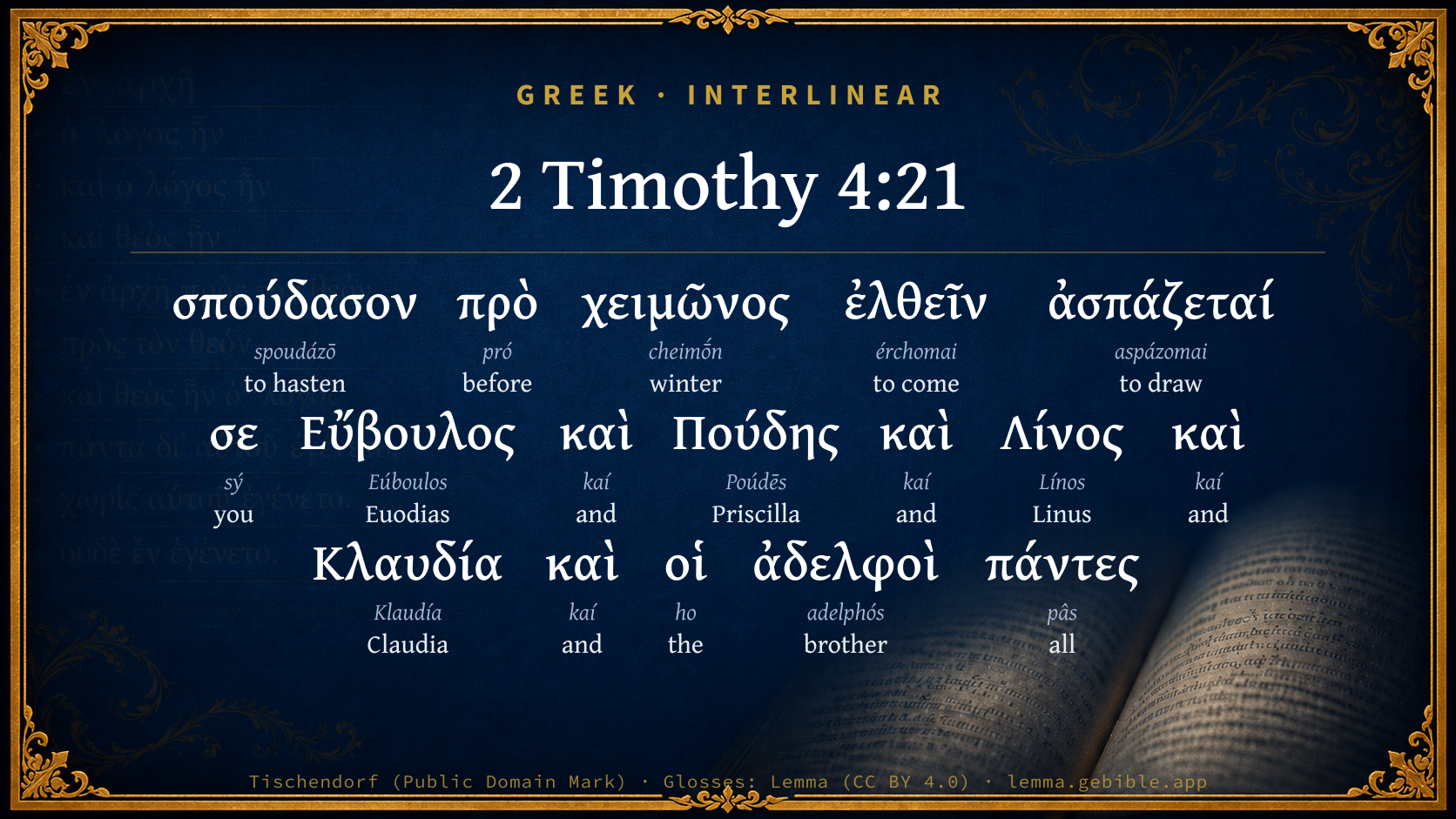
Greek (Tischendorf 8th ed.) 2 Timothy 4:21 appears in the Greek New Testament. The text above is from the Tischendorf 8th edition. Each word links to its Strong’s number and a concise gloss. Click any word for its full Thayer’s Greek Lexicon entry.
Download image
Cite this verse

2 Timothy 4:21 (World English Bible). Public Domain. Lemma interlinear Bible study tool, https://lemma.gebible.app/v/2-timothy/4/21.

Show BibTeX & RIS
BibTeX
RIS
English Translation
Be diligent to come before winter. Eubulus salutes you, as do Pudens, Linus, Claudia, and all the brothers.
World English Bible · Public Domain
Highlights
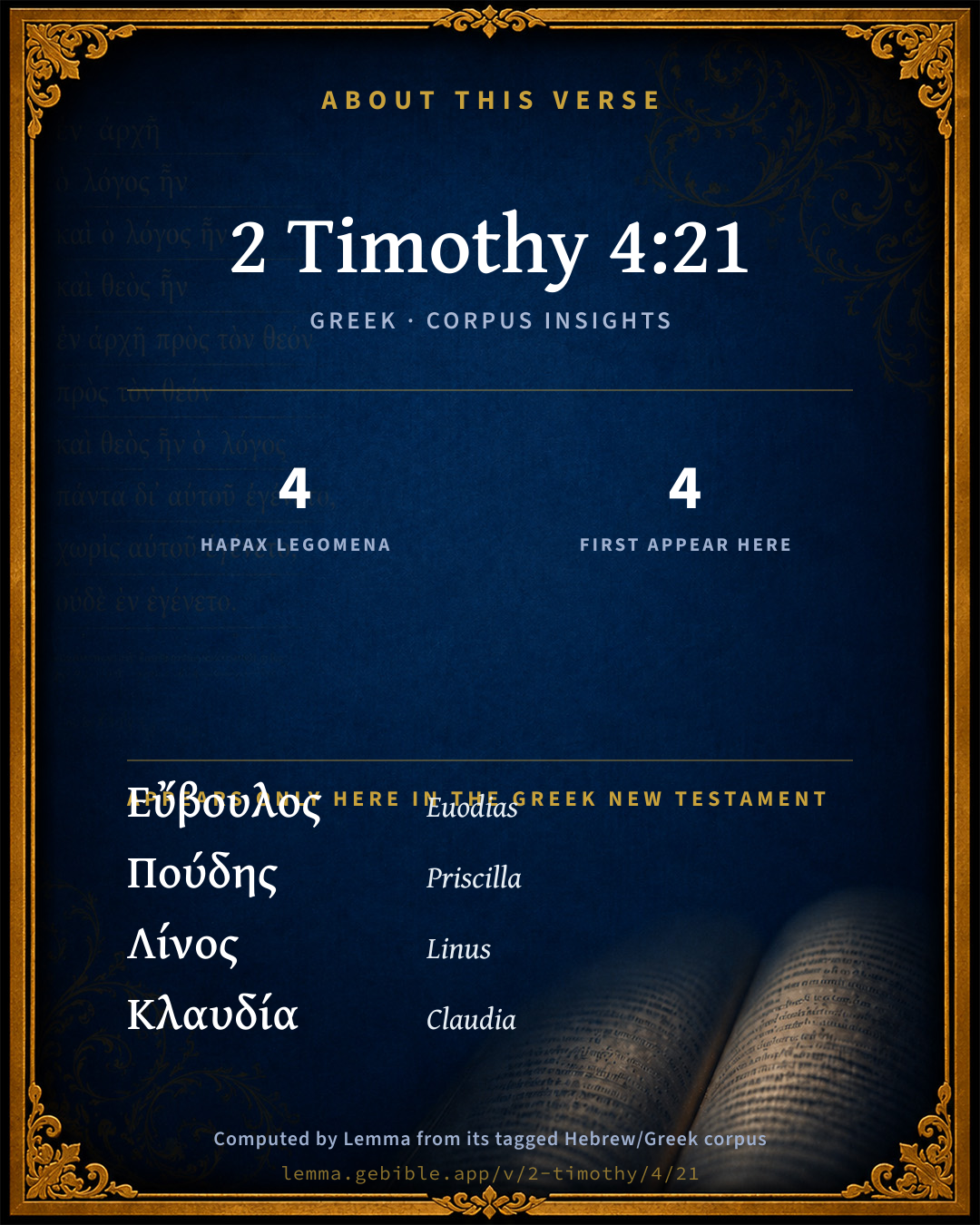
  • 4 hapax legomena — only here in the Greek New Testament
  • 4 first appearances in the Greek New Testament
Full analysis ↓
Download a study sheet

One document with this verse’s original text, its word-by-word gloss line, the meaning frame, cross-references with their text, attributed commentary, and full source and license credits — printable, and it pastes into notes with its structure intact.

This verse Autodidact and up

Study sheet (.html) Plain text (.txt)

A passage Seminary Student

Up to 50 verses in one chapter. A passage sheet keeps up to 6 commentary sources and 12 cross-references per verse, in the order this page ranks them, and says so on the sheet whenever that leaves anything out. Ask for a single verse and you get the Autodidact verse sheet above.

Everything on this page stays free to read, with no account — the sheet is a download of what is already on screen, not access to it.

Want to remove ads? Support Godless Engineer
Compare translations 3

The same verse in 3 English versions, stacked beneath the original-language interlinear above. Click any original word for its lexicon entry.

Each is an independent rendering of the whole verse — the interlinear is not word-aligned to these translations.

Highlighted words mark where these versions differ — a whole-verse word diff, not a word-by-word alignment.

  • World English Bible Public Domain
    Be diligent to come before winter. Eubulus salutes you, as do Pudens, Linus, Claudia, and all the brothers.
  • King James Version Public Domain
    Do thy diligence to come before winter. Eubulus greeteth thee, and Pudens, and Linus, and Claudia, and all the brethren.
  • unfoldingWord Literal Text CC BY-SA 4.0
    Strive to come before winter. Eubulus greets you, and Pudens and Linus and Claudia and the brothers.

unfoldingWord Literal Text — © unfoldingWord, licensed CC BY-SA 4.0. Word-aligned USFM3 via Door43 (git.door43.org/unfoldingWord/en_ult).

Versions to compare (up to 4)

3 of 4 selected

Show all 19 translations

Every available English version of this verse, each an independent rendering of the whole verse.

  • World English Bible Public Domain
    Be diligent to come before winter. Eubulus salutes you, as do Pudens, Linus, Claudia, and all the brothers.
  • Berean Standard Bible Public Domain
    Make every effort to come to me before winter. Eubulus sends you greetings, as do Pudens, Linus, Claudia, and all the brothers.
  • Majority Standard Bible Public Domain
    Make every effort to come to me before winter. Eubulus sends you greetings, as do Pudens, Linus, Claudia, and all the brothers.
  • King James Version Public Domain
    Do thy diligence to come before winter. Eubulus greeteth thee, and Pudens, and Linus, and Claudia, and all the brethren.
  • American Standard Version (1901) Public Domain
    Give diligence to come before winter. Eubulus saluteth thee, and Pudens, and Linus, and Claudia, and all the brethren.
  • Revised Version (1885) Public Domain
    Do thy diligence to come before winter. Eubulus saluteth thee, and Pudens, and Linus, and Claudia, and all the brethren.
  • Geneva Bible (1599) Public Domain
    Make speede to come before winter. Eubulus greeteth thee, and Pudens, and Linus, and Claudia, and all the brethren.
  • Douay-Rheims (1899) Public Domain
    Make haste to come before winter Eubulus and Pudens, and Linus and Claudia, and all the brethren, salute thee.
  • Young's Literal Translation Public Domain
    be diligent to come before winter. Salute thee doth Eubulus, and Pudens, and Linus, and Claudia, and all the brethren.
  • Literal Standard Version CC BY-SA 4.0
    be diligent to come before winter. Eubulus greets you, and Pudens, and Linus, and Claudia, and all the brothers.
  • Unlocked Literal Bible CC BY-SA 4.0
    Do your best to come before winter. Eubulus greets you, also Pudens, Linus, Claudia, and all the brothers.
  • unfoldingWord Literal Text CC BY-SA 4.0
    Strive to come before winter. Eubulus greets you, and Pudens and Linus and Claudia and the brothers.
  • Darby Bible Public Domain
    Use diligence to come before winter. Eubulus salutes thee, and Pudens, and Linus, and Claudia, and the brethren all.
  • World Messianic Bible Public Domain
    Be diligent to come before winter. Eubulus salutes you, as do Pudens, Linus, Claudia, and all the brothers.
  • Webster's Bible Public Domain
    Do thy diligence to come before winter. Eubulus greeteth thee, and Pudens, and Linus, and Claudia, and all the brethren.
  • Free Bible Version CC BY-SA 4.0
    Please try to come before winter. Eubulus sends his best wishes—and Pudens, Linus, Claudia, and all the brothers and sisters too.
  • Bible in Basic English Public Domain
    Do your best to come before the winter. Eubulus sends you his love, and Pudens and Linus and Claudia, and all the brothers.
  • Text-Critical English NT CC BY 4.0
    Make every effort to come before winter. Eubulus greets yoʋ, and so do Pudens, Linus, Claudia, and all the brothers.
  • Tyndale New Testament (1534) Public Domain
    Make spede to come before winter. Eubolus gretith the and Pudes and Linus and Claudia and all the brethren.

Literal Standard Version (2020), Covenant Press — licensed CC BY-SA 4.0. Text via the HelloAO Bible API (eBible.org). Unlocked Literal Bible (unfoldingWord) — licensed CC BY-SA 4.0. Text via the HelloAO Bible API (eBible.org). unfoldingWord Literal Text — © unfoldingWord, licensed CC BY-SA 4.0. Word-aligned USFM3 via Door43 (git.door43.org/unfoldingWord/en_ult). Free Bible Version, Dr. Jonathan Gallagher — licensed CC BY-SA 4.0. Text via the HelloAO Bible API (eBible.org).

Word by word

More ways to search: Search by grammar → Find every occurrence → Compare this word →

Practice this passage: Drill this verse → Learn its vocabulary →

Εὔβουλος
Eúboulos
G2103
“Euodias”
Noun, Nominative, Singular, Masculine
Part of Speech
Noun
Case
Nominative
Number
Singular
Gender
Masculine
Full Thayer's Definition

Origin: from G2095 and G1014

TDNT: None

Eubulus = "prudent" 1. a Christian at Rome
  1. σπούδασον spoudázō G4704 “to hasten” Verb, Aorist, Active, Imperative, 2nd person, Singular
  2. πρὸ pró G4253 “before” Preposition
  3. χειμῶνος cheimṓn G5494 “winter” Noun, Genitive, Singular, Masculine
  4. ἐλθεῖν érchomai G2064 “to come” Verb, Aorist, Active, Infinitive
  5. ἀσπάζεταί aspázomai G782 “to draw” Verb, Present, Middle or Passive deponent, Indicative, 3rd person, Singular
  6. σε sý G4771 “you” Personal pronoun, 2nd person, Accusative, Singular
  7. καὶ kaí G2532 “and” Conjunction
  8. Πούδης Poúdēs G4227 “Priscilla” Noun, Nominative, Singular, Masculine
  9. καὶ kaí G2532 “and” Conjunction
  10. Λίνος Línos G3044 “Linus” Noun, Nominative, Singular, Masculine
  11. καὶ kaí G2532 “and” Conjunction
  12. Κλαυδία Klaudía G2803 “Claudia” Noun, Nominative, Singular, Feminine
  13. καὶ kaí G2532 “and” Conjunction
  14. οἱ ho G3588 “the” Article, Nominative, Plural, Masculine
  15. ἀδελφοὶ adelphós G80 “brother” Noun, Nominative, Plural, Masculine
  16. πάντες pâs G3956 “all” Adjective, Nominative, Plural, Masculine

About this verse

These counts appear in no published source. They are computed here, from the morphology-tagged text and Lemma’s own curated glosses. What Lemma adds →

17
words
14
distinct lemmas
Pauline Epistles
section

Notable vocabulary

4 hapax legomena — words that appear only here in the entire Greek New Testament:

  • Εὔβουλος Euodias G2103
  • Πούδης Priscilla G4227
  • Λίνος Linus G3044
  • Κλαυδία Claudia G2803

First appearance in Scripture

These words make their first canonical appearance in the Greek New Testament here:

  • Εὔβουλος Euodias G2103
  • Πούδης Priscilla G4227
  • Λίνος Linus G3044
  • Κλαυδία Claudia G2803

Shared distinctive vocabulary

χειμῶνος winter G5494 occurs in 6 verses of the Greek New Testament. Also found in:

Repetition

A word recurs within this verse:

Cross-references

9

Topical passages linked to 2 Timothy 4:21 in the Treasury of Scripture Knowledge — connected by theme and wording, ordered by reader-vote popularity; previews shown in the World English Bible.

  • 2 Timothy 4:9 Be diligent to come to me soon,
  • Philippians 4:22 All the saints greet you, especially those who are of Caesar's household.
  • Romans 16:21–23 Timothy, my fellow worker, greets you, as do Lucius, Jason, and Sosipater, my relatives.
  • 1 Corinthians 16:20 All the brothers greet you. Greet one another with a holy kiss.
  • 2 Corinthians 13:13 All the saints greet you.
  • 2 Timothy 1:4 longing to see you, remembering your tears, that I may be filled with joy;
  • 2 Timothy 4:13 Bring the cloak that I left at Troas with Carpus when you come, and the books, especially the parchments.
  • 2 John 1:13 The children of your chosen sister greet you. Amen.
  • 3 John 1:14 but I hope to see you soon, and we will speak face to face. Peace be to you. The friends greet you. Greet the friends by name.

Cross-references courtesy of OpenBible.info (CC BY 4.0).

Commentary

Notes on 2 Timothy 4:21 from classic Christian and Jewish commentators (each source and its license shown beneath its notes). The classic Christian expositions comment on the surrounding passage and are grouped to its opening verse, so a note may address several verses; the Jewish commentaries on the Tanakh (Rashi and others) are per-verse, so they appear only where the commentator wrote on this verse.

Lemma curates 59 commentaries, every one of them public domain or Creative Commons licensed, each selected and text-cleaned for this edition rather than reprinted as found. About our sources →

The Cambridge Bible for Schools and Colleges

gen. ed. J. J. S. Perowne

21. before winter] ‘The motive (rather a motive) of the letter is the desire for Timothy’s presence, Haste! Come! 2Ti_4:9 “Haste to come quickly,” 2Ti_4:21 “Haste to come before winter,” 2Ti_4:13 “when thou comest,” 2Ti_1:4 “Yearning to see thee,” 2Ti_4:5 “my death is near at hand.” ’ Farrar, Message of the Books, p. 397.

Eubulus] Of him nothing is known.

Pudens … and Claudia] The identity of these two members of the Church at Rome with the Pudens and Claudia of Martial is discussed in Appendix, H.

Linus] According to general testimony bishop of Rome. Cf. Iren. iii. 3, § 3 ‘Peter and Paul, when they founded and built up the church of Rome, committed the office of its episcopate to Linus.’ Cf. also Euseb. H. E. iii. 2 ‘of the church of the Romans after the martyrdom of Paul and Peter the first to be appointed to the office of bishop was Linus, of whom Paul makes mention at the end of his letter to Timothy.’ Eusebius also gives the length of his episcopate as twelve years a.d. 68–80.

The Cambridge Bible for Schools and Colleges (gen. ed. J. J. S. Perowne; Cambridge University Press, 1878–1918) — public domain. Text from a community e-Sword module.

The Biblical Illustrator

Joseph S. Exell

2Ti_4:21

Come before winter.

Winter voyages

I. The voyage to the eternal city.

1. The departure.

2. The voyage.

3. The guidance of the helmsman.

4. The propulsion of all progress must come from the winds of heaven.

5. Industry on board the ship.

6. The shipping of the anchor.

7. The end of the journey.

II. The avoidance of winter risks. Put not off to old age, etc.

III. The adventure of diligence. Make haste. There is no time to lose. (S. H. Tyng, Jr. , D. D.)

Friendships

Of such friendships biography happily furnishes us with many examples:--Gray, the poet, and Mason; Cowper and Mrs. Unwin; Tennyson and Arthur Henry Hallam; Keats and Severn; Elizabeth Carter and Bishop Seeker; Mrs. Taft and Miss Marsh. This collocation of names reminds us of the old fallacy that true friendship can subsist only between individuals of similar character and disposition. Never was there a greater delusion! A mans friend is never his counterpart, but his complement; supplies that which is wanting in himself. And this is the use and value of friendship, it is like an offensive and defensive alliance between two equal powers, in which the one undertakes to furnish a military and the other a naval force, it provides for each party to the bond that which he or she most needs. (The Fireside.)

Eubulus and Pudens, and Ltuus, and Claudia. Eubulus is mentioned here only. It has been thought possible that Pudens may be the friend of the poet Martial, whose marriage with Claudia, a foreign lady, he celebrates in Epigram 8. lib. 4., supposing that other epigrams which are not favourable to the moral character of Pudens were written before his conversion. An inscription found at Colchester mentions a site given by one Pudens for a temple, built under the sanction of a British king, Claudius Cogidubrius; and it has been conjectured that this was the same Pudens who was a centurion in the army, and who may have married the daughter of Cogidubrius, whose name would consequently have been Claudia. The Claudia Rufina of Martial was a Briton, and may have received the name of Rufina from Pomponia, the wife of Aulus Ptantius, commander in Britain, who was connected with the Ruff family, and was accused of holding foreign superstitions. All this, however, is very uncertain. Linus is probably the same Roman Christian who became the first bishop of the Church there, according to Ignatius and Eusebius. (Bp. Jackson.)

The Biblical Illustrator, edited by Joseph S. Exell (c. 1880s–1900s) — public domain. Text from a community e-Sword module.

Tyndale Open Study Notes

Tyndale Open Resources

4:21 before winter: Paul was probably concerned there would be an extended delay if Timothy missed this chance to travel in the fall (see 1:4; 4:9). Winter closed travel across the Adriatic Sea from November to March (see Acts 27:12). Paul might also have been concerned to receive his coat (2 Tim 4:13) for the unheated prison. Eubulus is not mentioned elsewhere in the New Testament, but he was obviously well known to Timothy. • Pudens was a name used in upper class families. • Eusebius and Irenaeus later identified Linus as the first bishop of Rome. • Claudia is not mentioned elsewhere in the New Testament. • brothers and sisters: Greek adelphoi, a generic term that refers to members of the same family, both male and female.

Tyndale Open Study Notes — © Tyndale Open Resources, licensed CC BY-SA 4.0. Text via the HelloAO Bible API.

Bengel's Gnomon

Johann Albrecht Bengel

2Ti 4:21. Πρὸ χειμῶνος, before winter) In former times, during the actual winter, there was almost no sailing; and the martyrdom of Paul was at hand.—ἐλθεῖν, to come) He is invited by the mention of Eubulus, etc., who were with Paul, and were notwithstanding alive [therefore Timothy need not be afraid of his life in coming].—καὶ Λίνος, and Linus) He is put third in order; he was not yet a bishop.

Bengel's Gnomon of the New Testament — English translation (T&T Clark, Edinburgh, 1860) — public domain. Text from a community e-Sword module.

Meyer's Critical & Exegetical Commentary

Heinrich August Wilhelm Meyer

2Ti_4:21. Σπούδασον πρὸ χειμῶνος ἐλθεῖν] see 2Ti_4:9, ταχέως. Even if πρὸ χειμῶνος is to be connected with ταχέως, it does not follow that the epistle was written just before winter; comp. Introd. § 3. Χειμών may indeed mean the winter-storm (Wieseler), but it is more natural here to understand it of the season of the year (Wiesinger). Timothy is to come to the apostle before winter, that the winter might not prevent him from coming soon.

Finally, Paul sent greetings from Eubulus, Pudens, Linus, and Claudia, who are mentioned only here, and from all the Christians in Rome. These are named specially, not as the apostles σύνεργοι, but probably because they were personally acquainted with Timothy. Linus is probably the one whom the Fathers name as the first bishop of Rome.

Meyer — Critical and Exegetical Commentary on the New Testament — English translation by Peter Christie, edited by Frederick Crombie (T&T Clark, 1880) — public domain. Text from a community e-Sword module.

Expositor's Greek Testament

ed. W. Robertson Nicoll

2Ti 4:21 . πρὸ χειμῶνος : “That thou be not detained,” sc. by storm (Chrys.). This seems less urgent than ταχέως of 2Ti 4:9 , and we may infer that St. Paul did not expect his final trial to take place for some months.

Εὔβουλος : Nothing else is known of this good man.

Πούδης καὶ Λίνος καὶ Κλαυδία : Light-foot ( Apostolic Fathers , part i. vol. i. pp. 76 79) has an exhaustive discussion of the various ingenious theories which, starting with the assumption that Pudens and Claudia were man and wife a supposition opposed by the order of the names have identified them with (1) Martial’s congenial friend Aulus Pudens, to whom the poet casually “imputes the foulest vices of heathenism,” and his bride Claudia Rufina, a girl of British race ( Epigr . iv. 13, xi. 53), (2) “a doubtful Pudens and imaginary Claudia” who have been evolved out of a fragmentary inscription found at Chichester in 1722. This appears to record the erection of a temple by a Pudens with the sanction of Claudius Cogidubnus, who is probably a British king who might have had a daughter, whom he might have named Claudia, and who might have taken the name Rufina from Pomponia, the wife of Aulus Plautius, the Roman commander in Britain. This last supposition would identify (1) and (2). It should be added that in Const. Apost . vii. 46 she is mother of Linus. See also arts. Claudia and Pudens in Hastings’ D. B .

Linus is identified by Irenæus with the Linus whom SS. Peter and Paul consecrated first Bishop of Rome ( Haer . iii. 3). See also art. in Hastings’ D. B .

The Expositor's Greek Testament, edited by W. Robertson Nicoll (1897–1910) — public domain. Text from a community e-Sword module.

Jamieson, Fausset & Brown

Robert Jamieson, A. R. Fausset & David Brown

before winter--when a voyage, according to ancient usages of navigation, would be out of the question: also, Paul would need his "cloak" against the winter (Ti2 4:13).

Pudens . . . Claudia--afterwards husband and wife (according to MARTIAL [Epigrams, 4.13; 11.54]), he a Roman knight, she a Briton, surnamed Rufina. TACITUS [On Agriculture, 14], mentions that territories in southeast Britain were given to a British king; Cogidunus, in reward for his fidelity to Rome, A.D. 52, while Claudius was emperor. In 1772 a marble was dug up at Chichester, mentioning Cogidunus with the surname Claudius, added from his patron, the emperor's name; and Pudens in connection with Cogidunus, doubtless his father-in-law. His daughter would be Claudia, who seems to have been sent to Rome for education, as a pledge of the father's fidelity. Here she was under the protection of Pomponia, wife of Aulus Plautius, conqueror of Britain. Pomponia was accused of foreign superstitions, A.D. 57 [TACITUS, Annals, 3.32], probably Christianity. She probably was the instrument of converting Claudia, who took the name Rufina from her, that being a cognomen of the Pomponian gens (compare Rom 16:13, Rufus, a Christian). Pudens in MARTIAL and in the Chichester inscription, appears as a pagan; but perhaps he or his friends concealed his Christianity through fear. Tradition represents Timothy, a son of Pudens, as taking part in converting the Britons.

Linus--put third; therefore not at this time yet, as he was afterwards, bishop. His name being here inserted between Pudens and Claudia, implies the two were not yet married. "Eubulus" is identified by some with Aristobulus, who, with his converts, is said to have been among the first evangelists of Britain. Paul himself, says CLEMENT, "visited the farthest west [perhaps Britain, certainly Spain], and was martyred under the rulers at Rome," who were Nero's vicegerents in his absence from the city.

Jamieson, Fausset & Brown — Commentary Critical and Explanatory on the Whole Bible (1871) — public domain (CC PDM 1.0). Text via the HelloAO Bible API.

Adam Clarke's Commentary

Verse 21. Come before winter.]

1. Because the apostle's time was short and uncertain.

2. Because sailing in those seas was very dangerous in winter. Whether Timothy saw the apostle before he was martyred is not known.

Eubulus] This person is nowhere else mentioned in the New Testament.

Pudens] Of this person we have traditions and legends, but nothing certain. The Catholics make him bishop of Rome.

Linus] He also is made, by the same persons, bishop of Rome; but there is no sufficient ground for these pretensions.

Claudia] Supposed to be the wife of Pudens. Some think she was a British lady, converted by St. Paul; and that she was the first that brought the Gospel to Britain.

All the brethren.] All the Christians, of whom there were many at Rome; though of Paul's companions in travel, only Luke remained there.

Adam Clarke's Commentary on the Bible (1810–1826) — public domain. Text from a community e-Sword/MySword module.

Ellicott's Commentary for English Readers

(21) Do thy diligence to come before winter. Probably this was added to hasten his coming. If he delayed, the season of the year would put off, perhaps hinder altogether, his voyage.

Eubulus greeteth thee.—Of this Eubulus nothing is known.

And Pudens, and Linus, and Claudia.—Of these, Linus was, no doubt, the first of the long line of Bishops of Rome. The date of his consecration corresponds with the year of St. Paul’s martyrdom, A.D. 66. We know, from this greeting, he was one of the few “faithful” to his old master.

It is, perhaps, fair to assume, though of course there is no certainty of this, that the consecration of Linus to the government of the Roman Church as its first Bishop was one of the dying acts done by the Apostle Paul.

Some commentators identify the other two with “Pudens and Claudia” mentioned by Martial (Epigrams, iv. 13; xi. 54). Pudens was the son of a Roman senator; to Claudia, Martial gives the name of Rufina, and states she was a Briton. The dates of the Epigrams in question would agree with the identification. It is, however, only a supposition.

A Bible Commentary for English Readers, edited by Charles John Ellicott (1878–1897) — public domain. Text from a community e-Sword module.

Trapp's Complete Commentary

John Trapp

21 Do thy diligence to come before winter. Eubulus greeteth thee, and Pudens, and Linus, and Claudia, and all the brethren.

Ver. 21. Do thy diligence, &c.] The apostle quickeneth Timothy, as Cicero did his friend, Quamobrem si me amas, &c., si dormis expergiscere, si stas ingredere, si ingrederis curre, si curris advola. Credibile non est quantum ego in amore et fide tua ponam. Make all possible haste hither, for I rely much upon thy love and loyalty.

And Claudia] An English (or rather British) woman, who went to Rome, was converted by Paul, married a Roman gentleman called Pudens (as here) for his parts, but before called Rufus. It is thought she sent the gospel first into England. (See Antiq. Britan., Camden in Britan., Matth. Parker, Bale, Godwin’s Catalogue, Speed’s Chron., &c.) This is no article of our faith.

John Trapp, A Commentary or Exposition upon All the Books of the Old and New Testament (1647–1656) — public domain. Text from a community e-Sword module.

Albert Barnes' Notes on the Bible

Do thy diligence; - 2Ti 4:9.

To come before winter - Probably because of the dangers of the navigation then, and because the circumstances of the apostle were such as to demand the presence of a friend.

Eubulus, ... - These names are of common occurrence in the works of the classic writers, but of the persons here referred to we know nothing.

Albert Barnes' Notes on the Bible (1834–1885) — public domain. Text from a community e-Sword/MySword module.

Matthew Poole's English Annotations

Do thy diligence to come before winter; that is, to come to Rome to me before winter, either because sailing in the winter time would be more dangerous, or because in the winter time he might have more need of assistance.

Eubulus greeteth thee, and Pudens, and Linus, and Claudia, and all the brethren; we have no further account of these persons in holy writ; the first is a Greek name, the rest Latin, Claudia is a woman’s name. Paul sends the respects of these persons, and all the other Christians that at that time were in Rome to Timothy.

Matthew Poole's English Annotations on the Holy Bible (1683–1685) — public domain. Text from a community e-Sword/MySword module.

Whedon's Commentary on the Bible

Daniel D. Whedon

21. Before winter—When the ancient vessels were mostly laid up, and voyage across sea impossible. Such a delay might postpone Timothy’s coming until after Paul’s martyrdom.

Eubulus—Nowhere else mentioned.

Pudens… and Claudia—An epigram of the Roman poet, Martial, written not long after this time, celebrates the marriage of Pudens and Claudia. English scholars have found proofs that Martial’s Claudia was daughter of a British prince, and was a Christian lady at Rome. Hence a plausible and pleasing theory identifies Paul’s Pudens and Claudia with Martial’s. See Alford’s Prolegomena, and Conybeare and Howson, vol. ii, pp. 500-502.

Linus—Irenaeus says: “The apostles… conferred upon Linus the office of the episcopate [at Rome.] Of this Linus Paul makes mention in his epistles to Timothy.”

All the brethren—From which it appears that the Church had not been wholly scattered by persecution. And this was destined soon to become “the Church of the Catacombs.”

Daniel D. Whedon (gen. ed.), Commentary on the Old and New Testaments (1874–1909) — public domain. Text from a community e-Sword module.

The Pulpit Commentary

Saluteth for greeteth, A.V Do thy diligence (spoudason); see ver. 9 and 2Ti_2:15, note. Before winter; lest, when winter storms come, it be impossible to do so. St. Paul"s longing to have Timothy with him is apparent throughout. Eubulus; mentioned nowhere else. The name is not uncommon as a Greek name, and appears also in the patronymic Eubulides, and the female name Eubule. And Pudens, and Linus, and Claudia. Of these persons Linus is probably the same as is mentioned by Irenaeus and Eusebius as the first Bishop of Rome. Irenaeus (3:111, 3) says, "When the apostles, therefore, had founded the Church (of Rome) they entrusted the office (leitourgian) of the episcopate to Linus, of whom Paul makes mention in his Epistles to Timothy." Eusebius ("Ecc. Hist.," 3:2) says, "Linus was ordained the first Bishop of Rome (prwtov klhroutai thn) after the martyrdom of Paul and Peter" (see, too, of the same book). Some identify him with a certain Llin in Welsh hagiography, said to be the son of Caractacus. As regards Pudens and Claudia, nothing is known about them unless the very ingenious and interesting theory of Archdeacon Williams is true, which is necessarily very uncertain. According to this theory, Claudia is the foreign lady, a Briton, whose marriage with Pudens is spoken of by Martial in two epigrams, and who also bore the cognomen of Rufina. It is supposed that she was the daughter of the British king Cogidubnus, the ally of the Romans and of the Roman governor, Aulus Plautius, whose wife Pomponia is said by Tacitus to have been impeached of the crime of embracing a "foreign superstition," which was probably Christianity. Cogidubnus appears by an ancient inscription now at Goodwood to have taken the name of the Emperor Claudius, being called Tiberius Claudius Cogidubnus, which would naturally lead to his daughter being called Claudia. And if further she was adopted by the wife of her father"s ally, the name Rufina would be accounted for, as a distinguished branch of the gens Pomponia bore the name of Rufus. And Martial"s epigram is addressed to "Rufus," as one interested in the marriage. Claudia may either have learnt Christianity from Pomponia, or may have conveyed the knowledge of the gospel to her. On the other hand, the name of Pudens appears on the Goodwood inscription as having given, while still a heathen, a site for a temple of Neptune and Minerva, which was built "pro salute" of the imperial family under the authority of King Cogidubnus curiously connecting him with the British king. It is probable that Pudens and Claudia were not yet married. Thus it will be seen that, while this theory is borne out by many coincidences, it cannot by any means be adopted as certain (see Dean Alford"s excussus in the "Proleg. to 2 Timothy;" and Conybeare and Howson"s "Life of St. Paul," vol. it. p. 501). Lewin ("Life and Epist. of St. Paul," vol. 2, p. 392) warmly espouses the theory, but hesitates between Caractacus and Cogidubnus as the father of Claudia. Farrar rejects the whole theory "as an elaborate rope of sand" ("Life of St. Paul," vol. 2, p. 569). If Linus was the son, and Claudia the daughter, of Caractacus, they would be brother and sister.

Timothy"s presence desired.

thy diligence to come before winter." Travelling would be difficult then, if not impossible, and perhaps the white snow would be the shroud of the apostle. Anyway, he has been delivered once for a brief space out of the mouth of that lion Nero. But it is not easy to believe that this ferocious lion, satiated for the time with blood, should seek to devour him no more. But a Roman prison in winter is a very desolate place, and he who has been hurried from place to place by his keepers has left even his warm cloke behind him, and hopes to cover himself with that black goat"s-hair skin when winter comes. Bring the cloke, Timothy, and the papyrus books old vellum manuscripts, perhaps the roll of Isaiah and the prophets; let not Timothy forget them, for there are songs of prisoners in those inspired prophetic rolls. And let Timothy remember that St. Paul wants to see his face again.

I HERE IS ABSENCE OF MURMURING. We may and ought to learn what the gospel can achieve. Here is Paul prevented from preaching, with arrest laid on all his missionary work. In a dreary Roman dungeon he is "persecuted, but not forsaken;" "struck down, but not destroyed." Yet mark this he never suffered one murmuring word to pass his lips.

II HERE IS PRESENCE OF GREETING. He would cheer Timothy, and sends him various greetings, from the Roman saints, as we may see by their names Eubulus, Pudens, Linus, and Claudia, and all the brethren send greeting. What sublime self-abnegation there was in St. Paul! Forgetful always of himself! How like the Master! In the hour of expected dissolution he is thinking only of others. W.M.S.

The Pulpit Commentary (1880–1919), ed. H.D.M. Spence-Jones & Joseph S. Exell — public domain. Text from a community e-Sword module.

Fairbairn on Ezekiel, Jonah & the Pastoral Epistles

Patrick Fairbairn

Ver. 21. Do thy endeavour to come before winter—that is, while still the sea was open for navigation, according to the usages of the time; at the approach of winter, vessels were for the most part laid up till the return of spring (Act 27:9-10). Ex die tertio Iduum Novembris, usque in diem sextum Iduum Martiarum, Maria clauduntur, is a passage quoted by Mr. Smith, from Vegetius, in his Voyage and Shipwreck of St. Paul, p. 45. He has others to the same effect. So that, if Timothy did not reach Rome before winter, his visit would in all probability have to be postponed till the following year; and by that time the apostle should very possibly have finished his course. Eubulus saluteth thee, and Pudens, and Linus, and Claudia, and all the brethren. The names mentioned here occur nowhere else in New Testament Scripture. Tradition in one form connects with this Linus the first presidency of the church of Rome after the apostles, while another tradition assigns that honour to Clemens. The Pudens and Claudia here associated have been supposed to be the same mentioned as man and wife in an Epigram of Martial, 4:13, comp. with 11:34; and much learned labour has been employed of late to make out the identity. An outline of the discussion may be found in Alford’s Prolog, to this epistle—Appendix; also in Conybeare and Howson, vol. ii. pp. 500-2. But the story is woven together by so many slender threads, and has to be eked out by such a variety of hypothetical, sometimes not very probable conjectures, that I confess, with Ellicott, the identification appears to me “very doubtful.”

Patrick Fairbairn — An Exposition of Ezekiel (1851), Jonah (1849), and The Pastoral Epistles (1874) — public domain. Text from a community e-Sword module.

Burkitt's Expository Notes on the New Testament

William Burkitt

Our apostle being greatly desirous to see Timothy before his death, reneweth his request and suit to him to make haste and come before winter: the personal presence of good men is much, very much desired by them, in order to excite and quicken each other.

To encourage Timothy to hasten to him, he names several persons of note that were then at Rome, who sent salutations to him, and would rejoice to see him.

But where were all these, when our apostle was upon his trial?

Ans. They all forsook him, and not one of them stood with him.

Behold what frailty there may be! and what fear will do, in persons of choice note for eminency and grace in the church of God!

William Burkitt's Expository Notes on the New Testament (1700–1703) — public domain. Text from a community e-Sword module.

The People's New Testament

B. W. Johnson

21. Come before winter. He could not come in the winter because navigation was suspended. Eubulus. Not before mentioned. It is probable that all these were Roman brethren. Prudens. He is thought to have been a Roman senator, from data secured outside the New Testament. Linus. A Linus appears as a bishop of Rome not many years later. Claudia. It has been argued that this lady was the daughter of a British king, and the wife of Prudens. See Conybeare and Howson.

Shortly after this Epistle was written, within a few months at most, Paul had his second hearing, was sentenced to death by execution, was led out of the city at the Ostian Gate to a place called the Three Fountains, and there was beheaded. At least all early tradition, and the Fathers, among them Clement, one of his companions, support this view.

B. W. Johnson's The People's New Testament with Notes (1889–1891) — public domain. Electronic text from the Christian Classics Ethereal Library (CCEL) ThML edition.

Cambridge Greek Testament for Schools and Colleges

21. πάντες. א* 17 omit this word; and it is accordingly placed in brackets by WH.

21. σπούδασον πρὸ χειμῶνος ἐλθεῖν, do thy diligence to come before winter, when travelling would be difficult; cp. Mat 24:20. See 2Ti 4:9 above.

ἀσπάζεταί σε. The verb in the singular followed by the names of a number of individuals who send salutations is the construction adopted also at Rom 16:21; Rom 16:23.

Εὔβουλος. Of this person nothing further is known. The names which follow are those, seemingly, of prominent members of the Roman Church; they are not among Paul’s intimate friends, for of these ‘only Luke’ was with him (2Ti 4:10).

Πούδης καὶ Λίνος καὶ Κλαυδία. Linus is the only one of these three who can be identified with certainty. He was the first bishop of Rome after Apostolic days (Iren. Haer. III. 3), and governed the Roman Church, according to tradition, for twelve years after the death of St Peter and St Paul. He seems to be described in Apost. Const. VII. 46 as the son of Claudia (Λίνος ὁ Κλαυδίας), but it is probable that this is a mere guess resting on the juxtaposition of their names in this verse.

With the names of Pudens and Claudia modern ingenuity has been very busy. It has been assumed that they were husband and wife, and that they are identical with a dissolute friend of Martial called Aulus Pudens and a British maiden called Claudia Rufina, whose marriage is recorded in an epigram of Martial which appeared in A.D. 88 (Epigr. IV. 13). The chronological data are plainly inconsistent with this identification, and indeed the names Pudens and Claudia are sufficiently common to make such speculations highly uncertain. Another husband and wife with these names are recorded, e.g., in an inscription quoted by Lightfoot[528] (C.I.L. VI. 15066).

[528] Lightfoot’s Clement, 1, p. 79, where a fall discussion of the matter will be found.

Ingenuity has gone a step further. On an inscription discovered at Chichester it is recorded that one Pudens built a temple there to Neptune, with the sanction of the British king Claudius Cogidubnus, and it has been assumed that this Pudens was the Pudens mentioned by Martial, and that his wife Claudia was the daughter of Claudius Cogidubnus. Thus by a series of hypotheses, none of which is susceptible of proof, we reach a direct connexion between early British Christianity and the teaching of St Paul! It is sufficient to say that we know nothing for certain of the Pudens and Claudia mentioned in the verse before us, and that, inasmuch as the name of Linus is interposed between them, it is even improbable that they were husband and wife.

καὶ οἱ ἀδελφοὶ πάντες. See the crit. note, and cp. 1Co 16:20.

Cambridge Greek Testament for Schools and Colleges (Cambridge University Press, 1896; 21 vols, various authors incl. Carr, Maclear, Plummer, Farrar, Lumby, Moule, M. R. James, Simcox) — public domain. Text from a community e-Sword module.

International Critical Commentary

21. πρὸ χειμῶνος] as quickly as possible: before winter sets in which will make travelling dangerous for you, and when I shall specially need your presence—and (perhaps) the warm cloak.

These are members of the Roman Church, not companions of St. Paul, cf. 10, 11, and probably not of sufficient standing in the city to have appeared in court in support of him (cf. 16). Linus is probably the bishop of Rome (Iren. Hœr. iii. 3). Of Eubulus nothing is known. For an examination of the untrustworthy legends which have grown up round the names of Pudens and Claudia, cf. Lightfoot, Clement of Rome, i. pp. 76-79; Edmundson, The Church in Rome, note C.

International Critical Commentary — older volumes (1896–1929), various authors — public domain. Text from a community e-Sword module.

Vincent's Word Studies in the New Testament

Marvin R. Vincent

Eubulus, Pudens, Linus, Claudia. N. T. o.

Marvin R. Vincent, Word Studies in the New Testament (1887–1900) — public domain. Text from a community e-Sword/MySword module.

Lesson kit

Teaching starters — assembled from the data on this page, not authored interpretation. Every prompt links to the verse data it draws on. Edit before teaching.

2 Timothy, in the Pauline Epistles, opens this verse with 17 words (14 distinct Greek lemmas). Its most distinctive word is Eúboulos (“Euodias”). A historical commentator’s framing appears above. Read the whole chapter for the surrounding context.

Discussion questions

  1. The word Eúboulos carries the sense “Euodias.” How does it shape the verse?
  2. 4 words here appear nowhere else in the Greek New Testament. Why might the author reach for such rare wording?
  3. 4 words make their first appearance in Scripture here. What does this debut establish?
  4. How does Matthew 16:3, which shares the word «winter», read alongside this verse?
  5. What does the repetition of “and” (4× in this one verse) do in this verse?
  6. The translations on this page render this verse differently — a whole-verse word diff, not a word-by-word alignment. What might account for the different wordings?
  7. Compare how The Cambridge Bible for Schools and Colleges and The Biblical Illustrator read this verse. Where do they agree or differ?

Things to notice

  • 4 words in this verse appear nowhere else in the Greek New Testament.
  • 4 words make their first canonical appearance in Scripture here.
  • These translations choose different wording for 11 words in this verse.
  • “and” occurs 4× in this single verse.
  • 14 distinct Greek lemmas span 17 words in this verse.

Reading settings

Reading text

Shown beneath each verse's original-language words.

Old Testament
Old Testament edition

Read the OT as the Masoretic Hebrew (MT) or the Greek Septuagint (LXX).

English shown for the Greek Septuagint (in the Hebrew ↔ Greek comparison).

Comparing translations? Open the Compare panel on any verse page to stack up to four side by side.