Ezekiel 27:36

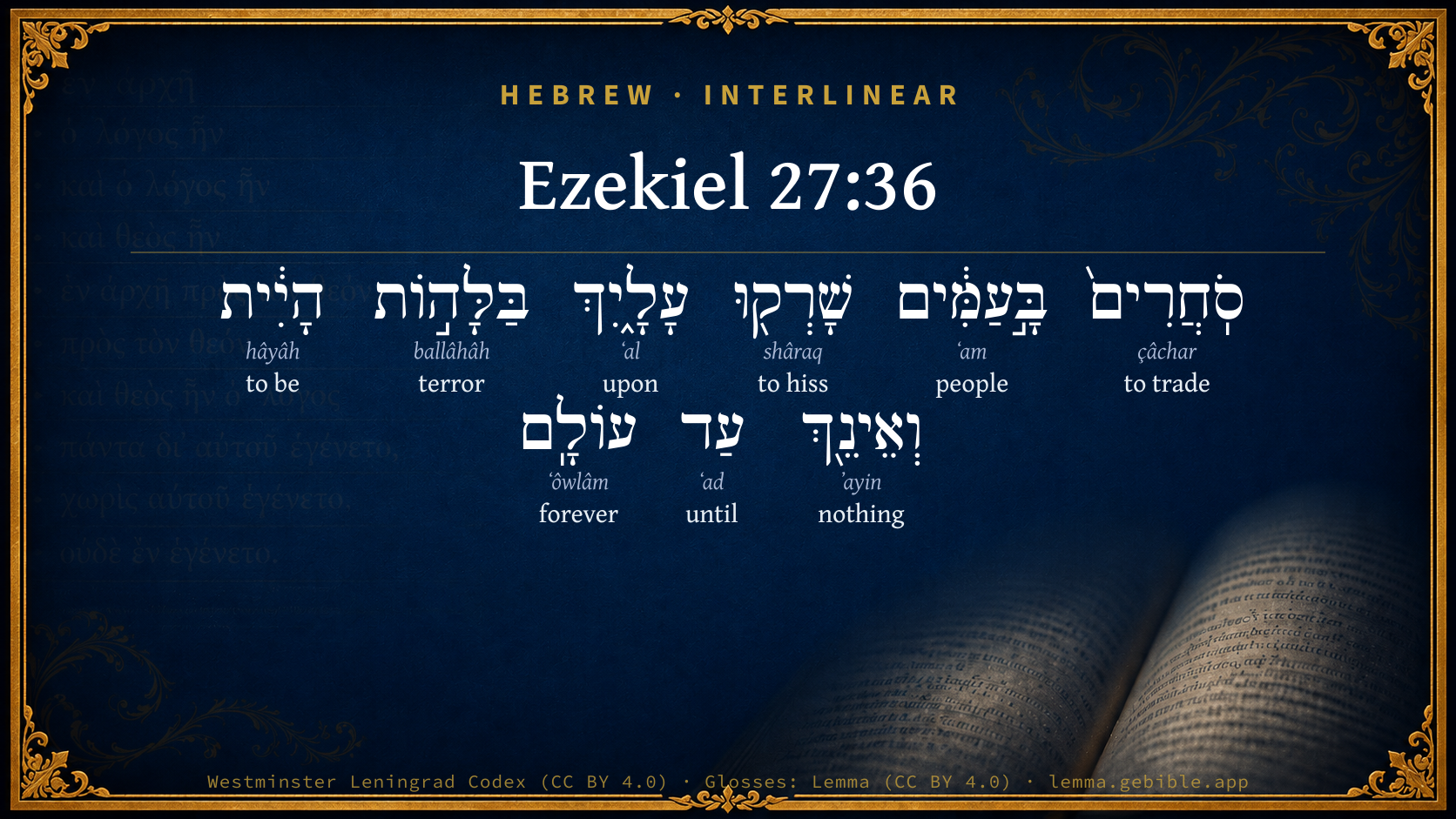
Hebrew (Westminster Leningrad Codex) Ezekiel 27:36 appears in the Hebrew Old Testament. The text above is from the Westminster Leningrad Codex. Each word links to its Strong’s number, a concise gloss, and parsing drawn from the Open Scriptures Hebrew Bible morphology. Click any word for its full Brown-Driver-Briggs (BDB) entry.
Download image
Cite this verse

Ezekiel 27:36 (World English Bible). Public Domain. Lemma interlinear Bible study tool, https://lemma.gebible.app/v/ezekiel/27/36.

Show BibTeX & RIS
BibTeX
RIS
English Translation
The merchants among the peoples hiss at you; you are become a terror, and you shall nevermore have any being.
World English Bible · Public Domain
Download a study sheet

One document with this verse’s original text, its word-by-word gloss line, the meaning frame, cross-references with their text, attributed commentary, and full source and license credits — printable, and it pastes into notes with its structure intact.

This verse Autodidact and up

Study sheet (.html) Plain text (.txt)

A passage Seminary Student

Up to 50 verses in one chapter. A passage sheet keeps up to 6 commentary sources and 12 cross-references per verse, in the order this page ranks them, and says so on the sheet whenever that leaves anything out. Ask for a single verse and you get the Autodidact verse sheet above.

Everything on this page stays free to read, with no account — the sheet is a download of what is already on screen, not access to it.

Want to remove ads? Support Godless Engineer
Compare translations 3

The same verse in 3 English versions, stacked beneath the original-language interlinear above. Click any original word for its lexicon entry.

Each is an independent rendering of the whole verse — the interlinear is not word-aligned to these translations.

Highlighted words mark where these versions differ — a whole-verse word diff, not a word-by-word alignment.

  • World English Bible Public Domain
    The merchants among the peoples hiss at you; you are become a terror, and you shall nevermore have any being.
  • King James Version Public Domain
    The merchants among the people shall hiss at thee; thou shalt be a terror, and never shalt be any more.
  • unfoldingWord Literal Text CC BY-SA 4.0
    The merchants of the people hiss at you; you have become a horror, and you will be no more forever.”

unfoldingWord Literal Text — © unfoldingWord, licensed CC BY-SA 4.0. Word-aligned USFM3 via Door43 (git.door43.org/unfoldingWord/en_ult).

Versions to compare (up to 4)

3 of 4 selected

Show all 18 translations

Every available English version of this verse, each an independent rendering of the whole verse.

  • World English Bible Public Domain
    The merchants among the peoples hiss at you; you are become a terror, and you shall nevermore have any being.
  • Berean Standard Bible Public Domain
    Those who trade among the nations hiss at you; you have come to a horrible end and will be no more.’”
  • Majority Standard Bible Public Domain
    Those who trade among the nations hiss at you; you have come to a horrible end and will be no more.’”
  • King James Version Public Domain
    The merchants among the people shall hiss at thee; thou shalt be a terror, and never shalt be any more.
  • American Standard Version (1901) Public Domain
    The merchants among the peoples hiss at thee; thou art become a terror, and thou shalt nevermore have any being.
  • Revised Version (1885) Public Domain
    The merchants among the peoples hiss at thee; thou art become a terror, and thou shalt never be any more.
  • Geneva Bible (1599) Public Domain
    The marchants among the people shall hisse at thee: thou shalt be a terrour, and neuer shalt be any more.
  • Douay-Rheims (1899) Public Domain
    The merchants of people have hissed at thee: thou art brought to nothing, and thou shalt never be any more.
  • Young's Literal Translation Public Domain
    Merchants among the peoples have shrieked for thee, Wastes thou hast been, and thou art not -- to the age!'
  • Literal Standard Version CC BY-SA 4.0
    Merchants among the peoples have shrieked for you, || You have been terrors, and you are not—for all time!”
  • Unlocked Literal Bible CC BY-SA 4.0
    The merchants of the people hiss at you; you have become a horror, and you will be no more forever.”
  • unfoldingWord Literal Text CC BY-SA 4.0
    The merchants of the people hiss at you; you have become a horror, and you will be no more forever.”
  • Darby Bible Public Domain
    The merchants among the peoples hiss at thee; thou art become a terror, and thou shalt never be any more.
  • World Messianic Bible Public Domain
    The merchants among the peoples hiss at you. You have come to a terrible end, and you will be no more.”’”
  • Webster's Bible Public Domain
    The merchants among the people shall hiss at thee; thou shalt be a terror, and never shalt be any more.
  • Free Bible Version CC BY-SA 4.0
    The traders of the nations hiss at you in derision; disaster has brought you down and you're finished forever.’”
  • Bible in Basic English Public Domain
    Those who do business among the peoples make sounds of surprise at you; you have become a thing of fear, you have come to an end for ever.
  • JPS Tanakh (1917) Public Domain
    The merchants among the peoples hiss at thee; thou art become a terror, and never shalt be any more.'

Literal Standard Version (2020), Covenant Press — licensed CC BY-SA 4.0. Text via the HelloAO Bible API (eBible.org). Unlocked Literal Bible (unfoldingWord) — licensed CC BY-SA 4.0. Text via the HelloAO Bible API (eBible.org). unfoldingWord Literal Text — © unfoldingWord, licensed CC BY-SA 4.0. Word-aligned USFM3 via Door43 (git.door43.org/unfoldingWord/en_ult). Free Bible Version, Dr. Jonathan Gallagher — licensed CC BY-SA 4.0. Text via the HelloAO Bible API (eBible.org).

Word by word

More ways to search: Search by grammar → Find every occurrence → Compare this word →

Practice this passage: Drill this verse → Learn its vocabulary →

About this verse

These counts appear in no published source. They are computed here, from the morphology-tagged text and Lemma’s own curated glosses. What Lemma adds →

9
words
9
distinct lemmas
Prophets
section

Notable vocabulary

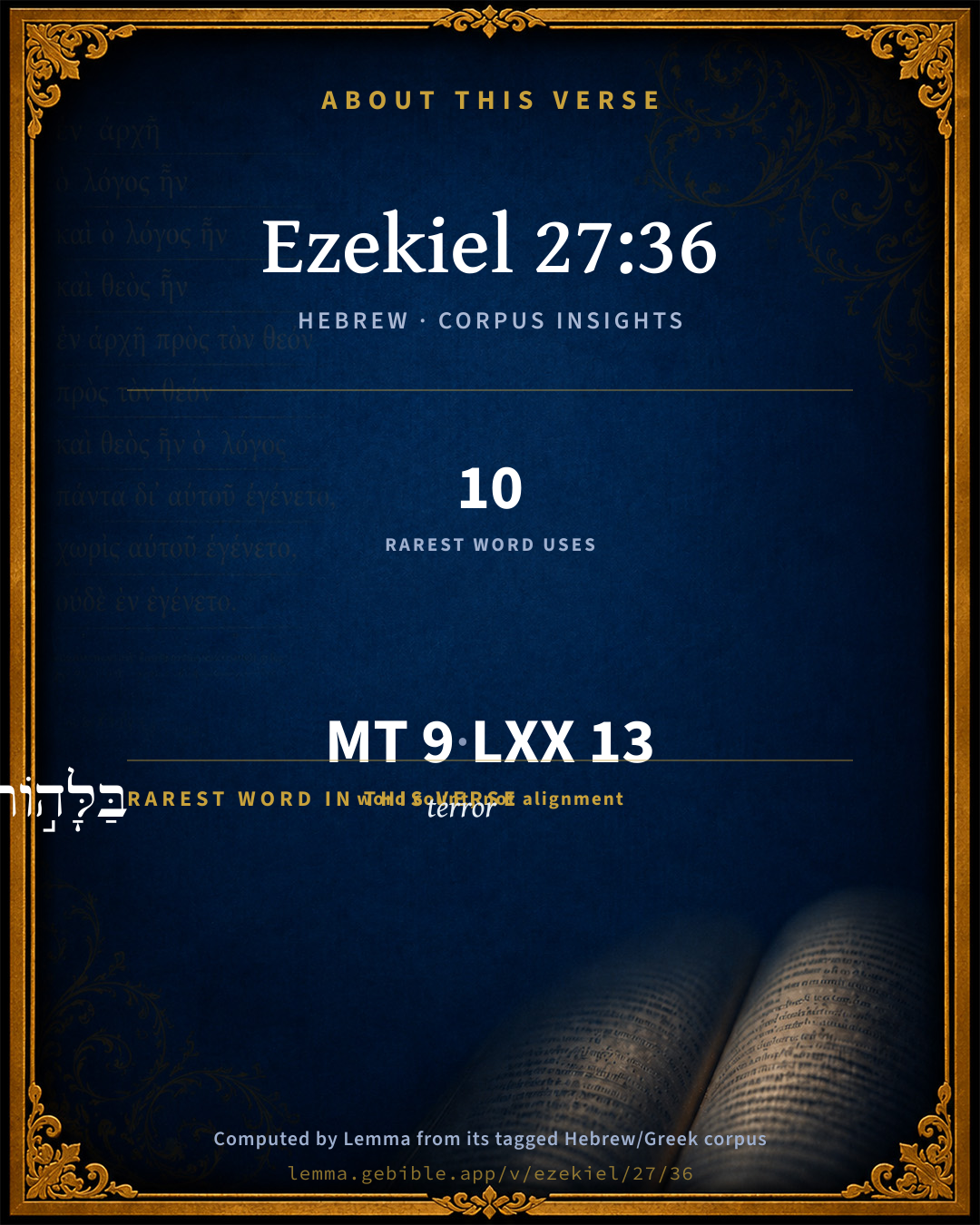
The rarest word here is בַּלָּה֣וֹת terror H1091 — appearing just 10 times in the whole Hebrew Bible.

Shared distinctive vocabulary

בַּלָּה֣וֹת terror H1091 occurs in 10 verses of the Hebrew Bible. Also found in:

Grammatical profile

  • 3 verbs
  • 3 nouns
  • 2 prepositions
  • 1 particle

Verb forms

  • סֹֽחֲרִים֙ Qal · Participle Active
  • שָׁרְק֖וּ Qal · Perfect
  • הָיִ֔ית Qal · Perfect

Hebrew & Septuagint length

In English translation the verse runs 20 words from the Hebrew and 20 from the Septuagint (LXX English) — the same length.

A rough comparison of the two English renderings, which tokenize alike — not a word-level alignment.

Word counts can differ between the Hebrew and the Greek without any difference in meaning — e.g. the Hebrew direct-object marker אֵת has no separate Greek word, and Greek often adds the article ὁ.

In the original languages it is 9 Hebrew tokens and 13 Greek tokens — but the two are counted differently (Hebrew bundles its prefixes and suffixes into one token; the Greek is in lemma form), so that isn’t a like-for-like length.

Cross-references

12

Topical passages linked to Ezekiel 27:36 in the Treasury of Scripture Knowledge — connected by theme and wording, ordered by reader-vote popularity; previews shown in the World English Bible.

  • Jeremiah 18:16 to make their land an astonishment, and a perpetual hissing; everyone who passes thereby shall be astonished, and shake his head.
  • Psalms 37:10 For yet a little while, and the wicked will be no more. Yes, though you look for his place, he isn't there.
  • Psalms 37:36 But he passed away, and, behold, he was not. Yes, I sought him, but he could not be found.
  • Jeremiah 19:8 I will make this city an astonishment, and a hissing; everyone who passes thereby shall be astonished and hiss because of all the plagues of it.
  • Ezekiel 26:21 I will make you a terror, and you shall no more have any being; though you are sought for, yet shall you never be found again, says the Lord Yahweh.
  • Zephaniah 2:15 This is the joyous city that lived carelessly, that said in her heart, "I am, and there is none besides me." How she has become a desolation, a place for animals to lie down in! Everyone who passes by her will hiss, and shake their fists.
  • 1 Kings 9:8 Though this house is so high, yet shall everyone who passes by it be astonished, and shall hiss; and they shall say, Why has Yahweh done thus to this land, and to this house?
  • Jeremiah 49:17 Edom shall become an astonishment: everyone who passes by it shall be astonished, and shall hiss at all the plagues of it.
  • Jeremiah 50:13 Because of the wrath of Yahweh she shall not be inhabited, but she shall be wholly desolate: everyone who goes by Babylon shall be astonished, and hiss at all her plagues.
  • Lamentations 2:15 All that pass by clap their hands at you; They hiss and wag their head at the daughter of Jerusalem, [saying], Is this the city that men called The perfection of beauty, The joy of the whole earth?
  • Ezekiel 26:2 Son of man, because Tyre has said against Jerusalem, Aha, she is broken: the gate of the peoples; she is turned to me; I shall be replenished, now that she is laid waste:
  • Ezekiel 26:14 I will make you a bare rock; you shall be a place for the spreading of nets; you shall be built no more: for I Yahweh have spoken it, says the Lord Yahweh.

Cross-references courtesy of OpenBible.info (CC BY 4.0).

Hebrew and Greek witnesses Masoretic Hebrew ↔ Greek Septuagint

The same verse in the two great witnesses to the Old Testament, shown verse-for-verse.

These are two independent witnesses, not word-aligned to each other, and the Septuagint is shown in lemma (dictionary) form.

Hebrew Ezekiel 27:36 Masoretic · Westminster Leningrad Codex

סֹֽחֲרִים֙ בָּ֣עַמִּ֔ים שָׁרְק֖וּ עָלָ֑יִךְ בַּלָּה֣וֹת הָיִ֔ית וְאֵינֵ֖ךְ עַד עוֹלָֽם

The merchants among the peoples hiss at you; you are become a terror, and you shall nevermore have any being.

World English Bible · Public Domain

Greek LXX Ezekiel 27:36 Septuagint · lemma form

ἔμπορος ἀπό ἔθνος συρίζω σύ ἀπώλεια γίγνομαι καί οὐκέτι εἰμί εἰς ὁ αἰών

Merchants from the nations have hissed at you; you are utterly destroyed, and shall not be any more for ever.

LXX2012 (modern English Septuagint) · Public Domain

Hebrew: Westminster Leningrad Codex (CC BY 4.0). Greek: Septuagint (public domain); English from LXX2012 (modern English Septuagint) (Public Domain). How the Septuagint differs from the Hebrew →

Targum (Aramaic paraphrase)

1

The Targum is the ancient Jewish Aramaic paraphrase of the Hebrew Scriptures — an interpretive translation, not the Hebrew text itself. Onkelos (literal) and Pseudo-Jonathan (expansive) render the Torah, and Jonathan the Prophets. Coverage is partial: where no permissively-licensed English translation exists for a verse, only the Aramaic is shown. This is verse-level text, not a word-by-word alignment to the Hebrew.

  1. Targum Jonathan Prophets (Joshua–Malachi)
    תַּגָרִין בְּעַמְמַיָא צְדִיאוּ עָלַיִךְ כִּדְלָא הֲוֵית אֶתְּנִינִיךְ וְכֵן תְּהֵין עַד עַלְמָא:

    (no public-domain English translation for this verse)

    Targum Jonathan — Aramaic: “Mikraot Gedolot” (public domain). English: “Sefaria Community Translation” (CC0 1.0 (public-domain dedication)); “London "Chaldee Paraphrase," 1871” (public domain). Text via Sefaria.

Commentary

Notes on Ezekiel 27:36 from classic Christian and Jewish commentators (each source and its license shown beneath its notes). The classic Christian expositions comment on the surrounding passage and are grouped to its opening verse, so a note may address several verses; the Jewish commentaries on the Tanakh (Rashi and others) are per-verse, so they appear only where the commentator wrote on this verse.

Lemma curates 59 commentaries, every one of them public domain or Creative Commons licensed, each selected and text-cleaned for this edition rather than reprinted as found. About our sources →

Trapp's Complete Commentary

John Trapp

Eze 27:36 The merchants among the people shall hiss at thee; thou shalt be a terror, and never [shalt be] any more.

Ver. 36. The merchants shall hiss at thee.] Either as astonied at thee, or rather as deriding thee, {a} like as he who seeth another fall into the dirt, first pitieth him and then jeereth him. See the like, Jer 19:8; Jer 49:17.

Thou shalt be a terror.] Because God hath hanged thee up in gibbets, as it were. Or thou wast a terror once, but now a scorn.

And never shalt be any more.] See on Eze 26:14.

{a} A Lapide.

John Trapp, A Commentary or Exposition upon All the Books of the Old and New Testament (1647–1656) — public domain. Text from a community e-Sword module.

Tyndale Open Study Notes

Tyndale Open Resources

27:36 Tyre’s former occupants and her former trading partners join the lament for her lost way of life. This panel, like the previous one, ends with the statement that Tyre has come to a horrible end and will exist no more (cp. 26:21).

Tyndale Open Study Notes — © Tyndale Open Resources, licensed CC BY-SA 4.0. Text via the HelloAO Bible API.

Geneva Bible (1599)

Geneva Bible translators

Whereby is meant a long time: for it was prophesied to be destroyed but seventy years, Isa. 23:15.

Geneva Bible (1599) marginal notes — public domain. Text via Bolls.life.

Jamieson, Fausset & Brown

Robert Jamieson, A. R. Fausset & David Brown

hiss--with astonishment; as in Kg1 9:8.

Next: Ezekiel Chapter 28

Jamieson, Fausset & Brown — Commentary Critical and Explanatory on the Whole Bible (1871) — public domain (CC PDM 1.0). Text via the HelloAO Bible API.

Adam Clarke's Commentary

Verse 36. Shall hiss at thee] שרקו shareku, shall shriek for thee. This powerfully expresses the sensation made on the feelings of the spectators on the shore when they saw the vessel swallowed up.

Adam Clarke's Commentary on the Bible (1810–1826) — public domain. Text from a community e-Sword/MySword module.

Ellicott's Commentary for English Readers

(36) Shall hiss at thee.—In Eze_27:35 the prophet again drops the figure of the ship, and looking forward (as in Eze_26:4-6; Eze_26:12-14) to the end, speaks of the final and utter overthrow which shall come upon Tyre. The word hiss is used, as in Isa_5:26; Isa_7:18; Zec_10:8, &c., in the sense of calling for. The prophet tells us that the people who have had commercial connection with Tyre shall call for her in vain; she shall be (not a terror, but, as in Eze_26:21) a sudden destruction, and shall not be for ever.

A Bible Commentary for English Readers, edited by Charles John Ellicott (1878–1897) — public domain. Text from a community e-Sword module.

The Cambridge Bible for Schools and Colleges

gen. ed. J. J. S. Perowne

36. among the people] peoples. “Hiss” here is hardly the expression of malicious joy, rather of astonishment and dismay, or other vivid emotion, 1Ki_9:8.

shalt be a terror] lit. terrors, i.e. destructions—thou shalt be utterly destroyed, cf. Eze_26:21.

The Cambridge Bible for Schools and Colleges (gen. ed. J. J. S. Perowne; Cambridge University Press, 1878–1918) — public domain. Text from a community e-Sword module.

Haydock's Catholic Bible Commentary

Hissed, through pity and astonishment. (Calmet)

George Leo Haydock (1774–1849), Haydock's Catholic Family Bible and Commentary, 1859 edition — public domain. Excludes Psalms (Douay-Rheims chapter numbering differs from Protestant) and Deuterocanonical books (Catholic canon only).

Matthew Poole's English Annotations

Hiss: this usually is an expression of scorn and contempt poured forth on the person hissed at; if thus understood, the meaning is, there should be some among Tyre’s customers that would rejoice at her fall, and flout at her, either perhaps wronged by her in their trade, Eze 28:16, or else with envy, and expectation of her trade to turn to them, return to her the wicked carriage she showed to Jerusalem fallen and sacked: if it be a sign of aught else, it is of wonder, as 1Ki 9:8.

A terror; matter of many fears, and to many people, who do or shall hear how terribly thine enemies have raged against thee and prevailed. Never shalt be any more: see Eze 26:14.

Matthew Poole's English Annotations on the Holy Bible (1683–1685) — public domain. Text from a community e-Sword/MySword module.

Whedon's Commentary on the Bible

Daniel D. Whedon

36. People — Literally, peoples.

Shall hiss — Toy translates are shocked.

Terror — Literally, terrors (Eze_26:21).

Daniel D. Whedon (gen. ed.), Commentary on the Old and New Testaments (1874–1909) — public domain. Text from a community e-Sword module.

John Wesley's Explanatory Notes

Shall hiss - Will mock at thy fall.

John Wesley, Explanatory Notes Upon the Whole Bible (1754–1765) — public domain. Text via the GEBible commentary corpus.

Rashi

Rabbi Shlomo Yitzchaki (Rashi)

hissed [Heb. שָּׁרְקוּ,] sibler in old French, to whistle. So do people whistle about a thing that has disappeared.

Rashi on the Tanakh — English translations: “The Judaica Press complete Tanach with Rashi, translated by A. J. Rosenberg” (CC BY 4.0); “Pentateuch with Rashi's commentary by M. Rosenbaum and A.M. Silbermann, 1929-1934” (public domain); “The Metsudah Tanach series, Lakewood, N.J” (CC BY 4.0); and “The Book of Joshua, Metsudah Publications, 1997” (CC BY 4.0). Text via Sefaria.

Lesson kit

Teaching starters — assembled from the data on this page, not authored interpretation. Every prompt links to the verse data it draws on. Edit before teaching.

Ezekiel, in the Prophets, opens this verse with 9 words (9 distinct Hebrew lemmas). Its most distinctive word is ballâhâh (“terror”). A historical commentator’s framing appears above. Read the whole chapter for the surrounding context.

Discussion questions

  1. The word ballâhâh carries the sense “terror.” How does it shape the verse?
  2. How does Job 18:11, which shares the word «terror», read alongside this verse?
  3. The translations on this page render this verse differently — a whole-verse word diff, not a word-by-word alignment. What might account for the different wordings?
  4. «סֹֽחֲרִים֙» is a Qal Participle Active verb. How does that grammatical form shape the action described?
  5. Compare how Trapp's Complete Commentary and Tyndale Open Study Notes read this verse. Where do they agree or differ?

Things to notice

Reading settings

Reading text

Shown beneath each verse's original-language words.

Old Testament
Old Testament edition

Read the OT as the Masoretic Hebrew (MT) or the Greek Septuagint (LXX).

English shown for the Greek Septuagint (in the Hebrew ↔ Greek comparison).

Comparing translations? Open the Compare panel on any verse page to stack up to four side by side.