
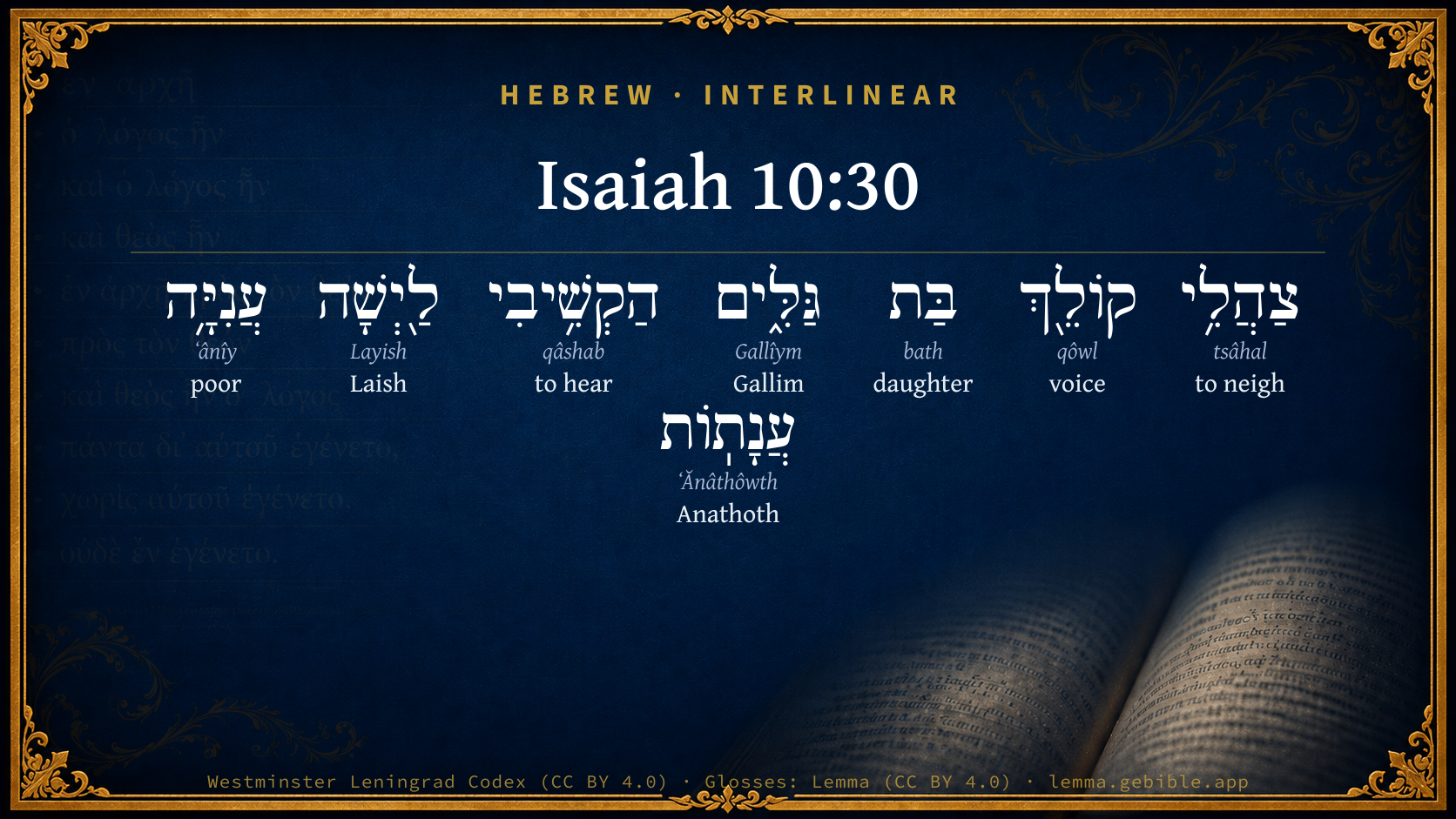
Isaiah 10:30

Hebrew (Westminster Leningrad Codex) Isaiah 10:30 appears in the Hebrew Old Testament. The text above is from the Westminster Leningrad Codex. Each word links to its Strong’s number, a concise gloss, and parsing drawn from the Open Scriptures Hebrew Bible morphology. Click any word for its full Brown-Driver-Briggs (BDB) entry.
Download image
Cite this verse

Isaiah 10:30 (World English Bible). Public Domain. Lemma interlinear Bible study tool, https://lemma.gebible.app/v/isaiah/10/30.

Show BibTeX & RIS
BibTeX
RIS
English Translation
Cry aloud with your voice, daughter of Gallim! listen, Laishah! You poor Anathoth!
World English Bible · Public Domain
Download a study sheet

One document with this verse’s original text, its word-by-word gloss line, the meaning frame, cross-references with their text, attributed commentary, and full source and license credits — printable, and it pastes into notes with its structure intact.

This verse Autodidact and up

Study sheet (.html) Plain text (.txt)

A passage Seminary Student

Up to 50 verses in one chapter. A passage sheet keeps up to 6 commentary sources and 12 cross-references per verse, in the order this page ranks them, and says so on the sheet whenever that leaves anything out. Ask for a single verse and you get the Autodidact verse sheet above.

Everything on this page stays free to read, with no account — the sheet is a download of what is already on screen, not access to it.

Want to remove ads? Support Godless Engineer
Compare translations 3

The same verse in 3 English versions, stacked beneath the original-language interlinear above. Click any original word for its lexicon entry.

Each is an independent rendering of the whole verse — the interlinear is not word-aligned to these translations.

Highlighted words mark where these versions differ — a whole-verse word diff, not a word-by-word alignment.

  • World English Bible Public Domain
    Cry aloud with your voice, daughter of Gallim! listen, Laishah! You poor Anathoth!
  • King James Version Public Domain
    Lift up thy voice, O daughter of Gallim: cause it to be heard unto Laish, O poor Anathoth.
  • unfoldingWord Literal Text CC BY-SA 4.0
    Cry out your voice, daughter of Gallim! Listen, Laishah! Poor Anathoth!

unfoldingWord Literal Text — © unfoldingWord, licensed CC BY-SA 4.0. Word-aligned USFM3 via Door43 (git.door43.org/unfoldingWord/en_ult).

Versions to compare (up to 4)

3 of 4 selected

Show all 18 translations

Every available English version of this verse, each an independent rendering of the whole verse.

  • World English Bible Public Domain
    Cry aloud with your voice, daughter of Gallim! listen, Laishah! You poor Anathoth!
  • Berean Standard Bible Public Domain
    Cry aloud, O Daughter of Gallim! Listen, O Laishah! O wretched Anathoth!
  • Majority Standard Bible Public Domain
    Cry aloud, O Daughter of Gallim! Listen, O Laishah! O wretched Anathoth!
  • King James Version Public Domain
    Lift up thy voice, O daughter of Gallim: cause it to be heard unto Laish, O poor Anathoth.
  • American Standard Version (1901) Public Domain
    Cry aloud with thy voice, O daughter of Gallim! hearken, O Laishah! O thou poor Anathoth!
  • Revised Version (1885) Public Domain
    Cry aloud with thy voice, O daughter of Gallim! hearken, O Laishah! O thou poor Anathoth!
  • Geneva Bible (1599) Public Domain
    Lift vp thy voyce, O daughter Gallim, cause Laish to heare, O poore Anathoth.
  • Douay-Rheims (1899) Public Domain
    Lift up thy voice, O daughter of Gallim, attend, O Laisa, poor Anathoth.
  • Young's Literal Translation Public Domain
    Cry aloud `with' thy voice, daughter of Gallim, Give attention, Laish! answer her, Anathoth.
  • Literal Standard Version CC BY-SA 4.0
    Cry aloud [with] your voice, daughter of Gallim, || Give attention, Laish! Answer her, Anathoth.
  • Unlocked Literal Bible CC BY-SA 4.0
    Cry aloud, daughter of Gallim! Give attention, Laishah! You poor Anathoth!
  • unfoldingWord Literal Text CC BY-SA 4.0
    Cry out your voice, daughter of Gallim! Listen, Laishah! Poor Anathoth!
  • Darby Bible Public Domain
    Lift up thy voice, daughter of Gallim! Hearken, O Laish! -- Poor Anathoth!
  • World Messianic Bible Public Domain
    Cry aloud with your voice, daughter of Gallim! Listen, Laishah! You poor Anathoth!
  • Webster's Bible Public Domain
    Lift up thy voice, O daughter of Gallim: cause it to be heard to Laish, O poor Anathoth.
  • Free Bible Version CC BY-SA 4.0
    Shout out a warning, people of Gallim! Pay attention, those living in Laishah! You poor people of Anathoth!
  • Bible in Basic English Public Domain
    Give a loud cry, daughter of Gallim; let Laishah give ear; let Anathoth give answer to her.
  • JPS Tanakh (1917) Public Domain
    Cry thou with a shrill voice, O daughter of Gallim! Hearken, O Laish! O thou poor Anathoth!

Literal Standard Version (2020), Covenant Press — licensed CC BY-SA 4.0. Text via the HelloAO Bible API (eBible.org). Unlocked Literal Bible (unfoldingWord) — licensed CC BY-SA 4.0. Text via the HelloAO Bible API (eBible.org). unfoldingWord Literal Text — © unfoldingWord, licensed CC BY-SA 4.0. Word-aligned USFM3 via Door43 (git.door43.org/unfoldingWord/en_ult). Free Bible Version, Dr. Jonathan Gallagher — licensed CC BY-SA 4.0. Text via the HelloAO Bible API (eBible.org).

Word by word

More ways to search: Search by grammar → Find every occurrence → Compare this word →

Practice this passage: Drill this verse → Learn its vocabulary →

About this verse

These counts appear in no published source. They are computed here, from the morphology-tagged text and Lemma’s own curated glosses. What Lemma adds →

8
words
8
distinct lemmas
Prophets
section

Notable vocabulary

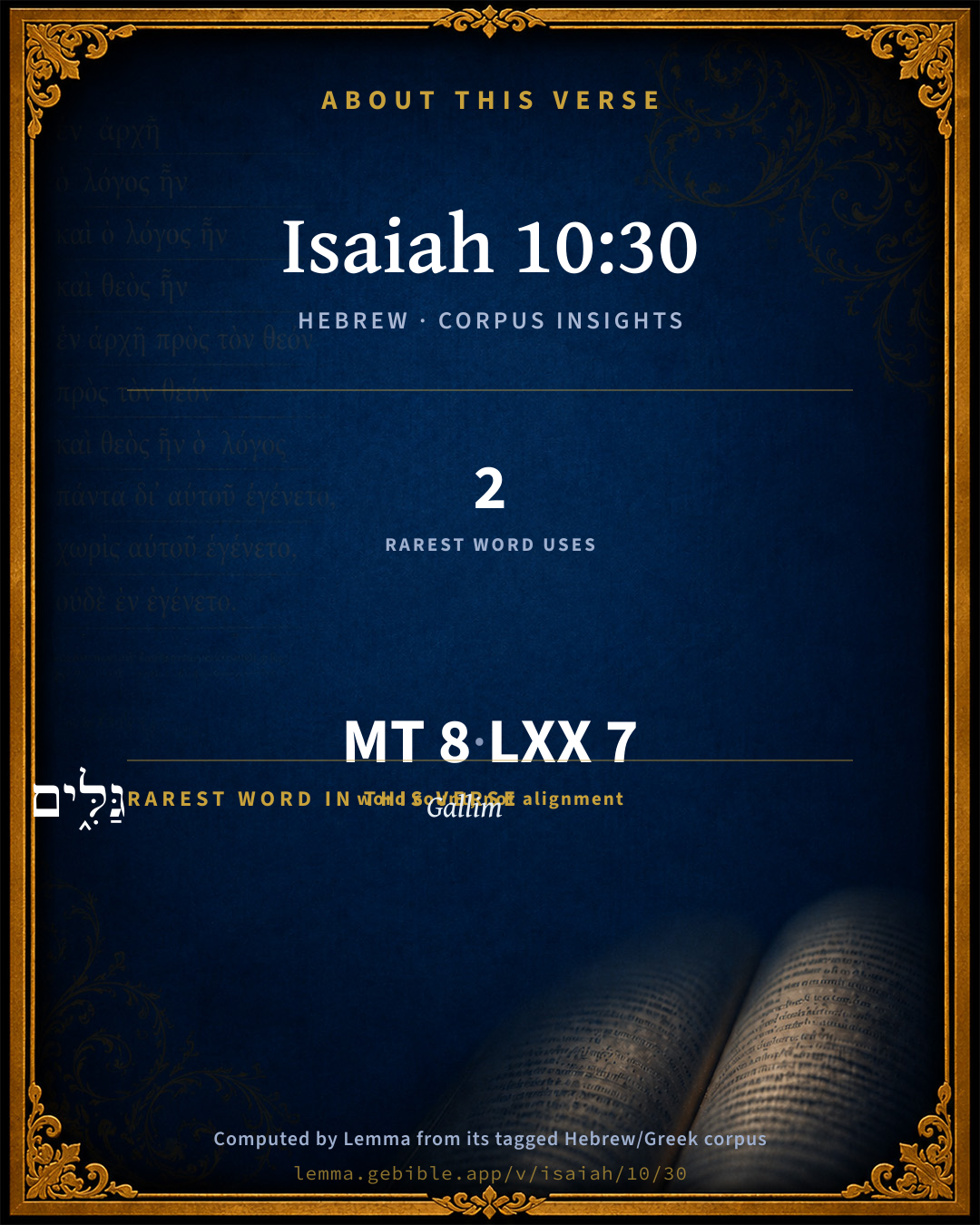
The rarest word here is גַּלִּ֑ים Gallim H1554 — appearing just 2 times in the whole Hebrew Bible.

Shared distinctive vocabulary

גַּלִּ֑ים Gallim H1554 occurs in 2 verses of the Hebrew Bible. Also found in:

Grammatical profile

  • 2 verbs
  • 5 nouns
  • 1 adjective

Verb forms

  • צַהֲלִ֥י Qal · Imperative
  • הַקְשִׁ֥יבִי Hiphil · Imperative

Hebrew & Septuagint length

In English translation the verse runs 13 words from the Hebrew and 14 from the Septuagint (LXX English) — closely comparable.

A rough comparison of the two English renderings, which tokenize alike — not a word-level alignment.

Word counts can differ between the Hebrew and the Greek without any difference in meaning — e.g. the Hebrew direct-object marker אֵת has no separate Greek word, and Greek often adds the article ὁ.

In the original languages it is 8 Hebrew tokens and 7 Greek tokens — but the two are counted differently (Hebrew bundles its prefixes and suffixes into one token; the Greek is in lemma form), so that isn’t a like-for-like length.

Cross-references

7

Topical passages linked to Isaiah 10:30 in the Treasury of Scripture Knowledge — connected by theme and wording, ordered by reader-vote popularity; previews shown in the World English Bible.

  • 1 Samuel 25:44 Now Saul had given Michal his daughter, David's wife, to Palti the son of Laish, who was of Gallim.
  • Jeremiah 1:1 The words of Jeremiah the son of Hilkiah, of the priests who were in Anathoth in the land of Benjamin:
  • Joshua 21:18 Anathoth with its suburbs, and Almon with its suburbs; four cities.
  • Judges 18:7 Then the five men departed, and came to Laish, and saw the people who were therein, how they lived in security, after the manner of the Sidonians, quiet and secure; for there was none in the land, possessing authority, that might put [them] to shame in anything, and they were far from the Sidonians, and had no dealings with any man.
  • Judges 18:29 They called the name of the city Dan, after the name of Dan their father, who was born to Israel: however the name of the city was Laish at the first.
  • 1 Kings 2:26 To Abiathar the priest said the king, Get you to Anathoth, to your own fields; for you are worthy of death: but I will not at this time put you to death, because you bear the ark of the Lord Yahweh before David my father, and because you were afflicted in all in which my father was afflicted.
  • Jeremiah 32:8 So Hanamel my uncle's son came to me in the court of the guard according to the word of Yahweh, and said to me, Please buy my field that is in Anathoth, which is in the land of Benjamin; for the right of inheritance is yours, and the redemption is yours; buy it for yourself. Then I knew that this was the word of Yahweh.

Cross-references courtesy of OpenBible.info (CC BY 4.0).

Hebrew and Greek witnesses Masoretic Hebrew ↔ Greek Septuagint

The same verse in the two great witnesses to the Old Testament, shown verse-for-verse.

These are two independent witnesses, not word-aligned to each other, and the Septuagint is shown in lemma (dictionary) form.

Hebrew Isaiah 10:30 Masoretic · Westminster Leningrad Codex

צַהֲלִ֥י קוֹלֵ֖ךְ בַּת גַּלִּ֑ים הַקְשִׁ֥יבִי לַ֖יְשָׁה עֲנִיָּ֥ה עֲנָתֽוֹת

Cry aloud with your voice, daughter of Gallim! listen, Laishah! You poor Anathoth!

World English Bible · Public Domain

Greek LXX Isaiah 10:30 Septuagint · lemma form

ὁ θυγάτηρ γαλλιμ ἐπιἀκούω λαισα ἐπιἀκούω αναθωθ

The daughter of Gallim shall flee; Laisa shall hear; one shall hear in Anathoth.

LXX2012 (modern English Septuagint) · Public Domain

Hebrew: Westminster Leningrad Codex (CC BY 4.0). Greek: Septuagint (public domain); English from LXX2012 (modern English Septuagint) (Public Domain). How the Septuagint differs from the Hebrew →

Targum (Aramaic paraphrase)

1

The Targum is the ancient Jewish Aramaic paraphrase of the Hebrew Scriptures — an interpretive translation, not the Hebrew text itself. Onkelos (literal) and Pseudo-Jonathan (expansive) render the Torah, and Jonathan the Prophets. Coverage is partial: where no permissively-licensed English translation exists for a verse, only the Aramaic is shown. This is verse-level text, not a word-by-word alignment to the Hebrew.

  1. Targum Jonathan Prophets (Joshua–Malachi)
    אָרִימוּ קָלֵיכוֹן אֱנַשׁ בַּת גַלִים אֲצִיתוּ דְיָתְבִין בְּלַיִשׁ דְדַיְרִין בַּעֲנִיָה עֲנָתוֹת:

    Lift up your voice, men of the daughter of Gallim: give ear, ye who are dwelling in Laish, who are dwelling in poor Anathoth.

    Targum Jonathan — Aramaic: “Mikraot Gedolot” (public domain). English: “Sefaria Community Translation” (CC0 1.0 (public-domain dedication)); “London "Chaldee Paraphrase," 1871” (public domain). Text via Sefaria.

Commentary

Notes on Isaiah 10:30 from classic Christian and Jewish commentators (each source and its license shown beneath its notes). The classic Christian expositions comment on the surrounding passage and are grouped to its opening verse, so a note may address several verses; the Jewish commentaries on the Tanakh (Rashi and others) are per-verse, so they appear only where the commentator wrote on this verse.

Lemma curates 59 commentaries, every one of them public domain or Creative Commons licensed, each selected and text-cleaned for this edition rather than reprinted as found. About our sources →

Trapp's Complete Commentary

John Trapp

Isa 10:30 Lift up thy voice, O daughter of Gallim: cause it to be heard unto Laish, O poor Anathoth.

Ver. 30. Lift up thy voice.] Heb., Hinni, i.e., claram vocem ede, eamque lugubrem, make a grievous outcry, eiula, quiritare; nam certa tibi imminet vastitas, for thou art undone.

O poor Anathoth.] Jeremiah’s country; "poor," because plundered.

John Trapp, A Commentary or Exposition upon All the Books of the Old and New Testament (1647–1656) — public domain. Text from a community e-Sword module.

Jamieson, Fausset & Brown

Robert Jamieson, A. R. Fausset & David Brown

daughter of Gallim--Gallim and her sons (see on Isa 1:8; Kg2 19:21). "Cry aloud in consternation."

Laish--not the town in Dan (Jdg 18:7), but one of the same name near Jerusalem (1 Maccabees 9:9).

Anathoth--three miles from Jerusalem in Benjamin; the birthplace of Jeremiah. "Poor" is applied to it in pity, on account of the impending calamity. Others translate, Answer her, O Anathoth.

Jamieson, Fausset & Brown — Commentary Critical and Explanatory on the Whole Bible (1871) — public domain (CC PDM 1.0). Text via the HelloAO Bible API.

Adam Clarke's Commentary

Verse 30. Cause it to be heard unto Laish, O poor Anothoth - "Hearken unto her, O Laish; answer her, O Anathoth!"] I follow in this the Syriac Version. The prophet plainly alludes to the name of the place, and with a peculiar propriety, if it had its name frown its remarkable echo. " ענתות anathoth, responsiones: eadem ratio nominis, quae in בית ענת beith anath, locus echus; nam hodienum ejus rudera ostenduntur in valle, scil. in medio montium, ut referent Robertus in Itiner. p. 70, et Monconnysius, p. 301." Simonis Onomasticon Vet. Test. - L. Anathoth - Answers, replies; for the same reason that Bethany, בית ענת beith anath, had its name, the house of echo; the remains of which are still shown in the valley, i.e., among the mountains.

Adam Clarke's Commentary on the Bible (1810–1826) — public domain. Text from a community e-Sword/MySword module.

The Cambridge Bible for Schools and Colleges

gen. ed. J. J. S. Perowne

30. Shriek loudly, O daughter of Gallim; listen, O Laishah. Neither of these places can be identified.

O poor Anathoth] Translate, with a slight change of pointing, answer her, O Anathoth. Anathoth (‘Anâta) is about three miles N.N.E. from Jerusalem.

The Cambridge Bible for Schools and Colleges (gen. ed. J. J. S. Perowne; Cambridge University Press, 1878–1918) — public domain. Text from a community e-Sword module.

John Gill's Exposition

Madmenah is removed,.... That is, the inhabitants of it, who removed from thence upon hearing that the Assyrian army had invaded the land, and was coming up to Jerusalem. There was a place called Madmannah, which lay in the southern part of the tribe of Judah, Jos 15:31 which, Jerom (i) says, was then called Memris, and was near the city of Gaza; but whether the same with this is not certain.

The inhabitants of Gebim gather themselves to flee; of this place we have no account any where. Hillerus (k) thinks the whole name of the city was Joshebehaggebim, which we render "the inhabitants of Gebim"; and supposes it had its name from the ditches that were in it, or about it.

(i) De Iocis Hebraicis, fol. 93. E. (k) Onomast. Sacr. p. 310.

John Gill's Exposition of the Whole Bible (1746–1763) — public domain (CC PDM 1.0). Text via the HelloAO Bible API.

Albert Barnes' Notes on the Bible

Lift up thy voice - That is, cry aloud from alarm and terror. The prophet here changes the manner of describing the advance of Sennacherib. He had described his rapid march from place to place Isa 10:28-29, and the consternation at Ramah and Gibeah; he now changes the mode of description, and calls on Gallim to lift up her voice of alarm at the approach of the army, so that it might reverberate among the hills, and be heard by neighboring towns.

Daughter - A term often applied to a beautiful city or town; see the note at Isa 1:8.

Gallim - This was a city of Benjamin, north of Jerusalem. It is mentioned only in this place and in 1Sa 25:44. No traces of this place are now to be found.

Cause it to be heard - That is, cause thy voice to be heard. Raise the cry of distress and alarm.

Unto Laish - There was a city of this name in the northern part of Palestine, in the bounds of the tribe of Dan; Jdg 18:7, Jdg 18:29. But it is contrary to all the circumstances of the case to suppose, that the prophet refers to a place in the north of Palestine. It was probably a small village in the neighborhood of Gallim. There are at present no traces of the village; in 1 Macc. 9:9, a city of this name is mentioned in the vicinity of Jerusalem, which is, doubtless, the one here referred to.

O poor Anathoth - Anathoth was a city of Benjamin Jos 21:18, where Jeremiah was born; Jer 1:1. ‘Anata, which is, doubtless, the same place here intended, is situated on a broad ridge of land, at the distance of one hour and a quarter, or about three miles, from Jerusalem. Josephus describes Anathoth as twenty stadia distant from Jerusalem (Ant. x. 7, 3); and Eusebius and Jerome mention it as about three miles to the north of the city. ‘Anata appears to have been once a walled town, and a place of strength. Portions of the wall still remain, built of large hewn stones, and apparently ancient, as are also the foundations of some of the houses. The houses are few, and the people are poor and miserable. From this point there is an extensive view over the whole eastern slope of the mountainous country of Benjamin, including all the valley of the Jordan, and the northern part of the Dead Sea. From this place, also, several of the villages here mentioned are visible. - Robinson’s “Bib. Researches,” ii. pp. 109-111.

The word “poor,” applied to it here (עניה ‛ănı̂yâh) denotes afflicted, oppressed; and the language is that of pity, on account of the impending calamity, and is not designed to be descriptive of its ordinary state. The language in the Hebrew is a paranomasia, a species of writing quite common in the sacred writings; see Gen 1:2; Gen 4:12; Isa 28:10, Isa 28:13; Joe 1:15; Isa 32:7; Mic 1:10, Mic 1:14; Zep 2:4; compare Stuart’s “Heb. Gram.” Ed. 1, Section 246. The figure abounded not only in the Hebrew but among the Orientals generally. Lowth reads this, ‘Answer her, O Anathoth;’ following in this the Syriac version, which reads the word rendered “poor” (עניה ‛ănı̂yâh) as a verb from ענה ‛ânâh, to answer, or respond, and supposes that the idea is retained of an “echo,” or reverberation among the hills, from which he thinks “Anathoth,” from the same verb, took its name. But the meaning of the Hebrew text is that given in our translation. The simple idea is that of neighboring cities and towns lifting up the voice of alarm; at the approach of the enemy.

Albert Barnes' Notes on the Bible (1834–1885) — public domain. Text from a community e-Sword/MySword module.

Matthew Poole's English Annotations

O daughter of Gallim: Jerusalem was the mother city, and lesser towns are commonly called her daughters, as hath been oft noted.

Matthew Poole's English Annotations on the Holy Bible (1683–1685) — public domain. Text from a community e-Sword/MySword module.

The Pulpit Commentary

Lift up thy voice, O daughter of Gallim. Gallim and Laish must have been villages between Geba and Jerusalem; but it is impossible to fix their site. Anathoth (now Aaata) obtains mention in Joshua as a city of refuge in the territory of Benjamin. (Jos_21:18) It was Jeremiah"s birthplace. (Jer_1:1) Gallim was the birthplace of the man who became the second husband of Michal, Saul"s daughter. Laish is not elsewhere mentioned. Cause it to be heard unto Laish; rather, hearken, O Laisha.

The Pulpit Commentary (1880–1919), ed. H.D.M. Spence-Jones & Joseph S. Exell — public domain. Text from a community e-Sword module.

John Wesley's Explanatory Notes

Daughter - Jerusalem was the mother city, and lesser towns are commonly called her daughters.

John Wesley, Explanatory Notes Upon the Whole Bible (1754–1765) — public domain. Text via the GEBible commentary corpus.

J. A. Alexander on Isaiah

Joseph Addison Alexander

To terror and flight he now adds an audible expression of distress, representing one place as crying, another as listening, and according to some writers, a third as responding. At the same time he exchanges the language of description for that of direct personal address. “Cry aloud, daughter Gallim (or daughter of Gallim), hearken Laishah, (ah) poor Anathoth!” The site of Gallim is no longer known, but it was no doubt somewhere in the neighborhood of Gibeah. The personification is made more distinct by the use of the word daughter, whether employed simply for that purpose and applied to the town itself, or, as in many other cases, to the population, as an individual.

Joseph Addison Alexander, The Prophecies of Isaiah (1846–1847; New York: Scribner, 1870–1878) — public domain. Text from a community e-Sword module.

unfoldingWord translationNotes

Door43 World Missions Community

daughter of Gallim

The word "daughter" here refers to the people who live in the city. AT: "Gallim" or "people of Gallim" (See: Idiom)

Gallim ... Laishah ... Anathoth ... Madmenah ... Gebim ... Nob

These are names of more cities and villages near Jerusalem that the Assyrian army traveled through causing fear among the people. All of these refer to the people who live in these places. (See: Metonymy and How to Translate Names)

he will halt at Nob and shake his fist

Here "he" and "his" refer to the king of Assyria and his soldiers. People would shake their fists at people whom they were threatening. AT: "the army of Assyria will stop at Nob and threaten" (See: Idiom)

the mountain of the daughter of Zion, the hill of Jerusalem

The words "mount" and "hill" are metonyms for the people who live on them. The words "mount of the daughter of Zion" mean almost the same thing as the words "hill of Jerusalem." See how they are translated in Isaiah 2:14. AT: "the people of Mount Zion and the people living on the hill in Jerusalem" (See: Metonymy and Doublet)

translationWords

Zion

Jerusalem

unfoldingWord translationNotes — © Distant Shores Media and the Door43 World Missions Community, licensed CC BY-SA 4.0. Source: git.door43.org/Door43/en_tn.

Rashi

Rabbi Shlomo Yitzchaki (Rashi)

Raise your voice to warn the people.

Hearken, Laishah to the sound of the shofar and flee, and so, Aniah Anathoth.

Rashi on the Tanakh — English translations: “The Judaica Press complete Tanach with Rashi, translated by A. J. Rosenberg” (CC BY 4.0); “Pentateuch with Rashi's commentary by M. Rosenbaum and A.M. Silbermann, 1929-1934” (public domain); “The Metsudah Tanach series, Lakewood, N.J” (CC BY 4.0); and “The Book of Joshua, Metsudah Publications, 1997” (CC BY 4.0). Text via Sefaria.

Ibn Ezra

Rabbi Abraham ibn Ezra

צהלי. Lift up the voice. Comp. מצהלת, the neighing of the horse (Jer. 8:16.)

בת גלים. Name of a country. בת has here perhaps the same meaning as in בת־ציון. (The state of, the people of.

Ibn Ezra on the Tanakh — English translations: “Sefaria Community Translation” (CC0 1.0 (public-domain dedication)); “Yalkut, Sifsei Chachomim Chumash, Metsudah Publications, 2009” (CC BY 4.0); and “Commentary of Ibn Ezra on Isaiah - trans. by M. Friedlander, 1873” (public domain). Text via Sefaria.

Lesson kit

Teaching starters — assembled from the data on this page, not authored interpretation. Every prompt links to the verse data it draws on. Edit before teaching.

Isaiah, in the Prophets, opens this verse with 8 words (8 distinct Hebrew lemmas). Its most distinctive word is Gallîym (“Gallim”). A historical commentator’s framing appears above. Read the whole chapter for the surrounding context.

Discussion questions

  1. The word Gallîym carries the sense “Gallim.” How does it shape the verse?
  2. How does 1 Samuel 25:44, which shares the word «Gallim», read alongside this verse?
  3. These translations render this verse differently; the difference is in the English rendering, not the original. What questions does that raise?
  4. «צַהֲלִ֥י» is a Qal Imperative verb. How does that grammatical form shape the action described?
  5. Compare how Trapp's Complete Commentary and Jamieson, Fausset & Brown read this verse. Where do they agree or differ?

Things to notice

Reading settings

Reading text

Shown beneath each verse's original-language words.

Old Testament
Old Testament edition

Read the OT as the Masoretic Hebrew (MT) or the Greek Septuagint (LXX).

English shown for the Greek Septuagint (in the Hebrew ↔ Greek comparison).

Comparing translations? Open the Compare panel on any verse page to stack up to four side by side.