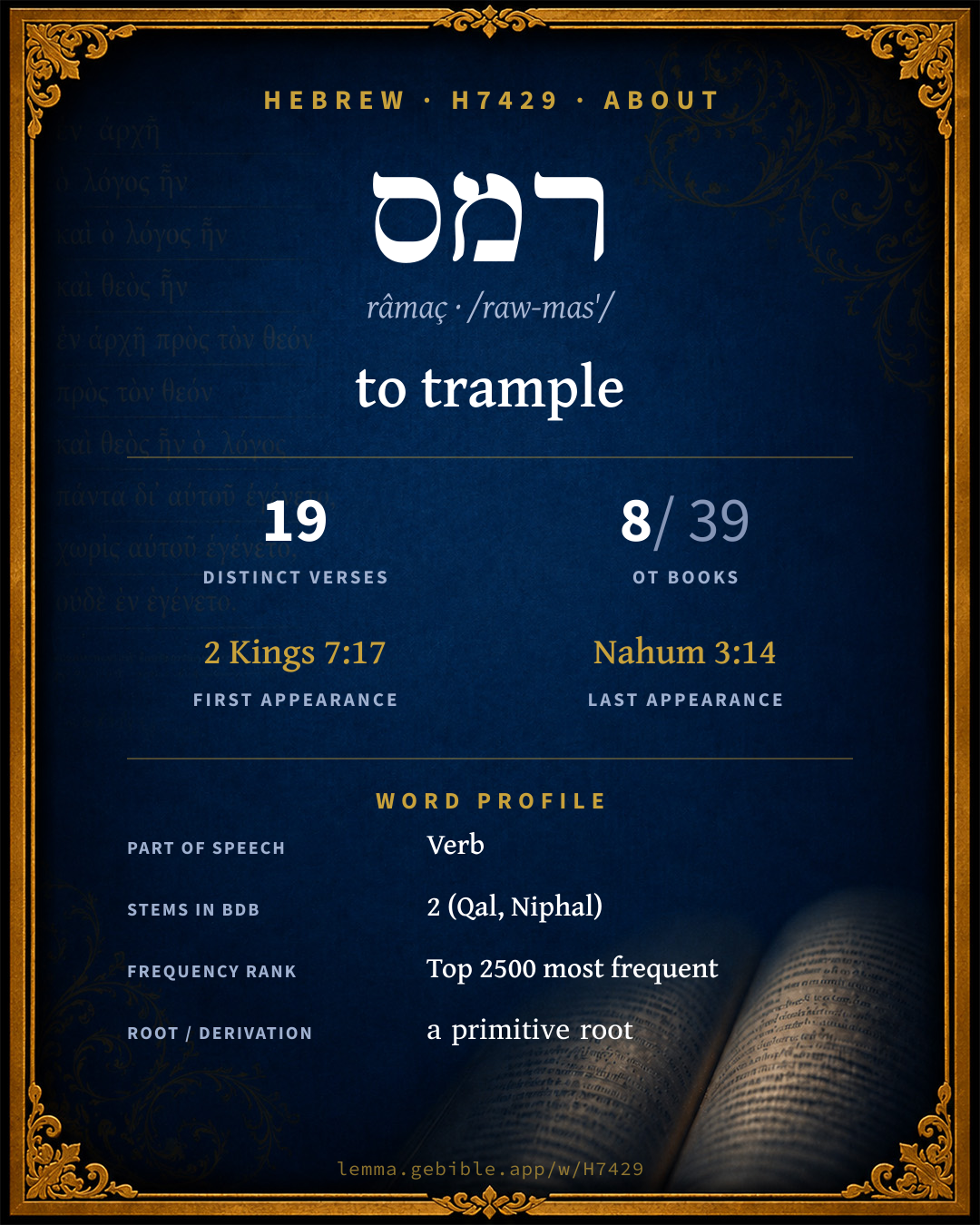
רָמַס
to trample
‘to trample’ is one of 2 main senses fuller range ↓
Full lexicon entry — Brown-Driver-Briggs (BDB)
From Brown-Driver-Briggs (BDB)
Where this word appears
See every Qal verb in the Hebrew Bible →
Grammar key — what these labels mean
Part of speech
- Verb
- An action or state-of-being word.
Stem
- Qal
- The basic, simple active stem — the plain form of the verb (“he wrote”).
- Niphal
- Usually the simple passive or reflexive of the Qal (“he was written”). Here: ‘be trampled’
Form
- Sequential Imperfect
- An imperfect with prefixed waw — the standard past-narrative form (waw-consecutive imperfect).
- Imperfect
- An incomplete, ongoing, or future action (“he will / would write”).
- Sequential Perfect
- A perfect with prefixed waw continuing a preceding imperfect or command (waw-consecutive perfect).
- Imperative
- A direct command (“write!”).
- Infinitive Construct
- A bound verbal noun, frequently with prepositions (“to write / in writing”).
- Participle Active
- A verbal adjective expressing ongoing or characteristic action (“writing / one who writes”).
State
- Absolute
- The independent form of a noun, not bound to a following word.
Person
- 3rd Person
- The one spoken about (“he / she / it / they”).
- 1st Person
- The speaker (“I / we”).
- 2nd Person
- The one addressed (“you”).
Gender
- Feminine
- Grammatically feminine.
- Masculine
- Grammatically masculine.
- Common
- Either gender — not distinguished for this form.
Number
- Singular
- One.
- Plural
- More than one (in Hebrew, generally three or more).
Grammatical forms 13 distinct
- Verb, Qal, Sequential Imperfect, 3rd Person, Feminine, Singular 3 times (16%)
- Verb, Qal, Imperfect, 3rd Person, Masculine, Singular 3 times (16%)
- Verb, Qal, Sequential Imperfect, 3rd Person, Masculine, Plural 2 times (11%)
- Verb, Qal, Sequential Imperfect, 3rd Person, Masculine, Singular 2 times (11%)
- Verb, Qal, Imperfect, 1st Person, Common, Singular 1 time (5%)
- Verb, Qal, Sequential Perfect, 3rd Person, Masculine, Singular 1 time (5%)
- Verb, Qal, Imperative, 2nd Person, Feminine, Singular 1 time (5%)
- Verb, Niphal, Imperfect, 3rd Person, Feminine, Plural 1 time (5%)
+5 more forms (5 occurrences)
Parsed forms decoded from the imported morphology (morphhb / Westminster Leningrad Codex — WLC text public domain, morphhb tagging CC BY 4.0), counted across 19 parsed occurrences — not distinct verses.
Every verse where H7429 appears — 19 distinct verses across 8 books. Click any verse to open its interlinear word-by-word view. Verse text shown in the World English Bible for context — . Each verse’s Hebrew form is shown with its reference; the English is not keyword-highlighted, since the data carries no word-level English alignment. Use “Compare translations” on any verse to read it across multiple English versions. This concordance covers the Hebrew Bible; Septuagint (Greek Old Testament) occurrences are not indexed here.
2 Kings 4 verses
- 2 Kings 7:17 וַ/יִּרְמְסֻ֧/הוּ conj + Qal wimpf 3mp + sfx pers 3ms The king appointed the captain on whose hand he leaned to have the charge of the gate: and the people trod on him in the gate, and he died as the man of God had said, who spoke when the king came down to him.
- 2 Kings 7:20 וַ/יִּרְמְס֨וּ conj + Qal wimpf 3mp it happened even so to him; for the people trod on him in the gate, and he died.
- 2 Kings 9:33 וַֽ/יִּרְמְסֶֽ/נָּה conj + Qal wimpf 3ms + sfx pers 3fs He said, Throw her down. So they threw her down; and some of her blood was sprinkled on the wall, and on the horses: and he trod her under foot.
- 2 Kings 14:9 וַ/תִּרְמֹ֖ס conj + Qal wimpf 3fs Jehoash the king of Israel sent to Amaziah king of Judah, saying, The thistle that was in Lebanon sent to the cedar that was in Lebanon, saying, Give your daughter to my son as wife: and there passed by a wild animal that was in Lebanon, and trod down the thistle.
2 Chronicles 1 verse
Psalms 2 verses
- Psalms 7:5 וְ/יִרְמֹ֣ס conj + Qal impf 3ms Let the enemy pursue my soul, and overtake it; Yes, let him tread my life down to the earth, And lay my glory in the dust. Selah.
- Psalms 91:13 תִּרְמֹ֖ס Qal impf 2ms You will tread on the lion and cobra. You will trample the young lion and the serpent underfoot.
Isaiah 6 verses
- Isaiah 1:12 רְמֹ֥ס Qal inf.cs When you come to appear before me, Who has required this at your hand, to trample my courts?
- Isaiah 16:4 רֹמֵ֖ס Qal ptcp.act ms Let my outcasts dwell with you; as for Moab, be a covert to him from the face of the destroyer. For the extortioner is brought to nothing, destruction ceases, the oppressors are consumed out of the land.
- Isaiah 26:6 תִּרְמְסֶ֖/נָּה Qal impf 3fs + sfx pers 3fs The foot shall tread it down; even the feet of the poor, and the steps of the needy.
- Isaiah 28:3 תֵּֽרָמַ֑סְנָה Niphal impf 3fp The crown of pride of the drunkards of Ephraim shall be trodden under foot:
- Isaiah 41:25 יִרְמָס Qal impf 3ms I have raised up one from the north, and he has come; from the rising of the sun one who calls on my name: and he shall come on rulers as on mortar, and as the potter treads clay.
- Isaiah 63:3 וְ/אֶרְמְסֵ֖/ם conj + Qal impf 1cs + sfx pers 3mp I have trodden the winepress alone; and of the peoples there was no man with me: yes, I trod them in my anger, and trampled them in my wrath; and their lifeblood is sprinkled on my garments, and I have stained all my clothing.
Ezekiel 2 verses
- Ezekiel 26:11 יִרְמֹ֖ס Qal impf 3ms With the hoofs of his horses shall he tread down all your streets; he shall kill your people with the sword; and the pillars of your strength shall go down to the ground.
- Ezekiel 34:18 תִּרְמְס֖וּ Qal impf 2mp Seems it a small thing to you to have fed on the good pasture, but you must tread down with your feet the residue of your pasture? and to have drunk of the clear waters, but you must foul the residue with your feet?
Daniel 2 verses
- Daniel 8:7 וַֽ/יִּרְמְסֵ֔/הוּ conj + Qal wimpf 3ms + sfx pers 3ms I saw him come close to the ram, and he was moved with anger against him, and struck the ram, and broke his two horns; and there was no power in the ram to stand before him; but he cast him down to the ground, and trampled on him; and there was none who could deliver the ram out of his hand.
- Daniel 8:10 וַֽ/תִּרְמְסֵֽ/ם conj + Qal wimpf 3fs + sfx pers 3mp It grew great, even to the host of the sky; and some of the host and of the stars it cast down to the ground, and trampled on them.
Micah 1 verse
Nahum 1 verse
About this entry
At a glance — auto-summarized from this page’s data, not written by a person. Every figure links to its source below. This summary describes the numbers; it doesn’t interpret them.
The Hebrew verb רמס centers on the idea of “to trample.” Its earliest occurrence is 2 Kings 7:17. It turns up in 19 verses across 8 books, an uncommon footprint. The word gravitates to Isaiah (32%), then 2 Kings and Psalms. The verb spans 2 stems, from Qal to Niphal. Dig into 19-verse concordance and the renderings breakdown below.
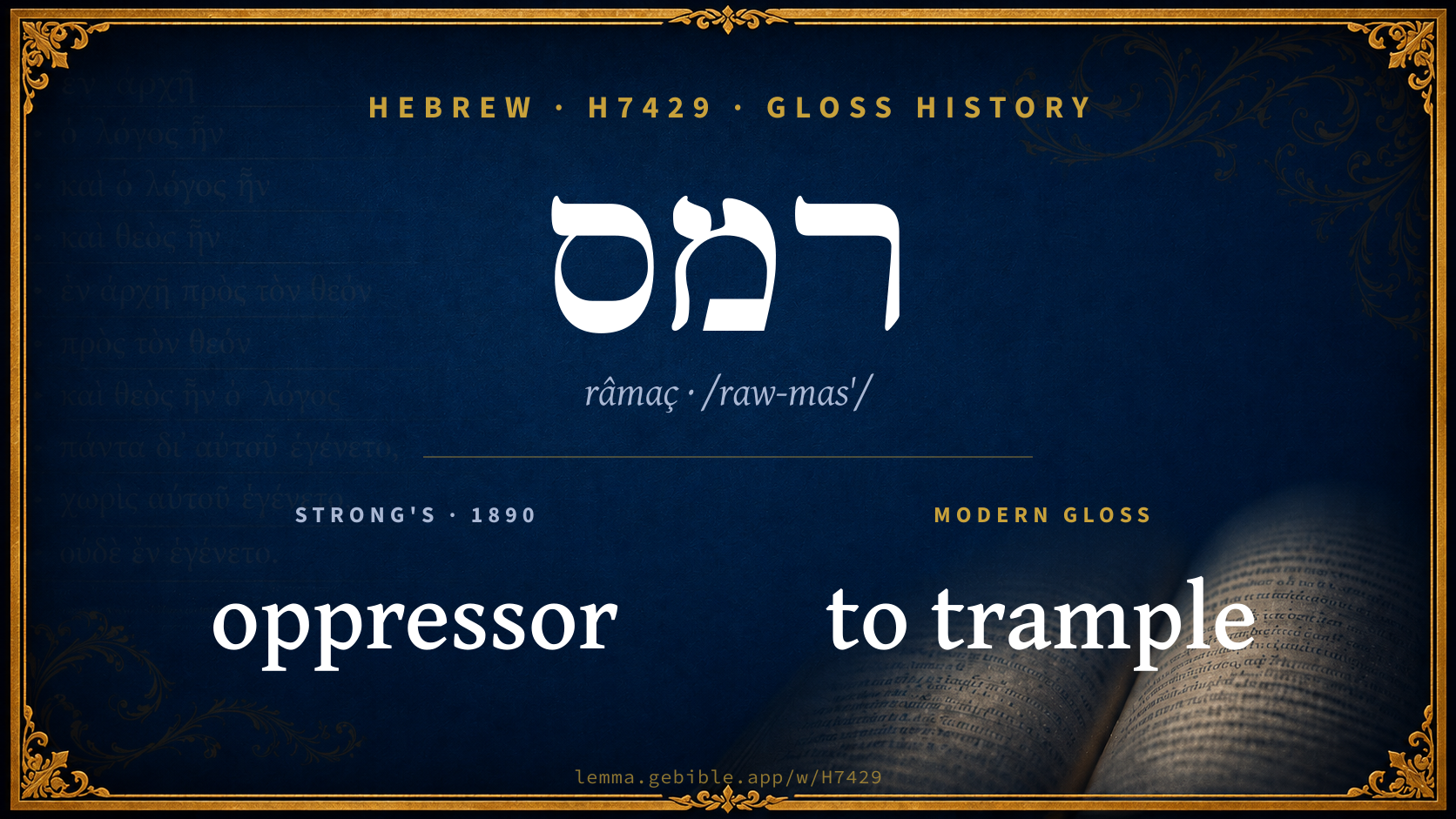
Gloss history
Strong's 1890 vs modern scholarship
About this word
Strong's H7429 catalogs a Hebrew word from the Hebrew Old Testament.
These counts are not copied from any lexicon or concordance. They are computed here, from the morphology-tagged Hebrew Old Testament. What Lemma adds →
- 19
- distinct verses
- The word appears in 19 distinct verses.
- 8 / 39
- OT books
- The word appears in 8 of 39 Old Testament books.
- #1,563
- by frequency
- Top 2500 most frequent Hebrew words (rank 1,563 of 8,640 Hebrew words by occurrence).
View all 19 occurrences in the concordance →
By section of the Old Testament
By traditional corpus
Conventional, traditional groupings — biblical authorship is debated, so this is a traditional corpus grouping, not an authorship claim. Each share is this word’s portion of its verses in that division of the Hebrew canon. Each figure is a share of the word’s 19 distinct verses.
- Prophets (Nevi'im) 14 verses · 74%
- Writings (Ketuvim) 5 verses · 26%
How translations render this word
Counts come from each version’s own published word-to-Strong’s tagging or interlinear alignment — an approximate guide to how each version renders this word, not a word-level alignment the data otherwise carries. Because each total is that version’s own tagged count, the per-version totals vary from one another and need not match the appearance or distinct-verse counts above. These counts may also differ from a printed concordance because Lemma counts each distinctly tagged rendering and does not collapse phrase taggings into a single head-word total. This is a fixed set of word-tagged versions (KJV, ASV, BSB, ULT) and does not change with the reading translation you choose elsewhere. Each version’s license is shown beside its name below (and on Sources).
- King James Version: Stamped 2×, Tread 2×, Trode 2×
- American Standard Version: Trampled 2×, Trod down 2×
- Berean Standard Bible: Trampled 3×, Trampled him 2×
- unfoldingWord Literal Text: Trampled 3×
King James Version Public Domain
Renders H7429 across 19 tagged occurrences — most commonly:
Plus 11 renderings that appear only once — usually multi-word phrases or single function words the recovered tagging swept in, not distinct renderings.
American Standard Version Public Domain
Renders H7429 across 18 tagged occurrences — most commonly:
Plus 14 renderings that appear only once — usually multi-word phrases or single function words the recovered tagging swept in, not distinct renderings.
Berean Standard Bible Public Domain
Renders H7429 across 19 tagged occurrences — most commonly:
Plus 14 renderings that appear only once — usually multi-word phrases or single function words the recovered tagging swept in, not distinct renderings.
unfoldingWord Literal Text CC BY-SA 4.0
Renders H7429 across 21 tagged occurrences — most commonly:
Plus 18 renderings that appear only once — usually multi-word phrases or single function words the recovered tagging swept in, not distinct renderings.
Senses in the full BDB
Hebrew verbs can shift meaning by stem (binyan): Qal is the basic action, Niphal is often passive or reflexive, Piel often intensifies or makes it factitive, and Hiphil is typically causative. The senses below are grouped under the stem BDB assigns to each.
What do BDB’s symbols mean?
BDB uses these scholarly abbreviations:
| Symbol | Meaning |
|---|---|
| 𝔊 | the Septuagint (the ancient Greek translation, LXX) |
| 𝔙 | the Vulgate (the Latin translation) |
| 𝔖 | the Syriac version (the Peshitta) |
| 𝔗 | the Targum (the Aramaic translation) |
| ψ | the Psalms |
| √ | root (the underlying root or stem) |
| ‖ | parallel passage (a synonymous or contrasted parallel) |
| † | the dagger: every passage where the word occurs is cited |
The 2 senses and sub-senses the full Brown-Driver-Briggs lexicon distinguishes for this word, in lexicon order (not ranked by frequency), with BDB’s own verbatim wording and sub-sense lettering. Shown in Hebrew script with BDB’s own scholarly abbreviations. The condensed entry is in the Lexicon Entry tab. See also the Forms in the corpus table below.
Qal
- Pf. 3 ms. consec. וְר׳ Mi 5:7; Impf. 3 ms. יִרְמֹם Ez 26:11 ψ 7:6, יִרְמָס־ Is 41:25, sf. וַיִּרְמְסֶנָּה 2 K 9:33, etc.; Imv. fs. רִמְסִי Na 3:14; Inf. cstr. רְמֹס Is 1:12; Pt. רֹמֵס Is 16:4;—trample, of men, c. acc. חֲצֵרָ֑י Is 1:12, חוּצוֹת Ez 26:11 (by horses’ hoofs), טִיט Is 41:25 (in sim.), cf. ר׳ בַחֹמֶר Na 3:14, acc. מִרְעֶה Ez 34:18 (in fig.); trample down, acc. pers., anim., vel rei, 2 K 7:17, 20, so (by horses’ hoofs) 9:33, יִר׳ לָאָרֶץ חַיָּי֑ ψ 7:6; 91:13 (‖ תִּדְרֹךְ); subj. י׳ Is 63:3 (fig.; + דָּֽרַךְ), subj. רֶגֶל Is 26:6; subj. beast 2 K 14:9 (allegory) = 2 Ch 25:18; Dn 8:7 (vision), of horn, v 10; abs. of lion, וְר׳ וְטָרַף Mi 5:7 (sim.); pt. as subst. coll. tramplers (i.e. devastators) Is 16:4. e.g. Micah 5:7
Niphal
- be trampled, Impf. 3 fpl. בְּרַגְלַיִם תֵּרָמַ֑סְנָה Is 28:3 (on subj. cf. Di Du CheHpt Köi. 183). e.g. Isaiah 28:3
Senses from the full Brown-Driver-Briggs lexicon (Brown, Driver, Briggs; Oxford 1906 — public domain), digitized via Sefaria, supplemented by the OpenScriptures HebrewLexicon (CC BY 4.0). Full attribution on Sources.
Word origin
vb. trample (NH id.; J.Aram רְמַס; cf. perhaps Syriac ܪܦܰܣ, Arabic رَفَسَ kick (BaES 33 Köii. 196); رَمَسَ is bury, and conceal grave);—
— Brown-Driver-Briggs (Oxford 1906, public domain), digitized via Sefaria, supplemented by the OpenScriptures HebrewLexicon (CC BY 4.0). See Sources.
Origin: a primitive root
Jastrow Dictionary
A second Hebrew/Aramaic lexicon for comparison, covering Aramaic and post-biblical (Talmudic, Targumic, Midrashic) usage that the biblical-Hebrew BDB does not. Matched by lemma rather than by Strong’s number, so a lemma may carry more than one Jastrow headword (shown separately below), and the entries cover usage well beyond the Bible.
רָמַס
- (b. h.) to tread, stamp. Y. Peah V, beg. 18ᵈ רוֹמֵס הייתי זתים וכ׳ I was stamping olives with R. Ḥiya &c.; ib. VI, 19ᶜ bot.; ib. VII, end, 20ᶜ. Kidd. 66ᵃ רוֹמְסֵם crush them (the Pharisees); a. fr.—Part. pass. רָמוּס; f. רְמוּסָה. Y. Ber. IV, 8ᵃ הר׳ ביד עריצים (the city of Jerusalem) which is trodden down by tyrants.
- same. Lev. R. s. 16 והיה קרון … ומְרַמַּסְתָּן (not ומרמסן) the carriage passed over them and crushed them to death; (Lam. R. to IV, 15 ומפסקתן).
רְמַס
- Targ. Ps. LXXXIX, 42.
רֶמֶס
- , pl. רְמָסִים, v. רֶמֶשׂ.
A Dictionary of the Targumim, the Talmud Babli and Yerushalmi, and the Midrashic Literature (Marcus Jastrow; London, Luzac, 1903) — Public Domain. Digitized via Sefaria. Digitized via Sefaria. Full attribution on Sources.
Forms in the corpus
The 18 distinct written forms H7429 takes in the Hebrew Bible, most frequent first — each parse links to that stem’s occurrences in the concordance. Hebrew forms include their vowel points and cantillation, so a single lemma takes many written forms.
Same root — word family
Other BDB entries built from the same root as H7429, grouped by Strong’s listed origin. These share a root / origin per the lexicon — not necessarily a shared meaning. Each links to that word’s own entry.
Derived from this word
Compare all same-root words → They share a root, not necessarily a meaning.
Septuagint verse parallels
This word appears in 19 verses that also exist in the Greek Old Testament (Septuagint), out of the 19 Hebrew verses it occurs in. You can read those verses in Greek by switching the Old Testament edition to the Septuagint.
Read these verses in the Septuagint
- 2 Kings 7:17
- 2 Chronicles 25:18
- Psalms 7:5
- Isaiah 1:12
- Ezekiel 26:11
- Daniel 8:7
- Micah 5:8
- Nahum 3:14
This is a verse-level parallel only — the same verses exist in both the Hebrew and Greek Old Testaments. No word-level Hebrew↔Greek correspondence is claimed: the data carries no such alignment, so no Greek word is shown as this Hebrew word’s translation. Coverage is not total — the Septuagint omits the deuterocanon and renumbers the Psalms, so some Hebrew verses have no direct Greek parallel.