Philippians 4:16

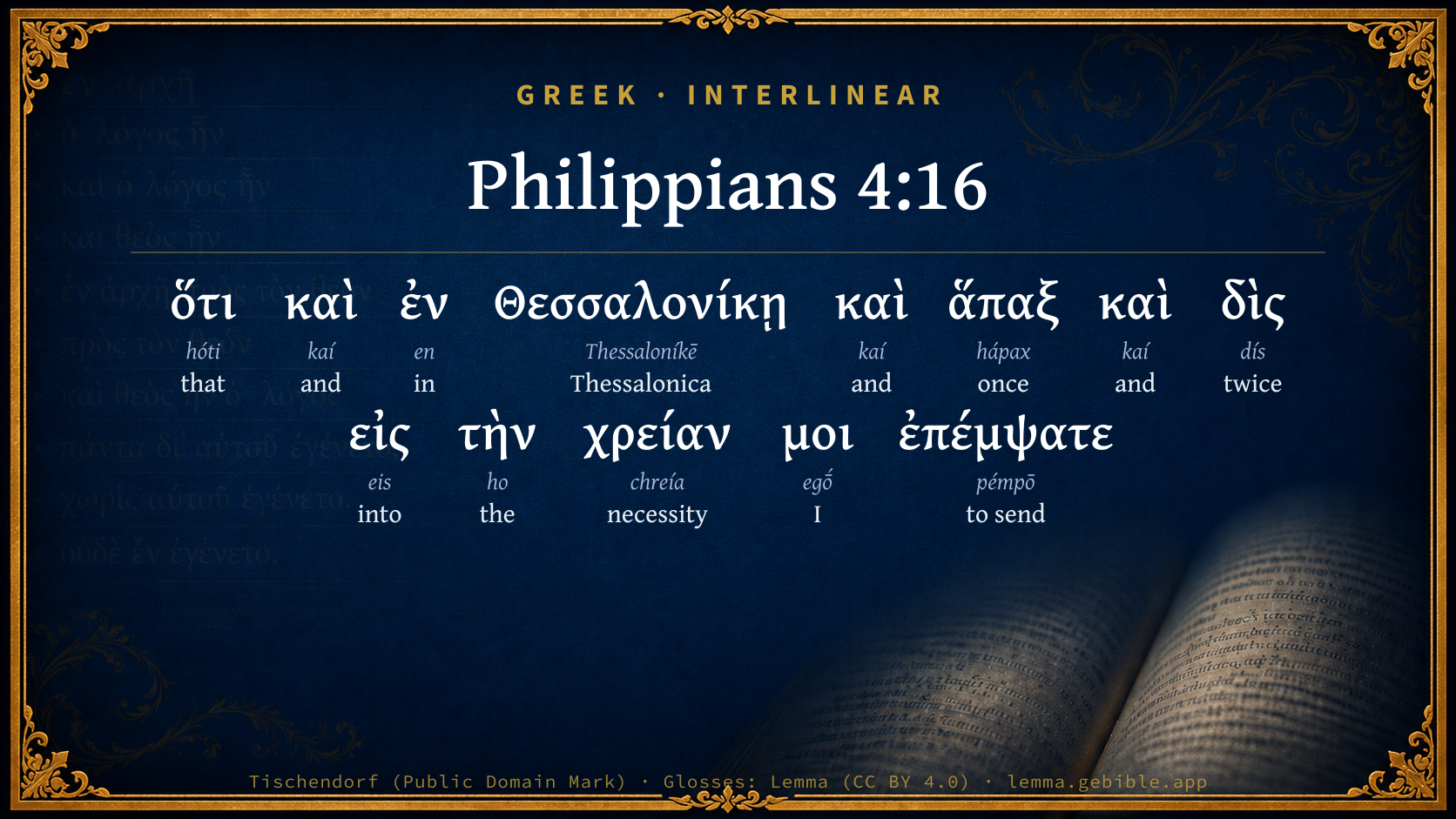
Greek (Tischendorf 8th ed.) Philippians 4:16 appears in the Greek New Testament. The text above is from the Tischendorf 8th edition. Each word links to its Strong’s number and a concise gloss. Click any word for its full Thayer’s Greek Lexicon entry.
Download image
Cite this verse

Philippians 4:16 (World English Bible). Public Domain. Lemma interlinear Bible study tool, https://lemma.gebible.app/v/philippians/4/16.

Show BibTeX & RIS
BibTeX
RIS
English Translation
For even in Thessalonica you sent once and again to my need.
World English Bible · Public Domain
Download a study sheet

One document with this verse’s original text, its word-by-word gloss line, the meaning frame, cross-references with their text, attributed commentary, and full source and license credits — printable, and it pastes into notes with its structure intact.

This verse Autodidact and up

Study sheet (.html) Plain text (.txt)

A passage Seminary Student

Up to 50 verses in one chapter. A passage sheet keeps up to 6 commentary sources and 12 cross-references per verse, in the order this page ranks them, and says so on the sheet whenever that leaves anything out. Ask for a single verse and you get the Autodidact verse sheet above.

Everything on this page stays free to read, with no account — the sheet is a download of what is already on screen, not access to it.

Want to remove ads? Support Godless Engineer
Compare translations 3

The same verse in 3 English versions, stacked beneath the original-language interlinear above. Click any original word for its lexicon entry.

Each is an independent rendering of the whole verse — the interlinear is not word-aligned to these translations.

Highlighted words mark where these versions differ — a whole-verse word diff, not a word-by-word alignment.

  • World English Bible Public Domain
    For even in Thessalonica you sent once and again to my need.
  • King James Version Public Domain
    For even in Thessalonica ye sent once and again unto my necessity.
  • unfoldingWord Literal Text CC BY-SA 4.0
    for even in Thessalonica, both once and twice you sent for my needs.

unfoldingWord Literal Text — © unfoldingWord, licensed CC BY-SA 4.0. Word-aligned USFM3 via Door43 (git.door43.org/unfoldingWord/en_ult).

Versions to compare (up to 4)

3 of 4 selected

Show all 19 translations

Every available English version of this verse, each an independent rendering of the whole verse.

  • World English Bible Public Domain
    For even in Thessalonica you sent once and again to my need.
  • Berean Standard Bible Public Domain
    For even while I was in Thessalonica, you provided for my needs again and again.
  • Majority Standard Bible Public Domain
    For even while I was in Thessalonica, you provided for my needs again and again.
  • King James Version Public Domain
    For even in Thessalonica ye sent once and again unto my necessity.
  • American Standard Version (1901) Public Domain
    for even in Thessalonica ye sent once and again unto my need.
  • Revised Version (1885) Public Domain
    for even in Thessalonica ye sent once and again unto my need.
  • Geneva Bible (1599) Public Domain
    For euen when I was in Thessalonica, yee sent once, and afterward againe for my necessitie,
  • Douay-Rheims (1899) Public Domain
    For unto Thessalonica also you sent once and again for my use.
  • Young's Literal Translation Public Domain
    because also in Thessalonica, both once and again to my need ye sent;
  • Literal Standard Version CC BY-SA 4.0
    because in Thessalonica also, both once and again you sent to my need;
  • Unlocked Literal Bible CC BY-SA 4.0
    Even when I was in Thessalonica, you sent help for my needs more than once.
  • unfoldingWord Literal Text CC BY-SA 4.0
    for even in Thessalonica, both once and twice you sent for my needs.
  • Darby Bible Public Domain
    for also in Thessalonica once and even twice ye sent to me for my need.
  • World Messianic Bible Public Domain
    For even in Thessalonica you sent once and again to my need.
  • Webster's Bible Public Domain
    For even in Thessalonica ye sent once and again to my necessity.
  • Free Bible Version CC BY-SA 4.0
    Even when I was in Thessalonica you helped me out not once but twice.
  • Bible in Basic English Public Domain
    Because even in Thessalonica you sent once and again to me in my need.
  • Text-Critical English NT CC BY 4.0
    Even when I was in Thessalonica, you sent me help for my needs more than once.
  • Tyndale New Testament (1534) Public Domain
    For when I was in Tessalonica ye sent once and afterwarde agayne vnto my nedes:

Literal Standard Version (2020), Covenant Press — licensed CC BY-SA 4.0. Text via the HelloAO Bible API (eBible.org). Unlocked Literal Bible (unfoldingWord) — licensed CC BY-SA 4.0. Text via the HelloAO Bible API (eBible.org). unfoldingWord Literal Text — © unfoldingWord, licensed CC BY-SA 4.0. Word-aligned USFM3 via Door43 (git.door43.org/unfoldingWord/en_ult). Free Bible Version, Dr. Jonathan Gallagher — licensed CC BY-SA 4.0. Text via the HelloAO Bible API (eBible.org).

Word by word

More ways to search: Search by grammar → Find every occurrence → Compare this word →

Practice this passage: Drill this verse → Learn its vocabulary →

About this verse

These counts appear in no published source. They are computed here, from the morphology-tagged text and Lemma’s own curated glosses. What Lemma adds →

13
words
11
distinct lemmas
Pauline Epistles
section

Notable vocabulary

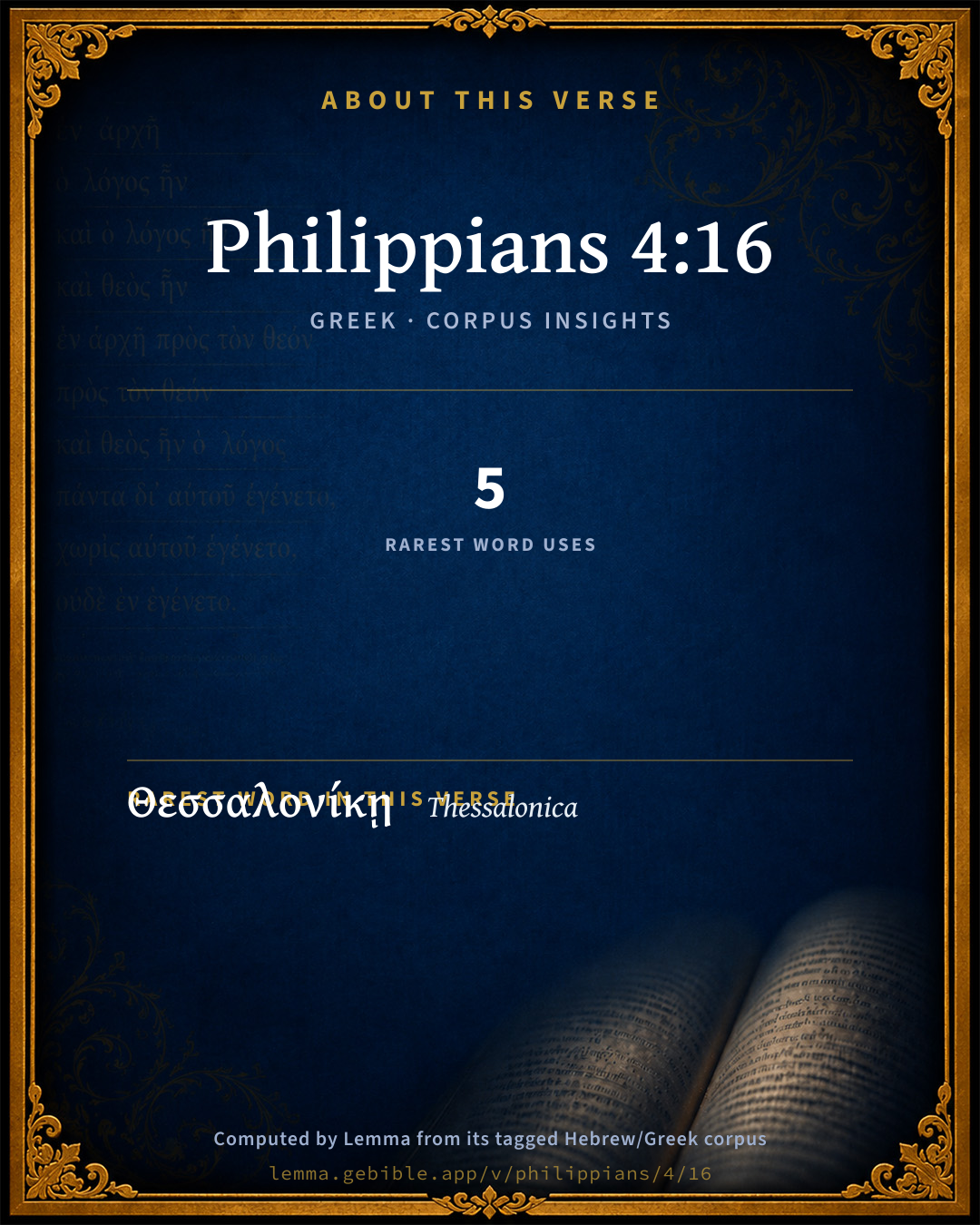
The rarest word here is Θεσσαλονίκῃ Thessalonica G2332 — appearing just 5 times in the whole Greek New Testament.

Shared distinctive vocabulary

Θεσσαλονίκῃ Thessalonica G2332 occurs in 5 verses of the Greek New Testament. Also found in:

Repetition

A word recurs within this verse:

Cross-references

3

Topical passages linked to Philippians 4:16 in the Treasury of Scripture Knowledge — connected by theme and wording, ordered by reader-vote popularity; previews shown in the World English Bible.

  • 1 Thessalonians 2:9 For you remember, brothers, our labor and travail; for working night and day, that we might not burden any of you, we preached to you the Gospel of God.
  • Acts 17:1 Now when they had passed through Amphipolis and Apollonia, they came to Thessalonica, where there was a synagogue of the Jews.
  • 1 Thessalonians 2:18 because we wanted to come to you--indeed, I, Paul, once and again-- but Satan hindered us.

Cross-references courtesy of OpenBible.info (CC BY 4.0).

Commentary

Notes on Philippians 4:16 from classic Christian and Jewish commentators (each source and its license shown beneath its notes). The classic Christian expositions comment on the surrounding passage and are grouped to its opening verse, so a note may address several verses; the Jewish commentaries on the Tanakh (Rashi and others) are per-verse, so they appear only where the commentator wrote on this verse.

Lemma curates 59 commentaries, every one of them public domain or Creative Commons licensed, each selected and text-cleaned for this edition rather than reprinted as found. About our sources →

Tyndale Open Study Notes

Tyndale Open Resources

4:16 After leaving Philippi (4:15) Paul had gone to Thessalonica (see Acts 17:1-8; cp. 1 Thes 2:1-14).

Tyndale Open Study Notes — © Tyndale Open Resources, licensed CC BY-SA 4.0. Text via the HelloAO Bible API.

Bengel's Gnomon

Johann Albrecht Bengel

Php 4:16. Καὶ ἅπαξ καὶ δὶς) Δὶς, an ordinal member in this passage; i.e. not once and twice, which would be equivalent to thrice, but once and again, so that under δὶς, twice, ἅπαξ, once, is comprehended. So 1Th 2:18.

Bengel's Gnomon of the New Testament — English translation (T&T Clark, Edinburgh, 1860) — public domain. Text from a community e-Sword module.

Meyer's Critical & Exegetical Commentary

Heinrich August Wilhelm Meyer

Php_4:16. Ὅτι] since, indeed, ye also already in Thessalonica, etc. It is argumentative, namely, outbidding the early definition of date ἐν ἀρχῇ … Μακεδονίας, in Php_4:15, by one even antecedent, and thus serving more amply to justify that specification of time,[192] for which purpose the ὍΤΙ specifying the reason was quite sufficient, and (in opposition to Hofmanns objection) no ΓΆΡ was necessary. The opinion of Wiesinger, that ὍΤΙ Κ.Τ.Λ. is intended to explain that it was only with the aid sent after Paul at a distance that the readers had entered into such a connection with the apostle as is previously mentioned, is bound up with the untenable interpretation of ἘΞῆΛΘΟΝ as pluperfect. The rendering of ὍΤΙ by that (Rheinwald, Matthies, Hoelemann, van Hengel, Rilliet, de Wette, Lünemann, Weiss) is to be set aside, because, while the emphatic οἴδατε καὶ ὑμεῖς, Php_4:15, accords doubtless with the exclusion of other churches in Php_4:15, it does not accord with Php_4:16 (ye also know that ye have sent … to me!), to which it would stand in an illogical relation, even apart from the uncalled-for inversion of the order of time, which would result. Hofmanns explanation, which makes ὅτι in Php_4:16 parallel to the ὍΤΙ in Php_4:15 and places it in causal relation to ΟἼΔΑΤΕ, falls with his erroneous view of Php_4:15.

The ΚΑΊ before ἘΝ ΘΕΣΣΑΛ., for which Hinsch, following Baur, thinks that he finds a reference in 2Co_11:9, is the simple also in the sense of also already; a climax as regards time; see Hartung, Partik. I. p. 135; Kühner, II. 2, p. 797.

ἐν Θεσσαλ.] is not used, in the sense of the bearers having arrived, for ΕἸς, for there is no certain instance of ἈΠΟΣΤΈΛΛΕΙΝ or ΠΈΜΠΕΙΝ with ἘΝ in this sense (Thuc. vii. 17 must, with Becker and Krüger, be read: Ἐς ΤῊΝ ΣΙΚΕΛΊΑΝ); but the preposition is used from the standpoint of the receiver: also at Thessalonica (when I was there) ye sent to me. Thus this sending took place in Thessalonica. Comp. on Mat_10:16; Poppo and Krüger on Thuc. iv. 27. 1.

καὶ ἅπαξ καὶ δίς] Comp. 1Th_2:18. The conception is: when the first aid arrived, the ἐπέμψατε had taken place once; when the second arrived, it had taken place both once and twice. Paul has not written δίς merely, nor yet ἍΠΑΞ Κ. ΔΊς (1Ma_3:30; Xen. Anab. iv. 7. 10), but by καὶ ἅπ. κ. ΔΊς he sets forth the repetition of the matter more emphatically, to the praise of his readers (Hartung, Partikell. I. p. 144). Comp. καὶ δὶς καὶ τρίς, Plat. Phaed. p. 63 D, Phil. p. 59 E; Herod, ii. 121, iii. 148. The opposite: οὐχ ἅπαξ οὐδὲ δίς, Plat. Clit. p. 410 B.

εἰς τ. χρείαν] on behalf of the necessity, in order to satisfy it; comp. Php_2:15. The article indicates the necessity that had been existing in Pauls case. On πέμψαι, used absolutely, comp. Act_11:29. What they sent, they knew.

[192] If Baur had noticed this correct logical connection, he would not have made an improper use of our passage to fortify his opinion of the affair of the aid being an invented incident.The same assistance which is meant in ver. 15 cannot be meant in ver. 16, as some not attending to the καί (comp. Luther, Castalio, and others) have thought. This view is also at variance with the specification of time ὅτε ἐξῆλθον, ver. 15; for Paul abode several weeks in Thessalonica (Act_17:2), and then there still followed his sojourn in Beroea (Act_17:10 ff.), ere he quitted Macedonia and travelled to Athens.

Meyer — Critical and Exegetical Commentary on the New Testament — English translation by Peter Christie, edited by Frederick Crombie (T&T Clark, 1880) — public domain. Text from a community e-Sword module.

Expositor's Greek Testament

ed. W. Robertson Nicoll

Phi 4:16 . ὅτι κ . τ . λ . We are greatly inclined to take ὅτι here, as in Phi 4:15 , as dependent on οἴδατε . “Ye know … that at the beginning … that even in Thessalonica,” etc. Thessalonica was a city of far greater wealth and importance than Philippi. καί might, however, emphasise the fact that they began at once to support him. ἁπαξ κ . δίς is probably to be taken literally. Cf. Deu 9:13 , λελάληκα πρὸς σὲ ἄπαξ καὶ δίς ; 1Ma 3:30 , εὐλαβήθη μὴ οὐκ ἔχει ὡς ἄπαξ καὶ δίς . It is interpreted in a more general sense by Lft [59] . and Wohl [60] . εἰς τ . χρείαν . εἰς should be read with most of the best authorities. It is probably used here in a semi-technical meaning often found in Papyri (see Dsm [61] . , BS [62] . , pp. 113. 115; NBS [63] . , p. 23) and also in Paul, e.g. , 1Co 16:1 , τῆς λογίας τῆς εἰς τοὺς ἁγίους ; Rom 15:26 , κοινωνίαν τινὰ ποιήσασθαι εἰς τοὺς πτωχούς . It describes the object of gifts, collections, etc., or the various items in an account which have to be met. This interpretation accords with the financial colouring of the passage.

[59] Lightfoot.

[60] Wohlenberg.

[61] Deissmann ( BS. = Bibelstudien, NBS. = Neue Bibelstudien ).

[62] Bibelstudien

[63] Neue Bibelstudien

The Expositor's Greek Testament, edited by W. Robertson Nicoll (1897–1910) — public domain. Text from a community e-Sword module.

Jamieson, Fausset & Brown

Robert Jamieson, A. R. Fausset & David Brown

even in Thessalonica--"even" as early as when I had got no further than Thessalonica, ye sent me supplies for my necessities more than once.

Jamieson, Fausset & Brown — Commentary Critical and Explanatory on the Whole Bible (1871) — public domain (CC PDM 1.0). Text via the HelloAO Bible API.

Adam Clarke's Commentary

Verse 16. For even in Thessalonica] While labouring to plant the Church there, he was supported partly by working with his hands, 1Th 2:9; 2Th 3:7-9; and partly by the contributions sent him from Philippi. Even the Thessalonians had contributed little to his maintenance: this is not spoken to their credit.

Adam Clarke's Commentary on the Bible (1810–1826) — public domain. Text from a community e-Sword/MySword module.

Ellicott's Commentary for English Readers

(16) Even in Thessalonica.—Not only after he left Macedonia, but even before that time, when he had just passed from Philippi to Thessalonica. At Thessalonica, as at Corinth—both very rich and luxurious communities—he refused maintenance, and lived mainly by the labour of his own hands (1Th_2:9; 2Th_3:8). But it appears from this passage that even then he received “once and again” (that is, occasionally, “once or twice”) some aid from Philippi “to supply his need”—that is (as in all right exercise of liberality), to supplement, and not to supersede, his own resources.

A Bible Commentary for English Readers, edited by Charles John Ellicott (1878–1897) — public domain. Text from a community e-Sword module.

The Cambridge Bible for Schools and Colleges

gen. ed. J. J. S. Perowne

16. even in Thessalonica] “Even when I was there.”—Thessalonica was just 100 Roman miles (about 92 English) from Philippi, on the Via Egnatia. Amphipolis and Apollonia were the two intermediate road-stations, about 30 miles from each other, and apparently Paul and Silas passed only a night at each, hastening to Thessalonica, where probably they spent some weeks, or even months (Act_17:1-9; and cp. Conybeare and Howson, Life and Epistles &c., ch. 9; Lewin, L. and E. &c., vol. 1. chap. 11). Thus Thessalonica was practically the Apostle’s first pause after leaving Philippi; and it was in Macedonia.

once and again] Within a short stay at the longest. In Acts 17 only “three sabbaths” are mentioned; but the Epistles to Thessalonica seem to imply that he stayed somewhat longer, by their allusions to the impression made at Thessalonica by his and his companions’ life and example. See 1Th_2:1-12; 2Th_3:7-8.

my necessity] The profits of his hard manual labour at Thessalonica (see 1 and 2 Thess. just quoted) evidently left him still very poor. He would take nothing of the Thessalonians, while still actually introducing the Gospel to them.

The Cambridge Bible for Schools and Colleges (gen. ed. J. J. S. Perowne; Cambridge University Press, 1878–1918) — public domain. Text from a community e-Sword module.

John Gill's Exposition

For even in Thessalonica,.... When the apostle was there; for from Philippi he went to Thessalonica; see Act 17:1,

ye sent once and again unto my necessity; for his use and service, to support him while he was at that place, and relieve and assist him in his necessities; for the people at Thessalonica were either not able to communicate, or were not of a beneficent disposition, or the apostle did not care to be chargeable to them; and they seem many of them to have been idle and lazy, and therefore he wrought among them with his own hands to set them an example; and the Philippians hearing and knowing that this was the case, sent frequently, while he was here, some of the brethren with gifts unto him.

John Gill's Exposition of the Whole Bible (1746–1763) — public domain (CC PDM 1.0). Text via the HelloAO Bible API.

Trapp's Complete Commentary

John Trapp

16 For even in Thessalonica ye sent once and again unto my necessity.

Ver. 16. Ye sent once and again] Charity’s fountain runs fresh, More perennis aquae, and is never dried up. "The liberal man deviseth liberal things," and holdeth that only his own that he hath given to others. Hoc habeo quodcunque dedi, saith Seneca (De Ben. vi. 3).

John Trapp, A Commentary or Exposition upon All the Books of the Old and New Testament (1647–1656) — public domain. Text from a community e-Sword module.

Albert Barnes' Notes on the Bible

For even in Thessalonica; - see the notes, Act 17:1. Paul remained there long enough to establish a flourishing church. He met, indeed, with much opposition and persecution there; and, hence, it was necessary that his wants should be supplied by others.

Albert Barnes' Notes on the Bible (1834–1885) — public domain. Text from a community e-Sword/MySword module.

Matthew Poole's English Annotations

They, for their parts, were most commendable in this matter, that when he was in Thessalonica, the mother city, (not above twenty-five miles distant), their care for his comfortable livelihood was more than once manifested, he passing again and again through Macedonia, 1Co 16:5; 2Co 1:16; which argues his thankful resentment of the constant purpose of their mind to succour him upon all occasions.

Matthew Poole's English Annotations on the Holy Bible (1683–1685) — public domain. Text from a community e-Sword/MySword module.

Whedon's Commentary on the Bible

Daniel D. Whedon

16. Once and again—This was at an earlier date, while he was still in the province, and so at home with them. They, perhaps, learn now, for the first time, in this free outpouring of precious memories, of the absolute need which their love had relieved.

Daniel D. Whedon (gen. ed.), Commentary on the Old and New Testaments (1874–1909) — public domain. Text from a community e-Sword module.

The Pulpit Commentary

For even in Thessalonica ye sent once and again unto my necessity. This shows the promptness of their generosity; they not only helped him when he departed from Macedonia; but, before that time, while he was still at Thessalonica, the city which he visited next after leaving Philippi, they sent more than once to supply his needs; Comp. 1Th_2:9 and 2Th_2:8, where St. Paul says that he avoided being chargeable to the Thessalonians; for which purpose he labored with his own hands; but, it seems, he needed additional help, and this was supplied from Philippi.

The Pulpit Commentary (1880–1919), ed. H.D.M. Spence-Jones & Joseph S. Exell — public domain. Text from a community e-Sword module.

The People's New Testament

B. W. Johnson

16. Even in Thessalonica. After leaving Philippi Paul next labored at Thessalonica. See @Acts, chapter 17. While here the newly-founded church of the Philippians sent to him contributions at least twice. They also aided him later while he was in Corinth (2 Cor. 11:9).

B. W. Johnson's The People's New Testament with Notes (1889–1891) — public domain. Electronic text from the Christian Classics Ethereal Library (CCEL) ThML edition.

Cambridge Greek Testament for Schools and Colleges

16. καὶ ἐν Θεσσαλονίκῃ. That is, even when I was no further away from you than Thessalonica; so prompt and generous were you.—See Act 17:1-9.—Thessalonica was just 100 Roman (about 92 English) miles from Philippi, on the Via Egnatia. Amphipolis and Apollonia were the two intermediate stations, each about 30 miles from the other and from one of the two other towns. Apparently Paul and Silas, leaving Philippi and hastening to Thessalonica, passed only a night at each intermediate place, and remained at least some weeks at Thessalonica. See Conybeare and H., ch. ix; and Lewin, L. and E. of St Paul, vol. I. ch. xi. Thessalonica was thus St Paul’s first long pause; and it lay comparatively near Philippi.

καὶ ἅπαξ καὶ δὶς. Within no very long time. In Act 17:2 we read of σάββατα τρία before the disturbances began. No certain note of time is given afterwards; but the withdrawal to Berœa was not long delayed. Short as the stay was, it was long enough to produce profound impressions, as the Thessalonian Epistles testify.

εἰς τὴν χρείαν μοι. At Thessalonica he refused to take support from the converts, and worked for his living. See 1Th 2:9, νυκτὸς καὶ ἡμέρας ἐργαζόμενοι, πρὸς τὸ μὴ ἐπιβαρῆσαί τινα ὑμῶν, ἐκηρύξαμεν εἰς ὑμᾶς τὸ εὐ. τοῦ θεοῦ.

Cambridge Greek Testament for Schools and Colleges (Cambridge University Press, 1896; 21 vols, various authors incl. Carr, Maclear, Plummer, Farrar, Lumby, Moule, M. R. James, Simcox) — public domain. Text from a community e-Sword module.

Alford’s Greek Testament

Henry Alford

16.] for even in Thessalonica (which was an early stage of my ἐξελθεῖν ἀπὸ Μακ., before the departure was consummated. The ὅτι gives a reason for and proof of the former assertion—ye were the only ones, &c.,—and ye began as early as ἐν Θεσσ., i.e. when I was at Thessalonica. In such brachylogical constructions the preposition of rest, as belonging to the act accomplished, overbears the preposition of motion, as belonging to it only in its imperfect state; so οἱ ἐν τῷ Ἡραίῳ καταπεφευγότες, Xen. Hell. iv. 5. 5,—ταῖς λοιπαῖς ἐν τῇ γῇ καταπεφευγυίαις ἐνέβαλλον, Thuc. iv. 14,—ἀποστελοῦντες … ἐν τῇ Σικελίᾳ, ib. vii. 17, where ἐς τὴν Σ. in Bekker’s text is a correction) ye sent both once and twice (the account of the expression being, that when the first arrived, they had sent once: when the second, not only once, but twice. So in ref.: and Herod. ii. 121, αὐτῷ κ. δὶς κ. τρὶς ἀνοίξαντι: iii. 148, τοῦτο κ. δὶς κ. τρὶς εἴπαντος Μαιανδρίου. The opposite expression, οὐχ ἅπαξ οὐδὲ δίς, is found in Plato, Clitoph. § 7) ye sent (absolute as in ref.) to (for the supply of, ref.) my necessity.

Henry Alford, The Greek Testament (1849–1861) — public domain. Text from a community e-Sword module.

International Critical Commentary

16. ὅτι: ‘for,’ or ‘since,’ justifying the statement of vs. 15. Not ‘that,’ as Ril., Weiss, connecting with οἴδατε.

καὶ ἐν Θεσσαλονίκῃ: ‘even in Thessalonica.’ A Macedonian city, near Philippi, where a church was founded by Paul before his departure into Achaia (Act 17:1-9); yet the contribution came from Philippi, and not from Thessalonica, and that while he was actually in Thessalonica. Ἐν cannot be explained as ‘to.’

καὶ ἅπαξ καὶ δὶς: ‘not merely once, but twice.’ (Comp. 1Th 2:18.)

εἰς τὴν χρείαν: ‘with reference to the (then) present need.’ Εἰς, as in 1:5; 2Co 2:12. Τὴν with a possessive sense, ‘my,’ or the particular need of the time. For χρείαν, comp. 2:25.

They are not, however, to understand him as implying that he desired their gifts principally for his own relief or enrichment. He prizes their gift chiefly because their sending it will be fruitful in blessing to them. In vs. 11 he disclaimed the sense of want. Here he disclaims the desire for the gift in itself considered.

International Critical Commentary — older volumes (1896–1929), various authors — public domain. Text from a community e-Sword module.

Vincent's Word Studies in the New Testament

Marvin R. Vincent

Even in Thessalonica [και] . Better also : in addition to the contribution received at Corinth.

Marvin R. Vincent, Word Studies in the New Testament (1887–1900) — public domain. Text from a community e-Sword/MySword module.

Lesson kit

Teaching starters — assembled from the data on this page, not authored interpretation. Every prompt links to the verse data it draws on. Edit before teaching.

Philippians, in the Pauline Epistles, opens this verse with 13 words (11 distinct Greek lemmas). Its most distinctive word is Thessaloníkē (“Thessalonica”). A historical commentator’s framing appears above. Read the whole chapter for the surrounding context.

Discussion questions

  1. How does “Thessalonica” (Thessaloníkē) shape what this verse is saying?
  2. Acts 17:1 shares the word «Thessalonica» with this verse. How do the two illuminate each other?
  3. “and” occurs 3× in this one verse. What is the effect of the repetition?
  4. These translations render this verse differently; the difference is in the English rendering, not the original. What questions does that raise?
  5. Reading how Tyndale Open Study Notes and Bengel's Gnomon read this verse, where do the two commentators agree and where do they part?

Things to notice

Reading settings

Reading text

Shown beneath each verse's original-language words.

Old Testament
Old Testament edition

Read the OT as the Masoretic Hebrew (MT) or the Greek Septuagint (LXX).

English shown for the Greek Septuagint (in the Hebrew ↔ Greek comparison).

Comparing translations? Open the Compare panel on any verse page to stack up to four side by side.