
Leviticus 21:13

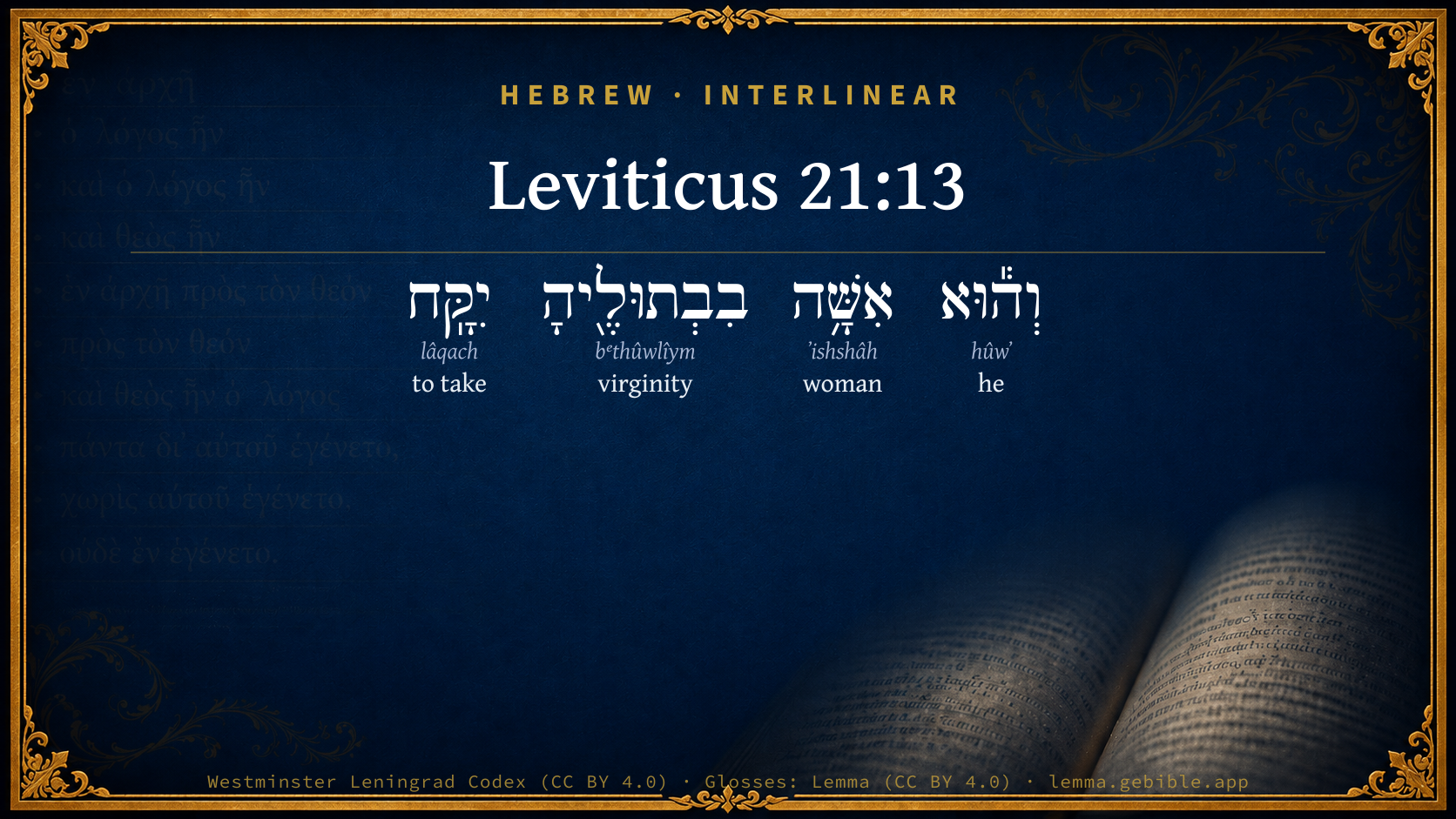
Hebrew (Westminster Leningrad Codex) Leviticus 21:13 appears in the Hebrew Old Testament. The text above is from the Westminster Leningrad Codex. Each word links to its Strong’s number, a concise gloss, and parsing drawn from the Open Scriptures Hebrew Bible morphology. Click any word for its full Brown-Driver-Briggs (BDB) entry.
Download image
Cite this verse

Leviticus 21:13 (World English Bible). Public Domain. Lemma interlinear Bible study tool, https://lemma.gebible.app/v/leviticus/21/13.

Show BibTeX & RIS
BibTeX
RIS
English Translation
"'He shall take a wife in her virginity.
World English Bible · Public Domain
Highlights Full analysis ↓
Download a study sheet

One document with this verse’s original text, its word-by-word gloss line, the meaning frame, cross-references with their text, attributed commentary, and full source and license credits — printable, and it pastes into notes with its structure intact.

This verse Autodidact and up

Study sheet (.html) Plain text (.txt)

A passage Seminary Student

Up to 50 verses in one chapter. A passage sheet keeps up to 6 commentary sources and 12 cross-references per verse, in the order this page ranks them, and says so on the sheet whenever that leaves anything out. Ask for a single verse and you get the Autodidact verse sheet above.

Everything on this page stays free to read, with no account — the sheet is a download of what is already on screen, not access to it.

Want to remove ads? Support Godless Engineer
Compare translations 3

The same verse in 3 English versions, stacked beneath the original-language interlinear above. Click any original word for its lexicon entry.

Each is an independent rendering of the whole verse — the interlinear is not word-aligned to these translations.

Highlighted words mark where these versions differ — a whole-verse word diff, not a word-by-word alignment.

  • World English Bible Public Domain
    "'He shall take a wife in her virginity.
  • King James Version Public Domain
    And he shall take a wife in her virginity.
  • unfoldingWord Literal Text CC BY-SA 4.0
    And he himself shall take a wife in her virginity.

unfoldingWord Literal Text — © unfoldingWord, licensed CC BY-SA 4.0. Word-aligned USFM3 via Door43 (git.door43.org/unfoldingWord/en_ult).

Versions to compare (up to 4)

3 of 4 selected

Show all 18 translations

Every available English version of this verse, each an independent rendering of the whole verse.

  • World English Bible Public Domain
    "'He shall take a wife in her virginity.
  • Berean Standard Bible Public Domain
    The woman he marries must be a virgin.
  • Majority Standard Bible Public Domain
    The woman he marries must be a virgin.
  • King James Version Public Domain
    And he shall take a wife in her virginity.
  • American Standard Version (1901) Public Domain
    And he shall take a wife in her virginity.
  • Revised Version (1885) Public Domain
    And he shall take a wife in her virginity.
  • Geneva Bible (1599) Public Domain
    Also he shall take a maide vnto his wife:
  • Douay-Rheims (1899) Public Domain
    He shall take a virgin unto his wife:
  • Young's Literal Translation Public Domain
    `And he taketh a wife in her virginity;
  • Literal Standard Version CC BY-SA 4.0
    And he takes a wife in her virginity;
  • Unlocked Literal Bible CC BY-SA 4.0
    The high priest must marry a virgin as his wife.
  • unfoldingWord Literal Text CC BY-SA 4.0
    And he himself shall take a wife in her virginity.
  • Darby Bible Public Domain
    And he shall take a wife in her virginity.
  • World Messianic Bible Public Domain
    “‘He shall take a wife in her virginity.
  • Webster's Bible Public Domain
    And he shall take a wife in her virginity.
  • Free Bible Version CC BY-SA 4.0
    He can only marry a virgin.
  • Bible in Basic English Public Domain
    And let him take as his wife one who has not had relations with a man.
  • JPS Tanakh (1917) Public Domain
    And he shall take a wife in her virginity.

Literal Standard Version (2020), Covenant Press — licensed CC BY-SA 4.0. Text via the HelloAO Bible API (eBible.org). Unlocked Literal Bible (unfoldingWord) — licensed CC BY-SA 4.0. Text via the HelloAO Bible API (eBible.org). unfoldingWord Literal Text — © unfoldingWord, licensed CC BY-SA 4.0. Word-aligned USFM3 via Door43 (git.door43.org/unfoldingWord/en_ult). Free Bible Version, Dr. Jonathan Gallagher — licensed CC BY-SA 4.0. Text via the HelloAO Bible API (eBible.org).

Word by word

More ways to search: Search by grammar → Find every occurrence → Compare this word →

Practice this passage: Drill this verse → Learn its vocabulary →

About this verse

These counts appear in no published source. They are computed here, from the morphology-tagged text and Lemma’s own curated glosses. What Lemma adds →

4
words
4
distinct lemmas
Pentateuch
section

Notable vocabulary

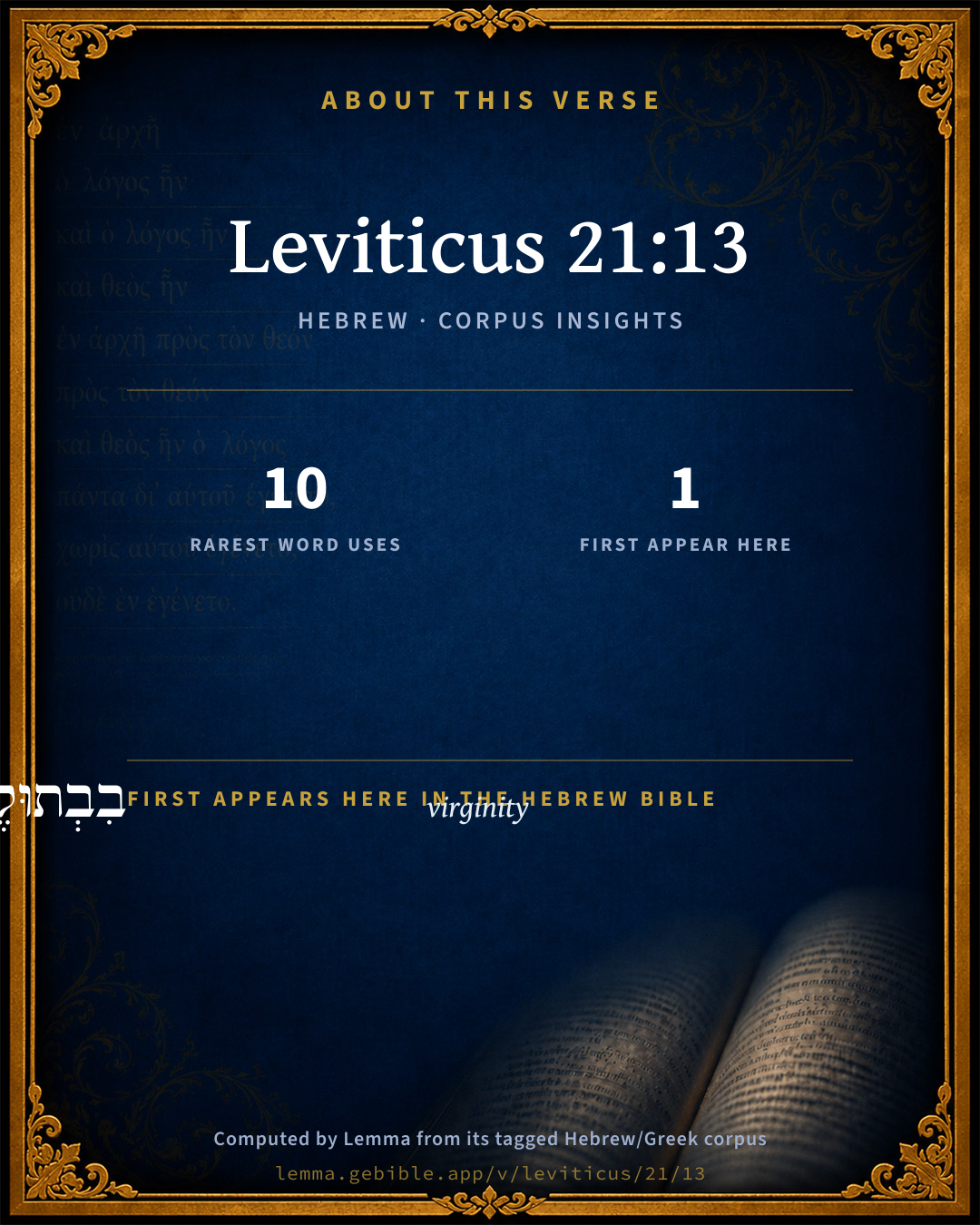
The rarest word here is בִבְתוּלֶ֖יהָ virginity H1331 — appearing just 10 times in the whole Hebrew Bible.

First appearance in Scripture

This word makes its first canonical appearance in the Hebrew Bible here:

  • בִבְתוּלֶ֖יהָ virginity H1331

Shared distinctive vocabulary

בִבְתוּלֶ֖יהָ virginity H1331 occurs in 9 verses of the Hebrew Bible. Also found in:

Grammatical profile

  • 1 verb
  • 2 nouns
  • 1 pronoun

Verb forms

  • יִקָּֽח Qal · Imperfect

Hebrew & Septuagint length

In English translation the verse runs 8 words from the Hebrew and 12 from the Septuagint (LXX English) — the Septuagint runs noticeably longer here. See the side-by-side →

A rough comparison of the two English renderings, which tokenize alike — not a word-level alignment.

Word counts can differ between the Hebrew and the Greek without any difference in meaning — e.g. the Hebrew direct-object marker אֵת has no separate Greek word, and Greek often adds the article ὁ.

Cross-references

4

Topical passages linked to Leviticus 21:13 in the Treasury of Scripture Knowledge — connected by theme and wording, ordered by reader-vote popularity; previews shown in the World English Bible.

  • Leviticus 21:7 "'They shall not marry a woman who is a prostitute, or profane; neither shall they marry a woman divorced from her husband: for he is holy to his God.
  • Ezekiel 44:22 Neither shall they take for their wives a widow, nor her who is put away; but they shall take virgins of the seed of the house of Israel, or a widow who is the widow of a priest.
  • 2 Corinthians 11:2 For I am jealous over you with a godly jealousy. For I married you to one husband, that I might present you as a pure virgin to Christ.
  • Revelation 14:4 These are those who were not defiled with women, for they are virgins. These are those who follow the Lamb wherever he goes. These were redeemed by Jesus from among men, the first fruits to God and to the Lamb.

Cross-references courtesy of OpenBible.info (CC BY 4.0).

Hebrew and Greek witnesses Masoretic Hebrew ↔ Greek Septuagint

The same verse in the two great witnesses to the Old Testament, shown verse-for-verse.

Here the Septuagint runs noticeably longer than the Hebrew — LXX2012 (modern English Septuagint) 12 words vs World English Bible 8. A rough length comparison of the two English translations, not a word-level alignment — read both below.

These are two independent witnesses, not word-aligned to each other, and the Septuagint is shown in lemma (dictionary) form.

Hebrew Leviticus 21:13 Masoretic · Westminster Leningrad Codex

וְה֕וּא אִשָּׁ֥ה בִבְתוּלֶ֖יהָ יִקָּֽח

"'He shall take a wife in her virginity.

World English Bible · Public Domain

Greek LXX Leviticus 21:13 Septuagint · lemma form

οὗτος γυνή παρθένος ἐκ ὁ γένος αὐτός λαμβάνω

He shall take for a wife a virgin of his own tribe.

LXX2012 (modern English Septuagint) · Public Domain

On this verse, Ellicott's Commentary for English Readers discusses the Septuagint’s reading. Read the note in Commentary ↓

Hebrew: Westminster Leningrad Codex (CC BY 4.0). Greek: Septuagint (public domain); English from LXX2012 (modern English Septuagint) (Public Domain). How the Septuagint differs from the Hebrew →

Targum (Aramaic paraphrase)

2

The Targum is the ancient Jewish Aramaic paraphrase of the Hebrew Scriptures — an interpretive translation, not the Hebrew text itself. Onkelos (literal) and Pseudo-Jonathan (expansive) render the Torah, and Jonathan the Prophets. Coverage is partial: where no permissively-licensed English translation exists for a verse, only the Aramaic is shown. This is verse-level text, not a word-by-word alignment to the Hebrew.

  1. Targum Onkelos Torah (Genesis–Deuteronomy)
    וְהוּא אִתְּתָא בִבְתֻלְתָּהָא יִסָב

    (no public-domain English translation for this verse)

    Targum Onkelos — Aramaic: “Onkelos Genesis” (public domain); “Onkelos Exodus” (public domain); “Onkelos Leviticus” (public domain); “Onkelos Numbers” (public domain); “Onkelos Deuteronomy” (public domain). English: “Sefaria Community Translation” (CC0 1.0 (public-domain dedication)); “J.W. Etheridge. The Targums of Onkelos and Jonathan Ben Uzziel on the Pentateuch. London: Longmans, Green, 1862” (public domain). Text via Sefaria.

  2. Targum Pseudo-Jonathan Torah (Genesis–Deuteronomy)
    וְהוּא אִיתָא דְאִית בָּהּ בְּתוּלָהָא יִסַב

    And he shall take a wife who is in her virginity;

    Targum Pseudo-Jonathan — Aramaic: “Targum Jonathan on Genesis” (public domain); “Targum Jonathan on Exodus” (public domain); “Targum Jonathan on Leviticus” (public domain); “Targum Jonathan on Numbers” (public domain); “Targum Jonathan on Deuteronomy” (public domain). English: “The Targum of Jonathan ben Uzziel, trans. J. W. Etheridge, London, 1862” (public domain). Text via Sefaria.

Commentary

Notes on Leviticus 21:13 from classic Christian and Jewish commentators (each source and its license shown beneath its notes). The classic Christian expositions comment on the surrounding passage and are grouped to its opening verse, so a note may address several verses; the Jewish commentaries on the Tanakh (Rashi and others) are per-verse, so they appear only where the commentator wrote on this verse.

Lemma curates 59 commentaries, every one of them public domain or Creative Commons licensed, each selected and text-cleaned for this edition rather than reprinted as found. About our sources →

Trapp's Complete Commentary

John Trapp

Lev 21:13 And he shall take a wife in her virginity.

Ver. 13. In her virginity.] Such is Christ’s wife, {2Co 11:1-33 : 2Ki 14:4 Mat 25:1-13} not giving her love, or his worship to any other.

John Trapp, A Commentary or Exposition upon All the Books of the Old and New Testament (1647–1656) — public domain. Text from a community e-Sword module.

Joseph Benson's Commentary

Lev 21:13. In her virginity — Or, a virgin, partly because, as he was a type of Christ, so his wife was a type of the church, which is compared to a virgin; and partly for greater caution and assurance that his wife was not a defiled or deflowered person. Most of these things are forbidden to all the priests; and here to the high-priest, to show that he also, and he especially, is obliged to the same cautions.

Joseph Benson's Commentary on the Old and New Testaments (1811–1818) — public domain. Text from a community e-Sword module.

Adam Clarke's Commentary

Verse 13. He shall take a wife in her virginity.] בתוליה bethuleyha. This is a full proof that בתולה bethulah is the proper Hebrew term for a virgin; from the emphatic root בתל bathal, to separate; because such a person was in her separate state, and had never been in any way united to man.

Adam Clarke's Commentary on the Bible (1810–1826) — public domain. Text from a community e-Sword/MySword module.

Ellicott's Commentary for English Readers

(13) A wife in her virginity.—From this verse the administrators of the Law during the second Temple concluded that (1) the high priest must be the husband of one wife, though the ordinary priests might have several; (2) that she must be a virgin, under the age of thirteen; (3) that she must not even have been betrothed to another person; and that (4) she must be the daughter of Jewish parents by race, as it is stated in the next verse, though the ordinary priest was allowed to marry the daughter of proselytes. The first of these enactments is also enjoined by St. Paul on Christian bishops (1Ti_3:2; Tit_1:16); whilst the fourth is actually expressed in the Greek version (LXX.), which has at the end of the verse, “of his own race.”

A Bible Commentary for English Readers, edited by Charles John Ellicott (1878–1897) — public domain. Text from a community e-Sword module.

John Gill's Exposition

And he shall take a wife in her virginity. One, and not two, or more, as Ben Gersom observes; and so Maimonides says (q), an high priest might never take two women together; for it is said, "a wife", or "woman", one, and not two; and so it is explained in the Talmud (r); for though polygamy was practised by the Israelites, and even by the common priests, yet these writers suppose it was by no means allowed to an high priest: among the Egyptians, though they took as many wives as they pleased, their priests, married but one (s); and so a minister of the New Testament is to be the husband of one wife, Ti1 3:2; and this wife the high priest was to take was to be a "virgin", one that not only had never known a man, but that was never betrothed to any; yea, according to the Talmudists (t), who was not quite ripe for marriage, or the time of her puberty not fully completed, which was the age of twelve years; within, or somewhat before that time, the high priest was to marry her, that it might be out of all doubt that she was a pure virgin; since it is said, "in her virginity", within the time of her puberty, before it was quite up; this, by many, is thought to be an emblem of Christ and his church; as he was typified by the high priest, so the church by the virgin he married, which is espoused to Christ as a chaste virgin, Co2 11:2.

(q) Hilchot Issure Biah, c. 17. sect. 13. (r) T. Bab. Yebamot, fol. 59. 1. (s) Diodor. Sicul. l. 1. p. 72. (t) T. Bab. Yebamot, ibid. Maimon. ut supra. (Cele Hamikdash, c. 5. sect. 5, 6.)

John Gill's Exposition of the Whole Bible (1746–1763) — public domain (CC PDM 1.0). Text via the HelloAO Bible API.

Haydock's Catholic Bible Commentary

Wife. Josephus says he could not divorce her. The Rabbins allow him only one wife at a time. It is said that Joiada had two. But that might be successively; and it is not certain that he was the high priest; (2 Paralipomenon xxiv. 3.; Calmet) though he has that title in the Vulgate, 2 Paralipomenon xxii. 11. (Haydock) --- His wife must be an Isrealite. The Septuagint intimates, "of his own race." But this is denied by others. He could not marry his brother’s widow, (Selden) nor a girl under twelve and a half. "The Egyptian priests marry only one, while others have as many wives as they please." (Diodorus i.) (Calmet)

George Leo Haydock (1774–1849), Haydock's Catholic Family Bible and Commentary, 1859 edition — public domain. Excludes Psalms (Douay-Rheims chapter numbering differs from Protestant) and Deuterocanonical books (Catholic canon only).

Matthew Poole's English Annotations

Or, a virgin, partly for the decency of the type, because as he was a type of Christ, so his wife was a type of the church, which is compared to a virgin, 2Co 11:2; Rev 14:4; and partly for greater caution and assurance that his wife was not a defiled or defloured person. This and the following rule belong not to all the priests, for then this were a gross tautology, these same things, or most of them, being expressly forbidden to them, Lev 21:7, but only to the high priest, to show that he also, and he especially, is obliged to the same cautions.

Matthew Poole's English Annotations on the Holy Bible (1683–1685) — public domain. Text from a community e-Sword/MySword module.

Whedon's Commentary on the Bible

Daniel D. Whedon

13, 14.

A wife in her virginity — The high priest’s range of choice is made narrower than the priest’s by the elimination of the widows and non-Israelites. His marriage with a virgin beautifully sets forth the character of the Church of Christ espoused unto her Lord as a “chaste virgin.” See 2Co_11:2. Hindoo priests can marry only virgins. This law was probably borrowed from Judaism. If the Hebrew high priest married outside of the prescribed limits, he profaned his seed, or disqualified his sons for the priesthood. This penalty was sufficient to deter the high priest, or the candidates for this office, from violation of this precept.

Daniel D. Whedon (gen. ed.), Commentary on the Old and New Testaments (1874–1909) — public domain. Text from a community e-Sword module.

John Wesley's Explanatory Notes

In her virginity - Or, a virgin, partly because as he was a type of Christ, so his wife was a type of the church, which is compared to a virgin, and partly for greater caution and assurance that his wife was not a defiled or deflowered person. Most of these things are forbidden to all the priests; and here to the high-priest, to shew that he also, and he especially is obliged to the same cautions.

John Wesley, Explanatory Notes Upon the Whole Bible (1754–1765) — public domain. Text via the GEBible commentary corpus.

Keil & Delitzsch

C. F. Keil & F. Delitzsch

He was only to marry a woman in her virginity, not a widow, a woman put away, or a fallen woman, a whore (זונה without a copulative is in apposition to חללה a fallen girl, who was to be the same to him as a whore), but "a virgin of his own people," that is to say, only an Israelitish woman.

Keil & Delitzsch — Biblical Commentary on the Old Testament (1861–1891) — public domain (CC PDM 1.0). Text via the HelloAO Bible API. (Old Testament only.)

Kretzmann's Popular Commentary

Paul E. Kretzmann

Wives of Priests; Blemishes

v. 13. And he shall take a wife in her virginity, a pure virgin.

v. 14. A widow, or a divorced woman, or profane, a fallen woman, or an harlot, these shall he not take,

v. 7. but he shall take a virgin of his own people to wife, a daughter of Israel.

v. 15. Neither shall he profane his seed among his people by being joined in wedlock in a way which would not harmonize with the sanctity of his position; for I, the Lord, do sanctify him.

v. 16. And the Lord spake unto Moses, saying,

v. 17. Speak unto Aaron, saying, Whosoever he be of thy seed in their generations, among all his coming descendants, that hath any blemish, any bodily defect, let him not approach to offer the bread of his God, the sacrifices in general, for these culminated in the showbread.

v. 18. For whatsoever man he be that hath a blemish, he shall not approach: a blind man, or a lame, or he that hath a flat nose, misshapen or slit, or anything superfluous, abnormal members of the body,

v. 19. or a man that is broken-footed, that has broken-down arches, or broken-handed,

v. 20. or crookbacked, one that has a hump, or a dwarf, one that is abnormally slender, or that hath a blemish in his eye, that is, a white spot conspicuous enough to draw attention, or be scurvy, affected with a growth which resembled leprosy,or scabbed, with a disfiguring skin-disease, or hath his stones broken, affected with a disease of the sexual organs;

v. 21. no man that hath a blemish of the seed of Aaron, the priest, shall come nigh to offer the offerings of the Lord made by fire; he hath a blemish; he shall not come nigh to offer the bread of his God, he was excluded from the characteristic work of the priesthood.

v. 22. He shall eat the bread of his God, both of the most holy, Lev 2:3, and of the holy, of the wave-breast and of the heave-shoulder, of first-fruits, tithes, and gifts. This compassionate provision compensated, in a way, for the exclusion of these men from active service in the Sanctuary.

v. 23. Only he shall not go in unto the veil, nor come nigh unto the altar, he shall not discharge the official functions of the high priest or of the priests, because he hath a blemish; that he profane not My sanctuaries; for I, the Lord, do sanctify them.

v. 24. And Moses told it unto Aaron and to his sons and unto all the children of Israel; for the entire congregation was interested in the observance of these ordinances. In the New Testament the congregation of the believers is even more interested in the keeping of God’s ordinances, because the discrimination between a special priesthood and a laity no longer exists, and every member is responsible for matters of doctrine and of life.

Paul E. Kretzmann, Popular Commentary of the Bible (1921–1924) — public domain. Text from a community e-Sword module.

unfoldingWord translationNotes

Door43 World Missions Community

from his own people

"from among his own tribe, the tribe of Levi"

he will not defile his children among his people

By marrying an unholy or ungodly woman, the priest would have children unworthy to be priest. AT: "that he will not have unworthy children by marrying an ungodly woman" (See: Idiom)

translationWords

virgin

divorce

prostitute

kind

obey

defile

children

holy

unfoldingWord translationNotes — © Distant Shores Media and the Door43 World Missions Community, licensed CC BY-SA 4.0. Source: git.door43.org/Door43/en_tn.

Ramban (Nachmanides)

Rabbi Moshe ben Nachman (Ramban / Nachmanides)

AND HE SHALL TAKE A WIFE IN HER VIRGINITY. This means that he is not to wed a woman who is not a virgin, this being a negative commandment which is derived from a positive commandment [which carries the force of a positive commandment]. to marry a woman who is not a virgin. And the reason why it is stated in a positive form, is to make the negative aspect of it carry the force of a positive commandment, because it is an accepted principle that a negative commandment which is derived from a positive commandment carries only the force of a positive commandment. Therefore if he marries a woman who is not a virgin, he does not incur whipping, since the prohibition thereof is derived from a positive commandment, and only carries the force of a positive commandment, for the violation of which the court is not empowered to mete out punishment. This interpretation is made necessary by the following Verse 14, where it is stated again, but a virgin of his own people shall he take to wife. As Ramban will explain further on, it is this expression in Verse 14 which established the positive aspect thereof, while Verse 13 before us expresses the prohibitive part thereof. Thus the two verses are not redundant, but instead complement each other. Afterwards [in the following verse] He forbids the High Priest by means of a negative commandment to marry a widow or other disqualified woman, and then says, but a virgin of his own people shall he take to wife, thus commanding him [in a positive manner] to take a virgin as a wife. It is this which our Rabbis have said: “He is forbidden [to marry] a widow, and he is commanded to marry a virgin.” And so the Rabbis taught in the Torath Kohanim: 2:6. “But a virgin. This teaches that he is commanded to marry a virgin.”

Ramban (Nachmanides) on the Tanakh — English translation: “Commentary on the Torah by Ramban (Nachmanides). Translated and annotated by Charles B. Chavel. New York, Shilo Pub. House, 1971-1976” (CC BY 4.0). Text via Sefaria.

Lesson kit

Teaching starters — assembled from the data on this page, not authored interpretation. Every prompt links to the verse data it draws on. Edit before teaching.

Leviticus, in the Pentateuch, opens this verse with 4 words (4 distinct Hebrew lemmas). Its most distinctive word is bᵉthûwlîym (“virginity”). The Greek Septuagint runs longer here. A historical commentator’s framing appears above. Read the whole chapter for the surrounding context.

Discussion questions

  1. How does “virginity” (bᵉthûwlîym) shape what this verse is saying?
  2. This is the first place “virginity” appears in Scripture (first appears here). What does its debut here establish?
  3. How does Deuteronomy 22:14, which shares the word «virginity», read alongside this verse?
  4. The Septuagint runs longer here than the Hebrew. What might account for the difference?
  5. The translations on this page render this verse differently — a whole-verse word diff, not a word-by-word alignment. What might account for the different wordings?
  6. «יִקָּֽח» is a Qal Imperfect verb. How does that grammatical form shape the action described?
  7. Compare how Trapp's Complete Commentary and Joseph Benson's Commentary read this verse. Where do they agree or differ?

Things to notice

  • 1 word makes its first canonical appearance in Scripture here.
  • These translations choose different wording for 1 word in this verse.
  • 4 distinct Hebrew lemmas span 4 words in this verse.

Reading settings

Reading text

Shown beneath each verse's original-language words.

Old Testament
Old Testament edition

Read the OT as the Masoretic Hebrew (MT) or the Greek Septuagint (LXX).

English shown for the Greek Septuagint (in the Hebrew ↔ Greek comparison).

Comparing translations? Open the Compare panel on any verse page to stack up to four side by side.