Joshua 10:41

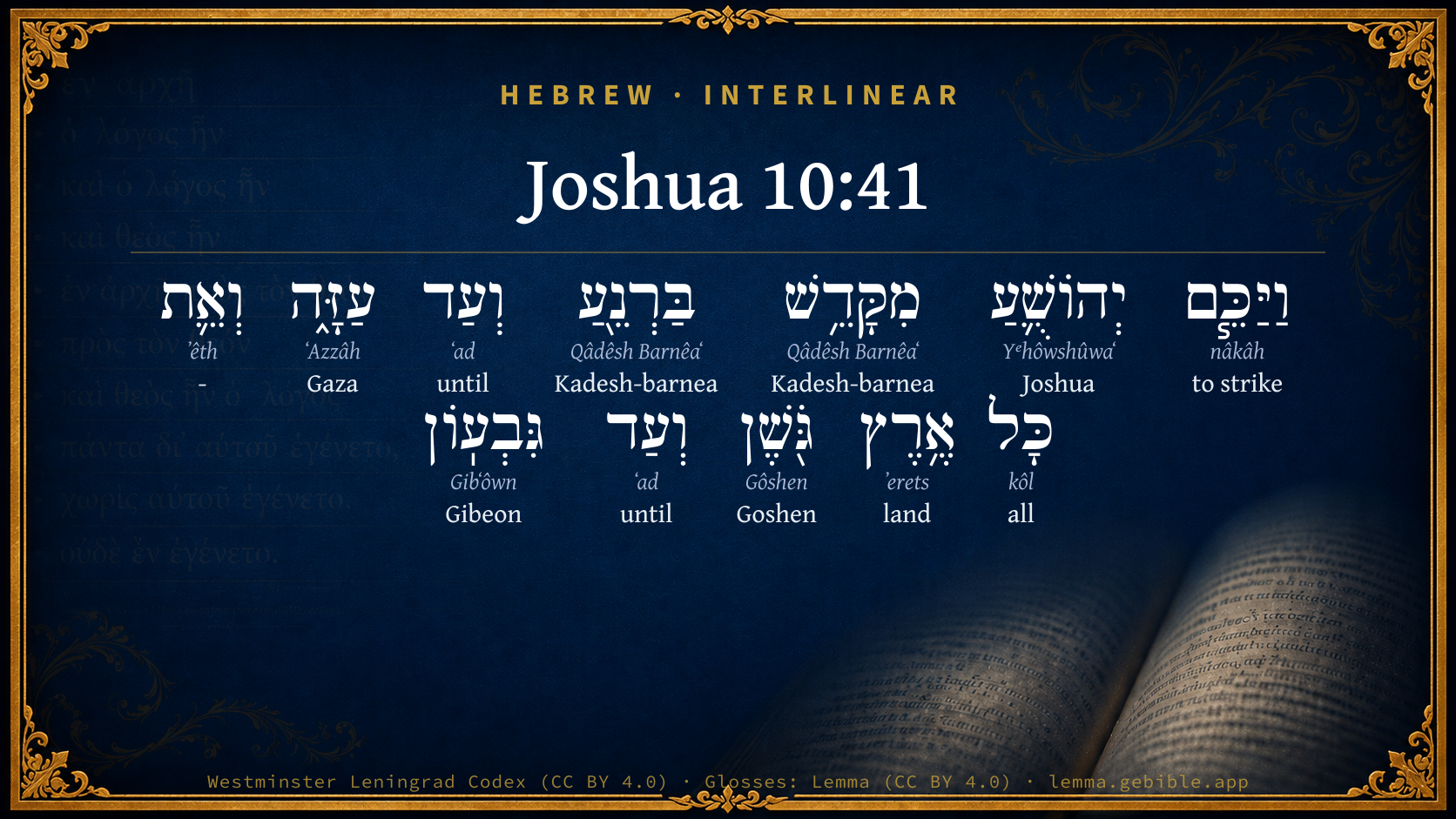
Hebrew (Westminster Leningrad Codex) Joshua 10:41 appears in the Hebrew Old Testament. The text above is from the Westminster Leningrad Codex. Each word links to its Strong’s number, a concise gloss, and parsing drawn from the Open Scriptures Hebrew Bible morphology. Click any word for its full Brown-Driver-Briggs (BDB) entry.
Download image
Cite this verse

Joshua 10:41 (World English Bible). Public Domain. Lemma interlinear Bible study tool, https://lemma.gebible.app/v/joshua/10/41.

Show BibTeX & RIS
BibTeX
RIS
English Translation
Joshua struck them from Kadesh-barnea even to Gaza, and all the country of Goshen, even to Gibeon.
World English Bible · Public Domain
Download a study sheet

One document with this verse’s original text, its word-by-word gloss line, the meaning frame, cross-references with their text, attributed commentary, and full source and license credits — printable, and it pastes into notes with its structure intact.

This verse Autodidact and up

Study sheet (.html) Plain text (.txt)

A passage Seminary Student

Up to 50 verses in one chapter. A passage sheet keeps up to 6 commentary sources and 12 cross-references per verse, in the order this page ranks them, and says so on the sheet whenever that leaves anything out. Ask for a single verse and you get the Autodidact verse sheet above.

Everything on this page stays free to read, with no account — the sheet is a download of what is already on screen, not access to it.

Want to remove ads? Support Godless Engineer
Compare translations 3

The same verse in 3 English versions, stacked beneath the original-language interlinear above. Click any original word for its lexicon entry.

Each is an independent rendering of the whole verse — the interlinear is not word-aligned to these translations.

Highlighted words mark where these versions differ — a whole-verse word diff, not a word-by-word alignment.

  • World English Bible Public Domain
    Joshua struck them from Kadesh-barnea even to Gaza, and all the country of Goshen, even to Gibeon.
  • King James Version Public Domain
    And Joshua smote them from Kadeshbarnea even unto Gaza, and all the country of Goshen, even unto Gibeon.
  • unfoldingWord Literal Text CC BY-SA 4.0
    And Joshua struck them from Kadesh Barnea and unto Gaza, and all of the land of Goshen and unto Gibeon.

unfoldingWord Literal Text — © unfoldingWord, licensed CC BY-SA 4.0. Word-aligned USFM3 via Door43 (git.door43.org/unfoldingWord/en_ult).

Versions to compare (up to 4)

3 of 4 selected

Show all 18 translations

Every available English version of this verse, each an independent rendering of the whole verse.

  • World English Bible Public Domain
    Joshua struck them from Kadesh-barnea even to Gaza, and all the country of Goshen, even to Gibeon.
  • Berean Standard Bible Public Domain
    Joshua conquered the area from Kadesh-barnea to Gaza, and the whole region of Goshen as far as Gibeon.
  • Majority Standard Bible Public Domain
    Joshua conquered the area from Kadesh-barnea to Gaza, and the whole region of Goshen as far as Gibeon.
  • King James Version Public Domain
    And Joshua smote them from Kadeshbarnea even unto Gaza, and all the country of Goshen, even unto Gibeon.
  • American Standard Version (1901) Public Domain
    And Joshua smote them from Kadesh-barnea even unto Gaza, and all the country of Goshen, even unto Gibeon.
  • Revised Version (1885) Public Domain
    And Joshua smote them from Kadesh-barnea even unto Gaza, and all the country of Goshen, even unto Gibeon.
  • Geneva Bible (1599) Public Domain
    And Ioshua smote them from Kadesh-barnea euen vnto Azzah, and all the countrey of Goshen, euen vnto Gibeon.
  • Douay-Rheims (1899) Public Domain
    From Cadesbarne even to Gaza. All the land of Gosen even to Gabaon,
  • Young's Literal Translation Public Domain
    And Joshua smiteth them from Kadesh-Barnea, even unto Gaza, and all the land of Goshen, even unto Gibeon;
  • Literal Standard Version CC BY-SA 4.0
    And Joshua strikes them from Kadesh-Barnea, even to Gaza, and all the land of Goshen, even to Gibeon;
  • Unlocked Literal Bible CC BY-SA 4.0
    Joshua struck them from Kadesh Barnea to Gaza, and all the country of Goshen to Gibeon.
  • unfoldingWord Literal Text CC BY-SA 4.0
    And Joshua struck them from Kadesh Barnea and unto Gaza, and all of the land of Goshen and unto Gibeon.
  • Darby Bible Public Domain
    And Joshua smote them from Kadesh-barnea even to Gazah, and all the country of Goshen, even to Gibeon;
  • World Messianic Bible Public Domain
    Joshua struck them from Kadesh Barnea even to Gaza, and all the country of Goshen, even to Gibeon.
  • Webster's Bible Public Domain
    And Joshua smote them from Kadesh-barnea even to Gaza, and all the country of Goshen, even to Gibeon.
  • Free Bible Version CC BY-SA 4.0
    Joshua destroyed them from Kadesh-barnea to Gaza and the whole of the land from Goshen to Gibeon.
  • Bible in Basic English Public Domain
    Joshua overcame them from Kadesh-barnea to Gaza, and all the land of Goshen as far as Gibeon.
  • JPS Tanakh (1917) Public Domain
    And Joshua smote them from Kadesh-barnea even unto Gaza, and all the country of Goshen, even unto Gibeon.

Literal Standard Version (2020), Covenant Press — licensed CC BY-SA 4.0. Text via the HelloAO Bible API (eBible.org). Unlocked Literal Bible (unfoldingWord) — licensed CC BY-SA 4.0. Text via the HelloAO Bible API (eBible.org). unfoldingWord Literal Text — © unfoldingWord, licensed CC BY-SA 4.0. Word-aligned USFM3 via Door43 (git.door43.org/unfoldingWord/en_ult). Free Bible Version, Dr. Jonathan Gallagher — licensed CC BY-SA 4.0. Text via the HelloAO Bible API (eBible.org).

Word by word

More ways to search: Search by grammar → Find every occurrence → Compare this word →

Practice this passage: Drill this verse → Learn its vocabulary →

גֹּ֖שֶׁן
Gôshen
H1657
“Goshen”
Noun, Proper
Part of Speech
Noun
Type
Proper
Full BDB Definition

Origin: probably of Egyptian origin

TWOT: 390

Goshen = "drawing near" - a region in northern Egypt, east of the lower Nile, where the children of Israel lived from the time of Joseph to the time of Moses - a district in southern Palestine between Gaza and Gibeon - a town in the mountains of Judah probably in the district of Goshen
  1. וַיַּכֵּ֧ם nâkâh H5221 “and · to strike · them” Conjunction + Verb, Hiphil, Sequential Imperfect, 3rd Person, Masculine, Singular + Suffix, Personal, 3rd Person, Masculine, Plural
  2. יְהוֹשֻׁ֛עַ Yᵉhôwshûwaʻ H3091 “Joshua” Noun, Proper
  3. מִקָּדֵ֥שׁ Qâdêsh Barnêaʻ H6947 “from · Kadesh-barnea” Preposition + Noun, Proper
  4. בַּרְנֵ֖עַ Qâdêsh Barnêaʻ H6947 “Kadesh-barnea” Noun, Proper
  5. וְעַד ʻad H5704 “and · until” Conjunction + Preposition
  6. עַזָּ֑ה ʻAzzâh H5804 “Gaza” Noun, Proper
  7. וְאֵ֛ת ʼêth H853 “and · -” Conjunction + Particle, Direct Object
  8. כָּל kôl H3605 “all of” Noun, Common, Masculine, Singular, Construct
  9. אֶ֥רֶץ ʼerets H776 “land of” Noun, Common, Both, Singular, Construct
  10. וְעַד ʻad H5704 “and · until” Conjunction + Preposition
  11. גִּבְעֽוֹן Gibʻôwn H1391 “Gibeon” Noun, Proper

About this verse

These counts appear in no published source. They are computed here, from the morphology-tagged text and Lemma’s own curated glosses. What Lemma adds →

12
words
10
distinct lemmas
Historical
section

Notable vocabulary

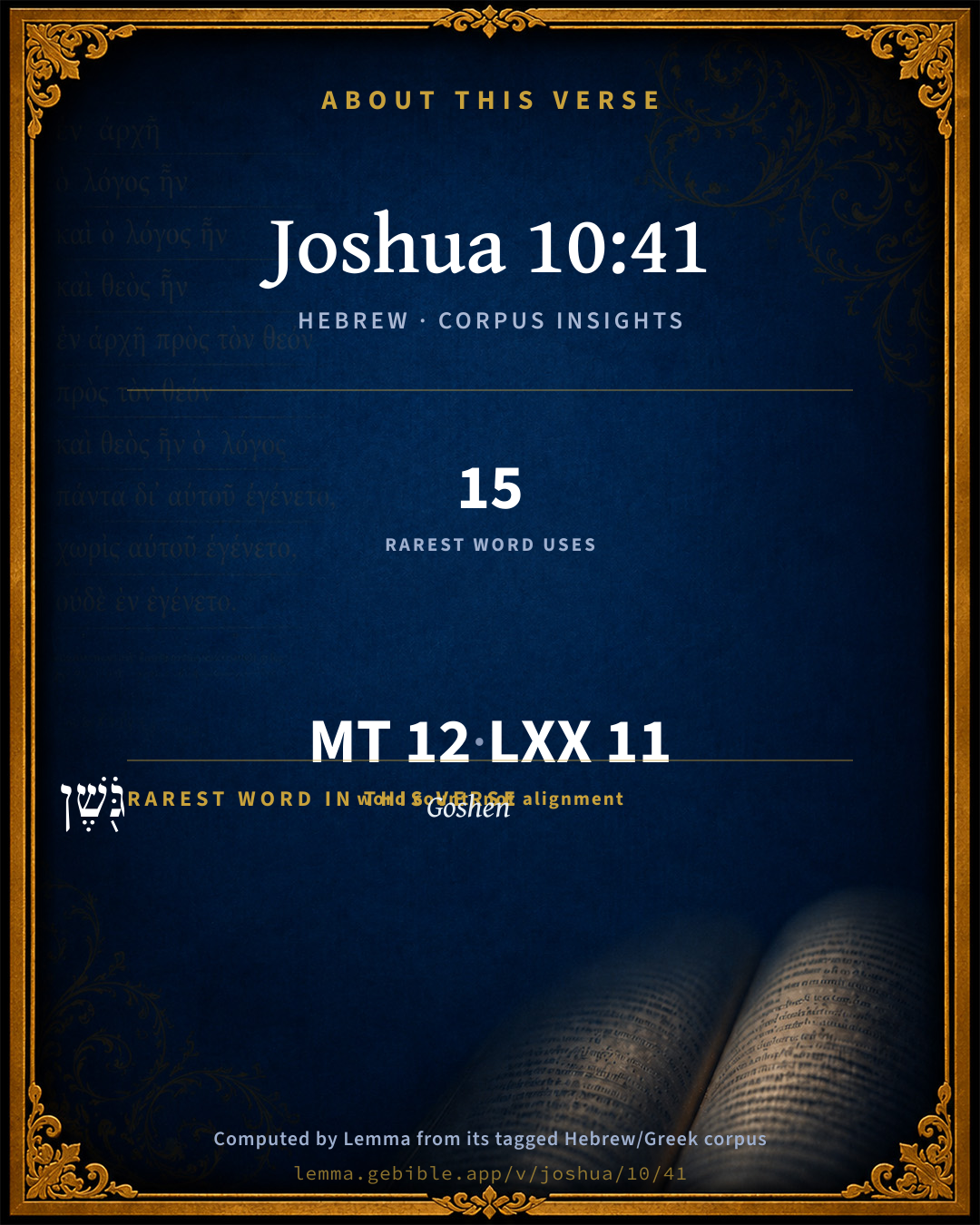
The rarest word here is גֹּ֖שֶׁן Goshen H1657 — appearing just 15 times in the whole Hebrew Bible.

Shared distinctive vocabulary

גֹּ֖שֶׁן Goshen H1657 occurs in 14 verses of the Hebrew Bible. Also found in:

Grammatical profile

  • 1 verb
  • 8 nouns
  • 2 prepositions
  • 1 particle

Verb forms

  • וַיַּכֵּ֧ם Hiphil · Sequential Imperfect

Repetition

Words recur within this verse — often emphatic in Hebrew:

  • מִקָּדֵ֥שׁ Kadesh-barnea H6947 ×2
  • וְעַד until H5704 ×2

Hebrew & Septuagint length

In English translation the verse runs 17 words from the Hebrew and 11 from the Septuagint (LXX English) — the Septuagint runs noticeably shorter here. See the side-by-side →

A rough comparison of the two English renderings, which tokenize alike — not a word-level alignment.

Word counts can differ between the Hebrew and the Greek without any difference in meaning — e.g. the Hebrew direct-object marker אֵת has no separate Greek word, and Greek often adds the article ὁ.

In the original languages it is 12 Hebrew tokens and 11 Greek tokens — but the two are counted differently (Hebrew bundles its prefixes and suffixes into one token; the Greek is in lemma form), so that isn’t a like-for-like length.

Cross-references

16

Topical passages linked to Joshua 10:41 in the Treasury of Scripture Knowledge — connected by theme and wording, ordered by reader-vote popularity; previews shown in the World English Bible.

  • Joshua 11:16 So Joshua took all that land, the hill-country, and all the South, and all the land of Goshen, and the lowland, and the Arabah, and the hill-country of Israel, and the lowland of the same;
  • Joshua 15:51 and Goshen, and Holon, and Giloh; eleven cities with their villages.
  • Genesis 10:19 The border of the Canaanites was from Sidon, as you go toward Gerar, to Gaza; as you go toward Sodom, Gomorrah, Admah, and Zeboiim, to Lasha.
  • Deuteronomy 9:23 When Yahweh sent you from Kadesh-barnea, saying, Go up and possess the land which I have given you; then you rebelled against the commandment of Yahweh your God, and you didn't believe him, nor listen to his voice.
  • Numbers 13:26 They went and came to Moses, and to Aaron, and to all the congregation of the children of Israel, to the wilderness of Paran, to Kadesh; and brought back word to them, and to all the congregation, and shown them the fruit of the land.
  • Numbers 32:8 Thus did your fathers, when I sent them from Kadesh-barnea to see the land.
  • Numbers 34:4 and your border shall turn about southward of the ascent of Akrabbim, and pass along to Zin; and the goings out of it shall be southward of Kadesh-barnea; and it shall go forth to Hazar Addar, and pass along to Azmon;
  • Joshua 10:2 that they feared greatly, because Gibeon was a great city, as one of the royal cities, and because it was greater than Ai, and all the men of it were mighty.
  • Joshua 10:12 Then spoke Joshua to Yahweh in the day when Yahweh delivered up the Amorites before the children of Israel; and he said in the sight of Israel, Sun, stand you still on Gibeon; You, Moon, in the valley of Aijalon.
  • Joshua 14:6–7 Then the children of Judah drew near to Joshua in Gilgal: and Caleb the son of Jephunneh the Kenizzite said to him, You know the thing that Yahweh spoke to Moses the man of God concerning me and concerning you in Kadesh-barnea.
  • Judges 16:1 Samson went to Gaza, and saw there a prostitute, and went in to her.
  • Judges 16:21 The Philistines laid hold on him, and put out his eyes; and they brought him down to Gaza, and bound him with fetters of brass; and he did grind in the prison-house.
  • 1 Samuel 6:17 These are the golden tumors which the Philistines returned for a trespass-offering to Yahweh: for Ashdod one, for Gaza one, for Ashkelon one, for Gath one, for Ekron one;
  • 1 Kings 3:5 In Gibeon Yahweh appeared to Solomon in a dream by night; and God said, Ask what I shall give you.
  • Zechariah 9:5 Ashkelon will see it, and fear; Gaza also, and will writhe in agony; As will Ekron, for her expectation will be disappointed; And the king will perish from Gaza, And Ashkelon will not be inhabited.
  • Acts 8:26 But an angel of the Lord spoke to Philip, saying, "Arise, and go toward the south to the way that goes down from Jerusalem to Gaza. This is a desert."

Cross-references courtesy of OpenBible.info (CC BY 4.0).

Hebrew and Greek witnesses Masoretic Hebrew ↔ Greek Septuagint

The same verse in the two great witnesses to the Old Testament, shown verse-for-verse.

Here the Septuagint runs noticeably shorter than the Hebrew — LXX2012 (modern English Septuagint) 11 words vs World English Bible 17. A rough length comparison of the two English translations, not a word-level alignment — read both below.

These are two independent witnesses, not word-aligned to each other, and the Septuagint is shown in lemma (dictionary) form.

Hebrew Joshua 10:41 Masoretic · Westminster Leningrad Codex

וַיַּכֵּ֧ם יְהוֹשֻׁ֛עַ מִקָּדֵ֥שׁ בַּרְנֵ֖עַ וְעַד עַזָּ֑ה וְאֵ֛ת כָּל אֶ֥רֶץ גֹּ֖שֶׁן וְעַד גִּבְעֽוֹן

Joshua struck them from Kadesh-barnea even to Gaza, and all the country of Goshen, even to Gibeon.

World English Bible · Public Domain

Greek LXX Joshua 10:41 Septuagint · lemma form

ἀπό καδης βαρνη ἕως γάζα πᾶς ὁ γοσομ ἕως ὁ γαβαων

from Cades Barne to Gaza, all Gosom, as far as Gabaon.

LXX2012 (modern English Septuagint) · Public Domain

Hebrew: Westminster Leningrad Codex (CC BY 4.0). Greek: Septuagint (public domain); English from LXX2012 (modern English Septuagint) (Public Domain). How the Septuagint differs from the Hebrew →

Targum (Aramaic paraphrase)

1

The Targum is the ancient Jewish Aramaic paraphrase of the Hebrew Scriptures — an interpretive translation, not the Hebrew text itself. Onkelos (literal) and Pseudo-Jonathan (expansive) render the Torah, and Jonathan the Prophets. Coverage is partial: where no permissively-licensed English translation exists for a verse, only the Aramaic is shown. This is verse-level text, not a word-by-word alignment to the Hebrew.

  1. Targum Jonathan Prophets (Joshua–Malachi)
    וּמְחָנוּן יְהוֹשֻׁעַ מֵרְקָם גֵיאָה וְעַד עַזָה וְיַת כָּל אֲרַע גּוֹשֶׁן וְעַד גִבְעוֹן:

    (no public-domain English translation for this verse)

    Targum Jonathan — Aramaic: “Mikraot Gedolot” (public domain). English: “Sefaria Community Translation” (CC0 1.0 (public-domain dedication)); “London "Chaldee Paraphrase," 1871” (public domain). Text via Sefaria.

Commentary

Notes on Joshua 10:41 from classic Christian and Jewish commentators (each source and its license shown beneath its notes). The classic Christian expositions comment on the surrounding passage and are grouped to its opening verse, so a note may address several verses; the Jewish commentaries on the Tanakh (Rashi and others) are per-verse, so they appear only where the commentator wrote on this verse.

Lemma curates 59 commentaries, every one of them public domain or Creative Commons licensed, each selected and text-cleaned for this edition rather than reprinted as found. About our sources →

Joseph Benson's Commentary

Jos 10:41. From Kadesh-barnea — Which lay in the south of Canaan, (Num 34:4; Deu 1:19,) and belonged to the tribe of Judah, Jos 15:3. Gaza was a city of the Philistines, in the south-west part. So he here signifies that Joshua did, in this expedition, subdue all those parts which lay south and west from Gilgal. All the country of Goshen — There was a city in the tribe of Judah of this name, which, like Hebron, was situated in the mountains, in the southern part of the country, (Jos 15:51,) from which city the adjacent region was called the country of Goshen. This tract was enriched with excellent pasture lands and plenteous streams, like that country in Egypt of the same denomination, and thence was called Goshen, as Pellicanus conjectures; because the Hebrew word geshem signifies copious showers, which impart fertility to the earth. Even unto Gibeon — Which was in the more northerly part of the country. And therefore, as the former account specified the conquests of Joshua from the south to the west, so here his conquests from the south to the north are related.

Joseph Benson's Commentary on the Old and New Testaments (1811–1818) — public domain. Text from a community e-Sword module.

Tyndale Open Study Notes

Tyndale Open Resources

10:41 This Goshen was not the region in Egypt’s Nile delta (Gen 47:27) but a town in the hill country (Josh 15:51) south of Jerusalem. From Goshen up to Gibeon describes the eastern reach of Joshua’s southern campaign.

Tyndale Open Study Notes — © Tyndale Open Resources, licensed CC BY-SA 4.0. Text via the HelloAO Bible API.

Adam Clarke's Commentary

Verse 41. And all the country of Goshen] Calmet contends that this was the very same country in which the Hebrews dwelt before their departure from Egypt; and according to this hypothesis he has constructed his map, causing it to extend from the Nile, which was called the river of Egypt, along the frontiers of the land of Cush or Arabia. It however appears plain that there was a city named Goshen in the tribe of Judah, see Jos 15:51; and this probably gave name to the adjacent country which may be that referred to above.

Adam Clarke's Commentary on the Bible (1810–1826) — public domain. Text from a community e-Sword/MySword module.

Ellicott's Commentary for English Readers

(41) From Kadesh-barnea (on the south-east) even unto Gaza (on the west, now Ghazzeh in Philistia), and all the country of Goshen (from the south to Gibeon in a northerly direction).

And all the country of Goshen.—This expression creates some difficulty. Goshen has been thought to be the town of that name mentioned in Jos_15:51; but it is inconceivable that a single place of no importance in the mountains of Judah should give the name to an extensive district, which is manifestly intended here. If we knew the exact northern boundary of the land of Goshen assigned for a distinct residence to Joseph’s brethren in Egypt, it might help to clear up the meaning of this passage. That Goshen, at its Egyptian end, bordered upon the Delta is clear. But how far did Goshen extend towards the north? In 1Ch_7:21-22, we find that Ephraim’s children in his lifetime made an incursion into Canaan as far as Gath. But this was during the time that Israel dwelt in the land of Goshen. Did they suppose that they were in the land of Goshen when they plundered the men of Gath? If Goshen (frontier) could be the general name for the border-land between Egypt and Palestine, we can understand that the borders might vary with the power of the Egyptian monarchy for the time being. The country of Goshen, unto Gibeon, seems to be described from south to north; Gibeon being intended as the northern boundary.

A Bible Commentary for English Readers, edited by Charles John Ellicott (1878–1897) — public domain. Text from a community e-Sword module.

The Cambridge Bible for Schools and Colleges

gen. ed. J. J. S. Perowne

41. from Kadesh-barnea] i.e. from the wilderness in which Kadesh-barnea lay. This place, the scene of Miriam’s death, was the furthest point which the Israelites reached in their direct road to Canaan. From it also the spies were sent forth (Num_13:17; Num_13:26), and there also, on their return, the people broke out into murmuring, and upon this their penal term of wandering began (Num_14:20-33; Deu_2:14).

even unto Gaza] In the Shephelah, and only about one hour from the Mediterranean Sea. This defines the limits of Joshua’s conquests on the west, Gaza being the last town in the S. W. of Palestine on the frontier towards Egypt. This town, properly Azzah, the name of which means “the strong,” appears even before the call of Abraham (Gen_10:19), as a “border” city of the Canaanites. We shall find the territory of Gaza mentioned afterwards, as one which Joshua was not able to subdue (Jos_11:22; Jos_13:3), and though assigned to the tribe of Judah (Jos_15:47), they did not obtain possession of it (Jdg_1:18-19).

all the country of Goshen] “Alle the lond of Josson,” Wyclif. This is not to be confounded with the province of Goshen (frontier) in Egypt. It was a district in the south of Judah, and probably derived its appellation from a town of that name, mentioned in company with Debir, Socoh, and others in the mountains of Judah (Jos_15:48-51).

even unto Gibeon] This marks the extent of the Conquest on the east.

The Cambridge Bible for Schools and Colleges (gen. ed. J. J. S. Perowne; Cambridge University Press, 1878–1918) — public domain. Text from a community e-Sword module.

John Gill's Exposition

And all these kings, and their land, did Joshua take at one time,.... Not in one day, but in a very short time, in a few days, as the history clearly shows:

because the Lord God of Israel fought for Israel; which is the true reason of such quick dispatch being made, otherwise in all probability much longer time must have been consumed in subduing them. The Targum is,"because the Lord God of Israel fought by his Word for Israel.''

John Gill's Exposition of the Whole Bible (1746–1763) — public domain (CC PDM 1.0). Text via the HelloAO Bible API.

Albert Barnes' Notes on the Bible

From Kadesh-barnea unto Gaza - Num 13:26 This limits Joshua’s conquests on the west, as the other line, “all the country of Goshen unto Gibeon,” does on the east. Goshen Jos 15:51 has not been identified. It was in the southern part of the territory of Judah, and is, of course, quite distinct from the Goshen of Gen 46:28.

Albert Barnes' Notes on the Bible (1834–1885) — public domain. Text from a community e-Sword/MySword module.

Haydock's Catholic Bible Commentary

Gaza. These cities were on the southern limits of the land of Chanaan, and of the Philistines. --- Gosen, or Gessen, where the Hebrews had formerly dwelt. It was then very fertile, chap. xiii. 3. The territory of Juda extended as far as the Nile; (Calmet) or this country may have resembled the country of Gessen, Genesis xlvi. (Menochius) --- It seems indeed rather wonderful, that if this was a part of the promised land, God should order his people to leave it, as it were, to the Egyptians; and father they had occupied another part of the country, should seize it again. But he might have secret reasons for this order. (Haydock)

George Leo Haydock (1774–1849), Haydock's Catholic Family Bible and Commentary, 1859 edition — public domain. Excludes Psalms (Douay-Rheims chapter numbering differs from Protestant) and Deuterocanonical books (Catholic canon only).

Matthew Poole's English Annotations

Kadesh-barnea lay in the south of Canaan, Num 34:4; Deu 1:19; Jos 15:3.

Gaza was in the south-west of Canaan. So he here signifies that Joshua did in this expedition subdue all those parts which lay south and west from Gilgal.

Goshen; not that Goshen in Egypt, but another in Judah, Jos 11:16; 15:51.

Matthew Poole's English Annotations on the Holy Bible (1683–1685) — public domain. Text from a community e-Sword/MySword module.

Whedon's Commentary on the Bible

Daniel D. Whedon

41. [Kadesh-barnea was a most important station in the southern border of the Holy Land, the starting-point of the forty years’ wandering, the place where Miriam died, and whence the spies went out to explore the Land of Promise. There has been uncertainty as to its exact location. Stanley proposes to identify it with Petra, the modern Wady Mousa; Robinson locates it at Ain el-Weibeh, twenty miles northwest of Mount Hor; but more recently Captain Palmer argues for the opinion first maintained by Dr. Rowlands, that the ancient Kadesh-barnea is represented by the modern Ain Gadis, a fountain in the plateau of Jebel Magrah, some forty miles west of Mount Hor. This view will probably gain general acceptance.] Gaza is still standing, and is a place larger than Jerusalem, situated on the Mediterranean Sea in Southern Palestine. It has been the scene of many remarkable events. See at Gen_10:19.

Country of Goshen — A city and district generally supposed to be in the mountains of Judah, though some think that it was on the plain. Its name suggests that it may have been founded by a colony from Goshen in Egypt.

Daniel D. Whedon (gen. ed.), Commentary on the Old and New Testaments (1874–1909) — public domain. Text from a community e-Sword module.

John Wesley's Explanatory Notes

Kadesh-barnea - Which lay in the south of Canaan, Num. xxxiv, 4 Deut. i, 19 chap. xv, 3. Gaza - Which was in the southwest of Canaan. So he here signifies, that Joshua did in this expedition subdue all those parts which lay south and west from Gilgal. Goshen - Not that Goshen in Egypt, but another in Judah.

John Wesley, Explanatory Notes Upon the Whole Bible (1754–1765) — public domain. Text via the GEBible commentary corpus.

Rashi

Rabbi Shlomo Yitzchaki (Rashi)

From Kadush-barnea to Gaza. This refers to the south side of Eretz Yisroel going from east to west, but he did not conquer the entire boundary, leaving unconquered the area from Gaza to the [Mediterranean] Sea. This is what is stated below, “This is the land that remained [unconquered], the Gazites and the Ashdodites”

Rashi on the Tanakh — English translations: “The Judaica Press complete Tanach with Rashi, translated by A. J. Rosenberg” (CC BY 4.0); “Pentateuch with Rashi's commentary by M. Rosenbaum and A.M. Silbermann, 1929-1934” (public domain); “The Metsudah Tanach series, Lakewood, N.J” (CC BY 4.0); and “The Book of Joshua, Metsudah Publications, 1997” (CC BY 4.0). Text via Sefaria.

Lesson kit

Teaching starters — assembled from the data on this page, not authored interpretation. Every prompt links to the verse data it draws on. Edit before teaching.

Joshua, in the Historical, opens this verse with 12 words (10 distinct Hebrew lemmas). Its most distinctive word is Gôshen (“Goshen”). The Greek Septuagint runs shorter here. A historical commentator’s framing appears above. Read the whole chapter for the surrounding context.

Discussion questions

  1. How does “Goshen” (Gôshen) shape what this verse is saying?
  2. Genesis 45:10 shares the word «Goshen» with this verse. How do the two illuminate each other?
  3. “Kadesh-barnea” occurs 2× in this one verse. What is the effect of the repetition?
  4. Compared with the Hebrew, the Septuagint runs shorter here. What questions does that raise?
  5. These translations render this verse differently; the difference is in the English rendering, not the original. What questions does that raise?
  6. The verb «וַיַּכֵּ֧ם» is Hiphil Sequential Imperfect. How does its form color the action?
  7. Reading how Joseph Benson's Commentary and Tyndale Open Study Notes read this verse, where do the two commentators agree and where do they part?

Things to notice

Reading settings

Reading text

Shown beneath each verse's original-language words.

Old Testament
Old Testament edition

Read the OT as the Masoretic Hebrew (MT) or the Greek Septuagint (LXX).

English shown for the Greek Septuagint (in the Hebrew ↔ Greek comparison).

Comparing translations? Open the Compare panel on any verse page to stack up to four side by side.