Song of Solomon 4:14

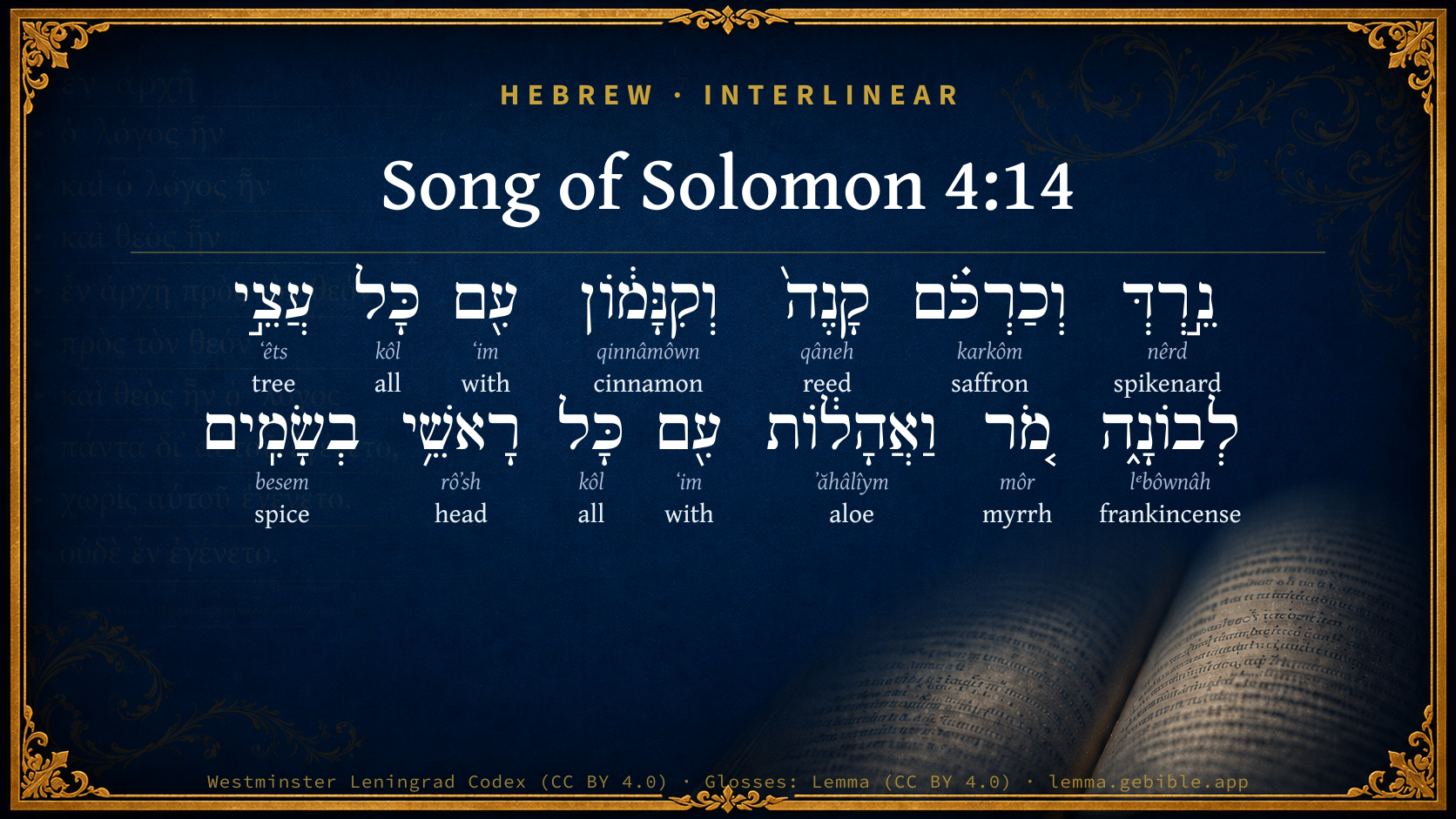
Hebrew (Westminster Leningrad Codex) Song of Solomon 4:14 appears in the Hebrew Old Testament. The text above is from the Westminster Leningrad Codex. Each word links to its Strong’s number, a concise gloss, and parsing drawn from the Open Scriptures Hebrew Bible morphology. Click any word for its full Brown-Driver-Briggs (BDB) entry.
Download image
Cite this verse

Song of Solomon 4:14 (World English Bible). Public Domain. Lemma interlinear Bible study tool, https://lemma.gebible.app/v/song-of-solomon/4/14.

Show BibTeX & RIS
BibTeX
RIS
English Translation
Spikenard and saffron, Calamus and cinnamon, with every kind of incense tree; Myrrh and aloes, with all the best spices,
World English Bible · Public Domain
Highlights
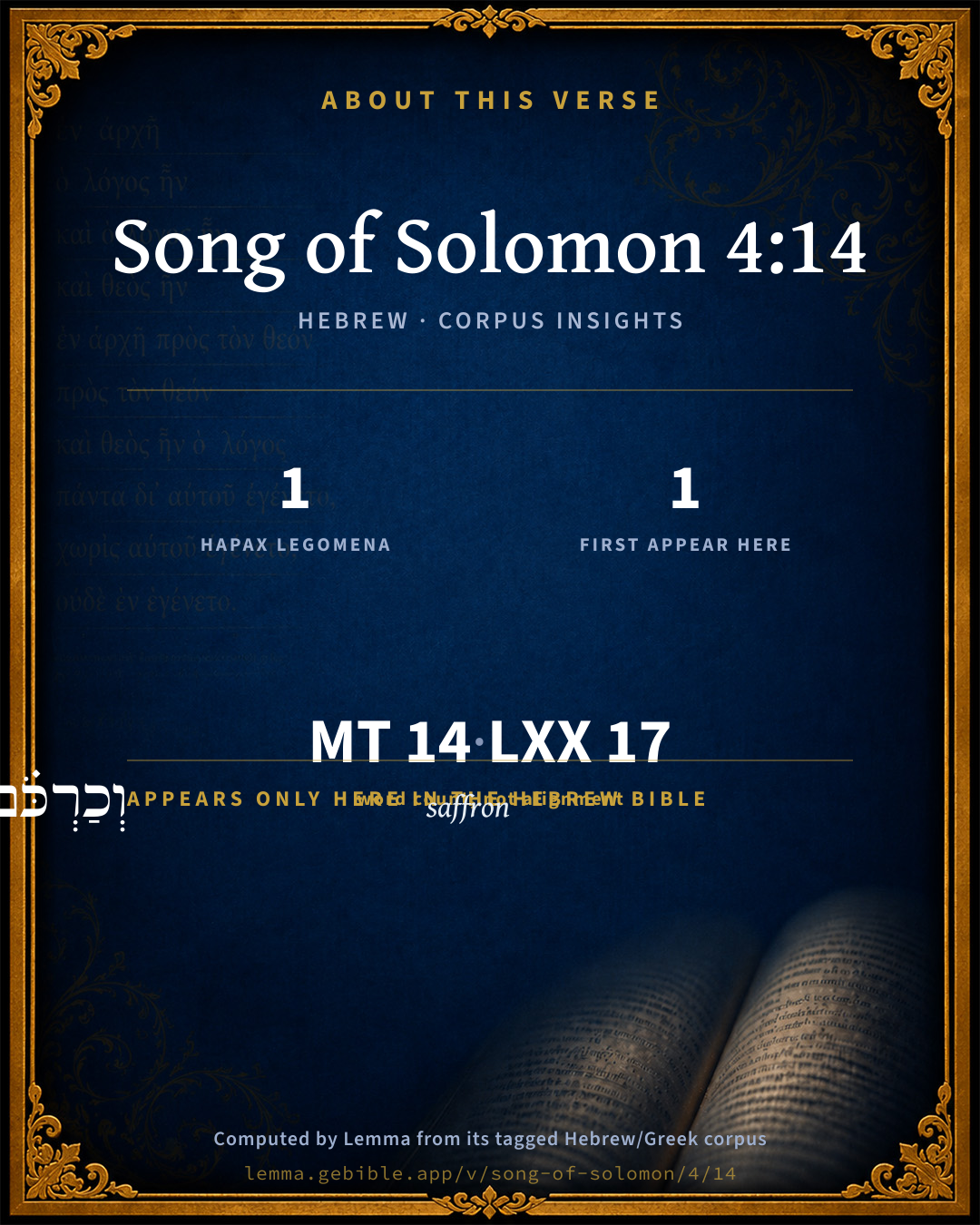
  • 1 hapax legomenon — only here in the Hebrew Bible
  • 1 first appearance in the Hebrew Bible
Full analysis ↓
Download a study sheet

One document with this verse’s original text, its word-by-word gloss line, the meaning frame, cross-references with their text, attributed commentary, and full source and license credits — printable, and it pastes into notes with its structure intact.

This verse Autodidact and up

Study sheet (.html) Plain text (.txt)

A passage Seminary Student

Up to 50 verses in one chapter. A passage sheet keeps up to 6 commentary sources and 12 cross-references per verse, in the order this page ranks them, and says so on the sheet whenever that leaves anything out. Ask for a single verse and you get the Autodidact verse sheet above.

Everything on this page stays free to read, with no account — the sheet is a download of what is already on screen, not access to it.

Want to remove ads? Support Godless Engineer
Compare translations 3

The same verse in 3 English versions, stacked beneath the original-language interlinear above. Click any original word for its lexicon entry.

Each is an independent rendering of the whole verse — the interlinear is not word-aligned to these translations.

Highlighted words mark where these versions differ — a whole-verse word diff, not a word-by-word alignment.

  • World English Bible Public Domain
    Spikenard and saffron, Calamus and cinnamon, with every kind of incense tree; Myrrh and aloes, with all the best spices,
  • King James Version Public Domain
    Spikenard and saffron; calamus and cinnamon, with all trees of frankincense; myrrh and aloes, with all the chief spices:
  • unfoldingWord Literal Text CC BY-SA 4.0
    nard and saffron, calamus and cinnamon, with all trees of frankincense, myrrh and aloes, with all the best spices,

unfoldingWord Literal Text — © unfoldingWord, licensed CC BY-SA 4.0. Word-aligned USFM3 via Door43 (git.door43.org/unfoldingWord/en_ult).

Versions to compare (up to 4)

3 of 4 selected

Show all 18 translations

Every available English version of this verse, each an independent rendering of the whole verse.

  • World English Bible Public Domain
    Spikenard and saffron, Calamus and cinnamon, with every kind of incense tree; Myrrh and aloes, with all the best spices,
  • Berean Standard Bible Public Domain
    with nard and saffron, with calamus and cinnamon, with every kind of frankincense tree, with myrrh and aloes, with all the finest spices.
  • Majority Standard Bible Public Domain
    with nard and saffron, with calamus and cinnamon, with every kind of frankincense tree, with myrrh and aloes, with all the finest spices.
  • King James Version Public Domain
    Spikenard and saffron; calamus and cinnamon, with all trees of frankincense; myrrh and aloes, with all the chief spices:
  • American Standard Version (1901) Public Domain
    Spikenard and saffron, Calamus and cinnamon, with all trees of frankincense; Myrrh and aloes, with all the chief spices.
  • Revised Version (1885) Public Domain
    Spikenard and saffron, calamus and cinnamon, with all trees of frankincense; myrrh and aloes, with all the chief spices.
  • Geneva Bible (1599) Public Domain
    Euen spikenarde, and saffran, calamus, and cynamon with all the trees of incense, myrrhe and aloes, with all the chiefe spices.
  • Douay-Rheims (1899) Public Domain
    Spikenard and saffron, sweet cane and cinnamon, with all the trees of Libanus, myrrh and aloes with all the chief perfumes.
  • Young's Literal Translation Public Domain
    Cypresses with nard -- nard and saffron, Cane and cinnamon, With all trees of frankincense, Myrrh and aloes, with all chief spices.
  • Literal Standard Version CC BY-SA 4.0
    Cypresses with nard—nard and saffron, || Cane and cinnamon, || With all trees of frankincense, || Myrrh and aloes, with all chief spices.
  • Unlocked Literal Bible CC BY-SA 4.0
    Nard and saffron, calamus and cinnamon with all kinds of spices, myrrh and aloes with all the finest spices.
  • unfoldingWord Literal Text CC BY-SA 4.0
    nard and saffron, calamus and cinnamon, with all trees of frankincense, myrrh and aloes, with all the best spices,
  • Darby Bible Public Domain
    Spikenard and saffron; Calamus and cinnamon, with all trees of frankincense; Myrrh and aloes, with all the chief spices:
  • World Messianic Bible Public Domain
    spikenard and saffron, calamus and cinnamon, with every kind of incense tree; myrrh and aloes, with all the best spices,
  • Webster's Bible Public Domain
    Spikenard and saffron; calamus and cinnamon, with all trees of frankincense; myrrh and aloes, with all the chief spices:
  • Free Bible Version CC BY-SA 4.0
    nard and saffron, calamus and cinnamon, with all kinds of trees producing frankincense, myrrh, aloes, and the finest spices.
  • Bible in Basic English Public Domain
    Spikenard and safron; calamus and cinnamon, with all trees of frankincense; myrrh and aloes, with all the chief spices.
  • JPS Tanakh (1917) Public Domain
    Spikenard and saffron, calamus and cinnamon, with all trees of frankincense; myrrh and aloes, with all the chief spices.

Literal Standard Version (2020), Covenant Press — licensed CC BY-SA 4.0. Text via the HelloAO Bible API (eBible.org). Unlocked Literal Bible (unfoldingWord) — licensed CC BY-SA 4.0. Text via the HelloAO Bible API (eBible.org). unfoldingWord Literal Text — © unfoldingWord, licensed CC BY-SA 4.0. Word-aligned USFM3 via Door43 (git.door43.org/unfoldingWord/en_ult). Free Bible Version, Dr. Jonathan Gallagher — licensed CC BY-SA 4.0. Text via the HelloAO Bible API (eBible.org).

Word by word

More ways to search: Search by grammar → Find every occurrence → Compare this word →

Practice this passage: Drill this verse → Learn its vocabulary →

וְכַרְכֹּ֗ם
karkôm
H3750
“and · saffron”
Conjunction + Noun, Common, Masculine, Singular, Absolute
Part of Speech
Conjunction + Noun
Type
Common
Gender
Masculine
Number
Singular
State
Absolute
Full BDB Definition

Origin: probably of foreign origin

TWOT: 1039

saffron - an orange-yellow flower of the crocus family, used for flavouring
  1. נֵ֣רְדְּ nêrd H5373 “spikenard” Noun, Common, Masculine, Singular, Absolute
  2. קָנֶה֙ qâneh H7070 “reed” Noun, Common, Masculine, Singular, Absolute
  3. וְקִנָּמ֔וֹן qinnâmôwn H7076 “and · cinnamon” Conjunction + Noun, Common, Masculine, Singular, Absolute
  4. עִ֖ם ʻim H5973 “with” Preposition
  5. כָּל kôl H3605 “all of” Noun, Common, Masculine, Singular, Construct
  6. עֲצֵ֣י ʻêts H6086 “trees of” Noun, Common, Masculine, Plural, Construct
  7. לְבוֹנָ֑ה lᵉbôwnâh H3828 “frankincense” Noun, Common, Feminine, Singular, Absolute
  8. מֹ֚ר môr H4753 “myrrh” Noun, Common, Masculine, Singular, Absolute
  9. וַאֲהָל֔וֹת ʼăhâlîym H174 “and · aloes” Conjunction + Noun, Common, Masculine, Plural, Absolute
  10. עִ֖ם ʻim H5973 “with” Preposition
  11. כָּל kôl H3605 “all of” Noun, Common, Masculine, Singular, Construct
  12. רָאשֵׁ֥י rôʼsh H7218 “heads of” Noun, Common, Masculine, Plural, Construct
  13. בְשָׂמִֽים besem H1314 “spices” Noun, Common, Masculine, Plural, Absolute

About this verse

These counts appear in no published source. They are computed here, from the morphology-tagged text and Lemma’s own curated glosses. What Lemma adds →

14
words
12
distinct lemmas
Wisdom
section

Notable vocabulary

1 hapax legomenon — a word that appears only here in the entire Hebrew Bible:

  • וְכַרְכֹּ֗ם saffron H3750

First appearance in Scripture

This word makes its first canonical appearance in the Hebrew Bible here:

  • וְכַרְכֹּ֗ם saffron H3750

Shared distinctive vocabulary

נֵ֣רְדְּ spikenard H5373 occurs in 3 verses of the Hebrew Bible. Also found in:

Grammatical profile

  • 12 nouns
  • 2 prepositions

Repetition

Words recur within this verse — often emphatic in Hebrew:

Hebrew & Septuagint length

In English translation the verse runs 20 words from the Hebrew and 17 from the Septuagint (LXX English) — closely comparable.

A rough comparison of the two English renderings, which tokenize alike — not a word-level alignment.

Word counts can differ between the Hebrew and the Greek without any difference in meaning — e.g. the Hebrew direct-object marker אֵת has no separate Greek word, and Greek often adds the article ὁ.

In the original languages it is 14 Hebrew tokens and 17 Greek tokens — but the two are counted differently (Hebrew bundles its prefixes and suffixes into one token; the Greek is in lemma form), so that isn’t a like-for-like length.

Cross-references

15

Topical passages linked to Song of Solomon 4:14 in the Treasury of Scripture Knowledge — connected by theme and wording, ordered by reader-vote popularity; previews shown in the World English Bible.

  • Exodus 30:23 "Also take fine spices: of liquid myrrh, five hundred shekels; and of fragrant cinnamon half as much, even two hundred and fifty; and of fragrant cane, two hundred and fifty;
  • Song of Solomon 4:6 Until the day is cool, and the shadows flee away, I will go to the mountain of myrrh, To the hill of frankincense.
  • Song of Solomon 3:6 Who is this who comes up from the wilderness like pillars of smoke, Perfumed with myrrh and frankincense, With all spices of the merchant?
  • Song of Solomon 6:2 My beloved has gone down to his garden, To the beds of spices, To feed in the gardens, and to gather lilies.
  • Proverbs 7:17 I have perfumed my bed with myrrh, aloes, and cinnamon.
  • Song of Solomon 1:12 While the king sat at his table, My perfume spread its fragrance.
  • Ezekiel 27:19 Vedan and Javan traded with yarn for your wares: bright iron, cassia, and calamus, were among your merchandise.
  • Genesis 43:11 Their father, Israel, said to them, "If it be so now, do this. Take from the choice fruits of the land in your bags, and carry down a present for the man, a little balm, a little honey, spices and myrrh, nuts, and almonds;
  • Numbers 24:6 As valleys are they spread forth, As gardens by the river-side, As lign-aloes which Yahweh has planted, As cedar trees beside the waters.
  • 1 Kings 10:10 She gave the king one hundred twenty talents of gold, and of spices very great store, and precious stones: there came no more such abundance of spices as these which the queen of Sheba gave to king Solomon.
  • 2 Chronicles 9:9 She gave the king one hundred and twenty talents of gold, and spices in great abundance, and precious stones: neither was there any such spice as the queen of Sheba gave to king Solomon.
  • Song of Solomon 5:1 I have come into my garden, my sister, my bride. I have gathered my myrrh with my spice; I have eaten my honeycomb with my honey; I have drunk my wine with my milk. Friends Eat, friends! Drink, yes, drink abundantly, beloved. Beloved
  • Mark 16:1 When the Sabbath was past, Mary Magdalene, and Mary the mother of James, and Salome, bought spices, that they might come and anoint him.
  • John 19:39 Nicodemus, who at first came to Jesus by night, also came bringing a mixture of myrrh and aloes, about a hundred pounds.
  • Revelation 18:13 and cinnamon, incense, perfume, frankincense, wine, olive oil, fine flour, wheat, sheep, horses, chariots, bodies, and people's souls.

Cross-references courtesy of OpenBible.info (CC BY 4.0).

Hebrew and Greek witnesses Masoretic Hebrew ↔ Greek Septuagint

The same verse in the two great witnesses to the Old Testament, shown verse-for-verse.

These are two independent witnesses, not word-aligned to each other, and the Septuagint is shown in lemma (dictionary) form.

Hebrew Song of Solomon 4:14 Masoretic · Westminster Leningrad Codex

נֵ֣רְדְּ וְכַרְכֹּ֗ם קָנֶה֙ וְקִנָּמ֔וֹן עִ֖ם כָּל עֲצֵ֣י לְבוֹנָ֑ה מֹ֚ר וַאֲהָל֔וֹת עִ֖ם כָּל רָאשֵׁ֥י בְשָׂמִֽים

Spikenard and saffron, Calamus and cinnamon, with every kind of incense tree; Myrrh and aloes, with all the best spices,

World English Bible · Public Domain

Greek LXX Song of Solomon 4:14 Septuagint · lemma form

νάρδος καί κρόκος κάλαμος καί κιννάμωμον μετά πᾶς ξύλον ὁ λίβανος σμύρνα αλωθ μετά πᾶς πρῶτος μύρον

spikenard and saffron, calamus and cinnamon; with all woods of Libanus, myrrh, aloes, with all chief spices:

LXX2012 (modern English Septuagint) · Public Domain

Hebrew: Westminster Leningrad Codex (CC BY 4.0). Greek: Septuagint (public domain); English from LXX2012 (modern English Septuagint) (Public Domain). How the Septuagint differs from the Hebrew →

Commentary

Notes on Song of Solomon 4:14 from classic Christian and Jewish commentators (each source and its license shown beneath its notes). The classic Christian expositions comment on the surrounding passage and are grouped to its opening verse, so a note may address several verses; the Jewish commentaries on the Tanakh (Rashi and others) are per-verse, so they appear only where the commentator wrote on this verse.

Lemma curates 59 commentaries, every one of them public domain or Creative Commons licensed, each selected and text-cleaned for this edition rather than reprinted as found. About our sources →

Trapp's Complete Commentary

John Trapp

Son 4:14 Spikenard and saffron; calamus and cinnamon, with all trees of frankincense; myrrh and aloes, with all the chief spices:

Ver. 14. Nard.] Called in Mar 14:3; Joh 12:3, "spikenard very costly," or rather, as some learned men will have it, nard of Opis, a town near Babylon, where grew the most precious spikenard, and whence it was transported to other places. {a} Of this plant, see Pliny, lib. xii. c. 11; as of cypress or camphire, lib. xii. c. 14; of saffron, lib. xii. c. 15; of calamus, lib. xii. c. 23; of cinnamon and myrrh, lib. xii. c. 23, 19. For pomegranates, {See Trapp on "Son 4:3"} for camphire, {See Trapp on "Son 1:14"} Saffron is in the Hebrew carcom: Shindler saith it should be read carcos with samech; and so it will exactly agree with κροκος, crocus, the one likely coming of the other. Our English comes of the Arabic zaphran, so called by the yellow colour. Calamus or sweet cane is a precious aromatical reed bought and brought out of far countries, as appeareth by Jer 6:20 Isa 43:24. Cinnamon was very rare in Galen’s time, and hard to be found, except in princes’ storehouses. {b} Pliny reports that a pound of cinnamon was worth a thousand denarii, - that is, 150 crowns of our money. As for those trees of frankincense, myrrh, and aloes, &c., Brightman thinks they betoken tall and eminent Christians, as calamus and cinnamon, shrubs of two cubits high or thereabouts, do Christians of a middle stature; and nard and saffron, herbs that scarce lift up themselves above the ground, represent those of a lower rank and lesser degree of holiness; which yet have all of them their place in God’s garden, and their several sweetnesses; the Spirit of grace being magnus in magnis, nec parvus in minimis, as Augustine hath it, - Great in God’s greater children, and not little in the least. And though there be diversity of gifts, yet are they from one Spirit, as the diverse smells of pleasant fruits and chief spices are from the same influence, and the divers sounds in the organs from the same breath. The Spirit of grace are those two golden pipes, {Zec 4:12} through the which the two olive branches empty out of themselves the golden oils of all precious graces into the candlestick, the Church. Hence grace is called the "fruit of the Spirit"; {Gal 5:22} yea, "Spirit"; {Gal 4:17} and albeit, "as the man is, so is his strength," as they said to Gideon; and God hath his children of all sizes, - babes, young men, old men; {1Jn 2:13} yet Philadelphia, with her "little strength," may "keep Christ’s word, and not deny his name" (while those churches that had more strength are not so commended), and in "that little strength I have set open a door for thee," even the door of heaven, wide enough so that none could shut it. {Rev 3:8} Why, then, should any "despise the day of small things?" God, who "hath begun a good work, his hands shall finish it: and he that hath laid the foundation, shall in due time bring forth the topstone thereof with shouting, crying, Grace, grace unto it." {Zec 4:7-10} An infant of days shall proceed from degree to degree, till he be like the Ancient of days; and "those that be planted in the house of the Lord, shall once flourish in the courts of our God. They shall still bring forth fruit in old age: they shall be fat and flourishing." {Psa 92:13-14} The seeds of the cypress tree are so very small, that they can scarce be seen with eyes, et tamen in iis tanta est arbor, tamque procera, {c} and yet in some one of them is potentially so large and so tall a tree. Despair not therefore of further measures, but aspire still to perfection. {Php 3:12-13 Heb 5:14} The blessing on man in the first creation was, "increase and multiply," in the second, "grow in grace." {Isa 61:3; Isa 61:11} And remember that growth is not always to be measured by joy, and other accessory graces. These sweet blooms may fall off when fruit comes on, &c.

{a} πιστικης, melius vero ποιστικης ab oppido prope Babylonem Opis dicto. - Scultet, ex Hartungi Criticis.

{b} Gal., lib. i. Antidot.

{c} Plin., lib. xi. cap. 2.

John Trapp, A Commentary or Exposition upon All the Books of the Old and New Testament (1647–1656) — public domain. Text from a community e-Sword module.

Ellicott's Commentary for English Readers

(14) Spikenard.—See Note, Son_1:12. Saffron; Heb. carchom; only here. The Arabic name is still kûrkûm = Crocus sativus, a well-known bulb of the order Iridaceœ. The pistil and stigma. dried, form the saffron.

Calamus.—Heb. kâneh. (Comp. kâneh bosem = sweet calamus, Exo_30:23; k. hottôv—sweet cane, Jer_6:20.) There are many sweet grasses in India and the East. Andropogon calamus aromaticus has been identified (Royle) with the “reed of fragrance” of Exodus, and Jeremiah’s “good reed from a far country,” but the identification is not to be implicitly accepted. (See Bible Educator, Vol. I., p. 245.)

Cinnamon.—Heb. kinnamôn probably included Cinnamomum Zeylanicum (cinnamon) and Cinnamomum cassia (Cassia lignea). (See Bible Educator, Vol. I., p. 245.) The rind of the plant is the “cinnamon” in use. The plant belongs to the family of laurels, and grows in Ceylon, on the Malabar coast, and in East Indian Islands. It attains a height of from twenty to thirty feet, having numerous boughs, bearing leaves of a scarlet colour when young, but changing to a bright green, and white blossoms.

Aloes.—See Note, Num_24:6.

With all the chief spices.—“That in thy sweet all sweets encloses” (H. Constable).

A Bible Commentary for English Readers, edited by Charles John Ellicott (1878–1897) — public domain. Text from a community e-Sword module.

The Cambridge Bible for Schools and Colleges

gen. ed. J. J. S. Perowne

14. saffron] Heb. karkôm occurs in the O.T. only here, but its meaning is clear from the Arabic kurkum = the Crocus sativus. There are many species of crocus in Palestine, and from most of them saffron is obtained. The women and children gather the pistil and stigma from the centre of each flower. These are dried in the sun and then pounded. It is used for a condiment. The name ‘saffron’ is merely the Arabic zafran = ‘yellow.’ The best saffron is of an orange-red colour. See Tristram, Nat. Hist. p. 480.

calamus] Heb. qâneh, i.e. ‘aromatic reed.’ According to Tristram, p. 438, who makes a careful collation of all the passages in which the word occurs, this is not a sweet cane like the sugar-cane, but an aromatic cane imported from the East, either from Arabia Felix, or more probably from India. It is the same as the qeneh bôsem, the ‘sweet calamus’ of Exo_30:23.

cinnamon] Heb. qinnâmôn, our cinnamon, a plant unknown in Syria. It is a native of Ceylon, and belongs to the family of the laurels. The tree attains to the height of 30 feet and has a white blossom. The spice is simply the inner rind separated from the outer bark and dried in the sun. See Tristram, Nat. Hist. p. 346.

trees of frankincense] For frankincense see ch. Son_3:6.

aloes] A stately tree (Num_24:6) from which some aromatic substance was derived. It has generally been identified, according to Tristram (p. 333), with the Aquilaria agallocha, the eagle wood, found in Cochin China and Silhet in Northern India. This tree attains a height of 120 feet, and from it a costly perfume is extracted, which yields a fragrant odour when burned. The Enc. Brit., sub voce, supposes that it more probably is the Aquilaria malaccensis, found in the Malayan Peninsula, from which it would more easily find its way into Palestine in Biblical times than the other from North India. Cp. article ‘Aloes,’ Encycl. Bibl. vol. 1. p. 121.

the chief spices] i.e. the chief spice-bearing trees. It is notable that all the trees of this ‘paradise’ are rare exotics, probably to hint that the bride’s charms are as rare and as much to be admired as such plants are. But the rare and foreign character of all the objects to which the bride is compared is entirely incompatible with the supposition that our book is a collection of popular songs (Volkslieder). In them the comparisons are always with homely well-known objects.

The Cambridge Bible for Schools and Colleges (gen. ed. J. J. S. Perowne; Cambridge University Press, 1878–1918) — public domain. Text from a community e-Sword module.

Haydock's Catholic Bible Commentary

Cinnamon. Very rare, Exodus xxx. 23. --- Libanus, or "incense." (Hebrew)

George Leo Haydock (1774–1849), Haydock's Catholic Family Bible and Commentary, 1859 edition — public domain. Excludes Psalms (Douay-Rheims chapter numbering differs from Protestant) and Deuterocanonical books (Catholic canon only).

Matthew Poole's English Annotations

Trees of frankincense; such trees as produce frankincense. Or, as others, both ancient and modern, render it, trees of Lebanon; such sweet-smelling trees and plants as grew in Lebanon, of which See Poole "Son 4:11".

Matthew Poole's English Annotations on the Holy Bible (1683–1685) — public domain. Text from a community e-Sword/MySword module.

Whedon's Commentary on the Bible

Daniel D. Whedon

14. Spikenard, etc. — A list is given of the choicest shrubs and flowers which the land could produce. Some, as cinnamon, which is a native of Ceylon and Southern Asia, must have been cultivated in Palestine as an exotic. Or it may have been known only as an article of commerce, and thus assigned a place in a garden furnished according to a lively ideal.

Daniel D. Whedon (gen. ed.), Commentary on the Old and New Testaments (1874–1909) — public domain. Text from a community e-Sword module.

John Wesley's Explanatory Notes

All trees - Such trees as produce frankincense.

John Wesley, Explanatory Notes Upon the Whole Bible (1754–1765) — public domain. Text via the GEBible commentary corpus.

Lesson kit

Teaching starters — assembled from the data on this page, not authored interpretation. Every prompt links to the verse data it draws on. Edit before teaching.

Song of Solomon, in the Wisdom, opens this verse with 14 words (12 distinct Hebrew lemmas). Its most distinctive word is karkôm (“saffron”). A historical commentator’s framing appears above. Read the whole chapter for the surrounding context.

Discussion questions

  1. The word karkôm carries the sense “saffron.” How does it shape the verse?
  2. This verse holds 1 word here found nowhere else in the Hebrew Bible. What might the rare word draw attention to?
  3. The word “saffron” first appears here in Scripture. What is being introduced at this debut?
  4. Song of Solomon 1:12 shares the word «spikenard» with this verse. How do the two illuminate each other?
  5. “all” occurs 2× in this one verse. What is the effect of the repetition?
  6. The translations on this page render this verse differently — a whole-verse word diff, not a word-by-word alignment. What might account for the different wordings?
  7. Reading how Trapp's Complete Commentary and Ellicott's Commentary for English Readers read this verse, where do the two commentators agree and where do they part?

Things to notice

  • 1 word in this verse appears nowhere else in the Hebrew Bible.
  • 1 word makes its first canonical appearance in Scripture here.
  • This verse counts 14 Hebrew ↔ 17 Greek words.
  • These translations choose different wording for 10 words in this verse.
  • “all” occurs 2× in this single verse.

Reading settings

Reading text

Shown beneath each verse's original-language words.

Old Testament
Old Testament edition

Read the OT as the Masoretic Hebrew (MT) or the Greek Septuagint (LXX).

English shown for the Greek Septuagint (in the Hebrew ↔ Greek comparison).

Comparing translations? Open the Compare panel on any verse page to stack up to four side by side.