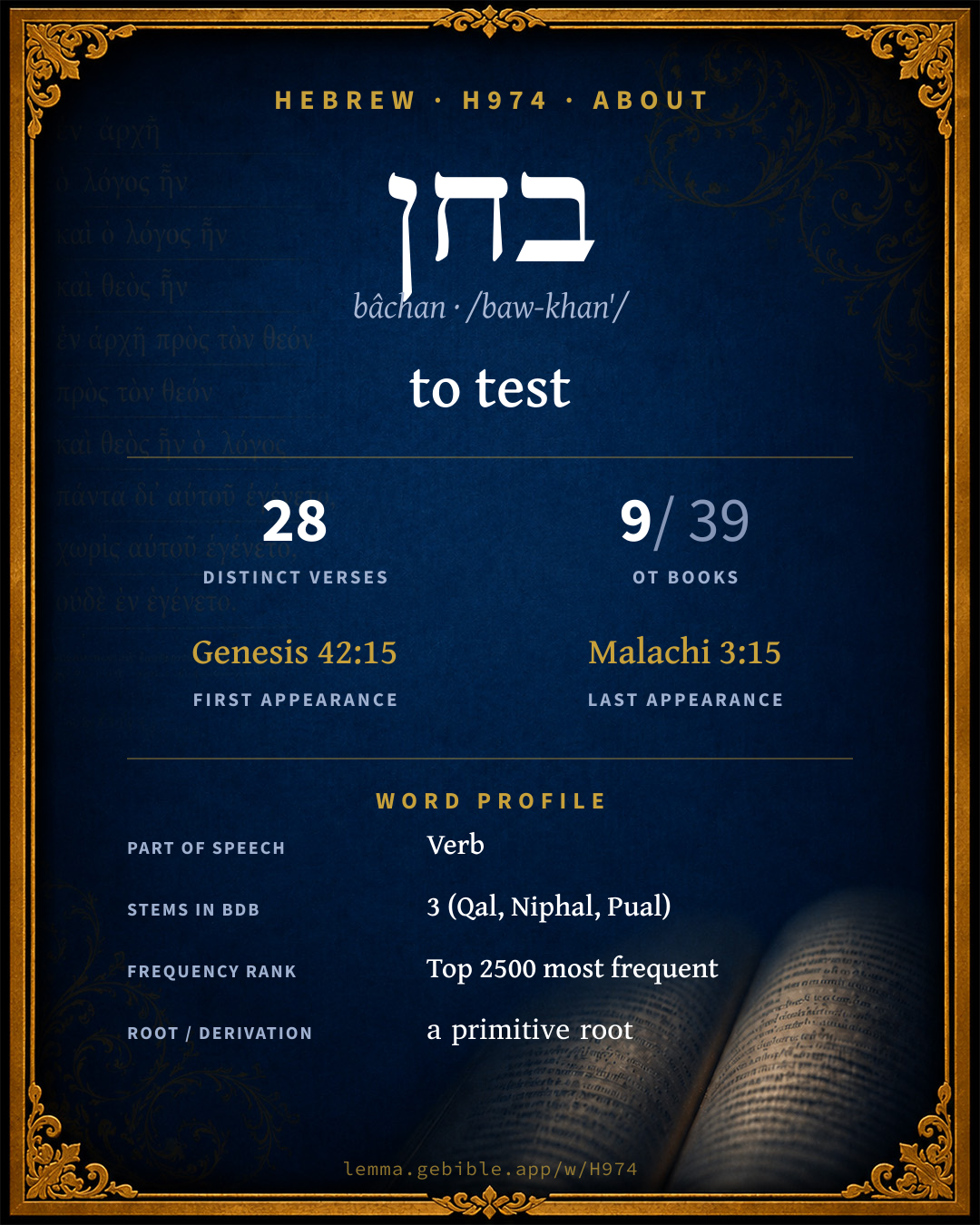
בָּחַן
to test
‘to test’ is one of 3 main senses fuller range ↓
Full lexicon entry — Brown-Driver-Briggs (BDB)
From Brown-Driver-Briggs (BDB)
Where this word appears
See every Qal verb in the Hebrew Bible →
Grammar key — what these labels mean
Part of speech
- Verb
- An action or state-of-being word.
Stem
- Qal
- The basic, simple active stem — the plain form of the verb (“he wrote”). Here: ‘examine’
- Niphal
- Usually the simple passive or reflexive of the Qal (“he was written”).
- Pual
- The passive counterpart of the Piel.
Form
- Participle Active
- A verbal adjective expressing ongoing or characteristic action (“writing / one who writes”).
- Sequential Perfect
- A perfect with prefixed waw continuing a preceding imperfect or command (waw-consecutive perfect).
- Imperfect
- An incomplete, ongoing, or future action (“he will / would write”).
- Imperative
- A direct command (“write!”).
- Infinitive Construct
- A bound verbal noun, frequently with prepositions (“to write / in writing”).
- Perfect
- A completed action or state — Hebrew marks aspect (completeness) more than strict tense (“he wrote”).
State
- Absolute
- The independent form of a noun, not bound to a following word.
Person
- 1st Person
- The speaker (“I / we”).
- 2nd Person
- The one addressed (“you”).
- 3rd Person
- The one spoken about (“he / she / it / they”).
Gender
- Masculine
- Grammatically masculine.
- Common
- Either gender — not distinguished for this form.
- Feminine
- Grammatically feminine.
Number
- Singular
- One.
- Plural
- More than one (in Hebrew, generally three or more).
Grammatical forms 18 distinct
- Verb, Qal, Participle Active, Masculine, Singular, Absolute 6 times (21%)
- Verb, Qal, Sequential Perfect, 1st Person, Common, Singular 2 times (7%)
- Verb, Qal, Sequential Perfect, 2nd Person, Masculine, Singular 2 times (7%)
- Verb, Qal, Imperfect, 3rd Person, Feminine, Singular 2 times (7%)
- Verb, Qal, Imperative, 2nd Person, Masculine, Singular 2 times (7%)
- Verb, Qal, Perfect, 2nd Person, Masculine, Singular 2 times (7%)
- Verb, Qal, Perfect, 3rd Person, Common, Plural 2 times (7%)
- Verb, Niphal, Imperfect, 3rd Person, Masculine, Plural 1 time (3%)
+10 more forms (10 occurrences)
Parsed forms decoded from the imported morphology (morphhb / Westminster Leningrad Codex — WLC text public domain, morphhb tagging CC BY 4.0), counted across 29 parsed occurrences — not distinct verses.
Every verse where H974 appears — 28 distinct verses across 9 books. Click any verse to open its interlinear word-by-word view. Verse text shown in the World English Bible for context — . Each verse’s Hebrew form is shown with its reference; the English is not keyword-highlighted, since the data carries no word-level English alignment. Use “Compare translations” on any verse to read it across multiple English versions. This concordance covers the Hebrew Bible; Septuagint (Greek Old Testament) occurrences are not indexed here.
Genesis 2 verses
- Genesis 42:15 תִּבָּחֵ֑נוּ Niphal impf 2mp Hereby you shall be tested. By the life of Pharaoh you shall not go forth from here, unless your youngest brother come here.
- Genesis 42:16 וְ/יִבָּֽחֲנוּ֙ conj + Niphal impf 3mp Send one of you, and let him get your brother, and you shall be bound, that your words may be tested, whether there is truth in you, or else by the life of Pharaoh surely you are spies."
1 Chronicles 1 verse
Job 5 verses
- Job 7:18 תִּבְחָנֶֽ/נּוּ Qal impf 2ms + sfx pers 3ms That you should visit him every morning, And test him every moment?
- Job 12:11 תִּבְחָ֑ן Qal impf 3fs Doesn't the ear try words, Even as the palate tastes its food?
- Job 23:10 בְּ֝חָנַ֗/נִי Qal pf 3ms + sfx pers 1cs But he knows the way that I take. When he has tried me, I shall come forth like gold.
- Job 34:3 תִּבְחָ֑ן Qal impf 3fs For the ear tries words, As the palate tastes food.
- Job 34:36 יִבָּחֵ֣ן Niphal impf 3ms I wish that Job were tried to the end, Because of his answering like wicked men.
Psalms 9 verses
- Psalms 7:9 וּ/בֹחֵ֣ן conj + Qal ptcp.act ms Oh let the wickedness of the wicked come to an end, But establish the righteous; Their minds and hearts are searched by the righteous God.
- Psalms 11:4 יִ֝בְחֲנ֗וּ Qal impf 3mp Yahweh is in his holy temple. Yahweh is on his throne in heaven. His eyes observe. His eyes examine the children of men.
- Psalms 11:5 יִ֫בְחָ֥ן Qal impf 3ms Yahweh examines the righteous, But the wicked and him who loves violence his soul hates.
- Psalms 17:3 בָּ֘חַ֤נְתָּ Qal pf 2ms You have proved my heart; you have visited me in the night; You have tried me, and found nothing; I have resolved that my mouth shall not disobey.
- Psalms 26:2 בְּחָנֵ֣/נִי Qal impv 2ms + sfx pers 1cs Examine me, Yahweh, and prove me. Try my heart and my mind.
- Psalms 66:10 בְחַנְתָּ֥/נוּ Qal pf 2ms + sfx pers 1cp For you, God, have tested us. You have refined us, as silver is refined.
- Psalms 81:7 אֶבְחָֽנְ/ךָ֨ Qal impf 1cs + sfx pers 2ms You called in trouble, and I delivered you. I answered you in the secret place of thunder. I tested you at the waters of Meribah." Selah.
- Psalms 95:9 בְּ֝חָנ֗וּ/נִי Qal pf 3cp + sfx pers 1cs When your fathers tempted me, Tested me, and saw my work.
- Psalms 139:23 בְּ֝חָנֵ֗/נִי Qal impv 2ms + sfx pers 1cs Search me, God, and know my heart. Try me, and know my thoughts.
Proverbs 1 verse
Jeremiah 6 verses
- Jeremiah 6:27 וּ/בָחַנְתָּ֖ conj + Qal wpf 2ms I have made you a tester of metals [and] a fortress among my people; that you may know and try their way.
- Jeremiah 9:7 וּ/בְחַנְתִּ֑י/ם conj + Qal wpf 1cs + sfx pers 3mp Therefore thus says Yahweh of Hosts, Behold, I will melt them, and try them; for how [else] should I do, because of the daughter of my people?
- Jeremiah 11:20 בֹּחֵ֥ן Qal ptcp.act ms But, Yahweh of Hosts, who judge righteously, who try the heart and the mind, I shall see your vengeance on them; for to you have I revealed my cause.
- Jeremiah 12:3 וּ/בָחַנְתָּ֥ conj + Qal wpf 2ms But you, Yahweh, know me; you see me, and try my heart toward you: pull them out like sheep for the slaughter, and prepare them for the day of slaughter.
- Jeremiah 17:10 בֹּחֵ֣ן Qal ptcp.act ms I, Yahweh, search the mind, I try the heart, even to give every man according to his ways, according to the fruit of his doings.
- Jeremiah 20:12 בֹּחֵ֣ן Qal ptcp.act ms But, Yahweh of Hosts, who tests the righteous, who sees the heart and the mind, let me see your vengeance on them; for to you have I revealed my cause.
Ezekiel 1 verse
Zechariah 1 verse
Malachi 2 verses
- Malachi 3:10 וּ/בְחָנ֤וּ/נִי conj + Qal impv 2mp + sfx pers 1cs Bring the whole tithe into the store-house, that there may be food in my house, and test me now in this," says Yahweh of hosts, "if I will not open you the windows of heaven, and pour you out a blessing, that there shall not be room enough for.
- Malachi 3:15 בָּחֲנ֛וּ Qal pf 3cp Now we call the proud happy; yes, those who work wickedness are built up; yes, they tempt God, and escape.'
About this entry
At a glance — auto-summarized from this page’s data, not written by a person. Every figure links to its source below. This summary describes the numbers; it doesn’t interpret them.
בחן — transliterated bâchan — is a Hebrew verb carrying the sense “to test.” Debuting at Genesis 42:15, it then recurs through the corpus. It appears 28 verses across 9 books of the Hebrew Bible, among its moderately common vocabulary. More than a quarter of its appearances fall in Psalms. As a verb its force shifts by stem, across 3 stems (Qal, Niphal, and more). See the sense tree, 28-verse concordance, and the renderings breakdown below.
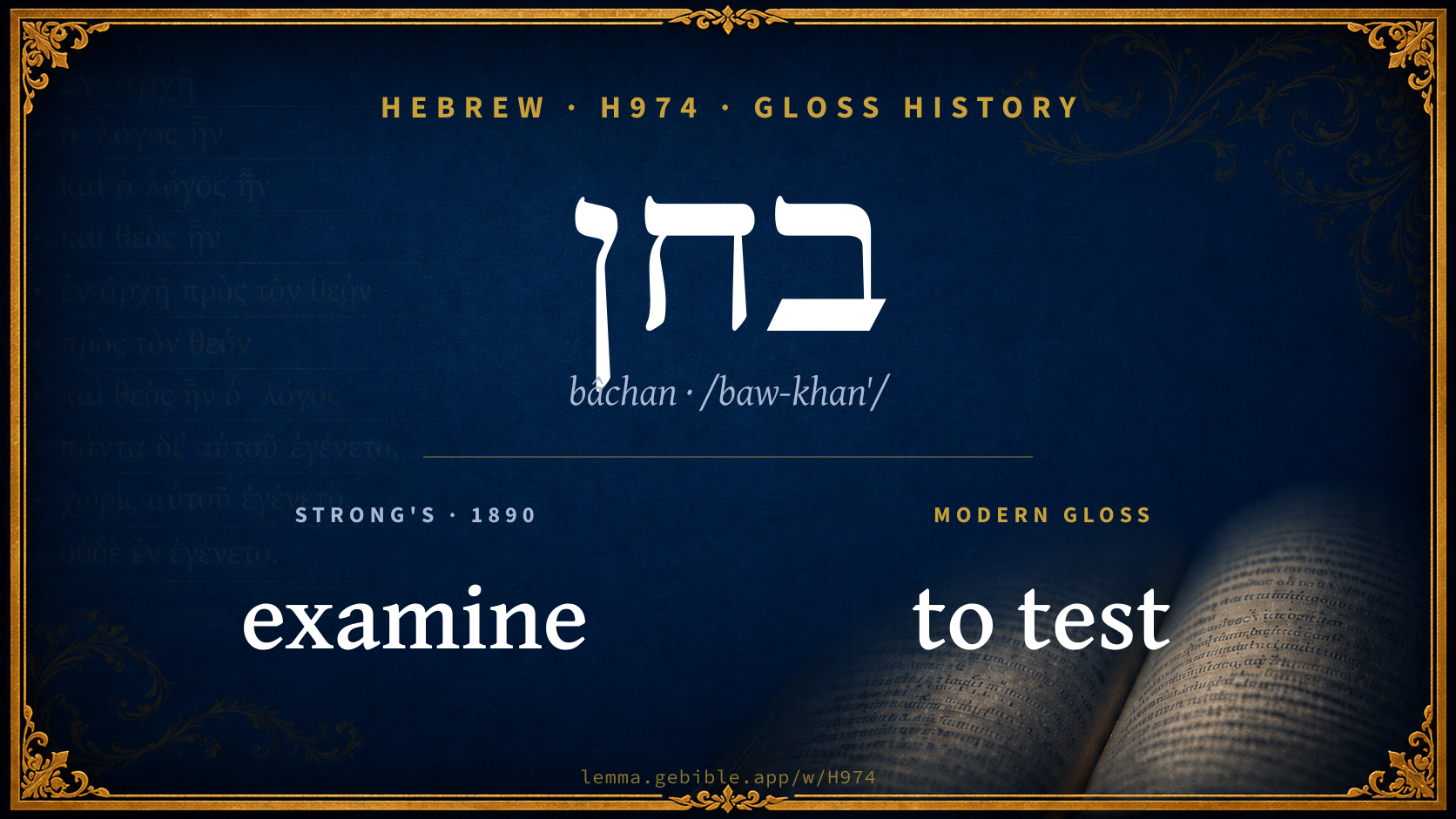
Gloss history
Strong's 1890 vs modern scholarship
About this word
Strong's H974 catalogs a Hebrew word from the Hebrew Old Testament.
These counts are not copied from any lexicon or concordance. They are computed here, from the morphology-tagged Hebrew Old Testament. What Lemma adds →
- 28
- distinct verses
- The word appears in 28 distinct verses.
- 9 / 39
- OT books
- The word appears in 9 of 39 Old Testament books.
- #1,160
- by frequency
- Top 2500 most frequent Hebrew words (rank 1,160 of 8,640 Hebrew words by occurrence).
View all 28 occurrences in the concordance →
By section of the Old Testament
By traditional corpus
Conventional, traditional groupings — biblical authorship is debated, so this is a traditional corpus grouping, not an authorship claim. Each share is this word’s portion of its verses in that division of the Hebrew canon. Each figure is a share of the word’s 28 distinct verses.
- Writings (Ketuvim) 16 verses · 57%
- Prophets (Nevi'im) 10 verses · 36%
- Torah (Pentateuch) 2 verses · 7%
How translations render this word
Counts come from each version’s own published word-to-Strong’s tagging or interlinear alignment — an approximate guide to how each version renders this word, not a word-level alignment the data otherwise carries. Because each total is that version’s own tagged count, the per-version totals vary from one another and need not match the appearance or distinct-verse counts above. These counts may also differ from a printed concordance because Lemma counts each distinctly tagged rendering and does not collapse phrase taggings into a single head-word total. This is a fixed set of word-tagged versions (KJV, ASV, BSB, ULT) and does not change with the reading translation you choose elsewhere. Each version’s license is shown beside its name below (and on Sources).
- King James Version: Try 6×, Trieth 4×, Triest 2×
- American Standard Version: Try 5×, Trieth 4×, Triest 2×
- Berean Standard Bible: Test 4×, Test me 3×, Examines 2×
- unfoldingWord Literal Text: Test 4×, Tests 3×, Examine me 2×
King James Version Public Domain
Renders H974 across 29 tagged occurrences — most commonly:
Plus 17 renderings that appear only once — usually multi-word phrases or single function words the recovered tagging swept in, not distinct renderings.
American Standard Version Public Domain
Renders H974 across 28 tagged occurrences — most commonly:
Plus 17 renderings that appear only once — usually multi-word phrases or single function words the recovered tagging swept in, not distinct renderings.
Berean Standard Bible Public Domain
Renders H974 across 28 tagged occurrences — most commonly:
Plus 15 renderings that appear only once — usually multi-word phrases or single function words the recovered tagging swept in, not distinct renderings. Not rendered by a distinct English word in 1 further occurrence.
unfoldingWord Literal Text CC BY-SA 4.0
Renders H974 across 33 tagged occurrences — most commonly:
Plus 24 renderings that appear only once — usually multi-word phrases or single function words the recovered tagging swept in, not distinct renderings.
9 senses and sub-senses in the full BDB
Hebrew verbs can shift meaning by stem (binyan): Qal is the basic action, Niphal is often passive or reflexive, Piel often intensifies or makes it factitive, and Hiphil is typically causative. The senses below are grouped under the stem BDB assigns to each. This entry also uses Pual (the passive of Piel).
What do BDB’s symbols mean?
BDB uses these scholarly abbreviations:
| Symbol | Meaning |
|---|---|
| 𝔊 | the Septuagint (the ancient Greek translation, LXX) |
| 𝔙 | the Vulgate (the Latin translation) |
| 𝔖 | the Syriac version (the Peshitta) |
| 𝔗 | the Targum (the Aramaic translation) |
| ψ | the Psalms |
| √ | root (the underlying root or stem) |
| ‖ | parallel passage (a synonymous or contrasted parallel) |
| † | the dagger: every passage where the word occurs is cited |
The 9 senses and sub-senses the full Brown-Driver-Briggs lexicon distinguishes for this word, in lexicon order (not ranked by frequency), with BDB’s own verbatim wording and sub-sense lettering. Shown in Hebrew script with BDB’s own scholarly abbreviations. The condensed entry is in the Lexicon Entry tab. See also the Forms in the corpus table below.
Qal
- Pf. sf. בְּחָנַ֫נִי Jb 23:10, בָּחַנְתָּ ψ 17:3 + 7 times; Impf. יִבְחָ֑ן ψ 11:5 + 5 times; Imv. sf. בְּחָנֵנִי ψ 26:2 + 2 times; Inf. בְּחֹן Zc 13:9; Pt. בֹּחֵן Je 11:20 + 5 times (‖ צרף, נסה);— e.g. Job 23:10
- 1. examine, scrutinize, try ψ 11:5; 139:23 Jb 7:18; עַפְעַפָּיו יִבְחֲנוּ בְנֵי אָדָם His eyelids try the children of men (search them through and through) ψ 11:4. e.g. Psalms 11:5
- 2. prove, test, try.
- a. with the metaphor of gold Jb 23:10; וּבְחַנְתִּים כִּבְחֹן אֶת־הַזָּהָב and I will try them as one tries gold Zc 13:9. e.g. Job 23:10
- b. without metaphor, of God testing persons ψ 26:2; 66:10; 81:8 Je 9:6; ways Je 6:27 (prophet); the לֵב ψ 17:3 Je 12:3 Pr 17:3 1 Ch 29:17; reins Je 17:10; heart and reins ψ 7:10 Je 11:20 (= 20:12). e.g. Psalms 26:2
- c. of man testing or tempting God ψ 95:9 Mal 3:10, 15. e.g. Psalms 95:9
- d. the ear trying words Jb 12:11 = 34:3. e.g. Job 12:11
Niphal
- Impf. יִבָּחֵן Jb 34:36 Gn 42:15, 16, to be tried, proved. e.g. Job 34:36
Pual
- בֹּחַן Ez 21:18 the trial has been made (𝔊 𝔖 𝔙 Ges MV Ew Ke, but noun בֹּ֫חַן MT Symm Haev; read בְּחֵן with grace, favour, Hi Co). e.g. Ezekiel 21:18
Senses from the full Brown-Driver-Briggs lexicon (Brown, Driver, Briggs; Oxford 1906 — public domain), digitized via Sefaria, supplemented by the OpenScriptures HebrewLexicon (CC BY 4.0). Full attribution on Sources.
Word origin
vb. examine, try (cf. Aramaic בְּחַן, Syriac ܒܰܚܶܢ, try, examine; Arabic محن i. viiii. test, cf. WSG 65)—
— Brown-Driver-Briggs (Oxford 1906, public domain), digitized via Sefaria, supplemented by the OpenScriptures HebrewLexicon (CC BY 4.0). See Sources.
Origin: a primitive root
Jastrow Dictionary
A second Hebrew/Aramaic lexicon for comparison, covering Aramaic and post-biblical (Talmudic, Targumic, Midrashic) usage that the biblical-Hebrew BDB does not. Matched by lemma rather than by Strong’s number, so a lemma may carry more than one Jastrow headword (shown separately below), and the entries cover usage well beyond the Bible.
בָּחַן
- , v. Ges. H. Dict. s. v.; cmp. בה s. v. בהי) prop. to distinguish, examine (cmp. בון, חזי), hence to try, probe (of metals); to find out. Snh. 107ᵃ בְּחָנֵנִי try me.—Part. pass. בָּחוּן. Pes. 87ᵃ בְּחוּנֶיךָ Ms. M. (ed. חנוניך, v. Rabb. D. S. a. l.) thy tried servants. Ib.ᵇ בְּחוּנַי my tried servants. Yalk. Hos. 515; a. e.
- to inquire. Yoma 73ᵇ; Shebu. 35ᵇ לא ביחנו they did not ask distinctly. Y. B. Kam. IV, 4ᵇ bot. שב"ד מְבַחֲנִין וכ׳ for the court (appointing him guardian) inquires after his character.
- to distinguish. Snh. 8ᵇ a. e. להַבְחִין בין וכ׳ in order to be able to distinguish between the ignorant and the willful transgressor. Yeb. 42ᵃ; a. fr.
בְּחַן
- Targ. Koh. II, 6; a. fr.—Y. Maas. Sh. V, beg. 55ᵈ (read:) דבָחִינַת ליה וכ׳ by whom every Mishnah has been critically examined.
- to be tried, tested. Targ. O. Gen. XLII, 15 sq. (Var. אתבחר, v. Berl. Targ. O. II, p. 15).
A Dictionary of the Targumim, the Talmud Babli and Yerushalmi, and the Midrashic Literature (Marcus Jastrow; London, Luzac, 1903) — Public Domain. Digitized via Sefaria. Digitized via Sefaria. Full attribution on Sources.
Forms in the corpus
The 26 distinct written forms H974 takes in the Hebrew Bible, most frequent first — each parse links to that stem’s occurrences in the concordance. Hebrew forms include their vowel points and cantillation, so a single lemma takes many written forms.
Same root — word family
Other BDB entries built from the same root as H974, grouped by Strong’s listed origin. These share a root / origin per the lexicon — not necessarily a shared meaning. Each links to that word’s own entry.
Derived from this word
Compare all same-root words → They share a root, not necessarily a meaning.
Septuagint verse parallels
This word appears in 26 verses that also exist in the Greek Old Testament (Septuagint), out of the 28 Hebrew verses it occurs in. You can read those verses in Greek by switching the Old Testament edition to the Septuagint.
Read these verses in the Septuagint
- Genesis 42:15
- 1 Chronicles 29:17
- Job 7:18
- Psalms 7:9
- Proverbs 17:3
- Jeremiah 6:27
- Ezekiel 21:13
- Zechariah 13:9
- Malachi 3:10
This is a verse-level parallel only — the same verses exist in both the Hebrew and Greek Old Testaments. No word-level Hebrew↔Greek correspondence is claimed: the data carries no such alignment, so no Greek word is shown as this Hebrew word’s translation. Coverage is not total — the Septuagint omits the deuterocanon and renumbers the Psalms, so some Hebrew verses have no direct Greek parallel.