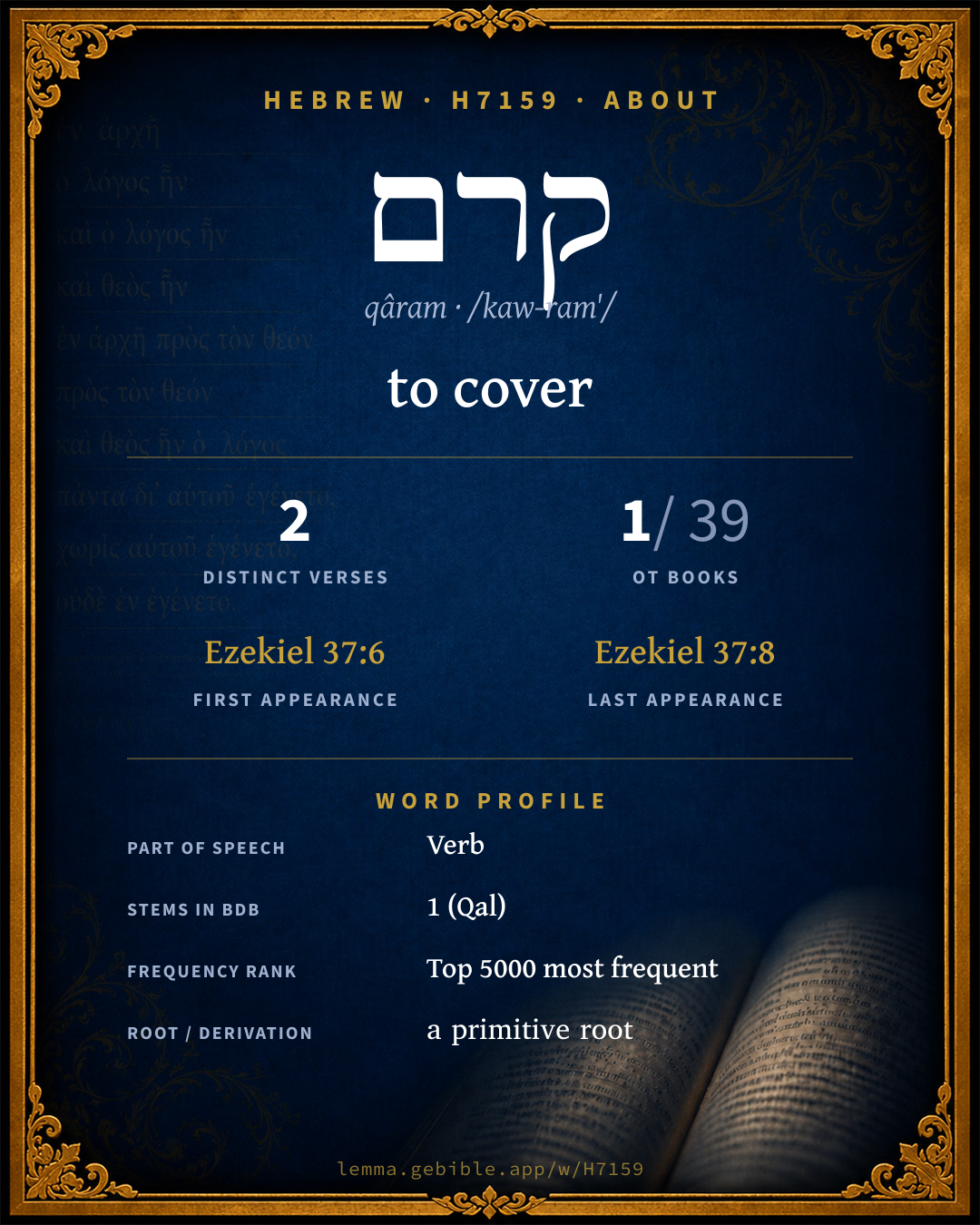
קָרַם
to cover
‘to cover’ is one of 2 main senses fuller range ↓
Full lexicon entry — Brown-Driver-Briggs (BDB)
From Brown-Driver-Briggs (BDB)
Where this word appears
Grammar key — what these labels mean
Stem
- Qal
- The basic, simple active stem — the plain form of the verb (“he wrote”).
Form
- Sequential Perfect
- A perfect with prefixed waw continuing a preceding imperfect or command (waw-consecutive perfect).
- Sequential Imperfect
- An imperfect with prefixed waw — the standard past-narrative form (waw-consecutive imperfect).
Person
- 1st Person
- The speaker (“I / we”).
- 3rd Person
- The one spoken about (“he / she / it / they”).
Gender
- Common
- Either gender — not distinguished for this form.
- Masculine
- Grammatically masculine.
Number
- Singular
- One.
Grammatical forms
- Verb, Qal, Sequential Perfect, 1st Person, Common, Singular 1 time (50%)
- Verb, Qal, Sequential Imperfect, 3rd Person, Masculine, Singular 1 time (50%)
Parsed forms decoded from the imported morphology (morphhb / Westminster Leningrad Codex — WLC text public domain, morphhb tagging CC BY 4.0), counted across 2 parsed occurrences — not distinct verses.
Every verse where H7159 appears — 2 distinct verses across 1 book. Click any verse to open its interlinear word-by-word view. Verse text shown in the World English Bible for context — . Each verse’s Hebrew form is shown with its reference; the English is not keyword-highlighted, since the data carries no word-level English alignment. Use “Compare translations” on any verse to read it across multiple English versions. This concordance covers the Hebrew Bible; Septuagint (Greek Old Testament) occurrences are not indexed here.
Ezekiel 2 verses
- Ezekiel 37:6 וְ/קָרַמְתִּ֤י conj + Qal wpf 1cs I will lay sinews on you, and will bring up flesh on you, and cover you with skin, and put breath in you, and you shall live; and you shall know that I am Yahweh.
- Ezekiel 37:8 וַ/יִּקְרַ֧ם conj + Qal wimpf 3ms I saw, and, behold, there were sinews on them, and flesh came up, and skin covered them above; but there was no breath in them.
About this entry
At a glance — auto-summarized from this page’s data, not written by a person. Every figure links to its source below. This summary describes the numbers; it doesn’t interpret them.
קרם (qâram) is a Hebrew verb most often rendered “to cover.” A scarce word — 2 verses in all of the Hebrew Bible. Ezekiel dominates its distribution — 2 of 2 verses. It first appears in Ezekiel 37:6. Not a single-sense word: explore its full sense range. The sections below give every sense, occurrence, and version rendering.
Gloss history
Strong's 1890 vs modern scholarship
About this word
Strong's H7159 catalogs a Hebrew word from the Hebrew Old Testament.
These counts are not copied from any lexicon or concordance. They are computed here, from the morphology-tagged Hebrew Old Testament. What Lemma adds →
- 2
- distinct verses
- The word appears in 2 distinct verses.
- 1 / 39
- OT books
- The word appears in 1 of 39 Old Testament books.
- #4,807
- by frequency
- Top 5000 most frequent Hebrew words (rank 4,807 of 8,640 Hebrew words by occurrence).
View all 2 occurrences in the concordance →
Most concentrated in
- Ezekiel 2 verses 100%
By section of the Old Testament
By traditional corpus
Conventional, traditional groupings — biblical authorship is debated, so this is a traditional corpus grouping, not an authorship claim. Each share is this word’s portion of its verses in that division of the Hebrew canon. Each figure is a share of the word’s 2 distinct verses.
- Prophets (Nevi'im) 2 verses · 100%
How translations render this word
Counts come from each version’s own published word-to-Strong’s tagging or interlinear alignment — an approximate guide to how each version renders this word, not a word-level alignment the data otherwise carries. Because each total is that version’s own tagged count, the per-version totals vary from one another and need not match the appearance or distinct-verse counts above. These counts may also differ from a printed concordance because Lemma counts each distinctly tagged rendering and does not collapse phrase taggings into a single head-word total. This is a fixed set of word-tagged versions (KJV, ASV, BSB, ULT) and does not change with the reading translation you choose elsewhere. Each version’s license is shown beside its name below (and on Sources).
- King James Version: Covered 1×, You and cover 1×
- American Standard Version: Covered 1×, You 1×
- Berean Standard Bible: Cover 1×, Covered them 1×
- unfoldingWord Literal Text: Covered them 1×, I will cover you 1×
King James Version Public Domain
Renders H7159 across 2 tagged occurrences — most commonly:
American Standard Version Public Domain
Renders H7159 across 2 tagged occurrences — most commonly:
Berean Standard Bible Public Domain
Renders H7159 across 2 tagged occurrences — most commonly:
unfoldingWord Literal Text CC BY-SA 4.0
Renders H7159 across 2 tagged occurrences — most commonly:
Senses in the full BDB
What do BDB’s symbols mean?
BDB uses these scholarly abbreviations:
| Symbol | Meaning |
|---|---|
| 𝔊 | the Septuagint (the ancient Greek translation, LXX) |
| 𝔙 | the Vulgate (the Latin translation) |
| 𝔖 | the Syriac version (the Peshitta) |
| 𝔗 | the Targum (the Aramaic translation) |
| ψ | the Psalms |
| √ | root (the underlying root or stem) |
| ‖ | parallel passage (a synonymous or contrasted parallel) |
| † | the dagger: every passage where the word occurs is cited |
The 1 sense the full Brown-Driver-Briggs lexicon distinguishes for this word, in lexicon order (not ranked by frequency), with BDB’s own verbatim wording and sub-sense lettering. Shown in Hebrew script with BDB’s own scholarly abbreviations. The condensed entry is in the Lexicon Entry tab. See also the Forms in the corpus table below.
Qal
- I will spread skin over you (i.e. dry bones)
Senses from the full Brown-Driver-Briggs lexicon (Brown, Driver, Briggs; Oxford 1906 — public domain), digitized via Sefaria, supplemented by the OpenScriptures HebrewLexicon (CC BY 4.0). Full attribution on Sources.
Word origin
[ קָרַם ] vb. spread or lay something over
— Brown-Driver-Briggs (Oxford 1906, public domain), digitized via Sefaria, supplemented by the OpenScriptures HebrewLexicon (CC BY 4.0). See Sources.
Origin: a primitive root
Jastrow Dictionary
A second Hebrew/Aramaic lexicon for comparison, covering Aramaic and post-biblical (Talmudic, Targumic, Midrashic) usage that the biblical-Hebrew BDB does not. Matched by lemma rather than by Strong’s number, so a lemma may carry more than one Jastrow headword (shown separately below), and the entries cover usage well beyond the Bible.
קָרַם
- (b. h.) [to contract, join,] to form a skin, cover. Tosef. T’bul Yom II, 10 חוט … שק׳ על וכ׳ if the film of an egg floated on the top of a pot; T’bul Yom III, 3. T’bul Yom III, 3. Ib. קטניות שקָרְמוּ על וכ׳ cooked peas which formed a skin on the rim of a pot. Ber. 25ᵃ כיון שקרמו פניה when its surface formed a crust. Men. VII, 3 (78ᵇ) עד שלא קרמו בתנור (v. Rabb. D. S. a. l. note 90) before the loaves had formed a slight crust in the oven. Sabb. I, 10 כדי שיִקְרְמוּ פניה וכ׳ in time for the cake to form a crust on the surface &c.; שיִקְרוֹם התחתון וכ׳ for the bottom to form a crust; a. fr.—Part. pass. קָרוּם. Ḥull. 49ᵇ; Tosef. ib. IX, 14, v. תּוֹתָב.
- same. Y. Ter. X, 47ᵇ bot. בצים שהִקְרִימוּ (abortive) eggs which have formed a membrane. Ber. 40ᵇ; B. Bath. 95ᵇ היין שה׳ wine which has formed a film; v. קָרַס
קְרַם
- , to form a skin; to cover, overlay. Targ. Prov. VII, 16 ובקרמא מצראה קְרִמְתָּהּ ed. Lag. (ed. incorr.) and I covered it with Egyptian (fine) cloth.—Part. pass. קְרִים. Ib. XXVI, 23 (some ed. קריס, corr. acc.; h. text מצפה).—[Targ. Job VI, 12, v. קְרַס.]
- (of wine) to form a film. Ab. Zar. 30ᵃ bot. (edd. Const. a. Ven. דאקריס); B. Bath. 95ᵇ; v. קְרַס.
קֶרֶם
- (preced.) fine cloth, gauze, hanging.—Pl. קְרָמִים, קְרָמִין. Succ. 10ᵃ; Sabb. 22ᵃ; 45ᵃ; Bets. 30ᵇ
A Dictionary of the Targumim, the Talmud Babli and Yerushalmi, and the Midrashic Literature (Marcus Jastrow; London, Luzac, 1903) — Public Domain. Digitized via Sefaria. Digitized via Sefaria. Full attribution on Sources.
Forms in the corpus
The 2 distinct written forms H7159 takes in the Hebrew Bible, most frequent first — each parse links to that stem’s occurrences in the concordance. Hebrew forms include their vowel points and cantillation, so a single lemma takes many written forms.
| Form | Parsing | Example | Uses |
|---|---|---|---|
| וְ/קָרַמְתִּ֤י | Verb, Qal, Sequential Perfect, 1st Person, Common, Singular | Ezekiel 37:6 | 1 |
| וַ/יִּקְרַ֧ם | Verb, Qal, Sequential Imperfect, 3rd Person, Masculine, Singular | Ezekiel 37:8 | 1 |
Septuagint verse parallels
This word appears in 2 verses that also exist in the Greek Old Testament (Septuagint), out of the 2 Hebrew verses it occurs in. You can read those verses in Greek by switching the Old Testament edition to the Septuagint.
Read these verses in the Septuagint
This is a verse-level parallel only — the same verses exist in both the Hebrew and Greek Old Testaments. No word-level Hebrew↔Greek correspondence is claimed: the data carries no such alignment, so no Greek word is shown as this Hebrew word’s translation. Coverage is not total — the Septuagint omits the deuterocanon and renumbers the Psalms, so some Hebrew verses have no direct Greek parallel.