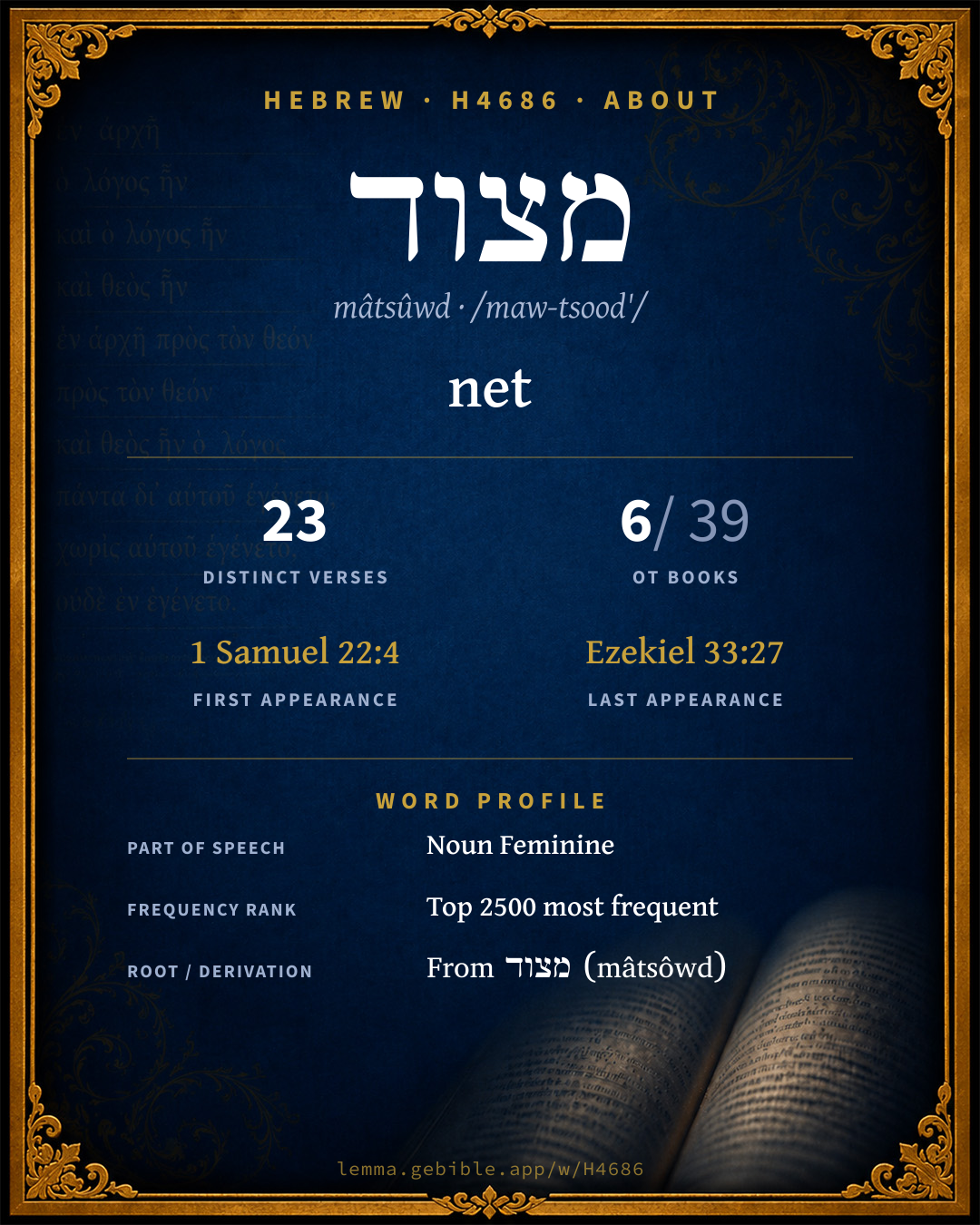
מְצוּדָה
net
also: prey, net prey fuller range ↓
Full lexicon entry — Brown-Driver-Briggs (BDB)
From Brown-Driver-Briggs (BDB)
Where this word appears
See every Absolute-state word in the Hebrew Bible →
Grammar key — what these labels mean
Part of speech
- Noun
- A naming word — a person, place, thing, or idea.
Noun type
- Common
- A common noun — a general class of person, place, or thing (“king,” “city,” “water”), not a specific name.
State
- Construct
- A noun bound to a following noun in a possessive / “of” relationship (the construct chain).
- Absolute
- The independent form of a noun, not bound to a following word.
Gender
- Both
- Attested as both masculine and feminine.
- Feminine
- Grammatically feminine.
Number
- Singular
- One.
- Plural
- More than one (in Hebrew, generally three or more).
Grammatical forms
- Noun, Common, Both, Singular, Construct 9 times (39%)
- Noun, Common, Both, Singular, Absolute 8 times (35%)
- Noun, Common, Feminine, Singular, Construct 2 times (9%)
- Noun, Common, Both, Plural, Absolute 2 times (9%)
- Noun, Common, Feminine, Singular, Absolute 2 times (9%)
Parsed forms decoded from the imported morphology (morphhb / Westminster Leningrad Codex — WLC text public domain, morphhb tagging CC BY 4.0), counted across 23 parsed occurrences — not distinct verses.
Every verse where H4686 appears — 23 distinct verses across 6 books. Click any verse to open its interlinear word-by-word view. Verse text shown in the World English Bible for context — . Each verse’s Hebrew form is shown with its reference; the English is not keyword-highlighted, since the data carries no word-level English alignment. Use “Compare translations” on any verse to read it across multiple English versions. This concordance covers the Hebrew Bible; Septuagint (Greek Old Testament) occurrences are not indexed here.
1 Samuel 3 verses
- 1 Samuel 22:4 בַּ/מְּצוּדָֽה prep det + n c bs He brought them before the king of Moab: and they lived with him all the while that David was in the stronghold.
- 1 Samuel 22:5 בַּ/מְּצוּדָ֔ה prep det + n c bs The prophet Gad said to David, Don't stay in the stronghold; depart, and get you into the land of Judah. Then David departed, and came into the forest of Hereth.
- 1 Samuel 24:22 הַ/מְּצוּדָֽה ptcl def.art + n c bs David swore to Saul. Saul went home; but David and his men got them up to the stronghold.
2 Samuel 5 verses
- 2 Samuel 5:7 מְצֻדַ֣ת n c bs cs Nevertheless David took the stronghold of Zion; the same is the city of David.
- 2 Samuel 5:9 בַּ/מְּצֻדָ֔ה prep det + n c bs David lived in the stronghold, and called it the city of David. David built round about from Millo and inward.
- 2 Samuel 5:17 הַ/מְּצוּדָֽה ptcl def.art + n c bs When the Philistines heard that they had anointed David king over Israel, all the Philistines went up to seek David; and David heard of it, and went down to the stronghold.
- 2 Samuel 22:2 וּ/מְצֻדָתִ֖/י conj + n c bs cs + sfx pers 1cs and he said, Yahweh is my rock, and my fortress, and my deliverer, even mine;
- 2 Samuel 23:14 בַּ/מְּצוּדָ֑ה prep det + n c bs David was then in the stronghold; and the garrison of the Philistines was then in Bethlehem.
1 Chronicles 2 verses
- 1 Chronicles 11:5 מְצֻדַ֣ת n c bs cs The inhabitants of Jebus said to David, You shall not come in here. Nevertheless David took the stronghold of Zion; the same is the city of David.
- 1 Chronicles 11:16 בַּ/מְּצוּדָ֑ה prep det + n c bs David was then in the stronghold, and the garrison of the Philistines was then in Bethlehem.
Job 2 verses
Psalms 7 verses
- Psalms 18:2 וּ/מְצוּדָתִ֗/י conj + n c bs cs + sfx pers 1cs Yahweh is my rock, my fortress, and my deliverer; My God, my rock, in whom I take refuge; My shield, and the horn of my salvation, my high tower.
- Psalms 31:2 מְצוּד֗וֹת n c bp Bow down your ear to me. Deliver me speedily. Be to me a strong rock, A house of defense to save me.
- Psalms 31:3 וּ/מְצוּדָתִ֣/י conj + n c bs cs + sfx pers 1cs For you are my rock and my fortress, Therefore for your name's sake lead me and guide me.
- Psalms 66:11 בַ/מְּצוּדָ֑ה prep det + n c fs You brought us into prison. You laid a burden on our backs.
- Psalms 71:3 וּ/מְצוּדָתִ֣/י conj + n c bs cs + sfx pers 1cs Be to me a rock of refuge to which I may always go. Give the command to save me, For you are my rock and my fortress.
- Psalms 91:2 וּ/מְצוּדָתִ֑/י conj + n c bs cs + sfx pers 1cs I will say of Yahweh, "He is my refuge and my fortress; My God, in whom I trust."
- Psalms 144:2 וּ/מְצוּדָתִ/י֮ conj + n c bs cs + sfx pers 1cs My loving kindness, my fortress, My high tower, my deliverer, My shield, and he in whom I take refuge; Who subdues my people under me.
Ezekiel 4 verses
- Ezekiel 12:13 בִּ/מְצֽוּדָתִ֑/י prep + n c fs cs + sfx pers 1cs My net also will I spread on him, and he shall be taken in my snare; and I will bring him to Babylon to the land of the Chaldeans; yet shall he not see it, though he shall die there.
- Ezekiel 13:21 לִ/מְצוּדָ֑ה prep + n c fs Your kerchiefs also will I tear, and deliver my people out of your hand, and they shall be no more in your hand to be hunted; and you shall know that I am Yahweh.
- Ezekiel 17:20 בִּ/מְצֽוּדָתִ֑/י prep + n c fs cs + sfx pers 1cs I will spread my net on him, and he shall be taken in my snare, and I will bring him to Babylon, and will enter into judgment with him there for his trespass that he has trespassed against me.
- Ezekiel 33:27 בַּ/מְּצָד֥וֹת prep det + n c bp Thus shall you tell them, Thus says the Lord Yahweh: As I live, surely those who are in the waste places shall fall by the sword; and him who is in the open field will I give to the animals to be devoured; and those who are in the strongholds and in the caves shall die of the pestilence.
About this entry
At a glance — auto-summarized from this page’s data, not written by a person. Every figure links to its source below. This summary describes the numbers; it doesn’t interpret them.
מצוד (mâtsûwd) is a Hebrew noun most often rendered “net.” Translators differ — “fortress” in the King James Version, then “stronghold” (unfoldingWord Literal Text), as the renderings breakdown shows. With 23 verses in 6 books, it is an uncommon word in the Hebrew Bible. It concentrates in Psalms, which alone accounts for 30% of its uses. Beyond its headline sense, its full sense range takes in “prey” and “net prey”. The sections below give every sense, occurrence, and version rendering.
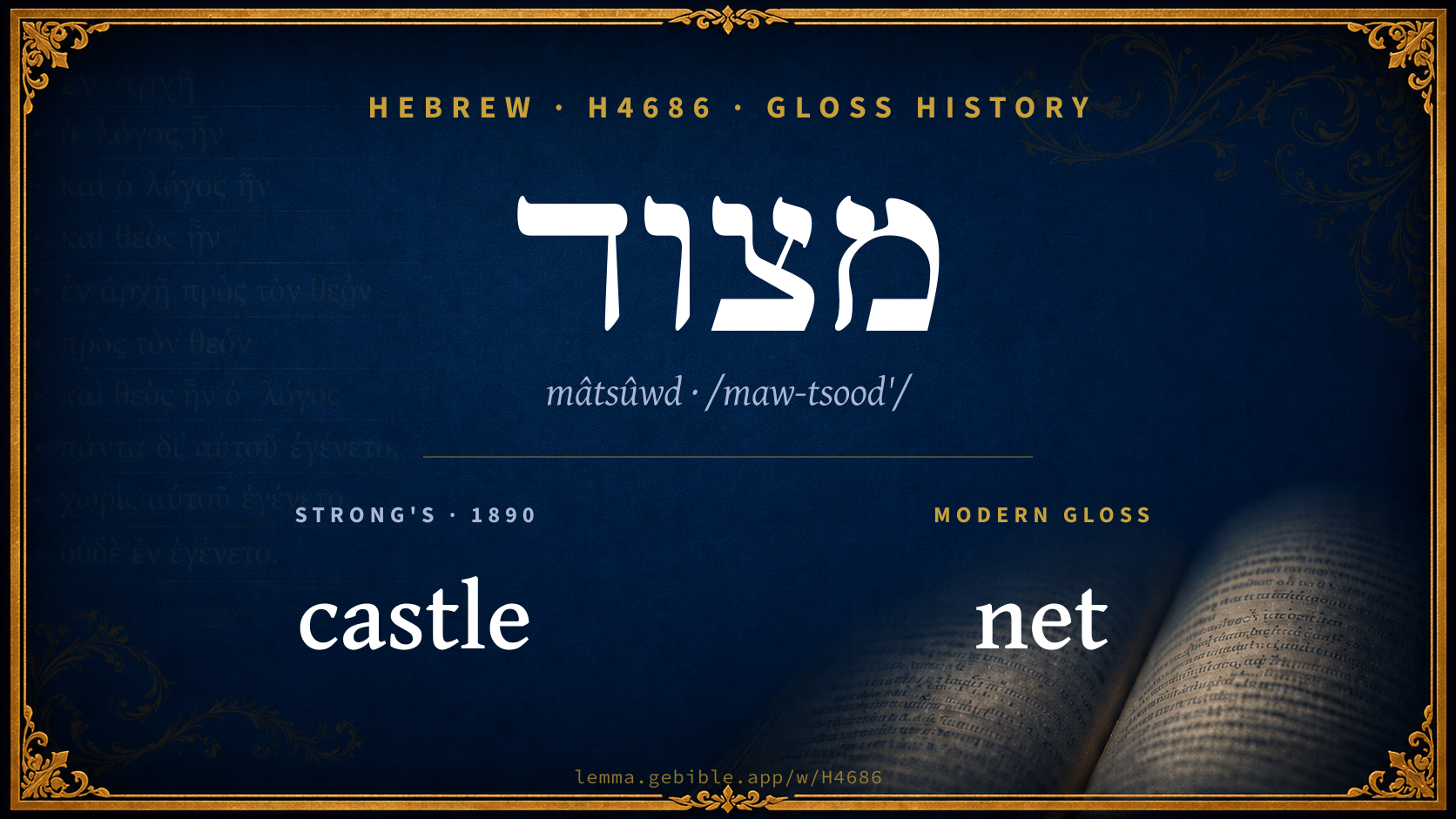
Gloss history
Strong's 1890 vs modern scholarship
About this word
Strong's H4686 catalogs a Hebrew word from the Hebrew Old Testament.
These counts are not copied from any lexicon or concordance. They are computed here, from the morphology-tagged Hebrew Old Testament. What Lemma adds →
- 23
- distinct verses
- The word appears in 23 distinct verses.
- 6 / 39
- OT books
- The word appears in 6 of 39 Old Testament books.
- #1,368
- by frequency
- Top 2500 most frequent Hebrew words (rank 1,368 of 8,640 Hebrew words by occurrence).
View all 23 occurrences in the concordance →
By section of the Old Testament
By traditional corpus
Conventional, traditional groupings — biblical authorship is debated, so this is a traditional corpus grouping, not an authorship claim. Each share is this word’s portion of its verses in that division of the Hebrew canon. Each figure is a share of the word’s 23 distinct verses.
- Prophets (Nevi'im) 12 verses · 52%
- Writings (Ketuvim) 11 verses · 48%
How translations render this word
Counts come from each version’s own published word-to-Strong’s tagging or interlinear alignment — an approximate guide to how each version renders this word, not a word-level alignment the data otherwise carries. Because each total is that version’s own tagged count, the per-version totals vary from one another and need not match the appearance or distinct-verse counts above. These counts may also differ from a printed concordance because Lemma counts each distinctly tagged rendering and does not collapse phrase taggings into a single head-word total. This is a fixed set of word-tagged versions (KJV, ASV, BSB, ULT) and does not change with the reading translation you choose elsewhere. Each version’s license is shown beside its name below (and on Sources).
BDB lists this Strong’s number as 5 distinct words (homographs). Each count above pools all of them and is not split by sense — see the Senses section below. A low-frequency rendering may belong to a different one of those words, not the primary meaning.
- King James Version†: Fortress 6×, Hold 3×, Net 2×
- American Standard Version†: Stronghold 6×, Fortress 5×, He shall be taken in my snare 2×
- Berean Standard Bible†: Fortress 9×, Stronghold 5×, Snare 2×
- unfoldingWord Literal Text†: Stronghold 12×, Fortress 2×, Net 2×
King James Version Public Domain
Renders H4686 across 22† tagged occurrences — most commonly:
Plus 9 renderings that appear only once — usually multi-word phrases or single function words the recovered tagging swept in, not distinct renderings.
American Standard Version Public Domain
Renders H4686 across 22† tagged occurrences — most commonly:
Plus 7 renderings that appear only once — usually multi-word phrases or single function words the recovered tagging swept in, not distinct renderings.
Berean Standard Bible Public Domain
Renders H4686 across 20† tagged occurrences — most commonly:
Plus 2 renderings that appear only once — usually multi-word phrases or single function words the recovered tagging swept in, not distinct renderings. Not rendered by a distinct English word in 1 further occurrence.
unfoldingWord Literal Text CC BY-SA 4.0
Renders H4686 across 25† tagged occurrences — most commonly:
Plus 5 renderings that appear only once — usually multi-word phrases or single function words the recovered tagging swept in, not distinct renderings.
Senses in the full BDB
What do BDB’s symbols mean?
BDB uses these scholarly abbreviations:
| Symbol | Meaning |
|---|---|
| 𝔊 | the Septuagint (the ancient Greek translation, LXX) |
| 𝔙 | the Vulgate (the Latin translation) |
| 𝔖 | the Syriac version (the Peshitta) |
| 𝔗 | the Targum (the Aramaic translation) |
| ψ | the Psalms |
| √ | root (the underlying root or stem) |
| ‖ | parallel passage (a synonymous or contrasted parallel) |
| † | the dagger: every passage where the word occurs is cited |
The 2 senses and sub-senses the full Brown-Driver-Briggs lexicon distinguishes for this word, in lexicon order (not ranked by frequency), with BDB’s own verbatim wording and sub-sense lettering. Shown in Hebrew script with BDB’s own scholarly abbreviations. The condensed entry is in the Lexicon Entry tab. See also the Forms in the corpus table below.
מצוד I Egypt, v. מצר, מִצְרַיִם.
מצוד II in pl., dub., usually siege-works
מצוד III [m.] siege-enclosure, siege, entrenchment
- 1. siege מ׳ שָׂם עָלֵינוּ Mi 4:14 he hath laid siege to us, cf. וְנָתַתָּ֫ עָלֶיהָ מ׳ Ez 4:2; בּוֹא בַמּ׳ is come into a state of siege Dt 20:19; 2 K 24:10; 25:2; Je 52:5, cf. וְהָֽיְתָה בַמּ׳ Ez 4:3; יוֹשֶׁבֶת֯י בַּמּ׳ Je 10:17; מְצוֹר יְרו׳ Ez 4:7 siege of Jerus., but also מ׳ עַל־יְרו׳ Zc 12:2; יְמֵי מ׳ of duration of siege Ez 4:8; 5:2; מֵי מ׳ Na 3:14 water for a siege; in phr. בְּמ׳ וּבְמָצוֹק in the siege and stress Dt 28:53, 55, 57 Je 19:9. e.g. Micah 4:14
- 2. enclosure, i.e. siege-works Dt 20:20; late = rampart Zc 9:3, עִיר מ׳ entrenched city ψ 31:22 (al. besieged), 60:11 (‖ 108:11 ע׳מִבְצָר), cf. 2 Ch 8:5; עָרִים לְמ׳ 11:5, ישְׁבִים בְּמ׳ בִּירוּשָׁלַם 32:10; מ׳ Hb 2:1 according to most (‖ מִשְׁמֶרֶת); but We der. from נצר, i.e. watch-tower, Now conj. מִצְפֶּה (cf. וַאֲצַפֶּה foll.); > Buhl conj. מְצָד—מ׳ n.pr.terr. v. p. 596. e.g. Deuteronomy 20:20
Senses from the full Brown-Driver-Briggs lexicon (Brown, Driver, Briggs; Oxford 1906 — public domain), digitized via Sefaria, supplemented by the OpenScriptures HebrewLexicon (CC BY 4.0). Full attribution on Sources.
Word origin
III. n.pr.terr.=מִצְרַיִם; only poet.: יְאֹרֵי מ׳ Is 19:6 2 K 19:24=Is 37:25; וְעָדֶיךָ יָבוֹא לְמִנִּי אַשּׁוּר וְעָרֵי מ׳ וּלְמִנִּי מ׳ וְעַד נָהָר Mi 7:12 (𝔊 misunderstands everywhere).
II. n.m. in pl., dub., usually siege-works;—מְצוֹדִים גְּדֹלִים Ec 9:14, but read מְצוּרִים WklAltor. Forsch. i. 353, v. מָצוֹר 2, p. 849 a.
IV. n.[m.] siege-enclosure, siege, entrenchment;—always מ׳ abs., exc. cstr. מְצוֹר Ez 4:7, sf. מְצוּרֶ֑ךָ v 8;—
— Brown-Driver-Briggs (Oxford 1906, public domain), digitized via Sefaria, supplemented by the OpenScriptures HebrewLexicon (CC BY 4.0). See Sources.
Derived from מצוד (mâtsôwd) (H4685) — siege.
Forms in the corpus
The 18 distinct written forms H4686 takes in the Hebrew Bible, most frequent first — each parse links to that state’s occurrences in the concordance. Hebrew forms include their vowel points and cantillation, so a single lemma takes many written forms.
Septuagint verse parallels
This word appears in 22 verses that also exist in the Greek Old Testament (Septuagint), out of the 23 Hebrew verses it occurs in. You can read those verses in Greek by switching the Old Testament edition to the Septuagint.
Read these verses in the Septuagint
This is a verse-level parallel only — the same verses exist in both the Hebrew and Greek Old Testaments. No word-level Hebrew↔Greek correspondence is claimed: the data carries no such alignment, so no Greek word is shown as this Hebrew word’s translation. Coverage is not total — the Septuagint omits the deuterocanon and renumbers the Psalms, so some Hebrew verses have no direct Greek parallel.