1 Samuel 24:22

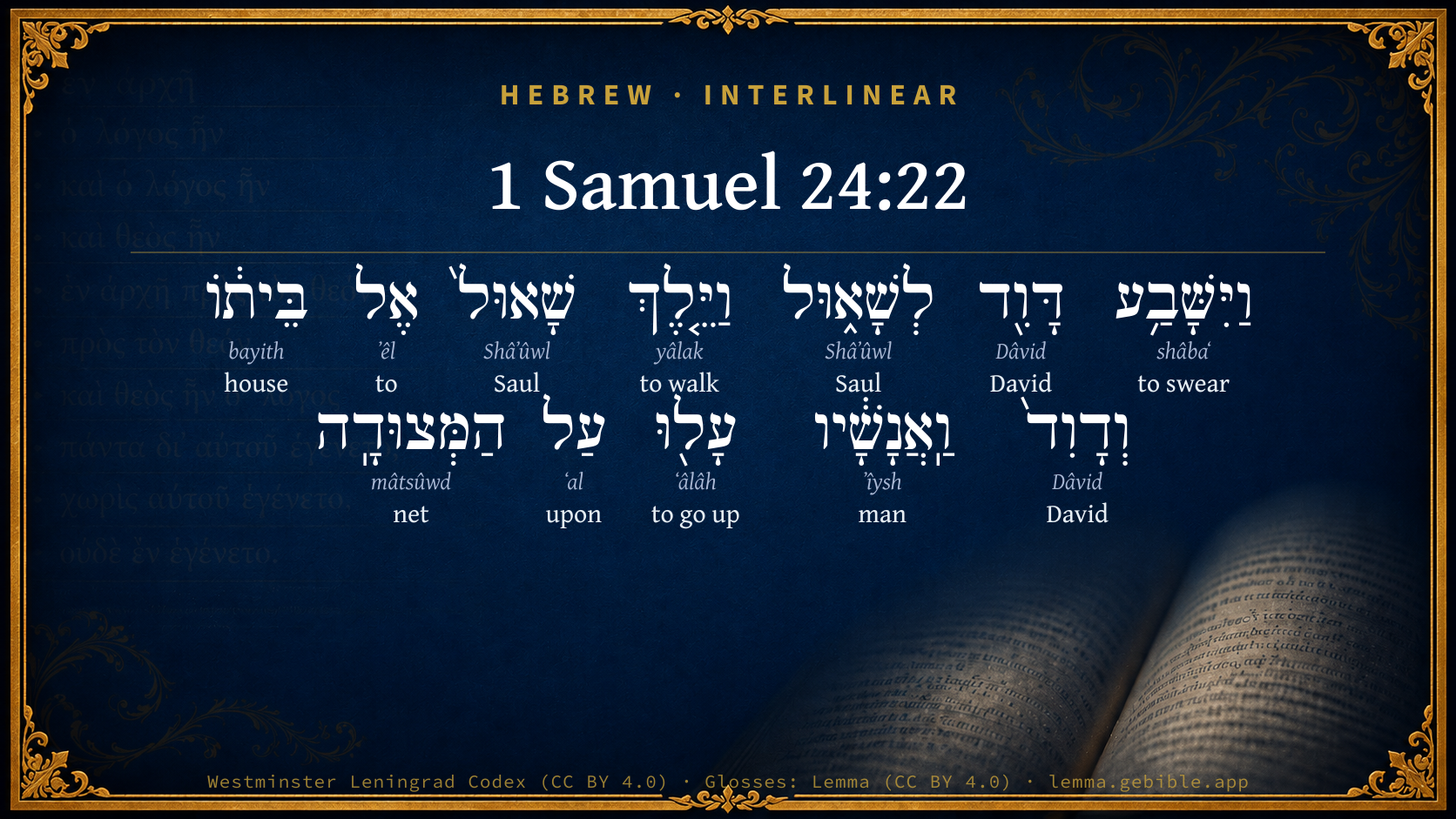
Hebrew (Westminster Leningrad Codex) 1 Samuel 24:22 appears in the Hebrew Old Testament. The text above is from the Westminster Leningrad Codex. Each word links to its Strong’s number, a concise gloss, and parsing drawn from the Open Scriptures Hebrew Bible morphology. Click any word for its full Brown-Driver-Briggs (BDB) entry.
Download image
Cite this verse

1 Samuel 24:22 (World English Bible). Public Domain. Lemma interlinear Bible study tool, https://lemma.gebible.app/v/1-samuel/24/22.

Show BibTeX & RIS
BibTeX
RIS
English Translation
David swore to Saul. Saul went home; but David and his men got them up to the stronghold.
World English Bible · Public Domain
Download a study sheet

One document with this verse’s original text, its word-by-word gloss line, the meaning frame, cross-references with their text, attributed commentary, and full source and license credits — printable, and it pastes into notes with its structure intact.

This verse Autodidact and up

Study sheet (.html) Plain text (.txt)

A passage Seminary Student

Up to 50 verses in one chapter. A passage sheet keeps up to 6 commentary sources and 12 cross-references per verse, in the order this page ranks them, and says so on the sheet whenever that leaves anything out. Ask for a single verse and you get the Autodidact verse sheet above.

Everything on this page stays free to read, with no account — the sheet is a download of what is already on screen, not access to it.

Want to remove ads? Support Godless Engineer
Compare translations 3

The same verse in 3 English versions, stacked beneath the original-language interlinear above. Click any original word for its lexicon entry.

Each is an independent rendering of the whole verse — the interlinear is not word-aligned to these translations.

Highlighted words mark where these versions differ — a whole-verse word diff, not a word-by-word alignment.

  • World English Bible Public Domain
    David swore to Saul. Saul went home; but David and his men got them up to the stronghold.
  • King James Version Public Domain
    And David sware unto Saul. And Saul went home; but David and his men gat them up unto the hold.
  • unfoldingWord Literal Text CC BY-SA 4.0
    And David swore to Saul. Then Saul went to his house, and David and his men went up onto the stronghold.

unfoldingWord Literal Text — © unfoldingWord, licensed CC BY-SA 4.0. Word-aligned USFM3 via Door43 (git.door43.org/unfoldingWord/en_ult).

Versions to compare (up to 4)

3 of 4 selected

Show all 18 translations

Every available English version of this verse, each an independent rendering of the whole verse.

  • World English Bible Public Domain
    David swore to Saul. Saul went home; but David and his men got them up to the stronghold.
  • Berean Standard Bible Public Domain
    So David gave his oath to Saul. Then Saul returned home, but David and his men went up to the stronghold.
  • Majority Standard Bible Public Domain
    So David gave his oath to Saul. Then Saul returned home, but David and his men went up to the stronghold.
  • King James Version Public Domain
    And David sware unto Saul. And Saul went home; but David and his men gat them up unto the hold.
  • American Standard Version (1901) Public Domain
    And David sware unto Saul. And Saul went home; but David and his men gat them up unto the stronghold.
  • Revised Version (1885) Public Domain
    And David sware unto Saul. And Saul went home; but David and his men gat them up unto the hold.
  • Geneva Bible (1599) Public Domain
    Sweare now therfore vnto me by the Lord, that thou wilt not destroy my seede after me, and that thou wilt not abolish my name out of my fathers house.
  • Douay-Rheims (1899) Public Domain
    Swear to me by the Lord, that thou wilt not destroy my seed after me, nor take away my name from the house of my father.
  • Young's Literal Translation Public Domain
    And David sweareth to Saul, and Saul goeth unto his house, and David and his men have gone up unto the fortress.
  • Literal Standard Version CC BY-SA 4.0
    And David swears to Saul, and Saul goes to his house, and David and his men have gone up to the fortress.
  • Unlocked Literal Bible CC BY-SA 4.0
    So David made an oath to Saul. Then Saul went home, but David and his men went up to the stronghold.
  • unfoldingWord Literal Text CC BY-SA 4.0
    And David swore to Saul. Then Saul went to his house, and David and his men went up onto the stronghold.
  • Darby Bible Public Domain
    And David swore to Saul. And Saul went home; and David and his men went up to the stronghold.
  • World Messianic Bible Public Domain
    David swore to Saul. Saul went home, but David and his men went up to the stronghold.
  • Webster's Bible Public Domain
    \\24:21\\Swear now therefore to me by the LORD, that thou wilt not cut off my seed after me, and that thou wilt not destroy my name out of my father's house.
  • Free Bible Version CC BY-SA 4.0
    So David promised this to Saul with an oath. Then Saul went back home, but David and his men returned to the stronghold.
  • Bible in Basic English Public Domain
    So give me your oath by the Lord, that you will not put an end to my seed after me or let my name be cut off from my father's family.
  • JPS Tanakh (1917) Public Domain
    (24-23) And David swore unto Saul. And Saul went home; but David and his men got them up unto the stronghold.

Literal Standard Version (2020), Covenant Press — licensed CC BY-SA 4.0. Text via the HelloAO Bible API (eBible.org). Unlocked Literal Bible (unfoldingWord) — licensed CC BY-SA 4.0. Text via the HelloAO Bible API (eBible.org). unfoldingWord Literal Text — © unfoldingWord, licensed CC BY-SA 4.0. Word-aligned USFM3 via Door43 (git.door43.org/unfoldingWord/en_ult). Free Bible Version, Dr. Jonathan Gallagher — licensed CC BY-SA 4.0. Text via the HelloAO Bible API (eBible.org).

Word by word

More ways to search: Search by grammar → Find every occurrence → Compare this word →

Practice this passage: Drill this verse → Learn its vocabulary →

הַמְּצוּדָֽה
mâtsûwd
H4686
“the · net”
Particle, Definite Article + Noun, Common, Both, Singular, Absolute
Part of Speech
Particle + Noun
Type
Common
Gender
Both
Number
Singular
State
Absolute
Full BDB Definition

Origin: for H4685

TWOT: 1885g , 1885i

net, prey, net prey - net - prey - fastness, stronghold
  1. וַיִּשָּׁבַ֥ע shâbaʻ H7650 “and · to swear” Conjunction + Verb, Niphal, Sequential Imperfect, 3rd Person, Masculine, Singular
  2. דָּוִ֖ד Dâvid H1732 “David” Noun, Proper
  3. לְשָׁא֑וּל Shâʼûwl H7586 “to/for · Saul” Preposition + Noun, Proper
  4. וַיֵּ֤לֶךְ yâlak H3212 “and · to walk” Conjunction + Verb, Qal, Sequential Imperfect, 3rd Person, Masculine, Singular
  5. שָׁאוּל֙ Shâʼûwl H7586 “Saul” Noun, Proper
  6. אֶל ʼêl H413 “to” Preposition
  7. בֵּית֔וֹ bayith H1004 “house · his” Noun, Common, Masculine, Singular, Construct + Suffix, Personal, 3rd Person, Masculine, Singular
  8. וְדָוִד֙ Dâvid H1732 “and · David” Conjunction + Noun, Proper
  9. וַֽאֲנָשָׁ֔יו ʼîysh H376 “and · men · his” Conjunction + Noun, Common, Masculine, Plural, Construct + Suffix, Personal, 3rd Person, Masculine, Singular
  10. עָל֖וּ ʻâlâh H5927 “to go up” Verb, Qal, Perfect, 3rd Person, Common, Plural
  11. עַל ʻal H5921 “upon” Preposition

About this verse

These counts appear in no published source. They are computed here, from the morphology-tagged text and Lemma’s own curated glosses. What Lemma adds →

12
words
10
distinct lemmas
Historical
section

Notable vocabulary

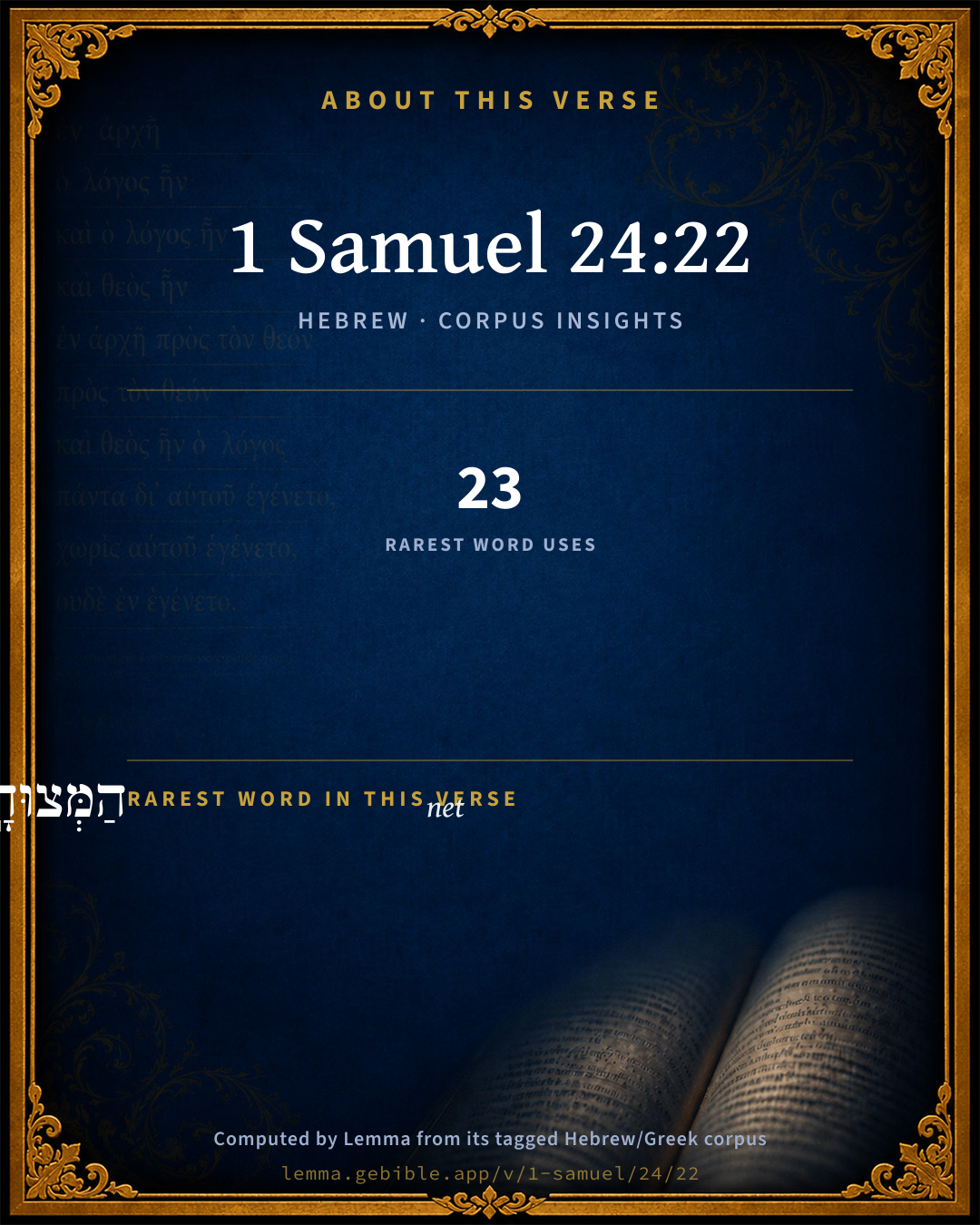
The rarest word here is הַמְּצוּדָֽה net H4686 — appearing just 23 times in the whole Hebrew Bible.

Shared distinctive vocabulary

הַמְּצוּדָֽה net H4686 occurs in 23 verses of the Hebrew Bible. Also found in:

Grammatical profile

  • 3 verbs
  • 7 nouns
  • 2 prepositions

Verb forms

  • וַיִּשָּׁבַ֥ע Niphal · Sequential Imperfect
  • וַיֵּ֤לֶךְ Qal · Sequential Imperfect
  • עָל֖וּ Qal · Perfect

Repetition

Words recur within this verse — often emphatic in Hebrew:

  • דָּוִ֖ד David H1732 ×2
  • לְשָׁא֑וּל Saul H7586 ×2

Hebrew & Septuagint length

In English translation the verse runs 18 words from the Hebrew and 31 from the Septuagint (LXX English) — the Septuagint runs noticeably longer here. See the side-by-side →

A rough comparison of the two English renderings, which tokenize alike — not a word-level alignment.

Word counts can differ between the Hebrew and the Greek without any difference in meaning — e.g. the Hebrew direct-object marker אֵת has no separate Greek word, and Greek often adds the article ὁ.

Cross-references

4

Topical passages linked to 1 Samuel 24:22 in the Treasury of Scripture Knowledge — connected by theme and wording, ordered by reader-vote popularity; previews shown in the World English Bible.

  • 1 Samuel 23:29 David went up from there, and lived in the strongholds of En Gedi.
  • Matthew 10:16–17 "Behold, I send you out as sheep in the midst of wolves. Therefore be wise as serpents, and harmless as doves.
  • John 2:24 But Jesus didn't trust himself to them, because he knew everyone,
  • Proverbs 26:24–25 A malicious man disguises himself with his lips, But he harbors evil in his heart.

Cross-references courtesy of OpenBible.info (CC BY 4.0).

Hebrew and Greek witnesses Masoretic Hebrew ↔ Greek Septuagint

The same verse in the two great witnesses to the Old Testament, shown verse-for-verse.

Here the Septuagint runs noticeably longer than the Hebrew — LXX2012 (modern English Septuagint) 31 words vs World English Bible 18. A rough length comparison of the two English translations, not a word-level alignment — read both below.

These are two independent witnesses, not word-aligned to each other, and the Septuagint is shown in lemma (dictionary) form.

Hebrew 1 Samuel 24:22 Masoretic · Westminster Leningrad Codex

וַיִּשָּׁבַ֥ע דָּוִ֖ד לְשָׁא֑וּל וַיֵּ֤לֶךְ שָׁאוּל֙ אֶל בֵּית֔וֹ וְדָוִד֙ וַֽאֲנָשָׁ֔יו עָל֖וּ עַל הַמְּצוּדָֽה

David swore to Saul. Saul went home; but David and his men got them up to the stronghold.

World English Bible · Public Domain

Greek LXX 1 Samuel 24:22 Septuagint · lemma form

καί νῦν ὄμνυμι ἐγώ ἐν κύριος ὅτι οὐ ἐκὀλεθρεύω ὁ σπέρμα ἐγώ ὀπίσω ἐγώ καί οὐ ἀπο ἀναἵζω ὁ ὄνομα ἐγώ ἐκ ὁ οἶκος ὁ πατήρ ἐγώ

Now then swear to me by the Lord, that you will not destroy my seed after me, that you will not blot out my name from the house of my father.

LXX2012 (modern English Septuagint) · Public Domain

Hebrew: Westminster Leningrad Codex (CC BY 4.0). Greek: Septuagint (public domain); English from LXX2012 (modern English Septuagint) (Public Domain). How the Septuagint differs from the Hebrew →

Targum (Aramaic paraphrase)

1

The Targum is the ancient Jewish Aramaic paraphrase of the Hebrew Scriptures — an interpretive translation, not the Hebrew text itself. Onkelos (literal) and Pseudo-Jonathan (expansive) render the Torah, and Jonathan the Prophets. Coverage is partial: where no permissively-licensed English translation exists for a verse, only the Aramaic is shown. This is verse-level text, not a word-by-word alignment to the Hebrew.

  1. Targum Jonathan Prophets (Joshua–Malachi)
    וּכְעַן קַיֵים לִי בְּמֵימְרָא דַייָ דְלָא תְשֵׁיצֵי יַת בְּנַי בַּתְרָי וְלָא תִפְסוֹק יַת שְׁמִי מִבֵּית אַבָּא:

    (no public-domain English translation for this verse)

    Targum Jonathan — Aramaic: “Mikraot Gedolot” (public domain). English: “Sefaria Community Translation” (CC0 1.0 (public-domain dedication)); “London "Chaldee Paraphrase," 1871” (public domain). Text via Sefaria.

Commentary

Notes on 1 Samuel 24:22 from classic Christian and Jewish commentators (each source and its license shown beneath its notes). The classic Christian expositions comment on the surrounding passage and are grouped to its opening verse, so a note may address several verses; the Jewish commentaries on the Tanakh (Rashi and others) are per-verse, so they appear only where the commentator wrote on this verse.

Lemma curates 59 commentaries, every one of them public domain or Creative Commons licensed, each selected and text-cleaned for this edition rather than reprinted as found. About our sources →

Trapp's Complete Commentary

John Trapp

1Sa 24:22 And David sware unto Saul. And Saul went home; but David and his men gat them up unto the hold.

Ver. 22. And David sware unto Saul.] The same in effect that he had sworn before to Jonathan.

And Saul went home.] Convinced, but not converted; Punctus et repunctus, minime tamen ad resipiscentiam compunctus.

Gat them up unto the hold,] i.e., Of Engedi, {1Sa 24:1} for they knew that there was little hold to be taken of Saul’s melting protestations, whom they had found so faithless. Credulity argueth folly.

John Trapp, A Commentary or Exposition upon All the Books of the Old and New Testament (1647–1656) — public domain. Text from a community e-Sword module.

Joseph Benson's Commentary

1Sa 24:22. David and his men get them up unto the hold — Of Engedi, 1Sa 24:1. For having had so frequent experience of Saul’s inconstancy, he would trust him no more. It is indeed dangerous to trust a reconciled enemy; and the son of Sirach advises, “Never trust thine enemy; though he humble himself, yet take good heed and beware of him.” Before we close our notes on this chapter, we beg leave to add one general remark; which is, that there is something so noble and generous in David’s whole behaviour, as related in it, that it is above all encomiums. We cannot say any thing in commendation of it, but what the relation itself far exceeds.

Joseph Benson's Commentary on the Old and New Testaments (1811–1818) — public domain. Text from a community e-Sword module.

Adam Clarke's Commentary

Verse 22. Saul went home] Confounded at a sense of his own baseness, and overwhelmed with a sense of David's generosity.

David and his men gat them up unto the hold.] Went up to Mizpeh, according to the Syriac and Arabic. David could not trust Saul with his life; the utmost he could expect from him was that he should cease from persecuting him; but even this was too much to expect from a man of such a character as Saul. He was no longer under the Divine guidance; an evil spirit had full dominion over his soul. What God fills not, the devil will occupy.

Adam Clarke's Commentary on the Bible (1810–1826) — public domain. Text from a community e-Sword/MySword module.

Ellicott's Commentary for English Readers

(22) And David sware unto Saul.—The generous son of Jesse at once complied with Saul’s curious request, and for a time, at least, the persecution and pursuit of David ceased. Stricken with remorse, the gloomy king left him to himself; no word, however, seems to have passed as to restoring the exile to his home or rank. Bishop Wordsworth quotes here a characteristic passage from one of Chrysostom’s eloquent homilies, in which the Patristic method of allegorising all these famous scenes of Old Testament history is well exemplified.

“Meditate on the example of David, and do thou imitate it: imitate it in his self-control and in his love of his enemy. The cave in which he was became like a Christian Church, and he became like a Christian bishop, who first preaches a sermon and then offers the sacrifice of the altar.

“So David preached a sermon by his example, and offered a true sacrifice—the spiritual sacrifice of himself and of his own anger; he became as it were a priest, a sacrifice, and an altar, and having offered his victims, he gained a glorious victory.”—St. Chrysostom, tom. 4, p. 761.

A Bible Commentary for English Readers, edited by Charles John Ellicott (1878–1897) — public domain. Text from a community e-Sword module.

The Cambridge Bible for Schools and Colleges

gen. ed. J. J. S. Perowne

22. gat them up unto the hold] Returned to the fastnesses of En-gedi. Experience had proved that Saul’s repentance was not to be trusted.

The Cambridge Bible for Schools and Colleges (gen. ed. J. J. S. Perowne; Cambridge University Press, 1878–1918) — public domain. Text from a community e-Sword module.

John Gill's Exposition

And David sware unto Saul,.... That he would not cut, off his posterity; which oath he religiously observed, in sparing Mephibosheth, Sa2 21:7, and in punishing the murderers of Ishbosheth, Sa2 4:12; and as for the seven sons of Saul, delivered up to the Gibeonites, Sa2 21:6, it may be questioned whether they were his genuine legitimate offspring; and if they were, it was by the appointment and command of God, and according to his will and pleasure they were executed, who is not bound by the oaths of men, and to whom they must be submitted, Sa2 21:1,

and Saul went home; to his palace in Gibeah:

but David and his men got them up unto the hold; in Engedi, Sa1 23:29; not trusting to Saul, whose inconstancy, perfidy, cruel hatred, and malice, David full well knew; and therefore thought it not safe to return to his own house, nor to dwell in the open country, but in the wilderness, and among the rocks, and in the caves there, such as were in the wilderness of Engedi; and here, and at this time, he penned the fifty seventh psalm, see Psa 57:1.

Next: 1 Samuel Chapter 25

John Gill's Exposition of the Whole Bible (1746–1763) — public domain (CC PDM 1.0). Text via the HelloAO Bible API.

Albert Barnes' Notes on the Bible

Saul does not appear to have invited David to return to Gibeah, or to have given him any security of doing so with safety. David, with his intuitive sagacity, perceived that the softening of Saul’s feelings was only momentary, and that the situation remained unchanged.

Albert Barnes' Notes on the Bible (1834–1885) — public domain. Text from a community e-Sword/MySword module.

Haydock's Catholic Bible Commentary

Father. David complied with this request as far as he was able: but, as God was resolved to punish the posterity of Saul, for the injury done to the Gabaonites, he was forced to give them all up, except Miphiboseth, the son of Jonathan. (Calmet) --- He could not promise to defend them, if they proved guilty.

George Leo Haydock (1774–1849), Haydock's Catholic Family Bible and Commentary, 1859 edition — public domain. Excludes Psalms (Douay-Rheims chapter numbering differs from Protestant) and Deuterocanonical books (Catholic canon only).

Matthew Poole's English Annotations

David sware unto Saul.

Quest. How then could David destroy so many of Saul’s sons, 2Sa 21:8,9?

Answ. David could bind himself by his oaths, but he could not bind God, to whose good pleasure all promises, vows, and oaths must in all reason be submitted; and that was done by God’s command, and God was well pleased with it, 2Sa 21:14. Nor is it to be supposed that David sware not to destroy any of them in case God should specially command it, or that should by miscarriage render themselves obnoxious to the sword of justice; but only that he would not do it barely on his own private account, nor seek occasions of so doing.

Unto the hold, to wit, of En-gedi, 1Sa 24:1; for having had so great and frequent experience of Saul’s inconstancy, and malice, and perfidiousness, he would trust him no more.

Matthew Poole's English Annotations on the Holy Bible (1683–1685) — public domain. Text from a community e-Sword/MySword module.

Whedon's Commentary on the Bible

Daniel D. Whedon

22. The hold — The particular stronghold in this wilderness (chap. xxiii, 29) in which at the time David and his men had their headquarters. Yielding himself now to holy meditation and song, he commemorates his deliverance by the composition of Psalms 142.

Daniel D. Whedon (gen. ed.), Commentary on the Old and New Testaments (1874–1909) — public domain. Text from a community e-Sword module.

John Wesley's Explanatory Notes

Unto the hold - Of En-gedi, ver. 1, for having had by frequent experience of Saul's inconstancy, he would trust him no more.

John Wesley, Explanatory Notes Upon the Whole Bible (1754–1765) — public domain. Text via the GEBible commentary corpus.

Keil & Delitzsch

C. F. Keil & F. Delitzsch

When David had sworn this, Saul returned home. But David remained upon the mountain heights, because he did not regard the passing change in Saul's feelings as likely to continue. המּצוּדה (translated "the hold") is used here to denote the mountainous part of the desert of Judah. It is different in Sa1 22:5.

Keil & Delitzsch — Biblical Commentary on the Old Testament (1861–1891) — public domain (CC PDM 1.0). Text via the HelloAO Bible API. (Old Testament only.)

Lesson kit

Teaching starters — assembled from the data on this page, not authored interpretation. Every prompt links to the verse data it draws on. Edit before teaching.

1 Samuel, in the Historical, opens this verse with 12 words (10 distinct Hebrew lemmas). Its most distinctive word is mâtsûwd (“net”). The Greek Septuagint runs longer here. A historical commentator’s framing appears above. Read the whole chapter for the surrounding context.

Discussion questions

  1. The word mâtsûwd carries the sense “net.” How does it shape the verse?
  2. 1 Samuel 22:4 shares the word «net» with this verse. How do the two illuminate each other?
  3. “David” occurs 2× in this one verse. What is the effect of the repetition?
  4. Compared with the Hebrew, the Septuagint runs longer here. What questions does that raise?
  5. These translations render this verse differently; the difference is in the English rendering, not the original. What questions does that raise?
  6. The verb «וַיִּשָּׁבַ֥ע» is Niphal Sequential Imperfect. How does its form color the action?
  7. Reading how Trapp's Complete Commentary and Joseph Benson's Commentary read this verse, where do the two commentators agree and where do they part?

Things to notice

Reading settings

Reading text

Shown beneath each verse's original-language words.

Old Testament
Old Testament edition

Read the OT as the Masoretic Hebrew (MT) or the Greek Septuagint (LXX).

English shown for the Greek Septuagint (in the Hebrew ↔ Greek comparison).

Comparing translations? Open the Compare panel on any verse page to stack up to four side by side.