
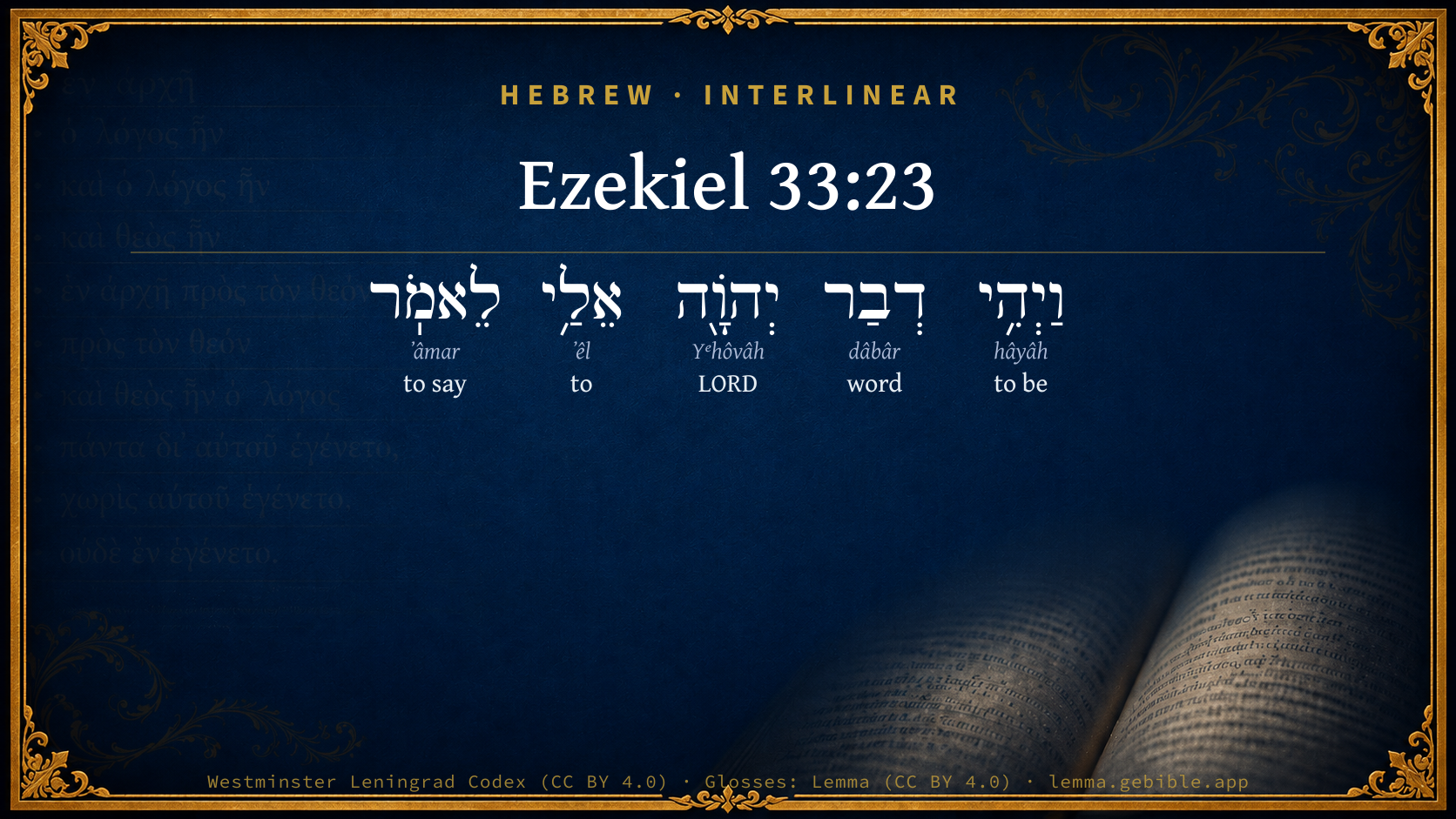
Ezekiel 33:23

Hebrew (Westminster Leningrad Codex) Ezekiel 33:23 appears in the Hebrew Old Testament. The text above is from the Westminster Leningrad Codex. Each word links to its Strong’s number, a concise gloss, and parsing drawn from the Open Scriptures Hebrew Bible morphology. Click any word for its full Brown-Driver-Briggs (BDB) entry.
Download image
Cite this verse

Ezekiel 33:23 (World English Bible). Public Domain. Lemma interlinear Bible study tool, https://lemma.gebible.app/v/ezekiel/33/23.

Show BibTeX & RIS
BibTeX
RIS
English Translation
The word of Yahweh came to me, saying,
World English Bible · Public Domain
Download a study sheet

One document with this verse’s original text, its word-by-word gloss line, the meaning frame, cross-references with their text, attributed commentary, and full source and license credits — printable, and it pastes into notes with its structure intact.

This verse Autodidact and up

Study sheet (.html) Plain text (.txt)

A passage Seminary Student

Up to 50 verses in one chapter. A passage sheet keeps up to 6 commentary sources and 12 cross-references per verse, in the order this page ranks them, and says so on the sheet whenever that leaves anything out. Ask for a single verse and you get the Autodidact verse sheet above.

Everything on this page stays free to read, with no account — the sheet is a download of what is already on screen, not access to it.

Want to remove ads? Support Godless Engineer
Compare translations 3

The same verse in 3 English versions, stacked beneath the original-language interlinear above. Click any original word for its lexicon entry.

Each is an independent rendering of the whole verse — the interlinear is not word-aligned to these translations.

Highlighted words mark where these versions differ — a whole-verse word diff, not a word-by-word alignment.

  • World English Bible Public Domain
    The word of Yahweh came to me, saying,
  • King James Version Public Domain
    Then the word of the LORD came unto me, saying,
  • unfoldingWord Literal Text CC BY-SA 4.0
    Then the word of Yahweh came to me, saying,

unfoldingWord Literal Text — © unfoldingWord, licensed CC BY-SA 4.0. Word-aligned USFM3 via Door43 (git.door43.org/unfoldingWord/en_ult).

Versions to compare (up to 4)

3 of 4 selected

Show all 18 translations

Every available English version of this verse, each an independent rendering of the whole verse.

  • World English Bible Public Domain
    The word of Yahweh came to me, saying,
  • Berean Standard Bible Public Domain
    Then the word of the LORD came to me, saying,
  • Majority Standard Bible Public Domain
    Then the word of the LORD came to me, saying,
  • King James Version Public Domain
    Then the word of the LORD came unto me, saying,
  • American Standard Version (1901) Public Domain
    And the word of Jehovah came unto me, saying,
  • Revised Version (1885) Public Domain
    And the word of the LORD came unto me, saying,
  • Geneva Bible (1599) Public Domain
    Againe the worde of the Lord came vnto me, and saide,
  • Douay-Rheims (1899) Public Domain
    And the word of the Lord came to me, saying:
  • Young's Literal Translation Public Domain
    And there is a word of Jehovah unto me, saying,
  • Literal Standard Version CC BY-SA 4.0
    And there is a word of YHWH to me, saying,
  • Unlocked Literal Bible CC BY-SA 4.0
    Then the word of Yahweh came to me, saying,
  • unfoldingWord Literal Text CC BY-SA 4.0
    Then the word of Yahweh came to me, saying,
  • Darby Bible Public Domain
    And the word of Jehovah came unto me, saying,
  • World Messianic Bible Public Domain
    The LORD’s word came to me, saying,
  • Webster's Bible Public Domain
    Then the word of the LORD came to me, saying,
  • Free Bible Version CC BY-SA 4.0
    A message from the Lord came to me, saying,
  • Bible in Basic English Public Domain
    And the word of the Lord came to me, saying,
  • JPS Tanakh (1917) Public Domain
    Then the word of the LORD came unto me, saying:

Literal Standard Version (2020), Covenant Press — licensed CC BY-SA 4.0. Text via the HelloAO Bible API (eBible.org). Unlocked Literal Bible (unfoldingWord) — licensed CC BY-SA 4.0. Text via the HelloAO Bible API (eBible.org). unfoldingWord Literal Text — © unfoldingWord, licensed CC BY-SA 4.0. Word-aligned USFM3 via Door43 (git.door43.org/unfoldingWord/en_ult). Free Bible Version, Dr. Jonathan Gallagher — licensed CC BY-SA 4.0. Text via the HelloAO Bible API (eBible.org).

Word by word

More ways to search: Search by grammar → Find every occurrence → Compare this word →

Practice this passage: Drill this verse → Learn its vocabulary →

About this verse

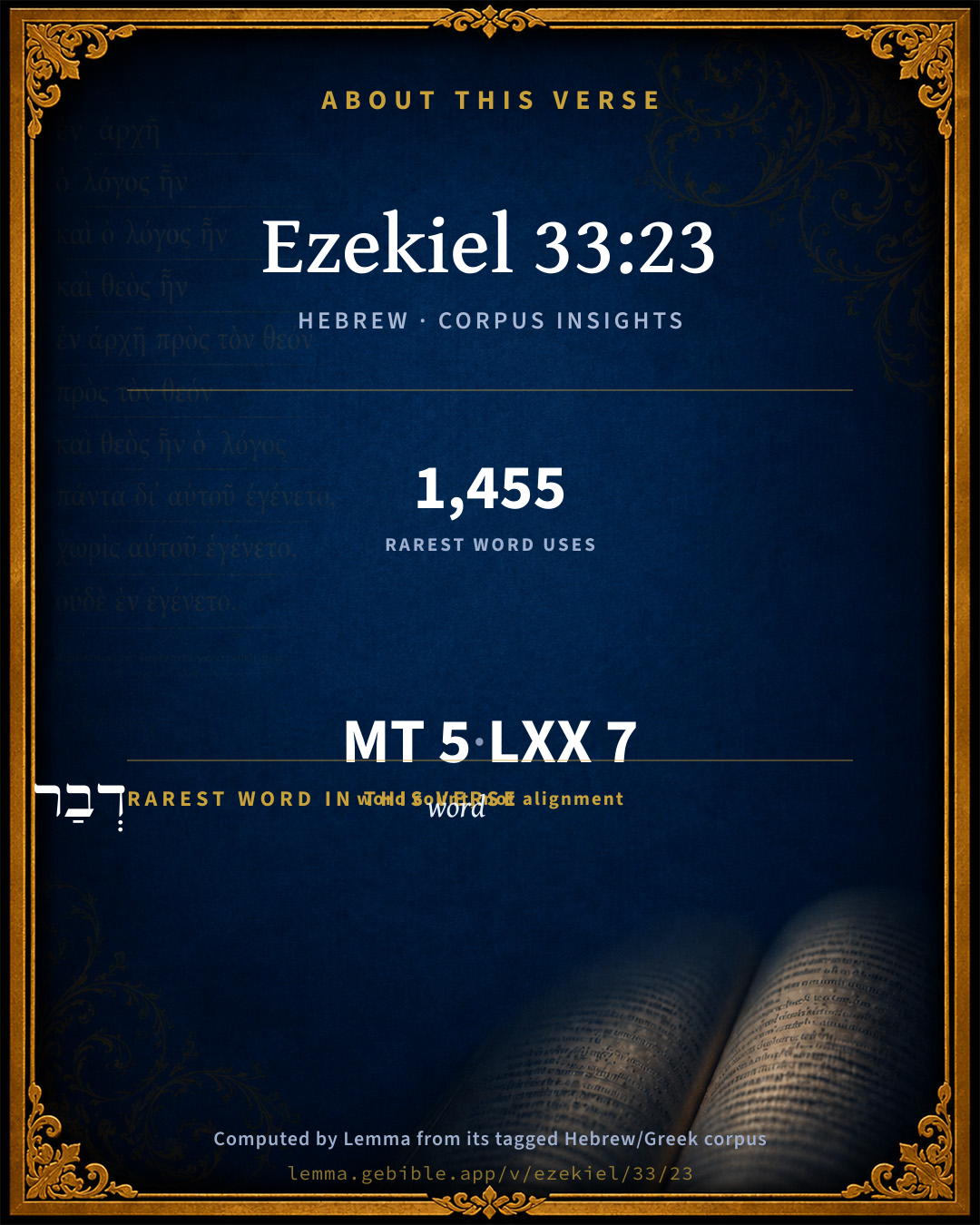
These counts appear in no published source. They are computed here, from the morphology-tagged text and Lemma’s own curated glosses. What Lemma adds →

5
words
5
distinct lemmas
Prophets
section

Grammatical profile

  • 2 verbs
  • 2 nouns
  • 1 preposition

Verb forms

  • וַיְהִ֥י Qal · Sequential Imperfect
  • לֵאמֹֽר Qal · Infinitive Construct

Hebrew & Septuagint length

In English translation the verse runs 8 words from the Hebrew and 10 from the Septuagint (LXX English) — closely comparable.

A rough comparison of the two English renderings, which tokenize alike — not a word-level alignment.

Word counts can differ between the Hebrew and the Greek without any difference in meaning — e.g. the Hebrew direct-object marker אֵת has no separate Greek word, and Greek often adds the article ὁ.

In the original languages it is 5 Hebrew tokens and 7 Greek tokens — but the two are counted differently (Hebrew bundles its prefixes and suffixes into one token; the Greek is in lemma form), so that isn’t a like-for-like length.

Hebrew and Greek witnesses Masoretic Hebrew ↔ Greek Septuagint

The same verse in the two great witnesses to the Old Testament, shown verse-for-verse.

These are two independent witnesses, not word-aligned to each other, and the Septuagint is shown in lemma (dictionary) form.

Hebrew Ezekiel 33:23 Masoretic · Westminster Leningrad Codex

וַיְהִ֥י דְבַר יְהֹוָ֖ה אֵלַ֥י לֵאמֹֽר

The word of Yahweh came to me, saying,

World English Bible · Public Domain

Greek LXX Ezekiel 33:23 Septuagint · lemma form

καί γίγνομαι λόγος κύριος πρός ἐγώ λέγω

And the word of the Lord came to me, saying,

LXX2012 (modern English Septuagint) · Public Domain

Hebrew: Westminster Leningrad Codex (CC BY 4.0). Greek: Septuagint (public domain); English from LXX2012 (modern English Septuagint) (Public Domain). How the Septuagint differs from the Hebrew →

Targum (Aramaic paraphrase)

1

The Targum is the ancient Jewish Aramaic paraphrase of the Hebrew Scriptures — an interpretive translation, not the Hebrew text itself. Onkelos (literal) and Pseudo-Jonathan (expansive) render the Torah, and Jonathan the Prophets. Coverage is partial: where no permissively-licensed English translation exists for a verse, only the Aramaic is shown. This is verse-level text, not a word-by-word alignment to the Hebrew.

  1. Targum Jonathan Prophets (Joshua–Malachi)
    וַהֲוָה פִּתְגָם נְבוּאָה מִן קֳדָם יְיָ עִמִי לְמֵימָר:

    (no public-domain English translation for this verse)

    Targum Jonathan — Aramaic: “Mikraot Gedolot” (public domain). English: “Sefaria Community Translation” (CC0 1.0 (public-domain dedication)); “London "Chaldee Paraphrase," 1871” (public domain). Text via Sefaria.

Commentary

Notes on Ezekiel 33:23 from classic Christian and Jewish commentators (each source and its license shown beneath its notes). The classic Christian expositions comment on the surrounding passage and are grouped to its opening verse, so a note may address several verses; the Jewish commentaries on the Tanakh (Rashi and others) are per-verse, so they appear only where the commentator wrote on this verse.

Lemma curates 59 commentaries, every one of them public domain or Creative Commons licensed, each selected and text-cleaned for this edition rather than reprinted as found. About our sources →

Trapp's Complete Commentary

John Trapp

Eze 33:23 Then the word of the LORD came unto me, saying,

Ver. 23. Then the word of the Lord.] See Eze 18:1.

John Trapp, A Commentary or Exposition upon All the Books of the Old and New Testament (1647–1656) — public domain. Text from a community e-Sword module.

Albert Barnes' Notes on the Bible

The exhortation to repentance. Ezekiel first addresses the remnant that still linger in their ancient home, and warns them against presumptuous hopes resting on false grounds Eze 33:23-29; then he turns his eyes to those near him, and points out that their apparent attention to his words was illusory.

Eze 33:24

Those wastes - The places in the holy land devastated by the conqueror.

Abraham - The argument is, Abraham was but one man, and he had the promise of the land, though he did not at once possess it; much more shall we, the descendants of Abraham, being many, retain this promise and possess the land, though for a time we are depressed and subject. Compare Mat 3:9; Joh 8:33, Joh 8:39.

Eze 33:25

To eat flesh with the blood was forbidden (see the marginal references). It seems to have been connected with the idolatries of Canaan. The prohibition was, on account of its connection with idolatry, continued in the enactment of the Council of Jerusalem Act 15:29.

Eze 33:26

Ye stand upon your sword - Ye put your trust in your swords.

Eze 33:30-33

God warns the prophet against being misled by the compliance of the people.

Eze 33:30

Against thee - Rather, about “thee.” “by the walls” Rather, within “the walls.”

Eze 33:31

As the people cometh - literally, as in the margin, i. e., in crowds. Render it: they shall come “unto thee” like the coming of a people,” and” shall “sit before thee as My people” etc., i. e., they assume the attitude of God’s people listening to His prophet. Compare Eze 14:1; Eze 20:1.

Eze 33:33

And when this - But when this.

Albert Barnes' Notes on the Bible (1834–1885) — public domain. Text from a community e-Sword/MySword module.

Keil & Delitzsch

C. F. Keil & F. Delitzsch

Preaching of Repentance after the Fall of Jerusalem

The first word of God, which Ezekiel received after the arrival of the fugitive with the intelligence of the destruction of Jerusalem, was not of a consolatory, but of a rebuking nature, and directed against those who, while boasting in an impenitent state of mind of the promise given to the patriarchs of the everlasting possession of the Holy Land, fancied that they could still remain in possession of the promised land even after the destruction of Jerusalem and of the kingdom of Judah. This delusion the prophet overthrows by the announcement that the unrighteous are to have no share in the possession of the land of Israel, but are to perish miserably, and that the land is to be utterly waste and without inhabitants (Eze 33:23-29). The Lord then shows him that his countrymen will indeed come to him and listen to his words, but will only do that which is pleasant to themselves; that they will still seek after gain, and not do his words; and that it will not be till after his words have been fulfilled that they will come to the knowledge of the fact that he really was a prophet (Eze 33:30-33). We perceive from these last verses that the threat uttered in Eze 33:24-29 was to form the basis for Ezekiel's further prophecies, so that the whole of this word of God has only the force of an introduction to his further labours. But however the two halves of this word of God may appear to differ, so far as their contents are concerned, they are nevertheless closely connected. The state of heart disclosed in the first half, with reference to the judgment that has already fallen upon the land and kingdom, is to preclude the illusion, that the fact of the people's coming to the prophet to hear his words is a sign of penitential humiliation under the punishing hand of God, and to bring out the truth, that the salvation which he is about to foretell to the people is only to be enjoyed by those who turn with sincerity to the Lord.

Eze 33:23-29

False reliance upon God's Promises

Eze 33:23. And the word of Jehovah came to me, saying, Eze 33:24. Son of man, the inhabitants of these ruins in the land of Israel speak thus: Abraham was one, and received the land for a possession; but we are many, the land is given to us for a possession. Eze 33:25. Therefore say to them, Thus saith the Lord Jehovah, Ye eat upon the blood, and lift up your eyes to your idols, and shed blood, and would ye possess the land? Eze 33:26. Ye rely upon your sword, do abomination, and one defileth another's wife, and would ye possess the land? Eze 33:27. Speak thus to them, Thus saith the Lord Jehovah, By my life, those who are in the ruins shall fall by the sword, and whoever is in the open field him do I give to the beasts to devour, and those who are in the fortresses and caves shall die of the pestilence. Eze 33:28. And I make the land devastation and waste, and its proud might shall have an end, and the mountains of Israel shall be waste, so that no one passeth through. Eze 33:29. And they shall know that I am Jehovah, when I make the land devastation and waste because of all the abominations which they have done. - This threat is directed against the people who remained behind in the land of Judah after the destruction of Jerusalem. ישׁבי are the Israelites who dwelt amidst the ruins of the Holy Land, the remnant of the people left behind in the land. For it is so evident as to need no proof that Kliefoth is wrong in asserting that by החרבות we are to understand the district bordering on the Chaboras, which was not properly cultivated; and by the inhabitants thereof, the exiles who surrounded Ezekiel. It is only by confounding אמר and דּבּר that Kliefoth is able to set aside the more precise definition of the inhabitants of these ruins contained in the words על אדמת ישׂראל, and to connect ישׂ 'על אד with אמרים, "they speak concerning the land of Israel;" and in Eze 33:27 it is only in a forced manner that he can generalize החרבות and take it as referring to the waste places both in the Holy Land and on the Chaboras. The fact, moreover, that Eze 33:30-33 treat of the Israelites by the Chaboras, is no proof whatever that they must also be referred to in Eze 33:24-29. For the relation in which the two halves of this word of God stand to one another is not that "Eze 33:30-33 depict the impression made upon the hearers by the words contained in Eze 33:24-29," so that "the persons alluded to in Eze 33:30-33 must necessarily be the hearers of Eze 33:24-29." Eze 33:30-33 treat in quite a general manner of the attitude which the prophet's countrymen would assume towards his words - that is to say, not merely to his threats, but also to his predictions of salvation; they would only attend to that which had a pleasant sound to them, but they would not do his words (Eze 33:31, Eze 33:32). It is quite in harmony with this, that in Eze 33:23-29 these people should be told of the state of heart of those who had remained behind on the ruins of the Holy Land, and that it should be announced to them that the fixed belief in the permanent possession of the Holy Land, on which those who remained behind in the land relied, was a delusion, and that those who were victims of this delusion should be destroyed by sword and pestilence. Just as in the first part of this book Ezekiel uttered the threatened prophecies concerning the destruction of Jerusalem and Judah in the presence of his countrymen by the Chaboras, and addressed them to these, because they stood in the same internal relation to the Lord as their brethren in Jerusalem and Judah; so here does he hold up this delusion before them as a warning, in order that he may disclose to them the worthlessness of such vain hope, and preach repentance and conversion as the only way to lie.

The meaning of the words spoken by these people, "Abraham was one," etc., is, that if Abraham, as one solitary individual, received the land of Canaan or a possession by the promise of God, the same God could not take this possession away from them, the many sons of Abraham. The antithesis of the "one" and the "many" derived its significance, in relation to their argument, from the descent of the many from the one, which is taken for granted, and also from the fact, which is assumed to be well know from the book of Genesis, that the land was not promised and given to the patriarch for his own possession, but for his seed or descendants to possess. They relied, like the Jews of the time of Christ (Joh 8:33, Joh 8:39), upon their corporeal descent from Abraham (compare the similar words in Eze 11:15). Ezekiel, on the other hand, simply reminds them of their own sinful conduct (Eze 33:25, Eze 33:26), for the purpose of showing them that they have thereby incurred the loss of this possession. Eating upon the blood, is eating flesh in which the blood is still lying, which has not been cleansed from blood, as in Lev 19:26 and Sa1 14:32-33; an act the prohibition of which was first addressed to Noah (Gen 9:4), and is repeatedly urged in the law (cf. Lev 7:26-27). This is also the case with the prohibition of idolatry, lifting up the eyes to idols (cf. Eze 18:6), and the shedding of blood (cf. Eze 18:10; Eze 22:3, etc.). עמד, to support oneself, or rely (עמד, used as in Eze 31:14) upon the sword, i.e., to put confidence in violence and bloodshed. In this connection we are not to think of the use of the sword in war. To work abomination, as in Eze 18:12. עשׂיתן is not a feminine, "ye women," but ן is written in the place of מ on account of the ת which follows, after the analogy of פּדיון for פּדיום (Hitzig). On the defiling of a neighbour's wife, see the comm. on Eze 18:6. Such daring sinners the Lord would destroy wherever they might be. In v. 37 the punishment is individualized (cf. Eze 14:21). Those in the חרבות shall fall by the חרב (the play upon the word is very obvious); those in the open country shall perish by wild beasts (compare Kg2 17:25; Exo 23:19; Lev 26:22); those who are in mountain fastnesses and caves, where they are safe from the sword and ravenous beasts, shall perish by plague and pestilence. This threat is not to be restricted to the acts of the Chaldeans in the land after the destruction of Jerusalem, but applies to all succeeding times. Even the devastation and utter depopulation of the land, threatened in Eze 33:28, are not to be taken as referring merely to the time of the Babylonian captivity, but embrace the devastation which accompanied and followed the destruction of Jerusalem by the Romans. For גּאון ע, see the comm. on Eze 7:24. For Eze 33:29, compare Eze 6:14.

Eze 33:30-33

Behaviour of the People Towards the prophet

Eze 33:30. And thou, son of man, the sons of thy people converse about thee by the walls and in the house-doors; one talketh to another, every one to his brother, saying, Come and let us hear what kind of word goeth out from Jehovah. Eze 33:31. And they will come to thee, like an assembly of the people, and sit before thee as my people, and will hear thy words, but not do them; but that which is pleasant in their mouth they do; their heart goeth after their gain. Eze 33:32. And, behold, thou art unto them like a pleasant singer, beautiful in voice and playing well; they will hear thy words, but they will not do them. Eze 33:33. But when it cometh - behold, it cometh - they will know that a prophet was in the midst of them. - This addition to the preceding word of God, which is addressed to Ezekiel personally, applies to the whole of the second half of his ministry, and stands in obvious connection with the instructions given to the prophet on the occasion of his first call (Eze 3:16.), and repeated, so far as their substance is concerned, in Eze 33:7-9, as Kliefoth himself acknowledges, in opposition to his assumption that vv. 1-20 of this chapter belong to the prophecies directed against the foreign nations. As God had directed the prophet's attention, on the occasion of his call, to the difficulties connected with the discharge of the duties of a watchman with which he was entrusted, by setting before him the object and the responsibility of his vocation, and had warned him not to allow himself to be turned aside by the opposition of the people; so here in Eze 33:30-33, at the commencement of the second section of his ministry, another word is addressed to him personally, in order that he may not be influenced in the further prosecution of his calling by either the pleasure or displeasure of men.

His former utterances had already induced the elders of the people to come to him to hear the word of God (cf. Eze 14:1 and Eze 20:1). But now that his prophecies concerning Jerusalem had been fulfilled, the exiles could not fail to be still more attentive to his words, so that they talked of him both secretly and openly, and encouraged one another to come and listen to his discourses. God foretells this to him, but announces to him at the same time that this disposition on the part of his countrymen to listen to him is even now no sign of genuine conversion to the word of God, in order that he may not be mistaken in his expectations concerning the people. Kliefoth has thus correctly explained the contents, design, and connection of these verses as a whole. In Eze 33:30 the article before the participle נדבּרים takes the place of the relative אשׁר, and the words are in apposition to בּני עמך, the sons of thy people who converse about thee. נדבּר is reciprocal, as in Mal 3:13, Mal 3:16, and Psa 119:12. But ב is to be understood, not in a hostile sense, as in the passage cited from the Psalms, but in the sense of concerning, like דּבּר ב in Sa1 19:3 as contrasted with דּבּר ב in Num 21:7, to speak against a person. The participle is continued by the finite ודּבּר, and the verb belonging to בּני follows, in the ויבאוּ of Eze 33:31, in the form of an apodosis. There is something monstrous in Hitzig's assumption, that the whole passage from Eze 33:30 to Eze 33:33 forms but one clause, and that the predicate to בּני עמך does not occur till the וידעוּ of Eze 33:33. - אצל , by the side of the walls, i.e., sitting against the walls, equivalent to secretly; and in the doors of the houses, in other words publicly, one neighbour conversing with another. חד, Aramean for אחד, and אישׁ by the side of אחד, every one; not merely one here or there, but every man to his neighbour. כּמבוא־עם, lit., as the coming of a people, i.e., as when a crowd of men flock together in crowds or troops. עמּי is a predicate, as my people, i.e., as if they wished, like my people, to hear my word from thee. But they do not think of doing thy words, i.e., what thou dost announce to them as my word. עגבים are things for which one cherishes an eager desire, pleasant things in their mouth, i.e., according to their taste (cf. Gen 25:28). Hvernick is wrong in taking עגבים to mean illicit love. The word בּפיהם is quite inapplicable to such a meaning. The rendering, they do it with their mouth, is opposed both to the construction and the sense. בּצעם .esnes , their gain, the source from which they promise themselves advantage or gain. In Eze 33:32 a clearer explanation is given of the reason why they come to the prophet, notwithstanding the fact that they do not wish to do his words. "Thou art to them כּשיּר עגבים;" this cannot mean like a pleasant song, but, as מטב נגּן (one who can play well) clearly shows, like a singer of pleasant songs. The abstract שׁיּר stands for the concrete שׁר, a singer, a man of song (Hitzig). In Eze 33:32, "they hear thy words, but do them not," is repeated with emphasis, for the purpose of attaching the threat in Eze 33:33. But when it cometh - namely, what thou sayest, or prophesiest - behold, it cometh, i.e., it will come as surely as thy prophecies concerning the destruction of Jerusalem; then will they know that a prophet was among them (cf. Eze 2:5), that is to say, that he proclaimed God's word to them. Therefore Ezekiel is not to be prevented, by the misuse which will be made of his words, from preaching the truth. - This conclusion of the word of God, which points back to Eze 2:5, also shows that it forms the introduction to the prophecies which follow.

Keil & Delitzsch — Biblical Commentary on the Old Testament (1861–1891) — public domain (CC PDM 1.0). Text via the HelloAO Bible API. (Old Testament only.)

Tyndale Open Study Notes

Tyndale Open Resources

33:23-33 Both those in Judah (33:23-29) and those in exile (33:30-33) continued to act as they had before Jerusalem fell.

33:23-26 Those who remained in the ruined cities of Judah hoped to turn the disaster of the Exile into an opportunity for personal profit rather than repentance. Claiming to be the sole remaining heirs of the promise to Abraham, they sought possession of the entire land. By their behavior, they proved that they were not really Abraham’s children. They did not follow the laws prohibiting eating meat still containing blood (see Deut 12:23), they worshiped idols, and they murdered the innocent. The lives of such people were a denial of Abraham’s faith, and they would not inherit the promise given him.

Tyndale Open Study Notes — © Tyndale Open Resources, licensed CC BY-SA 4.0. Text via the HelloAO Bible API.

Ellicott's Commentary for English Readers

(23) Then the word.—There is no reason to doubt that the following prophecy was uttered immediately after the arrival of the fugitive; but there may have been a short interval. None of the prophecies from this point to the close of Ezekiel 39 are dated. Ezekiel 40-48 form one continuous prophecy, which closes the book, and is dated more than twelve years after the present one. We are then to suppose that the prophecies, to Ezekiel 39 inclusive, were uttered at intervals during these twelve years, but we have no means of fixing their dates more exactly.

A Bible Commentary for English Readers, edited by Charles John Ellicott (1878–1897) — public domain. Text from a community e-Sword module.

The Cambridge Bible for Schools and Colleges

gen. ed. J. J. S. Perowne

23–29. The confirmation by the fugitives of all his previous predictions gave the prophet boldness to speak anew, and what he says is but a continuation of that which he had said before, and had been so literally confirmed. He had predicted the city’s fall because of its sins, and his prophecy had been verified; those remaining in the land continue in the sins for which the city fell, and its fate shall certainly overtake them. The judgment must be carried out till the offences cease. But the teaching of these verses is the natural supplement also to that in Eze_33:1-20. Those remaining in the land presume that they shall inherit the land because they are in it, notwithstanding their evil conduct: the inheritance of the land will be given on different conditions (Eze_33:1-20, cf. Eze_36:25-38, Eze_37:23).

The Cambridge Bible for Schools and Colleges (gen. ed. J. J. S. Perowne; Cambridge University Press, 1878–1918) — public domain. Text from a community e-Sword module.

John Gill's Exposition

Wherefore say unto them, thus saith the Lord God,.... Send them this message in writing, as from the Lord; for the prophet was now in Chaldea, and could not deliver it by word of mouth to those that inhabited the wastes of Israel; but he could tell it to the messenger that came to him, who had escaped from Jerusalem; or send it by him, or some other:

ye eat with the blood; or rather "upon", or "by" the "blood" (l); contrary to the law in Lev 19:26 which is a different law from that in Gen 9:4, and from that in Lev 3:17 and refers to an idolatrous practice of the Heathens, which these Jews imitated; who, having slain and offered their sacrifices to devils, sat down round about the blood of them, and ate their food or part of their sacrifice by it, as Kimchi on the text observes. The account Maimonides (m) gives of the Zabians is this,

"you must know (says he) that the blood is reckoned very unclean and impure by the Zabians, yet is eaten by them, because they think it is the food of devils; and that he that eats it by this means obtains some communications with them; so that they converse familiarly with him, and reveal things future to him, which the vulgar commonly attribute to devils: notwithstanding there were some among them, with whom it seemed very grievous and difficult to eat blood (for it is a thing which the nature of man abhors); these used to slay some beast, and take its blood, and put it in a vessel, or in a hole dug in the earth, and eat the slain beast, sitting in a circle about the blood; imagining to themselves, in so doing, while they ate the flesh the devils ate the blood, and that this is their food; and by this means friendship, fraternity, and familiarity were contracted between them, because they all ate at one table, and sat on one seat; besides, they were of opinion that the devils appeared to them in dreams, and told them things to come, and were of much advantage to them;''

and accordingly it follows:

and lift up your eyes towards your idols; make your devotion, and pray unto them, and worship them, and expect help and assistance from them:

and shed blood; innocent blood, as the Targum; they were guilty of murder as well as of idolatry, or shedding of blood, in sacrifice to idols:

and shall ye possess the land? can such wretches as you, such gross idolaters and murderers, ever think that you are the children of Abraham, and have a right to the inheritance of this land, or shall long continue in the possession of it, living in such abominable iniquities as these?

(l) "super sanguinem", Munster, Montanus, Cocceius, Starckius; "juxta sanguinem"; so some in Vatablus. (m) Moreh Nevochim, par. 3. c. 46. p. 484.

John Gill's Exposition of the Whole Bible (1746–1763) — public domain (CC PDM 1.0). Text via the HelloAO Bible API.

Whedon's Commentary on the Bible

Daniel D. Whedon

23-29. The captives were utterly paralyzed by the confirmed account of the destruction of the holy city (Eze_24:23), and Ezekiel with redoubled influence, because of the fulfillment of his former prophecy, lifts up his voice once more in another word of warning and comfort. He recites the boast of the miserable lawless remnant of the population which had been left in the ruined cities of the land that they would take possession of the property of the captives (Eze_33:24). He recounts their many sins, showing how they depended upon their swords, not upon law or justice, in their treatment of each other, and how they worked abominations and violated the most sacred family relations (Eze_33:25-26; compare Eze_18:6; Eze_18:11; Eze_18:15; Eze_20:9; Eze_22:6; Eze_22:9; and Jeremiah 40-44), and he declares that a dishonored death shall come to them for their sins (Eze_33:27; compare Eze_27:29-31), and the land shall be left uninhabited (Eze_33:28) until the exiles go back again to possess it (Eze_34:13).

Daniel D. Whedon (gen. ed.), Commentary on the Old and New Testaments (1874–1909) — public domain. Text from a community e-Sword module.

The Pulpit Commentary

Vers. 23-29The powerlessness of privilege to save.

At length the prophet"s lips are opened; and he who for so long has been dumb, so far as ministration to his own people was concerned, is set free to testify to the sons of Abraham. While silenced as regards Israel, Ezekiel has prophesied concerning the heathen nations. Now he again addresses his countrymen, and it is interesting to observe to what purpose he uses his recovered liberty of speech. Always candid, fearless, and faithful, the prophet assures his countrymen that a position of privilege, regarded by itself, is no guarantee of salvation and blessing, that privileges neglected and abused only entail the severer condemnation.

I ISRAEL"S PRIVELEGES. These were many, but Ezekiel makes especial reference to two.

1. The descent of the nation from Abraham, the father of the faithful and the friend of God.

2. The promise of inheriting the land. This Jehovah had given to the progenitors of the nation, and he had fulfilled his gracious assurance. No people were so highly favored; they possessed the memory of their glorious ancestors; the laws and promises given by Moses, their great leader, deliverer, and legislator; the institutions of priesthood, sacrifice, and worship, by which God revealed himself to his people and secured to them his mercy and favor; and all the associations and advantages connected with the occupation of the land of promise.

II ISRAEL"S UNFAITHFULNESS. The people had Abraham to their father, but they did not the works of Abraham, and they had not Abraham"s faith. The people did possess the land, but they did not use their national privileges as they might have done, they did not make the land a land of righteousness and true piety. The prophet, in this passage, refers to faults and sins of two orders, with which the people are especially upbraided.

(1) Idolatrous apostacy; and

(2) moral delinquency, both of which are charged upon the people with that outspoken plainness by which Ezekiel"s writings are so strikingly and honorably marked.

III ISRAEL"S PUNISHMENT. There is a certain monotony about these threats and denunciations. Because of the abominations which these highly favored people have committed, it is foretold:

1. That multitudes shall be slain by the sword of the enemy, by the wild beasts that shall multiply because of the desolation of the land, and by the pestilence.

2. That the country, in consequence of the calamities befalling its inhabitants, shall be wasted. The pride and pomp of her power shall cease, and her mountains shall be desolate, that done shall pass through.

IV ISRAEL"S WITNESS TO GOD. This is an unintentional and unconscious witness, but nonetheless a valuable and effective testimony for all who receive it. Those who see and hear of the fulfillment of the Divine warnings and predictions cannot but have their faith confirmed in the truth and power of the Most High, and in the righteousness of his dealings with the sons of men. He is shown to be a Judge, from whose observation and cognizance no misdemeanor can be screened, and from whose righteous sentence no criminal can escape. T.

Vers. 23-25. Ill-grounded hope.

The address of the prophet is delivered to that "miserable fraction in Judaea who dwelt among its desolations, and who, notwithstanding all they had seen and suffered of the righteous judgments of God, were still wedded to their sinful ways, and cherishing the most groundless hopes They were appealing in the most confident manner to their connection with Abraham, and on that ground assuring themselves of their right to possess the land of Canaan. " He, though but one, got the land for an inheritance, and we, his descendants, who are a greatly larger company than he could boast of, may we not justly expect to be kept in possession of it? (Fairbairn). The prophet dismisses this claim in the language of decisive disallowal and of strong rebuke. Fie tells them that, so far from God raising their position and making them possessors and rulers in the land, they may look for more judgments from his hand, for their iniquities were loudly demanding them. Here were

I MEN MISTAKING THEIR SPIRITUAL POSITION. It was much, in their mind, that they "had Abraham to their father." How little that mere genealogical fact weighed in the estimate of God we know from the language of the great prophet John, and of that One who was so much greater than he. (Mat_3:9; Joh_8:33-39) While boasting oftheir descent from Abraham, they were, in character and conduct, everything that Abraham was not everything from which that "friend of God" would have turned away with holy indignation (see vers. 25, 26). Consequently, they were numbered amongst the most disloyal subjects of Jehovah, and were the objects of his most severe displeasure. Their confidence in themselves was utterly misplaced. They may be said to be the spiritual ancestors of a very numerous seed. How many are they who because

(1) they have been born and brought up in the midst of some Christian community, or because

(2) they have gone through the formal rites of some Christian Church, imagine themselves to be the sons of God, enjoying his Divine favor and subjects of his spiritual kingdom! Yet the state of their heart, and (it may be) even the tenor of their life, effectually disprove it. Their hearts are far from God, and their deeds from uprightness and Christian worth.

II MEN DELUDING THEMSELVES WITH A FALSE HOPE. This, of course, follows from the other. The remnant of the Jews were hoping to become the possessors of the land, and to rise to the position from which their countrymen had fallen. But their hopes were vain, for they were built upon mistake and error. We may be looking forward to some position of authority and influence in the Church of Christ, or to a home in the heavenly country; but we have no right whatever to expect either of these if our claim is based either on fleshly connections or on the formalities of devotion, and the sooner we awake from our dream the better will it be for us. We must understand the one and only ground for hope in the future is our real, spiritual union with Jesus Christ, and the consequent rectitude of life which is the invariable and happy fruit of it.

III A FAITHFUL HUMAN TEACHER. It is a very painful thing to extinguish a pleasant but a false hope in the heart. Yet it has sometimes to be done at all costs. And kinder far is it to destroy that hope when it is budding than to let it grow to maturity when it has to suffer a severe and sad extinction. The faithful course is always the kind one as well as the wise one, when all things are counted. C.

The Pulpit Commentary (1880–1919), ed. H.D.M. Spence-Jones & Joseph S. Exell — public domain. Text from a community e-Sword module.

unfoldingWord translationNotes

Door43 World Missions Community

the word of Yahweh came

This is an idiom that is used to introduce something that God told his prophets or his people. See how you translated this in Ezekiel 3:16. AT: "Yahweh spoke this message" or "Yahweh spoke these words" (See: Idiom)

those ruins

Possible meanings are 1) "those ruined buildings" or 2) "those ruined cities"

he inherited the land

Yahweh giving the land to Abraham is spoken of as if Abraham inherited the land. AT: "Yahweh gave him the land" (See: Metaphor)

the land

"the land of Israel"

The land has been given to us

This can be stated in active form. AT: "Yahweh has given us the land" (See: Active or Passive)

as a possession

The abstract noun "possession" can be stated as "possess." AT: "so that we can possess it" (See: Abstract Nouns)

translationWords

word of God

Son of Man

ruin

Israel

Abraham

inherit

unfoldingWord translationNotes — © Distant Shores Media and the Door43 World Missions Community, licensed CC BY-SA 4.0. Source: git.door43.org/Door43/en_tn.

Lesson kit

Teaching starters — assembled from the data on this page, not authored interpretation. Every prompt links to the verse data it draws on. Edit before teaching.

Ezekiel, in the Prophets, opens this verse with 5 words (5 distinct Hebrew lemmas). Its most distinctive word is dâbâr (“word”). A historical commentator’s framing appears above. Read the whole chapter for the surrounding context.

Discussion questions

  1. The word dâbâr carries the sense “word.” How does it shape the verse?
  2. These translations render this verse differently; the difference is in the English rendering, not the original. What questions does that raise?
  3. The verb «וַיְהִ֥י» is Qal Sequential Imperfect. How does its form color the action?
  4. Reading how Trapp's Complete Commentary and Albert Barnes' Notes on the Bible read this verse, where do the two commentators agree and where do they part?

Things to notice

Reading settings

Reading text

Shown beneath each verse's original-language words.

Old Testament
Old Testament edition

Read the OT as the Masoretic Hebrew (MT) or the Greek Septuagint (LXX).

English shown for the Greek Septuagint (in the Hebrew ↔ Greek comparison).

Comparing translations? Open the Compare panel on any verse page to stack up to four side by side.