
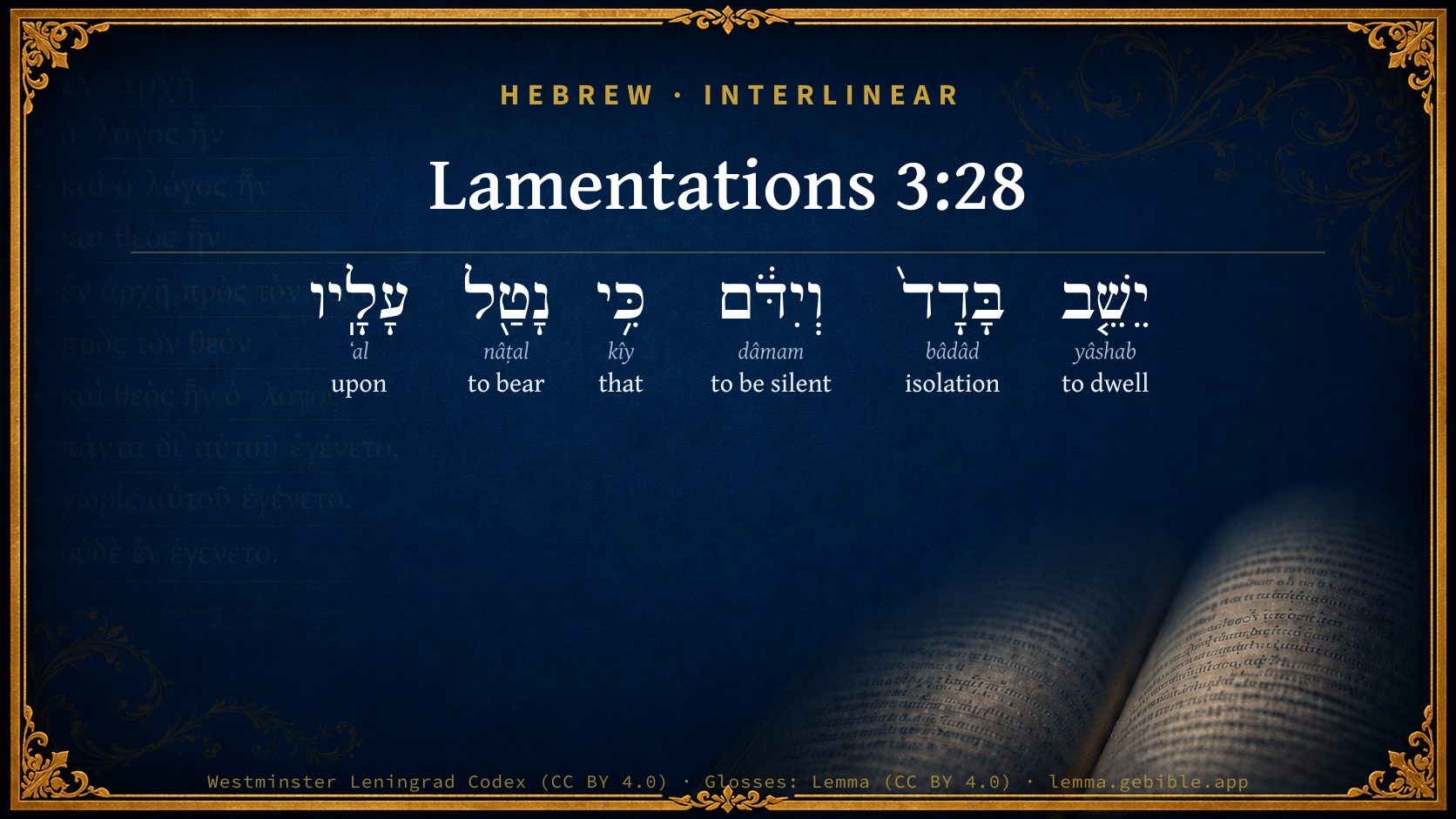
Lamentations 3:28

Hebrew (Westminster Leningrad Codex) Lamentations 3:28 appears in the Hebrew Old Testament. The text above is from the Westminster Leningrad Codex. Each word links to its Strong’s number, a concise gloss, and parsing drawn from the Open Scriptures Hebrew Bible morphology. Click any word for its full Brown-Driver-Briggs (BDB) entry.
Download image
Cite this verse

Lamentations 3:28 (World English Bible). Public Domain. Lemma interlinear Bible study tool, https://lemma.gebible.app/v/lamentations/3/28.

Show BibTeX & RIS
BibTeX
RIS
English Translation
Let him sit alone and keep silence, because he has laid it on him.
World English Bible · Public Domain
Download a study sheet

One document with this verse’s original text, its word-by-word gloss line, the meaning frame, cross-references with their text, attributed commentary, and full source and license credits — printable, and it pastes into notes with its structure intact.

This verse Autodidact and up

Study sheet (.html) Plain text (.txt)

A passage Seminary Student

Up to 50 verses in one chapter. A passage sheet keeps up to 6 commentary sources and 12 cross-references per verse, in the order this page ranks them, and says so on the sheet whenever that leaves anything out. Ask for a single verse and you get the Autodidact verse sheet above.

Everything on this page stays free to read, with no account — the sheet is a download of what is already on screen, not access to it.

Want to remove ads? Support Godless Engineer
Compare translations 3

The same verse in 3 English versions, stacked beneath the original-language interlinear above. Click any original word for its lexicon entry.

Each is an independent rendering of the whole verse — the interlinear is not word-aligned to these translations.

Highlighted words mark where these versions differ — a whole-verse word diff, not a word-by-word alignment.

  • World English Bible Public Domain
    Let him sit alone and keep silence, because he has laid it on him.
  • King James Version Public Domain
    He sitteth alone and keepeth silence, because he hath borne it upon him.
  • unfoldingWord Literal Text CC BY-SA 4.0
    Let him sit alone and be silent, for he has laid upon him.

unfoldingWord Literal Text — © unfoldingWord, licensed CC BY-SA 4.0. Word-aligned USFM3 via Door43 (git.door43.org/unfoldingWord/en_ult).

Versions to compare (up to 4)

3 of 4 selected

Show all 18 translations

Every available English version of this verse, each an independent rendering of the whole verse.

  • World English Bible Public Domain
    Let him sit alone and keep silence, because he has laid it on him.
  • Berean Standard Bible Public Domain
    Let him sit alone in silence, for God has disciplined him.
  • Majority Standard Bible Public Domain
    Let him sit alone in silence, for the LORD has laid it upon him.
  • King James Version Public Domain
    He sitteth alone and keepeth silence, because he hath borne it upon him.
  • American Standard Version (1901) Public Domain
    Let him sit alone and keep silence, because he hath laid it upon him.
  • Revised Version (1885) Public Domain
    Let him sit alone and keep silence, because he hath laid it upon him.
  • Geneva Bible (1599) Public Domain
    He sitteth alone, and keepeth silence, because he hath borne it vpon him.
  • Douay-Rheims (1899) Public Domain
    Jod. He shall sit solitary, and hold his peace: because he hath taken it up upon himself.
  • Young's Literal Translation Public Domain
    He sitteth alone, and is silent, For He hath laid `it' upon him.
  • Literal Standard Version CC BY-SA 4.0
    He sits alone, and is silent, || For He has laid [it] on him.
  • Unlocked Literal Bible CC BY-SA 4.0
    Let him sit alone in silence, when it is laid upon him.
  • unfoldingWord Literal Text CC BY-SA 4.0
    Let him sit alone and be silent, for he has laid upon him.
  • Darby Bible Public Domain
    He sitteth solitary and keepeth silence, because he hath laid it upon him;
  • World Messianic Bible Public Domain
    Let him sit alone and keep silence, because he has laid it on him.
  • Webster's Bible Public Domain
    He sitteth alone, and keepeth silence, because he hath borne it upon him.
  • Free Bible Version CC BY-SA 4.0
    They should sit by themselves in silence, because it's God who has disciplined them.
  • Bible in Basic English Public Domain
    Let him be seated by himself, saying nothing, because he has put it on him.
  • JPS Tanakh (1917) Public Domain
    Let him sit alone and keep silence, because He hath laid it upon him.

Literal Standard Version (2020), Covenant Press — licensed CC BY-SA 4.0. Text via the HelloAO Bible API (eBible.org). Unlocked Literal Bible (unfoldingWord) — licensed CC BY-SA 4.0. Text via the HelloAO Bible API (eBible.org). unfoldingWord Literal Text — © unfoldingWord, licensed CC BY-SA 4.0. Word-aligned USFM3 via Door43 (git.door43.org/unfoldingWord/en_ult). Free Bible Version, Dr. Jonathan Gallagher — licensed CC BY-SA 4.0. Text via the HelloAO Bible API (eBible.org).

Word by word

More ways to search: Search by grammar → Find every occurrence → Compare this word →

Practice this passage: Drill this verse → Learn its vocabulary →

About this verse

These counts appear in no published source. They are computed here, from the morphology-tagged text and Lemma’s own curated glosses. What Lemma adds →

6
words
6
distinct lemmas
Prophets
section

Notable vocabulary

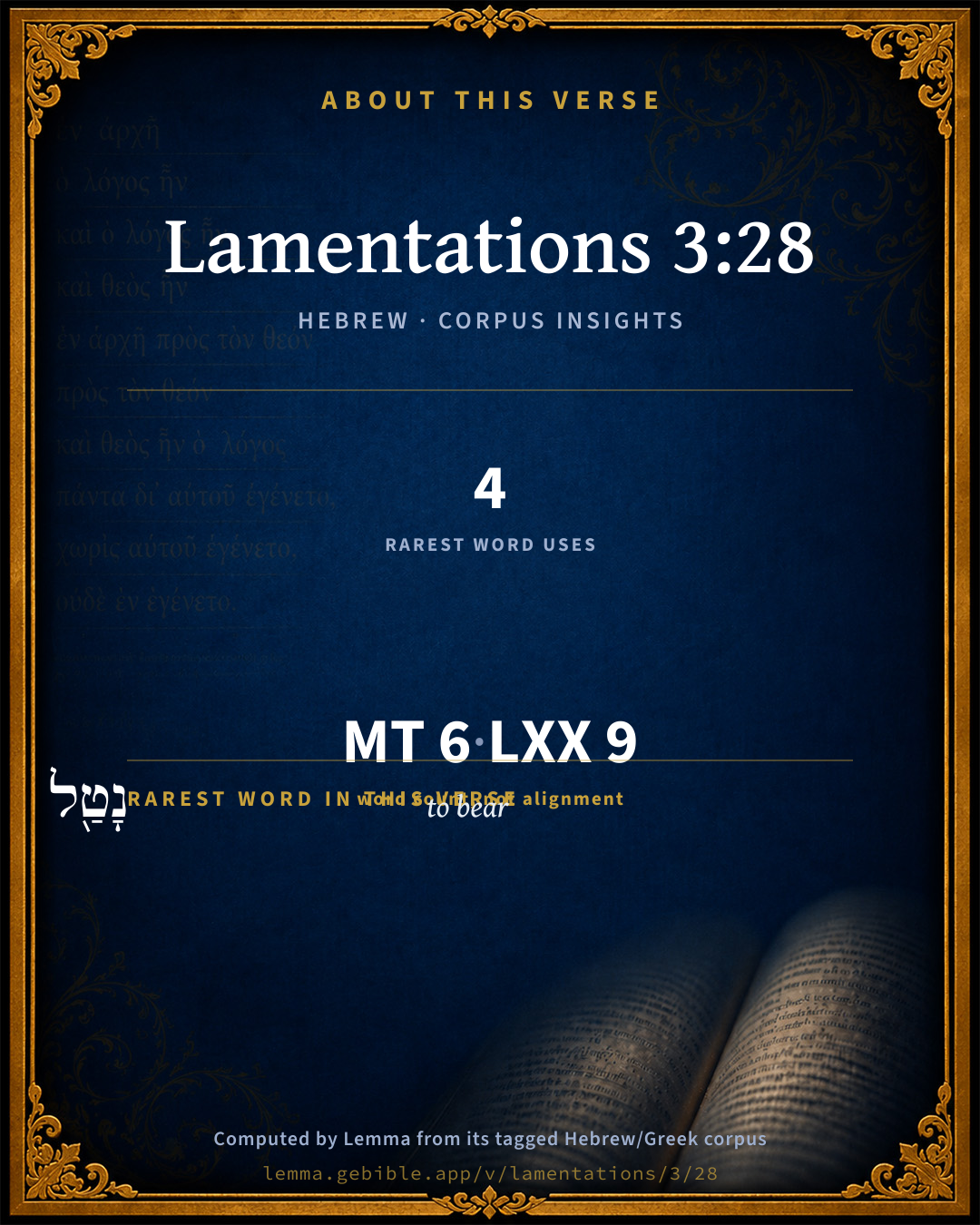
The rarest word here is נָטַ֖ל to bear H5190 — appearing just 4 times in the whole Hebrew Bible.

Shared distinctive vocabulary

נָטַ֖ל to bear H5190 occurs in 4 verses of the Hebrew Bible. Also found in:

Grammatical profile

  • 3 verbs
  • 1 noun
  • 1 preposition
  • 1 conjunction

Verb forms

  • יֵשֵׁ֤ב Qal · Jussive
  • וְיִדֹּ֔ם Qal · Jussive
  • נָטַ֖ל Qal · Perfect

Hebrew & Septuagint length

In English translation the verse runs 14 words from the Hebrew and 14 from the Septuagint (LXX English) — the same length.

A rough comparison of the two English renderings, which tokenize alike — not a word-level alignment.

Word counts can differ between the Hebrew and the Greek without any difference in meaning — e.g. the Hebrew direct-object marker אֵת has no separate Greek word, and Greek often adds the article ὁ.

In the original languages it is 6 Hebrew tokens and 9 Greek tokens — but the two are counted differently (Hebrew bundles its prefixes and suffixes into one token; the Greek is in lemma form), so that isn’t a like-for-like length.

Cross-references

4

Topical passages linked to Lamentations 3:28 in the Treasury of Scripture Knowledge — connected by theme and wording, ordered by reader-vote popularity; previews shown in the World English Bible.

  • Jeremiah 15:17 I didn't sit in the assembly of those who make merry, nor rejoiced; I sat alone because of your hand; for you have filled me with indignation.
  • Lamentations 2:10 The elders of the daughter of Zion sit on the ground, they keep silence; They have cast up dust on their heads; they have girded themselves with sackcloth: The virgins of Jerusalem hang down their heads to the ground.
  • Psalms 102:7 I watch, and have become like a sparrow that is alone on the housetop.
  • Psalms 39:9 I was mute. I didn't open my mouth, Because you did it.

Cross-references courtesy of OpenBible.info (CC BY 4.0).

Hebrew and Greek witnesses Masoretic Hebrew ↔ Greek Septuagint

The same verse in the two great witnesses to the Old Testament, shown verse-for-verse.

These are two independent witnesses, not word-aligned to each other, and the Septuagint is shown in lemma (dictionary) form.

Hebrew Lamentations 3:28 Masoretic · Westminster Leningrad Codex

יֵשֵׁ֤ב בָּדָד֙ וְיִדֹּ֔ם כִּ֥י נָטַ֖ל עָלָֽיו

Let him sit alone and keep silence, because he has laid it on him.

World English Bible · Public Domain

Greek LXX Lamentations 3:28 Septuagint · lemma form

καταἧμαι κατά μόνος καί σιωπάω ὅτι αἴρω ἐπί ἑαυτοῦ

He will sit alone, and be silent, because he has borne it upon him.

LXX2012 (modern English Septuagint) · Public Domain

Hebrew: Westminster Leningrad Codex (CC BY 4.0). Greek: Septuagint (public domain); English from LXX2012 (modern English Septuagint) (Public Domain). How the Septuagint differs from the Hebrew →

Commentary

Notes on Lamentations 3:28 from classic Christian and Jewish commentators (each source and its license shown beneath its notes). The classic Christian expositions comment on the surrounding passage and are grouped to its opening verse, so a note may address several verses; the Jewish commentaries on the Tanakh (Rashi and others) are per-verse, so they appear only where the commentator wrote on this verse.

Lemma curates 59 commentaries, every one of them public domain or Creative Commons licensed, each selected and text-cleaned for this edition rather than reprinted as found. About our sources →

Trapp's Complete Commentary

John Trapp

Lam 3:28 He sitteth alone and keepeth silence, because he hath borne [it] upon him.

Ver. 28. He sitteth alone.] Sessio solitaria, as being much in meditation, according to that counsel of the preacher, "in the day of adversity consider."

And keepeth silence.] When God’s hand is upon his back, his hand is upon his mouth. See on Lam 3:26.

Because he hath borne it upon him.] Or, When he hath taken it upon him; taken up his cross, as being active in suffering.

John Trapp, A Commentary or Exposition upon All the Books of the Old and New Testament (1647–1656) — public domain. Text from a community e-Sword module.

Whedon's Commentary on the Bible

Daniel D. Whedon

28-30. He sitteth — The verbs commencing these verses are apocopated futures, and should be rendered with a passive sense, as: Let him sit alone and keep silence; Let him put his mouth in the dust; Let him give his cheek, etc. The second clause of Lam_3:28 should read: For He (God) hath laid on him the burden. “There is a certain gradation in the three verses that is quite unmistakable. The sitting alone and in silence is comparatively the easiest; it is harder to place the mouth in the dust, and yet cling to hope; it is most difficult of all to give the cheek to the smiter, and to satiate one’s self with dishonour.” — Keil.

Daniel D. Whedon (gen. ed.), Commentary on the Old and New Testaments (1874–1909) — public domain. Text from a community e-Sword module.

The Preacher's Complete Homiletical Commentary

Joseph S. Exell (gen. ed.)

EXEGETICAL NOTES.—

(י) Lam_3:28. A yoke is not of itself beneficial; it must be borne along with desires and efforts to reach to its purpose. “Since it is good for man that he should learn to endure suffering, let him sit still and bear it patiently; … let him sit solitary, as becomes those in sorrow, and be silent without murmuring when God puts such a burden on him.”—Keil. The fogs of the world, if a man enters into them, may veil the waymarks of God.

Lam_3:29. Let him put his mouth in the dust—significant of being humbled under the mighty hand of God—indulging in no whimpers, framing no self-excuses, making no boasts, only waiting to hear what God the Lord will speak, and by no means despairing of help for every time of need. It may be there is hope.

Lam_3:30. Let him give his cheek to him that smiteth him, as was similarly enforced in the Sermon on the Mount (Mat_5:39). and involving the wider application, when reviled not to revile again. Exemplified by Job, by the prophetic Servant of Jehovah, by the greatest of all Sufferers. The gradation is perceptible. “The sitting alone and in silence is comparatively the easiest. It is harder to place the mouth in the dust and yet cling to hope; it is most difficult of all to give the cheek to the smiter, and to satiate oneself with dishonour” (Naegel.), be filled full with reproaches.

HOMILETICS

RESIGNATION

(Lam_3:28-30)

I. Should be borne in silence, recognising the hand of God in affliction. “He sitteth alone and keepeth silence, because He hath borne it upon Him” (Lam_3:28). It is difficult for an active spirit to settle down contentedly and in silence in any kind of circumstances. We cannot rid ourselves of the idea that something is to be done, and we must do it. If our misfortunes come as the result of our own folly, we feel we must do something to repair the damage, little dreaming how utterly useless are all our endeavours. When at length the truth dawns upon us that God is at work in connection with our sufferings, the soul is at once subdued into silence and patiently waits the issue. Something like this was once the experience of the Psalmist (Psa_39:9).

II. Should be borne with reverential humility, knowing there is hope of deliverance. “He putteth his mouth in the dust, if so be there may be hope” (Lam_3:29). The putting the mouth in the dust indicates how completely the soul is prostrated before God in humility and reverential silence. The soul can bear any burden when it knows that the hand of God imposes it, and that He has still hold of it. While we are conscious God is in touch with our burden, there is always hope of its removal. It is when God leaves us to our fate that hope dies. Resignation is no evidence of hopelessness, but rather an evidence how firmly our hope is grounded. We could not so completely cease from all personal effort were we not so fully assured of Divine deliverance.

III. Should be borne without resentment, not shrinking from the bitterest dregs of the cup. “He giveth his cheek to him that smiteth him; he is filled full with reproach” (Lam_3:30). We are to be resigned, but not insensible; submissive, but not apathetic. We are keenly alive to the reproaches heaped upon us by our enemies. Our very resignation is offensive to them, and is made a handle of scorn. It is hard to bear the jeers of others without retaliation. When our sufferings come through our fellow-men, it is but human to resent their attacks with indignation—to meet scorn with scorn. But when we are sensible our troubles come from God, we can more readily submit, and we have grace given to bear, without resentment, all that it may please Him to impose upon us. Behind the divine severity there is unspeakable gentleness.

LESSONS.—

1. The greatest sorrow must be borne alone and in silence.

2. Murmuring and resentment will increase, but not relieve our sufferings.

3. A spirit of humble resignation secures the Divine compassion and help.

GERM NOTES ON THE VERSES

Lam_3:28-30. Silent suffering. I. Not the less acute because endured in silence (Lam_3:28). II. Is bearable when the soul has a glimmering of hope (Lam_3:29). III. Shows that the sufferer has exhausted every possible ground for complaint (Lam_3:30).

Lam_3:28. Retirement and silence.

“What then should be a sinner’s course?

Silence to all save himself and his God.

And so also our Lord ‘became dumb;

He still waited upon his Father;

He made as if He had nothing to say.

How much more should we be silent in our guilt!

Thou hast sinned in company,

Learn to do without company at all.

Thou hast dealt rudely with thy God,

Be content to be rudely dealt with.

Thou hast forsaken Him,

Be content to be forsaken.

Thou hast sinned in talk,

Be content to keep silence.

Thou hast sinned in selfish ways,

Be content, nay be glad, to be overlooked,

To be disappointed—forgotten.

The less thou art able to retire at fixed times,

Be the more watchful to do so at occasional times.

Thou hast sinned in boasting,

Be sometimes silent, even from good words.

Thou hast sinned by cowardice,

Force thyself to speak—in truthfulness to confess.

Accept bereavements, separations, estrangements,

As opportunities of penance assigned by Him.

That He may open thy mouth at last,

To shew forth His praise,

And nothing but His praise.”

—Keble.

ILLUSTRATIONS.—Resignation to the will of God. A remarkable instance of Christian resignation was discovered on one particular occasion in the conduct of Archbishop Fenélon. When his illustrious and hopeful pupil, the Duke of Burgundy, lay dead in his coffin, and the nobles of his court, in all the pomp of silent sadness, stood around, the Archbishop came into the apartment, and having fixed his eyes for some time on the corpse, broke out at length in words to this effect—“There lies my beloved prince, for whom my affections were equal to the tenderest regard of the tenderest parents. Nor were my affections lost; he loved me in return with all the ardour of a son. There he lies, and all my worldly happiness lies dead with him. But if the turning of a straw would call him back to life, I would not for ten thousand worlds be the turner of that straw in opposition to the will of God.”

Soul-growth aided by silence. Some of the best and most beautiful works are perfected in silence. In the making of plate-glass the process of pouring the melted material is so delicate, requiring such care and steadiness, that the men, impressed with the great danger of carelessness, usually preserve silence during the process.

Humility a help to knowledge. When the recent military expedition went to Lower Egypt, it was found that only the smallest boats could go great distances up the Nile. There are some truths that are only revealed to those who grow in loneliness and self-forgetfulness—secret teachings which are reserved for those who are intensely childlike in spirit. “Blessed are the poor in spirit.”

Heroic endurance. One of the secrets of Victor Hugo’s power over the French people was their memory of the following. When the disasters of the Franco-German war were falling thickly, and the iron band was closing round Paris, word came that Victor Hugo was coming to the city. He came at the very moment that the investment was complete, with the last train, the last breath of free air. On the way he had seen the Bavarians, seen villages burned with petroleum, and he came to imprison himself in Paris. A memorable ovation was given him by the people, and they never forgot his voluntary sharing of their sufferings.

The Preacher's Complete Homiletical Commentary (gen. ed. Joseph S. Exell; Funk & Wagnalls, c. 1892) — public domain (pre-1929). A full-Bible homiletical/sermon-outline anthology covering 65 of 66 books (2 John is absent from the source module). Text from a community e-Sword module.

Tyndale Open Study Notes

Tyndale Open Resources

3:28 sit alone in silence: Humble submission stops the tongue and quiets the heart.

Tyndale Open Study Notes — © Tyndale Open Resources, licensed CC BY-SA 4.0. Text via the HelloAO Bible API.

Geneva Bible (1599)

Geneva Bible translators

He murmureth not against God, but is patient.

Geneva Bible (1599) marginal notes — public domain. Text via Bolls.life.

Jamieson, Fausset & Brown

Robert Jamieson, A. R. Fausset & David Brown

The fruit of true docility and patience. He does not fight against the yoke (Jer 31:18; Act 9:5), but accommodates himself to it.

alone--The heathen applauded magnanimity, but they looked to display and the praise of men. The child of God, in the absence of any witness, "alone," silently submits to the will of God.

borne it upon him--that is, because he is used to bearing it on him. Rather, "because He (the Lord, Lam 3:26) hath laid it on him" [VATABLUS].

Jamieson, Fausset & Brown — Commentary Critical and Explanatory on the Whole Bible (1871) — public domain (CC PDM 1.0). Text via the HelloAO Bible API.

Adam Clarke's Commentary

Verse 28. He sitteth alone] He has learned that necessary lesson of independence, that shows him how he is to serve himself; to give no trouble to others; and keep his troubles, as far as possible, in his own bosom.

Adam Clarke's Commentary on the Bible (1810–1826) — public domain. Text from a community e-Sword/MySword module.

John Calvin's Commentaries

Here he shews the fruit of teachableness; for when God deals severely with his children, they yet do not rebel, but even then they willingly submit to his authority. For whence comes it that so much impatience rages in men, except that they know not what it is to obey God, to prepare themselves to bear the yoke? so, then, men become furious like wild beasts, never tamed, therefore the Prophet now says, “Whosoever is thus habituated to the yoke of God, will also be silent in extreme evils, and remain quiet.” We now perceive what I have just said, that the fruit of docility and obedience is set forth in this verse.

But when he says that those who are thus trained to obey God will sit apart, he expresses most fitly the strength and character of patience. For they for the most part who wish to appear magnanimous make a great display, and think that their valor is nothing except they appear as on a theater; they allow themselves at the same time an unbridled liberty when they are alone; for they who seem the most valorous, except God’s fear and true religion prevail in their souls, rage against God and champ the bridle in adversities, though they may not make a clamor before men, for, as I have already said, they regard display. But here a very different account is given of patience, even that we are to sit alone and be silent, that is, even were no one present as a witness, whose presence might make us ashamed; were we even then to sit, and to submit with calm minds to God, and to take his yoke, we should thus prove our patience. This verse then distiguishes between the simplicity of the godly and that will display in which they delight who seek to obtain the praise of courage, patience, and perseverance, from the world; for these also sit and speak words as from heaven, and as though they had put off the flesh. He who has lost a son will say, that he had begotten a mortal: he who is stripped of all his goods will say, “All my things I carry with me.” Thus magnanimously do ungodly men speak, so that they seem to surpass in fortitude and firmness all the children of God. But when they give utterance to these swelling words, what they regard is the opinion which men may form of them. But the faithful, what do they do? They sit apart, that is, though they might shamelessly clamor against God, yet they are quiet and submit to his will. We now understand what is meant by sitting apart.

Then he says, because he will carry it on himself Some take נטל nuthel, in a transitive sense, “he will cast it upon him.” But this is a forced rendering. It would be a simpler meaning, were we to say, because he will carry or raise it on himself. The verb נטל, nuthel, means not only to carry, but also elevate or raise up. When, therefore, the Prophet says, that it is an example of real patience when we carry it on ourselves, he means that we succumb not under our adversities, nor are overwhelmed by them; for it is patience when it is not grievous to us to undergo any burdens which God may lay on us; and on this account we are said to regard his yoke as not grievous — how so? because it is pleasant to us. As, then, meekness thus extenuates the heaviness of the burden, which would otherwise overwhelm us, the Prophet says that those who raise up on themselves all their troubles sit apart.

I do not, however, know whether this passage has been corrupted; for the expression seems not to me natural. Were we to read עלו, olu, his yoke, it would be more appropriate, and a reason would be given for what goes before, that the faithful sit apart and are silent before God, because they bear his yoke; for the pronoun may be referred to God as well as to man. But this is only a conjecture. It follows, —

John Calvin's Commentaries (1540-1563) — public domain. Text from the Calvin Translation Society English edition (1840s-50s) via the Christian Classics Ethereal Library (ccel.org). Calvin's coverage is partial (roughly two-thirds of the Bible); uncommented books and verses are honest gaps, never fabricated. The 19th-century editor's footnotes and remarks are omitted so the notes are faithfully Calvin's own voice.

Ellicott's Commentary for English Readers

(28) He sitteth alone . . .—Better, Let him sit alone, and keep silence when He (Jehovah) hath laid it (the yoke) upon him; and so in the next verses, Let him put his mouth . . . Let him give his cheek.

A Bible Commentary for English Readers, edited by Charles John Ellicott (1878–1897) — public domain. Text from a community e-Sword module.

The Cambridge Bible for Schools and Colleges

gen. ed. J. J. S. Perowne

28. The hortative form is better than mg. He sitteth alone, etc. For sitting alone in grief, cp. Jer_15:17. The connexion is, inasmuch as suffering is really attended with benefit to the sufferer, let him submit readily to it.

hath laid] The subject is God.

The Cambridge Bible for Schools and Colleges (gen. ed. J. J. S. Perowne; Cambridge University Press, 1878–1918) — public domain. Text from a community e-Sword module.

John Gill's Exposition

He putteth his mouth in the dust,.... Of self-abhorrence; sensible of his own vileness and nothingness, his unworthiness, and the unprofitableness of all his duties; ascribing the whole of his salvation to the free grace of God, Job 42:6; humbling himself under the mighty hand of God; not daring to open his mouth in a complaining way against him; but prostrating himself before him to the earth, as the manner of the eastern people in prayer was, to which the allusion is; licking as it were the dust of the earth, under a sense of the distance and disproportion between God and him, who is but dust and ashes; so the Targum adds,

"and is prostrate before the Lord:''

if so be there may be hope; or, "peradventure there is hope" (d); for, as some interpreters observe, these words do not express hesitation and doubt, but hope and expectation of help, to bear the yoke of God's commandments, and in due time to be delivered from affliction and distress.

(d) "forte est expectatio", Junius & Tremellius; "fortassis", Piscator, Cocceius; "forte est spes", Michaelis.

John Gill's Exposition of the Whole Bible (1746–1763) — public domain (CC PDM 1.0). Text via the HelloAO Bible API.

Albert Barnes' Notes on the Bible

Translate:

Let him sit alone and keep silence;

For He (God) hath laid the yoke upon him.

Let him place his mouth in the dust;

Perchance there is hope.

Let him offer his cheek to him that smiteth him;

Let him be filled to the full with reproach.

It is good for a man to bear the yoke in his youth, but only if he bear it rightly. To attain this result, let him learn resignation, remembering who has laid the yoke upon him. This reverential silence is described Lam 3:29, as putting the mouth in the dust, and so lying prostrate before the Deity; while Lam 3:30 the harder task is imposed of bearing contumely with meekness (margin reference), and not shrinking from the last dregs of the cup of reproach. Many who submit readily to God are indignant when the suffering comes through men.

Albert Barnes' Notes on the Bible (1834–1885) — public domain. Text from a community e-Sword/MySword module.

Haydock's Catholic Bible Commentary

Himself, with perfect resignation.

George Leo Haydock (1774–1849), Haydock's Catholic Family Bible and Commentary, 1859 edition — public domain. Excludes Psalms (Douay-Rheims chapter numbering differs from Protestant) and Deuterocanonical books (Catholic canon only).

Matthew Poole's English Annotations

Our English Annotations supplying that, makes the connexion clear, It is good for a man that he sit alone, Jer 15:17; not doing what he doth to be seen of men, but sitting alone, and when he is alone suppressing the mutinies of his spirit, and keeping his soul in subjection to God; because God hath humbled him by his rod, humbling himself to his will.

Matthew Poole's English Annotations on the Holy Bible (1683–1685) — public domain. Text from a community e-Sword/MySword module.

The Pulpit Commentary

Vers. 28-30. He sitteth alone, etc.; rather, Let him sit alone... let him keep silence (ver. 28)... let him put (ver. 29)... let him give... let him be filled (ver. 30). The connection is since it is good for a man to be afflicted, let him sit still, when trouble is sent, and resign himself to bear it.

Because he hath borne it; rather, when he (viz. God) hath laid it.

The Pulpit Commentary (1880–1919), ed. H.D.M. Spence-Jones & Joseph S. Exell — public domain. Text from a community e-Sword module.

John Wesley's Explanatory Notes

Born it - That he keep his soul in subjection to God, because God hath humbled him by his rod.

John Wesley, Explanatory Notes Upon the Whole Bible (1754–1765) — public domain. Text via the GEBible commentary corpus.

Rashi

Rabbi Shlomo Yitzchaki (Rashi)

Let him sit solitary Whoever was befallen by mourning and trouble should sit solitary and hope for the best.

and wait Heb. וְיִדֹם, an expression of waiting, like (I Sam. 14:9): “If they say thus to us, Wait! (דֹמוּ)” about Jonathan.

for He has laid [it] upon him for the Lord of decrees has laid this decree upon him.

Rashi on the Tanakh — English translations: “The Judaica Press complete Tanach with Rashi, translated by A. J. Rosenberg” (CC BY 4.0); “Pentateuch with Rashi's commentary by M. Rosenbaum and A.M. Silbermann, 1929-1934” (public domain); “The Metsudah Tanach series, Lakewood, N.J” (CC BY 4.0); and “The Book of Joshua, Metsudah Publications, 1997” (CC BY 4.0). Text via Sefaria.

Lesson kit

Teaching starters — assembled from the data on this page, not authored interpretation. Every prompt links to the verse data it draws on. Edit before teaching.

Lamentations, in the Prophets, opens this verse with 6 words (6 distinct Hebrew lemmas). Its most distinctive word is nâṭal (“to bear”). A historical commentator’s framing appears above. Read the whole chapter for the surrounding context.

Discussion questions

  1. The word nâṭal carries the sense “to bear.” How does it shape the verse?
  2. 2 Samuel 24:12 shares the word «to bear» with this verse. How do the two illuminate each other?
  3. These translations render this verse differently; the difference is in the English rendering, not the original. What questions does that raise?
  4. The verb «יֵשֵׁ֤ב» is Qal Jussive. How does its form color the action?
  5. Reading how Trapp's Complete Commentary and Whedon's Commentary on the Bible read this verse, where do the two commentators agree and where do they part?

Things to notice

Reading settings

Reading text

Shown beneath each verse's original-language words.

Old Testament
Old Testament edition

Read the OT as the Masoretic Hebrew (MT) or the Greek Septuagint (LXX).

English shown for the Greek Septuagint (in the Hebrew ↔ Greek comparison).

Comparing translations? Open the Compare panel on any verse page to stack up to four side by side.