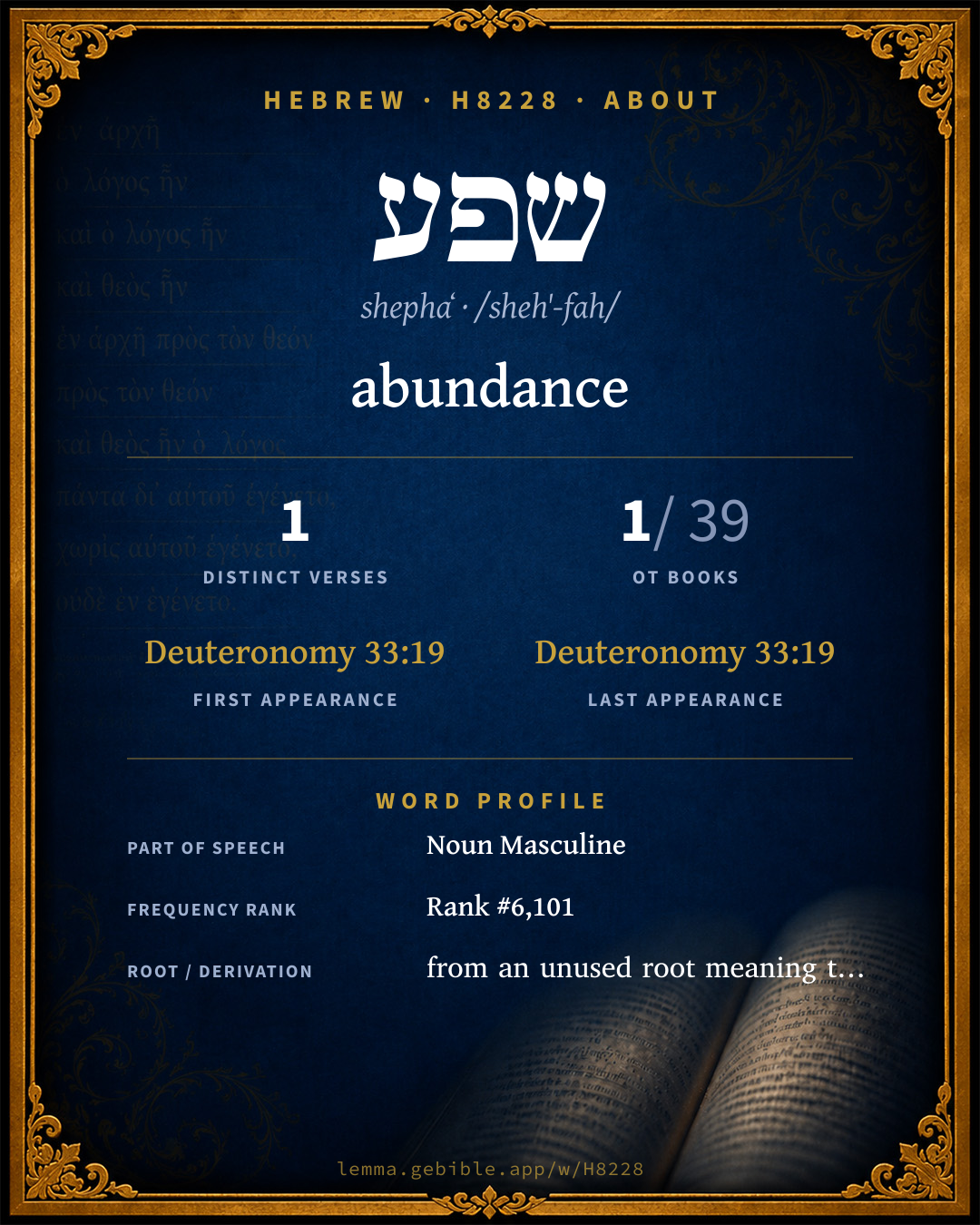
שֶׁ֫פַע
abundance
Full lexicon entry — Brown-Driver-Briggs (BDB)
From Brown-Driver-Briggs (BDB)
Where this word appears
Grammar key — what these labels mean
Part of speech
- Noun
- A naming word — a person, place, thing, or idea.
Noun type
- Common
- A common noun — a general class of person, place, or thing (“king,” “city,” “water”), not a specific name.
State
- Construct
- A noun bound to a following noun in a possessive / “of” relationship (the construct chain).
Gender
- Masculine
- Grammatically masculine.
Number
- Singular
- One.
Every verse where H8228 appears — 1 distinct verse across 1 book. Click any verse to open its interlinear word-by-word view. Verse text shown in the World English Bible for context — . Each verse’s Hebrew form is shown with its reference; the English is not keyword-highlighted, since the data carries no word-level English alignment. Use “Compare translations” on any verse to read it across multiple English versions. This concordance covers the Hebrew Bible; Septuagint (Greek Old Testament) occurrences are not indexed here.
Deuteronomy 1 verse
About this entry
At a glance — auto-summarized from this page’s data, not written by a person. Every figure links to its source below. This summary describes the numbers; it doesn’t interpret them.
“abundance” is the headline sense of the Hebrew noun שפע (shephaʻ). A scarce word — 1 verse in all of the Hebrew Bible. More than three-quarters of its appearances fall in Deuteronomy. Its lone occurrence is Deuteronomy 33:19. It shares a root with שפעה and שפעי. The sections below give every sense, occurrence, and version rendering.
Gloss history
Strong's 1890 vs modern scholarship
About this word
Strong's H8228 catalogs a Hebrew word from the Hebrew Old Testament.
These counts are not copied from any lexicon or concordance. They are computed here, from the morphology-tagged Hebrew Old Testament. What Lemma adds →
- 1
- distinct verses
- The word appears in 1 distinct verse.
- 1 / 39
- OT books
- The word appears in 1 of 39 Old Testament books.
- #6,101
- by frequency
- Rank #6,101 (rank 6,101 of 8,640 Hebrew words by occurrence).
View all 1 occurrence in the concordance →
Most concentrated in
- Deuteronomy 1 verse 100%
By section of the Old Testament
By traditional corpus
Conventional, traditional groupings — biblical authorship is debated, so this is a traditional corpus grouping, not an authorship claim. Each share is this word’s portion of its verses in that division of the Hebrew canon. Each figure is a share of the word’s 1 distinct verse.
- Torah (Pentateuch) 1 verse · 100%
How translations render this word
Counts come from each version’s own published word-to-Strong’s tagging or interlinear alignment — an approximate guide to how each version renders this word, not a word-level alignment the data otherwise carries. Because each total is that version’s own tagged count, the per-version totals vary from one another and need not match the appearance or distinct-verse counts above. These counts may also differ from a printed concordance because Lemma counts each distinctly tagged rendering and does not collapse phrase taggings into a single head-word total. This is a fixed set of word-tagged versions (KJV, ASV, BSB, ULT) and does not change with the reading translation you choose elsewhere. Each version’s license is shown beside its name below (and on Sources).
- King James Version: Abundance 1×
- American Standard Version: Abundance 1×
- Berean Standard Bible: Abundance 1×
- unfoldingWord Literal Text: Abundance of 1×
King James Version Public Domain
Renders H8228 across 1 tagged occurrence — most commonly:
American Standard Version Public Domain
Renders H8228 across 1 tagged occurrence — most commonly:
Berean Standard Bible Public Domain
Renders H8228 across 1 tagged occurrence — most commonly:
unfoldingWord Literal Text CC BY-SA 4.0
Renders H8228 across 1 tagged occurrence — most commonly:
Senses in BDB
The 1 sense BDB distinguishes for this word, in lexicon order (not ranked by frequency or importance). The full entry — with sub-senses — is in the Lexicon Entry tab.
- abundance
Word origin
n.[m.] abundance;—cstr. שׁ׳ Dt 33:19.
— Brown-Driver-Briggs (Oxford 1906, public domain), digitized via Sefaria, supplemented by the OpenScriptures HebrewLexicon (CC BY 4.0). See Sources.
Origin: from an unused root meaning to abound
Jastrow Dictionary
A second Hebrew/Aramaic lexicon for comparison, covering Aramaic and post-biblical (Talmudic, Targumic, Midrashic) usage that the biblical-Hebrew BDB does not. Matched by lemma rather than by Strong’s number, so a lemma may carry more than one Jastrow headword (shown separately below), and the entries cover usage well beyond the Bible.
שָׁפַע
- (cmp. שָׁפָה II)
- 1. to be smooth. Gen. R. s. 14 קורה שׁוֹפַעַת a smooth-trimmed trunk (of a palm-tree, v. שִׁפְעָה I).
- 2. to incline, slide. Neg. X, 10 השׁוֹפֵעַ וכ׳, v. גַּבַּחַת; Sifra Thazr. Par. 5, ch. X. Tosef. Kel. B. Kam. VI, 15 תנור ששפתיו שׁוֹפְעוֹת לתוכו (not ששפתות) a stove the rims of which incline towards the inside; שפתיו שופעות לאחוריו if its rims incline towards its outer walls. Ohol. VII, 2 אהל שהוא שופע וכ׳ a tent the top of which goes slanting down, so that the flat roof is only of the size of a finger; a. e.
- 3. to pour out, run, discharge. Yalk. Lev. 554 כל זמן ששופע לתוכה וכ׳ as long as it (the spring) discharges its overflow into the garden, the vegetables get black (dark green) &c. Nidd. IX, 8 (among the symptoms of approaching menstruation) ושׁוֹפַעַת and she discharges, expl. ib. 63ᵇ top. Bekh. III, 1 בהמה גסה ששָׁפְעָה וכ׳ a large domestic animal that discharged a clod of blood; a. e.—[Y. Hor. I, 46ᵃ top עד שישפע, read: שישמע, v. שָׁמַע.]
- 1. to make slanting. Erub. 43ᵇ משְׁפִּיעַ ועולה משפיע ויורד (not משפיעו) let him make the wall slanting (from the centre) upwards and downwards (so that it should cast no shade).
- 2. to pour abundantly; to sell in large quantities; trnsf. to give in abundance. Dem. II, 4 כל המַשְׁפִּיעִים במדה גסה (Y. ed. המשופעים, corr. acc.) all wholesale dealers; אלו הן המַשְׁפִּיעִין וכ׳ these are considered wholesale dealers &c., v. סִיטוֹן. Ber. 32ᵃ (ref. to ודי זהב, Deut. I, 1) בשביל … וזהב שהִשְׁפַּעְתָּ להם וכ׳ on account of the silver and gold which thou didst pour upon them, until they said, enough!—this was why they made the golden calf; (Yoma 86ᵇ שהרבית). Snh. 108ᵃ דור … בשביל טובה שה׳ וכ׳ the generation of the flood became overbearing only on account of the wealth that the Lord bestowed upon them. Ib. בטובה שהִשְׁפַּעְתִּי וכ׳ with the very blessing that I bestowed upon them, do they provoke me to anger; a. fr. e.g. Deuteronomy 1:1
- 3. to give overmeasure. Tosef. B. Bath. V, 3 מקום שנהגו להַשְׁפִּיעַ משפיע וכ׳ where it is customary to give overmeasure, you must pour as much as is required: as long as the back and the bottom rim of the vessel are not wetted; a. e.—Part. pass. מוּשְׁפָּע, v. infra.
- 1. to make slanting. Part. pass. מְשׁוּפָּע; f. מְשׁוּפַּעַת; pl. מְשׁופָּעִים, מְשׁוּפָּעִין; מְשׁוּפָּעוֹת. Sabb. 5ᵃ כותל מש׳ a slanting wall. Y. Ned. V, beg. 39ᵃ היה המקום מש׳ וכ׳ if the place in his court is sloping …, the neighbor may protest (against washing being done in it), for he may say, thou pourest out, and it comes to my ground; a. e.—[Yalk. Lev. 571 דרך משופע, v. מְשׁוּפָּשׁ.]
- 2. to cause to flow. Lam. R. to IV, 15 מהו ושפח וש׳ וכ׳ what is v’sippaḥ (Is. III, 17)? It means v’shippʿa (he caused them to discharge blood), in order that the holy seed be not mixed up &c.—Part. pass. as ab. abundant, eloquent, verbose. Midr. Till. to Ps. I, 5 ed. Bub. (ref. to Prov. XV, 7ᵇ) אלו המש׳ וכ׳ this refers to those who are extremely fluent, but in whom there is not the sap of the Law; Yalk. Prov. 953 המוּשְׁפָּעִים. e.g. Isaiah 3:17
- 1. to be made slanting; part. מְשׁוּפָּע, v. supra.
- 2. to be poured. Gen. R. s. 69 end; Yalk. ib. 120, v. פַּךְ.
- to slant. Y. Erub. X, 26ᵇ bot. במִשְׁתַּפֵּעַ עשרה וכ׳ when the wall slants at the grade of ten hand-breadths to three.
שְׁפַע
- 1. to flow, run, overflow. Targ. Prov. III, 10. Ib. V, 16; a. e.—Nidd. 63ᵃ שופעת הא שָׁפְעָה ואזלה the Mishnah says, ‘she discharges;’ but does she not continue to discharge (how can this be a premonitory symptom)?
- 2. to slant, hang down. Targ. Y. Ex. XXVI, 12 (Levy quotes תַּשְׁפַּע Af.).
- to make slanting, let hang down, v. supra.
- 2. to pour, give in abundance. Lev. R. s. 27 אן דאת יהיב את מַשְׁפַּע where thou givest, thou givest plentifully; Gen. R. s. 33 הן דיהבת אַשְׁפַּעַת (not אשפע); Yalk. Ps. 727; Tanḥ. Emor 6; Pesik. Shor, p. 74ᵃ מַשְׁפִּיעַ.
- to incline, make slanting, let hang down. Part. pass. מְשַׁפַּע. Targ. Y. Ex. XXVI, 13 (some ed. מְשֻׁפַּע Hebraism).—Sot. 22ᵇ, v. מְדוֹכְיָא. B. Mets. 26ᵃ דמש׳ בחד גיסא when the wall is slanting on one side.
שֶׁפַע
- preced.) overflow, esp. overmeasure, customary addition. Midr. Till. to Ps. LXXVIII, 50 כל מכה … דבר ש׳ עליהן to every plague that came upon them, pestilence came as an addition (in the bargain); ed. Bub., a. Yalk. Ps. 820 שָׁפָה.
A Dictionary of the Targumim, the Talmud Babli and Yerushalmi, and the Midrashic Literature (Marcus Jastrow; London, Luzac, 1903) — Public Domain. Digitized via Sefaria. Digitized via Sefaria. Full attribution on Sources.
Same root — word family
Other BDB entries built from the same root as H8228, grouped by Strong’s listed origin. These share a root / origin per the lexicon — not necessarily a shared meaning. Each links to that word’s own entry.
Derived from this word
Proper names from this root
People and places named from this root — a name, not an additional meaning of the word.
Compare all same-root words → 1 of the same-root words is a proper name (a person or place). They share a root, not necessarily a meaning.
Septuagint verse parallels
This word appears in 1 verse that also exists in the Greek Old Testament (Septuagint), out of the 1 Hebrew verse it occurs in. You can read those verses in Greek by switching the Old Testament edition to the Septuagint.
Read these verses in the Septuagint
This is a verse-level parallel only — the same verses exist in both the Hebrew and Greek Old Testaments. No word-level Hebrew↔Greek correspondence is claimed: the data carries no such alignment, so no Greek word is shown as this Hebrew word’s translation. Coverage is not total — the Septuagint omits the deuterocanon and renumbers the Psalms, so some Hebrew verses have no direct Greek parallel.