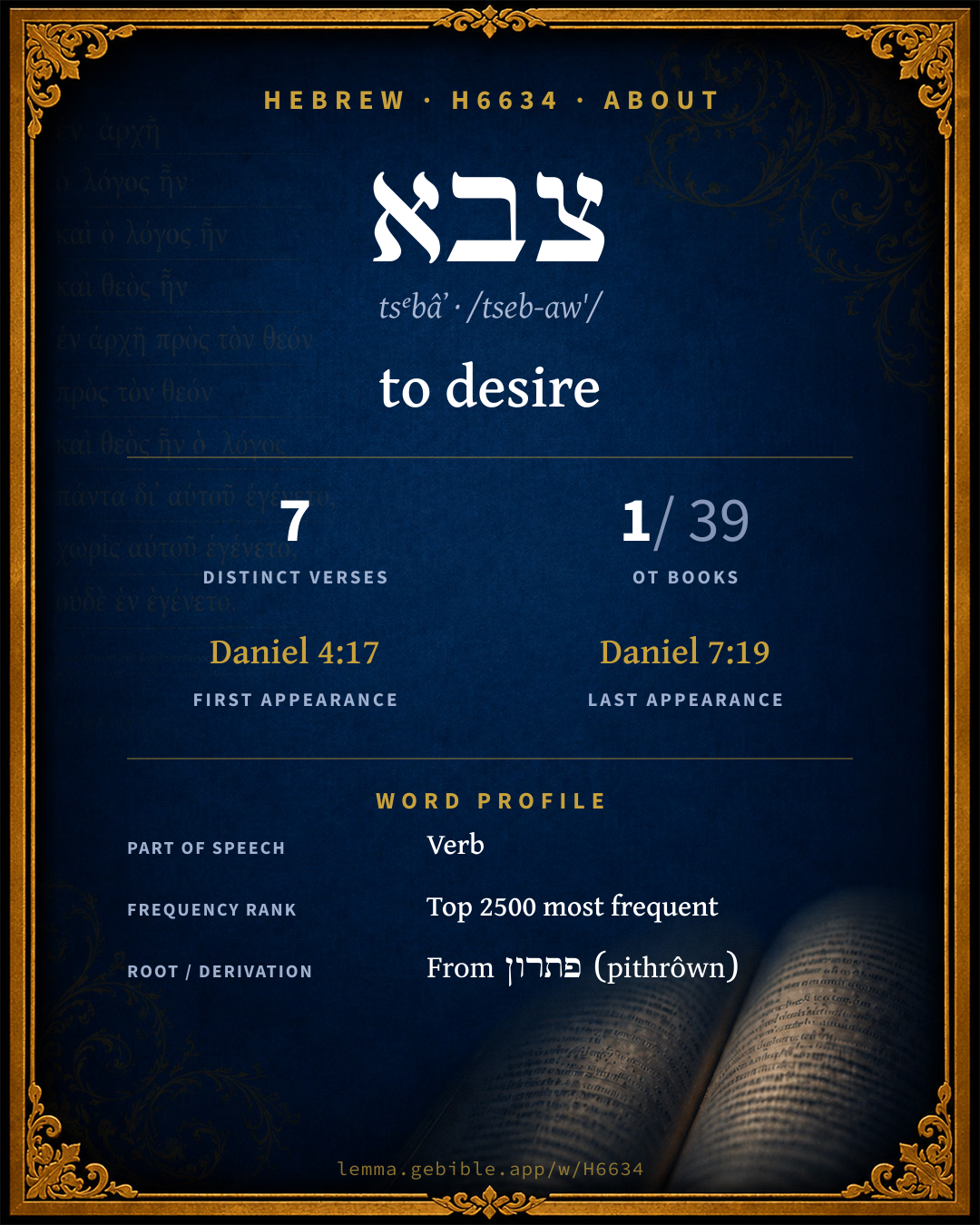
צְבָא
to desire
also: be inclined, be willing, be pleased fuller range ↓
Full lexicon entry — Brown-Driver-Briggs (BDB)
From Brown-Driver-Briggs (BDB)
Where this word appears
Grammar key — what these labels mean
Part of speech
- Verb
- An action or state-of-being word.
Stem
- Qal
- The basic, simple active stem — the plain form of the verb (“he wrote”).
Form
- Participle Active
- A verbal adjective expressing ongoing or characteristic action (“writing / one who writes”).
- Imperfect
- An incomplete, ongoing, or future action (“he will / would write”).
- Infinitive Construct
- A bound verbal noun, frequently with prepositions (“to write / in writing”).
- Perfect
- A completed action or state — Hebrew marks aspect (completeness) more than strict tense (“he wrote”).
State
- Absolute
- The independent form of a noun, not bound to a following word.
Person
- 3rd Person
- The one spoken about (“he / she / it / they”).
- 1st Person
- The speaker (“I / we”).
Gender
- Masculine
- Grammatically masculine.
- Common
- Either gender — not distinguished for this form.
Number
- Singular
- One.
Grammatical forms
- Verb, Qal, Participle Active, Masculine, Singular, Absolute 4 times (40%)
- Verb, Qal, Imperfect, 3rd Person, Masculine, Singular 3 times (30%)
- Verb, Qal, Infinitive Construct 1 time (10%)
- Verb, Qal, Perfect, 1st Person, Common, Singular 1 time (10%)
- Verb, Qal, Perfect, 3rd Person, Masculine, Singular 1 time (10%)
Parsed forms decoded from the imported morphology (morphhb / Westminster Leningrad Codex — WLC text public domain, morphhb tagging CC BY 4.0), counted across 10 parsed occurrences — not distinct verses.
Every verse where H6634 appears — 7 distinct verses across 1 book. Click any verse to open its interlinear word-by-word view. Verse text shown in the World English Bible for context — . Each verse’s Hebrew form is shown with its reference; the English is not keyword-highlighted, since the data carries no word-level English alignment. Use “Compare translations” on any verse to read it across multiple English versions. This concordance covers the Hebrew Bible; Septuagint (Greek Old Testament) occurrences are not indexed here.
Daniel 7 verses
- Daniel 4:17 יִצְבֵּא֙ Qal pf 3ms The sentence is by the decree of the watchers, and the demand by the word of the holy ones; to the intent that the living may know that the Most High rules in the kingdom of men, and gives it to whoever he will, and sets up over it the lowest of men.
- Daniel 4:25 יִצְבֵּ֖א Qal impf 3ms that you shall be driven from men, and your dwelling shall be with the animals of the field, and you shall be made to eat grass as oxen, and shall be wet with the dew of the sky, and seven times shall pass over you; until you know that the Most High rules in the kingdom of men, and gives it to whoever he will.
- Daniel 4:32 יִצְבֵּ֖א Qal impf 3ms and you shall be driven from men; and they dwelling shall be with the animals of the field; you shall be made to eat grass as oxen; and seven times shall pass over you; until you know that the Most High rules in the kingdom of men, and gives it to whoever he will.
- Daniel 4:35 וּֽ/כְ/מִצְבְּיֵ֗/הּ conj + prep + Qal inf.cs + sfx pers 3ms All the inhabitants of the earth are reputed as nothing; and he does according to his will in the army of heaven, and among the inhabitants of the earth; and none can stay his hand, or tell him, What do you?
- Daniel 5:19 צָבֵ֜א צָבֵא֙ צָבֵא֙ צָבֵ֖א Qal ptcp.act ms Qal ptcp.act ms Qal ptcp.act ms Qal ptcp.act ms and because of the greatness that he gave him, all the peoples, nations, and languages trembled and feared before him: whom he would he killed, and whom he would he kept alive; and whom he would he raised up, and whom he would he put down.
- Daniel 5:21 יִצְבֵּ֖ה Qal impf 3ms and he was driven from the sons of men, and his heart was made like the animals', and his dwelling was with the wild donkeys; he was fed with grass like oxen, and his body was wet with the dew of the sky; until he knew that the Most High God rules in the kingdom of men, and that he sets up over it whoever he will.
- Daniel 7:19 צְבִית֙ Qal pf 1cs Then I desired to know the truth concerning the fourth animal, which was diverse from all of them, exceedingly terrible, whose teeth were of iron, and its nails of brass; which devoured, broke in pieces, and stamped the residue with its feet;
About this entry
At a glance — auto-summarized from this page’s data, not written by a person. Every figure links to its source below. This summary describes the numbers; it doesn’t interpret them.
צבא — transliterated tsᵉbâʼ — is a Hebrew verb carrying the sense “to desire.” Its uses cluster heavily in Daniel (100% of all occurrences). With 7 verses in 1 book, it is an uncommon word in the Hebrew Bible. Debuting at Daniel 4:17, it then recurs through the corpus. BDB distinguishes 4 senses; alongside “to desire” it spans “be inclined”, “be willing”, and “be pleased”. See the sense tree, 7-verse concordance, and the renderings breakdown below.
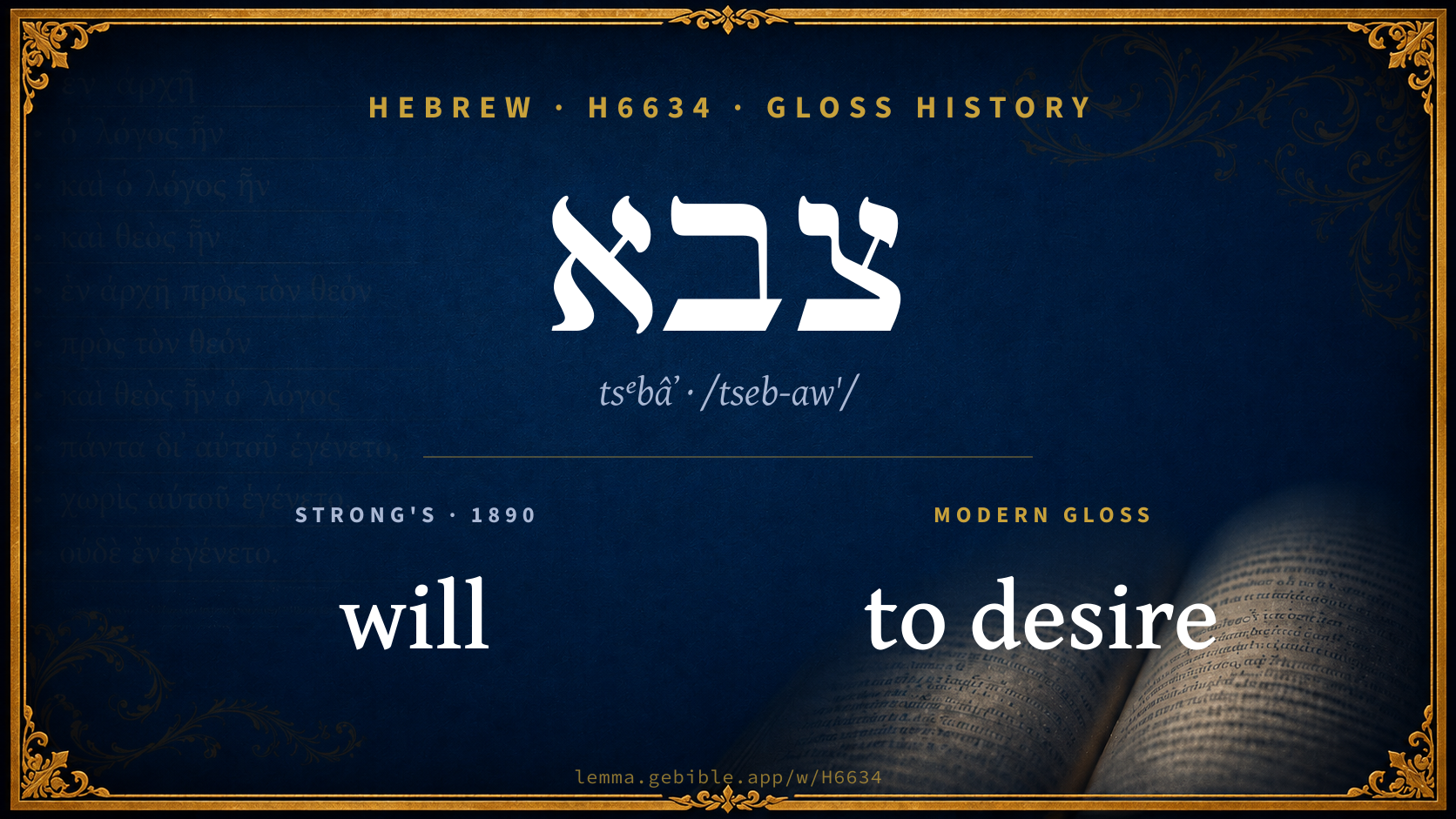
Gloss history
Strong's 1890 vs modern scholarship
About this word
Strong's H6634 catalogs a Hebrew word from the Hebrew Old Testament.
These counts are not copied from any lexicon or concordance. They are computed here, from the morphology-tagged Hebrew Old Testament. What Lemma adds →
- 7
- distinct verses
- The word appears in 7 distinct verses.
- 1 / 39
- OT books
- The word appears in 1 of 39 Old Testament books.
- #2,342
- by frequency
- Top 2500 most frequent Hebrew words (rank 2,342 of 8,640 Hebrew words by occurrence).
View all 7 occurrences in the concordance →
Most concentrated in
- Daniel 7 verses 100%
By section of the Old Testament
By traditional corpus
Conventional, traditional groupings — biblical authorship is debated, so this is a traditional corpus grouping, not an authorship claim. Each share is this word’s portion of its verses in that division of the Hebrew canon. Each figure is a share of the word’s 7 distinct verses.
- Writings (Ketuvim) 7 verses · 100%
How translations render this word
Counts come from each version’s own published word-to-Strong’s tagging or interlinear alignment — an approximate guide to how each version renders this word, not a word-level alignment the data otherwise carries. Because each total is that version’s own tagged count, the per-version totals vary from one another and need not match the appearance or distinct-verse counts above. These counts may also differ from a printed concordance because Lemma counts each distinctly tagged rendering and does not collapse phrase taggings into a single head-word total. This is a fixed set of word-tagged versions (KJV, ASV, BSB, ULT) and does not change with the reading translation you choose elsewhere. Each version’s license is shown beside its name below (and on Sources).
- King James Version: He will 4×
- American Standard Version: He will 4×
- Berean Standard Bible: He wishes 4×, Wished 4×
- unfoldingWord Literal Text: He wished 4×, He wishes 4×
King James Version Public Domain
Renders H6634 across 6 tagged occurrences — most commonly:
Plus 2 renderings that appear only once — usually multi-word phrases or single function words the recovered tagging swept in, not distinct renderings. Not rendered by a distinct English word in 4 further occurrences.
American Standard Version Public Domain
Renders H6634 across 6 tagged occurrences — most commonly:
Plus 2 renderings that appear only once — usually multi-word phrases or single function words the recovered tagging swept in, not distinct renderings.
Berean Standard Bible Public Domain
Renders H6634 across 10 tagged occurrences — most commonly:
Plus 2 renderings that appear only once — usually multi-word phrases or single function words the recovered tagging swept in, not distinct renderings.
unfoldingWord Literal Text CC BY-SA 4.0
Renders H6634 across 10 tagged occurrences — most commonly:
Plus 2 renderings that appear only once — usually multi-word phrases or single function words the recovered tagging swept in, not distinct renderings.
Senses in BDB
The 4 senses BDB distinguishes for this word, in lexicon order (not ranked by frequency or importance). The full entry — with sub-senses — is in the Lexicon Entry tab.
- to desire, be inclined, be willing, be pleased
(Peal)
- to desire
- to be pleased
- to will (without hindrance) (of God)
Word origin
[ צְבָא ] vb. be inclined, desire, be pleased
— Brown-Driver-Briggs (Oxford 1906, public domain), digitized via Sefaria, supplemented by the OpenScriptures HebrewLexicon (CC BY 4.0). See Sources.
Derived from פתרון (pithrôwn) (H6623) — interpretation.
Jastrow Dictionary
A second Hebrew/Aramaic lexicon for comparison, covering Aramaic and post-biblical (Talmudic, Targumic, Midrashic) usage that the biblical-Hebrew BDB does not. Matched by lemma rather than by Strong’s number, so a lemma may carry more than one Jastrow headword (shown separately below), and the entries cover usage well beyond the Bible.
צַבָּא
- ch. = צָב I. Targ. O. Lev. XI, 29 (v. Berl. Targ. O. II, p. 34).
צִבָּא
- , v. צִיבָּא
צָבָא
- , v. צבי h. a. ch.
צָבָא ²
- צבא to join, follow, v. צָוָה a. צָבַת)service; army, host. Gen. R. s. 10 שלשה צבאים הן צ׳ לשמים וכ׳ there are three kinds of services, there is a service for heaven and earth (ref. to Gen. II, 1); צ׳ לתלמידים there is a service for students (ref. to Job XIV, 14); צ׳ ליסורים a service (message) for sufferings (ref. to ib. VII,. Ib. זכה צ׳ לו אם לאו צ׳ עליו if he is favored, a host (of divine powers) is for him; if not, a host (of hostile forces) is against him. Cant. R. to II, 7 (ref. to צבאות, ib.) בצ׳ של מעלה ובצ׳ של מטה by the host above (the angels) and by the host below (humanity). Ib. אם תשמרו … כצ׳ של מעלה וכ׳ if you guard mine oath, I will make you resemble the host above; if not, I will make you resemble the host below (the animals). Keth. 3ᵇ דאמרי שר צ׳ בא לעיר it was said, a (Roman) general is coming to the place (and will seize things for his maintenance); a. fr.—Pl. צְבָאִים; (fem.) צְבָאוֹת. Gen. R. l. c., v. supra. Ib. הרבה צ׳ מינה וכ׳ the Lord has appointed many hosts (messengers) to revenge the wrongs &c. Cant. R. l. c. בשתי צ׳ וכ׳ he adjured them by the two hosts (v. supra). Ib. בצ׳ … שעשו צביוני וכ׳ ‘by the hosts’, that means the patriarchs who did my will &c. Num. R. s. 2 והם צִבְאוֹתַי and they (the Israelites) are my hosts. Ib. שהם היו צִבְאוֹתָיו וכ׳ they were his hosts, and he wanted to count them &c. Ib. כך צ׳ יש לי בעולמי וכ׳ so and so many troops have I that do my will; a. fr.—(אלהים) ה׳ צבאות the Lord of Hosts. Targ. Jer. V, 14; a. e.—Ber. 7ᵃ.—[צְבָאִים, pl. of צְבִי, q. v.] e.g. Genesis 2:1
צבי
- to swell. Y. B. Kam. VIII, beg. 6ᵇ אם כוייו … וצָבַת if one burnt a person with a heated spit on the palm of his hand, and it swelled; ib. על ראשו וצבת, (read וצבה) a. e.—[Ber. 6ᵇ לִצְבּוֹת Ar., v. צָבַת.]
- same. Y. Sot. V, beg. 20ᵃ (line 20) מים מגולין שתה ונ׳ (ed. Krot. שתת ונצבית, corr. acc.) he drank uncovered water (poisoned by a serpent) and his belly was swollen. Ib. (line 25) שתת ונִצְבֵּית she drank &c.
- 1. to cause to swell. Lev. R. s. 17; Yalk. Ps. 808 [read:] ולא צִבִּיתִים, v. עוֹנָה II.
- 2. to cause the appearance of being swollen. Tosef. Peah IV, 14 המְצַבֶּה את כריסו he that feigns a swollen belly; Y. ib. VIII, 21ᵇ top המְצַבֵּא; Keth. 68ᵃ המצב׳ את בטנו.
A Dictionary of the Targumim, the Talmud Babli and Yerushalmi, and the Midrashic Literature (Marcus Jastrow; London, Luzac, 1903) — Public Domain. Digitized via Sefaria. Digitized via Sefaria. Full attribution on Sources.
Forms in the corpus
The 8 distinct written forms H6634 takes in the Hebrew Bible, most frequent first — each parse links to that stem’s occurrences in the concordance. Hebrew forms include their vowel points and cantillation, so a single lemma takes many written forms.
| Form | Parsing | Example | Uses |
|---|---|---|---|
| יִצְבֵּ֖א | Verb, Qal, Imperfect, 3rd Person, Masculine, Singular | Daniel 4:25 | 2 |
| צָבֵא֙ | Verb, Qal, Participle Active, Masculine, Singular, Absolute | Daniel 5:19 | 2 |
| וּֽ/כְ/מִצְבְּיֵ֗/הּ | Verb, Qal, Infinitive Construct | Daniel 4:35 | 1 |
| יִצְבֵּ֖ה | Verb, Qal, Imperfect, 3rd Person, Masculine, Singular | Daniel 5:21 | 1 |
| יִצְבֵּא֙ | Verb, Qal, Perfect, 3rd Person, Masculine, Singular | Daniel 4:17 | 1 |
| צְבִית֙ | Verb, Qal, Perfect, 1st Person, Common, Singular | Daniel 7:19 | 1 |
| צָבֵ֖א | Verb, Qal, Participle Active, Masculine, Singular, Absolute | Daniel 5:19 | 1 |
| צָבֵ֜א | Verb, Qal, Participle Active, Masculine, Singular, Absolute | Daniel 5:19 | 1 |
Same root — word family
Other BDB entries built from the same root as H6634, grouped by Strong’s listed origin. These share a root / origin per the lexicon — not necessarily a shared meaning. Each links to that word’s own entry.
Derives from
Derived from this word
Compare all same-root words → They share a root, not necessarily a meaning.
Septuagint verse parallels
This word appears in 4 verses that also exist in the Greek Old Testament (Septuagint), out of the 7 Hebrew verses it occurs in. You can read those verses in Greek by switching the Old Testament edition to the Septuagint.
Read these verses in the Septuagint
This is a verse-level parallel only — the same verses exist in both the Hebrew and Greek Old Testaments. No word-level Hebrew↔Greek correspondence is claimed: the data carries no such alignment, so no Greek word is shown as this Hebrew word’s translation. Coverage is not total — the Septuagint omits the deuterocanon and renumbers the Psalms, so some Hebrew verses have no direct Greek parallel.