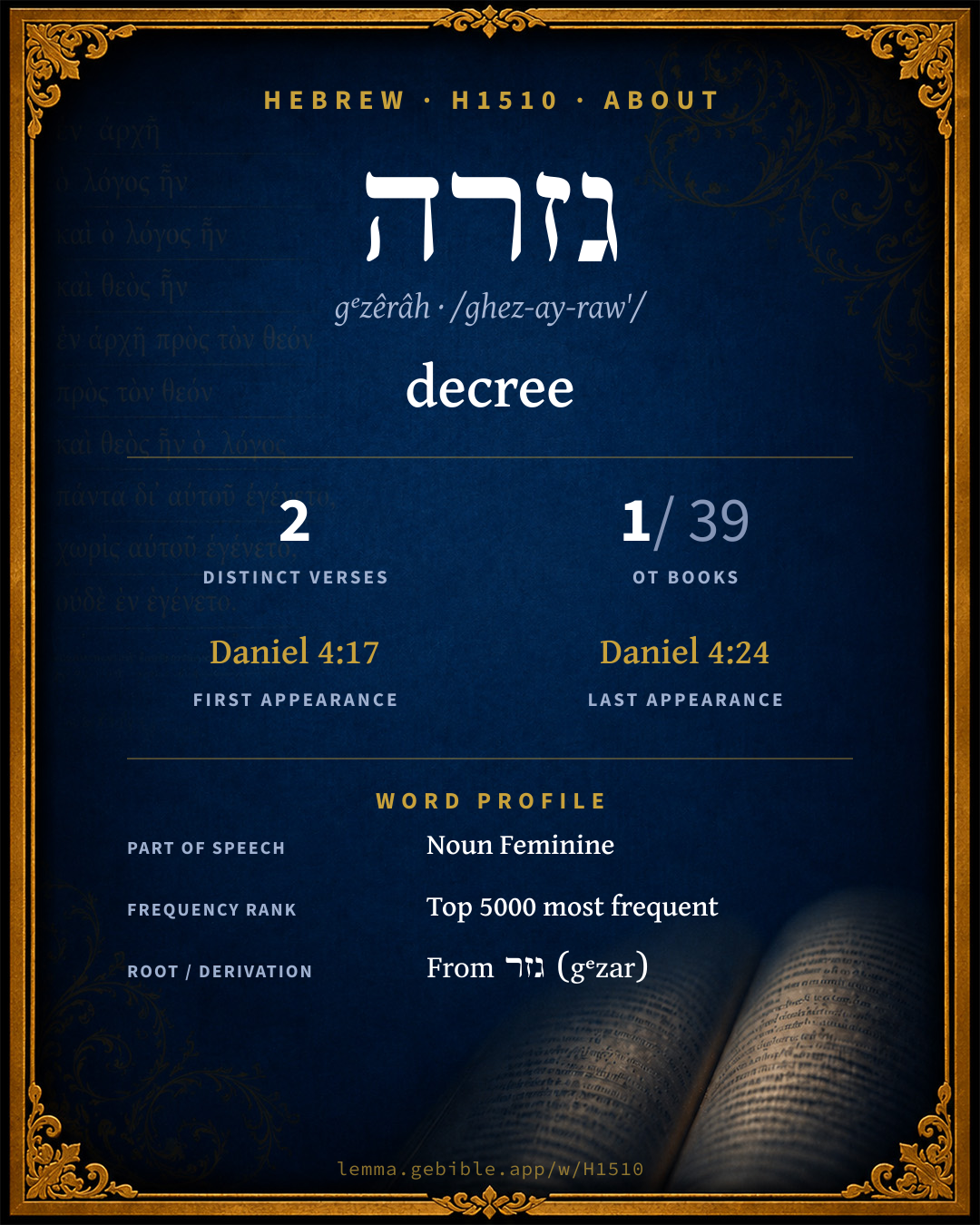
גְּזֵרָה
decree
Full lexicon entry — Brown-Driver-Briggs (BDB)
From Brown-Driver-Briggs (BDB)
Where this word appears
Grammar key — what these labels mean
Noun type
- Common
- A common noun — a general class of person, place, or thing (“king,” “city,” “water”), not a specific name.
State
- Construct
- A noun bound to a following noun in a possessive / “of” relationship (the construct chain).
Gender
- Feminine
- Grammatically feminine.
Number
- Singular
- One.
Every verse where H1510 appears — 2 distinct verses across 1 book. Click any verse to open its interlinear word-by-word view. Verse text shown in the World English Bible for context — . Each verse’s Hebrew form is shown with its reference; the English is not keyword-highlighted, since the data carries no word-level English alignment. Use “Compare translations” on any verse to read it across multiple English versions. This concordance covers the Hebrew Bible; Septuagint (Greek Old Testament) occurrences are not indexed here.
Daniel 2 verses
- Daniel 4:17 בִּ/גְזֵרַ֤ת prep + n c fs cs The sentence is by the decree of the watchers, and the demand by the word of the holy ones; to the intent that the living may know that the Most High rules in the kingdom of men, and gives it to whoever he will, and sets up over it the lowest of men.
- Daniel 4:24 וּ/גְזֵרַ֤ת conj + n c fs cs this is the interpretation, O king, and it is the decree of the Most High, which is come on my lord the king:
About this entry
At a glance — auto-summarized from this page’s data, not written by a person. Every figure links to its source below. This summary describes the numbers; it doesn’t interpret them.
גזרה — transliterated gᵉzêrâh — is a Hebrew noun carrying the sense “decree.” A scarce word — 2 verses in all of the Hebrew Bible. Its uses cluster heavily in Daniel (100% of all occurrences). It first appears in Daniel 4:17. See the sense tree, 2-verse concordance, and the renderings breakdown below.
Gloss history
Strong's 1890 vs modern scholarship
About this word
Strong's H1510 catalogs a Hebrew word from the Hebrew Old Testament.
These counts are not copied from any lexicon or concordance. They are computed here, from the morphology-tagged Hebrew Old Testament. What Lemma adds →
- 2
- distinct verses
- The word appears in 2 distinct verses.
- 1 / 39
- OT books
- The word appears in 1 of 39 Old Testament books.
- #4,807
- by frequency
- Top 5000 most frequent Hebrew words (rank 4,807 of 8,640 Hebrew words by occurrence).
View all 2 occurrences in the concordance →
Most concentrated in
- Daniel 2 verses 100%
By section of the Old Testament
By traditional corpus
Conventional, traditional groupings — biblical authorship is debated, so this is a traditional corpus grouping, not an authorship claim. Each share is this word’s portion of its verses in that division of the Hebrew canon. Each figure is a share of the word’s 2 distinct verses.
- Writings (Ketuvim) 2 verses · 100%
How translations render this word
Counts come from each version’s own published word-to-Strong’s tagging or interlinear alignment — an approximate guide to how each version renders this word, not a word-level alignment the data otherwise carries. Because each total is that version’s own tagged count, the per-version totals vary from one another and need not match the appearance or distinct-verse counts above. These counts may also differ from a printed concordance because Lemma counts each distinctly tagged rendering and does not collapse phrase taggings into a single head-word total. This is a fixed set of word-tagged versions (KJV, ASV, BSB, ULT) and does not change with the reading translation you choose elsewhere. Each version’s license is shown beside its name below (and on Sources).
- King James Version: Is by the decree 1×, Is the decree 1×
- American Standard Version: Is by the decree 1×, Is the decree 1×
- Berean Standard Bible: Is the decree 2×
- unfoldingWord Literal Text: And 1×, Is by the decree of 1×, Is the decree of 1×
King James Version Public Domain
Renders H1510 across 2 tagged occurrences — most commonly:
American Standard Version Public Domain
Renders H1510 across 2 tagged occurrences — most commonly:
Berean Standard Bible Public Domain
Renders H1510 across 2 tagged occurrences — most commonly:
unfoldingWord Literal Text CC BY-SA 4.0
Renders H1510 across 3 tagged occurrences — most commonly:
Senses in BDB
The 1 sense BDB distinguishes for this word, in lexicon order (not ranked by frequency or importance). The full entry — with sub-senses — is in the Lexicon Entry tab.
- decree
Word origin
n.f. separation—אֶל־אֶרֶץ גְּזֵרָ֑ה Lv 16:22 (P) unto a land of separation, of the goat for Azazel; solitary land RV; ‘cut off,’ i.e. whence it would not readily find its way back VB.
— Brown-Driver-Briggs (Oxford 1906, public domain), digitized via Sefaria, supplemented by the OpenScriptures HebrewLexicon (CC BY 4.0). See Sources.
Derived from גזר (gᵉzar) (H1505) — to determine.
Jastrow Dictionary
A second Hebrew/Aramaic lexicon for comparison, covering Aramaic and post-biblical (Talmudic, Targumic, Midrashic) usage that the biblical-Hebrew BDB does not. Matched by lemma rather than by Strong’s number, so a lemma may carry more than one Jastrow headword (shown separately below), and the entries cover usage well beyond the Bible.
גִּזְרָה
- enclosure; balcony. Ohol. XIV, 1, v. גְּזוּזְטְרָא; Y. Shebi. III, 34ᶜ bot., v. גִּבְלִית.—Pl. (from גִּזְרִית) גִּזְרִיּות. Ohol. VIII, 2 Mish. (Talm. ed. גְּזִירִיּוֹת, Ar. גזוזטראות, R. Hai Gaon גִיזְרָאוֹת, v. Koh. Ar. Compl. II, p. 264, note 3).—2) (cmp. גָּזִית a. גָּזִיר) hewn stone block. Pesik. Aniya p. 135ᵇ (ref. to ספיר גזרתם, Lam. IV, 7, v. Bub. note 24) כל ג׳ וג׳ וכ׳ every block which will be placed in the future Jerusalem, will be as handsome as sapphire; Yalk. Is. 339 גְּזִירָה; Lam. R. to l. c. כל גזירה וגזי׳ שהיתה וכ׳ every stone block in Jerusalem was as hard as sapphire. e.g. Lamentations 4:7
גְּזֵרָה
- 1. a secluded and narrow place, dale, precipice. Yoma 67ᵇ ומנין שבצוק ת"ל ג׳ and how do we know that the place (Azazel) must be precipitous? We read g’zerah (Lev. XVI, 22); Sifra Aḥaré Par. 2, ch. II Gen. R. s. 98, beg. איזה לשם ואיזה לג׳ which (goat) for the Lord and which for the precipice.—2) decree, edict, divine dispensation; (in an evil sense) persecution by foreign governments. Sifra l. c. ch. VI, Par. 5 יכול יהא גְּזֵרַת מלך lest you may think it is a royal ordinance (the reason of which is not known); v. vers. in Yalk. Lev. 576. Num. R. s. 19 ג׳ גזרתי … על גְּזֵרָתִי I have decreed it, thou art not permitted to transgress my decree (though knowing no reason).—R. Hash. 18ᵇ גְּזֵרַת המלכות (Ms. M. שמד) political persecution. Sabb. 145ᵇ to reflect איזו ג׳ קשה אביא וכ׳ what hard dispensation to send them; a. fr. e.g. Leviticus 16:22
- 3. a rabbinical enactment issued as a guard (v. גֶּדֶר), preventive measure; in gen. prohibition, restriction. B. Bath. 60ᵇ, a. e. אין גוזרין ג׳ על וכ׳ we must not impose a restriction on the public which the majority can not endure. Bets. 2ᵇ, a. fr. ג׳ משום וכ׳ it is prohibited in order to prevent &c. Ib. 3ᵃ ג׳ לג׳ a guard to a guard, i.e. a preventive measure enacted in order to prevent the violation of another preventive measure; a. fr.—Pl. גְּזֵרוֹת, גְּזֵירוֹת. B. Bath. l. c. ג׳ רעות וקשות Ms. M. (v. Rabb. D. S. a. l. note) bad and severe enactments (persecutions). Sabb. 30ᵃ Moses, our teacher גזר כמה ג׳ issued so many restrictions. Macc. 24ᵃ ארבע ג׳ גזר וכ׳ four hardships did Moses pronounce over Israel. Erub. 21ᵇ הרבה ג׳ גזרתי על עצמי וכ׳ many restrictions did I (Israel) impose upon myself beyond those which thou (the Lord, in the Torah) &c. Pes. 87ᵇ, v. אֲרָם; a. fr.—M. Kat. III, 3, v. גָּזָר.
- 4. (logics) category, esp. ג׳ שָׁוָה G’zerah shavah, an equal or identic category, i.e. an analogy between two laws established on the basis of verbal congruities in the texts, e.g. Pes. 66ᵃ, נאמר מועדו בפסח וכ׳ the Passover law contains the word moădo (due season, Num. XI, 2) and the law concerning the daily sacrifices uses the same word (ib. XXVIII, 2): as the word moădo in the latter indicates that it applies also to the Sabbath day (superseding the ordinary Sabbath law concerning labor), so does it in the former intimate that it supersedes the Sabbath law (if the eve of Passover occurs on a Sabbath). Ib. אין אדם דן ג"ש מעצמו you cannot establish an analogy from congruent expressions of your own accord, i.e. it must be authorized by tradition that the verbal congruity is applied to a certain analogy and no other.—Y. Yeb. XI, 11ᵈ top ג"ש במקום שבאת an analogy can be drawn wherever it occurs, i.e. a textual analogy once established must be carried through all details; ib. VIII, 9ᶜ bot. ג"ש במקום שכתוב (corr. acc.); Y. Kidd. IV, 65ᵈ top; Y. Snh. IX, 26ᵈ bot.; a. e.—Sabb. 97ᵃ ג"ש לא גמיר he had no tradition concerning that analogy; a. fr.—In gen. ג"ש analogy. Bets. I, 6; a. e.—Pl. גְּזֵירוֹת שָׁווֹת. Gen. R. s. 46; Lev. R. s. 25. [Y. Ber. VIII, 12ᵇ top גזירה דהוא רבע, read גזרית or גזירנא I command that &c.; Y. Keth. V, 30ᵃ גזירה דגזרין, v. גָּזוֹרָא.] e.g. Numbers 11:2
A Dictionary of the Targumim, the Talmud Babli and Yerushalmi, and the Midrashic Literature (Marcus Jastrow; London, Luzac, 1903) — Public Domain. Digitized via Sefaria. Digitized via Sefaria. Full attribution on Sources.
Forms in the corpus
The 2 distinct written forms H1510 takes in the Hebrew Bible, most frequent first — each parse links to that state’s occurrences in the concordance. Hebrew forms include their vowel points and cantillation, so a single lemma takes many written forms.
| Form | Parsing | Example | Uses |
|---|---|---|---|
| בִּ/גְזֵרַ֤ת | Noun, Common, Feminine, Singular, Construct | Daniel 4:17 | 1 |
| וּ/גְזֵרַ֤ת | Noun, Common, Feminine, Singular, Construct | Daniel 4:24 | 1 |
Septuagint verse parallels
This word appears in 2 verses that also exist in the Greek Old Testament (Septuagint), out of the 2 Hebrew verses it occurs in. You can read those verses in Greek by switching the Old Testament edition to the Septuagint.
Read these verses in the Septuagint
This is a verse-level parallel only — the same verses exist in both the Hebrew and Greek Old Testaments. No word-level Hebrew↔Greek correspondence is claimed: the data carries no such alignment, so no Greek word is shown as this Hebrew word’s translation. Coverage is not total — the Septuagint omits the deuterocanon and renumbers the Psalms, so some Hebrew verses have no direct Greek parallel.