
1 Samuel 30:23

Hebrew (Westminster Leningrad Codex) 1 Samuel 30:23 appears in the Hebrew Old Testament. The text above is from the Westminster Leningrad Codex. Each word links to its Strong’s number, a concise gloss, and parsing drawn from the Open Scriptures Hebrew Bible morphology. Click any word for its full Brown-Driver-Briggs (BDB) entry.
Download image
Cite this verse

1 Samuel 30:23 (World English Bible). Public Domain. Lemma interlinear Bible study tool, https://lemma.gebible.app/v/1-samuel/30/23.

Show BibTeX & RIS
BibTeX
RIS
English Translation
Then said David, You shall not do so, my brothers, with that which Yahweh has given to us, who has preserved us, and delivered the troop that came against us into our hand.
World English Bible · Public Domain
Download a study sheet

One document with this verse’s original text, its word-by-word gloss line, the meaning frame, cross-references with their text, attributed commentary, and full source and license credits — printable, and it pastes into notes with its structure intact.

This verse Autodidact and up

Study sheet (.html) Plain text (.txt)

A passage Seminary Student

Up to 50 verses in one chapter. A passage sheet keeps up to 6 commentary sources and 12 cross-references per verse, in the order this page ranks them, and says so on the sheet whenever that leaves anything out. Ask for a single verse and you get the Autodidact verse sheet above.

Everything on this page stays free to read, with no account — the sheet is a download of what is already on screen, not access to it.

Want to remove ads? Support Godless Engineer
Compare translations 3

The same verse in 3 English versions, stacked beneath the original-language interlinear above. Click any original word for its lexicon entry.

Each is an independent rendering of the whole verse — the interlinear is not word-aligned to these translations.

Highlighted words mark where these versions differ — a whole-verse word diff, not a word-by-word alignment.

  • World English Bible Public Domain
    Then said David, You shall not do so, my brothers, with that which Yahweh has given to us, who has preserved us, and delivered the troop that came against us into our hand.
  • King James Version Public Domain
    Then said David, Ye shall not do so, my brethren, with that which the LORD hath given us, who hath preserved us, and delivered the company that came against us into our hand.
  • unfoldingWord Literal Text CC BY-SA 4.0
    But David said, “You shall not do thus, my brothers, with what Yahweh has given to us. For he has kept us and given the band having come against us into our hand.

unfoldingWord Literal Text — © unfoldingWord, licensed CC BY-SA 4.0. Word-aligned USFM3 via Door43 (git.door43.org/unfoldingWord/en_ult).

Versions to compare (up to 4)

3 of 4 selected

Show all 18 translations

Every available English version of this verse, each an independent rendering of the whole verse.

  • World English Bible Public Domain
    Then said David, You shall not do so, my brothers, with that which Yahweh has given to us, who has preserved us, and delivered the troop that came against us into our hand.
  • Berean Standard Bible Public Domain
    But David said, “My brothers, you must not do this with what the LORD has given us. He has protected us and delivered into our hands the raiders who came against us.
  • Majority Standard Bible Public Domain
    But David said, “My brothers, you must not do this with what the LORD has given us. He has protected us and delivered into our hands the raiders who came against us.
  • King James Version Public Domain
    Then said David, Ye shall not do so, my brethren, with that which the LORD hath given us, who hath preserved us, and delivered the company that came against us into our hand.
  • American Standard Version (1901) Public Domain
    Then said David, Ye shall not do so, my brethren, with that which Jehovah hath given unto us, who hath preserved us, and delivered the troop that came against us into our hand.
  • Revised Version (1885) Public Domain
    Then said David, Ye shall not do so, my brethren, with that which the LORD hath given unto us, who hath preserved us, and delivered the troop that came against us into our hand.
  • Geneva Bible (1599) Public Domain
    Then saide Dauid, Yee shall not doe so, my brethren, with that which the Lord hath giuen vs, who hath preserued vs, and deliuered the companie that came against vs, into our handes.
  • Douay-Rheims (1899) Public Domain
    But David said: You shall not do so, my brethren, with these things, which the Lord hath given us, who hath kept us, and hath delivered the robbers that invaded us into our hands.
  • Young's Literal Translation Public Domain
    And David saith, `Ye do not do so, my brethren, with that which Jehovah hath given to us, and He doth preserve us, and doth give the troop which cometh against us into our hand;
  • Literal Standard Version CC BY-SA 4.0
    And David says, “You do not do so, my brothers, with that which YHWH has given to us, and He preserves us, and gives the troop which comes against us into our hand;
  • Unlocked Literal Bible CC BY-SA 4.0
    Then David said, “You must not act like this, my brothers, with what Yahweh has given to us. He has preserved us and given into our hand the raiders who came against us.
  • unfoldingWord Literal Text CC BY-SA 4.0
    But David said, “You shall not do thus, my brothers, with what Yahweh has given to us. For he has kept us and given the band having come against us into our hand.
  • Darby Bible Public Domain
    Then said David, Ye shall not do so, my brethren, with that which Jehovah has given us, who has preserved us, and given the troop that came against us into our hand.
  • World Messianic Bible Public Domain
    Then David said, “Do not do so, my brothers, with that which the LORD has given to us, who has preserved us, and delivered the troop that came against us into our hand.
  • Webster's Bible Public Domain
    Then said David, Ye shall not do so, my brethren, with that which the LORD hath given us, who hath preserved us, and delivered the company that came against us into our hand.
  • Free Bible Version CC BY-SA 4.0
    But David intervened, saying, “No, my brothers, you shouldn't do this with what the Lord has given us. He has protected us and handed over to us the raiders that had attacked us.
  • Bible in Basic English Public Domain
    Then David said, You are not to do this, my brothers, after what the Lord has given us, who has kept us safe and given up the band which came against us into our hands.
  • JPS Tanakh (1917) Public Domain
    Then said David: 'Ye shall not do so, my brethren, with that which the LORD hath given unto us, who hath preserved us, and delivered the troop that came against us into our hand.

Literal Standard Version (2020), Covenant Press — licensed CC BY-SA 4.0. Text via the HelloAO Bible API (eBible.org). Unlocked Literal Bible (unfoldingWord) — licensed CC BY-SA 4.0. Text via the HelloAO Bible API (eBible.org). unfoldingWord Literal Text — © unfoldingWord, licensed CC BY-SA 4.0. Word-aligned USFM3 via Door43 (git.door43.org/unfoldingWord/en_ult). Free Bible Version, Dr. Jonathan Gallagher — licensed CC BY-SA 4.0. Text via the HelloAO Bible API (eBible.org).

Word by word

More ways to search: Search by grammar → Find every occurrence → Compare this word →

Practice this passage: Drill this verse → Learn its vocabulary →

הַגְּד֛וּד
gᵉdûwd
H1416
“the · troop”
Particle, Definite Article + Noun, Common, Masculine, Singular, Absolute
Part of Speech
Particle + Noun
Type
Common
Gender
Masculine
Number
Singular
State
Absolute
Full BDB Definition

Origin: from H1413

TWOT: 313a

a band, troop, marauding band - marauding band, raiding band - troop, band (of divisions of army) - foray, raid
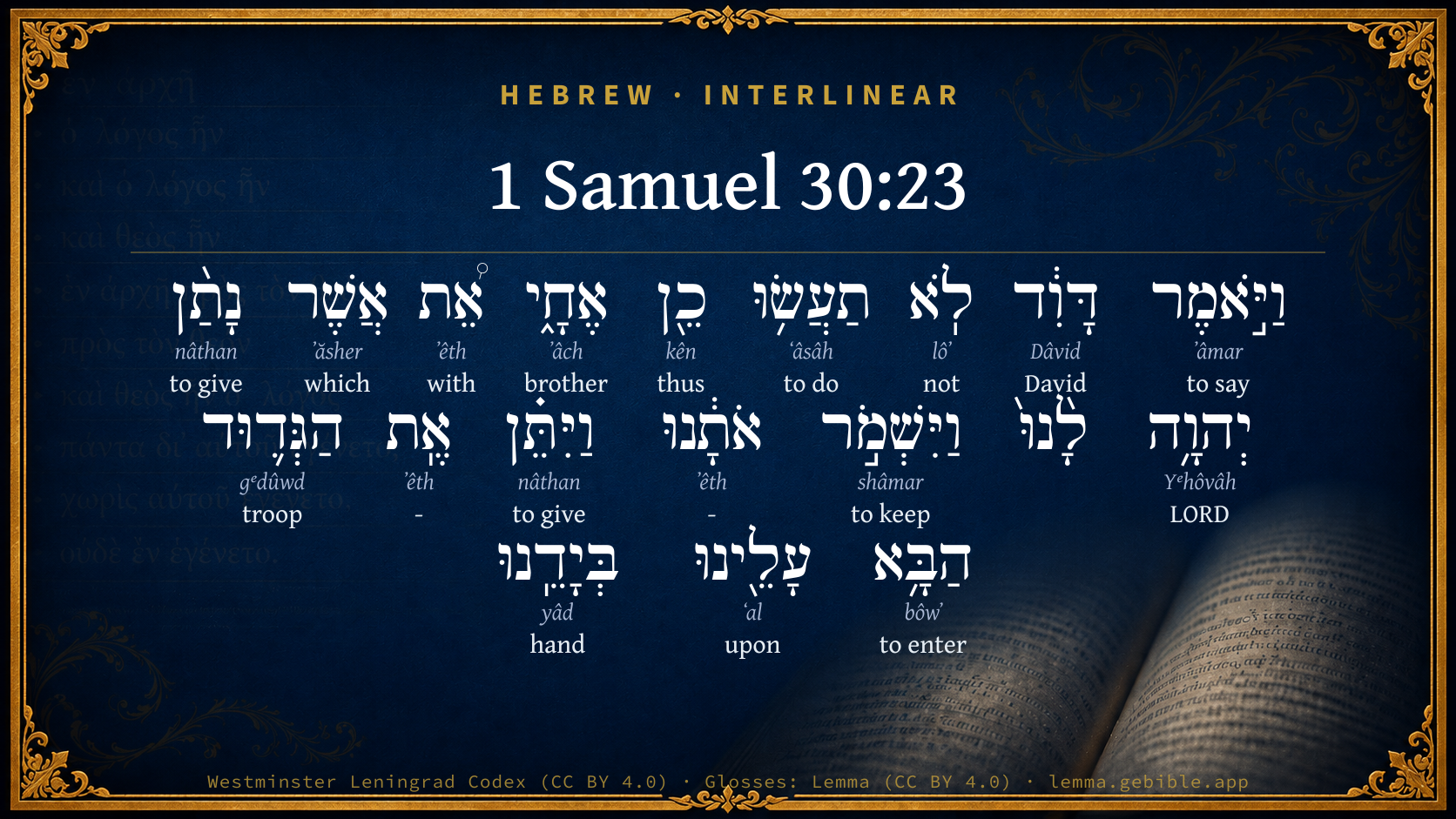
  1. וַיֹּ֣אמֶר ʼâmar H559 “and · to say” Conjunction + Verb, Qal, Sequential Imperfect, 3rd Person, Masculine, Singular
  2. דָּוִ֔ד Dâvid H1732 “David” Noun, Proper
  3. לֹֽא lôʼ H3808 “not” Particle, Negative
  4. תַעֲשׂ֥וּ ʻâsâh H6213 “to do” Verb, Qal, Imperfect, 2nd Person, Masculine, Plural
  5. כֵ֖ן kên H3651 “thus” Adverb
  6. אֶחָ֑י ʼâch H251 “brothers · my” Noun, Common, Masculine, Plural, Construct + Suffix, Personal, 1st Person, Common, Singular
  7. אֵ֠ת ʼêth H854 “with” Preposition
  8. אֲשֶׁר ʼăsher H834 “which” Particle, Relative
  9. נָתַ֨ן nâthan H5414 “to give” Verb, Qal, Perfect, 3rd Person, Masculine, Singular
  10. יְהוָ֥ה Yᵉhôvâh H3068 “LORD” Noun, Proper
  11. וַיִּשְׁמֹ֣ר shâmar H8104 “and · to keep” Conjunction + Verb, Qal, Sequential Imperfect, 3rd Person, Masculine, Singular
  12. אֹתָ֔נוּ ʼêth H853 “- · us” Particle, Direct Object + Suffix, Personal, 1st Person, Common, Plural
  13. וַיִּתֵּ֗ן nâthan H5414 “and · to give” Conjunction + Verb, Qal, Sequential Imperfect, 3rd Person, Masculine, Singular
  14. אֶֽת ʼêth H853 “-” Particle, Direct Object
  15. הַבָּ֥א bôwʼ H935 “the · entering” Particle, Definite Article + Verb, Qal, Participle Active, Masculine, Singular, Absolute
  16. עָלֵ֖ינוּ ʻal H5921 “upon · us” Preposition + Suffix, Personal, 1st Person, Common, Plural
  17. בְּיָדֵֽנוּ yâd H3027 “in/at · hand · our” Preposition + Noun, Common, Both, Singular, Construct + Suffix, Personal, 1st Person, Common, Plural

About this verse

These counts appear in no published source. They are computed here, from the morphology-tagged text and Lemma’s own curated glosses. What Lemma adds →

19
words
16
distinct lemmas
Historical
section

Shared distinctive vocabulary

הַגְּד֛וּד troop H1416 occurs in 29 verses of the Hebrew Bible. Also found in:

Grammatical profile

  • 6 verbs
  • 5 nouns
  • 3 prepositions
  • 1 adverb
  • 4 particles

Verb forms

  • וַיֹּ֣אמֶר Qal · Sequential Imperfect
  • תַעֲשׂ֥וּ Qal · Imperfect
  • נָתַ֨ן Qal · Perfect
  • וַיִּשְׁמֹ֣ר Qal · Sequential Imperfect
  • וַיִּתֵּ֗ן Qal · Sequential Imperfect
  • הַבָּ֥א Qal · Participle Active

Repetition

A word recurs within this verse — often emphatic in Hebrew:

  • נָתַ֨ן to give H5414 ×2

Hebrew & Septuagint length

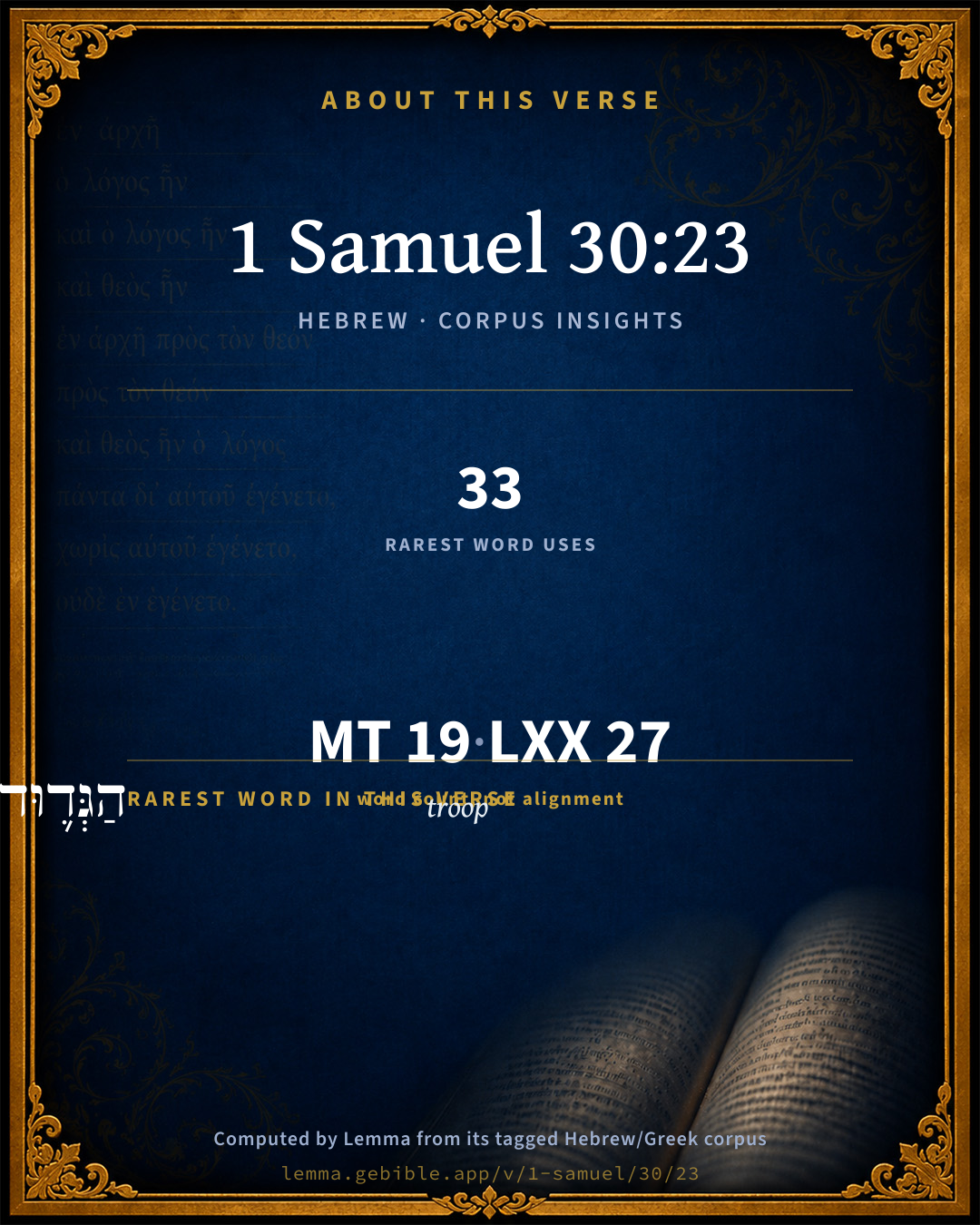
In English translation the verse runs 33 words from the Hebrew and 34 from the Septuagint (LXX English) — closely comparable.

A rough comparison of the two English renderings, which tokenize alike — not a word-level alignment.

Word counts can differ between the Hebrew and the Greek without any difference in meaning — e.g. the Hebrew direct-object marker אֵת has no separate Greek word, and Greek often adds the article ὁ.

In the original languages it is 19 Hebrew tokens and 27 Greek tokens — but the two are counted differently (Hebrew bundles its prefixes and suffixes into one token; the Greek is in lemma form), so that isn’t a like-for-like length.

Cross-references

13

Topical passages linked to 1 Samuel 30:23 in the Treasury of Scripture Knowledge — connected by theme and wording, ordered by reader-vote popularity; previews shown in the World English Bible.

  • Deuteronomy 8:18 But you shall remember Yahweh your God, for it is he who gives you power to get wealth; that he may establish his covenant which he swore to your fathers, as at this day.
  • Psalms 44:2–7 You drove out the nations with your hand, But you planted them. You afflicted the peoples, But you spread them abroad.
  • Psalms 121:7–8 Yahweh will keep you from all evil. He will keep your soul.
  • Genesis 19:7 He said, "Please, my brothers, don't act so wickedly.
  • Numbers 31:49–54 and they said to Moses, Your servants have taken the sum of the men of war who are under our charge, and there lacks not one man of us.
  • Deuteronomy 8:10 You shall eat and be full, and you shall bless Yahweh your God for the good land which he has given you.
  • Judges 19:23 The man, the master of the house, went out to them, and said to them, No, my brothers, please don't act so wickedly; seeing that this man is come into my house, don't do this folly.
  • 1 Samuel 2:7 Yahweh makes poor, and makes rich: He brings low, he also lifts up.
  • Acts 7:2 He said, "Brothers and fathers, listen. The God of glory appeared to our father Abraham, when he was in Mesopotamia, before he lived in Haran,
  • Acts 22:1 "Brothers and fathers, listen to the defense which I now make to you."
  • 1 Samuel 30:8 David inquired of Yahweh, saying, If I pursue after this troop, shall I overtake them? He answered him, Pursue; for you shall surely overtake [them], and shall without fail recover [all].
  • 1 Chronicles 29:12–14 Both riches and honor come of you, and you rule over all; and in your hand is power and might; and it is in your hand to make great, and to give strength to all.
  • Habakkuk 1:16 Therefore he sacrifices to his net, and burns incense to his dragnet, because by them his life is luxurious, and his food is good.

Cross-references courtesy of OpenBible.info (CC BY 4.0).

Hebrew and Greek witnesses Masoretic Hebrew ↔ Greek Septuagint

The same verse in the two great witnesses to the Old Testament, shown verse-for-verse.

These are two independent witnesses, not word-aligned to each other, and the Septuagint is shown in lemma (dictionary) form.

Hebrew 1 Samuel 30:23 Masoretic · Westminster Leningrad Codex

וַיֹּ֣אמֶר דָּוִ֔ד לֹֽא תַעֲשׂ֥וּ כֵ֖ן אֶחָ֑י אֵ֠ת אֲשֶׁר נָתַ֨ן יְהוָ֥ה לָ֨נוּ֙ וַיִּשְׁמֹ֣ר אֹתָ֔נוּ וַיִּתֵּ֗ן אֶֽת הַגְּד֛וּד הַבָּ֥א עָלֵ֖ינוּ בְּיָדֵֽנוּ

Then said David, You shall not do so, my brothers, with that which Yahweh has given to us, who has preserved us, and delivered the troop that came against us into our hand.

World English Bible · Public Domain

Greek LXX 1 Samuel 30:23 Septuagint · lemma form

καί εἶπον δαυίδ οὐ ποιέω οὕτως μετά ὁ παραδίδωμι ὁ κύριος ἐγώ καί φυλάσσω ἐγώ καί παραδίδωμι κύριος ὁ γεδδουρ ὁ ἐπιἔρχομαι ἐπί ἐγώ εἰς χείρ ἐγώ

And David said, You⌃ shall not do so, after the Lord has delivered the enemy to us, and guarded us, and the Lord has delivered into our hands the troop that came against us.

LXX2012 (modern English Septuagint) · Public Domain

Hebrew: Westminster Leningrad Codex (CC BY 4.0). Greek: Septuagint (public domain); English from LXX2012 (modern English Septuagint) (Public Domain). How the Septuagint differs from the Hebrew →

Targum (Aramaic paraphrase)

1

The Targum is the ancient Jewish Aramaic paraphrase of the Hebrew Scriptures — an interpretive translation, not the Hebrew text itself. Onkelos (literal) and Pseudo-Jonathan (expansive) render the Torah, and Jonathan the Prophets. Coverage is partial: where no permissively-licensed English translation exists for a verse, only the Aramaic is shown. This is verse-level text, not a word-by-word alignment to the Hebrew.

  1. Targum Jonathan Prophets (Joshua–Malachi)
    וַאֲמַר דָוִד לָא תַעַבְדוּן כֵּן אֶחָי יַת דִיהַב יְיָ לָנָא וּנְטַר יָתָנָא וּמְסַר יַת מַשְׁרִיתָא דְאָתַת עֲלָנָא בִּידָנָא:

    (no public-domain English translation for this verse)

    Targum Jonathan — Aramaic: “Mikraot Gedolot” (public domain). English: “Sefaria Community Translation” (CC0 1.0 (public-domain dedication)); “London "Chaldee Paraphrase," 1871” (public domain). Text via Sefaria.

Commentary

Notes on 1 Samuel 30:23 from classic Christian and Jewish commentators (each source and its license shown beneath its notes). The classic Christian expositions comment on the surrounding passage and are grouped to its opening verse, so a note may address several verses; the Jewish commentaries on the Tanakh (Rashi and others) are per-verse, so they appear only where the commentator wrote on this verse.

Lemma curates 59 commentaries, every one of them public domain or Creative Commons licensed, each selected and text-cleaned for this edition rather than reprinted as found. About our sources →

Trapp's Complete Commentary

John Trapp

1Sa 30:23 Then said David, Ye shall not do so, my brethren, with that which the LORD hath given us, who hath preserved us, and delivered the company that came against us into our hand.

Ver. 23. Ye shall not do so, my brethren.] So they were by place and race, but not by grace; but he hoped they might become better hereafter; and therefore giveth them this compellation.

John Trapp, A Commentary or Exposition upon All the Books of the Old and New Testament (1647–1656) — public domain. Text from a community e-Sword module.

Joseph Benson's Commentary

1Sa 30:23-25. Ye shall not do so, my brethren — He uses his authority to overrule their intention; but manages the matter with all sweetness, though they were such wicked and unreasonable men, calling them brethren; not only as being of the same nation and religion with him, but as his fellow- soldiers. With that which the Lord hath given us — As much as to say, When God hath been so good to us, we ought not to be unkind to our brethren, nor what he hath freely imparted, ought we churlishly and injuriously to withhold from them. For who will hearken unto you? — No disinterested person, he tells them, would be of their opinion, if the matter were referred to them. They shall part alike — A prudent and equitable constitution, and therefore practised by the Romans, as Polybius and others note. The reason of it is manifest; because they were exposed to hazards as well as their brethren; and were a reserve to whom they might retreat in case of a defeat; and they were now in actual service, and in the station in which their general had placed them. And it was so from that day forward — This law, concerning the division of the spoil taken from an enemy, seems to have continued to the time of the Maccabees, as appears from the second book of their history, 2Ma 8:28; 2Ma 8:30.

Joseph Benson's Commentary on the Old and New Testaments (1811–1818) — public domain. Text from a community e-Sword module.

Tyndale Open Study Notes

Tyndale Open Resources

30:23 what the Lord has given: Some of David’s men ascribed success to their own military prowess; David attributed victory to God and gave him the glory.

Tyndale Open Study Notes — © Tyndale Open Resources, licensed CC BY-SA 4.0. Text via the HelloAO Bible API.

Adam Clarke's Commentary

Verse 23. That which the Lord hath given us] He very properly attributes this victory to God; the numbers of the Amalekites being so much greater than his own. Indeed, as many fled away on camels as were in the whole host of David.

Adam Clarke's Commentary on the Bible (1810–1826) — public domain. Text from a community e-Sword/MySword module.

Ellicott's Commentary for English Readers

(23) Ye shall not do so my brethren.—Translate “Do not so my brethren with that which the Lord hath given us,” that is, “in respect to that which the Lord,” &c. Ewald prefers to render the phrase as an ejaculatory oath, “By that which the Lord,” &c. Some commentators here quote a passage from Polybius, where a similar scene is depicted as having taken place after the capture of Nova Carthago, where Publius Scipio decided that the spoil then taken should be divided equally among the troops that had been actually engaged, and the reserves and the sick among the soldiery, and those in the army who had been detached from the main body on special service.

A Bible Commentary for English Readers, edited by Charles John Ellicott (1878–1897) — public domain. Text from a community e-Sword module.

John Gill's Exposition

Then said David, ye shall not do so, my brethren,.... Though he saw through their wickedness, and disapproved of the bad sentiments they had embraced, yet he deals gently with them, calling them brethren, being of the same nation and religion, and his fellow soldiers; yet at the same time keeps up and maintains his dignity and authority as a general, and declares it should not be as they willed, and gives his reasons for it, that it was not fit they should do as they pleased:

with that which the Lord hath given us; what they had was given them, and therefore, as they had freely received, they should freely give; and what was given them, was not given to them only, but to the whole body, by the Lord:

who hath preserved us, and delivered the company that came against us into our hand; it was not by their own power and might that they got the victory over the enemy, and the spoil into their hands, but it was through the Lord only; and therefore, as they should not assume the honour of the victory to themselves, so neither should they claim the spoil as wholly belonging to them.

John Gill's Exposition of the Whole Bible (1746–1763) — public domain (CC PDM 1.0). Text via the HelloAO Bible API.

Matthew Poole's English Annotations

Ye shall not do so, my brethren: he useth his power and authority to overrule them; but manageth it with all sweetness, calling them brethren; not only as of the same nation and religion with him, but as his fellow soldiers.

With that which the Lord hath given us; what he hath freely imparted to us, we should not unkindly and injuriously withhold from our brethren.

Matthew Poole's English Annotations on the Holy Bible (1683–1685) — public domain. Text from a community e-Sword/MySword module.

Whedon's Commentary on the Bible

Daniel D. Whedon

23. Ye shall not do so — Strong in the glory of his victory, and in his confidence in God, David is not now afraid of mutiny among his men, and bravely speaks his mind.

Which the Lord hath given us — They owed their victory to the overruling providence of Jehovah, but of this David’s men were prone to be forgetful.

Daniel D. Whedon (gen. ed.), Commentary on the Old and New Testaments (1874–1909) — public domain. Text from a community e-Sword module.

The Pulpit Commentary

Ver. 23, 24. Ye shall not do so, my brethren. David rejects their unjust proposal kindly, but firmly. With that which. i.e. in respect of that which, etc. Who will hearken unto you in this matter? Literally, "this word," this proposal of yours. David then enacts that those left to guard the baggage are to share in the booty equally with the combatants. Patrick in his commentary quotes a similar rule enacted by Publius Scipio after the capture of New Carthage (Polybius, 10., 15:5).

The Pulpit Commentary (1880–1919), ed. H.D.M. Spence-Jones & Joseph S. Exell — public domain. Text from a community e-Sword module.

John Wesley's Explanatory Notes

My brethren -- he useth his authority to over-rule them; but manageth it with all sweetness, tho' they were such wicked and unreasonable men, calling them brethren; not only as of the same nation and religion with him, but as his fellow-soldiers. What God hath freely imparted to us, we should not unkindly and injuriously withhold from our brethren.

John Wesley, Explanatory Notes Upon the Whole Bible (1754–1765) — public domain. Text via the GEBible commentary corpus.

unfoldingWord translationNotes

Door43 World Missions Community

Who will listen to you in this matter?

This rhetorical question can be translated as a statement: AT: "No one will listen to you in this matter." (See: Rhetorical Question)

as the share is for anyone who goes

The abstract noun "share" can be translated as a verb. AT: "as what belongs to anyone who goes" (See: Abstract Nouns)

anyone who goes into battle

the warriors who actually fought the enemy in war

will share and share alike

"will make sure that all receive the same amount"

anyone who waits by the baggage

the people who supported the warriors by managing and guarding their supplies

baggage

belongings that the soldiers left behind when they went into battle

translationWords

David

brother

Yahweh

statute

decree

Israel

unfoldingWord translationNotes — © Distant Shores Media and the Door43 World Missions Community, licensed CC BY-SA 4.0. Source: git.door43.org/Door43/en_tn.

Lesson kit

Teaching starters — assembled from the data on this page, not authored interpretation. Every prompt links to the verse data it draws on. Edit before teaching.

1 Samuel, in the Historical, opens this verse with 19 words (16 distinct Hebrew lemmas). Its most distinctive word is gᵉdûwd (“troop”). A historical commentator’s framing appears above. Read the whole chapter for the surrounding context.

Discussion questions

  1. What does “troop” (gᵉdûwd) contribute to the verse as a whole?
  2. Genesis 49:19 shares the word «troop» with this verse. How do the two illuminate each other?
  3. “to give” occurs 2× in this one verse. What is the effect of the repetition?
  4. These translations render this verse differently; the difference is in the English rendering, not the original. What questions does that raise?
  5. The verb «וַיֹּ֣אמֶר» is Qal Sequential Imperfect. How does its form color the action?
  6. Reading how Trapp's Complete Commentary and Joseph Benson's Commentary read this verse, where do the two commentators agree and where do they part?

Things to notice

Reading settings

Reading text

Shown beneath each verse's original-language words.

Old Testament
Old Testament edition

Read the OT as the Masoretic Hebrew (MT) or the Greek Septuagint (LXX).

English shown for the Greek Septuagint (in the Hebrew ↔ Greek comparison).

Comparing translations? Open the Compare panel on any verse page to stack up to four side by side.