
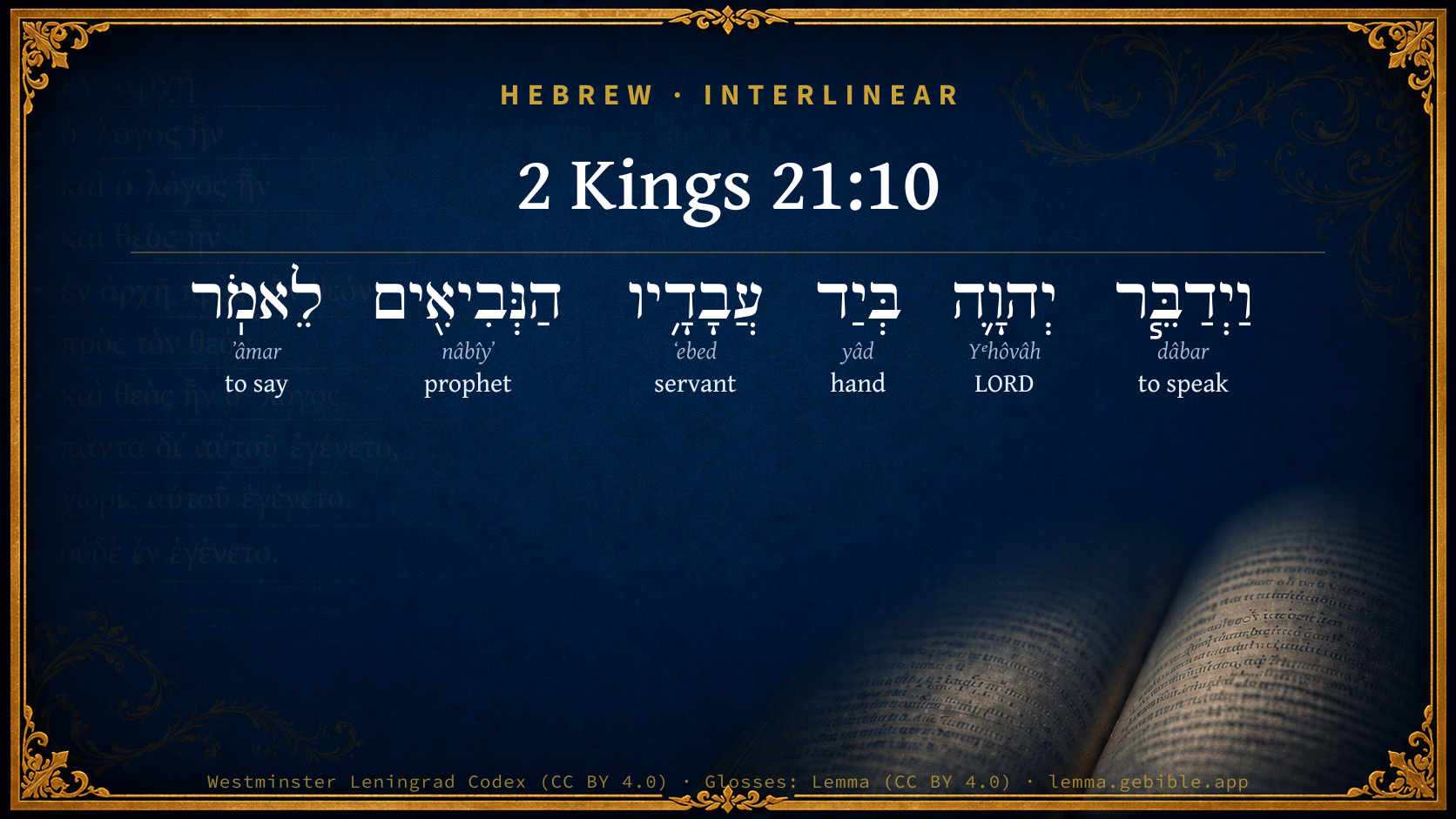
2 Kings 21:10

Hebrew (Westminster Leningrad Codex) 2 Kings 21:10 appears in the Hebrew Old Testament. The text above is from the Westminster Leningrad Codex. Each word links to its Strong’s number, a concise gloss, and parsing drawn from the Open Scriptures Hebrew Bible morphology. Click any word for its full Brown-Driver-Briggs (BDB) entry.
Download image
Cite this verse

2 Kings 21:10 (World English Bible). Public Domain. Lemma interlinear Bible study tool, https://lemma.gebible.app/v/2-kings/21/10.

Show BibTeX & RIS
BibTeX
RIS
English Translation
Yahweh spoke by his servants the prophets, saying,
World English Bible · Public Domain
Download a study sheet

One document with this verse’s original text, its word-by-word gloss line, the meaning frame, cross-references with their text, attributed commentary, and full source and license credits — printable, and it pastes into notes with its structure intact.

This verse Autodidact and up

Study sheet (.html) Plain text (.txt)

A passage Seminary Student

Up to 50 verses in one chapter. A passage sheet keeps up to 6 commentary sources and 12 cross-references per verse, in the order this page ranks them, and says so on the sheet whenever that leaves anything out. Ask for a single verse and you get the Autodidact verse sheet above.

Everything on this page stays free to read, with no account — the sheet is a download of what is already on screen, not access to it.

Want to remove ads? Support Godless Engineer
Compare translations 3

The same verse in 3 English versions, stacked beneath the original-language interlinear above. Click any original word for its lexicon entry.

Each is an independent rendering of the whole verse — the interlinear is not word-aligned to these translations.

Highlighted words mark where these versions differ — a whole-verse word diff, not a word-by-word alignment.

  • World English Bible Public Domain
    Yahweh spoke by his servants the prophets, saying,
  • King James Version Public Domain
    And the LORD spake by his servants the prophets, saying,
  • unfoldingWord Literal Text CC BY-SA 4.0
    And Yahweh spoke by the hand of his servants the prophets, saying,

unfoldingWord Literal Text — © unfoldingWord, licensed CC BY-SA 4.0. Word-aligned USFM3 via Door43 (git.door43.org/unfoldingWord/en_ult).

Versions to compare (up to 4)

3 of 4 selected

Show all 18 translations

Every available English version of this verse, each an independent rendering of the whole verse.

  • World English Bible Public Domain
    Yahweh spoke by his servants the prophets, saying,
  • Berean Standard Bible Public Domain
    And the LORD spoke through His servants the prophets, saying,
  • Majority Standard Bible Public Domain
    And the LORD spoke through His servants the prophets, saying,
  • King James Version Public Domain
    And the LORD spake by his servants the prophets, saying,
  • American Standard Version (1901) Public Domain
    And Jehovah spake by his servants the prophets, saying,
  • Revised Version (1885) Public Domain
    And the LORD spake by his servants the prophets, saying,
  • Geneva Bible (1599) Public Domain
    Therefore the Lord spake by his seruants the Prophets, saying,
  • Douay-Rheims (1899) Public Domain
    And the Lord spoke in the hand of his servants, the prophets, saying:
  • Young's Literal Translation Public Domain
    And Jehovah speaketh by the hand of his servants the prophets, saying,
  • Literal Standard Version CC BY-SA 4.0
    And YHWH speaks by the hand of his servants the prophets, saying,
  • Unlocked Literal Bible CC BY-SA 4.0
    So Yahweh spoke by his servants the prophets, saying,
  • unfoldingWord Literal Text CC BY-SA 4.0
    And Yahweh spoke by the hand of his servants the prophets, saying,
  • Darby Bible Public Domain
    And Jehovah spoke by his servants the prophets saying,
  • World Messianic Bible Public Domain
    The LORD spoke by his servants the prophets, saying,
  • Webster's Bible Public Domain
    And the LORD spoke by his servants the prophets, saying,
  • Free Bible Version CC BY-SA 4.0
    The Lord said through his servants the prophets:
  • Bible in Basic English Public Domain
    And the Lord said, by his servants the prophets,
  • JPS Tanakh (1917) Public Domain
    And the LORD spoke by His servants the prophets, saying:

Literal Standard Version (2020), Covenant Press — licensed CC BY-SA 4.0. Text via the HelloAO Bible API (eBible.org). Unlocked Literal Bible (unfoldingWord) — licensed CC BY-SA 4.0. Text via the HelloAO Bible API (eBible.org). unfoldingWord Literal Text — © unfoldingWord, licensed CC BY-SA 4.0. Word-aligned USFM3 via Door43 (git.door43.org/unfoldingWord/en_ult). Free Bible Version, Dr. Jonathan Gallagher — licensed CC BY-SA 4.0. Text via the HelloAO Bible API (eBible.org).

Word by word

More ways to search: Search by grammar → Find every occurrence → Compare this word →

Practice this passage: Drill this verse → Learn its vocabulary →

About this verse

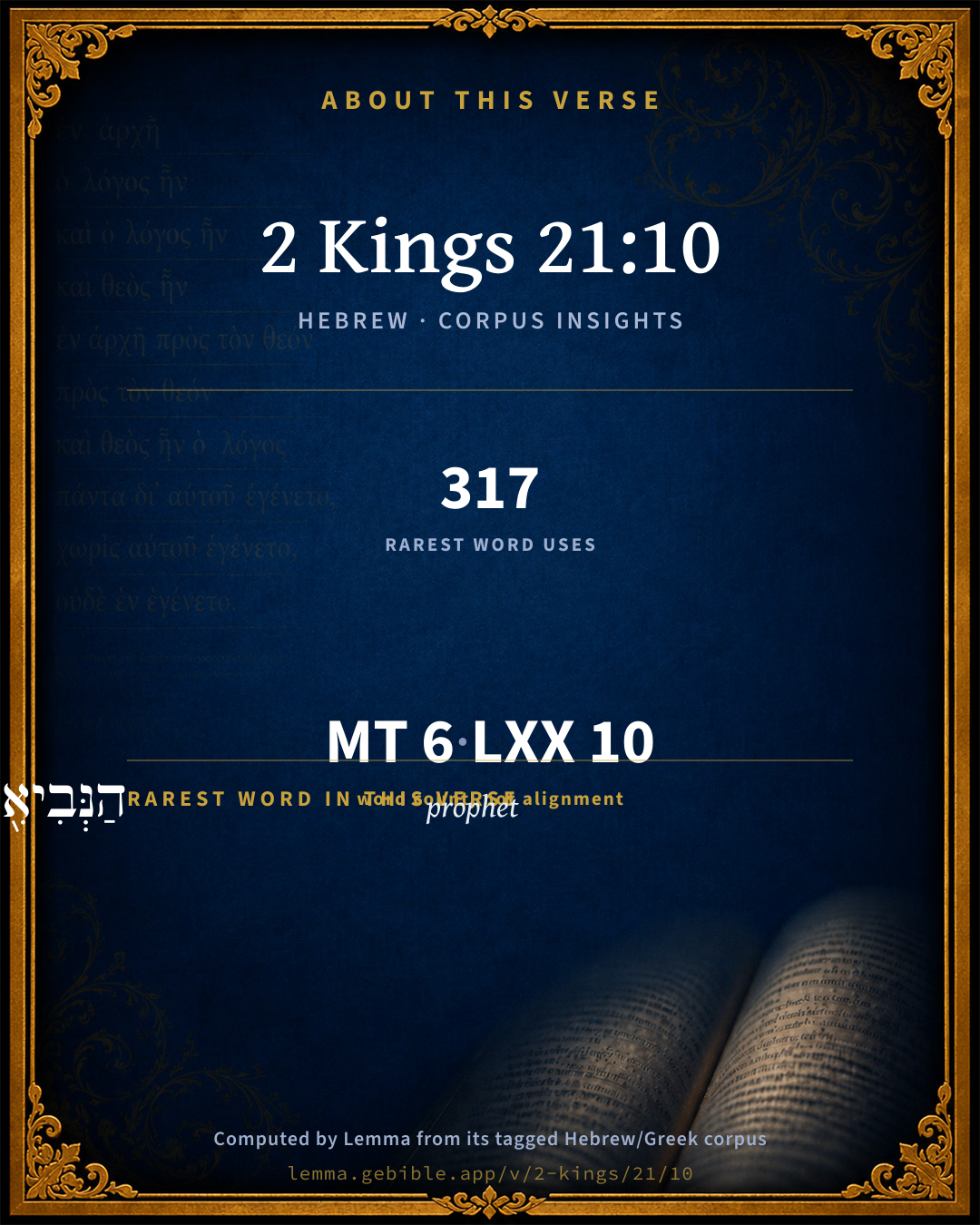
These counts appear in no published source. They are computed here, from the morphology-tagged text and Lemma’s own curated glosses. What Lemma adds →

6
words
6
distinct lemmas
Historical
section

Grammatical profile

  • 2 verbs
  • 4 nouns

Verb forms

  • וַיְדַבֵּ֧ר Piel · Sequential Imperfect
  • לֵאמֹֽר Qal · Infinitive Construct

Hebrew & Septuagint length

In English translation the verse runs 8 words from the Hebrew and 10 from the Septuagint (LXX English) — closely comparable.

A rough comparison of the two English renderings, which tokenize alike — not a word-level alignment.

Word counts can differ between the Hebrew and the Greek without any difference in meaning — e.g. the Hebrew direct-object marker אֵת has no separate Greek word, and Greek often adds the article ὁ.

In the original languages it is 6 Hebrew tokens and 10 Greek tokens — but the two are counted differently (Hebrew bundles its prefixes and suffixes into one token; the Greek is in lemma form), so that isn’t a like-for-like length.

Cross-references

5

Topical passages linked to 2 Kings 21:10 in the Treasury of Scripture Knowledge — connected by theme and wording, ordered by reader-vote popularity; previews shown in the World English Bible.

  • 2 Chronicles 33:10 Yahweh spoke to Manasseh, and to his people; but they gave no heed.
  • 2 Chronicles 36:15 Yahweh, the God of their fathers, sent to them by his messengers, rising up early and sending, because he had compassion on his people, and on his dwelling-place:
  • Nehemiah 9:26 Nevertheless they were disobedient, and rebelled against you, and cast your law behind their back, and killed your prophets that testified against them to turn them again to you, and they committed awful blasphemies.
  • Nehemiah 9:30 Yet many years did you bear with them, and testified against them by your Spirit through your prophets: yet would they not give ear: therefore gave you them into the hand of the peoples of the lands.
  • Matthew 23:34–37 Therefore, behold, I send to you prophets, wise men, and scribes. Some of them you will kill and crucify; and some of them you will scourge in your synagogues, and persecute from city to city;

Cross-references courtesy of OpenBible.info (CC BY 4.0).

Hebrew and Greek witnesses Masoretic Hebrew ↔ Greek Septuagint

The same verse in the two great witnesses to the Old Testament, shown verse-for-verse.

These are two independent witnesses, not word-aligned to each other, and the Septuagint is shown in lemma (dictionary) form.

Hebrew 2 Kings 21:10 Masoretic · Westminster Leningrad Codex

וַיְדַבֵּ֧ר יְהוָ֛ה בְּיַד עֲבָדָ֥יו הַנְּבִיאִ֖ים לֵאמֹֽר

Yahweh spoke by his servants the prophets, saying,

World English Bible · Public Domain

Greek LXX 2 Kings 21:10 Septuagint · lemma form

καί λαλέω κύριος ἐν χείρ δοῦλος αὐτός ὁ προφήτης λέγω

And the Lord spoke by his servants the prophets, saying,

LXX2012 (modern English Septuagint) · Public Domain

Hebrew: Westminster Leningrad Codex (CC BY 4.0). Greek: Septuagint (public domain); English from LXX2012 (modern English Septuagint) (Public Domain). How the Septuagint differs from the Hebrew →

Targum (Aramaic paraphrase)

1

The Targum is the ancient Jewish Aramaic paraphrase of the Hebrew Scriptures — an interpretive translation, not the Hebrew text itself. Onkelos (literal) and Pseudo-Jonathan (expansive) render the Torah, and Jonathan the Prophets. Coverage is partial: where no permissively-licensed English translation exists for a verse, only the Aramaic is shown. This is verse-level text, not a word-by-word alignment to the Hebrew.

  1. Targum Jonathan Prophets (Joshua–Malachi)
    וּמַלֵל יְיָ בְּיַד עַבְדוֹהִי נְבִיַיָא לְמֵימָר:

    (no public-domain English translation for this verse)

    Targum Jonathan — Aramaic: “Mikraot Gedolot” (public domain). English: “Sefaria Community Translation” (CC0 1.0 (public-domain dedication)); “London "Chaldee Paraphrase," 1871” (public domain). Text via Sefaria.

Commentary

Notes on 2 Kings 21:10 from classic Christian and Jewish commentators (each source and its license shown beneath its notes). The classic Christian expositions comment on the surrounding passage and are grouped to its opening verse, so a note may address several verses; the Jewish commentaries on the Tanakh (Rashi and others) are per-verse, so they appear only where the commentator wrote on this verse.

Lemma curates 59 commentaries, every one of them public domain or Creative Commons licensed, each selected and text-cleaned for this edition rather than reprinted as found. About our sources →

Trapp's Complete Commentary

John Trapp

2Ki 21:10 And the LORD spake by his servants the prophets, saying,

Ver. 10. And the Lord spake by his servants the prophets.] Isaiah, Hosea, Joel, Nahum, Micah, &c, one or other of whom Manasseh martyred every day, saith Josephus. {a} Isaiah he sawed asunder with a wooden saw, &c.

{a} Lib. x. cap. 4.

John Trapp, A Commentary or Exposition upon All the Books of the Old and New Testament (1647–1656) — public domain. Text from a community e-Sword module.

Matthew Henry's Commentary

Here is the doom of Judah and Jerusalem read, and it is heavy doom. The prophets were sent, in the first place, to teach them the knowledge of God, to remind them of their duty and direct them in it. If they succeeded not in that, their next work was to reprove them for their sins, and to set them in view before them, that they might repent and reform, and return to their duty. If in this they prevailed not, but sinners went on frowardly, their next work was to foretel the judgments of God, that the terror of them might awaken those to repentance who would not be made sensible of the obligations of his love, or else that the execution of them, in their season, might be a demonstration of the divine mission of the prophets that foretold them. The prophets were deputed judges to those that would not hear and receive them as teachers. We have here,

I. A recital of the crime. The indictment is read upon which the judgment is grounded, Kg2 21:11. Manasseh had done wickedly himself, though he knew better things, had even justified the Amorites, whose copy he wrote after, by outdoing them in impieties, and debauched the people of God, whom he had taught to sin and forced to sin; and besides that (though that was bad enough) he had filled Jerusalem with innocent blood (Kg2 21:16), had multiplied his murders in every corner of the city, and filled the measure of Jerusalem's blood-guiltiness (Mat 23:32) up to the brim, and all this against the crown and dignity of the King of kings, the peace of his kingdom, and the statutes in these cases made and provided.

II. A prediction of the judgment God would bring upon them for this: They have done that which was evil, and therefore I am bringing evil upon them (Kg2 21:12); it will come and it is not far off. The judgment should be, 1. Very terrible and amazing; the very report of it should make men's ears to tingle (Kg2 21:12), that is, their hearts to tremble. It should make a great noise in the world and occasion many speculations. 2. It should be copied out (as the sins of Jerusalem had been) from Samaria and the house of Ahab, Kg2 21:13. When God lays righteousness to the line it shall be the line of Samaria, measuring out to Jerusalem that which had been the lot of Samaria; when he lays judgment to the plummet it shall be the plummet of the house of Ahab, marking out for the same ruin to which that wretched family was devoted. See Isa 28:17. Note, Those who resemble and imitate others in their sins must expect to fare as they fared. 3. That it should be an utter destruction: I will wipe it as a man wipes a dish. This intimates, (1.) That every thing should be put into disorder, and their state subverted; they should be turned upside down, and all their foundations put out of course. (2.) That the city should be emptied of its inhabitants, which had been the filth of it, as a dish is emptied when it is wiped: "They shall all be carried captive, the land shall enjoy her sabbaths, and be laid by as a dish when it is wiped." See the comparison of the boiled pot, not much unlike this, Eze 24:1-14. (3.) That yet this should be in order to the purifying, not the destroying, of Jerusalem. The dish shall not be dropped, not broken to pieces, or melted down, but only wiped. This shall be the fruit, the taking away of the sinners first, and then of the sin. 4. That therefore they should be destroyed, because they should be deserted (Kg2 21:14): I will forsake the remnant of my inheritance. Justly are those that forsake God forsaken of him; nor does he ever leave any till they have first left him: but, when God has forsaken a people, their defence has departed, and they become a prey, an easy prey, to all their enemies. Sin is spoken of here as the alpha and omega of their miseries. (1.) Old guilt came in remembrance, as that which began to fill the measure (Kg2 21:15): "They have provoked me to anger from their conception and birth as a people, since the day their fathers came out of Egypt." The men of this generation, treading in their fathers' steps, are justly reckoned with for their fathers' sins. (2.) The guilt of blood was that which filled the measure, Kg2 21:16. Nothing has a louder cry, nor brings a sorer vengeance, than that.

This is all we have here of Manasseh; he stands convicted and condemned; but we hope in the book of Chronicles to hear of his repentance, and acceptance with God. Meantime, we must be content, in this place, to have only one intimation of his repentance (for so we are willing to take it), that he was buried, it is likely by his own order, in the garden of his own house (Kg2 21:18); for, being truly humbled for his sins, he judged himself no more worthy to be called a son, a son of David, and therefore not worthy to have even his dead body buried in the sepulchres of his fathers. True penitents take shame to themselves, not honour; yet, having lost the credit of an innocent, the credit of a penitent was the next best he was capable of. And better it is, and more honourable, for a sinner to die repenting, and be buried in a garden, than to die impenitent, and be buried in the abbey.

Matthew Henry's Commentary on the Whole Bible (1708–1710) — public domain (CC PDM 1.0). Text via the HelloAO Bible API.

Jamieson, Fausset & Brown

Robert Jamieson, A. R. Fausset & David Brown

And the Lord spake by his servants the prophets--These were Hosea, Joel, Nahum, Habakkuk, and Isaiah. Their counsels, admonitions, and prophetic warnings, were put on record in the national chronicles (Ch2 33:18) and now form part of the sacred canon.

Jamieson, Fausset & Brown — Commentary Critical and Explanatory on the Whole Bible (1871) — public domain (CC PDM 1.0). Text via the HelloAO Bible API.

Adam Clarke's Commentary

Verse 10. The Lord spake by - the prophets] The prophets were Hosea, Joel, Nahum, Habakkuk, and Isaiah. These five following verses contain the sum of what these prophets spoke. It is said that Isaiah not only prophesied in those days, but also that he was put to death by Manasseh, being sawn asunder by a wooden saw.

Adam Clarke's Commentary on the Bible (1810–1826) — public domain. Text from a community e-Sword/MySword module.

Ellicott's Commentary for English Readers

(10) By His servants the prophets . . .—This general expression is used because the historian found no name assigned in his source. It is possible that Isaiah was still living under Manasseh, and protested in the manner here described against his apostacy. More probably, however, the protests in question were those of that great prophet’s disciples: the style is not Isaiah’s. 2Ch_33:18 refers to the history of the kings of Israel for “the words of the seers who spake to Manasseh; “and the originality of the language in 2Ki_21:13 might be held to favour the view that we have in 2Ki_21:11-15, an extract from that work embodying the authentic oracle of a contemporary prophet. (So Ewald.) But it appears much more likely that the passage before us is a sort of résumé of the substance of many such prophetic addresses.

A Bible Commentary for English Readers, edited by Charles John Ellicott (1878–1897) — public domain. Text from a community e-Sword module.

The Cambridge Bible for Schools and Colleges

gen. ed. J. J. S. Perowne

10–15. God’s message of punishment (2Ch_33:10)

10. the Lord spake] The Chronicler says God’s warnings were sent both to the king and to his people but they would not hearken.

The Cambridge Bible for Schools and Colleges (gen. ed. J. J. S. Perowne; Cambridge University Press, 1878–1918) — public domain. Text from a community e-Sword module.

John Gill's Exposition

And the Lord spake by his servants the prophets,.... Who prophesied in the days of Manasseh; and were, according to the Jewish chronology (f), Joel, Nahum, and Habakkuk:

saying: as follows.

(f) Seder Olam Rabba, c. 20. p. 55.

John Gill's Exposition of the Whole Bible (1746–1763) — public domain (CC PDM 1.0). Text via the HelloAO Bible API.

Albert Barnes' Notes on the Bible

The prophets - None of the prophets of this reign are certainly known. One may possibly have been Hosai or Hozai (2Ch 33:19, margin), who perhaps wrote a life of Manasseh.

Albert Barnes' Notes on the Bible (1834–1885) — public domain. Text from a community e-Sword/MySword module.

Haydock's Catholic Bible Commentary

Prophets, Joel, Osee, Amos, Nahum, Jonas, Abdias, Micheas, and particularly by Isaias, who was related to the king. (Tirinus) --- Tradition informs us, that Manasses was so irritated, that he ordered Isaias to be slain with a wooden saw, (St. Augustine, City of God xviii. 24.) for greater torment; (Calmet) and his companions were daily executed, Josephus, [Antiquities?] x. 3. --- Isaias (xxii. 13.) seems to pronounce his sin irremissible, (Calmet) or that he should not, at least, escape the punishment of it, as long as he lived. But we are assured that the eyes of Manasses were at last opened by adversity, and that he performed many laudable things after his return from captivity; (2 Paralipomenon xxxiii.) so that the latter part of his reign resembled that of his father; though the beginning had been like that of the impious Achab. His coming to the throne so soon, before his pious father could have time to impress upon his mind the truths of salvation, had nearly proved his ruin. The sins of my youth, and my ignorances, remember not, O Lord, Psalm xxiv. 7. (Haydock)

George Leo Haydock (1774–1849), Haydock's Catholic Family Bible and Commentary, 1859 edition — public domain. Excludes Psalms (Douay-Rheims chapter numbering differs from Protestant) and Deuterocanonical books (Catholic canon only).

Whedon's Commentary on the Bible

Daniel D. Whedon

10. By his… prophets — The prophets of this period are nowhere named.

Daniel D. Whedon (gen. ed.), Commentary on the Old and New Testaments (1874–1909) — public domain. Text from a community e-Sword module.

The Pulpit Commentary

And the Lord spake by his servants the prophets, saying. It is uncertain who were the prophets of Manasseh"s time. Probably Isaiah was one of them (see "Introduction to Isaiah," p. 3.). Habakkuk is thought to have been another (Keil). Nahum and Zephaniah seem also to belong, in part, to his reign.

Vers. 10-18. Prophetic denunciations.

In all that he had done, Manasseh had not only sinned himself, but had "seduced" others to sin (ver. 9). Persons in high positions have this great influence. They are the natural social leaders, and their example tells powerfully for good or evil. The prophets, however, though as it proved at the risk of their lives, did not fail to warn him. It was no doubt their faithful denunciations, and the terrible evils they predicted, which brought down upon them the king"s wrath, and led to the great persecution.

I MANASSEH MORE WICKED THAN THE CANAANITES. He had "done wickedly above all that the Amorites did." His deeds may have been the same, but his guilt was greater than theirs, inasmuch as:

1. His light was greater than theirs. The Canaanites had the light of nature, and that, indeed, sufficed to render them inexcusable. (Rom_1:18-32 Rom_2:14, Rom_2:15) But Manasseh had the light of revelation. He was king of a nation to which God had made fully known the truth of his Being, character, and attributes; which had laws and statutes given to it such as no other nation possessed; (Deu_4:6-8) and which enjoyed the living ministry of holy prophets. He had also had the advantage of a pious father"s example and training. For such a one to go back to the sins of the Amorites was a heinous offence. It made his wickedness greater than theirs. We shall be judged by the light we possess, (Luk_12:47, Luk_12:48) and if our light is not improved it will be more tolerable for heathen nations than for us. (Mat_11:21-24 Mat_12:41, Mat_12:42)

2. He was guilty of apostasy; they were not. If the Amorities did these abominations, and served these idols, it could at least be said that they had never lived under any other system. God had suffered them to walk in their own way. (Act_14:16 Act_17:30) But in his evil Manasseh was guilty of a direct act of apostasy. He was going back from past attainments. He was violating a covenant made at Sinai, and repeatedly renewed. It is a different thing for a heathen to commit the vile acts in which he has been brought up, and for a Christian to renounce Christian training and baptismal engagements, and do the same acts.

3. The corruption of the best is the worst. This is another principle which explains why Manasseh"s abominations are represented as worse than those of the Amorites. A nation, being once enlightened, cannot sin as the semi-ignorant heathen do. It develops worse and more virulent evils. As a brute cannot sin in the same way as a man, or a child in the same way as an adult, so a nation enlightened by revelation can no longer sin as a nation does which has not this light. The higher consciousness reacts upon the sin and modifies it. There are evils possible under a Christian civilization which surpass anything known in heathenism. If our great cities show higher heights of virtue, they could also reveal lower depths of vice than Nineveh, Rome, Pekin, or Calcutta.

II THE SEVERITY OF JERUSALEM"S PUNISHMENT.

1. The grounds of the punishment. These are twofold:

(1) Manasseh"s sins as above described. "Because Manasseh King of Judah hath done these abominations," etc. (ver. 11). In this sin of the king, however, the people shared. He "made Judah also to sin with his idols." King and people, therefore, must suffer together. There is a corporate responsibility, which involves a community in common guilt, whether the sin proceeds from the head or the members.

(2) The entail of past transgression. "Because they have done evil in my sight since the day their fathers came forth from Egypt, unto this day" (ver. 15). That entail would have been cut off by timely repentance, but, in default of repentance, the guilt continues to be handed down. This is another phase of corporate responsibility. The life of the nation is continuous, and one generation has to accept its responsibilities from another. We see the same principle, e.g., in the handing down of national doubt. Christ views the Jewish nation of his day as chargeable with all the righteous blood that had been shed from the days of Abel downwards. (Mat_23:35)

2. The character of the punishment. It would be:

(1) Startling. "Such evil upon Jerusalem and Judah, that whosoever heareth of it, both his ears shall tingle." Wars, sieges of cities, and captivities, with the horrors attendant on them, were common enough in those days, but this vengeance of God on Jerusalem would be so awful as to shock and amaze even those familiarized with such scenes. The very report of it would produce a stinging sound in their ears. The fulfillment of the threat was partly under Nebuchadnezzar, but completely under the Romans. (Mat_24:21)

(2) Measured. "I will stretch over Jerusalem the line of Samaria, and the plummet of the house of Ahab." The idea is that God would take strict account of Judah"s sin, as already he had done of that of Samaria. The measuring-line and "plummet are introduced for purposes of precision. God would measure exactly the transgression of the people; would note precisely the degree of their deviation from righteousness; (cf. Amo_7:7-9) and to this measured guilt the punishment would be proportioned. The reason of measurement was that judgment was no more to be qualified by mercy. The nation was to bear the full load of its iniquity. It is a terrible thing when God thus "marks iniquity"; (Psa_130:3) for then the case of the sinner is hopeless.

(3) Complete. "I will wipe Jerusalem as a man wipeth a dish," etc. "I will forsake the remnant of my inheritance," etc. The figure of cleansing out a dish till it is as clean as wiping can make it is a very graphic one for the utter emptying and desolation that was to overtake Jerusalem. The city would not simply be humbled, as on many previous occasions, but would be completely destroyed, and the people led away by their enemies as a prey and a spoil. The predictions, as we know, were fulfilled to the letter. Manasseh might kill the men who uttered them, but he could not hinder their words from coming true; nay, his violence put a new seal on the certainty of their fulfillment. In the temporal calamities that were to overtake Jerusalem, we find a proof that verily there "is a God that judgeth in the earth", (Psa_58:11) and we are warned lest we provoke his "wrath to the uttermost" (1Th_2:16) by our own impenitence.

III MANASSEH"S DEATH. The reign of more than half a century came at length to a close, and, though the last years of it were marked by repentance, it left indelible traces of evil on the condition of the people. That by which Manasseh was specially remembered was "his sin that he sinned." He was buried in "the garden of his own house, the garden of Uzza." Amen also was buried in this garden (ver. 26). There was another garden which had a sepulcher in it; (Joh_19:41) but how different the sleepers! J.O.

The Pulpit Commentary (1880–1919), ed. H.D.M. Spence-Jones & Joseph S. Exell — public domain. Text from a community e-Sword module.

unfoldingWord translationNotes

Door43 World Missions Community

with his idols, therefore Yahweh, the God of Israel, says this: Look

Possible meanings are 1) Yahweh is speaking about himself in the third person. This can be stated in first person. AT: "with his idols, therefore I, Yahweh, the God of Israel, say this: Look" or 2) the prophet is introducing what Yahweh says. AT: "with his idols.' Therefore, this is what Yahweh, the God of Israel, says: 'Look" (See: First, Second, or Third Person)

whoever hears of it, both his ears will tingle

The physical feeling is a metonym for the emotional feeling that causes it. AT: "those who hear what Yahweh does, will be shocked" (See: Metonymy)

translationWords

Yahweh

prophet

Manasseh

king

kingdom of Judah

evil

Amorite

sin

false god

Jerusalem

unfoldingWord translationNotes — © Distant Shores Media and the Door43 World Missions Community, licensed CC BY-SA 4.0. Source: git.door43.org/Door43/en_tn.

Rashi

Rabbi Shlomo Yitzchaki (Rashi)

Through His servants the prophets. Nachum and Chavakuk, but because Menashe was wicked, they were not referred to with his name to explain that they were [prophesying] in his time.

Rashi on the Tanakh — English translations: “The Judaica Press complete Tanach with Rashi, translated by A. J. Rosenberg” (CC BY 4.0); “Pentateuch with Rashi's commentary by M. Rosenbaum and A.M. Silbermann, 1929-1934” (public domain); “The Metsudah Tanach series, Lakewood, N.J” (CC BY 4.0); and “The Book of Joshua, Metsudah Publications, 1997” (CC BY 4.0). Text via Sefaria.

Lesson kit

Teaching starters — assembled from the data on this page, not authored interpretation. Every prompt links to the verse data it draws on. Edit before teaching.

2 Kings, in the Historical, opens this verse with 6 words (6 distinct Hebrew lemmas). Its most distinctive word is nâbîyʼ (“prophet”). A historical commentator’s framing appears above. Read the whole chapter for the surrounding context.

Discussion questions

  1. The word nâbîyʼ carries the sense “prophet.” How does it shape the verse?
  2. 2 Chronicles 33:10 shares this passage’s theme. How do the two illuminate each other?
  3. These translations render this verse differently. What is at stake in choosing one wording over another?
  4. The verb «וַיְדַבֵּ֧ר» is Piel Sequential Imperfect. How does its form color the action?
  5. Reading how Trapp's Complete Commentary and Matthew Henry's Commentary read this verse, where do the two commentators agree and where do they part?

Things to notice

Reading settings

Reading text

Shown beneath each verse's original-language words.

Old Testament
Old Testament edition

Read the OT as the Masoretic Hebrew (MT) or the Greek Septuagint (LXX).

English shown for the Greek Septuagint (in the Hebrew ↔ Greek comparison).

Comparing translations? Open the Compare panel on any verse page to stack up to four side by side.