
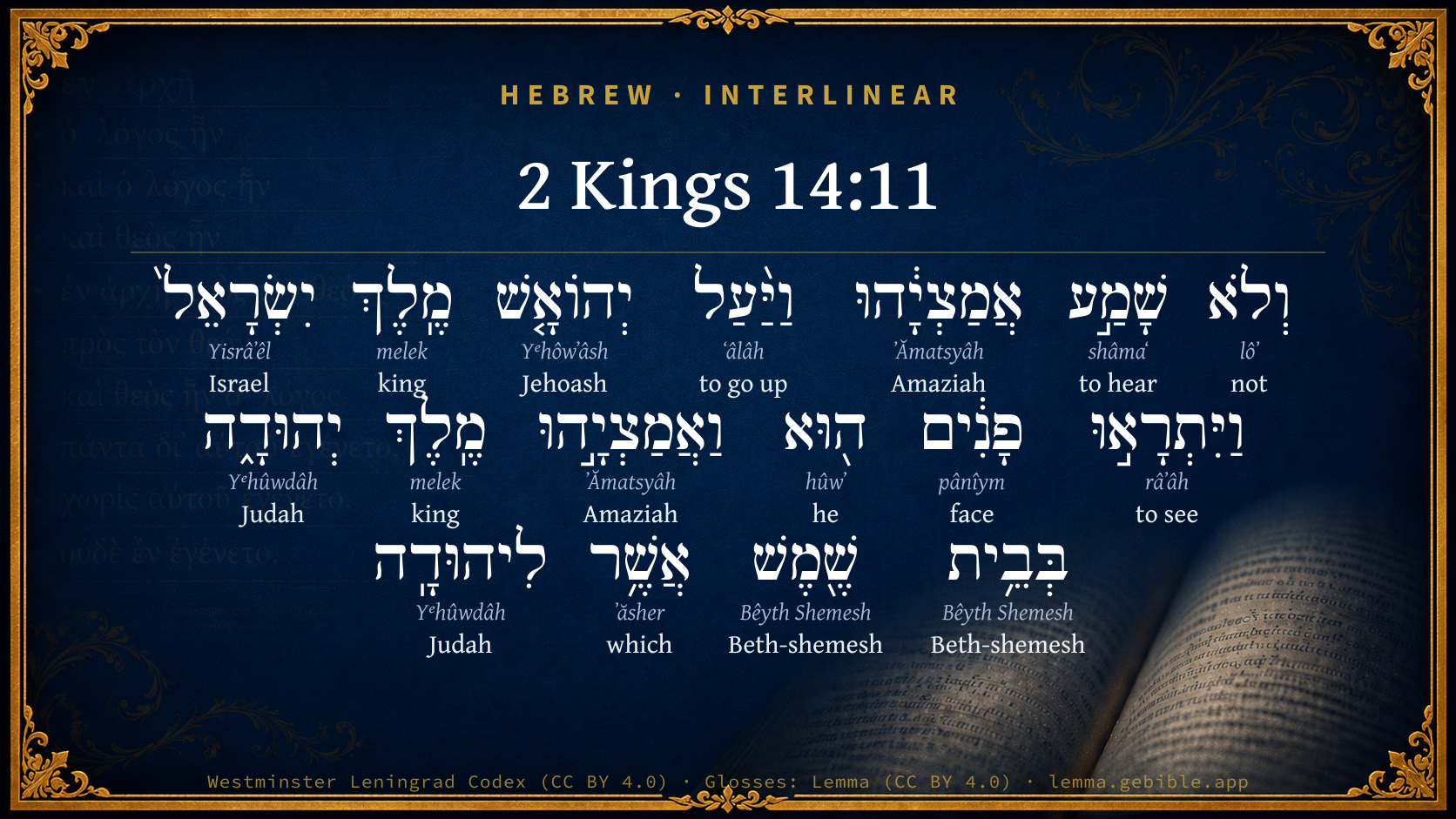
2 Kings 14:11

Hebrew (Westminster Leningrad Codex) 2 Kings 14:11 appears in the Hebrew Old Testament. The text above is from the Westminster Leningrad Codex. Each word links to its Strong’s number, a concise gloss, and parsing drawn from the Open Scriptures Hebrew Bible morphology. Click any word for its full Brown-Driver-Briggs (BDB) entry.
Download image
Cite this verse

2 Kings 14:11 (World English Bible). Public Domain. Lemma interlinear Bible study tool, https://lemma.gebible.app/v/2-kings/14/11.

Show BibTeX & RIS
BibTeX
RIS
English Translation
But Amaziah would not hear. So Jehoash king of Israel went up; and he and Amaziah king of Judah looked one another in the face at Beth-shemesh, which belongs to Judah.
World English Bible · Public Domain
Download a study sheet

One document with this verse’s original text, its word-by-word gloss line, the meaning frame, cross-references with their text, attributed commentary, and full source and license credits — printable, and it pastes into notes with its structure intact.

This verse Autodidact and up

Study sheet (.html) Plain text (.txt)

A passage Seminary Student

Up to 50 verses in one chapter. A passage sheet keeps up to 6 commentary sources and 12 cross-references per verse, in the order this page ranks them, and says so on the sheet whenever that leaves anything out. Ask for a single verse and you get the Autodidact verse sheet above.

Everything on this page stays free to read, with no account — the sheet is a download of what is already on screen, not access to it.

Want to remove ads? Support Godless Engineer
Compare translations 3

The same verse in 3 English versions, stacked beneath the original-language interlinear above. Click any original word for its lexicon entry.

Each is an independent rendering of the whole verse — the interlinear is not word-aligned to these translations.

Highlighted words mark where these versions differ — a whole-verse word diff, not a word-by-word alignment.

  • World English Bible Public Domain
    But Amaziah would not hear. So Jehoash king of Israel went up; and he and Amaziah king of Judah looked one another in the face at Beth-shemesh, which belongs to Judah.
  • King James Version Public Domain
    But Amaziah would not hear. Therefore Jehoash king of Israel went up; and he and Amaziah king of Judah looked one another in the face at Bethshemesh, which belongeth to Judah.
  • unfoldingWord Literal Text CC BY-SA 4.0
    But Amaziah did not listen. So Jehoash, the king of Israel, went up, and they saw one another’s faces, he and Amaziah, the king of Judah, at Beth Shemesh, which to Judah.

unfoldingWord Literal Text — © unfoldingWord, licensed CC BY-SA 4.0. Word-aligned USFM3 via Door43 (git.door43.org/unfoldingWord/en_ult).

Versions to compare (up to 4)

3 of 4 selected

Show all 18 translations

Every available English version of this verse, each an independent rendering of the whole verse.

  • World English Bible Public Domain
    But Amaziah would not hear. So Jehoash king of Israel went up; and he and Amaziah king of Judah looked one another in the face at Beth-shemesh, which belongs to Judah.
  • Berean Standard Bible Public Domain
    But Amaziah would not listen, and Jehoash king of Israel advanced. He and King Amaziah of Judah faced each other at Beth-shemesh in Judah.
  • Majority Standard Bible Public Domain
    But Amaziah would not listen, so Jehoash king of Israel advanced. He and King Amaziah of Judah faced each other at Beth-shemesh in Judah.
  • King James Version Public Domain
    But Amaziah would not hear. Therefore Jehoash king of Israel went up; and he and Amaziah king of Judah looked one another in the face at Bethshemesh, which belongeth to Judah.
  • American Standard Version (1901) Public Domain
    But Amaziah would not hear. So Jehoash king of Israel went up; and he and Amaziah king of Judah looked one another in the face at Beth-shemesh, which belongeth to Judah.
  • Revised Version (1885) Public Domain
    But Amaziah would not hear. So Jehoash king of Israel went up; and he and Amaziah king of Judah looked one another in the face at Beth-shemesh, which belongeth to Judah.
  • Geneva Bible (1599) Public Domain
    But Amaziah would not heare: therefore Iehoash King of Israel went vp: and he and Amaziah King of Iudah sawe one another in the face at Beth-shemesh which is in Iudah.
  • Douay-Rheims (1899) Public Domain
    But Amasias did not rest satisfied. So Joas king of Israel went up, and he and Amasias king of Juda saw one another in Bethsames a town in Juda.
  • Young's Literal Translation Public Domain
    And Amaziah hath not hearkened, and go up doth Jehoash king of Israel, and they look one another in the face, he and Amaziah king of Judah, in Beth-Shemesh, that `is' Judah's,
  • Literal Standard Version CC BY-SA 4.0
    And Amaziah has not listened, and Jehoash king of Israel goes up, and they look one another in the face, he and Amaziah king of Judah, in Beth-Shemesh, that [is] Judah’s,
  • Unlocked Literal Bible CC BY-SA 4.0
    But Amaziah would not listen. So Jehoash king of Israel attacked and he and Amaziah king of Judah met each other face to face at Beth Shemesh, which belongs to Judah.
  • unfoldingWord Literal Text CC BY-SA 4.0
    But Amaziah did not listen. So Jehoash, the king of Israel, went up, and they saw one another’s faces, he and Amaziah, the king of Judah, at Beth Shemesh, which to Judah.
  • Darby Bible Public Domain
    But Amaziah would not hear. And Jehoash king of Israel went up; and they looked one another in the face, he and Amaziah king of Judah, at Beth-shemesh, which is in Judah.
  • World Messianic Bible Public Domain
    But Amaziah would not listen. So Jehoash king of Israel went up; and he and Amaziah king of Judah looked one another in the face at Beth Shemesh, which belongs to Judah.
  • Webster's Bible Public Domain
    But Amaziah would not hear. Therefore Jehoash king of Israel went up: and he and Amaziah king of Judah looked one another in the face at Beth-shemesh, which belongeth to Judah.
  • Free Bible Version CC BY-SA 4.0
    But Amaziah refused to listen, so Jehoash, king of Israel, came to attack him. He and Amaziah, king of Judah, met face to face at Beth Shemesh in Judah.
  • Bible in Basic English Public Domain
    But Amaziah gave no attention. So Jehoash, king of Israel, went up, and he and Amaziah, king of Judah, came face to face at Beth-shemesh, which is in Judah.
  • JPS Tanakh (1917) Public Domain
    But Amaziah would not hear. So Jehoash king of Israel went up; and he and Amaziah king of Judah looked one another in the face at Beth-shemesh, which belongeth to Judah.

Literal Standard Version (2020), Covenant Press — licensed CC BY-SA 4.0. Text via the HelloAO Bible API (eBible.org). Unlocked Literal Bible (unfoldingWord) — licensed CC BY-SA 4.0. Text via the HelloAO Bible API (eBible.org). unfoldingWord Literal Text — © unfoldingWord, licensed CC BY-SA 4.0. Word-aligned USFM3 via Door43 (git.door43.org/unfoldingWord/en_ult). Free Bible Version, Dr. Jonathan Gallagher — licensed CC BY-SA 4.0. Text via the HelloAO Bible API (eBible.org).

Word by word

More ways to search: Search by grammar → Find every occurrence → Compare this word →

Practice this passage: Drill this verse → Learn its vocabulary →

יְהוֹאָ֤שׁ
Yᵉhôwʼâsh
H3060
“Jehoash”
Noun, Proper
Part of Speech
Noun
Type
Proper
Full BDB Definition

Origin: from H3068 and (perhaps) H784

TWOT: None

Jehoash = "given by the Lord" - son of king Ahaziah and the 8th king of Judah - son of king Jehoahaz and the 12th king of the northern kingdom of Israel
  1. וְלֹא lôʼ H3808 “and · not” Conjunction + Particle, Negative
  2. שָׁמַ֣ע shâmaʻ H8085 “to hear” Verb, Qal, Perfect, 3rd Person, Masculine, Singular
  3. אֲמַצְיָ֔הוּ ʼĂmatsyâh H558 “Amaziah” Noun, Proper
  4. וַיַּ֨עַל ʻâlâh H5927 “and · to go up” Conjunction + Verb, Qal, Sequential Imperfect, 3rd Person, Masculine, Singular
  5. מֶֽלֶךְ melek H4428 “king of” Noun, Common, Masculine, Singular, Construct
  6. יִשְׂרָאֵל֙ Yisrâʼêl H3478 “Israel” Noun, Proper
  7. וַיִּתְרָא֣וּ râʼâh H7200 “and · to see” Conjunction + Verb, Hithpael, Sequential Imperfect, 3rd Person, Masculine, Plural
  8. פָנִ֔ים pânîym H6440 “face(s)” Noun, Common, Both, Plural, Absolute
  9. ה֖וּא hûwʼ H1931 “he” Pronoun, Personal, 3rd Person, Masculine, Singular
  10. וַאֲמַצְיָ֣הוּ ʼĂmatsyâh H558 “and · Amaziah” Conjunction + Noun, Proper
  11. מֶֽלֶךְ melek H4428 “king of” Noun, Common, Masculine, Singular, Construct
  12. יְהוּדָ֑ה Yᵉhûwdâh H3063 “Judah” Noun, Proper
  13. בְּבֵ֥ית Bêyth Shemesh H1053 “in/at · Beth-shemesh” Preposition + Noun, Proper
  14. שֶׁ֖מֶשׁ Bêyth Shemesh H1053 “Beth-shemesh” Noun, Proper
  15. אֲשֶׁ֥ר ʼăsher H834 “which” Particle, Relative
  16. לִיהוּדָֽה Yᵉhûwdâh H3063 “to/for · Judah” Preposition + Noun, Proper

About this verse

These counts appear in no published source. They are computed here, from the morphology-tagged text and Lemma’s own curated glosses. What Lemma adds →

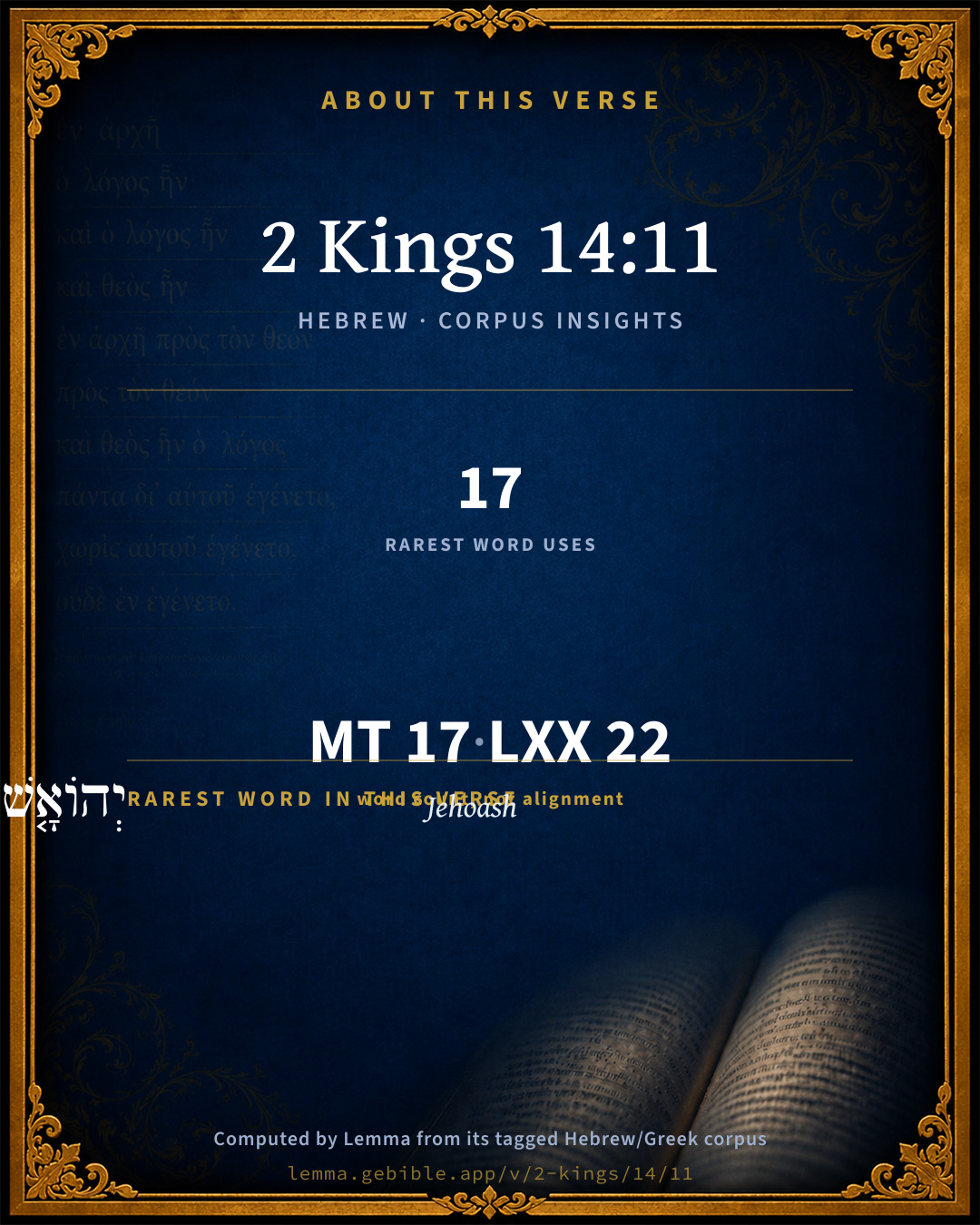
17
words
13
distinct lemmas
Historical
section

Notable vocabulary

The rarest word here is יְהוֹאָ֤שׁ Jehoash H3060 — appearing just 17 times in the whole Hebrew Bible.

Shared distinctive vocabulary

יְהוֹאָ֤שׁ Jehoash H3060 occurs in 16 verses of the Hebrew Bible. Also found in:

Grammatical profile

  • 3 verbs
  • 11 nouns
  • 1 pronoun
  • 2 particles

Verb forms

  • שָׁמַ֣ע Qal · Perfect
  • וַיַּ֨עַל Qal · Sequential Imperfect
  • וַיִּתְרָא֣וּ Hithpael · Sequential Imperfect

Repetition

Words recur within this verse — often emphatic in Hebrew:

  • אֲמַצְיָ֔הוּ Amaziah H558 ×2
  • מֶֽלֶךְ king H4428 ×2
  • יְהוּדָ֑ה Judah H3063 ×2
  • בְּבֵ֥ית Beth-shemesh H1053 ×2

Hebrew & Septuagint length

In English translation the verse runs 31 words from the Hebrew and 28 from the Septuagint (LXX English) — closely comparable.

A rough comparison of the two English renderings, which tokenize alike — not a word-level alignment.

Word counts can differ between the Hebrew and the Greek without any difference in meaning — e.g. the Hebrew direct-object marker אֵת has no separate Greek word, and Greek often adds the article ὁ.

In the original languages it is 17 Hebrew tokens and 22 Greek tokens — but the two are counted differently (Hebrew bundles its prefixes and suffixes into one token; the Greek is in lemma form), so that isn’t a like-for-like length.

Cross-references

6

Topical passages linked to 2 Kings 14:11 in the Treasury of Scripture Knowledge — connected by theme and wording, ordered by reader-vote popularity; previews shown in the World English Bible.

  • Joshua 19:38 Iron, and Migdal-el, Horem, and Beth Anath, and Beth-shemesh; nineteen cities with their villages.
  • Joshua 15:10 and the border turned about from Baalah westward to Mount Seir, and passed along to the side of Mount Jearim on the north (the same is Chesalon), and went down to Beth-shemesh, and passed along by Timnah;
  • Joshua 21:16 and Ain with its suburbs, and Juttah with its suburbs, [and] Beth-shemesh with its suburbs; nine cities out of those two tribes.
  • 1 Samuel 6:9–19 Behold; if it goes up by the way of its own border to Beth-shemesh, then he has done us this great evil: but if not, then we shall know that it is not his hand that struck us; it was a chance that happened to us."
  • 2 Chronicles 25:16 It happened, as he talked with him, that [the king] said to him, Have we made you of the king's counsel? Stop! Why should you be struck down? Then the prophet stopped, and said, I know that God has determined to destroy you, because you have done this, and have not listened to my counsel.
  • 2 Chronicles 25:20 But Amaziah would not hear; for it was of God, that he might deliver them into the hand [of their enemies], because they had sought after the gods of Edom.

Cross-references courtesy of OpenBible.info (CC BY 4.0).

Hebrew and Greek witnesses Masoretic Hebrew ↔ Greek Septuagint

The same verse in the two great witnesses to the Old Testament, shown verse-for-verse.

These are two independent witnesses, not word-aligned to each other, and the Septuagint is shown in lemma (dictionary) form.

Hebrew 2 Kings 14:11 Masoretic · Westminster Leningrad Codex

וְלֹא שָׁמַ֣ע אֲמַצְיָ֔הוּ וַיַּ֨עַל יְהוֹאָ֤שׁ מֶֽלֶךְ יִשְׂרָאֵל֙ וַיִּתְרָא֣וּ פָנִ֔ים ה֖וּא וַאֲמַצְיָ֣הוּ מֶֽלֶךְ יְהוּדָ֑ה בְּבֵ֥ית שֶׁ֖מֶשׁ אֲשֶׁ֥ר לִיהוּדָֽה

But Amaziah would not hear. So Jehoash king of Israel went up; and he and Amaziah king of Judah looked one another in the face at Beth-shemesh, which belongs to Judah.

World English Bible · Public Domain

Greek LXX 2 Kings 14:11 Septuagint · lemma form

καί οὐ ἀκούω αμεσσιας καί ἀναβαίνω ὁ βασιλεύς ἰσραήλ καί ὁράω πρόσωπον αὐτός καί αμεσσιας βασιλεύς ιουδα ἐν βαιθσαμυς ὁ ὁ ιουδα

Nevertheless Amessias listened not: so Joas king of Israel went up, and he and Amessias king of Juda looked one another in the face in Baethsamys of Juda.

LXX2012 (modern English Septuagint) · Public Domain

Hebrew: Westminster Leningrad Codex (CC BY 4.0). Greek: Septuagint (public domain); English from LXX2012 (modern English Septuagint) (Public Domain). How the Septuagint differs from the Hebrew →

Targum (Aramaic paraphrase)

1

The Targum is the ancient Jewish Aramaic paraphrase of the Hebrew Scriptures — an interpretive translation, not the Hebrew text itself. Onkelos (literal) and Pseudo-Jonathan (expansive) render the Torah, and Jonathan the Prophets. Coverage is partial: where no permissively-licensed English translation exists for a verse, only the Aramaic is shown. This is verse-level text, not a word-by-word alignment to the Hebrew.

  1. Targum Jonathan Prophets (Joshua–Malachi)
    וְלָא קַבֵּל אֲמַצְיָהוּ וּסְלֵיק יְהוֹאָשׁ מַלְכָּא דְיִשְׂרָאֵל וְאַקְבִּילוּ אַפֵּיהוֹן בִּקְרָבָא הוּא וַאֲמַצְיָהוּ מְלַךְ שִׁבְטָא דְבֵית יְהוּדָה בְבֵית שֶׁמֶשׁ דִי לְשִׁבְטָא דִיהוּדָה:

    (no public-domain English translation for this verse)

    Targum Jonathan — Aramaic: “Mikraot Gedolot” (public domain). English: “Sefaria Community Translation” (CC0 1.0 (public-domain dedication)); “London "Chaldee Paraphrase," 1871” (public domain). Text via Sefaria.

Commentary

Notes on 2 Kings 14:11 from classic Christian and Jewish commentators (each source and its license shown beneath its notes). The classic Christian expositions comment on the surrounding passage and are grouped to its opening verse, so a note may address several verses; the Jewish commentaries on the Tanakh (Rashi and others) are per-verse, so they appear only where the commentator wrote on this verse.

Lemma curates 59 commentaries, every one of them public domain or Creative Commons licensed, each selected and text-cleaned for this edition rather than reprinted as found. About our sources →

Trapp's Complete Commentary

John Trapp

2Ki 14:11 But Amaziah would not hear. Therefore Jehoash king of Israel went up; and he and Amaziah king of Judah looked one another in the face at Bethshemesh, which [belongeth] to Judah.

Ver. 11. But Amaziah would not hear.] See the reason in 2Ch 25:20. He was ripe for ruin, and therefore, like a sea monster, with a deaf ear, he slighteth good counsel. "A deceived heart had now turned him aside, that he could not deliver his soul, nor say, Is there not a lie in my right hand?" {Isa 44:20}

John Trapp, A Commentary or Exposition upon All the Books of the Old and New Testament (1647–1656) — public domain. Text from a community e-Sword module.

Joseph Benson's Commentary

2Ki 14:11-12. Amaziah would not hear — Being blinded and hardened by God to his destruction, as a punishment of his abominable and ridiculous idolatry, 2Ch 25:10. Therefore Jehoash went up — Namely, into the kingdom of Judah, carrying the war into his enemies’ country. At Beth-shemesh, which belongeth to Judah — Which is added to distinguish it from Beth-shemesh in Issachar, and another in Naphtali. And Judah was put to the worse — Their army being routed and dispersed. Josephus says that, when they were to engage, they were struck with such a terror that they did not strike a stroke, but every one made the best of his way home. Probably they were not satisfied as to the ground and manner of the quarrel, were discouraged by the king’s idolatry, and smitten by God with a spirit of fear.

Joseph Benson's Commentary on the Old and New Testaments (1811–1818) — public domain. Text from a community e-Sword module.

Tyndale Open Study Notes

Tyndale Open Resources

14:11-12 Beth-shemesh, a fortress town fifteen miles west of Jerusalem, was a natural place for the battle between Israel and Judah. The city history stretched back to when Judah occupied it after the Danites migrated northward (Josh 21:16; see also 1 Sam 6:1-14; 2 Chr 28:18).

Tyndale Open Study Notes — © Tyndale Open Resources, licensed CC BY-SA 4.0. Text via the HelloAO Bible API.

Jamieson, Fausset & Brown

Robert Jamieson, A. R. Fausset & David Brown

But Amaziah would not hear--The sarcastic tenor of this reply incited the king of Judah the more; for, being in a state of judicial blindness and infatuation (Ch2 25:20), he was immovably determined on war. But the superior energy of Joash surprised him ere he had completed his military preparations. Pouring a large army into the territory of Judah, he encountered Amaziah in a pitched battle, routed his army, and took him prisoner. Then having marched to Jerusalem [Kg2 14:13], he not only demolished part of the city walls, but plundered the treasures of the palace and temple. Taking hostages to prevent any further molestation from Judah, he terminated the war. Without leaving a garrison in Jerusalem, he returned to his capital with all convenient speed, his presence and all his forces being required to repel the troublesome incursions of the Syrians.

Jamieson, Fausset & Brown — Commentary Critical and Explanatory on the Whole Bible (1871) — public domain (CC PDM 1.0). Text via the HelloAO Bible API.

Ellicott's Commentary for English Readers

(11) Looked one another in the face—i.e., encountered one another; joined battle.

Beth-shemesh.—The modern Ain-shems, north of which is a great plain now called Wâdy-es-Surâr, in which the encounter probably happened. Jehoash proposed to attack Jerusalem from the west, as Hazael also had intended (2Ki_12:17).

A Bible Commentary for English Readers, edited by Charles John Ellicott (1878–1897) — public domain. Text from a community e-Sword module.

The Cambridge Bible for Schools and Colleges

gen. ed. J. J. S. Perowne

11. But Amaziah would not hear] Bearing out the proverb ‘Quem Deus vult perdere prius dementat’.

Jehoash king of Israel went up] When the king of Israel saw that Amaziah would persist, he apparently made the first movement. For Beth-shemesh, where the engagement took place was in Amaziah’s territory, on the northern boundary of Judah. Jehoash therefore never allowed the army of Judah to enter the land of the Israelites.

Beth-shemesh] The name signifies ‘house of the sun’ and may contain some allusion to ancient idolatrous worship which prevailed there. (Cf. Jer_43:13.) The place is mentioned before this time as that to which the ark was brought when it was sent home by the Philistines (1Sa_6:9; 1Sa_6:12). It was one of the cities allotted to the priests, and in 1Ki_4:9 it is among the places selected for commissariat cities by Solomon. In the later history we find that the Philistines obtained possession of it (2Ch_28:18).

The Cambridge Bible for Schools and Colleges (gen. ed. J. J. S. Perowne; Cambridge University Press, 1878–1918) — public domain. Text from a community e-Sword module.

John Gill's Exposition

And Jehoash king of Israel took Amaziah king of Judah, the son of Jehoash the son of Ahaziah, at Bethshemesh,.... And then they looked one another in the face indeed, but Amaziah must look very silly:

and came to Jerusalem; the metropolis of Judah, with his royal prisoner:

and broke down the wall of Jerusalem; in at the breach of which he went with his chariot, as Josephus says (e), in triumph:

from the gate of Ephraim unto the corner gate, four hundred cubits; the gate of Ephraim was to the north of the city, towards the tribe of Ephraim, from whence it had its name; and the corner gate was that which joined the northern and western walls together, or rather the northern and eastern walls; for Rauwolff says (f), there is still the corner gate in its old place, where the north and east walls meet on large and high rocks, and is still called by some the gate of Naphtali.

(e) Antiqu. l. 9. c. 9. sect. 3. (f) Travels, par. 3. ch. 3. p. 228. by Ray.

John Gill's Exposition of the Whole Bible (1746–1763) — public domain (CC PDM 1.0). Text via the HelloAO Bible API.

Albert Barnes' Notes on the Bible

Jehoash did not wait to be attacked. Invading Judaea from the west, and so ascending out of the low coast tract, he met the army of Amaziah at Beth-shemesh (see Jos 19:21 note), about 15 miles from Jerusalem.

Albert Barnes' Notes on the Bible (1834–1885) — public domain. Text from a community e-Sword/MySword module.

Haydock's Catholic Bible Commentary

Saw, or fought, ver. 8., and chap. xxiii. 29. Bethsames was in the tribe of Dan, (Calmet) but belonging to the king of Juda.

George Leo Haydock (1774–1849), Haydock's Catholic Family Bible and Commentary, 1859 edition — public domain. Excludes Psalms (Douay-Rheims chapter numbering differs from Protestant) and Deuterocanonical books (Catholic canon only).

Matthew Poole's English Annotations

Amaziah would not hear, because God blinded and hardened him to his destruction, for his abominable and ridiculous idolatry, 2Ch 25:20.

Jehoash went up, to wit, into the kingdom of Judah, carrying the war into his enemy’s country.

Which belongeth to Judah; which is added to distinguish it from that Beth-shemesh in Issachar, and another in Naphtali, Jos 19:22,38.

Matthew Poole's English Annotations on the Holy Bible (1683–1685) — public domain. Text from a community e-Sword/MySword module.

Whedon's Commentary on the Bible

Daniel D. Whedon

11. Amaziah would not hear — He listened neither to the counsel of Jehoash nor to the prophet whom the Lord sent to advise him, but, according to Chronicles, he took the advice of evil-minded persons, who counselled war.

Beth-shemesh — The modern Ain Shems, fifteen miles southwest of Jerusalem. See notes on Jos_15:10 and 1Sa_6:9.

Daniel D. Whedon (gen. ed.), Commentary on the Old and New Testaments (1874–1909) — public domain. Text from a community e-Sword module.

The Pulpit Commentary

But Amaziah would not hear. The message of Joash was not conciliatory, but provocative. On hearing it, Amaziah (as Josephus says, "Ant. Jud:," 9:9. was the more spurred on to make his expedition. Therefore Jehoash King of Israel went up. "Joash," as Bahr says, "did not wait for the attack of Amaziah, but anticipated his movements, and carried the war into the enemy"s country." Defensive warfare often requires such an Offensive movement. And he and Amaziah King of Judah looked one another in the face e.g., came to an engagement (ver. 8)at Beth-shemesh, which belongeth to Judah. Bethshemesh was assigned to Judah by Joshua (19:38), and lay on its western frontier line. Its position is marked by the modern Ain-Shems, which lies nearly due west of Jerusalem, on the road from Hebron to Jaffa. Ain-Shems itself is an Arab village, but "just to the west of it are the manifest traces of an ancient site" (Robinson, "Researches," vol. 3. p. 17). The position commands the approach from the Philistine plain; and we may suspect that Joash, avoiding the direct line of approach, led his troops to the attack through Philistia, as was so often done by the Syrians in their attacks on the Maccabees. (see RAPC 1Ma 3:40 13:12, 13 15:40 16:4-8, etc.)

The Pulpit Commentary (1880–1919), ed. H.D.M. Spence-Jones & Joseph S. Exell — public domain. Text from a community e-Sword module.

unfoldingWord translationNotes

Door43 World Missions Community

But Amaziah would not listen

Here "listen" refers to obeying the warning. AT: "However, Amaziah would not obey Jehoash's warning" (See: Metonymy)

So Jehoash king of Israel attacked ... Amaziah king of Judah met each other

The armies of these kings went to battle with them. AT: "So Jehoash and his army went to fight Amaziah and his army and they met each other" (See: Synecdoche)

Beth Shemesh

This is a town in Judah near the border of Israel. (See: How to Translate Names)

Judah was defeated by Israel

This can be stated in active form. AT: "Israel defeated Judah" (See: Active or Passive)

every man fled home

"all the men in the army of Judah ran home"

translationWords

king

kingdom of Israel

kingdom of Judah

Beth Shemesh

unfoldingWord translationNotes — © Distant Shores Media and the Door43 World Missions Community, licensed CC BY-SA 4.0. Source: git.door43.org/Door43/en_tn.

Lesson kit

Teaching starters — assembled from the data on this page, not authored interpretation. Every prompt links to the verse data it draws on. Edit before teaching.

2 Kings, in the Historical, opens this verse with 17 words (13 distinct Hebrew lemmas). Its most distinctive word is Yᵉhôwʼâsh (“Jehoash”). A historical commentator’s framing appears above. Read the whole chapter for the surrounding context.

Discussion questions

  1. The word Yᵉhôwʼâsh carries the sense “Jehoash.” How does it shape the verse?
  2. How does 2 Kings 11:21, which shares the word «Jehoash», read alongside this verse?
  3. What does the repetition of “Amaziah” (2× in this one verse) do in this verse?
  4. The translations on this page render this verse differently — a whole-verse word diff, not a word-by-word alignment. What might account for the different wordings?
  5. «שָׁמַ֣ע» is a Qal Perfect verb. How does that grammatical form shape the action described?
  6. Compare how Trapp's Complete Commentary and Joseph Benson's Commentary read this verse. Where do they agree or differ?

Things to notice

Reading settings

Reading text

Shown beneath each verse's original-language words.

Old Testament
Old Testament edition

Read the OT as the Masoretic Hebrew (MT) or the Greek Septuagint (LXX).

English shown for the Greek Septuagint (in the Hebrew ↔ Greek comparison).

Comparing translations? Open the Compare panel on any verse page to stack up to four side by side.