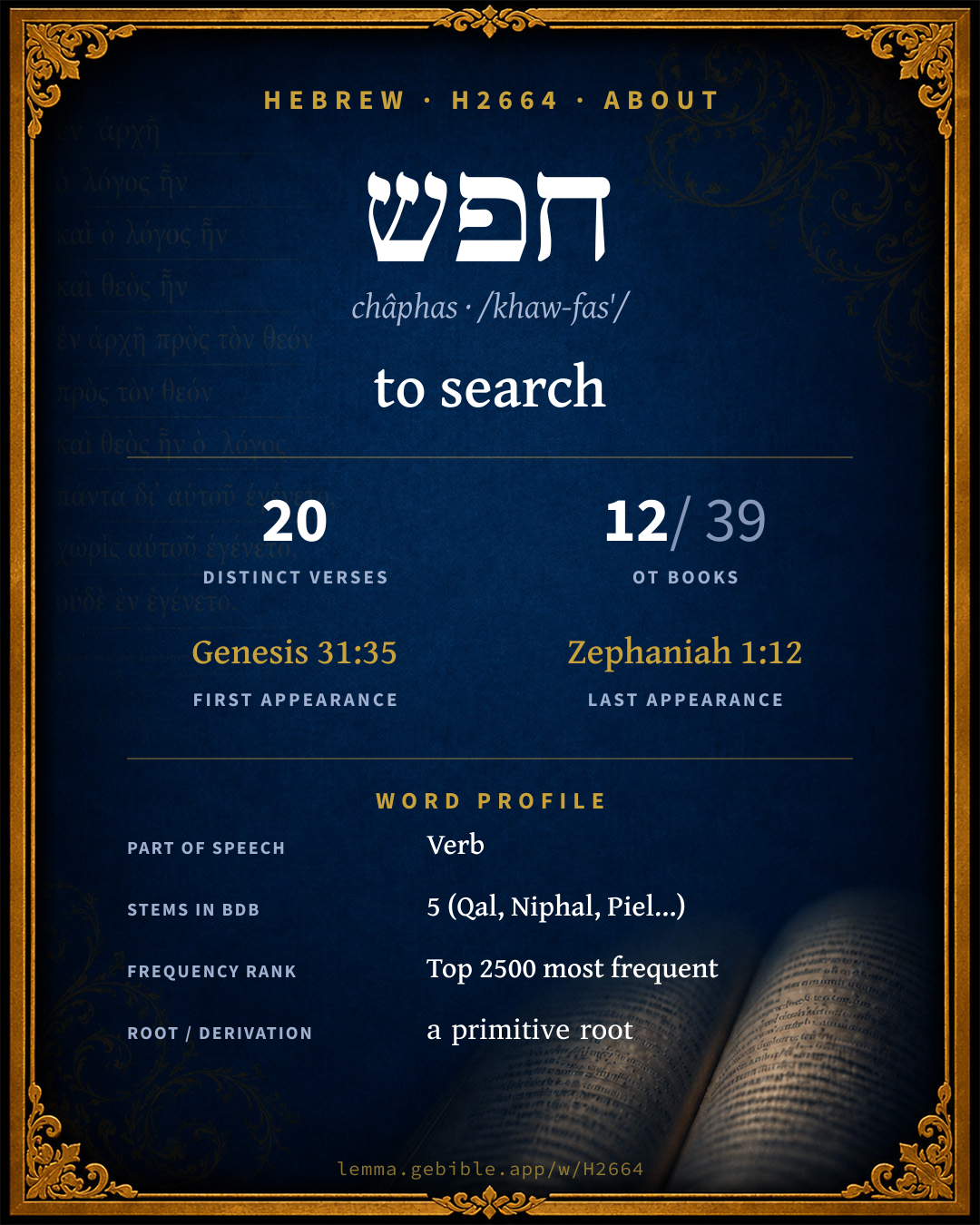
חָפַשׂ
to search
also: search for, to search out, disguise oneself fuller range ↓
Full lexicon entry — Brown-Driver-Briggs (BDB)
From Brown-Driver-Briggs (BDB)
Where this word appears
See every Piel verb in the Hebrew Bible →
Grammar key — what these labels mean
Part of speech
- Verb
- An action or state-of-being word.
Stem
- Hithpael
- The reflexive or reciprocal stem (the subject acts on itself).
- Piel
- An intensive or resultative active stem. Here: ‘search through’
- Niphal
- Usually the simple passive or reflexive of the Qal (“he was written”).
- Pual
- The passive counterpart of the Piel.
- Qal
- The basic, simple active stem — the plain form of the verb (“he wrote”). Here: ‘search for’
Form
- Sequential Imperfect
- An imperfect with prefixed waw — the standard past-narrative form (waw-consecutive imperfect).
- Imperfect
- An incomplete, ongoing, or future action (“he will / would write”).
- Infinitive Absolute
- An unbound verbal noun, often intensifying or standing in for a finite verb.
- Perfect
- A completed action or state — Hebrew marks aspect (completeness) more than strict tense (“he wrote”).
- Participle Passive
- A verbal adjective expressing action received (“written”).
- Imperative
- A direct command (“write!”).
- Cohortative
- A first-person volitional form expressing wish or resolve (“let me / let us write”).
- Participle Active
- A verbal adjective expressing ongoing or characteristic action (“writing / one who writes”).
State
- Absolute
- The independent form of a noun, not bound to a following word.
Person
- 3rd Person
- The one spoken about (“he / she / it / they”).
- 1st Person
- The speaker (“I / we”).
- 2nd Person
- The one addressed (“you”).
Gender
- Masculine
- Grammatically masculine.
- Common
- Either gender — not distinguished for this form.
Number
- Singular
- One.
- Plural
- More than one (in Hebrew, generally three or more).
Grammatical forms 16 distinct
- Verb, Hithpael, Sequential Imperfect, 3rd Person, Masculine, Singular 4 times (17%)
- Verb, Piel, Sequential Imperfect, 3rd Person, Masculine, Singular 3 times (13%)
- Verb, Piel, Imperfect, 1st Person, Common, Singular 2 times (9%)
- Verb, Hithpael, Infinitive Absolute 2 times (9%)
- Verb, Piel, Perfect, 1st Person, Common, Singular 1 time (4%)
- Verb, Piel, Perfect, 3rd Person, Common, Plural 1 time (4%)
- Verb, Niphal, Perfect, 3rd Person, Common, Plural 1 time (4%)
- Verb, Pual, Imperfect, 3rd Person, Masculine, Singular 1 time (4%)
+8 more forms (8 occurrences)
Parsed forms decoded from the imported morphology (morphhb / Westminster Leningrad Codex — WLC text public domain, morphhb tagging CC BY 4.0), counted across 23 parsed occurrences — not distinct verses.
Every verse where H2664 appears — 20 distinct verses across 12 books. Click any verse to open its interlinear word-by-word view. Verse text shown in the World English Bible for context — . Each verse’s Hebrew form is shown with its reference; the English is not keyword-highlighted, since the data carries no word-level English alignment. Use “Compare translations” on any verse to read it across multiple English versions. This concordance covers the Hebrew Bible; Septuagint (Greek Old Testament) occurrences are not indexed here.
Genesis 2 verses
- Genesis 31:35 וַ/יְחַפֵּ֕שׂ conj + Piel wimpf 3ms She said to her father, "Don't let my lord be angry that I can't rise up before you; for the manner of women is on me." He searched, but didn't find the teraphim.
- Genesis 44:12 וַ/יְחַפֵּ֕שׂ conj + Piel wimpf 3ms He searched, beginning with the eldest, and ending at the youngest. The cup was found in Benjamin's sack.
1 Samuel 2 verses
- 1 Samuel 23:23 וְ/חִפַּשְׂתִּ֣י conj + Piel pf 1cs See therefore, and take knowledge of all the lurking-places where he hides himself, and come you again to me of a certainty, and I will go with you: and it shall happen, if he be in the land, that I will search him out among all the thousands of Judah.
- 1 Samuel 28:8 וַ/יִּתְחַפֵּ֣שׂ conj + Hithpael wimpf 3ms Saul disguised himself, and put on other clothing, and went, he and two men with him, and they came to the woman by night: and he said, Please divine to me by the familiar spirit, and bring me up whoever I shall name to you.
1 Kings 3 verses
- 1 Kings 20:6 וְ/חִפְּשׂוּ֙ conj + Piel pf 3cp but I will send my servants to you tomorrow about this time, and they shall search your house, and the houses of your servants; and it shall be, that whatever is pleasant in your eyes, they shall put it in their hand, and take it away.
- 1 Kings 20:38 וַ/יִּתְחַפֵּ֥שׂ conj + Hithpael wimpf 3ms So the prophet departed, and waited for the king by the way, and disguised himself with his headband over his eyes.
- 1 Kings 22:30 הִתְחַפֵּשׂ֙ וַ/יִּתְחַפֵּשׂ֙ Hithpael inf.abs conj + Hithpael wimpf 3ms The king of Israel said to Jehoshaphat, I will disguise myself, and go into the battle; but put you on your robes. The king of Israel disguised himself, and went into the battle.
2 Kings 1 verse
2 Chronicles 2 verses
- 2 Chronicles 18:29 הִתְחַפֵּשׂ֙ וַ/יִּתְחַפֵּשׂ֙ Hithpael inf.abs conj + Hithpael wimpf 3ms The king of Israel said to Jehoshaphat, I will disguise myself, and go into the battle; but put you on your robes. So the king of Israel disguised himself; and they went into the battle.
- 2 Chronicles 35:22 הִתְחַפֵּ֔שׂ Hithpael pf 3ms Nevertheless Josiah would not turn his face from him, but disguised himself, that he might fight with him, and didn't listen to the words of Neco from the mouth of God, and came to fight in the valley of Megiddo.
Job 1 verse
Psalms 2 verses
- Psalms 64:6 יַֽחְפְּֽשׂוּ מְחֻפָּ֑שׂ Qal impf 3mp Pual ptcp.pass ms They plot injustice, saying, "We have made a perfect plan!" Surely man's mind and heart are cunning.
- Psalms 77:6 וַ/יְחַפֵּ֥שׂ conj + Piel wimpf 3ms I remember my song in the night. I consider in my own heart; My spirit diligently inquires:
Proverbs 3 verses
- Proverbs 2:4 תַּחְפְּשֶֽׂ/נָּה Qal impf 2ms + sfx pers 3fs If you seek her as silver, And search for her as for hidden treasures:
- Proverbs 20:27 חֹ֝פֵ֗שׂ Qal ptcp.act ms The spirit of man is Yahweh's lamp, Searching all his innermost parts.
- Proverbs 28:12 יְחֻפַּ֥שׂ Pual impf 3ms When the righteous triumph, there is great glory; But when the wicked rise, men hide themselves.
Lamentations 1 verse
Amos 1 verse
Obadiah 1 verse
Zephaniah 1 verse
About this entry
At a glance — auto-summarized from this page’s data, not written by a person. Every figure links to its source below. This summary describes the numbers; it doesn’t interpret them.
חפש (châphas) is a Hebrew verb most often rendered “to search.” As a verb its force shifts by stem, across 5 stems (Qal, Niphal, and more). The Hebrew Bible uses it across 20 verses — uncommon. It first appears in Genesis 31:35. Sharing its root, it stands alongside חפש. For the data behind this summary, explore the sense tree and the renderings breakdown below.
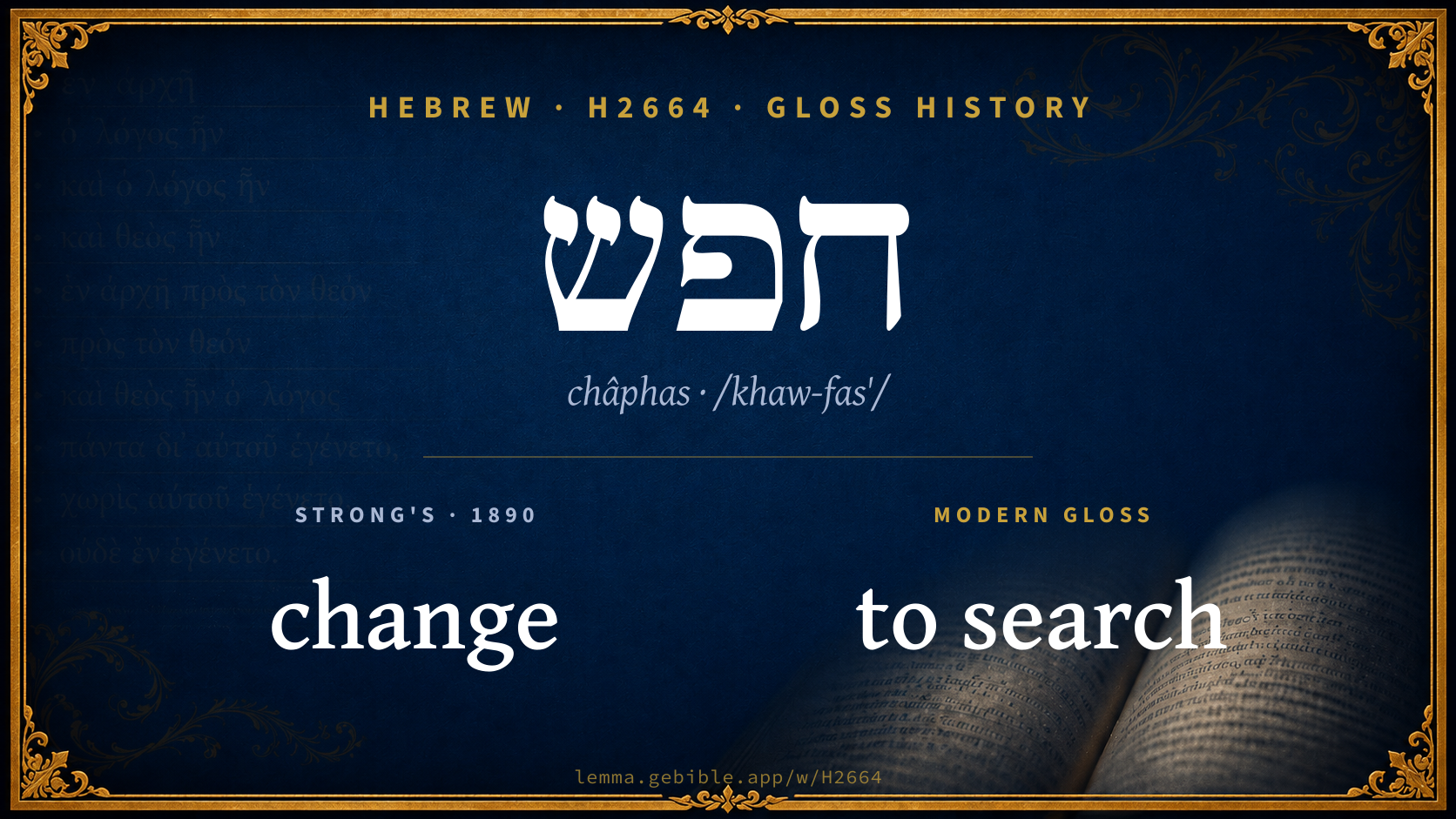
Gloss history
Strong's 1890 vs modern scholarship
About this word
Strong's H2664 catalogs a Hebrew word from the Hebrew Old Testament.
These counts are not copied from any lexicon or concordance. They are computed here, from the morphology-tagged Hebrew Old Testament. What Lemma adds →
- 20
- distinct verses
- The word appears in 20 distinct verses.
- 12 / 39
- OT books
- The word appears in 12 of 39 Old Testament books.
- #1,368
- by frequency
- Top 2500 most frequent Hebrew words (rank 1,368 of 8,640 Hebrew words by occurrence).
View all 20 occurrences in the concordance →
By section of the Old Testament
By traditional corpus
Conventional, traditional groupings — biblical authorship is debated, so this is a traditional corpus grouping, not an authorship claim. Each share is this word’s portion of its verses in that division of the Hebrew canon. Each figure is a share of the word’s 20 distinct verses.
- Prophets (Nevi'im) 9 verses · 45%
- Writings (Ketuvim) 9 verses · 45%
- Torah (Pentateuch) 2 verses · 10%
How translations render this word
Counts come from each version’s own published word-to-Strong’s tagging or interlinear alignment — an approximate guide to how each version renders this word, not a word-level alignment the data otherwise carries. Because each total is that version’s own tagged count, the per-version totals vary from one another and need not match the appearance or distinct-verse counts above. These counts may also differ from a printed concordance because Lemma counts each distinctly tagged rendering and does not collapse phrase taggings into a single head-word total. This is a fixed set of word-tagged versions (KJV, ASV, BSB, ULT) and does not change with the reading translation you choose elsewhere. Each version’s license is shown beside its name below (and on Sources).
- King James Version: Disguised 5×, I will search 3×, I will disguise 2×
- American Standard Version: Disguised 4×, I will search 3×, I will disguise 2×
- Berean Standard Bible: Disguised himself 3×, I will disguise myself 2×
- unfoldingWord Literal Text: And 3×, Disguised himself 3×, He disguised himself 2×
King James Version Public Domain
Renders H2664 across 23 tagged occurrences — most commonly:
Plus 13 renderings that appear only once — usually multi-word phrases or single function words the recovered tagging swept in, not distinct renderings.
American Standard Version Public Domain
Renders H2664 across 24 tagged occurrences — most commonly:
Plus 13 renderings that appear only once — usually multi-word phrases or single function words the recovered tagging swept in, not distinct renderings.
Berean Standard Bible Public Domain
Renders H2664 across 23 tagged occurrences — most commonly:
Plus 18 renderings that appear only once — usually multi-word phrases or single function words the recovered tagging swept in, not distinct renderings.
unfoldingWord Literal Text CC BY-SA 4.0
Renders H2664 across 26 tagged occurrences — most commonly:
Plus 12 renderings that appear only once — usually multi-word phrases or single function words the recovered tagging swept in, not distinct renderings.
12 senses and sub-senses in the full BDB
Hebrew verbs can shift meaning by stem (binyan): Qal is the basic action, Niphal is often passive or reflexive, Piel often intensifies or makes it factitive, and Hiphil is typically causative. The senses below are grouped under the stem BDB assigns to each. This entry also uses Pual (the passive of Piel) and Hithpael (reflexive or reciprocal).
What do BDB’s symbols mean?
BDB uses these scholarly abbreviations:
| Symbol | Meaning |
|---|---|
| 𝔊 | the Septuagint (the ancient Greek translation, LXX) |
| 𝔙 | the Vulgate (the Latin translation) |
| 𝔖 | the Syriac version (the Peshitta) |
| 𝔗 | the Targum (the Aramaic translation) |
| ψ | the Psalms |
| √ | root (the underlying root or stem) |
| ‖ | parallel passage (a synonymous or contrasted parallel) |
| † | the dagger: every passage where the word occurs is cited |
The 12 senses and sub-senses the full Brown-Driver-Briggs lexicon distinguishes for this word, in lexicon order (not ranked by frequency), with BDB’s own verbatim wording and sub-sense lettering. Shown in Hebrew script with BDB’s own scholarly abbreviations. The condensed entry is in the Lexicon Entry tab. See also the Forms in the corpus table below.
Qal
- Impf. 2 ms. sf. תַּחְפְּשֶׂ֫נָּה Pr 2:4; יַחְפְּשׂוּ ψ 64:7; נַחְפְּשָׂה La 3:40; Pt. חֹפֵשׂ Pr 20:27;—search, search out, fig.; e.g. Proverbs 2:4
- 1. search for, obj. בִּינָה etc. Pr 2:4 (‖ בקשׁ). e.g. Proverbs 2:4
- 2. = think out, devise, c. acc. עולות unjust acts ψ 64:7 (cf. also sub Pu.) e.g. Psalms 64:7
- 3. search = test, La 3:40 (obj. דרכינו; ‖ חקר), Pr 20:27. e.g. Lamentations 3:40
Niphal
- Pf. נֶחְפְּשׂוּ Ob6 subj. עֵשָׂו coll.; searched out = exposed and plundered (‖ נִבְעוּ מַצְפּוּנָיו).
Piel
- Pf. וְחִפַּשְׂתִּ֫י 1 S 23:23; וְחִפְּשׂוּ 1 K 20:6; Impf. וַיְחַפֵּשׂ Gn 31:35 + 2 times; אֲחַפֵּשׂ Am 9:3 Zp 1:12; Imv. חַפְּשׂוּ 2 K 10:23;— e.g. 1 Samuel 23:23
- 1. search through, c. acc., a house 1 K 20:6, Jerusalem (metaph.) Zp 1:12; no obj. expr. 2 K 10:23. e.g. 1 Kings 20:6
- 2. search for:
- a. a person c. acc. 1 S 23:23. e.g. 1 Samuel 23:23
- b. a thing, c. acc. Gn 44:12 (J; Joseph searching for his cup); Gn 31:35 (E; no obj. expr., Laban looking for his teraphim); Am 9:3 (י׳ searching for evildoers), ψ 77:7 (soul searching to understand י׳’s dealings with his servants). e.g. Genesis 44:12
Pual
- Impf. יְחֻפַּשׂ Pr 28:12 be searched for = be hidden; Pt. מְחֻפָּשׂ ψ 64:7 in חֵפֶשׂ מ׳ = a searched out search, i.e. a device well thought out (cf. Che; ‖ Qal q.v.); v. also חֵ֫פֶשׂ. e.g. Proverbs 28:12
Hithpael
- Pf. הִתְחַפֵּשׂ 2 Ch 35:22 (but 𝔊 הִתְחַזֵּק, cf. also 𝔙 𝔖 3 Esdr 1:26, so Be Öt); Impf. יִתְחַפֵּשׂ Jb 30:18; וַיִּתְחַפֵּשׂ 1 S 28:8 + 3 times; Inf. abs. הִתְחַפֵּשׂ 1 K 22:30 = 2 Ch 18:29;—disguise oneself (lit. let oneself be searched for) 1 S 28:8 1 K 22:30(×2) = 2 Ch 18:29(×2), 2 Ch 35:22 (but v. supr.), all of disguise by change of garments; 1 K 20:38 באפר i.e. with headgear over eyes; subj. לבושׁ Jb 30:18, i.e. his garment is disguised, no longer looks like the mantle it is. e.g. 2 Chronicles 35:22
Senses from the full Brown-Driver-Briggs lexicon (Brown, Driver, Briggs; Oxford 1906 — public domain), digitized via Sefaria, supplemented by the OpenScriptures HebrewLexicon (CC BY 4.0). Full attribution on Sources.
Word origin
vb. search (𝔗Jer חֲפַס dig, seek; Pal. Syriac dig (Schw); perhaps Assyrian êppêšu, êtpêšu, sensible, LyonSargontexte 65)—
— Brown-Driver-Briggs (Oxford 1906, public domain), digitized via Sefaria, supplemented by the OpenScriptures HebrewLexicon (CC BY 4.0). See Sources.
Origin: a primitive root
Jastrow Dictionary
A second Hebrew/Aramaic lexicon for comparison, covering Aramaic and post-biblical (Talmudic, Targumic, Midrashic) usage that the biblical-Hebrew BDB does not. Matched by lemma rather than by Strong’s number, so a lemma may carry more than one Jastrow headword (shown separately below), and the entries cover usage well beyond the Bible.
חֲפַס
- = h. חָפַשׂ
- 1. to dig. Targ. Y. Ex. XXI, 33 (ed. Amst. יַחְפֵּס). Targ. Job III, 20.—Y. B. Mets. II, 8ᶜ bot. וחספתה, read: וחַפְסוּנָהּ and when they were digging it up.
- 2. (cmp. חֲפִיסָה) to grab. Targ. Y. I. Num. XI, 8 (some ed. חַפְּ׳ Pa.; h. text שָׁטוּ). Targ. Job III, 21. e.g. Numbers 11:8
- same. Ib. XXXIX, 21 מְחַפְּשִׂין ed. Lag. (oth. ed. מחפרין).
חָפַשׂ
- , Pi. חִיפֵּשׂ to dig, search. Pes. II, 3 כל … לחַפֵּשׂ אחריו what the dog cannot reach by digging for it. Sabb. 89ᵃ חִיפַּשְׂתִּי וכ׳ I searched all over the world. Cant. R. to I, 1 אם אתה מחַפֵּשׂ אחר וכ׳ if thou wilt dig after the words of the Law as for secret treasures; a. fr.
חֲפַשׂ
- , Pa. חַפֵּשׂ, v. חֲפַס.
חָפַשׁ
- (b. h.) [to be white, cmp. Arab.ḥafaš decorticare, cmp. חֲפַר II,] to be free (cmp. חוֹר II). V. next w.
- to deliver. Pesik. R. s. 8 (ref. to אֲחַפֵּשׂ, Zeph. I, 12) לא תהא קורא סמי"ך אלא שי"ן אֲחַפֵּשׁ וכ׳ read not the word with Samme but with Shin, ‘I shall deliver &c.’; Yalk. Zeph. 567. e.g. Zephaniah 1:12
- to be set free. Kerith. 11ᵃ (ref. to Lev. XIX, 20) מכלל דהוא ח׳ this implies that he (her betrothed) has been liberated, is a freedman. e.g. Leviticus 19:20
A Dictionary of the Targumim, the Talmud Babli and Yerushalmi, and the Midrashic Literature (Marcus Jastrow; London, Luzac, 1903) — Public Domain. Digitized via Sefaria. Digitized via Sefaria. Full attribution on Sources.
Forms in the corpus
The 20 distinct written forms H2664 takes in the Hebrew Bible, most frequent first — each parse links to that stem’s occurrences in the concordance. Hebrew forms include their vowel points and cantillation, so a single lemma takes many written forms.
Same root — word family
Other BDB entries built from the same root as H2664, grouped by Strong’s listed origin. These share a root / origin per the lexicon — not necessarily a shared meaning. Each links to that word’s own entry.
Derived from this word
Compare all same-root words → They share a root, not necessarily a meaning.
Septuagint verse parallels
This word appears in 18 verses that also exist in the Greek Old Testament (Septuagint), out of the 20 Hebrew verses it occurs in. You can read those verses in Greek by switching the Old Testament edition to the Septuagint.
Read these verses in the Septuagint
- Genesis 31:35
- 1 Samuel 23:23
- 1 Kings 20:6
- 2 Kings 10:23
- 2 Chronicles 18:29
- Job 30:18
- Psalms 64:6
- Proverbs 2:4
- Lamentations 3:40
- Amos 9:3
- Obadiah 1:6
- Zephaniah 1:12
This is a verse-level parallel only — the same verses exist in both the Hebrew and Greek Old Testaments. No word-level Hebrew↔Greek correspondence is claimed: the data carries no such alignment, so no Greek word is shown as this Hebrew word’s translation. Coverage is not total — the Septuagint omits the deuterocanon and renumbers the Psalms, so some Hebrew verses have no direct Greek parallel.