1 Kings 20:38

Hebrew (Westminster Leningrad Codex) 1 Kings 20:38 appears in the Hebrew Old Testament. The text above is from the Westminster Leningrad Codex. Each word links to its Strong’s number, a concise gloss, and parsing drawn from the Open Scriptures Hebrew Bible morphology. Click any word for its full Brown-Driver-Briggs (BDB) entry.
Download image
Cite this verse

1 Kings 20:38 (World English Bible). Public Domain. Lemma interlinear Bible study tool, https://lemma.gebible.app/v/1-kings/20/38.

Show BibTeX & RIS
BibTeX
RIS
English Translation
So the prophet departed, and waited for the king by the way, and disguised himself with his headband over his eyes.
World English Bible · Public Domain
Highlights
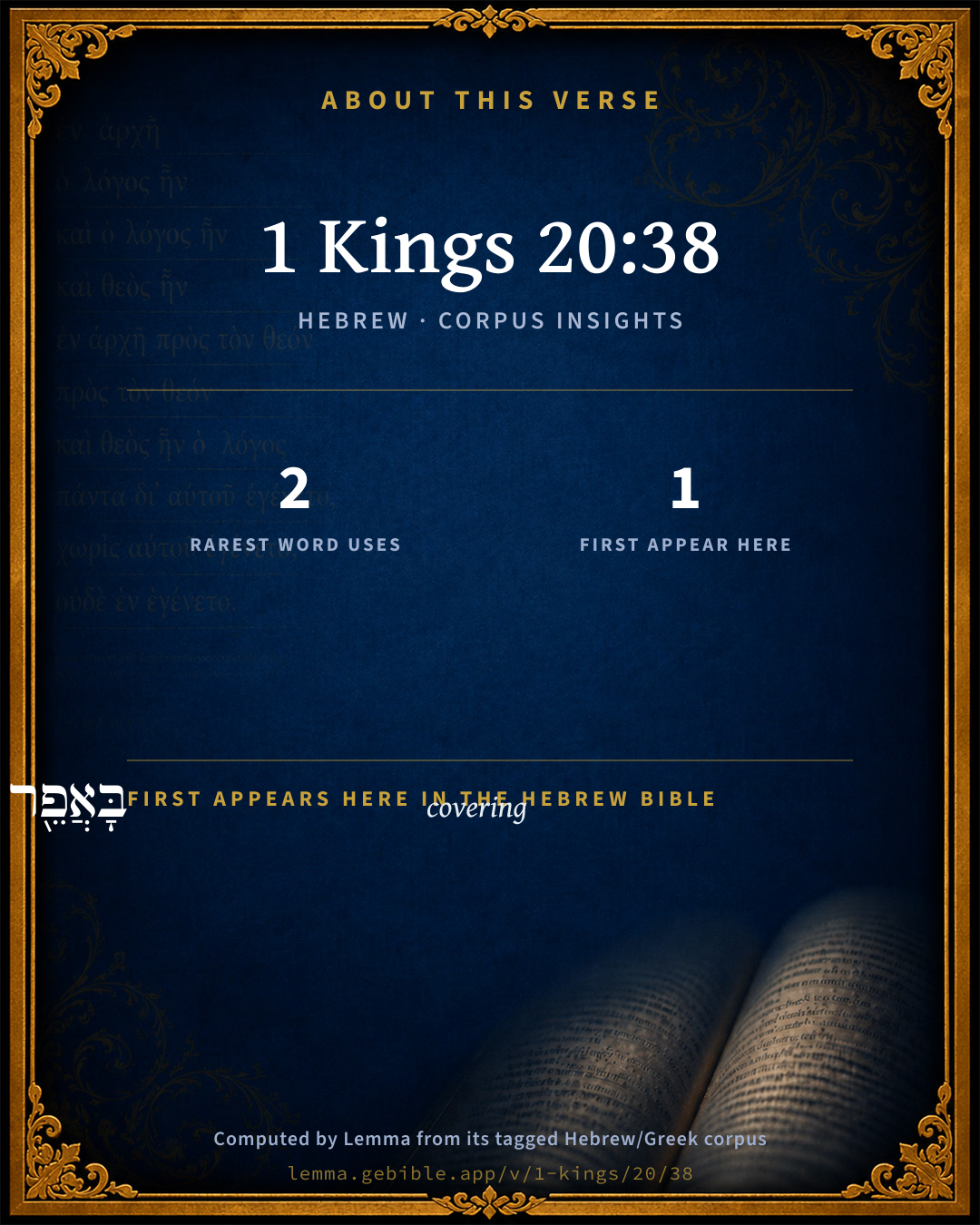
  • 1 first appearance in the Hebrew Bible
Full analysis ↓
Download a study sheet

One document with this verse’s original text, its word-by-word gloss line, the meaning frame, cross-references with their text, attributed commentary, and full source and license credits — printable, and it pastes into notes with its structure intact.

This verse Autodidact and up

Study sheet (.html) Plain text (.txt)

A passage Seminary Student

Up to 50 verses in one chapter. A passage sheet keeps up to 6 commentary sources and 12 cross-references per verse, in the order this page ranks them, and says so on the sheet whenever that leaves anything out. Ask for a single verse and you get the Autodidact verse sheet above.

Everything on this page stays free to read, with no account — the sheet is a download of what is already on screen, not access to it.

Want to remove ads? Support Godless Engineer
Compare translations 3

The same verse in 3 English versions, stacked beneath the original-language interlinear above. Click any original word for its lexicon entry.

Each is an independent rendering of the whole verse — the interlinear is not word-aligned to these translations.

Highlighted words mark where these versions differ — a whole-verse word diff, not a word-by-word alignment.

  • World English Bible Public Domain
    So the prophet departed, and waited for the king by the way, and disguised himself with his headband over his eyes.
  • King James Version Public Domain
    So the prophet departed, and waited for the king by the way, and disguised himself with ashes upon his face.
  • unfoldingWord Literal Text CC BY-SA 4.0
    And the prophet went, and he stood on the road for the king. And he disguised himself with a covering over his eyes.

unfoldingWord Literal Text — © unfoldingWord, licensed CC BY-SA 4.0. Word-aligned USFM3 via Door43 (git.door43.org/unfoldingWord/en_ult).

Versions to compare (up to 4)

3 of 4 selected

Show all 18 translations

Every available English version of this verse, each an independent rendering of the whole verse.

  • World English Bible Public Domain
    So the prophet departed, and waited for the king by the way, and disguised himself with his headband over his eyes.
  • Berean Standard Bible Public Domain
    and the prophet went and waited on the road for the king, disguising himself with a bandage over his eyes.
  • Majority Standard Bible Public Domain
    and the prophet went and waited on the road for the king, disguising himself with a bandage over his eyes.
  • King James Version Public Domain
    So the prophet departed, and waited for the king by the way, and disguised himself with ashes upon his face.
  • American Standard Version (1901) Public Domain
    So the prophet departed, and waited for the king by the way, and disguised himself with his headband over his eyes.
  • Revised Version (1885) Public Domain
    So the prophet departed, and waited for the king by the way, and disguised himself with his headband over his eyes.
  • Geneva Bible (1599) Public Domain
    So the Prophet departed, and wayted for the King by the way, and disguised himselfe with ashes vpon his face.
  • Douay-Rheims (1899) Public Domain
    So the prophet went, and met the king in the way, and disguised himself by sprinkling dust on his face and his eyes.
  • Young's Literal Translation Public Domain
    and the prophet goeth and standeth for the king on the way, and disguiseth himself with ashes on his eyes.
  • Literal Standard Version CC BY-SA 4.0
    and the prophet goes and stands for the king on the way, and disguises himself with ashes on his eyes.
  • Unlocked Literal Bible CC BY-SA 4.0
    Then the prophet left and waited for the king by the road; he had disguised himself with a bandage over his eyes.
  • unfoldingWord Literal Text CC BY-SA 4.0
    And the prophet went, and he stood on the road for the king. And he disguised himself with a covering over his eyes.
  • Darby Bible Public Domain
    And the prophet departed, and waited for the king by the way, and disguised himself with a sash over his eyes.
  • World Messianic Bible Public Domain
    So the prophet departed and waited for the king by the way, and disguised himself with his headband over his eyes.
  • Webster's Bible Public Domain
    So the prophet departed, and waited for the king by the way, and disguised himself with ashes upon his face.
  • Free Bible Version CC BY-SA 4.0
    Then the prophet went and stood beside the road, waiting for the king. He had disguised himself with a bandage over his eyes.
  • Bible in Basic English Public Domain
    So the prophet went away, and pulling his head-band over his eyes to keep his face covered, took his place by the road waiting for the king.
  • JPS Tanakh (1917) Public Domain
    So the prophet departed, and waited for the king by the way, and disguised himself with his headband over his eyes.

Literal Standard Version (2020), Covenant Press — licensed CC BY-SA 4.0. Text via the HelloAO Bible API (eBible.org). Unlocked Literal Bible (unfoldingWord) — licensed CC BY-SA 4.0. Text via the HelloAO Bible API (eBible.org). unfoldingWord Literal Text — © unfoldingWord, licensed CC BY-SA 4.0. Word-aligned USFM3 via Door43 (git.door43.org/unfoldingWord/en_ult). Free Bible Version, Dr. Jonathan Gallagher — licensed CC BY-SA 4.0. Text via the HelloAO Bible API (eBible.org).

Word by word

More ways to search: Search by grammar → Find every occurrence → Compare this word →

Practice this passage: Drill this verse → Learn its vocabulary →

בָּאֲפֵ֖ר
ʼăphêr
H666
“in/at the · covering”
Preposition, Determined + Noun, Common, Masculine, Singular, Absolute
Part of Speech
Preposition + Noun
Type
Common
Gender
Masculine
Number
Singular
State
Absolute
Full BDB Definition

Origin: from the same as H665 (in the sense of covering)

TWOT: 151a

covering, bandage
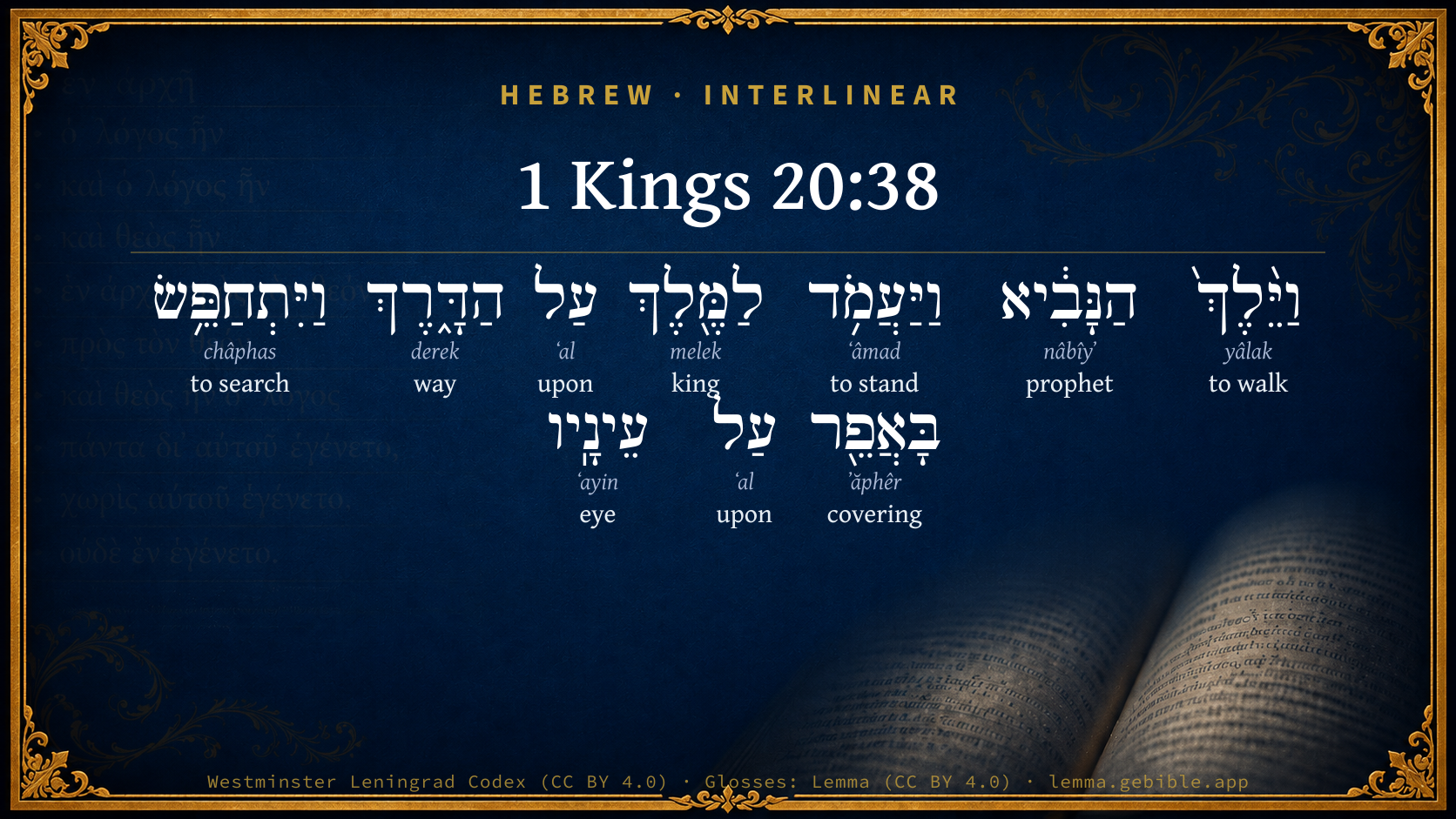
  1. וַיֵּ֨לֶךְ֙ yâlak H3212 “and · to walk” Conjunction + Verb, Qal, Sequential Imperfect, 3rd Person, Masculine, Singular
  2. הַנָּבִ֔יא nâbîyʼ H5030 “the · prophet” Particle, Definite Article + Noun, Common, Masculine, Singular, Absolute
  3. וַיַּעֲמֹ֥ד ʻâmad H5975 “and · to stand” Conjunction + Verb, Qal, Sequential Imperfect, 3rd Person, Masculine, Singular
  4. לַמֶּ֖לֶךְ melek H4428 “to/for the · king” Preposition, Determined + Noun, Common, Masculine, Singular, Absolute
  5. עַל ʻal H5921 “upon” Preposition
  6. הַדָּ֑רֶךְ derek H1870 “the · way” Particle, Definite Article + Noun, Common, Both, Singular, Absolute
  7. וַיִּתְחַפֵּ֥שׂ châphas H2664 “and · to search” Conjunction + Verb, Hithpael, Sequential Imperfect, 3rd Person, Masculine, Singular
  8. עַל ʻal H5921 “upon” Preposition
  9. עֵינָֽיו ʻayin H5869 “eyes · his” Noun, Common, Both, Dual, Construct + Suffix, Personal, 3rd Person, Masculine, Singular

About this verse

These counts appear in no published source. They are computed here, from the morphology-tagged text and Lemma’s own curated glosses. What Lemma adds →

10
words
9
distinct lemmas
Historical
section

Notable vocabulary

The rarest word here is בָּאֲפֵ֖ר covering H666 — appearing just 2 times in the whole Hebrew Bible.

First appearance in Scripture

This word makes its first canonical appearance in the Hebrew Bible here:

  • בָּאֲפֵ֖ר covering H666

Shared distinctive vocabulary

בָּאֲפֵ֖ר covering H666 occurs in 2 verses of the Hebrew Bible. Also found in:

Grammatical profile

  • 3 verbs
  • 5 nouns
  • 2 prepositions

Verb forms

  • וַיֵּ֨לֶךְ֙ Qal · Sequential Imperfect
  • וַיַּעֲמֹ֥ד Qal · Sequential Imperfect
  • וַיִּתְחַפֵּ֥שׂ Hithpael · Sequential Imperfect

Repetition

A word recurs within this verse — often emphatic in Hebrew:

Cross-references

4

Topical passages linked to 1 Kings 20:38 in the Treasury of Scripture Knowledge — connected by theme and wording, ordered by reader-vote popularity; previews shown in the World English Bible.

  • 1 Kings 14:2 Jeroboam said to his wife, Please get up and disguise yourself, that you not be known to be the wife of Jeroboam; and get you to Shiloh: behold, there is Ahijah the prophet, who spoke concerning me that I should be king over this people.
  • 2 Samuel 14:2 Joab sent to Tekoa, and fetched there a wise woman, and said to her, please act like a mourner, and put on mourning clothing, Please, and don't anoint yourself with oil, but be as a woman who has a long time mourned for the dead:
  • 1 Kings 22:30 The king of Israel said to Jehoshaphat, I will disguise myself, and go into the battle; but put you on your robes. The king of Israel disguised himself, and went into the battle.
  • Matthew 6:16 "Moreover when you fast, don't be like the hypocrites, with sad faces. For they disfigure their faces, that they may be seen by men to be fasting. Most assuredly I tell you, they have received their reward.

Cross-references courtesy of OpenBible.info (CC BY 4.0).

Hebrew and Greek witnesses Masoretic Hebrew ↔ Greek Septuagint

The same verse in the two great witnesses to the Old Testament, shown verse-for-verse.

These are two independent witnesses, not word-aligned to each other, and the Septuagint is shown in lemma (dictionary) form.

Hebrew 1 Kings 20:38 Masoretic · Westminster Leningrad Codex

וַיֵּ֨לֶךְ֙ הַנָּבִ֔יא וַיַּעֲמֹ֥ד לַמֶּ֖לֶךְ עַל הַדָּ֑רֶךְ וַיִּתְחַפֵּ֥שׂ בָּאֲפֵ֖ר עַל עֵינָֽיו

So the prophet departed, and waited for the king by the way, and disguised himself with his headband over his eyes.

World English Bible · Public Domain

On this verse, Adam Clarke's Commentary discusses the Septuagint’s reading. Read the note in Commentary ↓

Hebrew: Westminster Leningrad Codex (CC BY 4.0). Greek: Septuagint (public domain); English from a public-domain English Septuagint. How the Septuagint differs from the Hebrew →

Targum (Aramaic paraphrase)

1

The Targum is the ancient Jewish Aramaic paraphrase of the Hebrew Scriptures — an interpretive translation, not the Hebrew text itself. Onkelos (literal) and Pseudo-Jonathan (expansive) render the Torah, and Jonathan the Prophets. Coverage is partial: where no permissively-licensed English translation exists for a verse, only the Aramaic is shown. This is verse-level text, not a word-by-word alignment to the Hebrew.

  1. Targum Jonathan Prophets (Joshua–Malachi)
    וַאֲזַל נְבִיָא וְקָם לְמַלְכָּא עַל אוֹרְחָא וּכְרִיךְ בְּמַעֲפָרָא עֵינוֹהִי:

    (no public-domain English translation for this verse)

    Targum Jonathan — Aramaic: “Mikraot Gedolot” (public domain). English: “Sefaria Community Translation” (CC0 1.0 (public-domain dedication)); “London "Chaldee Paraphrase," 1871” (public domain). Text via Sefaria.

Commentary

Notes on 1 Kings 20:38 from classic Christian and Jewish commentators (each source and its license shown beneath its notes). The classic Christian expositions comment on the surrounding passage and are grouped to its opening verse, so a note may address several verses; the Jewish commentaries on the Tanakh (Rashi and others) are per-verse, so they appear only where the commentator wrote on this verse.

Lemma curates 59 commentaries, every one of them public domain or Creative Commons licensed, each selected and text-cleaned for this edition rather than reprinted as found. About our sources →

Trapp's Complete Commentary

John Trapp

1Ki 20:38 So the prophet departed, and waited for the king by the way, and disguised himself with ashes upon his face.

Ver. 38. And disguised himself.] He slurried his face with ashes cast upon blood, that he might not appear to be a prophet; for then guilty Ahab would not have heard him, especially being now puffed up by his great victory.

John Trapp, A Commentary or Exposition upon All the Books of the Old and New Testament (1647–1656) — public domain. Text from a community e-Sword module.

Joseph Benson's Commentary

1Ki 20:38. And disguised himself with ashes upon his face — As a man in a very sorrowful condition. Houbigant reads it, He had his eyes covered with a bandage, supposing that the genuine, reading of the text is, not אפר, apher, but אפד, aphed, which signifies a bandage; whence comes the Hebrew word ephod; something bound round. Several of the versions render it, with a veil: and thus the Hebrew doctors understand it. It is probable, it was a cloth or bandage of some kind, wherewith he bound up his wound, which probably was in his face: for it was made in a conspicuous place, that it might be visible to Ahab and others.

Joseph Benson's Commentary on the Old and New Testaments (1811–1818) — public domain. Text from a community e-Sword module.

Adam Clarke's Commentary

Verse 38. Disguised himself with ashes upon his face.] It does not immediately appear how putting ashes upon his face could disguise him. Instead of אפר apher, dust, Houbigant conjectures that it should be אפד aphad, a fillet or bandage. It is only the corner of the last letter which makes the difference; for the ד daleth and ר resh are nearly the same, only the shoulder of the former is square, the latter round. That bandage, not dust, was the original reading, seems pretty evident from its remains in two of the oldest versions, the Septuagint and the Chaldee; the former has Και κατεδησατο εν τελαμωνι τους οφθαλμους αυτου, "And he bound his eyes with a fillet." The latter has וכריך במעפריאעינוהי ukerich bemaaphira einohi; "And he covered his eyes with a cloth." The MSS. of Kennicott and De Rossi contain no various reading here; but bandage is undoubtedly the true one. However, in the way of mortification, both the Jews and Hindoos put ashes upon their heads and faces, and make themselves sufficiently disgusting.

Adam Clarke's Commentary on the Bible (1810–1826) — public domain. Text from a community e-Sword/MySword module.

Ellicott's Commentary for English Readers

(38) Ashes upon his face.—It should be a “bandage over his head,” to cover his face, and to accord with the appearance of a wounded soldier. Unless the wound had some symbolic significance in application to Ahab or Israel, it is difficult to see what purpose it could serve.

A Bible Commentary for English Readers, edited by Charles John Ellicott (1878–1897) — public domain. Text from a community e-Sword module.

The Cambridge Bible for Schools and Colleges

gen. ed. J. J. S. Perowne

38. waited for the king by the way] He wished to intercept Ahab just as he was coming from his interview with Ben-hadad. A parallel this to the lion meeting the disobedient prophet as soon as he had departed from his fellow.

and disguised himself] With this action may be compared the assumed mourning garb of the widow of Tekoah (2Sa_14:2).

with ashes upon his face] R.V. with his head band over his eyes. The A. V. is the rendering of the Vulg. and Syriac, and is the result of taking אֲפֵר in the text as the same אֵפֶר which means ‘dust’, ‘ashes’. The LXX. has the true sense in τελαμών = a bandage, while the Chaldee translates it as ‘a veil’. When the proper meaning is given to the first word, the common rendering ‘eyes’ for the second can be brought in.

The Cambridge Bible for Schools and Colleges (gen. ed. J. J. S. Perowne; Cambridge University Press, 1878–1918) — public domain. Text from a community e-Sword module.

John Gill's Exposition

So the prophet departed, and waited for the king by the way,.... As he went from Aphek, the place where the battle had been fought, to Samaria, his royal seat:

and disguised himself with ashes upon his face; the Targum is, he covered his eyes with a vail, or piece of cloth, which he wrapped about his head, as men do when they have got a wound or bruise in such a part, which seems very probable; for had he besmeared his face with ashes, clay, or dust, or any such thing, he could not so easily have got it off, as in Kg1 20:41.

John Gill's Exposition of the Whole Bible (1746–1763) — public domain (CC PDM 1.0). Text via the HelloAO Bible API.

Albert Barnes' Notes on the Bible

Ashes - Rather, “a bandage” (and in 1Ki 20:41). The object of the wound and bandage was double. Partly, it was to prevent Ahab from recognizing the prophet’s face; partly, to induce him to believe that the man had really been engaged in the recent war.

Albert Barnes' Notes on the Bible (1834–1885) — public domain. Text from a community e-Sword/MySword module.

Haydock's Catholic Bible Commentary

Dust. Chaldean and Septuagint, "he tied a veil," &c. Apher has both meanings.

George Leo Haydock (1774–1849), Haydock's Catholic Family Bible and Commentary, 1859 edition — public domain. Excludes Psalms (Douay-Rheims chapter numbering differs from Protestant) and Deuterocanonical books (Catholic canon only).

Matthew Poole's English Annotations

That he might sooner gain access to the king, and audience from him. See Poole "1Ki 20:35".

With ashes; whereby he changed the colour of it. Or, with a veil, or cloth, or band, (as the Hebrew doctors understand the word,) whereby he might seem to have bound up his wound, which probably was in his face; for it was to be made in a very conspicuous place, that it might be visible to Ahab and others.

Matthew Poole's English Annotations on the Holy Bible (1683–1685) — public domain. Text from a community e-Sword/MySword module.

Whedon's Commentary on the Bible

Daniel D. Whedon

38. With ashes upon his face — Rather, with a bandage over his eyes. אפר, a bandage, a fillet or head band. Septuagint, τελαμων. He disguised himself with this head-covering that the king might not recognize him as one of the prophets, (compare 1Ki_20:41,) and he had procured himself smitten and wounded that his parable (1Ki_20:39) might have the greater semblance of reality.

Daniel D. Whedon (gen. ed.), Commentary on the Old and New Testaments (1874–1909) — public domain. Text from a community e-Sword module.

The Pulpit Commentary

So the prophet departed, and waited for the king by the way, and disguised himself with ashes upon his face. Rather, a bandage upon his eyes. rpea there can be no doubt, denotes some sort of covering (LXX telamwn), and is probably the equivalent of rpe Ashes cannot be put on the eyes, and even on the head would be but a poor disguise. This bandage was at the same time in keeping with the prophet"s role as a wounded man, and an effective means of concealment. It would almost seem as if this prophet was personally known to the king.

The Pulpit Commentary (1880–1919), ed. H.D.M. Spence-Jones & Joseph S. Exell — public domain. Text from a community e-Sword module.

John Wesley's Explanatory Notes

With ashes - Or, with a cloath, or band; (as the Hebrew doctors understand the word) whereby he bound up his wound, which probably was in his face; for it was to be made in a conspicuous place, that it might be visible to Ahab and others.

John Wesley, Explanatory Notes Upon the Whole Bible (1754–1765) — public domain. Text via the GEBible commentary corpus.

Keil & Delitzsch

C. F. Keil & F. Delitzsch

With these wounds he placed himself in the king's path, and disguised himself (יתחפּשׂ as in Sa1 28:8) by a bandage over his eyes. אפר does not mean ashes (Syr., Vulg., Luth., etc.), but corresponds to the Chaldee מעפרא, head-band, τελαμών (lxx).

Keil & Delitzsch — Biblical Commentary on the Old Testament (1861–1891) — public domain (CC PDM 1.0). Text via the HelloAO Bible API. (Old Testament only.)

Rashi

Rabbi Shlomo Yitzchaki (Rashi)

And disguised himself with a kerchief. He changed his hooded cloak so that they would not recognize him. Any change of clothes is an expression of disguise.

With a kerchief. [Targum] Yonoson rendered this במעפרא, “a hooded cloak.”

Rashi on the Tanakh — English translations: “The Judaica Press complete Tanach with Rashi, translated by A. J. Rosenberg” (CC BY 4.0); “Pentateuch with Rashi's commentary by M. Rosenbaum and A.M. Silbermann, 1929-1934” (public domain); “The Metsudah Tanach series, Lakewood, N.J” (CC BY 4.0); and “The Book of Joshua, Metsudah Publications, 1997” (CC BY 4.0). Text via Sefaria.

Lesson kit

Teaching starters — assembled from the data on this page, not authored interpretation. Every prompt links to the verse data it draws on. Edit before teaching.

1 Kings, in the Historical, opens this verse with 10 words (9 distinct Hebrew lemmas). Its most distinctive word is ʼăphêr (“covering”). A historical commentator’s framing appears above. Read the whole chapter for the surrounding context.

Discussion questions

  1. How does “covering” (ʼăphêr) shape what this verse is saying?
  2. The word “covering” first appears here in Scripture. What is being introduced at this debut?
  3. 1 Kings 20:41 shares the word «covering» with this verse. How do the two illuminate each other?
  4. “upon” occurs 2× in this one verse. What is the effect of the repetition?
  5. These translations render this verse differently; the difference is in the English rendering, not the original. What questions does that raise?
  6. The verb «וַיֵּ֨לֶךְ֙» is Qal Sequential Imperfect. How does its form color the action?
  7. Reading how Trapp's Complete Commentary and Joseph Benson's Commentary read this verse, where do the two commentators agree and where do they part?

Things to notice

  • 1 word makes its first canonical appearance in Scripture here.
  • These translations choose different wording for 13 words in this verse.
  • “upon” occurs 2× in this single verse.
  • 9 distinct Hebrew lemmas span 10 words in this verse.

Reading settings

Reading text

Shown beneath each verse's original-language words.

Old Testament
Old Testament edition

Read the OT as the Masoretic Hebrew (MT) or the Greek Septuagint (LXX).

English shown for the Greek Septuagint (in the Hebrew ↔ Greek comparison).

Comparing translations? Open the Compare panel on any verse page to stack up to four side by side.