
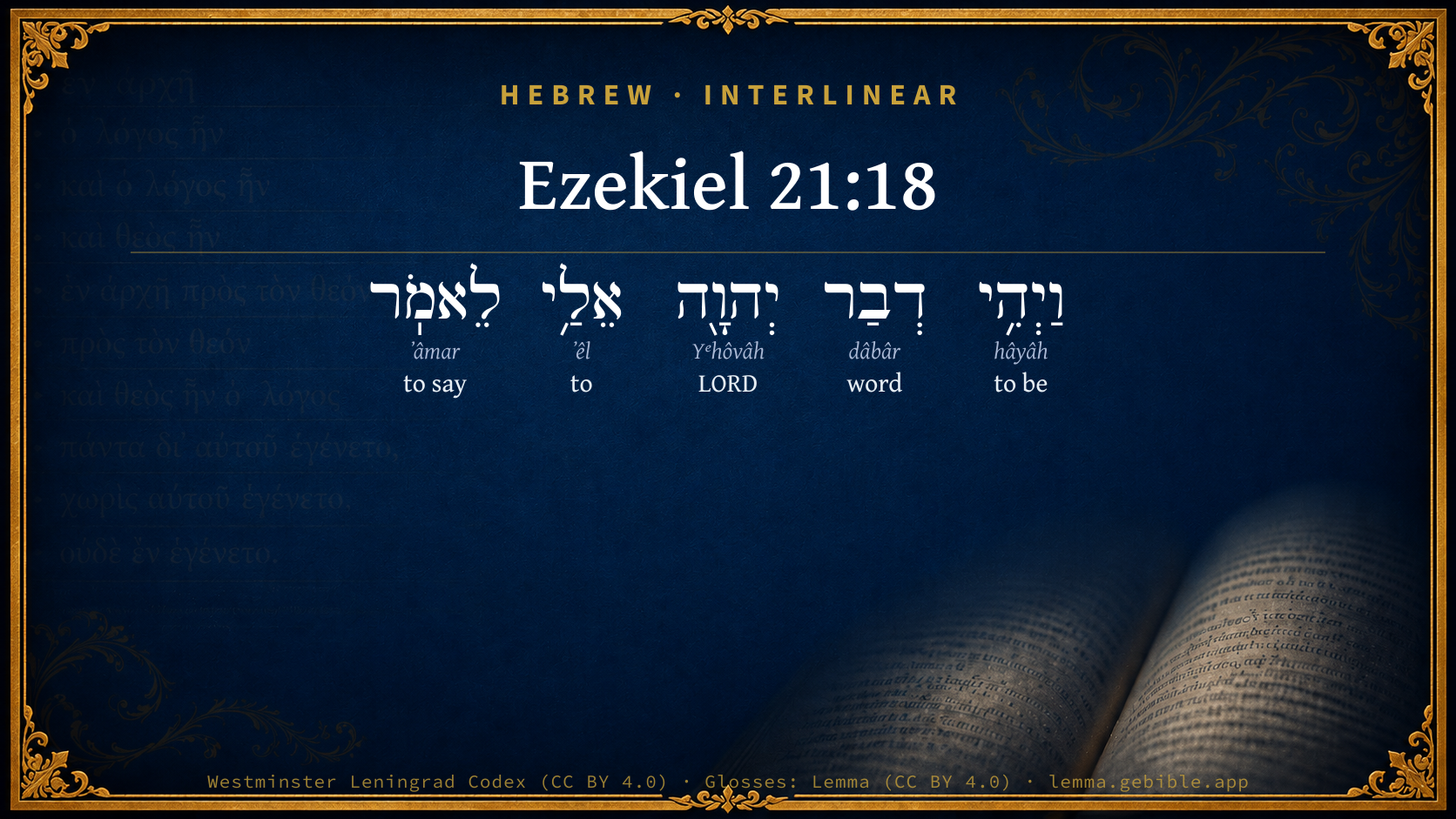
Ezekiel 21:18

Hebrew (Westminster Leningrad Codex) Ezekiel 21:18 appears in the Hebrew Old Testament. The text above is from the Westminster Leningrad Codex. Each word links to its Strong’s number, a concise gloss, and parsing drawn from the Open Scriptures Hebrew Bible morphology. Click any word for its full Brown-Driver-Briggs (BDB) entry.
Download image
Cite this verse

Ezekiel 21:18 (World English Bible). Public Domain. Lemma interlinear Bible study tool, https://lemma.gebible.app/v/ezekiel/21/18.

Show BibTeX & RIS
BibTeX
RIS
English Translation
The word of Yahweh came to me again, saying,
World English Bible · Public Domain
Download a study sheet

One document with this verse’s original text, its word-by-word gloss line, the meaning frame, cross-references with their text, attributed commentary, and full source and license credits — printable, and it pastes into notes with its structure intact.

This verse Autodidact and up

Study sheet (.html) Plain text (.txt)

A passage Seminary Student

Up to 50 verses in one chapter. A passage sheet keeps up to 6 commentary sources and 12 cross-references per verse, in the order this page ranks them, and says so on the sheet whenever that leaves anything out. Ask for a single verse and you get the Autodidact verse sheet above.

Everything on this page stays free to read, with no account — the sheet is a download of what is already on screen, not access to it.

Want to remove ads? Support Godless Engineer
Compare translations 3

The same verse in 3 English versions, stacked beneath the original-language interlinear above. Click any original word for its lexicon entry.

Each is an independent rendering of the whole verse — the interlinear is not word-aligned to these translations.

Highlighted words mark where these versions differ — a whole-verse word diff, not a word-by-word alignment.

  • World English Bible Public Domain
    The word of Yahweh came to me again, saying,
  • King James Version Public Domain
    The word of the LORD came unto me again, saying,
  • unfoldingWord Literal Text CC BY-SA 4.0
    The word of Yahweh came to me again, saying,

unfoldingWord Literal Text — © unfoldingWord, licensed CC BY-SA 4.0. Word-aligned USFM3 via Door43 (git.door43.org/unfoldingWord/en_ult).

Versions to compare (up to 4)

3 of 4 selected

Show all 18 translations

Every available English version of this verse, each an independent rendering of the whole verse.

  • World English Bible Public Domain
    The word of Yahweh came to me again, saying,
  • Berean Standard Bible Public Domain
    Then the word of the LORD came to me, saying,
  • Majority Standard Bible Public Domain
    Then the word of the LORD came to me, saying,
  • King James Version Public Domain
    The word of the LORD came unto me again, saying,
  • American Standard Version (1901) Public Domain
    The word of Jehovah came unto me again, saying,
  • Revised Version (1885) Public Domain
    The word of the LORD came unto me again, saying,
  • Geneva Bible (1599) Public Domain
    The worde of the Lord came vnto mee againe, saying,
  • Douay-Rheims (1899) Public Domain
    And the word of the Lord came to me, saying:
  • Young's Literal Translation Public Domain
    And there is a word of Jehovah unto me, saying,
  • Literal Standard Version CC BY-SA 4.0
    And there is a word of YHWH to me, saying,
  • Unlocked Literal Bible CC BY-SA 4.0
    The word of Yahweh came to me again, saying,
  • unfoldingWord Literal Text CC BY-SA 4.0
    The word of Yahweh came to me again, saying,
  • Darby Bible Public Domain
    And the word of Jehovah came unto me, saying,
  • World Messianic Bible Public Domain
    The LORD’s word came to me again, saying,
  • Webster's Bible Public Domain
    The word of the LORD came to me again, saying,
  • Free Bible Version CC BY-SA 4.0
    Another message from the Lord came to me, saying,
  • Bible in Basic English Public Domain
    And the word of the Lord came to me again, saying,
  • JPS Tanakh (1917) Public Domain
    (21-23) And the word of the LORD came unto me, saying:

Literal Standard Version (2020), Covenant Press — licensed CC BY-SA 4.0. Text via the HelloAO Bible API (eBible.org). Unlocked Literal Bible (unfoldingWord) — licensed CC BY-SA 4.0. Text via the HelloAO Bible API (eBible.org). unfoldingWord Literal Text — © unfoldingWord, licensed CC BY-SA 4.0. Word-aligned USFM3 via Door43 (git.door43.org/unfoldingWord/en_ult). Free Bible Version, Dr. Jonathan Gallagher — licensed CC BY-SA 4.0. Text via the HelloAO Bible API (eBible.org).

Word by word

More ways to search: Search by grammar → Find every occurrence → Compare this word →

Practice this passage: Drill this verse → Learn its vocabulary →

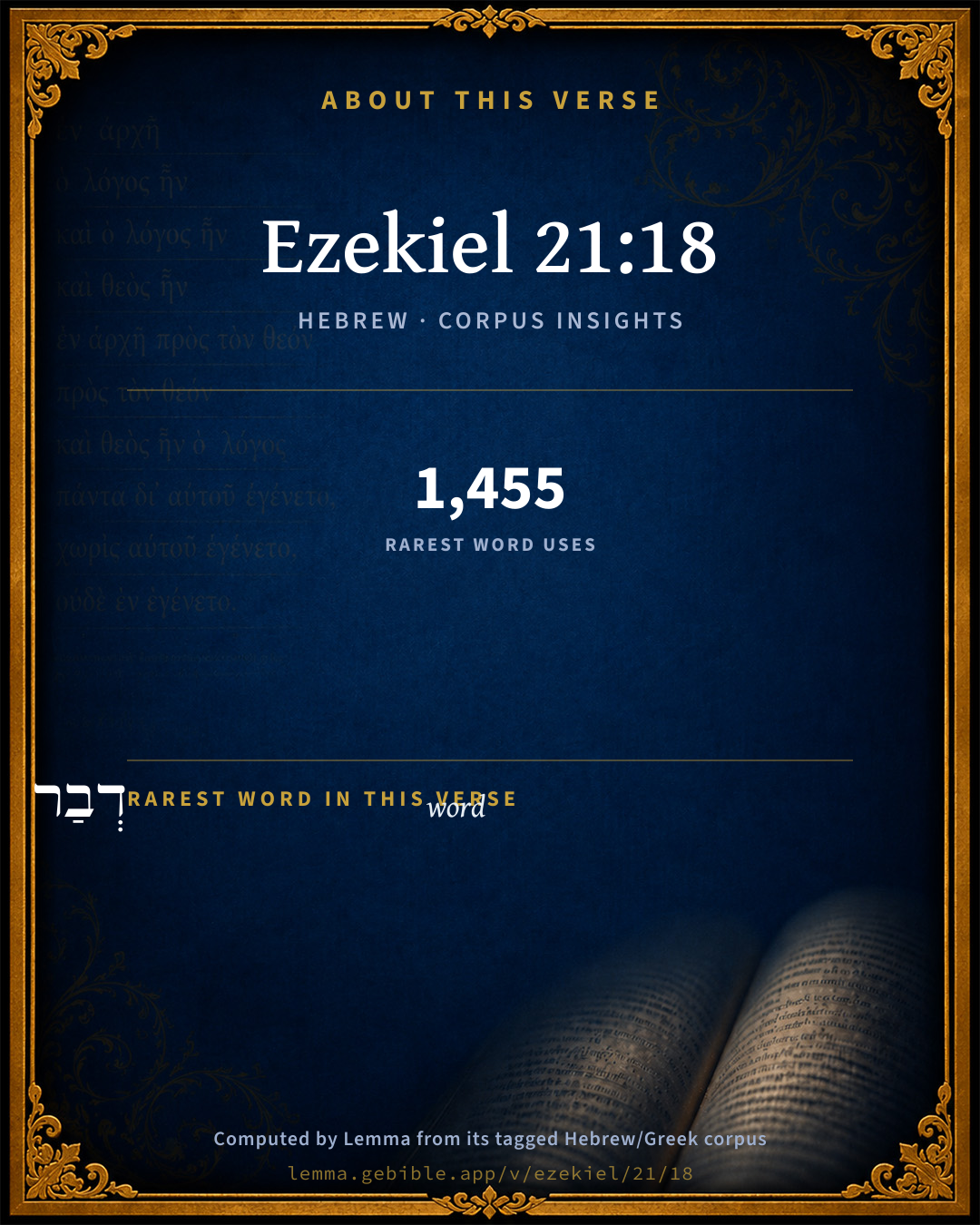
About this verse

These counts appear in no published source. They are computed here, from the morphology-tagged text and Lemma’s own curated glosses. What Lemma adds →

5
words
5
distinct lemmas
Prophets
section

Grammatical profile

  • 2 verbs
  • 2 nouns
  • 1 preposition

Verb forms

  • וַיְהִ֥י Qal · Sequential Imperfect
  • לֵאמֹֽר Qal · Infinitive Construct

Hebrew & Septuagint length

In English translation the verse runs 9 words from the Hebrew and 10 from the Septuagint (LXX English) — closely comparable.

A rough comparison of the two English renderings, which tokenize alike — not a word-level alignment.

Word counts can differ between the Hebrew and the Greek without any difference in meaning — e.g. the Hebrew direct-object marker אֵת has no separate Greek word, and Greek often adds the article ὁ.

Hebrew and Greek witnesses Masoretic Hebrew ↔ Greek Septuagint

The same verse in the two great witnesses to the Old Testament, shown verse-for-verse.

These are two independent witnesses, not word-aligned to each other, and the Septuagint is shown in lemma (dictionary) form.

Hebrew Ezekiel 21:18 Masoretic · Westminster Leningrad Codex

וַיְהִ֥י דְבַר יְהוָ֖ה אֵלַ֥י לֵאמֹֽר

The word of Yahweh came to me again, saying,

World English Bible · Public Domain

Greek LXX Ezekiel 21:18 Septuagint · lemma form

ὅτι δικαιόω καί τίς εἰ καί φυλή ἀποὠθέω οὐ εἰμί λέγω κύριος κύριος

And the word of the Lord came to me, saying,

LXX2012 (modern English Septuagint) · Public Domain

On this verse, Keil & Delitzsch discusses the Septuagint’s reading. Read the note in Commentary ↓

Hebrew: Westminster Leningrad Codex (CC BY 4.0). Greek: Septuagint (public domain); English from LXX2012 (modern English Septuagint) (Public Domain). How the Septuagint differs from the Hebrew →

Targum (Aramaic paraphrase)

1

The Targum is the ancient Jewish Aramaic paraphrase of the Hebrew Scriptures — an interpretive translation, not the Hebrew text itself. Onkelos (literal) and Pseudo-Jonathan (expansive) render the Torah, and Jonathan the Prophets. Coverage is partial: where no permissively-licensed English translation exists for a verse, only the Aramaic is shown. This is verse-level text, not a word-by-word alignment to the Hebrew.

  1. Targum Jonathan Prophets (Joshua–Malachi)
    אֲרֵי אִתְנַבִּיאוּ עֲלֵיהוֹן נְבִיָא וְלָא תָבוּ וּמָה יְהֵי בְסוֹפֵיהוֹן אֱמַר וְאַף שִׁבְטָא דְבֵית יְהוּדָה וּבִנְיָמִין מִגְלָא יַגְלוּן וּבְעוֹבְדֵיהוֹן בִּישַׁיָא לָא יִתְקַיְמוּן אֲמַר יְיָ אֱלֹהִים:

    (no public-domain English translation for this verse)

    Targum Jonathan — Aramaic: “Mikraot Gedolot” (public domain). English: “Sefaria Community Translation” (CC0 1.0 (public-domain dedication)); “London "Chaldee Paraphrase," 1871” (public domain). Text via Sefaria.

Commentary

Notes on Ezekiel 21:18 from classic Christian and Jewish commentators (each source and its license shown beneath its notes). The classic Christian expositions comment on the surrounding passage and are grouped to its opening verse, so a note may address several verses; the Jewish commentaries on the Tanakh (Rashi and others) are per-verse, so they appear only where the commentator wrote on this verse.

Lemma curates 59 commentaries, every one of them public domain or Creative Commons licensed, each selected and text-cleaned for this edition rather than reprinted as found. About our sources →

Trapp's Complete Commentary

John Trapp

Eze 21:18 The word of the LORD came unto me again, saying,

Ver. 18. The word of the Lord.] See on Eze 18:1.

John Trapp, A Commentary or Exposition upon All the Books of the Old and New Testament (1647–1656) — public domain. Text from a community e-Sword module.

The Preacher's Complete Homiletical Commentary

Joseph S. Exell (gen. ed.)

EXEGETICAL NOTES.—(Eze_21:18-22). The sword of the king of Babylon will smite Jerusalem, and then the Ammonites.

Eze_21:19. “Appoint thee two ways, that the sword of the king of Babylon may come.” The force of this word, “appoint,” is to draw a symbolic sketch, to give an ocular demonstration. Ezekiel is to draw on a table or tablet a sketch of the siege of Jerusalem. The Hebrew word rendered “choose” in the latter part of the verse has the primary meaning of to cut, and points to the cutting or engraving of a representation. “Both twain shall come forth out of one land.” Or, the land of one, i.e., the land of the Babylonish king, from which both ways shall proceed. “Choose thou a place, choose it at the head of the way to the city.” “The ‘one land’ whence the two ways proceeded was that of Babylon, and the ways ran in a westerly direction; the more northerly by Riblah in Syria; and the more southerly by Tadmor, or Palmyra, in the desert. The former was that usually taken from Babylon to Jerusalem; the latter from the same city to Rabbah on the east of the Jordan. The prophet is directed to choose a place at the head of the way, or as it is literally, to cut a hand (Heb. yod, a hand or a sign), a sign pointing to the direction in which the Chaldean army was to proceed. This he was to place at the head or commencement of the way, where the two roads separated, each taking its own course; while we are necessarily to understand its being made to point towards that which the King of Babylon was to select, as we are taught in Eze_21:21. Our authorised translators have adopted the secondary signification of the word to cut, by rendering it choose. That the hand is not supposed to have been formed by sculpture, would appear from the circumstance that, in case it had been so, a different Hebrew verb would have been employed. It may have been made of wood, just like our finger-posts, with the representation of a city cut in it. The word city is purposely indefinite, the Article being left to be supplied by the consciences of those whom the prophet addressed.”—Henderson.)

Eze_21:20. “That the sword may come to Rabbah of the Ammonites.” “It may at first sight appear inappropriate that Rabbah, the metropolis of the country of the Ammonites, should be mentioned before Jerusalem, the guilty city against which the prophet was especially commissioned to denounce the Divine judgments; but, considering to what an extent the Jews had adopted the idols of the Ammonites, there was a singular propriety in first taking up the heathen city, to intimate that as the Jews had participated in its crimes so they might expect to share in its punishment. Rabbah of the children of Ammon, so called to distinguish it from a city of the same name in the tribe of Judah. It was built on the banks of the river Moret-Amman, which empties itself into the Jabbok.” (Henderson.) “Judah in Jerusalem the defenced.” The royal house of Judah was the special object of Nebuchadnezzar’s indignation. “The defenced”; same word as in Deu_28:52, “thy high and fenced walls, wherein thou trustedst.” It was Zedekiah’s trust in the strong fortifications of Jerusalem that led him to break faith with his sovereign. “Instead of simply expressing the name of Jerusalem, the other metropolis, that of the inhabitants is prefixed, to mark them as the guilty objects of the Divine indignation. The reason why Jerusalem is here said to be defenced would seem to be to intimate the vain confidence which the Jews reposed in their fortifications.” (Henderson.)

Eze_21:21. “The King of Babylon stood at the parting of the way, at the head of the two ways, to use divination; he made his arrows bright, he consulted with images, he looked in the liver.” “Nebuchadnezzar is supposed to have marched his army to a certain point to the west of Babylon, where the road branched off into the two referred to. The ‘parting’ (Heb. the mother of the way), so-called, not as generally supposed, because there the road divided, for that is immediately afterwards described as the head of the two ways, but because it was the principal road. Here the monarch is represented as having been at a loss to determine which of the routes he should take; and, in order to decide, as having recourse to divination. Of this as practised by the ancients there were different kinds, some of which are here mentioned. ‘Made his arrows bright;’ Heb. he shook the arrows—i.e., the helmet, quiver, or whatever else they were put into. It is most probable that he caused the name Jerusalem to be inscribed on one arrow, and Rabbah on another, and mixing them with others, determined to march against the city whose name was first drawn out. This mode of divining by arrows was practised by the Arabs till the time of Mohammed, who strictly prohibited it in the Koran. Another species of divination to which the King of Babylon had recourse, was that of looking into the liver or the entrails of a newly-killed sacrifice, and judging that any undertaking would be prosperous or otherwise according as they were found in a healthy or unhealthy state. This art is mentioned by Diodorus as practised among the Chaldeans. Not satisfied with the use of these two species of divination, Nebuchadnezzar consulted the Teraphim, which appear to have been penates or family gods, from whom it was thought possible to obtain information relative to future events (Gen_31:19; Gen_31:34; Jdg_17:5; Jdg_18:14).”—(Henderson.)

Eze_21:22. “At his right hand was the divination for Jerusalem.” The king with his right hand draws out the arrow on which was marked the name Jerusalem. The omen decides for him, and he is represented as holding up the arrow to encourage his army in their march against Jerusalem.“To open the mouth in the slaughter.” “This expression cannot well be taken in its usual signification of murder, but must be understood, as Gesenius explains, as an outbreak of the voice; both terms thus energetically expressing the horrible war-shout of the Chaldean soldiers when commencing the attack.”—(Henderson.) “The slaughter-cry of the besiegers is called slaughter, because the slaughter is virtually contained in it.”—(Hengstenberg).

The Preacher's Complete Homiletical Commentary (gen. ed. Joseph S. Exell; Funk & Wagnalls, c. 1892) — public domain (pre-1929). A full-Bible homiletical/sermon-outline anthology covering 65 of 66 books (2 John is absent from the source module). Text from a community e-Sword module.

Keil & Delitzsch

C. F. Keil & F. Delitzsch

The sword of the king of Babylon will smite Jerusalem, and then the Ammonites also. - Eze 21:18. And the word of Jehovah came to me, saying, Eze 21:19. And thou, son of man, make to thyself two ways, that the sword of the king of Babylon may come by them; out of one land shall they both come forth, and draw a hand, at the cross road of the city do thou draw it. Eze 21:20. Make a way that the sword may come to Rabbah of the sons of Ammon, and to Judah into fortified Jerusalem. Eze 21:21. For the king of Babylon is stopping at the cross road, at the parting of the two ways, to practise divination. He is shaking the arrows, inquiring of the teraphim, looking at the liver. Eze 21:22. The divination falls to his right: Jerusalem, to set battering-rams, to open the mouth with a death-cry, to lift up the voice with a war-cry, to set battering-rams at the gates, to heap up a rampart, to build siege towers. - After the picture of the terrible devastation which the sword of the Lord will produce, the last word of God in this prophecy answers the questions, in whose hand Jehovah will place His sword, and whom it will smite. The slayer into whose hand the sharpened sword is given (Eze 21:11) is the king of Babylon, and it will smite not only Judah, but the Ammonites also. Jerusalem and Judah will be the first to fall, and then the arch-enemy of the covenant nation, namely Ammon, will succumb to the strokes of the sword of Jehovah, in order that the embittered enemies of the Lord and His people may learn that the fall of Jerusalem is not, as they fancy, a proof of the impotence, but rather of the omnipotence, of its God. In this way does our prophecy expand into a prediction of the judgment which will fall upon the whole of the world in hostility to God. For it is only as the arch-enemies of the kingdom of God that the Ammonites come into consideration here. The parallel between Israel and the sons of Ammon is carried out in such a way as to give constant prominence to the distinction between them. Jerusalem will fall, the ancient theocracy will be destroyed till he shall come who will restore the right (Eze 21:26 and Eze 21:27). Ammon, on the other hand, will perish, and not a trace be left (Eze 21:31, Eze 21:32).

This prediction is exhibited to the eye by means of a sign. The prophet is to make two ways, i.e., to prepare a sketch representing a road leading from a country, viz., Babylon, and dividing at a certain spot into two roads, one of which leads to Rabbath-Ammon, the capital of the kingdom of the Ammonites, the other to Judah, into Jerusalem. He is to draw the ways for the coming (לבוא) of the sword of the king of Babylon. At the fork of the road he is to engrave a hand, יד, i.e., an index. בּרא signifies in the Piel to cut away (Jos 17:15, Jos 17:18), to dig or hew (Eze 23:47), here to engrave written characters in hard material. The selection of this word shows that Ezekiel was to sketch the ways upon some hard material, probably a brick or tile (cf. Eze 4:1). יד does not mean locus spatium, but a hand, i.e., an index. ראשׁ , the beginning of the road, i.e., the fork of the road (Eze 16:25), is explained in Eze 21:21, where it is called אם, mother of the road, inasmuch as the roads start from the point of separation, and ראשׁ שׁני הדּרכים, beginning of the two roads. דּרך עיר, the road to a city. For Rabbath-Ammon, which is preserved in the ruins of Ammn, on the Upper Jabbok (Nahr Ammn), see the comm. on Deu 3:11. The road to Judah is still more precisely defined by בּירוּשׁלים בּצוּרה, into fortified Jerusalem, because the conquest of Jerusalem was the purpose of Nebuchadnezzar's expedition. The omission of the article before בּצוּרה may be explained from the nature of the participle, in which, even in prose, the article may be left out after a definite noun (cf. Ewald, 335a). The drawing is explained in Eze 21:21 and Eze 21:22. The king of Babylon is halting (עמד, to stand still, stop) to consult his oracles, and inquire which of the two roads he is to take. קסם, to take in hand, or practise divination. In order that he may proceed safely, he avails himself of all the means of divination at his command. He shakes the arrows (more strictly, the quiver with the arrows). On the practice itself Jerome writes as follows: "He consults the oracle according to the custom of his nation, putting his arrows into a quiver, and mixing them together, with the names of individuals inscribed or stamped upon them, to see whose arrow will come out, and which state shall be first attacked."

(Note: The arrow-lot (Belomantie) of the ancient Greeks (Homer, Il. iii. 324, vii. 182, 183) was similar to this; also that of the ancient Arabs (vid., Pococke, Specim. hist. Arab. pp. 327ff., and the passages from Nuweiri quoted by Reiske, Samml. einiger Arab. Sprichwrter von den Stecken oder Stben, p. 21). Another kind, in which the lot was obtained by shooting off the arrows, was common according to the Fihrist el Ulum of En-Nedm among the Hananian Ssabians (see Chwolsohn, Ssabier, ii. pp. 26 and 119, 200).)

He consults the Teraphim, or Penates, worshipped as oracular deities and gods of good fortune (see the comm. on Gen 31:19 and my Biblical Archaeology, 90). Nothing is known concerning the way in which these deities were consulted and gave their oracles. He examines the liver. The practice of ἡπατοσκοπία, extispicium, in which signs of good or bad luck, of the success or failure of any enterprise, were obtained from the peculiar condition of the liver of the sacrificial animals, was a species of divination to which great importance was attached by both the Babylonians (vid., Diod. Sic. ii. 29) and the Romans (Cicero, de divin. vi. 13), and of which traces were found, according to Barhebr. Chron. p. 125, as late as the eighth century of the Christian era among the Ssabians of Haran.

The divination resulted in a decision for Jerusalem. בּימינו היה is not to be translated "in his right hand was," but "into his right hand there came." היה: ἐγένετο (lxx), נפיל (Chald.), קסם does not mean lot (Ges.), but soothsaying, divination. ירוּשׁלים is connected with this in the form of a noun in apposition: the divination which indicated Jerusalem. The right hand is the more important of the two. The meaning of the words cannot be more precisely defined, because we are not acquainted with the king of divination referred to; even if we were to take the words as simply relating to the arrow in this sense, that an arrow with the inscription "Jerusalem" came into his right hand, and thus furnished the decision, which was afterwards confirmed by consulting the Teraphim and examining the liver. But the circumstance itself, that is to say, the fact that the divination coincided with the purpose of God, must not be taken, as Hvernick supposes, as suggesting a point of contact between Hebraism and the soothsaying of heathenism, which was peculiar to Ezekiel or to the time of the captivity. All that is proved by this fact is, that even heathenism is subject to the rule and guidance of Almighty God, and is made subservient to the accomplishment of the plans of both His kingdom and His salvation. In the words, to set bettering rams, etc., the substance of the oracle obtained by Nebuchadnezzar is more minutely given. It is a double one, showing what he is to do: viz., (1) to set bettering rams, i.e., to proceed to the siege of Jerusalem, as still further described in the last portion of the verse (Eze 4:2); and (2) to raise the war-cry for storming the city, that is to say, to take it by storm. The two clauses 'לפתּח וגו and 'להרים וגו are synonymous; they are not "pure tautology," however, as Hitzig affirms, but are chosen for the purpose of giving greater emphasis to the thought. The expression בּרצח creates some difficulty, inasmuch as the phrase "ut aperiat os in caede" (Vulg.), to open the mouth in murder or ruin, i.e., to put to death or lay in ruins, is a very striking one, and could hardly be justified as an "energetic expression for the battle-cry" (Hvernick). ב does not mean "to," and cannot indicate the intention, all the less because בּרצח is parallel to בּתרוּעה, where תרועה is that in which the raising of the voice expresses itself. There is nothing left then but to take רצח in the sense of field-or war-cry, and to derive this meaning either from רצח or, per metathesin, from צרח.

Keil & Delitzsch — Biblical Commentary on the Old Testament (1861–1891) — public domain (CC PDM 1.0). Text via the HelloAO Bible API. (Old Testament only.)

Fairbairn on Ezekiel, Jonah & the Pastoral Epistles

Patrick Fairbairn

Eze 21:18. And the word of the Lord came to me, saying,

Eze 21:19. And thou, son of man, set thee two ways, by which the sword of the king of Babylon may come; from one land they shall both proceed; and make a finger-post, (Literally, make or engrave a hand, וְיָד בָּרֵא. The old rendering of “appoint a place,” is now justly exploded; for neither does יָד ever signify exactly a place, or בּרָא to appoint. That the word יָד was sometimes used in much the same sense that our word hand is, as something to indicate or point out what was to be observed or known, is evident from 1Sa 15:12, 2Sa 18:18, where hand-post or index-pillar must be meant. See also Deu 23:12 : “And a hand (or sign-post) shall be to thee without the camp;” and Isa 56:5. That בָּרָא is used in the sense of forming or engraving, needs no proof.) at the head of the way to the city make it.

Eze 21:20. Set a way for the sword to come to Rabbath of the children of Ammon, and to Judah, into Jerusalem the fortified. (The expressions here are chosen with great care to bring out an impressive sense: This way for the sword of the king of Babylon was not only to lead to Judah, but into Jerusalem, to settle and rest there, in the fortified—what then will its fortifications avail? In such a connection, the fortified has a strongly ironical meaning.)

Eze 21:21. For the king of Babylon stood at the parting of the way (the cross- way, the point where the way to those two cities diverged), (The phrase אֵם הָדֶּרֶך, mother of the way, is peculiar, but there is no reason to think with Häv. that the Arabic sense of highway should be given to it. The point where the king stood was, as it were, the parent of ways. Two directions issued from it; the king hesitated which to take, and the prophet was, as by a finger-post, to indicate his course.) at the head of the two ways, to use divination; he shakes the arrows; he in quires at the teraphim; he inspects the liver. (These things are plainly mentioned as the practices that would naturally be followed by an idolater, such as the king of Babylon, in seeking direction regarding the course it was advisable for him to pursue. The inspection of the liver is known to have been particularly resorted to in such cases, even in the later periods of Greek and Roman History. The shaking of the arrows is not mentioned as a practice in divination among ancient European nations, although some earlier commentators, and still also Hitzig, held it to be much the same as the βελομαντία among the Greeks; but it is referred to in some old Arabic writings as formerly in use, Pockocke Specil. Hist. Arab. p. 329, etc.; also Sale’s Koran, Prelim. Disc. sec. 5, makes mention of seven arrows kept in the temple at Mecca, for the purpose of divining, though only three were customarily used. The practice is condemned in the Koran among other superstitions (c. 5). In one of the sculptures brought from Nineveh, a representation is given of the king with a cup in his right hand, his left resting upon his bow, and then again with two arrows in his right hand and his bow in the left; and there is reason for supposing that he there appears practising the arts of divination, both by cup and arrows (Bonomi’s Nineveh, pp. 263-5). The other action mentioned, inquiring at the teraphim, was an idolatrous practice too frequently resorted to by the covenant-people themselves. Indeed, this is the only passage where the use of teraphim is expressly ascribed to a heathen, although in 1Sa 15:23, it is stigmatized as of an essentially heathen, and consequently obnoxious character,” Stubbornness is as iniquity and teraphirn.” They first appear as idol-gods of Mesopotamia, whence Rachel brought them by stealth out of her father’s house, who expressly styles them “his gods.” From the connection in which they are afterwards found, there can be little doubt that they were a sort of household gods, a kind of family talisman, worshipped with the general design of obtaining a blessing on the family, and at times also for the more special purpose of getting direction respecting the future. There was consequently always a degree of superstition and idolatry connected with their use, and the idea of Horsley (on Hos 3:4), that they were probably at first symbolical figures, somewhat like the cherubim, and not improperly used in the worship of Jehovah, is entirely without foundation. The very first mention of them is in the way of disapprobation, as not only did Jacob disown having anything to do with them, but afterwards caused them to be buried under the oak at Shechem (Gen 35:4). The setting up of teraphim by Micah, as recorded in Judges 17 etc., and coupling them with the ephod (made after that of the high priest, by which he inquired of God), is in perfect accordance with what has been said: it indicated a family-worship, considerably corrupt, and closely connected with divination. And so must we regard the use of them here by the king of Babylon, for the purpose of getting direction in his course; the more so as he came from Mesopotamia, the original country of the teraphim. In Zec 10:2 the false prophets are said to get their lying answers from teraphim.)

Eze 21:22. In his right hand is the divination of Jerusalem (i.e. the lot determining that he should first direct his course to Jerusalem), to place battering-rains, to open the mouth in slaughter (i.e. to raise the war-cry of death), to lift the voice with shouting, to place battering-rams against the gates, to cast a mount, to erect a watch-tower.

Eze 21:23. And it is to them as a divination of nothingness in their eyes (the eyes of those) that have sworn oaths to them; (Here, again, there is room for considerable diversity of opinion. We have adopted the most natural rendering, and understand by the persons who had sworn oaths, the Jews, and by the Babylonians, the them to whom they had sworn. It certainly is rather strange that these Babylonians, to whom the them in this case refers, had not been previously mentioned, at least no further than as they were represented by the king of Babylon. To avoid this harshness, various other interpretations have been adopted. Häv.: “Oaths of oaths are to them;” meaning, they had very solemn oaths from the Lord, or pledges of his protection and support, on which they falsely relied—a very far-fetched interpretation. Ewald: “They thought they were to have weeks upon weeks”—changing the punctuation. But what even if they thought that? It still would not have evinced the divination to be false in their account. There is more of apparent reason in the interpretation of Jerome and some of the ancients, who take the words in substantially the same sense, but understood them as referring especially to the seventh day: keeping Sabbaths as if they were perfectly secure. But this also is strained and untenable. There can be little doubt, I think, that the words refer to the Jews; the divination which directed the course of Nebuchadnezzar to them, and promised him a successful siege, appear unworthy of credit to them, even as nothingness in their view—though they were in closest compact with the invaders (so I would be inclined to take the allusion, somewhat ironically), had sworn oaths of allegiance to them; these no longer secure unanimity of mind, or suffice to avert the brooding evil, because the iniquity of those who had sworn comes into remembrance for chastisement.) but he remembers the iniquity, that they may be taken.

Eze 21:24. Therefore, thus saith the Lord Jehovah, Because your iniquities are remembered for you, by reason of the discovering of your transgressions, to make your sins appear in all your doings, because of your being remembered, ye shall be taken with the hand.

Eze 21:25. And thou, pierced through, (That חָלָל here should be taken in the same sense in which it occurs at Eze 21:14, seems quite manifest; for it was evidently used there in the singular, and with the additional epithet הַגָּדוֹל, the mighty one, with express allusion to the king. The apparent contrariety between this sense and the actual result in history has led very generally to the adoption of the meaning of profane. But the word never properly signifies profane, and the grammatical sense must be retained, whatever consequences follow. The contrariety, however, is only apparent, as we shall show.) wicked prince of Israel, whose day comes at the time of the sin of the end (i.e. the last stage of guilt, when the iniquity being full, the final arrest must be laid on it, Eze 35:5).

Eze 21:26. Thus saith the Lord Jehovah, the mitre is removed, (מִצְנֶפֶת is never used for the crown of a king, but, as is now on all hands admitted, denotes the mitre or head ornament of the high priest (Exo 28:4, etc.). See Ges. Lex., and Hengstenberg’s Christol. on this passage.) and the crown is taken off; this is not this; the low is exalted and the high is brought down.

Eze 21:27. An overturning, overturning, overturning will I render it; also this shall not be until he comes, to whom belongs righteousness, and I will give it to him.

This remarkable passage, in its earlier part representing Nebuchadnezzar as hesitating whether he was to take the road that led to Rabbath or that to Jerusalem, and brought ultimately to decide upon the latter by the usual appliances of divination, contains as to its form a striking specimen of Ezekiel’s manner. He does not simply announce the event that was to happen, as the prophets generally do, but gives it life and motion; exhibits the springs of action as actually at work before our eyes. It were entirely to mistake the character of the representation (however commonly it is done), to suppose that the scene here described, as it appeared to the illuminated sense of the prophet, was in real life to take place precisely after this form; not less than it would be to maintain that the two ways toward Jerusalem and Rabbath, with the directing sign at the point of divergence, must have been actually constructed by the prophet’s hand. The whole is a delineation in a vision of what, as to the substance, was to happen in the regular course of things. All would occur precisely as if the lively scene here described were to pass into reality. Nebuchadnezzar would assuredly move toward the south with his hosts and implements of war, and, advancing under the auspices of his religion, would as assuredly direct his march, in the first instance, toward Jerusalem. What a sublime proof of the overruling providence and controlling agency of Jehovah! The mightiest monarch of the world, travelling at the head of almost unnumbered legions, and himself consciously owning no other direction than that furnished by the blind instruments of his own superstition, yet having his path marked out to him beforehand by this servant of the living God! How strikingly did it show that the greatest potentates on earth, and even the spiritual wickednesses in high places, have their bounds appointed to them by the hand of God, and that however magisterially they may seem to conduct themselves, still they cannot overstep the prescribed limits, and must be kept in all their operations subservient to the higher purposes of Heaven!

The chief point, however, in the representation, is the view that is given in the concluding part of the senseless security of the people at Jerusalem while the portentous cloud was gathering in the north, and of the tremendous fury with which it was soon to discharge itself upon their heads. They who were ready to believe every divination among themselves that fell in with their own vain and corrupt imaginations, would pay no regard either to the oracles of superstition, or to the solemn utterances of God’s Spirit, when these told against the infatuated and perilous course they were pursuing. Remaining confident and secure to the last, the evil was destined to come upon them as a resistless whirlwind of destruction. And to show how in this fearful convulsion all was to be really of God, while human instruments alone outwardly appeared—to show that the approaching storm of violence and uproar was to be all directed by the hand of him whom they had so long offended and provoked by their sins—the king of Babylon and his forces are now in a manner lost sight of, and Jehovah alone seems to speak and act. It is he who brings into remembrance the transgressions of the people, and punishes them for their sin; he who utterly subverts the order of things then existing, because of the prevailing and incorrigible wickedness; yet so as, at the same time, not to involve all in complete and final destruction, but only to level with the dust what had become so offensive to the eye of his holiness, and hold the prospect of a new and better destiny in reserve for one who could accomplish it in righteousness.

It is from this change in the mode of representation—from the Lord himself being here again brought directly upon the stage, that we are to account for the peculiar language employed, especially in regard to king Zedekiah. By a lively and energetic turn in the discourse, the prophet passes from the people at large to address himself immediately to Zedekiah, and styles him not only wicked, but also pierced through; although, it is well known, he was not actually slain in the calamities that ensued. But it is not exactly what was to be done by the external sword of the Babylonians that comes here into view; it is the execution of the Lord’s judgment, under the same form and aspect of severity as that which had been presented in the former part of the vision—the terrors of his drawn sword. This sword is but an image of the judgment itself, precisely as the devouring fire had been in the vision immediately preceding; and it is not the less true that Zedekiah fell under its powerful stroke, though he personally survived the catastrophe. Driven ignominiously from his throne, doomed to see his family slain before his eyes, to have these eyes themselves put out, and to be led as a miserable and helpless captive in chains to Babylon, he might with the most perfect propriety be regarded as the grand victim of the Lord’s sword—already, in a manner, pierced through with it; for, to the strongly idealistic spirit of the prophet, the wickedness and the sword, the sin and its punishment, appear inseparably connected together. The overthrow to which he was destined seemed to the prophet’s eye at once so inevitable and so near, that he could speak of it no otherwise than as a thing already in existence.

But it was to be no merely personal loss and degradation; the overthrow to be accomplished on Zedekiah was to draw along with it the complete subversion of the present state of things. Therefore, while the prophet represents the day of visitation as coming upon him, he also speaks of it as being at the time when sin generally had reached its consummation, and the completeness of the guilt was to have its parallel in the complete and terminal character of the judgment. All must now be made desolate; the mitre of the high priest (the emblem of his official dignity and honour, as the representative of a consecrated and priestly people), as well as the crown of the king, was to be put away, and everything turned upside down. Such a convulsed and disorganized state of things was approaching, that, as it is said, “this should no longer be this;” in other words, nothing should be allowed to remain what it had been, it should be another thing than formerly; as is presently explained in what follows, “the low is exalted and the high is brought down,”—a general revolution, in which the outward relations of things should be made to change places, in just retaliation upon the people for having so grossly perverted the moral relations of things. (Quite similar descriptions are given of great revolutions and subversions of the established order of things in the other prophets—for example, Isa 24:1; Isa 2:12.) Yet the agents and participators in these revolutions are warned not to expect any settled condition to come out of them; “this also,” it is said, “shall not be,” it shall not attain to permanence and security. And so overthrow is to follow overthrow; “nowhere shall there be rest, nowhere security, all things shall be in a state of fluctuation, until the appearing of the great restorer and prince of peace.” (Hengstenberg on the verse.)

When the passage is viewed thus in its proper connection and comprehensive import, the objections vanish which have been raised (by Pradus and others) against the mention of the high priest’s insignia, and in justification of their understanding all of the king—such as, that it is the king alone who is personally addressed in the preceding context, and the priesthood is not immediately contemplated in any other part of the discourse. But the king himself, who is expressly named, is not introduced as if he alone were concerned in what is said; he comes thus prominently into notice only as the political head and representative of the covenant-people; and the day of his calamity was to be for them also the time of the end, as regarded their existing privileges and comforts. The loss of these could not be more strikingly represented than by the removal, at one blow, of the distinctions of the high priest and the king; for what should become of all that peculiarly belonged to them as a people, if there was no one either to hold the reins of government, or to make intercession with Heaven! Everything, in such a case, must be in a state of prostration and ruin.

Yet only for a time, and as regarded the existing order of things; the period of trouble and desolation was to have a limit; it was only to last till one should come, who would prevail to rectify the disorder and retrieve the ruin. We can have no hesitation in understanding by this person the Messiah, whether we translate, u till he comes to whom the right is,” or, “till he comes to whom the judgment belongs;” (I am inclined to adopt the latter view; authorities are very nearly equally divided on the matter. But I scarcely think the passages referred to for ascribing to מִשְּׁפָט the sense of right or prerogative, bear out that meaning, especially when used absolutely, as here. The common and usual meaning of the word undoubtedly is judgment, or right objectively, right as administered and done, the execution of righteousness. Now, while this in the full and primary sense is ascribed to God (Deu 1:17), it is also ascribed, subordinately, to rulers, but especially to Messiah, as the grand representative and revealer of Godhead in the affairs of men (Psalms 72; Isa 9:7, etc.). He is held out to men’s hopes, in these and many similar passages, as the great avenger of evil, and the administrator of righteousness. Finally, this view appears to suit the connection much better. The contrast between those who then were in office and him that was to come was not as to the right to rule, but to the fitness and power for exercising the right. They had the right, but abused it; he was to exercise it with perfect rectitude; they had put all wrong, he was to put all right. I therefore hold with Hävernick here, in opposition to Hengstenberg, Hitzig, and many others, and believe with him that the promise has some reference to the word in Gen 49:10. The sceptre was not to depart from Judah, nor a lawgiver from between his feet, till Shiloh come; but now, says Ezekiel, there shall be no crown till the Just One comes—a certain withdrawal meanwhile takes place—a mere fragment remains till then.) “and I give it to him.” It is not expressly said what was to be given him, and should stand waiting for its proper possessor till he should come; but the context plainly forbids us to understand anything less than what was taken away—the things represented by the priestly mitre and the royal crown. The true priestly dignity and the proper regal glory were to be gone for a time into abeyance; some partial, temporary, and fluctuating possession of them might be regained, but nothing more; the adequate and permanent realization was only to be found in the person of Messiah, because in him alone was there to be a fitting representation of the Divine righteousness. It is true there was something like a restoration of the standing and honour of the priesthood after the return from the Babylonish exile; and if the ideas currently entertained upon the subject were correct, there might appear in that a failure of the prophecy. But there was no right restoration of the priestly, any more than of the regal dignity at the time specified; it was but a shadow of the original glory. For there was no longer the distinctive prerogative of the Urim and Thummim, nor the ark of the covenant, nor the glory overshadowing the mercy-seat; all was in a depressed and mutilated condition, and even that subject to many interferences from the encroachments of foreign powers. So much only was given, both in respect to the priesthood and the kingdom, as to show that the Lord had not forsaken his people, and to serve as pledge of the coming glory. But it was to the still prospective, rather than the present state of things, that the eye of faith was directed to look for the proper restoration. And lest any should expect otherwise, the prophet Zechariah, after the return from Babylon, took up the matter, as it were, where Ezekiel had left it, and intimated in the plainest manner that what was then accomplished was scarcely worth taking into account; it was, at the most, but doing in a figure what could only find its real accomplishment in the person and work of Messiah. Especially at Eze 6:14: “And he (the branch) shall build the temple of the Lord, and he shall bear the glory; and shall sit and rule upon his throne, and he shall be a priest upon his throne.” Thus the mitre and the crown were both to meet in him, and the temple in its noblest sense be built, and the glory be obtained, such as it became the Lord’s anointed to possess. Meanwhile, all was but preparatory and imperfect.

But now, with this glimpse of coming revival and future glory peering through the dark cloud of judgment and tribulation, which for the present hung around the covenant-people, let us listen to the prophet’s announcement of the doom of Ammon, in which there is no such perspective of future recovery.

Patrick Fairbairn — An Exposition of Ezekiel (1851), Jonah (1849), and The Pastoral Epistles (1874) — public domain. Text from a community e-Sword module.

Tyndale Open Study Notes

Tyndale Open Resources

21:18-20 The sword of the Lord was not an abstract metaphor; it would take shape as the sword of Babylon’s king. Nebuchadnezzar’s preparation for this campaign was depicted when Ezekiel drew a map showing Nebuchadnezzar’s two possible campaign objectives—Rabbah, the capital of Ammon, and Jerusalem, the capital of Judah.

Tyndale Open Study Notes — © Tyndale Open Resources, licensed CC BY-SA 4.0. Text via the HelloAO Bible API.

Matthew Henry's Commentary

The prophet, in the verses before, had shown them the sword coming; he here shows them that sword coming against them, that they might not flatter themselves that by some means or other it should be diverted a contrary way.

I. He must see and show the Chaldean army coming against Jerusalem and determined by a supreme power so to do. The prophet must appoint him two ways, that is, he must upon a paper draw out two roads (Eze 21:19), as sometimes is done in maps; and he must bring the king of Babylon's army to the place where the roads part, for there they will make a stand. They both come out of the same land; but when they come to the place where one road leads to Rabbath, the head city of the Ammonites, and the other to Jerusalem, he makes a pause; for, though he is resolved to be the ruin of both, yet he is not determined which to attack first; here his politics and his politicians leave him at a loss. The sword must go either to Rabbath or to Judah in Jerusalem. Many of the inhabitants of Judah had now taken shelter in Jerusalem, and all the interests of the country were bound up in the safety of the city, and therefore it is called Judah in Jerusalem the defenced; so strongly fortified was it, both by nature and art, that it was thought impregnable, Lam 4:12. The prophet must describe this dilemma that the king of Babylon is at (Eze 21:21); for the king of Babylon stood (that is, he shall stand considering what course to take) at the head of the two ways. Though he was a prince of great foresight and great resolution, yet, it seems, he knew neither his own interest nor his own mind. Let not the wise man then glory in his wisdom nor the mighty man in his arbitrary power, for even those that may do what they will seldom know what to do for the best. Now observe, 1. The method he took to come to a resolution; he used divination, applied to a higher and invisible power, perhaps to the determination of Providence by a lot, in order to which he made his arrows bright, that were to be drawn for the lots, in honour of the solemnity. Perhaps Jerusalem was written on one arrow and Rabbath on the other, and that which was first drawn out of the quiver he determined to attack first. Or he applied to the direction of some pretended oracle: he consulted with images or teraphim, expecting to receive audible answers from them. Or to the observations which the augurs made upon the entrails of the sacrifices: he looked in the liver, whether the position of that portended good or ill luck. Note, It is a mortification to the pride of the wise men of the earth that in difficult cases they have been glad to make their court to heaven for direction; as it is an instance of their folly that they have taken such ridiculous ways of doing it, when in cases proper for an appeal to Providence it is sufficient that the lot be cast into the lap, with that prayer, Give a perfect lot, and a firm belief that the disposal thereof is not fortuitous, but of the Lord, Pro 16:33. 2. The resolution he was hereby brought to. Even by these sinful practices God served his own purposes and directed him to go to Jerusalem, Eze 21:22. The divination for Jerusalem happened to be at his right hand, which, according to the rules of divination, determined him that way. Note, What services God designs men for he will be sure in his providence to lead them to, though perhaps they themselves are not aware what guidance they are under. Well, Jerusalem being the mark set up, the campaign is presently opened with the siege of that important place. Captains are appointed for the command of the forces to be employed in the siege, who must open the mouth in the slaughter, must give directions to the soldiers what to do and make speeches to animate them. Orders are given to provide every thing necessary for carrying on the siege with vigour; battering rams must be prepared and forts built. O what pains, what cost, are men at to destroy one another!

II. He must show both the people and the prince that they bring this destruction upon themselves by their own sin.

1. The people do so, Eze 21:23, Eze 21:24. They slight the notices that are given them of the judgment coming. Ezekiel's prophecy is to them a false divination; they are not moved or awakened to repentance by it. When they hear that Nebuchadnezzar by his divination is directed to Jerusalem, and assured of success in that enterprise, they laugh at it and continue secure, calling it a false divination; because they have sworn oaths, that is, they have joined in a solemn league with the Egyptians, and they depend upon the promise they have made them to raise the siege, or upon the assurances which the false prophets have given them that it shall be raised. Or it may refer to the oaths of allegiance they had sworn to the king of Babylon, but had violated, for which treachery of theirs God had given them up to a judicial blindness, so that the fairest warnings given them were slighted by them as false divinations. Note, It is not strange if those who make a jest of the most sacred oaths can make a jest likewise of the most sacred oracles; for where will a profane mind stop? But shall their unbelief invalidate the counsel of God? Are they safe because they are secure? By no means; nay, the contempt they put upon divine warnings is a sin that brings to remembrance their other sins, and they may thank themselves if they be now remembered against them. (1.) Their present wickedness is discovered. Now that God is contending with them so perverse and obstinate are they that whatever they offer in their own defence does but add to their offence; they never conducted themselves so ill as they did now that they had the loudest call given them to repent and reform: "So that in all your doings your sins do appear. Turn yourselves which way you will, you show a black side." This is too true of every one of us; for not only there is none that lives and sins not, but there is not a must man upon earth that does good and sins not. Our best services have such allays of weakness, and folly, and imperfection, and so much evil is present with us even when we would do good, that we may say, with sorrow and shame, In all our doings, and in all our sayings too, our sins do appear, and witness against us, so that if we were under the law we were undone. (2.) This brings to mind their former wickedness: "You have made your iniquity to be remembered, not by yourselves that it might be repented of, but by the justice of God that it might be reckoned for. Your own sins make the sins of your fathers to be remembered against you, which otherwise you should never have smarted for." Note, God remembers former iniquities against those only who by the present discoveries of their wickedness show that they do not repent of them. (3.) That they may suffer for all together, they are turned over to the destroyed, that they may be taken (v. 23): "You shall be taken with the hand that God had appointed to seize you and to hold you and out of which you cannot escape." Men are said to be God's hand when they are made use of as the ministers of his justice, Psa 17:14. Note, Those who will not be taken with the word of God's grace shall at last be taken by the hand of his wrath.

2. The prince likewise brings his ruin upon himself. Zedekiah is the prince of Israel, to whom the prophet here, in God's name, addresses himself; and, if he had not spoken in God's name, he would not have spoken so boldly, so bluntly; for is it fit to say to a king, Thou art wicked? (1.) He gives him his character, Eze 21:25. Thou profane and wicked prince of Israel! He was not so bad as some of his predecessors, and yet bad enough to merit his character. He was himself profane, lost to every thing that is virtuous and sacred. And he was wicked, as he promoted sin among his people; he sinned, and made Israel to sin. Note, Profaneness and wickedness are bad in any, but worst of all in a prince, a prince of Israel, who as an Israelite should know better himself, and as a prince should set a better example and have a better influence on those about him. (2.) He reads him his doom. His iniquity has an end; the measure of it is full, and therefore his day has come, the day of his punishment, the day of divine vengeance. Note, Though those who are wicked and profane may flourish awhile, yet their day will come to fall. The sentence here passed is, [1.] That Zedekiah shall be deposed. He has forfeited his crown, and he shall no longer wear it; he has by his profaneness profaned his crown, and it shall be cast to the ground (Eze 21:26): Remove the diadem. Crowns and diadems are losable things; it is only in the other world that there is a crown of glory that fades not away, a kingdom that cannot be moved. The Chaldee paraphrase expounds it thus: Take away the diadem from Seraiah the chief priest, and I will take away the crown from Zedekiah the king; neither this nor that shall abide in his place, but shall be removed. This shall not be the same, not the same that he has been; this not this (so the word is); profane and wicked perhaps he is as he has been. Note, Men lose their dignity by their iniquity. Their profaneness and wickedness remove their diadem, and take off their crown, and make them the reverse of what they were. [2.] That great confusion and disorder in the state shall follow hereupon. Every thing shall be turned upside down. The conqueror shall take a pride in exalting him that is low and abasing him that is high, preferring some and degrading others, at his pleasure, without any regard either to right or merit. [3.] Attempts to re-establish the government shall be blasted and come to nothing, Gedaliah's particularly, and Ishmael's who was of the seed-royal (to which the Chaldee paraphrase refers this); neither of them shall be able to make any thing of it. I will overturn, overturn, overturn, first one project and then another; for who can build up what God will throw down? [4.] This monarchy shall never be restored till it is fixed for perpetuity in the hands of the Messiah. There shall be no more kings of the house of David after Zedekiah, till Christ comes, whose right the kingdom is, who is that seed of David in whom the promise was to have its full accomplishment, and I will give it to him. He shall have the throne of his father David, Luk 1:32. Immediately before the coming of Christ there was a long eclipse of the royal dignity, as there was also a failing of the spirit of prophecy, that his shining forth in the fulness of time both as king and prophet might appear the more illustrious. Note, Christ has an incontestable title to the dominion and sovereignty both in the church and in the world; the kingdom is his right. And, having the right, he shall in due time have the possession: I will give it to him; and there shall be a general overturning of all rather than he shall come short of his right, and a certain overturning of all the opposition that stands in his way to make room for him, Dan 2:45; Co1 15:25. This is mentioned here for the comfort of those who feared that the promise made in David would fail for evermore. "No," says God, "that promise is sure, for the Messiah's kingdom shall last for ever."

Matthew Henry's Commentary on the Whole Bible (1708–1710) — public domain (CC PDM 1.0). Text via the HelloAO Bible API.

The Cambridge Bible for Schools and Colleges

gen. ed. J. J. S. Perowne

18–27. He who is, or who wields, the sword, the king of Babylon. The verses furnish the interpretation of the preceding passage.

18–27. The prophet is commanded to represent a way which parts into two ways. At the parting of the ways he is to set up two guideposts, the one pointing to Rabbath Ammon, the other to Jerusalem. The king of Babylon, coming to the parting of the ways, hesitates which he shall take. He consults the oracle, draws lots by means of the arrows, and the arrow that he draws out in his right hand is the one inscribed “Jerusalem.”

The Cambridge Bible for Schools and Colleges (gen. ed. J. J. S. Perowne; Cambridge University Press, 1878–1918) — public domain. Text from a community e-Sword module.

John Gill's Exposition

Appoint a way,.... Mark out a way, describe a road, draw one out upon the ground, or point out one upon a table, or tile:

that the sword may come; in which the sword will come; or those that kill with the sword, as the Targum, even the Chaldean army under Nebuchadnezzar:

to Rabbath of the Ammonites; which was the metropolis of the Ammonites, and is now called Philadelphia, as Jerom writes; it is so called, to distinguish it from others of the same name; see Sa2 12:26,

and to Judah in Jerusalem, the defenced city; which was so both by nature and art; it had mountains round about it, and had been fortified by several kings from the time of David, as Solomon, Hezekiah, and Manasseh. Judah is said to be in it; though it would seem more properly that Jerusalem was in Judah, because that people from all parts of Judah, upon hearing of the king of Babylon's intention and near approach to invade their land, fled to Jerusalem, being a fortified place, for security. Now the prophet is bid to describe a way hither; not that one and the same way led to Rabbath and Jerusalem; but he was to describe a way from the place where Nebuchadnezzar stopped, which led to Rabbath, and another which led to Jerusalem.

John Gill's Exposition of the Whole Bible (1746–1763) — public domain (CC PDM 1.0). Text via the HelloAO Bible API.

Albert Barnes' Notes on the Bible

The third word of judgment. The king of Babylon’s march upon Judaea and upon the Ammonites. Destruction is to go forth not on Judah only, but also on such neighboring tribes as the Ammonites (compare Jer 27:2-3).

Eze 21:19

Appoint thee - Set before thee.

Choose thou a place, choose it - Rather, “mark a spot, mark it,” as upon a map, at the head of the two roads, one leading to Jerusalem, the other to Ammon. These were the two roads by one or other of which an invading army must march from Babylon to Egypt.

Eze 21:21

The Chaldaean king is depicted standing at the entrance of the holy land from the north, meditating his campaign, using rites of divination that really belonged to the Akkadians, a primitive race which originally occupied the plains of Mesopotamia. The Accadians and the Etruscans belong through the Finnish family to the Turanian stock; this passage therefore shows a characteristic mode of divination in use among two widely separated nations; and as the Romans acquired their divination from the conquered Etruscans, so the Chaldaeans acquired the same art from the races whose soil they had occupied as conquerors.

He made his arrows briqht - Rather, he shook his arrow; a mode of divination much in practice with the Arabians. It was usual to place in some vessel three arrows, on one of which was written, “My God orders me;” on the other, “My God forbids me;” on the third was no inscription. These three arrows were shaken together until one came out; if it was the first, the thing was to be done; if the second, it was to be avoided; if the third, the arrows were again shaken together, until one of the arrows bearing a decided answer should come forth.

Images - Teraphim (Gen 31:19 note).

He looked in the liver - It was the practice both of the Greeks and the Romans (derived from the Etruscans) to take omens from the inspection of the entrails (especially the liver) of animals offered in sacrifice.

Eze 21:22

The divination for Jerusalem - The lot fixing the campaign against Jerusalem.

Eze 21:23

It shalt be unto them - The Jews in their vain confidence shall look upon the hopes gathered from the divinations by the Babylonians as false and groundless.

To them that have sworn oaths - According to some, “oaths of oaths are theirs;” i. e., they have the most solemn oaths sworn by God to His people, in these they trust, forgetful of the sin which broke the condition upon which these promises were given. More probably the allusion is to the oaths which the Jews had sworn to Nebuchadnezzar as vassals Eze 17:18-19; therefore they trust he will not attack them, forgetting how imperfectly they had kept their oaths, and that Nebuchadnezzar knew this.

But he will call to remembrance the iniquity - The king of Babylon will by punishment remind them of their perjury 2Ki 25:6-7; 2Ch 36:17.

Eze 21:25

Profane - Rather, “wounded,” - not dead but - having a death-wound. The prophet, turning from the general crowd, addresses Zedekiah.

When iniquity shall have an end - i. e., at the time when iniquity shall be closed with punishment. So in Eze 21:29.

Eze 21:26

The diadem (“the mitre,” the unique head-dress of the high priest) shall be removed, and the crown taken off (this shall not be as it is), the low exalted, and the high abased. Glory shall be removed alike from priest and king; the present glory and power attached to the government of God’s people shall be quite removed.

Eze 21:27

It shall be no more - Or, “This also shall not be;” the present state of things shall not continue: all shall be confusion “until He come” to whom the dominion belongs of right. Not Zedekiah but Jeconiah and his descendants were the rightful heirs of David’s throne. Through the restoration of the true line was there hope for Judah (compare Gen 49:10), the promised King in whom all power shall rest - the Son of David - Messiah the Prince. Thus the prophecy of destruction ends for Judah in the promise of restoration (as in Eze 20:40 ff).

Eze 21:28

The burden of the Song of the Sword, also in the form of poetry, is again taken up, directed now against the Ammonites, who, exulting in Judah’s destruction, fondly deemed that they were themselves to escape. For Judah there is yet hope, for Ammon irremediable ruin.

Their reproach - The scorn with which they reproach Judah (marginal references).

The sword ... the glittering - Or, “the sword is drawn for the slaughter; it is furbished that it may detour, in order that it may glitter.” In the Septuagint (and Vulgate) the sword is addressed; e. g., Septuagint, “Arise that thou mayest shine.”

Eze 21:29

Whiles ... unto thee - A parenthesis. The Ammonites had their false diviners who deluded with vain hopes.

To bring thee upon the necks of them that are slain - To cast thee (Ammon) upon the heap of slaughtered men.

Shall have an end - Shall have its final doom.

Eze 21:30

Shall I cause it to return ... - Or, Back to its sheath! The work of the sword is over.

Albert Barnes' Notes on the Bible (1834–1885) — public domain. Text from a community e-Sword/MySword module.

The Pulpit Commentary

Vers. 18-32. The impartiality of Divine justice.

Very picturesque and memorable is this portion of Ezekiel"s prophecies. The prophet in his vision beholds the King of Babylon on his way to execute the purposes of God upon the rebellious and treacherous prince of Judah, and upon his partakers in sin. He sees him at some point of this expedition, standing on the northeast of Palestine, uncertain whether in the first instance to direct his arms against Rabbath, the capitol of the Ammonites, or Jerusalem, the metropolis of Judah. He is at "the parting of the way," and calls to his aid, to help him to a decision, not only the counsel of the politician and the commander, but that also of the diviner. The bright arrows, on which the names of the two cities are inscribed, are drawn as in a lottery, the images are consulted, the liver is inspected by the augur. The prophet sees the resolve taken to proceed against Jerusalem; yet at the same time, he predicts that the children of Ammon shall not escape the edge of the glittering sword of retribution and vengeance.

I DIVINE JUSTICE MAKES USE OF HUMAN AGENCIES OF RETRIBUTION, OFTEN THEMSELVES UNCONSCIOUS OF THE PURPOSES FOR WHICH THEY ARE EMPLOYED. The King of Babylon was appointed as the minister of righteous avenging upon both Judah and Ammon. Unawares to himself, he, in his military operations, was carrying out the predictions of God"s prophets, and the decree of God himself. Infinite wisdom is never at a loss for means by which to bring to pass its own counsels and resolves.

II DIVINE JUSTICE PUNISHES THE PRIVILEGED WHO ARE UNFAITHFUL TO THEIR PRIVILEGES AS WELL AS THOSE WHOSE PRIVILEGES HAVE NOT BEEN EXCEPTIONAL. Although the descendants of Abraham were selected from among the nations for a special purpose connected with God"s plans for the moral government of the world, they were not thereby released from their righteous obligations, or from liability to punishment in case those obligations were repudiated. Israel"s election did not secure exemption from the consequences of defection and rebellion. Rather was the guilt of the nation deemed to be aggravated by their neglect to use aright the many advantages with which they were favoured. On the other hand, the Ammonites were not secured against righteous retribution merely because they were less highly privileged than Israel. They had a measure of light, and they were responsible for walking in the light they enjoyed; and if they loved darkness rather than light, they secured their own condemnation.

III DIVINE JUSTICE DECIDES WHICH GUILTY NATION SHALL BE CORRECTED, AND WHICH SHALL BE DESTROYED. Into the secret counsels of God it is not given us to enter. Facts are before us; and we see that, according to this prophecy, Ammon was committed as fuel to the fire, and was no more remembered; that the very name of the Ammonites vanished out of human history; and we see that the Jewish people survived, and were brought forth from the furnace into which they were cast. We can only apply to these facts our faith in the Divine righteousness, and hold fast by our conviction that in this, as in all his dealings with men, the Eternal Ruler has acted upon principles of unquestionable equity.

IV DIVINE JUSTICE SUMMONS SINFUL NATIONS TO REPENTANCE AND NEWNESS OF LIFE. These predictions and their fulfilment in history have been recorded for our instruction. What we read in Scripture is fitted to deepen within our nature the conviction that this world is under the righteous government of God. And we shall be foolish indeed if we do not infer from this fact the necessity of repentance and of renewal; if we are not led to welcome the assurance that for the penitent there is mercy, and for the lowly, life. T.

Vers. 18-27. The all-controlling providence of God.

We have here a striking instance of the superintending agency of God. From his invisible throne he controls all the plans, divinations, arts, and labours of kings and generals. All persons and all events are directed into the channel of his purpose, and aid in the final consummation of his righteous end.

I GOD USES EVES WICKED MEN TO DO HIS WORK. If he employed only righteous men, he would have to reject the service of the human species. There is a class of services which men render consciously and intentionally, and for which they obtain reward. They are blessed in their deeds. There is also a class of services which men render unconsciously and without intention. These have no excellence, and bring the doer no advantage. With his infinite skill God can turn all streams to work his mill. Sin shall be overruled to bring about a greater good. The wicked are God"s hand.

II HEATHEN DIVINATIONS ARE MADE TO CONVEY GOD"S WILL. The choice and will of men have a certain sphere in which to move freely. Yet, after all, they are but parts, minor parts, of larger machinery. Proud and presumptuous men may choose to go either east or west: they think they have their own way; yet, in the final result, it simply contributes to bring about God"s way. The ends which some men seek, and which they often attain, are only means to an end in God"s larger plan. The responses which foolish men imagine they obtain from heathen oracles or from human diviners are decrees and edicts from the unknown God. Nebuchadnezzar flattered himself that he had gained a splendid triumph, in Judaea, while he was only doing servile work as a vassal of the King of kings.

III ALL MILITARY INVENTIONS AND EXERTIONS SERVE THE CAUSE OF GOD. How instructive is it to perceive that all the martial preparations then about to be made by Nebuchadnezzar were all prearranged by God all sketched in outline by his prophet! How this fact humiliates man! How it exalts God in our esteem! How small a thing, afar all, is human ambition! Men who rail against God yet serve him. And if this fact is so transparently seen in the case of the King of Babylon, may we not conclude that this is a sample of every event in human life? As every atom in the mountains occupies the place allotted to it by God, so every event in human history fills a place according to God"s purpose.

IV WICKED MEN, ALTHOUGH EMPLOYED AS INSTRUMENTS FOR CHASTISING OTHERS, BECOME VICTIMS OF GOD"S DISPLEASURE. "Thou, profane wicked prince of Israel, thy day is come, when iniquity shall have an end." To unreflecting minds, the defeat of a king would seem a commonplace thing a chance of war. Yet the hand of God is in the matter. "He setteth up one, and putteth down another." As a king has larger scope for evil or for good, so proportionately is his accountability. At the best, we see but a tiny fragment of God"s method of rule; if we could comprehend the whole, we should admire the skill and power and beneficence of his vast administration.

V SUBVERSION OF HUMAN SYSTEMS SHALL MAKE FOR THE ESTABLISHMENT OF RIGHTEOUSNESS. "I will overturn, overturn, overturn it until he come whose right it is; and I will give it him." There is no question but that this Coming One is "Jesus Christ the Righteous." "Because he loveth righteousness and hateth wickedness," therefore his throne shall be forever and ever. The only solid foundation for a throne is righteousness. The dynasty founded in might shall be demolished by a greater might. Mere power has an ephemeral tenure. The mightiest thing in heaven or earth is holiness. This is the thing that cannot be shaken: this shall remain. Today the strongest kingdom upon the earth is the most righteous. "There shall be new heavens, and a new earth!" And what shall be their distinctive principle their special glory? In them "dwelleth righteousness." The man of right is the man of might. D.

Vers. 18-27. The approaching judgment.

word of the Lord came unto me again, saying, Also, thou son of man, appoint thee two ways," etc. The following homiletic points are suggested by this paragraph.

I THE DESTINATION OF THE APPROACHING JUDGMENT DETERMINED BY GOD, THOUGH THE AGENTS THEREOF WERE UNCONSCIOUS OF HIS INFLUENCE. "Son of man, appoint thee two ways, that the sword of the King of Babylon may come," etc. (vers. 18-22).

The prophet is here summoned to make upon a tablet, or parchment, or other material, a sketch in which two ways branch out of one principal way the one leading to Rabbath, and the other to Jerusalem; and at the head of one of the ways to make a hand, or finger post, pointing to a city; and at the head of the two ways the King of Babylon employing divination to ascertain whether he shall proceed first against Rabbath or Jerusalem, and being directed to go to Jerusalem and besiege it. Thus he was to represent symbolically the judgment that was approaching Jerusalem from Chaldea. Notice:

1. The use of superstitious means for obtaining direction in conduct. "The King of Babylon stood at the parting of the way, at the head of the two ways, to use divination," etc. (ver. 21). "Divination" is a general term. Three different kinds thereof are here mentioned.

(1) "He shook the arrows to and fro." The method referred to was probably this: Three arrows were taken, on one of them was written "Jerusalem," on another "Rabbath," while the third was without any inscription. These arrows were placed in a helmet or in some vessel, which was shaken until one came out; if this one bore any name, to the place thus named the king must proceed; but if the arrow without an inscription first came out, they all had to be shaken again until one bearing a name came forth and indicated the course to be taken.

(2) "He consulted the teraphim." "The teraphim were wooden images consulted as idols, from which the excited worshippers fancied that they received oracular responses". (cf. Gen_31:19, Gen_31:30, Gen_31:32, Gen_31:34; 1Sa_19:13) The mode of consulting them is unknown.

(3) "He looked in the livery of animals offered in sacrifice the liver was looked upon as the most important part; and from an inspection of it, as to its size and condition, omens were drawn amongst several ancient nations. Nebuchadnezzar is represented by the prophet as feeling his need of direction as to whether he shall proceed first against Jerusalem or against Rabbath, and as using these modes of divination to obtain such direction. This need of our nature is recognized by God, and he has graciously provided for it. (cf. Jer_10:23; Pro_3:5, Pro_3:6)

2. The use of superstitious means controlled by God for the accomplishment of his own purposes. Rabhath as well as Jerusalem had incurred the resentment of the King of Babylon. The antecedent probability was that he would first attack that place, seeing that it was somewhat nearer Chaldea than was Jerusalem. But God had determined otherwise, and accordingly the divination points Nebuchadnezzar to Jerusalem. "What a sublime proof," says Fairbairn, "of the overruling providence and controlling agency of Jehovah! The mightiest monarch of the world, travelling at the head of almost unnumbered legions, and himself consciously owning no other direction than that furnished by the instruments of his own blind superstition, yet having his path marked out to him beforehand by this servant of the living God! How strikingly did it show that the greatest potentates on earth, and even the spiritual wickedness in high places, have their bounds appointed to them by the hand of God, and that, however majestically they may seem to conduct themselves, still they cannot overstep the prescribed limits, and must be kept in all their operations subservient to the higher purposes of Heaven!" "The lot is cast into the lap; but the whole disposing thereof is of the Lord.

There"s a divinity doth shape our ends, Rough-hew them holy we will. (Shakespeare.)

II THE DIVINELY COMMISSIONED ANNOUNCEMENT OF THE APPROACHING JUDGMENT TREATED WITH CONTEMPT BY THE FAVOURED PEOPLE. "And it shall be unto them as a vain divination in their sight, which have sworn oaths unto them: but he bring the iniquity to remembrance that they may be taken." The meaning of part of this verse is difficult to determine. Many and various are the interpretations of the "oaths" here mentioned. Two of these, each of which seems to us probably correct, we adduce.

1. That they refer to the awful declarations of the coming judgments whichthe prophet had made to them, which he generally introduced by the solemn formula, "As I live, saith the Lord Jehovah". (Eze_5:11 Eze_14:16, Eze_14:18, 20 16:48 17:16, 19 20:3, 33) Notwithstanding the solemnity of these assertions, they looked upon the prophet"s announcement of impending judgment "as a vain divination.

2. That they refer to the oaths of fealty which the Jews had sworn toNebuchadnezzar (Eze_17:18, Eze_17:19; 2Ch_36:13) and which they had so shamefully broken. Because they were his sworn vassals, they thought that he would not attack them. But he would call their iniquity to remembrance, and bring home to them their perjury by the stern punishment thereof. Whatever interpretation of the clause in question be adopted, it is clear that the Jews made light of the announcement of judgment by the prophet. While the Chaldeans accepted the directions of their divinations, and acted upon them, the favoured Jews treated the word of Divine inspiration "as a vain divination." And these same Jews eagerly accepted as true the messages of false prophets which assured them of peace and safety. They had so trifled with the truth of God that they had almost destroyed their moral capacity for recognizing it when it was proclaimed unto them.

III THE INFLICTION OF THE APPROACHING JUDGMENT VINDICATED BY THE MANIFESTATION OF THE SINS OF THOSE UPON WHOM IT WAS COMING. "Therefore thus saith the Lord God; Because ye have made your iniquity to be remembered," etc. (vers. 24-26).

1. Persistence in sin leads to the discovery of their sins. "Because ye have made your iniquity to be remembered, in that your transgressions are discovered, so that in all your doings your sins do appear." Their unbelief of the word of the Lord by Ezekiel, and their treachery towards Nebuchadnezzar, which led to their dread punishment, brought to light their other sins, showing the wickedness of their entire conduct. When thieves are "taken in some wicked acts," says Greenhill, "their former villanies come to light. As one sin begets another, so one sin discovers another.

2. Persistence in sin leads to the punishment of their sins. "Because that ye are come to remembrance, ye shall be taken with the hand. And thou, O deadly wounded wicked one, the prince of Israel," etc. (vers. 25, 26). The people were to "be taken with the hand." God would deliver them into the hand of the Chaldeans, who would inflict upon them the dreadful judgments already predicted by the prophet sword, famine, pestilence, captivity. The glory of the priesthood would be taken away; for the Lord God would "remove the diadem," or "mitre." The king would be carried into a miserable captivity, after enduring the most terrible sufferings, (2Ki_25:4-7) and the kingdom would be destroyed; for God would "take off the crown." Their most valued institutions would be overthrown. The then existing state of things would be destroyed. "This shall be no more the same: exalt that which is low, and abase that which is high." All would be brought to one melancholy condition of misery. National ruin was to be the penalty of national sin. Persistence in sin must ever lead to its just punishment.

3. The manifestation of sin vindicates the punishment thereof. It brings to light the justice of such punishment. That the Jews brought upon themselves the terrible sufferings which they endured at the hand of the Chaldeans was made unmistakably clear. And it was also shown that the terrible fate of the king was but the harvest of which he himself had sown the seed. In due season God himself will justify all his dealings with men.

IV REVOLUTIONS IN HUMAN HISTORY LEADING TO THE ADVENT OF THE RIGHTFUL SOVEREIGN OF MAN. "I will overturn, overturn, overturn it: this also shall be no more, until he come whose right it is; and I will give it him." Three points are suggested by this verse.

1. The completeness of the national downfall. The repetition of the "overturn" indicates the thoroughness of the destruction. No attempt to restore the kingdom to prosperity and power would fully succeed.

2. The duration of the national downfall. "This also shall be no more, until he come whose right it is." The regal authority and the priestly dignity were not restored to the Jews. "As to the kingdom, Zerubbabel, the leader of the people after the exile, although of David"s line, was no king on David"s throne. But Herod, who becomes king over Israel, is of Edomite origin" (Schroder). There was a partial restoration of the functions of the priesthood after the return from Babylon, but it never recovered its former dignity and glory. For, as Fairbairn observes, "there was no longer the distinctive prerogative of the Urim and Thummim, nor the ark of the covenant, nor the glory overshadowing the mercy seat; all was in a depressed and mutilated condition, and even that subject to many interferences from the encroachments of foreign powers. So much only was given, both in respect to the priesthood and the kingdom, as to show that the Lord had not forsaken his people, and to serve as pledge of the coming glory.

3. The advent of the rightful Sovereign. "Until he come whose right it is; and I will give it him." Undoubtedly these words point to the Messiah. They probably contain a reference to Psa_72:1, "Give the King thy judgments, O God, and thy righteousness unto the King"s Son." He is the great High Priest. He is the divinely anointed King. Previous to his coming into our world all revolutions in human history were overruled by God to lead on to that event. And all subsequent revolutions, and all revolutions in the present, are being overruled by him for the establishment of his gracious rule over the hearts and lives of men throughout the whole world. "Of his kingdom there shall be no end." Thus in the declaration of dread judgments mercy was not forgotten by God. "Even now, when he is in a full career of overturning, he tells them of the coming of Christ, who should be their King, wear the crown, and raise up the kingdom again. This was a great mercy in the depth of misery; if they lost an earthly kingdom, they should have a spiritual one; if they lost a profane and temporal king, they should have a King of righteousness, an eternal King" (Greenhill). Even in wrath he remembers and exercises mercy. W.J.

The Pulpit Commentary (1880–1919), ed. H.D.M. Spence-Jones & Joseph S. Exell — public domain. Text from a community e-Sword module.

Kretzmann's Popular Commentary

Paul E. Kretzmann

The Sword of Babylon upon Judah and upon Ammon

v. 18. The word of the Lord came unto me again, saying,

v. 19. Also, thou son of man, appoint thee two ways, by means of a drawing or map showing a road branching off in two directions, that the sword of the king of Babylon may come, as his armies advanced to the conquest,—both twain shall come forth out of one land,—and choose thou a place, a finger-post, or pointer, to guide men aright; choose it at the head of the way to the city, placing it at the parting of the ways, so that no mistake as to directions would be possible.

v. 20. Appoint a way, pointing out the road, that the sword may come to Rabbath of the Ammonites, to destroy the capital with the nation, and to Judah in Jerusalem, the defensed, for the capital practically represented and included the entire nation.

v. 21. For the king of Babylon stood at the parting of the way, literally, "at the mother of the way," undecided, for the moment, which way to take, at the head of the two ways, to use divination, to determine by supernatural means which road he should take first. He made his arrows bright, he consulted with images, he looked in the liver. These are the three ways in which he practiced divination, by shaking arrows together in a vessel and then making a drawing at random, by asking the teraphim, or household gods, whose will was made known in some strange manner, by inspecting the liver of certain sacrificial animals, the appearance or the position of the lobes determining the matter. We have here a graphic bit of description, which must have impressed all hearers with the certainty of the approaching doom.

v. 22. At his right hand was the divination for Jerusalem, that is, Nebuchadnezzar held up in his right hand the arrow marked "Jerusalem," to indicate that this was their goal, to appoint captains, rather, to place battering rams against’ the city, to open the mouth in the slaughter, in murderous shouting, to lift up the voice with shouting, in a loud battle cry, to appoint battering-rams against the gates, the taking of which would mean the taking of the city, to cast a mount, to build trenches, and to build a fort, siege-towers.

v. 23. And it shall be unto them, namely, to the Jews, who were prone to yield to false hopes, as a false divination in their sight, they refused to believe that matters would come to such a pass, to them that have sworn oaths, literally, "oaths of oaths are to them," that is, they relied either upon the solemn promises of the Lord which He had made to their fathers, or they depended upon the oaths of allegiance sworn by them to the Chaldean king, forgetting that these oaths had been violated on their part; but He, either God or Nebuchadnezzar, will call to remembrance the iniquity, the violation of their oath of allegiance, that they may be taken, that their conquest may be accomplished.

v. 24. Therefore, thus saith the Lord God, Because ye have made your iniquity to be remembered, their chief transgression being their unfaithfulness to the covenant God, in that your transgressions are discovered, laid bare before the eyes of all men, so that in all your doings your sins do appear; because, I say, that ye are come to remembrance, the Lord’s attention being directed to them time and again, ye shall be taken with the hand, namely, that of the king of Babylon.

v. 25. And thou, profane wicked prince of Israel, Zedekiah, who had desecrated his office as the Lord’s anointed by idolatry and perjury, whose day is come, the day of his punishment, when iniquity shall have an end, or, "at the time of the iniquity of the end. "

v. 26. Thus saith the Lord God, Remove the diadem, the high-priestly miter, with which Zedekiah was associated as the representative of a priestly people, and take off the crown, the symbol of kingly power; this shall not be the same, they will not remain as heretofore, Judah having lost its ancient position. Exalt him that is low, and abase him that is high, there will be a complete overthrow of conditions, particularly in the Messianic era.

v. 27. I will overturn, overturn, overturn it, and it shall be no more, the threefold repetition denoting the awful certainty of the event, until He come whose right it is, until the rightful Heir, the Messiah, would make His appearance; and I will give it Him, so that He would perform the functions both of priest and of king in the highest and truest sense of the terms. Until the time of His coming everything was preparatory and imperfect.

v. 28. And thou, son of man, prophesy and say, Thus saith the Lord God concerning the Ammonites and concerning their reproach, who were allied with Israel against the Babylonians, hut continued in their enmity toward Judah throughout, even say thou, The sword, the sword is drawn, ready to descend in punishment; for the slaughter it is furbished, to consume because of the glittering, as it falls with lightning-like flashes;

v. 29. whiles they see vanity unto thee, whiles they divine a lie unto thee, that is, while the false prophets were prophesying deception and falsehood to the Ammonites eager for such support, to bring thee upon the necks of them that are slain, of the wicked, that is, the sword would lay them low with the wicked already slaughtered, whose day is come when their iniquity shall have an end, "at the time of the iniquity of the end," that just preceding the final punishment.

v. 30. Shall I cause it to return into his sheath? namely, without having performed this work of vengeance; or, "Cause it to return to its sheath," the punishment being carried out with great rapidity, so that the very idea of defense is futile. I will judge thee in the place where thou wast created, in the land of thy nativity, so that Ammon would be destroyed in its own country, without being carried into exile.

v. 31. And I will pour out Mine indignation upon thee, as from an overturned vessel; I will blow against thee in the fire of My wrath, so that this fire would consume the children of Ammon, and deliver thee into the hand of brutish men, such as are fierce and cruel in warfare, and skilful to destroy.

v. 32. Thou shalt be for fuel to the fire, the land to he consumed by fire; thy blood shall be in the midst of the land, in their own homes, all weapons of defense being of no avail; thou shalt be no more remembered, be consigned to oblivion as a nation; for I, the Lord, have spoken it. Thus the Lord carries out His sentence of destruction upon the enemies of His people, even if He, at the same time, finds it necessary to punish His children severely.

Paul E. Kretzmann, Popular Commentary of the Bible (1921–1924) — public domain. Text from a community e-Sword module.

unfoldingWord translationNotes

Door43 World Missions Community

The word of Yahweh came to me again

The phrase "the word of Yahweh came" is an idiom that is used to introduce something that God told his prophets or his people. See how you translated this in Ezekiel 18:1. AT: "Yahweh spoke to me again" (See: Idiom)

the sword of the king of Babylon

The word "sword" is a metonym for soldiers who kill people using swords. AT: "the soldiers of the king of Babylon" or "the Babylonian army" (See: Metonymy)

a signpost will mark one of them as leading to a city

This is a sign posted where the road divides into two roads. AT: "a sign will be posted where the road divides into two roads" (See: Assumed Knowledge and Implicit Information)

translationWords

sword

king

Babylon

Rabbah

Ammon

Judah

Jerusalem

unfoldingWord translationNotes — © Distant Shores Media and the Door43 World Missions Community, licensed CC BY-SA 4.0. Source: git.door43.org/Door43/en_tn.

Rashi

Rabbi Shlomo Yitzchaki (Rashi)

For a test For a great test, with torments in many other forms of retribution, they were tested: the rod, pestilence, famine, and wild beasts.

and what of it, if there be also a rod that disdains—He will not be And what more will be on My son if also this disdainful rod comes upon him with the rest of the test?

He will not be My son will no longer be in the world. Jonathan also rendered it “they will not exist,” but the rest of the verse he did not render in this [i.e., Rashi’s] way, but so it appears to me. I heard many explanations for it, and I saw [others] in books of interpretations, but they did not appear correct to me, and the ‘payat’ who composed for Chanukah [for the morning of the first Sabbath]: “That which disdained all wood stabbed the adulterer,” supports me, for he called the sword “that which disdained all wood.” Jonathan rendered in this manner: (verse 15) אוֹ נָשִׂישׂ. because the tribe of the house of Judah and Benjamin rejoiced at the tribes of Israel when they were exiled for worshipping idols, and they returned to stray after wooden images. He, too, explains אוֹ נָשִׂישׂ as a rhetorical question.

For a test and what if also a rod that disdains He will not be [Jonathan renders:] “For the prophets prophesied about them but they did not repent.” That is to say, the matter is already determined that they will not repent. And what will be their end?

if also a disdainful rod? He will not be He [Jonathan] says: “And also the tribes of the house of Judah and Benjamin will be exiled, and with their evil deeds, they not [continue to] exist.” The kingdom of the tribe that disdained its fellow and scorned them and the evil that befell themshe too will not be and will not endure. I shall further interpret it in another manner: Or shall we rejoice, etc. Or perhaps we should rejoice, for you say to Me that the tribe of My son disdains all wood: The kings of Judah disdain idolatry, as we find with Abijah, who said (II Chron. 13:8): “and with you are the golden calves,” and Asa, Jehoshaphat, Hezekiah, and Josiah, who abolished all the idolatry in the world that was under their control, and these [the remaining tribes] too will repent.

Cry and wail and do not rejoice over this, for it will be upon My people. And why? Because it is tested The matter is already tested and determined before Me that they will not repent properly. And what if even they disdain wood, it will not be And what if I wait longer? Even if they came to repent and to disdain idolatry, the matter would not last with them because they would hasten to revert to their wickedness. That is what is said in Jeremiah (8: 4): “if he repents, will he not return?”

Rashi on the Tanakh — English translations: “The Judaica Press complete Tanach with Rashi, translated by A. J. Rosenberg” (CC BY 4.0); “Pentateuch with Rashi's commentary by M. Rosenbaum and A.M. Silbermann, 1929-1934” (public domain); “The Metsudah Tanach series, Lakewood, N.J” (CC BY 4.0); and “The Book of Joshua, Metsudah Publications, 1997” (CC BY 4.0). Text via Sefaria.

Lesson kit

Teaching starters — assembled from the data on this page, not authored interpretation. Every prompt links to the verse data it draws on. Edit before teaching.

Ezekiel, in the Prophets, opens this verse with 5 words (5 distinct Hebrew lemmas). Its most distinctive word is dâbâr (“word”). A historical commentator’s framing appears above. Read the whole chapter for the surrounding context.

Discussion questions

  1. The word dâbâr carries the sense “word.” How does it shape the verse?
  2. The translations on this page render this verse differently — a whole-verse word diff, not a word-by-word alignment. What might account for the different wordings?
  3. «וַיְהִ֥י» is a Qal Sequential Imperfect verb. How does that grammatical form shape the action described?
  4. Compare how Trapp's Complete Commentary and The Preacher's Complete Homiletical Commentary read this verse. Where do they agree or differ?

Things to notice

Reading settings

Reading text

Shown beneath each verse's original-language words.

Old Testament
Old Testament edition

Read the OT as the Masoretic Hebrew (MT) or the Greek Septuagint (LXX).

English shown for the Greek Septuagint (in the Hebrew ↔ Greek comparison).

Comparing translations? Open the Compare panel on any verse page to stack up to four side by side.