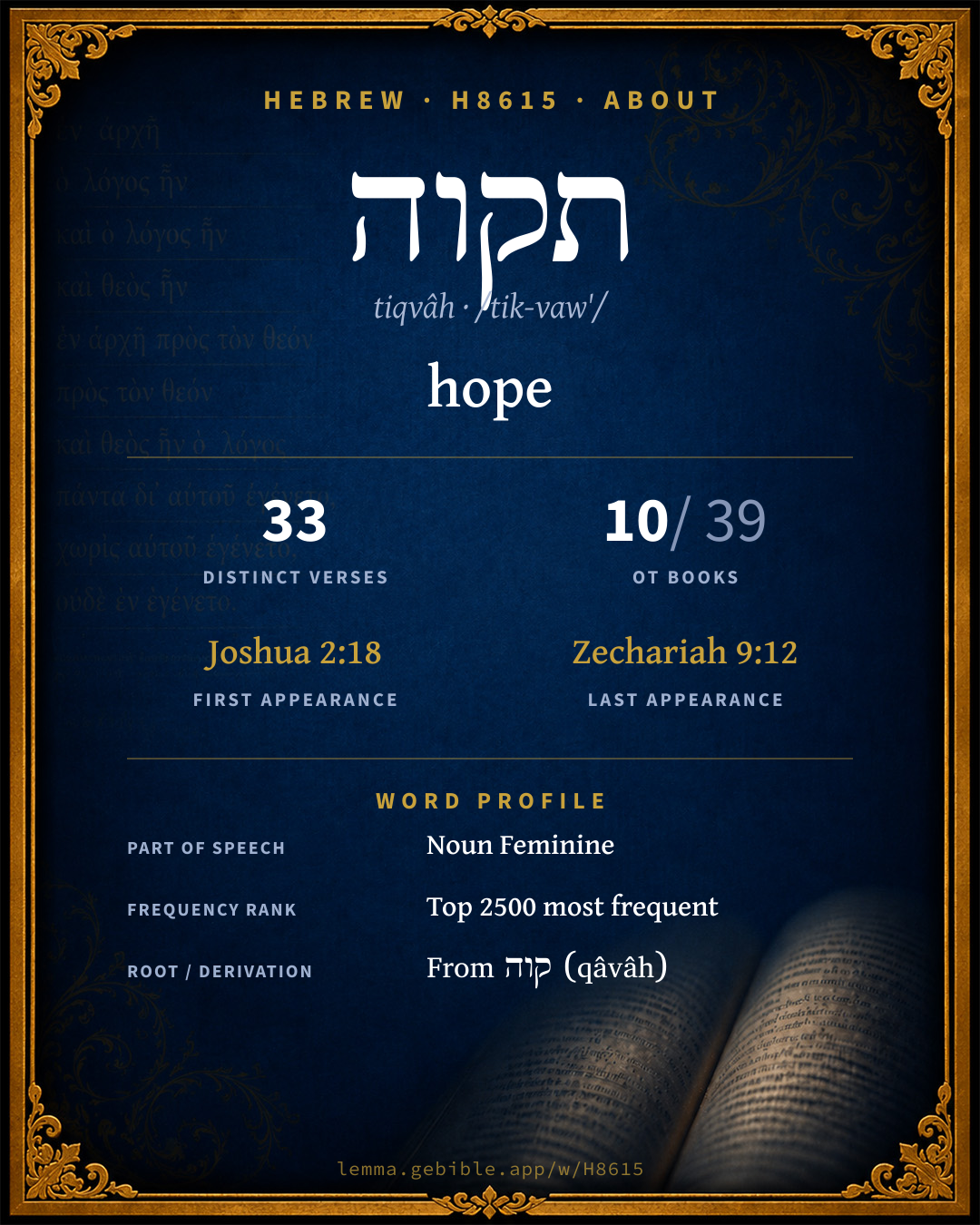
תִּקְוָה
hope
‘hope’ is one of 2 main senses fuller range ↓
Full lexicon entry — Brown-Driver-Briggs (BDB)
From Brown-Driver-Briggs (BDB)
Where this word appears
See every Construct-state word in the Hebrew Bible →
Grammar key — what these labels mean
Part of speech
- Noun
- A naming word — a person, place, thing, or idea.
Noun type
- Common
- A common noun — a general class of person, place, or thing (“king,” “city,” “water”), not a specific name.
State
- Absolute
- The independent form of a noun, not bound to a following word.
- Construct
- A noun bound to a following noun in a possessive / “of” relationship (the construct chain).
Gender
- Feminine
- Grammatically feminine.
Number
- Singular
- One.
Grammatical forms
- Noun, Common, Feminine, Singular, Construct 20 times (59%)
- Noun, Common, Feminine, Singular, Absolute 14 times (41%)
Parsed forms decoded from the imported morphology (morphhb / Westminster Leningrad Codex — WLC text public domain, morphhb tagging CC BY 4.0), counted across 34 parsed occurrences — not distinct verses.
Every verse where H8615 appears — 33 distinct verses across 10 books. Click any verse to open its interlinear word-by-word view. Verse text shown in the World English Bible for context — . Each verse’s Hebrew form is shown with its reference; the English is not keyword-highlighted, since the data carries no word-level English alignment. Use “Compare translations” on any verse to read it across multiple English versions. This concordance covers the Hebrew Bible; Septuagint (Greek Old Testament) occurrences are not indexed here.
Joshua 2 verses
- Joshua 2:18 תִּקְוַ֡ת n c fs cs Behold, when we come into the land, you shall bind this line of scarlet thread in the window which you did let us down by: and you shall gather to you into the house your father, and your mother, and your brothers, and all your father's household.
- Joshua 2:21 תִּקְוַ֥ת n c fs cs She said, According to your words, so be it. She sent them away, and they departed: and she bound the scarlet line in the window.
Ruth 1 verse
Job 12 verses
- Job 4:6 תִּ֝קְוָתְ/ךָ֗ n c fs cs + sfx pers 2ms Isn't your piety your confidence, The integrity of your ways your hope?
- Job 5:16 תִּקְוָ֑ה n c fs So the poor has hope, And injustice shuts her mouth.
- Job 6:8 וְ֝/תִקְוָתִ֗/י conj + n c fs cs + sfx pers 1cs "Oh that I might have my request; That God would grant the thing that I long for!
- Job 7:6 תִּקְוָֽה n c fs My days are swifter than a weaver's shuttle, And are spent without hope.
- Job 8:13 וְ/תִקְוַ֖ת conj + n c fs cs So are the paths of all who forget God. The hope of the godless man shall perish,
- Job 11:18 תִּקְוָ֑ה n c fs You shall be secure, because there is hope; Yes, you shall search, and shall take your rest in safety.
- Job 11:20 וְ֝/תִקְוָתָ֗/ם conj + n c fs cs + sfx pers 3mp But the eyes of the wicked shall fail, They shall have no way to flee; Their hope shall be the giving up of the spirit."
- Job 14:7 תִּ֫קְוָ֥ה n c fs "For there is hope for a tree, If it is cut down, that it will sprout again, That the tender branch of it will not cease.
- Job 14:19 וְ/תִקְוַ֖ת conj + n c fs cs The waters wear the stones; The torrents of it wash away the dust of the earth: So you destroy the hope of man.
- Job 17:15 תִקְוָתִ֑/י וְ֝/תִקְוָתִ֗/י n c fs cs + sfx pers 1cs conj + n c fs cs + sfx pers 1cs Where then is my hope? As for my hope, who shall see it?
- Job 19:10 תִּקְוָתִֽ/י n c fs cs + sfx pers 1cs He has broken me down on every side, and I am gone. My hope he has plucked up like a tree.
- Job 27:8 תִּקְוַ֣ת n c fs cs For what is the hope of the godless, when he is cut off, When God takes away his life?
Psalms 3 verses
- Psalms 9:18 תִּקְוַ֥ת n c fs cs For the needy shall not always be forgotten, Nor the hope of the poor perish forever.
- Psalms 62:5 תִּקְוָתִֽ/י n c fs cs + sfx pers 1cs My soul, wait in silence for God alone, For my expectation is from him.
- Psalms 71:5 תִקְוָתִ֑/י n c fs cs + sfx pers 1cs For you are my hope, Lord Yahweh; My confidence from my youth.
Proverbs 8 verses
- Proverbs 10:28 וְ/תִקְוַ֖ת conj + n c fs cs The prospect of the righteous is joy, But the hope of the wicked will perish.
- Proverbs 11:7 תִּקְוָ֑ה n c fs When a wicked man dies, hope perishes, And expectation of power comes to nothing.
- Proverbs 11:23 תִּקְוַ֖ת n c fs cs The desire of the righteous is only good. The expectation of the wicked is wrath.
- Proverbs 19:18 תִּקְוָ֑ה n c fs Discipline your son, for there is hope; Don't be a willing party to his death.
- Proverbs 23:18 וְ֝/תִקְוָתְ/ךָ֗ conj + n c fs cs + sfx pers 2ms Indeed surely there is a future hope, And your hope will not be cut off.
- Proverbs 24:14 וְ֝/תִקְוָתְ/ךָ֗ conj + n c fs cs + sfx pers 2ms So you shall know wisdom to be to your soul; If you have found it, then there will be a reward, Your hope will not be cut off.
- Proverbs 26:12 תִּקְוָ֖ה n c fs Do you see a man wise in his own eyes? There is more hope for a fool than for him.
- Proverbs 29:20 תִּקְוָ֖ה n c fs Do you see a man who is hasty in his words? There is more hope for a fool than for him.
Jeremiah 2 verses
- Jeremiah 29:11 וְ/תִקְוָֽה conj + n c fs For I know the thoughts that I think toward you, says Yahweh, thoughts of peace, and not of evil, to give you hope in your latter end.
- Jeremiah 31:17 תִּקְוָ֥ה n c fs There is hope for your latter end, says Yahweh; and [your] children shall come again to their own border.
Lamentations 1 verse
Ezekiel 2 verses
- Ezekiel 19:5 תִּקְוָתָ֑/הּ n c fs cs + sfx pers 3fs Now when she saw that she had waited, and her hope was lost, then she took another of her cubs, and made him a young lion.
- Ezekiel 37:11 תִקְוָתֵ֖/נוּ n c fs cs + sfx pers 1cp Then he said to me, Son of man, these bones are the whole house of Israel: behold, they say, Our bones are dried up, and our hope is lost; we are clean cut off.
Hosea 1 verse
Zechariah 1 verse
About this entry
At a glance — auto-summarized from this page’s data, not written by a person. Every figure links to its source below. This summary describes the numbers; it doesn’t interpret them.
At its core, תקוה (tiqvâh) means “hope.” It first appears in Joshua 2:18. It turns up in 33 verses across 10 books, a moderately common footprint. The word gravitates to Job (36%), then Proverbs and Psalms. Not a single-sense word: explore its full sense range. Each statement above links to its evidence; the full detail follows below.
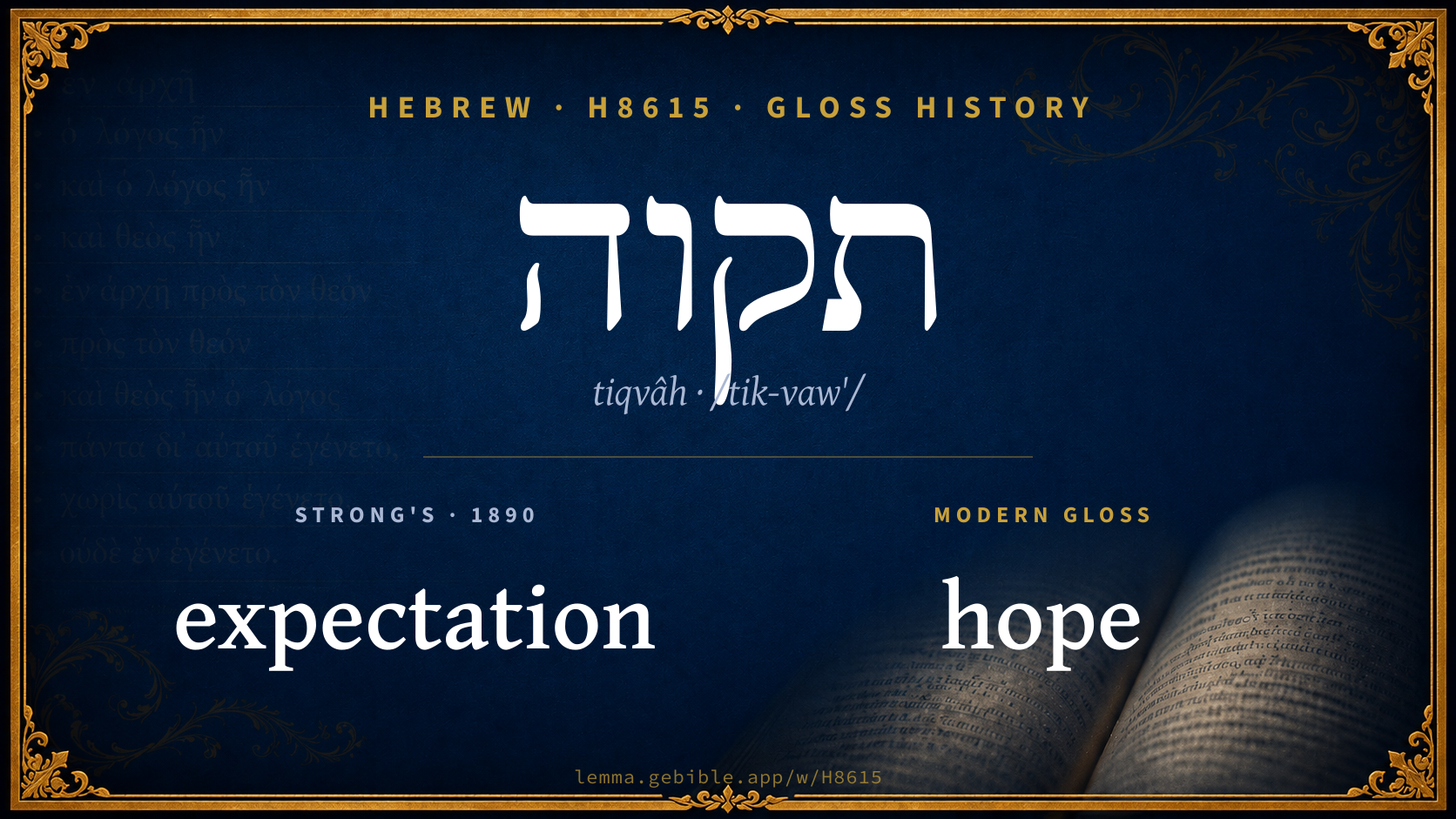
Gloss history
Strong's 1890 vs modern scholarship
About this word
Strong's H8615 catalogs a Hebrew word from the Hebrew Old Testament.
These counts are not copied from any lexicon or concordance. They are computed here, from the morphology-tagged Hebrew Old Testament. What Lemma adds →
- 33
- distinct verses
- The word appears in 33 distinct verses.
- 10 / 39
- OT books
- The word appears in 10 of 39 Old Testament books.
- #1,041
- by frequency
- Top 2500 most frequent Hebrew words (rank 1,041 of 8,640 Hebrew words by occurrence).
View all 33 occurrences in the concordance →
By section of the Old Testament
By traditional corpus
Conventional, traditional groupings — biblical authorship is debated, so this is a traditional corpus grouping, not an authorship claim. Each share is this word’s portion of its verses in that division of the Hebrew canon. Each figure is a share of the word’s 33 distinct verses.
- Writings (Ketuvim) 25 verses · 76%
- Prophets (Nevi'im) 8 verses · 24%
How translations render this word
Counts come from each version’s own published word-to-Strong’s tagging or interlinear alignment — an approximate guide to how each version renders this word, not a word-level alignment the data otherwise carries. Because each total is that version’s own tagged count, the per-version totals vary from one another and need not match the appearance or distinct-verse counts above. These counts may also differ from a printed concordance because Lemma counts each distinctly tagged rendering and does not collapse phrase taggings into a single head-word total. This is a fixed set of word-tagged versions (KJV, ASV, BSB, ULT) and does not change with the reading translation you choose elsewhere. Each version’s license is shown beside its name below (and on Sources).
BDB lists this Strong’s number as 3 distinct words (homographs). Each count above pools all of them and is not split by sense — see the Senses section below. A low-frequency rendering may belong to a different one of those words, not the primary meaning.
- King James Version†: Hope 18×, Expectation 7×, Is more hope 2×
- American Standard Version†: Hope 19×, Expectation 4×, Is more hope 2×
- Berean Standard Bible†: Hope 24×, Cord 2×, Is more hope 2×
- unfoldingWord Literal Text†: Hope 18×, And 2×, Cord of 2×
King James Version Public Domain
Renders H8615 across 34† tagged occurrences — most commonly:
Plus 5 renderings that appear only once — usually multi-word phrases or single function words the recovered tagging swept in, not distinct renderings.
American Standard Version Public Domain
Renders H8615 across 34† tagged occurrences — most commonly:
Plus 7 renderings that appear only once — usually multi-word phrases or single function words the recovered tagging swept in, not distinct renderings.
Berean Standard Bible Public Domain
Renders H8615 across 34† tagged occurrences — most commonly:
Plus 6 renderings that appear only once — usually multi-word phrases or single function words the recovered tagging swept in, not distinct renderings.
unfoldingWord Literal Text CC BY-SA 4.0
Renders H8615 across 35† tagged occurrences — most commonly:
Plus 5 renderings that appear only once — usually multi-word phrases or single function words the recovered tagging swept in, not distinct renderings.
Senses in the full BDB
What do BDB’s symbols mean?
BDB uses these scholarly abbreviations:
| Symbol | Meaning |
|---|---|
| 𝔊 | the Septuagint (the ancient Greek translation, LXX) |
| 𝔙 | the Vulgate (the Latin translation) |
| 𝔖 | the Syriac version (the Peshitta) |
| 𝔗 | the Targum (the Aramaic translation) |
| ψ | the Psalms |
| √ | root (the underlying root or stem) |
| ‖ | parallel passage (a synonymous or contrasted parallel) |
| † | the dagger: every passage where the word occurs is cited |
The 5 senses and sub-senses the full Brown-Driver-Briggs lexicon distinguishes for this word, in lexicon order (not ranked by frequency), with BDB’s own verbatim wording and sub-sense lettering. Shown in Hebrew script with BDB’s own scholarly abbreviations. The condensed entry is in the Lexicon Entry tab. See also the Forms in the corpus table below.
תקוה I cord (cf. √ ad init.)
תקוה II hope
- 1. hope, Je 31:17; La 3:29; Jb 5:16; 7:6; 11:18, 20; 14:7, 19; 17:15a; 19:10; ψ 62:6; Pr 19:18; 26:12; 29:20; Ru 1:12; פֶּתַח ת׳ Ho 2:17; אֲסִירֵי הַתּ׳ Zc 9:12 (i.e. with hope of deliverance). e.g. Jeremiah 31:17
- 2. = ground of hope Jb 4:6 ψ 71:5 (cf. 62:6). e.g. Job 4:6
- 3. things hoped for, outcome, Ez 19:5; 37:11; Jb 6:8; 8:13; 17:15b (but read טוֹבָתִי 𝔊 Me Bi Siegf Beer Bu Du), 27:8 ψ 9:19 Pr 10:28; 11:7, 23; 23:18; 24:14 (del. Toy as gloss); אַחֲרִית וְת׳ Je 29:11 (i. e. by hendiadys, the hoped-for future). e.g. Ezekiel 19:5
תקוה III m. (hope
- 1. father-in-law of Huldah 2 K 22:14, Θεκουαυ, A 𝔊L Θεκ(κ)ουε (= תוקהת 2 Ch 34:22 Kt [Qr תָּקְהַת], Καθουαλ, A Θακουαθ, 𝔊L Θεκωε). e.g. 2 Kings 22:14
- 2. post-ex. name Ezr 10:15, Ελκεια, A 𝔊L Θεκουε. e.g. Ezra 10:15
Senses from the full Brown-Driver-Briggs lexicon (Brown, Driver, Briggs; Oxford 1906 — public domain), digitized via Sefaria, supplemented by the OpenScriptures HebrewLexicon (CC BY 4.0). Full attribution on Sources.
Word origin
I. n.f. cord (cf. √ ad init.);—cstr. הַשָּׁנִי (חוּט) תִּקְוַת Jos 2:18, 21.
II. n.f. hope;—abs. ת׳ Ho 2:17 +; cstr. תִּקְוַת Jb 8:13 +; sf. תִּקְוָתִי 6:8 +, etc.;—
III. n.pr.m. (hope; cf. LagBN 131);—
— Brown-Driver-Briggs (Oxford 1906, public domain), digitized via Sefaria, supplemented by the OpenScriptures HebrewLexicon (CC BY 4.0). See Sources.
Derived from קוה (qâvâh) (H6960) — to wait.
Jastrow Dictionary
A second Hebrew/Aramaic lexicon for comparison, covering Aramaic and post-biblical (Talmudic, Targumic, Midrashic) usage that the biblical-Hebrew BDB does not. Matched by lemma rather than by Strong’s number, so a lemma may carry more than one Jastrow headword (shown separately below), and the entries cover usage well beyond the Bible.
תִּקְוָה
- hope; term of time. Y. Ber. IX, 13ᵇ bot. כל זמן … ת׳ מת אבדה תִקְוָותוֹ as long as a man lives, he has hope; when he dies, his hope is lost. Y. Naz. I, end, 51ᶜ הנותן ת׳ לנזירותו he who sets a limit to his vow of nazariteship (even if it exceed a life time); a. e.
A Dictionary of the Targumim, the Talmud Babli and Yerushalmi, and the Midrashic Literature (Marcus Jastrow; London, Luzac, 1903) — Public Domain. Digitized via Sefaria. Digitized via Sefaria. Full attribution on Sources.
Forms in the corpus
The 21 distinct written forms H8615 takes in the Hebrew Bible, most frequent first — each parse links to that state’s occurrences in the concordance. Hebrew forms include their vowel points and cantillation, so a single lemma takes many written forms.
Same root — word family
Other BDB entries built from the same root as H8615, grouped by Strong’s listed origin. These share a root / origin per the lexicon — not necessarily a shared meaning. Each links to that word’s own entry.
Derives from
Shares the same root
Proper names from this root
People and places named from this root — a name, not an additional meaning of the word.
Compare all same-root words → Showing 4 of 6 — not the complete family. 1 of the same-root words is a proper name (a person or place). They share a root, not necessarily a meaning.
Septuagint verse parallels
This word appears in 31 verses that also exist in the Greek Old Testament (Septuagint), out of the 33 Hebrew verses it occurs in. You can read those verses in Greek by switching the Old Testament edition to the Septuagint.
Read these verses in the Septuagint
- Joshua 2:18
- Ruth 1:12
- Job 4:6
- Psalms 9:18
- Proverbs 10:28
- Jeremiah 31:17
- Ezekiel 19:5
- Hosea 2:15
- Zechariah 9:12
This is a verse-level parallel only — the same verses exist in both the Hebrew and Greek Old Testaments. No word-level Hebrew↔Greek correspondence is claimed: the data carries no such alignment, so no Greek word is shown as this Hebrew word’s translation. Coverage is not total — the Septuagint omits the deuterocanon and renumbers the Psalms, so some Hebrew verses have no direct Greek parallel.