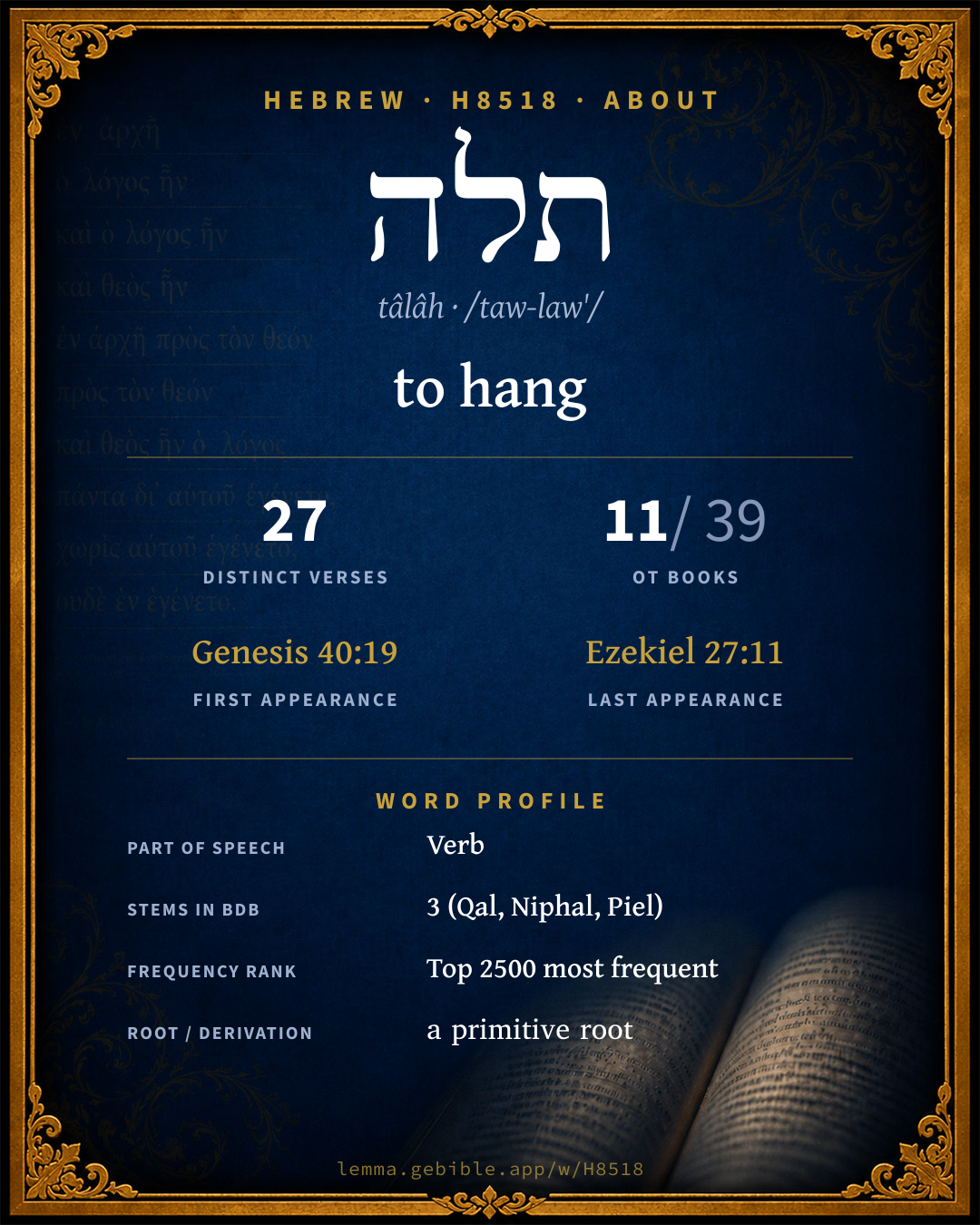
תָּלָה
to hang
‘to hang’ is one of 3 main senses fuller range ↓
Full lexicon entry — Brown-Driver-Briggs (BDB)
From Brown-Driver-Briggs (BDB)
Where this word appears
See every Qal verb in the Hebrew Bible →
Grammar key — what these labels mean
Part of speech
- Verb
- An action or state-of-being word.
Stem
- Qal
- The basic, simple active stem — the plain form of the verb (“he wrote”). Here: ‘hang up any object’
- Piel
- An intensive or resultative active stem. Here: ‘hang up for display’
- Niphal
- Usually the simple passive or reflexive of the Qal (“he was written”).
Form
- Perfect
- A completed action or state — Hebrew marks aspect (completeness) more than strict tense (“he wrote”).
- Participle Passive
- A verbal adjective expressing action received (“written”).
- Sequential Perfect
- A perfect with prefixed waw continuing a preceding imperfect or command (waw-consecutive perfect).
- Sequential Imperfect
- An imperfect with prefixed waw — the standard past-narrative form (waw-consecutive imperfect).
- Infinitive Construct
- A bound verbal noun, frequently with prepositions (“to write / in writing”).
- Jussive
- A third- or second-person volitional form expressing wish or command (“let him write”).
- Participle Active
- A verbal adjective expressing ongoing or characteristic action (“writing / one who writes”).
- Imperative
- A direct command (“write!”).
State
- Absolute
- The independent form of a noun, not bound to a following word.
Person
- 3rd Person
- The one spoken about (“he / she / it / they”).
- 2nd Person
- The one addressed (“you”).
- 1st Person
- The speaker (“I / we”).
Gender
- Masculine
- Grammatically masculine.
- Common
- Either gender — not distinguished for this form.
Number
- Singular
- One.
- Plural
- More than one (in Hebrew, generally three or more).
Grammatical forms 17 distinct
- Verb, Qal, Perfect, 3rd Person, Common, Plural 4 times (14%)
- Verb, Qal, Perfect, 3rd Person, Masculine, Singular 3 times (10%)
- Verb, Qal, Participle Passive, Masculine, Singular, Absolute 3 times (10%)
- Verb, Qal, Sequential Perfect, 3rd Person, Common, Plural 2 times (7%)
- Verb, Qal, Sequential Imperfect, 3rd Person, Masculine, Plural 2 times (7%)
- Verb, Qal, Infinitive Construct 2 times (7%)
- Verb, Piel, Perfect, 3rd Person, Common, Plural 2 times (7%)
- Verb, Qal, Jussive, 3rd Person, Masculine, Plural 2 times (7%)
+9 more forms (9 occurrences)
Parsed forms decoded from the imported morphology (morphhb / Westminster Leningrad Codex — WLC text public domain, morphhb tagging CC BY 4.0), counted across 29 parsed occurrences — not distinct verses.
Every verse where H8518 appears — 27 distinct verses across 11 books. Click any verse to open its interlinear word-by-word view. Verse text shown in the World English Bible for context — . Each verse’s Hebrew form is shown with its reference; the English is not keyword-highlighted, since the data carries no word-level English alignment. Use “Compare translations” on any verse to read it across multiple English versions. This concordance covers the Hebrew Bible; Septuagint (Greek Old Testament) occurrences are not indexed here.
Genesis 3 verses
- Genesis 40:19 וְ/תָלָ֥ה conj + Qal wpf 3ms Within three more days, Pharaoh will lift up your head from off you, and will hang you on a tree; and the birds will eat your flesh from off you."
- Genesis 40:22 תָּלָ֑ה Qal pf 3ms but he hanged the chief baker, as Joseph had interpreted to them.
- Genesis 41:13 תָלָֽה Qal pf 3ms It happened, as he interpreted to us, so it was: he restored me to my office, and he hanged him."
Deuteronomy 2 verses
- Deuteronomy 21:22 וְ/תָלִ֥יתָ conj + Qal wpf 2ms If a man have committed a sin worthy of death, and he be put to death, and you hang him on a tree;
- Deuteronomy 21:23 תָּל֑וּי Qal ptcp.pass ms his body shall not remain all night on the tree, but you shall surely bury him the same day; for he who is hanged is accursed of God; that you don't defile your land which Yahweh your God gives you for an inheritance.
Joshua 2 verses
- Joshua 8:29 תָּלָ֥ה Qal pf 3ms The king of Ai he hanged on a tree until the evening: and at the going down of the sun Joshua commanded, and they took his body down from the tree, and cast it at the entrance of the gate of the city, and raised thereon a great heap of stones, to this day.
- Joshua 10:26 וַ/יִּתְלֵ֕/ם תְּלוּיִ֥ם conj + Qal wimpf 3ms + sfx pers 3mp Qal ptcp.pass mp Afterward Joshua struck them, and put them to death, and hanged them on five trees: and they were hanging on the trees until the evening.
2 Samuel 3 verses
- 2 Samuel 4:12 וַ/יִּתְל֥וּ conj + Qal wimpf 3mp David commanded his young men, and they killed them, and cut off their hands and their feet, and hanged them up beside the pool in Hebron. But they took the head of Ish-bosheth, and buried it in the grave of Abner in Hebron.
- 2 Samuel 18:10 תָּל֖וּי Qal ptcp.pass ms A certain man saw it, and told Joab, and said, Behold, I saw Absalom hanging in an oak.
- 2 Samuel 21:12 תלו/ם תְּלָא֥וּ/ם Qal pf 3cp + sfx pers 3mp Qal pf 3cp + sfx pers 3mp David went and took the bones of Saul and the bones of Jonathan his son from the men of Jabesh Gilead, who had stolen them from the street of Beth-shan, where the Philistines had hanged them, in the day that the Philistines killed Saul in Gilboa;
Esther 9 verses
- Esther 2:23 וַ/יִּתָּל֥וּ conj + Niphal wimpf 3mp When inquisition was made of the matter, and it was found to be so, they were both hanged on a tree: and it was written in the book of the chronicles before the king.
- Esther 5:14 וְ/יִתְל֤וּ conj + Qal juss 3mp Then said Zeresh his wife and all his friends to him, Let a gallows be made fifty cubits high, and in the morning speak you to the king that Mordecai may be hanged thereon: then go you in merrily with the king to the banquet. The thing pleased Haman; and he caused the gallows to be made.
- Esther 6:4 לִ/תְלוֹת֙ prep + Qal inf.cs The king said, "Who is in the court?" Now Haman was come into the outward court of the king's house, to speak to the king to hang Mordecai on the gallows that he had prepared for him.
- Esther 7:9 תְּלֻ֥/הוּ Qal impv 2mp + sfx pers 3ms Then said Harbonah, one of the chamberlains who were before the king, Behold also, the gallows fifty cubits high, which Haman has made for Mordecai, who spoke good for the king, stands in the house of Haman. The king said, Hang him thereon.
- Esther 7:10 וַ/יִּתְלוּ֙ conj + Qal wimpf 3mp So they hanged Haman on the gallows that he had prepared for Mordecai. Then was the king's wrath pacified.
- Esther 8:7 תָּל֣וּ Qal pf 3cp Then the king Ahasuerus said to Esther the queen and to Mordecai the Jew, See, I have given Esther the house of Haman, and him they have hanged on the gallows, because he laid his hand on the Jews.
- Esther 9:13 יִתְל֥וּ Qal juss 3mp Then said Esther, If it please the king, let it be granted to the Jews who are in Shushan to do tomorrow also according to this day's decree, and let Haman's ten sons be hanged on the gallows.
- Esther 9:14 תָּלֽוּ Qal pf 3cp The king commanded it so to be done: and a decree was given out in Shushan; and they hanged Haman's ten sons.
- Esther 9:25 וְ/תָל֥וּ conj + Qal wpf 3cp but when [the matter] came before the king, he commanded by letters that his wicked device, which he had devised against the Jews, should return on his own head, and that he and his sons should be hanged on the gallows.
Job 1 verse
Psalms 1 verse
Song of Solomon 1 verse
Isaiah 1 verse
Lamentations 1 verse
Ezekiel 3 verses
- Ezekiel 15:3 לִ/תְל֥וֹת prep + Qal inf.cs Shall wood be taken of it to make any work? or will men take a pin of it to hang any vessel thereon?
- Ezekiel 27:10 תִּלּוּ Piel pf 3cp Persia and Lud and Put were in your army, your men of war: they hanged the shield and helmet in you; they set forth your comeliness.
- Ezekiel 27:11 תִּלּ֤וּ Piel pf 3cp The men of Arvad with your army were on your walls round about, and valorous men were in your towers; they hanged their shields on your walls round about; they have perfected your beauty.
About this entry
At a glance — auto-summarized from this page’s data, not written by a person. Every figure links to its source below. This summary describes the numbers; it doesn’t interpret them.
The Hebrew verb תלה centers on the idea of “to hang.” Its earliest occurrence is Genesis 40:19. It turns up in 27 verses across 11 books, a moderately common footprint. The word gravitates to Esther (33%), then Genesis and 2 Samuel. Across 3 stems, its meaning turns on the binyan (Qal, Niphal). Dig into 27-verse concordance and the renderings breakdown below.
Gloss history
Strong's 1890 vs modern scholarship
About this word
Strong's H8518 catalogs a Hebrew word from the Hebrew Old Testament.
These counts are not copied from any lexicon or concordance. They are computed here, from the morphology-tagged Hebrew Old Testament. What Lemma adds →
- 27
- distinct verses
- The word appears in 27 distinct verses.
- 11 / 39
- OT books
- The word appears in 11 of 39 Old Testament books.
- #1,160
- by frequency
- Top 2500 most frequent Hebrew words (rank 1,160 of 8,640 Hebrew words by occurrence).
View all 27 occurrences in the concordance →
By section of the Old Testament
By traditional corpus
Conventional, traditional groupings — biblical authorship is debated, so this is a traditional corpus grouping, not an authorship claim. Each share is this word’s portion of its verses in that division of the Hebrew canon. Each figure is a share of the word’s 27 distinct verses.
- Writings (Ketuvim) 13 verses · 48%
- Prophets (Nevi'im) 9 verses · 33%
- Torah (Pentateuch) 5 verses · 19%
How translations render this word
Counts come from each version’s own published word-to-Strong’s tagging or interlinear alignment — an approximate guide to how each version renders this word, not a word-level alignment the data otherwise carries. Because each total is that version’s own tagged count, the per-version totals vary from one another and need not match the appearance or distinct-verse counts above. These counts may also differ from a printed concordance because Lemma counts each distinctly tagged rendering and does not collapse phrase taggings into a single head-word total. This is a fixed set of word-tagged versions (KJV, ASV, BSB, ULT) and does not change with the reading translation you choose elsewhere. Each version’s license is shown beside its name below (and on Sources).
- King James Version: They hanged 4×, Hang 3×, Hanged 3×
- American Standard Version: They hanged 4×, He hanged 3×, Hang 2×
- Berean Standard Bible: Hang 4×, He hung 2×, They hanged 2×
- unfoldingWord Literal Text: Hang 4×, Hanging 3×, He hanged 3×
King James Version Public Domain
Renders H8518 across 27 tagged occurrences — most commonly:
Plus 14 renderings that appear only once — usually multi-word phrases or single function words the recovered tagging swept in, not distinct renderings. Not rendered by a distinct English word in 1 further occurrence.
American Standard Version Public Domain
Renders H8518 across 27 tagged occurrences — most commonly:
Plus 18 renderings that appear only once — usually multi-word phrases or single function words the recovered tagging swept in, not distinct renderings.
Berean Standard Bible Public Domain
Renders H8518 across 27 tagged occurrences — most commonly:
Plus 17 renderings that appear only once — usually multi-word phrases or single function words the recovered tagging swept in, not distinct renderings. Not rendered by a distinct English word in 1 further occurrence.
unfoldingWord Literal Text CC BY-SA 4.0
Renders H8518 across 31 tagged occurrences — most commonly:
Plus 14 renderings that appear only once — usually multi-word phrases or single function words the recovered tagging swept in, not distinct renderings.
Senses in the full BDB
Hebrew verbs can shift meaning by stem (binyan): Qal is the basic action, Niphal is often passive or reflexive, Piel often intensifies or makes it factitive, and Hiphil is typically causative. The senses below are grouped under the stem BDB assigns to each.
What do BDB’s symbols mean?
BDB uses these scholarly abbreviations:
| Symbol | Meaning |
|---|---|
| 𝔊 | the Septuagint (the ancient Greek translation, LXX) |
| 𝔙 | the Vulgate (the Latin translation) |
| 𝔖 | the Syriac version (the Peshitta) |
| 𝔗 | the Targum (the Aramaic translation) |
| ψ | the Psalms |
| √ | root (the underlying root or stem) |
| ‖ | parallel passage (a synonymous or contrasted parallel) |
| † | the dagger: every passage where the word occurs is cited |
The 5 senses and sub-senses the full Brown-Driver-Briggs lexicon distinguishes for this word, in lexicon order (not ranked by frequency), with BDB’s own verbatim wording and sub-sense lettering. Shown in Hebrew script with BDB’s own scholarly abbreviations. The condensed entry is in the Lexicon Entry tab. See also the Forms in the corpus table below.
Qal
- Pf. 3 ms. ת׳ Gn 40:22 +; 2 ms. וְתָלִ֫יתָ Dt 21:22 consec.; 3 pl. תָּלוּ Est 8:7; 9:14, sf. תלום 2 S 21:12 Kt (Qr v. תלא), etc.; Impf. 3 ms. sf. וַיִּתְלֵם Jos 10:26, etc.; Imv. mpl. sf. תְּלֻהוּ Est 7:9; Inf. cstr. לִתְלוֹת Ez 15:3 Est 6:4; Pt. act. תֹּלֶה Jb 26:7; pass. תָּלוּי Dt 31:23 + 2 times, pl. תְּלוּיִם Jos 10:26;—hang: e.g. Genesis 40:22
- 1. hang up any object: acc. of hands and feet of slain, + עַל־הַבְּרֵכָה 2 S 4:12; תָּלוּי of Absalom בָּאֵלָה in the terebinth 18:10; ת׳ c. acc. rei, + עַל Is 22:24 Ez 15:3 Ct 4:4 ψ 137:2; subj. י׳, ת׳ אֶרֶץ עַל־בְּלִימָה Jb 26:7. e.g. 2 Samuel 4:12
- 2. specif. put to death by hanging, c. acc. pers. Gn 40:22; 41:13 (both E), 2 S 21:12 (cf. תלא), Est 9:14; abs. תָּלוּי Dt 21:23 one hanged; acc. pers. + עַל־עֵץ Gn 40:19 (E), Dt 21:22 Jos 8:29; 10:26(×2) (all JE), Est 5:14; 6:4; 7:9, 10; 8:7; 9:13, 25. e.g. Genesis 40:22
Niphal
- Pf. 3 pl. שָׂרִים בְּיָדָם נִתְלוּ La 5:12 princes have been hung up by their hands; Impf. 3 mpl. וַיִּתָּלוּ עַל־עֵץ Est 2:23 they were hanged on a tree; + 3 ms. apoc. וַיִּתָּל 2 S 18:9 (for וַיֻּתַּן v. נתן Hoph.). e.g. Lamentations 5:12
Piel
- hang up for display, c. acc. rei: Pf. 3 pl. תִּלּוּ Ez 27:10 (ב loc.), v 11 (עַל־חוֹמוֹתַיִךְ). e.g. Ezekiel 27:10
Senses from the full Brown-Driver-Briggs lexicon (Brown, Driver, Briggs; Oxford 1906 — public domain), digitized via Sefaria, supplemented by the OpenScriptures HebrewLexicon (CC BY 4.0). Full attribution on Sources.
Word origin
vb. hang (NH id.; Assyrian Pi. tullû, hang up; Arabic تَّلَ let down, dangle (a rope, etc.); Aramaic תְּלָא, ܬܠܴܐ hang; perhaps Old Aramaic תלה id., Lzb386; Ethiopic ተለወ in derived sense, be devoted, addicted, to);—
— Brown-Driver-Briggs (Oxford 1906, public domain), digitized via Sefaria, supplemented by the OpenScriptures HebrewLexicon (CC BY 4.0). See Sources.
Origin: a primitive root
Jastrow Dictionary
A second Hebrew/Aramaic lexicon for comparison, covering Aramaic and post-biblical (Talmudic, Targumic, Midrashic) usage that the biblical-Hebrew BDB does not. Matched by lemma rather than by Strong’s number, so a lemma may carry more than one Jastrow headword (shown separately below), and the entries cover usage well beyond the Bible.
תָּלָה
- , v. תלי, תְּלֵי.
תְּלַהּ
- , v. תְּלַח, תִּלְחָא.
תְּלַח
- 1. to tear apart, v. תְּלַע II.
- 2. to fall apart, v. infra.
- to fall apart. Ḥull. 53ᵇ כי הוו … הוה מִיתְלְחָא ונפלה וכ׳ Ms. R. (v. Rabb. D. S. a. l. note 400; Ar. מִיתְלְהָא; ed. תָלְחָא) when they lifted the lung up, it crumbled and fell in pieces.
A Dictionary of the Targumim, the Talmud Babli and Yerushalmi, and the Midrashic Literature (Marcus Jastrow; London, Luzac, 1903) — Public Domain. Digitized via Sefaria. Digitized via Sefaria. Full attribution on Sources.
Forms in the corpus
The 29 distinct written forms H8518 takes in the Hebrew Bible, most frequent first — each parse links to that stem’s occurrences in the concordance. Hebrew forms include their vowel points and cantillation, so a single lemma takes many written forms.
Same root — word family
Other BDB entries built from the same root as H8518, grouped by Strong’s listed origin. These share a root / origin per the lexicon — not necessarily a shared meaning. Each links to that word’s own entry.
Derived from this word
Proper names from this root
People and places named from this root — a name, not an additional meaning of the word.
Compare all same-root words → 1 of the same-root words is a proper name (a person or place). They share a root, not necessarily a meaning.
Septuagint verse parallels
This word appears in 26 verses that also exist in the Greek Old Testament (Septuagint), out of the 27 Hebrew verses it occurs in. You can read those verses in Greek by switching the Old Testament edition to the Septuagint.
Read these verses in the Septuagint
- Genesis 40:19
- Deuteronomy 21:22
- Joshua 8:29
- 2 Samuel 4:12
- Esther 2:23
- Job 26:7
- Psalms 137:2
- Song of Solomon 4:4
- Isaiah 22:24
- Lamentations 5:12
- Ezekiel 15:3
This is a verse-level parallel only — the same verses exist in both the Hebrew and Greek Old Testaments. No word-level Hebrew↔Greek correspondence is claimed: the data carries no such alignment, so no Greek word is shown as this Hebrew word’s translation. Coverage is not total — the Septuagint omits the deuterocanon and renumbers the Psalms, so some Hebrew verses have no direct Greek parallel.