2 Samuel 18:10

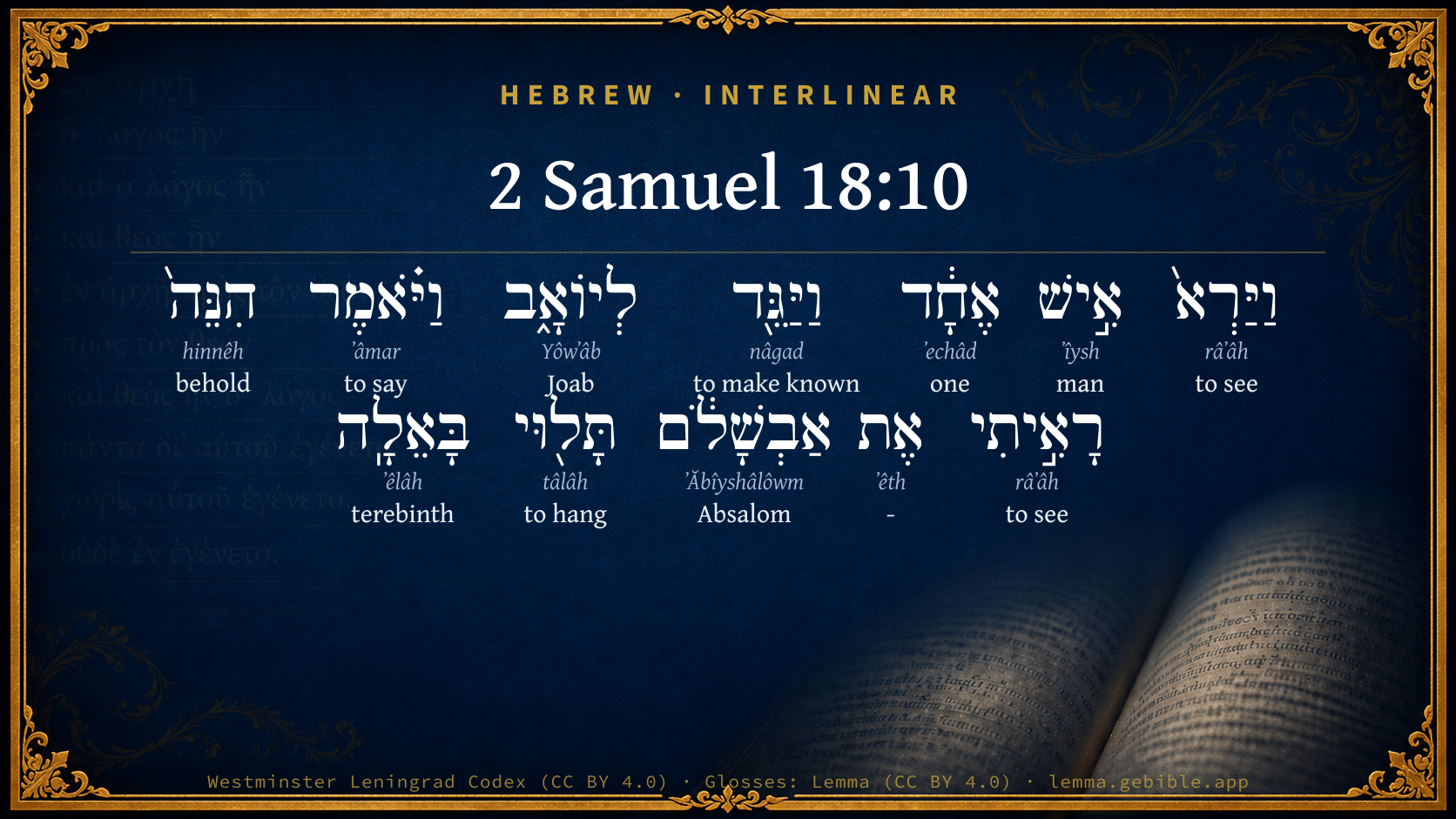
Hebrew (Westminster Leningrad Codex) 2 Samuel 18:10 appears in the Hebrew Old Testament. The text above is from the Westminster Leningrad Codex. Each word links to its Strong’s number, a concise gloss, and parsing drawn from the Open Scriptures Hebrew Bible morphology. Click any word for its full Brown-Driver-Briggs (BDB) entry.
Download image
Cite this verse

2 Samuel 18:10 (World English Bible). Public Domain. Lemma interlinear Bible study tool, https://lemma.gebible.app/v/2-samuel/18/10.

Show BibTeX & RIS
BibTeX
RIS
English Translation
A certain man saw it, and told Joab, and said, Behold, I saw Absalom hanging in an oak.
World English Bible · Public Domain
Download a study sheet

One document with this verse’s original text, its word-by-word gloss line, the meaning frame, cross-references with their text, attributed commentary, and full source and license credits — printable, and it pastes into notes with its structure intact.

This verse Autodidact and up

Study sheet (.html) Plain text (.txt)

A passage Seminary Student

Up to 50 verses in one chapter. A passage sheet keeps up to 6 commentary sources and 12 cross-references per verse, in the order this page ranks them, and says so on the sheet whenever that leaves anything out. Ask for a single verse and you get the Autodidact verse sheet above.

Everything on this page stays free to read, with no account — the sheet is a download of what is already on screen, not access to it.

Want to remove ads? Support Godless Engineer
Compare translations 3

The same verse in 3 English versions, stacked beneath the original-language interlinear above. Click any original word for its lexicon entry.

Each is an independent rendering of the whole verse — the interlinear is not word-aligned to these translations.

Highlighted words mark where these versions differ — a whole-verse word diff, not a word-by-word alignment.

  • World English Bible Public Domain
    A certain man saw it, and told Joab, and said, Behold, I saw Absalom hanging in an oak.
  • King James Version Public Domain
    And a certain man saw it, and told Joab, and said, Behold, I saw Absalom hanged in an oak.
  • unfoldingWord Literal Text CC BY-SA 4.0
    And one man saw, and he declared to Joab, and he said, “Behold, I saw Absalom hung on an oak tree.”

unfoldingWord Literal Text — © unfoldingWord, licensed CC BY-SA 4.0. Word-aligned USFM3 via Door43 (git.door43.org/unfoldingWord/en_ult).

Versions to compare (up to 4)

3 of 4 selected

Show all 18 translations

Every available English version of this verse, each an independent rendering of the whole verse.

  • World English Bible Public Domain
    A certain man saw it, and told Joab, and said, Behold, I saw Absalom hanging in an oak.
  • Berean Standard Bible Public Domain
    When one of the men saw this, he told Joab, “I just saw Absalom hanging in an oak tree!”
  • Majority Standard Bible Public Domain
    When one of the men saw this, he told Joab, “I just saw Absalom hanging in an oak tree!”
  • King James Version Public Domain
    And a certain man saw it, and told Joab, and said, Behold, I saw Absalom hanged in an oak.
  • American Standard Version (1901) Public Domain
    And a certain man saw it, and told Joab, and said, Behold, I saw Absalom hanging in an oak.
  • Revised Version (1885) Public Domain
    And a certain man saw it, and told Joab, and said, Behold, I saw Absalom hanging in an oak.
  • Geneva Bible (1599) Public Domain
    And one that sawe it, tolde Ioab, saying, Beholde, I sawe Absalom hanged in an oke.
  • Douay-Rheims (1899) Public Domain
    And one saw this and told Joab, saying: I saw Absalom hanging upon an oak.
  • Young's Literal Translation Public Domain
    And one man seeth, and declareth to Joab, and saith, `Lo, I saw Absalom hanged in an oak.'
  • Literal Standard Version CC BY-SA 4.0
    And one man sees, and declares [it] to Joab, and says, “Behold, I saw Absalom hanging in an oak.”
  • Unlocked Literal Bible CC BY-SA 4.0
    Someone saw this and told Joab, “Look, I saw Absalom hanging in an oak tree!”
  • unfoldingWord Literal Text CC BY-SA 4.0
    And one man saw, and he declared to Joab, and he said, “Behold, I saw Absalom hung on an oak tree.”
  • Darby Bible Public Domain
    And a man saw it, and told Joab, and said, Behold, I saw Absalom hanging in a terebinth.
  • World Messianic Bible Public Domain
    A certain man saw it, and told Joab, and said, “Behold, I saw Absalom hanging in an oak.”
  • Webster's Bible Public Domain
    And a certain man saw it, and told Joab, and said, Behold, I saw Absalom hanging in an oak.
  • Free Bible Version CC BY-SA 4.0
    One of David's men saw what happened, so he told Joab, “I just saw Absalom hanging from an oak tree!”
  • Bible in Basic English Public Domain
    And a certain man saw it and said to Joab, I saw Absalom hanging in a tree.
  • JPS Tanakh (1917) Public Domain
    And a certain man saw it, and told Joab, and said: 'Behold, I saw Absalom hanging in a terebinth.'

Literal Standard Version (2020), Covenant Press — licensed CC BY-SA 4.0. Text via the HelloAO Bible API (eBible.org). Unlocked Literal Bible (unfoldingWord) — licensed CC BY-SA 4.0. Text via the HelloAO Bible API (eBible.org). unfoldingWord Literal Text — © unfoldingWord, licensed CC BY-SA 4.0. Word-aligned USFM3 via Door43 (git.door43.org/unfoldingWord/en_ult). Free Bible Version, Dr. Jonathan Gallagher — licensed CC BY-SA 4.0. Text via the HelloAO Bible API (eBible.org).

Word by word

More ways to search: Search by grammar → Find every occurrence → Compare this word →

Practice this passage: Drill this verse → Learn its vocabulary →

בָּאֵלָֽה
ʼêlâh
H424
“in/at the · terebinth”
Preposition, Determined + Noun, Common, Feminine, Singular, Absolute
Part of Speech
Preposition + Noun
Type
Common
Gender
Feminine
Number
Singular
State
Absolute
Full BDB Definition

Origin: from H352

TWOT: 45h

terebinth, terebinth tree - valley where David killed Goliath
  1. וַיַּרְא֙ râʼâh H7200 “and · to see” Conjunction + Verb, Qal, Sequential Imperfect, 3rd Person, Masculine, Singular
  2. אִ֣ישׁ ʼîysh H376 “man” Noun, Common, Masculine, Singular, Absolute
  3. אֶחָ֔ד ʼechâd H259 “one” Adjective, Cardinal number, Masculine, Singular, Absolute
  4. וַיַּגֵּ֖ד nâgad H5046 “and · to make known” Conjunction + Verb, Hiphil, Sequential Imperfect, 3rd Person, Masculine, Singular
  5. לְיוֹאָ֑ב Yôwʼâb H3097 “to/for · Joab” Preposition + Noun, Proper
  6. וַיֹּ֗אמֶר ʼâmar H559 “and · to say” Conjunction + Verb, Qal, Sequential Imperfect, 3rd Person, Masculine, Singular
  7. הִנֵּה֙ hinnêh H2009 “behold” Particle, Demonstrative
  8. רָאִ֣יתִי râʼâh H7200 “to see” Verb, Qal, Perfect, 1st Person, Common, Singular
  9. אֶת ʼêth H853 “-” Particle, Direct Object
  10. אַבְשָׁלֹ֔ם ʼĂbîyshâlôwm H53 “Absalom” Noun, Proper
  11. תָּל֖וּי tâlâh H8518 “hung” Verb, Qal, Participle Passive, Masculine, Singular, Absolute

About this verse

These counts appear in no published source. They are computed here, from the morphology-tagged text and Lemma’s own curated glosses. What Lemma adds →

12
words
11
distinct lemmas
Historical
section

Notable vocabulary

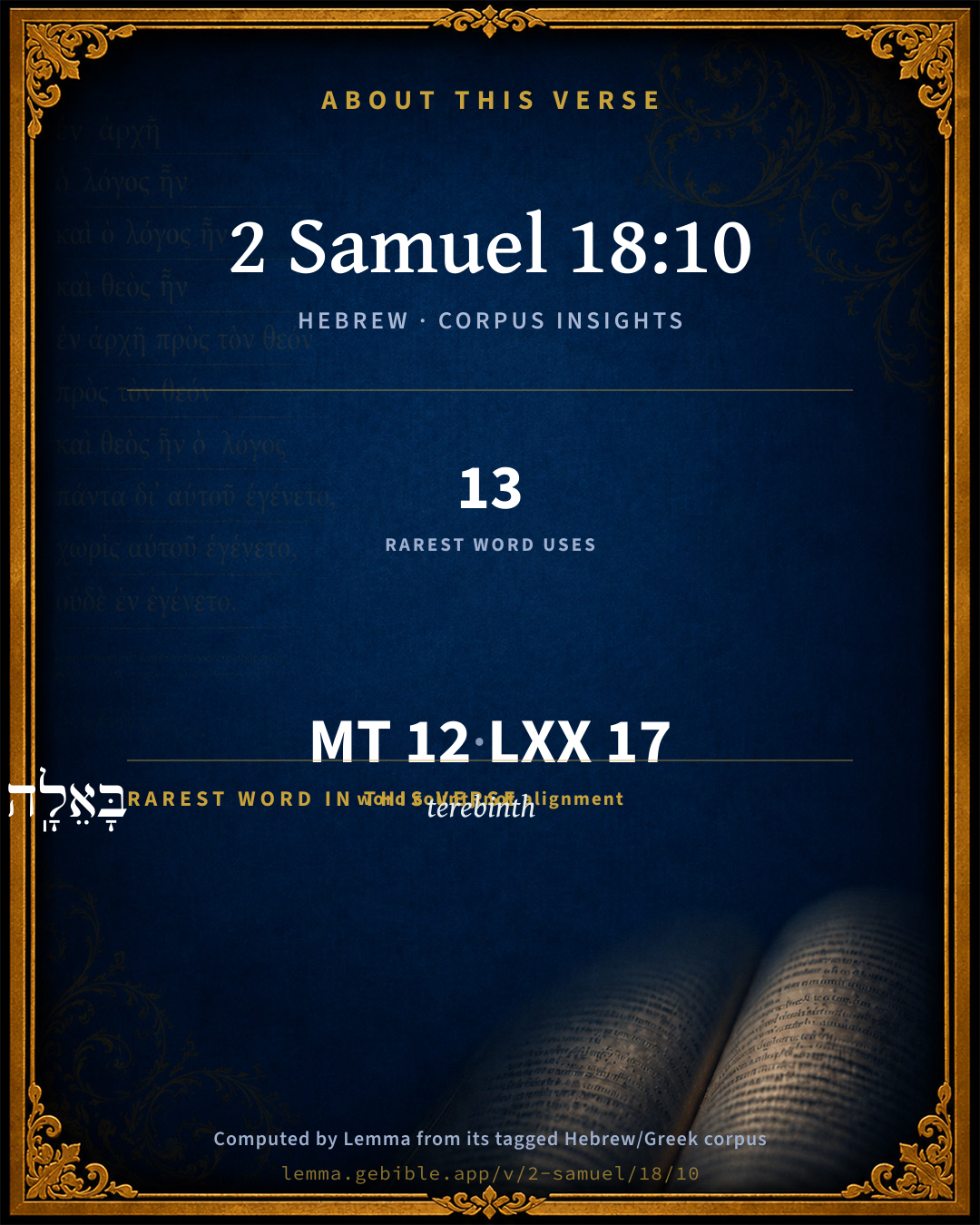
The rarest word here is בָּאֵלָֽה terebinth H424 — appearing just 13 times in the whole Hebrew Bible.

Shared distinctive vocabulary

בָּאֵלָֽה terebinth H424 occurs in 12 verses of the Hebrew Bible. Also found in:

Grammatical profile

  • 5 verbs
  • 4 nouns
  • 1 adjective
  • 2 particles

Verb forms

  • וַיַּרְא֙ Qal · Sequential Imperfect
  • וַיַּגֵּ֖ד Hiphil · Sequential Imperfect
  • וַיֹּ֗אמֶר Qal · Sequential Imperfect
  • רָאִ֣יתִי Qal · Perfect
  • תָּל֖וּי Qal · Participle Passive

Repetition

A word recurs within this verse — often emphatic in Hebrew:

  • וַיַּרְא֙ to see H7200 ×2

Hebrew & Septuagint length

In English translation the verse runs 18 words from the Hebrew and 19 from the Septuagint (LXX English) — closely comparable.

A rough comparison of the two English renderings, which tokenize alike — not a word-level alignment.

Word counts can differ between the Hebrew and the Greek without any difference in meaning — e.g. the Hebrew direct-object marker אֵת has no separate Greek word, and Greek often adds the article ὁ.

In the original languages it is 12 Hebrew tokens and 17 Greek tokens — but the two are counted differently (Hebrew bundles its prefixes and suffixes into one token; the Greek is in lemma form), so that isn’t a like-for-like length.

Hebrew and Greek witnesses Masoretic Hebrew ↔ Greek Septuagint

The same verse in the two great witnesses to the Old Testament, shown verse-for-verse.

These are two independent witnesses, not word-aligned to each other, and the Septuagint is shown in lemma (dictionary) form.

Hebrew 2 Samuel 18:10 Masoretic · Westminster Leningrad Codex

וַיַּרְא֙ אִ֣ישׁ אֶחָ֔ד וַיַּגֵּ֖ד לְיוֹאָ֑ב וַיֹּ֗אמֶר הִנֵּה֙ רָאִ֣יתִי אֶת אַבְשָׁלֹ֔ם תָּל֖וּי בָּאֵלָֽה

A certain man saw it, and told Joab, and said, Behold, I saw Absalom hanging in an oak.

World English Bible · Public Domain

Greek LXX 2 Samuel 18:10 Septuagint · lemma form

καί ὁράω ἀνήρ εἷς καί ἀναἀγγέλλω ιωαβ καί εἶπον ἰδού ὁράω ὁ αβεσσαλωμ κρεμάζω ἐν ὁ δρῦς

And a man saw it, and reported to Joab, and said, Behold, I saw Abessalom hanging in an oak.

LXX2012 (modern English Septuagint) · Public Domain

Hebrew: Westminster Leningrad Codex (CC BY 4.0). Greek: Septuagint (public domain); English from LXX2012 (modern English Septuagint) (Public Domain). How the Septuagint differs from the Hebrew →

Targum (Aramaic paraphrase)

1

The Targum is the ancient Jewish Aramaic paraphrase of the Hebrew Scriptures — an interpretive translation, not the Hebrew text itself. Onkelos (literal) and Pseudo-Jonathan (expansive) render the Torah, and Jonathan the Prophets. Coverage is partial: where no permissively-licensed English translation exists for a verse, only the Aramaic is shown. This is verse-level text, not a word-by-word alignment to the Hebrew.

  1. Targum Jonathan Prophets (Joshua–Malachi)
    וַחֲזָא גַבְרָא חָד וְחַוֵי לְיוֹאָב וַאֲמַר הָא חֲזֵיתִי יַת אַבְשָׁלוֹם תְּלִי בְּבוּטְמָא:

    (no public-domain English translation for this verse)

    Targum Jonathan — Aramaic: “Mikraot Gedolot” (public domain). English: “Sefaria Community Translation” (CC0 1.0 (public-domain dedication)); “London "Chaldee Paraphrase," 1871” (public domain). Text via Sefaria.

Commentary

Notes on 2 Samuel 18:10 from classic Christian and Jewish commentators (each source and its license shown beneath its notes). The classic Christian expositions comment on the surrounding passage and are grouped to its opening verse, so a note may address several verses; the Jewish commentaries on the Tanakh (Rashi and others) are per-verse, so they appear only where the commentator wrote on this verse.

Lemma curates 59 commentaries, every one of them public domain or Creative Commons licensed, each selected and text-cleaned for this edition rather than reprinted as found. About our sources →

Trapp's Complete Commentary

John Trapp

2Sa 18:10 And a certain man saw [it], and told Joab, and said, Behold, I saw Absalom hanged in an oak.

Ver. 10. Behold, I saw Absalom hanged in an oak.] Which oak, by the just judgment of God, this new king had for a throne, his twisted hair for a crown. He shall shortly have three darts in his heart for a sceptre, and Joab’s ten armourbearers for a guard: but this in the text dared not meddle with him, because of the king’s command to the contrary. {2Sa 18:5}

John Trapp, A Commentary or Exposition upon All the Books of the Old and New Testament (1647–1656) — public domain. Text from a community e-Sword module.

The Biblical Illustrator

Joseph S. Exell

2Sa_18:10

I saw Absalom hanging in an oak.

Glory: Human and Divine

I. A mans glory is his doom. For although in a strict sense the custom does not fit with the fashion of the age, there are men to-day who, figuratively speaking, cannot cut their hair without weighing it. In plain language, there are men whose whole attention is directed to the contemplation of their endowments and the worship of their powers. And, just as with Absalom, these very endowment may lead to their destruction; they may be in at the death.

1. New, in the first place, let the proposition be accepted that man must glory. By his very nature he attaches himself to something either external or personal to himself, in which he takes a lively interest and manifests a palpable pride. Every man is, more or less, what is vulgarly called a Faddist. He takes hold of something, and makes it the centre of his existence, the object of his aims and desires. Or else that something lays hold of him, and keeps him a bondman to its service. It may be personal, or social, or municipal, or political, or religious, but there it is, embedded in the soul, or laying its grasp upon the mind. It comes out on any and every occasion. It is made manifest in the thought and in the life and in the work. And seldom indeed is its power found either to diminish or to die. Or, to vary the figure, each life has its Sun. And here, of course, the moral, the spiritual law, diverges from the natural, which knows of only one centre. Round this sun the life-planet circles, kept in place by its influence, partaking of its light, and reflecting its radiancy with more or less brilliance, according to what may be called the atmospheric conditions which prevail. Without that sun, the life falls from its place and loses its power. The suns light may have a greater or a less intensity, its attraction have a greater or a less force. It may range from the lowest to the highest extreme. It may glimmer as a fad, or it may shine brightly as an ideal: but still it is there, necessary to all existence, indispensable to all true life. For we are all of us in a sense mirrors; very often, God knows, scored and imperfect and dull, but in some measure reflecting a borrowed glory, catching rays from the unknown and the infinite, and throwing them at very different angles upon the world. In short, the rays of one life--of various colours as they must ofttimes be--when gathered together will generally be found to have one common source. That is its glory, that is its sun.

II. Death lies in human glory. To reason from the particular to the general directly is not consistent with the canons of logic and the forms of thought. Because a thing happens in one case there are no grounds for declaring that it must happen in all. But if it can be shown by the evidence of illustration and instances that there are few, if any, exceptions, then we may, with some show of reason, claim recognition for the rule. What was said a little ago of the unit of humanity, man, supplies with equal truth to men in the mass. A living organisation, an aggregate of thinking men, is also a reflection of a glory. Here is a country whose glory has a human source. Two thousand years ago, looking from her seven hills across the subjugated lands Rome stood, the proud and pompous mistress of the world. Along her ringing thoroughfares there rolled the chariot of war. By Tibets bank the sentry trod his everlasting round. President of the council of her gods sat Jupiter, the king of heaven, to whom the war-shout of the conqueror and the sacrifice of the sword ascended as a sweet savour. Tribe by tribe the inhabitants of the known world passed beneath the yoke, and power became the one object in the national outlook. Raising it to the place of deity, they tendered it the honour and the praise. Triumph! triumph! was the cry that rent the Roman air. Number the captives and measure their land! Ours is the brave heart, ours the mighty arm, and great indeed is our glory! Ay! two thousand years ago. But the day of downfall was at hand. The oak caught Absalom by the hair. Into collision with the eternal oak of Gods will and purpose came the blind and boastful glory of the Empire. Thus far and no further was the stern decree. And on swept the steed of History, leaving its Rome behind.

2. Here is a church whose glory, too, has a human source. Its Bible is the morality, the etiquette, the fashion of the age. Its teaching is laid on the basis of what is proper rather than what is right. Its creed runs thus--I believe in well-cushioned pews, wealthy communicants, and a respectable record of missionary zeal, so long as that calls for no work of mine. Through the pillars and arches of its buildings there floats the breath of sweetest music, and the silver tones of the snowy-banded, dilettante, delicate-handed priest. And from an aesthetic point all is sweet to hear and fair to see. But where is God in that church? Where is the glory due unto His name? Left out of account! It glories in its exclusiveness; in what it calls its culture, its high tone. But high tone and culture of that kind fall foul of the hard judgment of a stern world. The entanglement comes; and on goes religion heedless of its loss while enemies arrive with their darts of disestablishment and popular clamour to thrust into the useless body. In its glory there lies its death.

3. Here is an individual whose glory too, has a human source. He believes in himself to the exclusion of all else. He takes some attribute or characteristic of his own, and says, This is what I am by the grace of my own endeavours. He owns allegiance to human nature, to the tendencies of the age, until, like Wolsey, he is forced to the bitter cry, Had I but served my God with half the zeal I served my king, He would not in mine age have left me naked to mine enemies! And not infrequently I should say this: Show me that in which a man prides himself, and I shall know one thing at least that he is not. Let me take you back to the survey of that image of the sun; and let me ask you to observe one such as I have mentioned, whose sun has nothing but an earthly effulgence and a human light; who circles, for example, about pride, or riches, or merely worldly wisdom; who is content to live in the light of these, and to take the glory of his life from them. And there you have the most terrible of all spectacles, the most ghastly of all weird pictures--a heart without God. A world without its sun! A heart without God! A heart with nothing but its own cherished glory! And that very pride, these very riches, that very worldly wisdom brings him at last under the power of God. On goes eternity, and the wretched man is left behind to realise the truth of these awful words, It is a fearful thing to fall into the hands of the living God.

III. Life lies in divine glory. It is a far cry from the Jewish prince to the Gentile preacher, but pass with me to St. Paul. A man of like passions with you, he, too, must glory in something; nor, humanly speaking, had he far to seek for a cause. If I must glory, he says, if I must have my one life-support, if I must look somewhere for a spiritual dynamic--then God forbid that I should glory save in the cross of our Lord Jesus Christ. Ah! there he finds the proper source, the real centre, the bright sun. From over Calvarys hill there steal the roseate rays of the Sun of Righteousness--and these he seeks to reflect. To glory in a cross--a cross! the badge of infamy--the stamp of shame! Now I see that St. Paul is in the right, that he knows whom he has believed. For in that cross I find the earnest of life eternal and undying love; through that cross I feel the power of God and the wisdom of God; from that cross I see a light that streams across the desert of life. Think of what it typifies and teaches; think of all which led up to it, and all to which it leads, and say, has it not glory sufficient for us to-day? It speaks of a self-renunciation; of a sacrifice solemn and significant, which, while it can never in itself be repeated, may still, thank God, be copied; and what though there be many a shortcoming and many a fault? Lay yourself down before it in heroic martyrdom: cast away the old, dull self: giving is getting with Jesus; and getting with Him is glory. Make it the centre of your spiritual existence; make your life a reflection of. Him who gives it at once its value and its power; and you can say to the worldling, in full assurance of faith--Death worketh in you; but life in us. (R. Barclay, M. A.)

The fallen prince

I. Absalom was the beloved child of his parents. Exactly why he was the favourite son cannot, perhaps, be decided. All Davids children were beautiful in person, though Absalom seems to have excelled them all in personal grace. It has been suggested that his mother was a queen, and so he seemed more royal than the rest of the princes.

II. Absalom was the hope of a party in the nation. The country, in his day, was unsettled. Judah had lost the supremacy it had gained during Davids reign in Hebron, and was restless and jealous. Davids neglects were telling on the country, producing discontent. And one great party was looking to Absalom, the affable and kingly son. By his blandishment he stole the hearts of the people, and, on the first favourable opportunity, the people bore him, with a sudden impulse, to the royal throne.

III. Absalom bore some of the penalty of his fathers sins. For the Divine penalties on transgressions come in part by consequences, which are sure to reach beyond the transgressor, and he is punished and wounded in the sufferings of others, often of those nearest and dearest to him. Absalom bore some of the penalty of Davids sin by his wrong-doing.

IV. And Absalom met with a tragic end, A hasty ride through the woods; an overhanging bough; three smitings of the darts; rude hackings of the young mens swords; and a grave in a pit. (R;. Tuck, B. A.)

The circumstances of Absaloms death

As the ruined gambler for a crown rode recklessly on in his fear, he was swept out of the saddle by being caught by the low, spreading branches of a great terebinth tree, and the startled mule galloping away, was left hanging there, unable to lift his arms so as to haul himself up. It is from Josephus that we get the statement that Absalom was caught by his hair, which is probable enough, but the lesson does not describe how he was entangled. Perhaps his head was jammed between the forks of some great branch. At all events, there he dangled, half throttled, and utterly incapable of releasing himself. There is something of horror and ghastliness in so strange a fate, as if this criminal was too bad to die by a common death. But there is a deeper lesson in that figure swinging there, with his gay clothing all disordered. God has plenty of instruments to punish evil-doers. Thousands at his bidding wait. There is no need for a miracle. He works through the natural operations of his creation. So all things are against the man who is against God, even as all work together for good to those who love Him, and, when He wills, the leafy beauty of the great tree shall be the gallows for the rebel Absalom. The stars in their courses fought against Sisera. A frightened mule and an unconscious tree bring Absalom to his death. There are no accidents in the great scheme of things. Gods foes have foes in every bush and every beast. (A. Maclaren, D. D.)

Caught in the maelstrom of vanity and pride

The Road to Ruin, taken by Absalom, may be illustrated by what is known of the Maelstrom, a famous whirlpool off the coast of Norway. The immense body of water forming it extends, in a circle, about thirteen miles in circumference. A great rock stands in the midst thereof, against which the tide, when ebbing, beats with inconceivable fury, instantly swallowing up all things coming within the sphere of its violence. No dexterity of steering or strength of rowing on the mariners part can accomplish his escape. The most experienced sailor at the helm finds his ship beginning to move in a direction opposite to his efforts and intentions; the motion at first is slow and nearly imperceptible, but becomes every moment more rapid; the vessel goes round in circles, narrowing each time, until, dashed against the central rock, it is lost with all on board. Thus was Absalom borne onward in the ever-narrowing circle of vanity, self-indulgence, and cruel treachery, until he perished in the Maelstrom of Divine Retribution.

The Biblical Illustrator, edited by Joseph S. Exell (c. 1880s–1900s) — public domain. Text from a community e-Sword module.

Adam Clarke's Commentary

Verse 10. I saw Absalom hanged in an oak.] He must have hung there a considerable time. this man saw him hanging; how long he had been hanging before he saw him, we cannot tell. He came and informed Joab; this must have taken up a considerable time. Joab went and pierced him through with three darts; this must have taken up still more time. It is therefore natural to conclude that his life must have been nearly gone after having been so long suspended, and probably was past recovery, even if Joab had taken him down.

Adam Clarke's Commentary on the Bible (1810–1826) — public domain. Text from a community e-Sword/MySword module.

John Gill's Exposition

And a certain man saw it,.... Saw him in the above posture, one of David's soldiers:

and told Joab, and said, behold, I saw Absalom hanged in an oak; caught by the neck in one, out of which he could not disengage himself, but there he hung, though alive.

John Gill's Exposition of the Whole Bible (1746–1763) — public domain (CC PDM 1.0). Text via the HelloAO Bible API.

Whedon's Commentary on the Bible

Daniel D. Whedon

10. Saw Absalom hanged — Suspended by his head, hair, and arms, and probably struggling to disentangle himself. He must have suffered serious injury to his person and almost perished by this mishap before the darts of Joab pierced him, for so the statement in 2Sa_18:14, that he was yet alive, seems to imply.

Daniel D. Whedon (gen. ed.), Commentary on the Old and New Testaments (1874–1909) — public domain. Text from a community e-Sword module.

Keil & Delitzsch

C. F. Keil & F. Delitzsch

A man (one of David's men) saw him in this situation, and told Joab, Joab replied (Sa2 18:11), "Behold, thou hast seen it, and wherefore has thou not smitten him there to the ground? and it was for me to give thee ten silverlings and a girdle;" i.e., if thou hadst slain him, it would have been my duty to reward thee.

Keil & Delitzsch — Biblical Commentary on the Old Testament (1861–1891) — public domain (CC PDM 1.0). Text via the HelloAO Bible API. (Old Testament only.)

Lesson kit

Teaching starters — assembled from the data on this page, not authored interpretation. Every prompt links to the verse data it draws on. Edit before teaching.

2 Samuel, in the Historical, opens this verse with 12 words (11 distinct Hebrew lemmas). Its most distinctive word is ʼêlâh (“terebinth”). A historical commentator’s framing appears above. Read the whole chapter for the surrounding context.

Discussion questions

  1. How does “terebinth” (ʼêlâh) shape what this verse is saying?
  2. How does Genesis 35:4, which shares the word «terebinth», read alongside this verse?
  3. What does the repetition of “to see” (2× in this one verse) do in this verse?
  4. These translations render this verse differently. What is at stake in choosing one wording over another?
  5. «וַיַּרְא֙» is a Qal Sequential Imperfect verb. How does that grammatical form shape the action described?
  6. Compare how Trapp's Complete Commentary and The Biblical Illustrator read this verse. Where do they agree or differ?

Things to notice

Reading settings

Reading text

Shown beneath each verse's original-language words.

Old Testament
Old Testament edition

Read the OT as the Masoretic Hebrew (MT) or the Greek Septuagint (LXX).

English shown for the Greek Septuagint (in the Hebrew ↔ Greek comparison).

Comparing translations? Open the Compare panel on any verse page to stack up to four side by side.