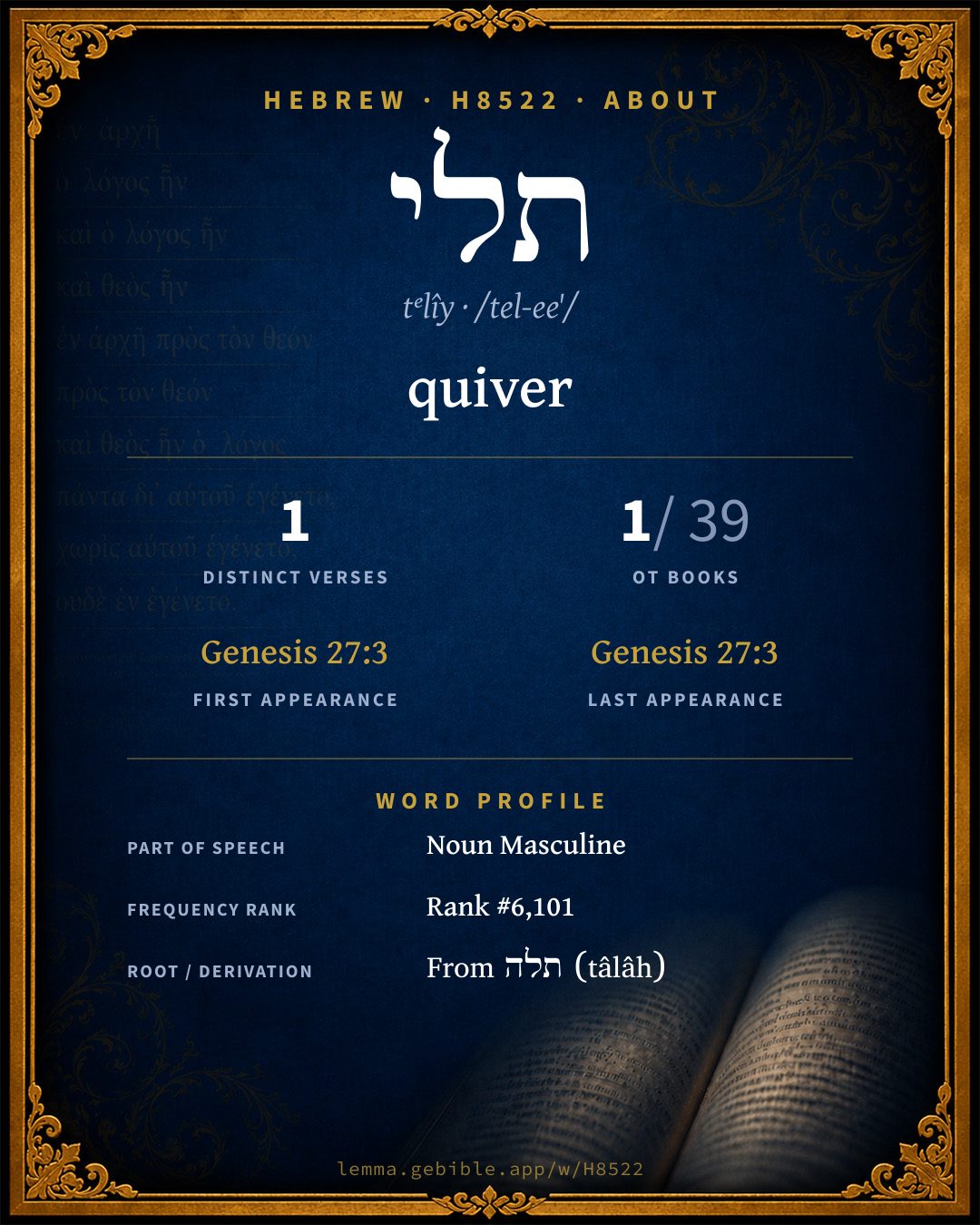
תְּלִי
quiver
‘quiver’ is one of 3 main senses fuller range ↓
Full lexicon entry — Brown-Driver-Briggs (BDB)
From Brown-Driver-Briggs (BDB)
Where this word appears
Grammar key — what these labels mean
Part of speech
- Noun
- A naming word — a person, place, thing, or idea.
Noun type
- Common
- A common noun — a general class of person, place, or thing (“king,” “city,” “water”), not a specific name.
State
- Construct
- A noun bound to a following noun in a possessive / “of” relationship (the construct chain).
Gender
- Masculine
- Grammatically masculine.
Number
- Singular
- One.
Every verse where H8522 appears — 1 distinct verse across 1 book. Click any verse to open its interlinear word-by-word view. Verse text shown in the World English Bible for context — . Each verse’s Hebrew form is shown with its reference; the English is not keyword-highlighted, since the data carries no word-level English alignment. Use “Compare translations” on any verse to read it across multiple English versions. This concordance covers the Hebrew Bible; Septuagint (Greek Old Testament) occurrences are not indexed here.
Genesis 1 verse
About this entry
At a glance — auto-summarized from this page’s data, not written by a person. Every figure links to its source below. This summary describes the numbers; it doesn’t interpret them.
The Hebrew noun תלי centers on the idea of “quiver.” The Hebrew Bible uses it only 1 verse. Genesis dominates its distribution — 1 of 1 verses. Scripture uses it exactly once, at Genesis 27:3. BDB distinguishes 3 senses for it. Dig into 1-verse concordance and the renderings breakdown below.
Gloss history
Strong's 1890 vs modern scholarship
About this word
Strong's H8522 catalogs a Hebrew word from the Hebrew Old Testament.
These counts are not copied from any lexicon or concordance. They are computed here, from the morphology-tagged Hebrew Old Testament. What Lemma adds →
- 1
- distinct verses
- The word appears in 1 distinct verse.
- 1 / 39
- OT books
- The word appears in 1 of 39 Old Testament books.
- #6,101
- by frequency
- Rank #6,101 (rank 6,101 of 8,640 Hebrew words by occurrence).
View all 1 occurrence in the concordance →
Most concentrated in
- Genesis 1 verse 100%
By section of the Old Testament
By traditional corpus
Conventional, traditional groupings — biblical authorship is debated, so this is a traditional corpus grouping, not an authorship claim. Each share is this word’s portion of its verses in that division of the Hebrew canon. Each figure is a share of the word’s 1 distinct verse.
- Torah (Pentateuch) 1 verse · 100%
How translations render this word
Counts come from each version’s own published word-to-Strong’s tagging or interlinear alignment — an approximate guide to how each version renders this word, not a word-level alignment the data otherwise carries. Because each total is that version’s own tagged count, the per-version totals vary from one another and need not match the appearance or distinct-verse counts above. These counts may also differ from a printed concordance because Lemma counts each distinctly tagged rendering and does not collapse phrase taggings into a single head-word total. This is a fixed set of word-tagged versions (KJV, ASV, BSB, ULT) and does not change with the reading translation you choose elsewhere. Each version’s license is shown beside its name below (and on Sources).
- King James Version: Quiver 1×
- American Standard Version: Weapons thy quiver 1×
- Berean Standard Bible: Quiver 1×
- unfoldingWord Literal Text: Quiver 1×
King James Version Public Domain
Renders H8522 across 1 tagged occurrence — most commonly:
American Standard Version Public Domain
Renders H8522 across 1 tagged occurrence — most commonly:
Berean Standard Bible Public Domain
Renders H8522 across 1 tagged occurrence — most commonly:
unfoldingWord Literal Text CC BY-SA 4.0
Renders H8522 across 1 tagged occurrence — most commonly:
Senses in BDB
The 3 senses BDB distinguishes for this word, in lexicon order (not ranked by frequency or importance). The full entry — with sub-senses — is in the Lexicon Entry tab.
- quiver
- quiver (with its arrows)
- quiver (as hanging from shoulder)
Word origin
[ תְּלִי ] n.[m.] quiver (with its arrows) (as hanging from shoulder);—sf. Gn 27:3
— Brown-Driver-Briggs (Oxford 1906, public domain), digitized via Sefaria, supplemented by the OpenScriptures HebrewLexicon (CC BY 4.0). See Sources.
Derived from תלה (tâlâh) (H8518) — to hang.
Jastrow Dictionary
A second Hebrew/Aramaic lexicon for comparison, covering Aramaic and post-biblical (Talmudic, Targumic, Midrashic) usage that the biblical-Hebrew BDB does not. Matched by lemma rather than by Strong’s number, so a lemma may carry more than one Jastrow headword (shown separately below), and the entries cover usage well beyond the Bible.
תלי
- 1. to swing, raise; to suspend, hang. Y. Sot. I, 16ᵈ bot. (ref. to Gen. XXXVIII, 14) תָּלַת עיניה בפתח וכ׳ she raised her eyes to the gate to which all eyes look hopefully; Y. Keth. XIII, beg. 35ᶜ; Gen. R. s. 85 שׁתָּלְתָה … תְּלוּיוֹת בו (not שתלה). B. Mets. 58ᵇ לא יִתְלֶה עיניו על וכ׳ one must not hang his eyes on a purchase (look as if he wanted to buy), when he has no money; (Pes. 112ᵇ אל תעמוד על, v. מִקָּח). Gen. R. s. 98 כדי שיתלה עיניו וכ׳ in order that he (Joseph) might lift up his eyes and look at them (the Egyptian women). Snh. VI, 4 והלא … ת׳ נשים וכ׳ did not Simon b. Sh. hang women in Ashkelon? Ib. כיצד תולין אותו how is the hanging (of the convict stoned to death) done? Ib. ותולה … ומתירין וכ׳ and one person hangs him as the butchers suspend animals, and he is taken down at once. Ib. 46ᵇ צוה … ותְלָאוּהוּ the king gave the order, and they hanged him. Sabb. XX, 1 תולין וכ׳, v. מְשַׁמֶּרֶת. Y. Taan. IV, 69ᵇ top תְּלָיָין וכ׳ (strike out תלו), v. גַּרְדּוֹם; a. fr.—Trnsf. to hang on; to attach, assign. B. Bath. 109ᵇ, v. קַלְקָלָה. Nidd. IX, 3 הרי זו תוֹלָה בה she may trace (the bloodstain) to her (the woman to whom she had lent the garment). Ib. 4 ותוֹלוֹת זו זו each of them may assign the cause of the stain to the other. Ib. VIII, 2 ותולה … לִתְלוֹת and she may assign the cause to anything that she may possibly assign it to; a. fr.—Part. pass. תָּלוּי; f. תְּלוּיָה; pl. תְּלוּיִים, תְּלוּיִין; תְּלוּיוֹת. Sabb. l. c. נותנין לת׳ בשבת you may pour wine into the suspended strainer on the Sabbath. Y. Gitt. VII, 48ᶜ bot. בחזקת שהנשמה ת׳ בו under the presumption that the soul was yet attached to him (that he was still of a sane mind). Ḥull. 135ᵃ דבר שהנשמה ת׳ בו a limb on which life depends, a vital organ. Snh. 97ᵇ ואין הדבר ת׳ וכ׳, and the thing (redemption) depends &c., v. קֵץ. Gen. R. s. 85 שכל העינים ת׳ בו to which all eyes are lifted up, v. supra. Kidd. 39ᵇ תחיית המתים ת׳ בה, v. תְּחִיָּה. Ib. I, 9 מצוה שהיא ת׳ בארץ a command which is made dependent on the land (of Israel, to which the Biblical text attaches living in Palestine as a condition). Ḥag. I, 8 כהררים הת׳ בשערה, v. הַר. Cant. R. to III, 4, v. עיי"ן; a. fr. e.g. Genesis 38:14
- 2. to hold in suspense, leave undecided, leave in doubt; to be suspended. Yoma VIII, 8 ועל החמורות הוא תולה עד וכ׳ as to heavy sins, he (who repents) is in suspense (will neither be punished nor acquitted), until the Day of Atonement comes and brings forgiveness. Tanḥ. Sh’moth 20 וכשאני תולה על חטאיו וכ׳ when I suspend judgment for a man’s sins, I am called El Shadday. Sot. III, 4 אם … היתה תוֹלָה לה if she (the Soṭah) has any merit, it will create suspension of punishment for her; יש זכות תולה שנה אחת וכ׳ some merits create a suspension of one year, some of two &c. Ib. 5 אין זכות תולה במים וכ׳ in the case of testing waters merit causes no suspension. Pes. I, 4 אוכלין … ותוֹלִין כל חמש וכ׳ you may eat (leavened bread on the eve of Passover) to four hours of the day, and hold it in suspense during the fifth hour, and burn it &c. Ib. 5 תולין לא אוכלין וכ׳ they held it in suspense: they did not eat it, nor did they burn it; a. fr.—Part. pass. as ab. Ib. 7 they differ על הת׳ ועל הטמאה concerning T’rumah in suspense (under suspicion of uncleanness) and such as is surely unclean. Nidd. 60ᵃ טהור ות׳ a clean person and one under doubt of uncleanness; a. fr.—אשם ת׳, v. אָשָׁם.
- to be hanged. Snh. VI, 4 האיש נִתְלֶה ואין האשה נִתְלֵית a man (stoned to death) is hanged, but a woman must not be hanged. Ib. כל … נִתְלִין all persons that are put to death by stoning are afterwards hanged. Y. Taan. IV, 67ᵈ להִיתָּלוֹת בה, v. יָתֵד. Pes. 112ᵃ הִיתָּלֶה, v. אִילָּן; a. fr.—Lam. R. to IV, 22 למה … להתלות בית וכ׳ why were divine visitations created to be movable (to be taken from one and put on another)? (As we say,) they have a house to go to (with ref. to Lam. l. c. a. Deut. VII, 15). e.g. Deuteronomy 7:15
- to swing. Gen. R. s. 22 מַתְלֵא בעקיבו; Yalk. Prov. 961 מַתְלֶה, v. עָקֵב.
תְּלֵי
- , to lift up; to suspend, hang; to be hanged. [Targ. Y. Ex. II, 16 Ar. (ed. Vien. דלא; h. text דלה).] Targ. Jer. X, 12. Targ. Y. Gen. XXXVIII, 25. Ib. XLIX, 22. Targ. II Chr. XX, 12. Targ. Ez. XV, 3. Targ. O. Deut. XXVIII, 66. Targ. Prov. XIII, 12 (ed. Lag. תָּאלֵי); a. fr.—Part. pass. תָּלֵי; f. תַּלְיָא; pl. תָּלְיָן, תָּלְיָין. Targ. Y. Deut. l. c. Ib. XXVII, 14 Ar. (ed. רמא; h. text רם); a. fr.—Y. Sot. I, 17ᵃ top ההין … ואת תְּלֵית עינים וכ׳ this man (thy husband) feeds and sustains thee, and thou liftest thy eyes up to another man? Keth. 71ᵇ [read:] תְּלַתְנְהוּ, v. קִישּׁוּט. Yeb. 39ᵇ בדידך ת׳ רחמנא the law makes it dependent on thee (leaves thee the choice). Cant. R. to V, 14 מִיתְלֵי, v. עִקְבָא. Ab. Zar. 7ᵇ תַּלְיָא וכ׳, v. אֶשְׁלָא. Keth. 2ᵃ ת׳ תניא בדלא וכ׳ he hangs that which has been distinctly taught on that which has not been taught, i.e. draws a conclusion from the unknown to the known; B. Bath. 134ᵇ; a. fr.—Y. Bicc. III, 65ᶜ bot. אתר תלי an elevated place. Y. Succ. V, 55ᵇ bot. כל דתלי מאה וכ׳ a column a hundred cubits high requires a base of thirty-three. Gitt. 37ᵇ ת׳ ליה עד וכ׳ he must look up to him, until he says so (that he gives him the money, although he is not bound to pay it); [Rashi: and he is suspended (tortured) until &c.]. B. Bath. 47ᵇ תַּלְיוּהָ וזבין וכ׳ if they suspended (tortured) him, and he agreed to sell, the sale is valid; ib. 48ᵇ (not תלויה); B. Kam. 62ᵃ תְּלוּהָ. Lam. R. to III, 65 (play on ת̇א̇ל̇ת̇ך, ib.) ת̇לי … כל א̇ל̇ות̇ וכ׳ (some vers. תְּלֵה h.) force them through suffering, and bring upon them all the curses &c.—Y. Kil. IX, 32ᵇ top תלה לון יומא וכ׳ the day remained suspended for them (the sun did not set), until every one of them reached his home; Y. Keth. XII, 35ᵃ תלת (corr. acc., or תלא).—[Pesik. Par., p. 37ᵇ ותלין, read: זחלין, v. זְחַל II.]
- to be hanged. Targ. II Esth. II, 23.
A Dictionary of the Targumim, the Talmud Babli and Yerushalmi, and the Midrashic Literature (Marcus Jastrow; London, Luzac, 1903) — Public Domain. Digitized via Sefaria. Digitized via Sefaria. Full attribution on Sources.
Same root — word family
Other BDB entries built from the same root as H8522, grouped by Strong’s listed origin. These share a root / origin per the lexicon — not necessarily a shared meaning. Each links to that word’s own entry.
Derives from
Proper names from this root
People and places named from this root — a name, not an additional meaning of the word.
Compare all same-root words → 1 of the same-root words is a proper name (a person or place). They share a root, not necessarily a meaning.
Septuagint verse parallels
This word appears in 1 verse that also exists in the Greek Old Testament (Septuagint), out of the 1 Hebrew verse it occurs in. You can read those verses in Greek by switching the Old Testament edition to the Septuagint.
Read these verses in the Septuagint
This is a verse-level parallel only — the same verses exist in both the Hebrew and Greek Old Testaments. No word-level Hebrew↔Greek correspondence is claimed: the data carries no such alignment, so no Greek word is shown as this Hebrew word’s translation. Coverage is not total — the Septuagint omits the deuterocanon and renumbers the Psalms, so some Hebrew verses have no direct Greek parallel.